
Eve Schaub Is Growing a Dress: What the Year of the Dress Actually Confirms About Labor Density, Slow Fashion, and the One Original Object
In a backyard in southern Vermont, the memoirist Eve Schaub is growing a dress. Not buying one, not sewing one from purchased cloth — growing it: planting flax, then retting, scutching, hackling, spinning, and weaving the fiber into linen, and finally cutting and sewing that linen into a single wearable garment. The project, which she calls the Year of the Dress, extends the method of her “Year of No” trilogy of stunt memoirs into the realm of fiber. The press that has found it frames it as a slow-fashion parable, a rebuke to fast fashion, a feel-good lesson in patience. This study argues that the dominant frame mistakes the project’s genre. Read not as virtue but as Object Testimony, the Year of the Dress is the most legible demonstration of Labor Density available in contemporary culture — a garment whose entire value is the year of accumulated Legibility of Labor it carries. We read the dress through the One Original Principle, Tactical Friction, Material Singularity, Narrative Permanence, and the Anti-Commodity Commitment, and we test it against the framework’s hardest internal check: the difference between Moral Weight and Naïve Authenticity. The conclusion is that Schaub, working without any theory at all, has produced the object the theory predicts — and that this is precisely why the project matters more than the slow-fashion sentence written about it can register.
THE OBJECT ARRIVES WITHOUT ASKING PERMISSION
The bio line is the whole argument in miniature: “currently growing a dress in my backyard.” It is a sentence that should not parse. Dresses are not grown; they are manufactured, purchased, occasionally made. Yet Eve Ogden Schaub — a Cornell-educated memoirist and humorist, half of the creative team EveNSteve, author of Year of No Sugar, Year of No Clutter, and Year of No Garbage — means it literally. She planted flax. She is taking the plant the entire distance to cloth, and the cloth the entire distance to a single garment, by hand, documenting each week of the attempt with the running confession that she has no idea what she is doing.
Her three previous books were subtraction projects: a year without added sugar, a year without clutter, a year without garbage. Each used a household-scale constraint to expose a system. The Year of the Dress inverts the method. It is not a year of no but a year of from-scratch — an addition project, a making rather than an abstaining. The constraint is no longer “remove the thing” but “author the thing completely, from seed.” That inversion is what moves the project out of the lifestyle column and into the register that this House studies. A garment grown over a year is not a consumer choice. It is a Sovereign Object — an artifact that owes nothing to a supply chain, carries no brand, and cannot be re-ordered.
OAC does not pitch or adopt. It arrives at a subject when the subject has already, unknowingly, arrived at the framework. Schaub has. She is not making post-luxury conceptual functional art; she would almost certainly reject the phrase. But the object she is producing has the exact value structure the framework was built to describe, and the gap between what she is doing and the language available to describe it is why this study exists.
“A garment grown over a year is not a consumer choice. It is a sovereign object — it owes nothing to a supply chain, carries no brand, and cannot be re-ordered.”

The visual matrix of Labor Density: A four-part documentary sequence following Eve Schaub through harvesting, fiber preparation, spinning, and cultivation, demonstrating the literal execution of the Sovereign Object.
THE SLOW-FASHION SENTENCE AND WHAT IT CANNOT SEE
When the project gets covered, it gets covered in one sentence with predictable variations: a brave stand against Fast Fashion, a return to Slow Fashion, a lesson in where our clothes come from. Schaub herself supplies much of this frame, invoking Fibershed, the Pennsylvania Flax Project, and the environmental cost of disposable clothing. The sentence is not wrong. It is simply the wrong altitude. It reads the dress as a message — a moral communication about consumption — when the dress’s real significance is that it is an object with a particular internal accounting.
This is the competitive gap, and it is the gap OAC always occupies. Vogue, lifestyle desks, and sustainability blogs can convey the project’s sentiment. They cannot describe its structure, because they lack the vocabulary for what makes a single unsellable garment more valuable than the linen it is made of. The slow-fashion sentence treats the year of labor as a cost — the heroic price Schaub pays to make her point. The framework treats the year of labor as the product. This is not a rhetorical flourish. It is the entire difference between a virtue narrative and a theory of value.
We have argued before, in Why Marine Serré’s Upcycling Is Not a Trend, that the sustainability press systematically misfiles structural arguments as ethical ones — reading a designer’s Circular Economy as a brand position rather than a claim about where value actually lives. The Year of the Dress is the same misfiling at the household scale. The slow-fashion sentence cannot see the dress because it is looking for a moral when it should be looking for an Affective Object.
LABOR DENSITY: THE DRESS AS ACCUMULATED TIME
The central term is Labor Density: the quantity of irreducible human time and attention stored inside an object, and the degree to which that time remains legible in the finished thing. A fast-fashion dress has near-zero labor density, not because no one worked on it, but because the labor is industrialized, distributed, and deliberately erased — the seams are smooth precisely so you cannot read the hands. Schaub’s dress is the asymptote at the other end. Every gram of its fiber passed through a single person’s hands across a calendar year.
Consider the actual sequence, because the framework insists that the labor be named rather than gestured at. Flax is sown and grown for roughly a hundred days. It is pulled (not cut, to preserve fiber length), then retted — left to rot in a controlled way so the woody stalk separates from the fiber. Then breaking, scutching, and hackling to clean the line fiber. Then spinning — the agony of the drop spindle, the first lumpy skein wound off the niddy-noddy that, in Schaub’s own weekly accounting, “mostly sucks.” Then warping a loom, weaving the cloth, and only then cutting and sewing the garment. Each step is a site of failure, she documents. The Visible Seams of the process are the point.
This is the argument we made about machine perfection in The Algorithm of the Hand, and about the artisanal contract under threat in The Hand Strikes Back: in an age when generative systems can produce flawless surfaces at zero marginal cost, Labor Density becomes the only honest scarcity left. The dress cannot be faked, accelerated, or Speculative Velocity–ed into existence. A year is a year. The Cost of Intention is paid in real time, and the object holds the receipt.
“A fast-fashion seam is smooth precisely so you cannot read the hands. Schaub’s dress is the asymptote at the other end: every gram of its fiber is legible labor.”
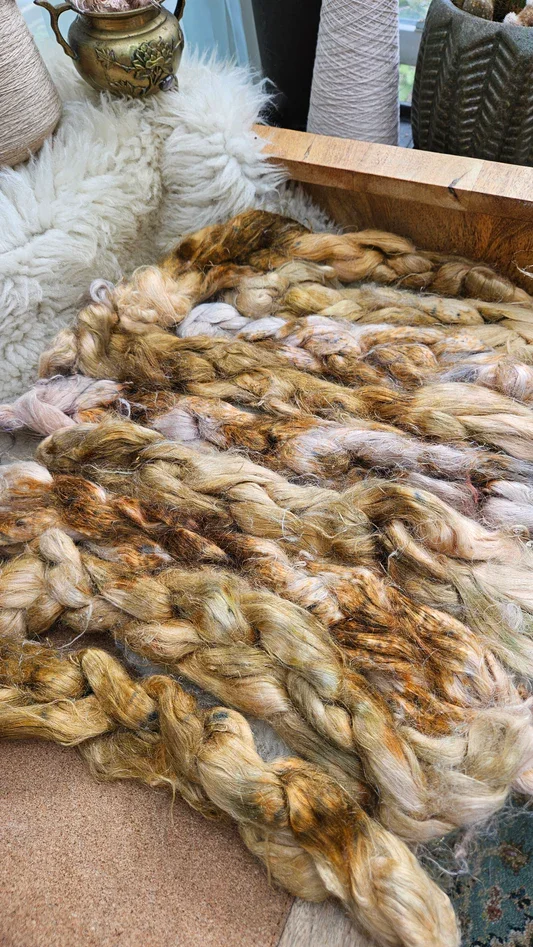
The visual ledger of Tactical Friction: Braided strands of raw, hand-processed flax fiber arrayed by tone, detailing the intensive physical interaction required before spinning can begin.
THE ONE ORIGINAL PRINCIPLE, LIVED IN FLAX
OAC’s design practice is governed by the One Original Principle: no editions, no multiples, one object that exists once. We have treated this as a deliberate institutional covenant — a chosen constraint that separates an original from a product. Schaub arrives at the same principle by a different road: not by covenant but by sheer impossibility of repetition. She could not make a second identical dress, no matter how hard she tried. The flax of one season is not the flax of the next; the indigo, the weather, the failures of a particular skein are unrepeatable inputs. The One Original Principle is, for her, not a rule imposed on the object but a fact discovered inside it.
This matters because it answers the obvious objection — that anyone could grow a dress, that the method is a recipe, that scarcity here is artificial. It is not. In The Narrative as the Original, we distinguished the reproducible Simulacrum from the singular Materially Singular Object whose value cannot survive copying. The recipe for flax-to-linen is ancient and public; the dress is still unrepeatable, because the value is not in the recipe but in the irreversible passage of one year of one life through one set of plants. The instructions are a Simulacrum; the dress is an original.
TACTICAL FRICTION AND THE REFUSAL OF THE SMOOTH
Byung-Chul Han’s diagnosis of the Aesthetic of Smoothness — the frictionless, the immediately consumable, the surface that offers no resistance — is the negative space against which this project becomes visible. We developed the post-luxury response to Han in The Aesthetics of Endurance. The Year of the Dress is a sustained exercise in Tactical Friction: the deliberate (or, here, unavoidable) reintroduction of difficulty into a process the market has spent two centuries trying to eliminate.
Fast fashion is the perfection of smoothness — a dress on a doorstep in two days, friction abolished at every link of the chain. Schaub’s project is friction-restored at every link. The drop spindle that will not cooperate, the retting that smells, the warp that breaks, the skein that “mostly sucks”: each is a productive obstruction. The friction is not a bug in the slow-fashion message; it is the mechanism by which the object accrues Moral Weight. A garment that cost nothing but money carries no weight. A garment that costs a year of failed skeins is heavy with the Legibility of Labor.
Note the documentary structure that friction enables. Schaub posts the failures, not just the triumphs — Week 33’s spinning agony, Week 34’s dreaded drop spindle, Week 35’s first lumpy skein. This is the opposite of the Hyperreal Consumer Landscape in which production is hidden, and only the finished, smooth commodity appears. The friction is shown. Showing it is what converts private effort into public Object Testimony.
“Fast fashion is the perfection of smoothness. The Year of the Dress is friction restored at every link of the chain — and the friction is not a bug in the message, it is how the object accrues weight.”
MATERIAL SINGULARITY AND NARRATIVE PERMANENCE
Two further terms close the structural reading. Material Singularity names the condition of an object that is one-of-one not by branding but by composition — this flax, this season, this dye, this set of imperfections. Narrative Permanence names the inseparability of an object from the documented story of its making, such that the narrative cannot be detached from the thing without destroying its value.
The Year of the Dress satisfies both unusually cleanly. The dress will be Materially Singular by necessity. And because Schaub has documented every week, the dress and its narrative are already fused: the garment will be inseparable from the public record of the year that produced it. You cannot buy this dress, but even if you could, you could not buy it without its year — the narrative is welded to the object. This is the same fusion we traced in The Weight of a Thousand Years, where an object’s value was shown to live in its capacity to carry its own time forward, and in Material as Manifesto, where Arte Povera made humble material into argument.
There is an irony worth naming. The most advanced thing about the Year of the Dress is how primitive it is. The Narrative Permanence is achieved not with a digital product passport or a blockchain ledger but with a flax field and a weekly post. The provenance is the process, witnessed. This is the cheapest and most durable authentication system there is, and it cannot be hacked, because there is nothing to hack — only a year that was either lived or not.
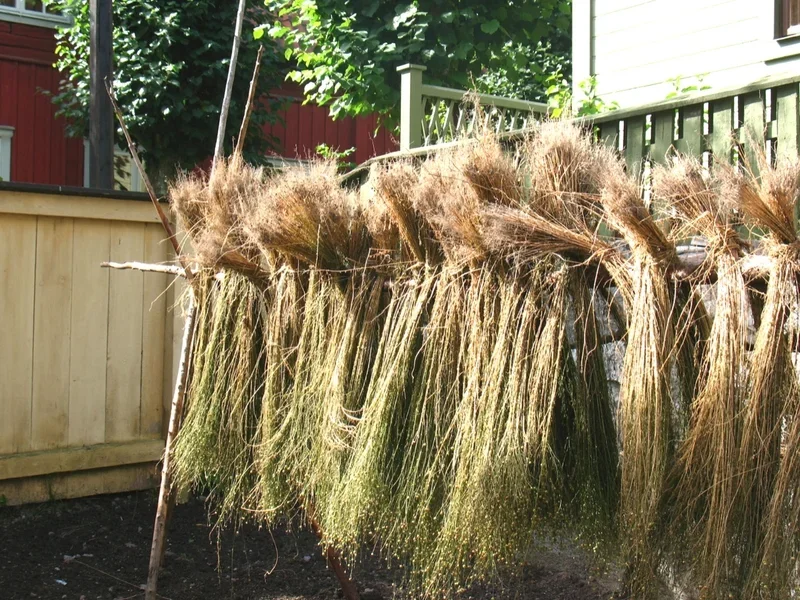
Material Singularity rendered in real time: Harvested flax hanging to dry on an outdoor frame, exposing the completely un-hackable, environment-dependent step of native textile provenance.
THE MORAL WEIGHT PROBLEM: AGAINST NAÏVE AUTHENTICITY
Honesty requires the framework’s hardest internal test. Not every laborious, handmade, well-intentioned object carries Moral Weight. The framework has a specific failure mode for objects that perform authenticity — Naïve Authenticity — in which sincerity and effort are mistaken for value, and the handmade becomes its own kind of Costly Signaling: a status display that says “I have the time and land to grow a dress, and you do not.” The most serious objection to the Year of the Dress is the one the slow-fashion sentence never raises: Is growing your own clothes a genuine alternative, or a luxury available only to those with a Vermont backyard and a year to spend?
We built the apparatus to adjudicate exactly this in The Material as Political Capital, where Moral Weight per Material (MWPM) was proposed to separate real labor-value from its performance, and in Hermès’ Mycelium Handbag, where we asked whether a sustainability gesture was substance or Greenwashing. Apply the same scrutiny here. The Year of the Dress survives the test — narrowly, and for a precise reason. It survives because Schaub does not sell the dress, does not scale the method into a brand, and does not pretend the project is a prescription. She presents it as an experiment, failures included. The moment a “grow your own dress” kit appears for $400, the Moral Weight collapses into Costly Signaling. The project's honesty is conditional on its refusal to become a product.
This is the disciplined version of the OAC angle, and it is more useful to Schaub than praise. Her project is not valuable because it is sincere. Sincerity is cheap. It is valuable because its value-structure — unsellable, unrepeatable, friction-laden, fully legible — happens to be sound. The framework defends the dress not on the grounds that she means well, but on the grounds that the object accounts honestly.
“Her project is not valuable because it is sincere. Sincerity is cheap. It is valuable because the object — unsellable, unrepeatable, friction-laden — accounts honestly.”
ANTI-COMMODITY COMMITMENT: THE DRESS THAT CANNOT BE SOLD
The final term is the Anti-Commodity Commitment: the structural refusal of an object to enter the market as a fungible good. For OAC this is a covenant — the Anti-Sale Covenant, the Monastic Veto. For Schaub it is, again, simply a fact of the object. What is the dress’s price? There is none, because there is no second unit to price it against and no labor rate that could rationally compensate a year of attention. The dress is priceless in the strict, deflationary sense: it is outside price.
Set this against the system the project implicitly indicts. Fast fashion is the apotheosis of Disposable Culture and Planned Obsolescence: maximum throughput, minimum legibility, the garment engineered to be replaced before it is understood. We traced the consumer turning away from that system from Quiet Luxury to Post-Growth Citizen, and the macro-level evidence for the shift in the Bain Global Luxury Report 2026 analysis. The Post-Growth Citizen is not buying differently; she is, at the limit, refusing to buy at all and making instead. Schaub is the household-scale proof of that refusal.
And the textile-labor history matters here, because the dress is not a fantasy of escape from industry but a deliberate re-enactment of what industry abolished. In The Shadow of the Loom we examined how the mechanization of cloth severed the maker from the made and erased the labor inside the weave. The Year of the Dress reverses that severance for one garment, one time. It does not solve the politics of textile labor. It makes them, for a year, Legibility of Labor — visible again in a single person’s hands.
WHAT THE YEAR OF THE DRESS CONFIRMS, AND WHAT IT LEAVES OPEN
What the Year of the Dress confirms is that the post-luxury value-structure is not an artifact of OAC’s institutional machinery — not a product of the studies, the lexicon, or the commission model. It is a real pattern in the world, recoverable by anyone stubborn enough to grow a dress in a backyard. Schaub reached Labor Density, the One Original Principle, Tactical Friction, and the Anti-Commodity Commitment with no theory and no intention of reaching them. The framework did not invent these; it named what is already there. That a humorist documenting her own incompetence at spinning should produce a cleaner demonstration of the principles than most of the luxury market manages is the strongest possible evidence that the principles are not ours — they are simply true.
What it leaves open is the question the project is still, at this writing, mid-flax to answer: what happens when the dress is finished? An un-sellable, unrepeatable, year-long object has no obvious afterlife in the systems we have. It cannot be a product; it resists being merely a relic; it is too laborious to be casual and too personal to be institutional. The framework can describe the dress perfectly and still cannot yet tell you what a culture is supposed to do with one. That is not a weakness in the reading. It is the unresolved edge of the whole post-luxury project: we now know how to make the Sovereign Object; we do not yet know how to live with a world full of them. Schaub will have one dress. The question of what a civilization does when everyone wants to grow their own is the question the next decade has to answer.
“The framework did not invent these principles. A humorist documenting her own incompetence at spinning recovered them in a backyard. That is the strongest evidence they were never ours — they are simply true.”
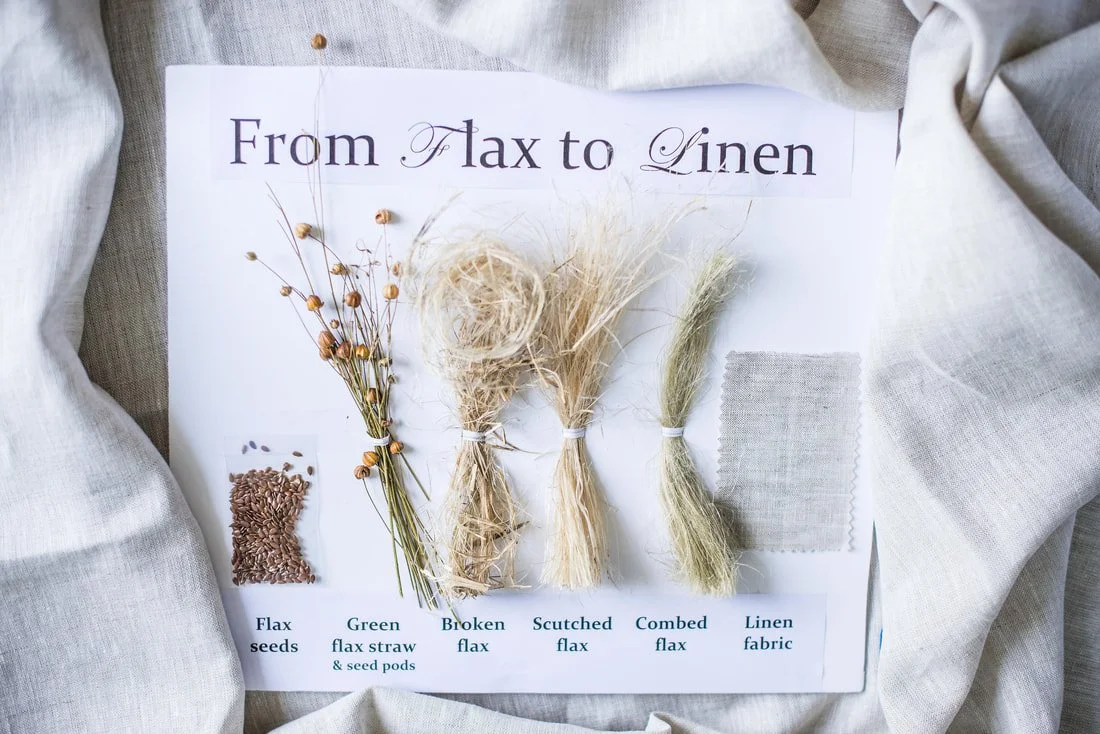
Object Testimony achieved: An analytical taxonomy of the garment’s lifecycle from seed to cloth, illustrating the absolute opposite of fast fashion's erased labor.
Authored by Christopher Banks, Anthropologist of Luxury, Critical Theorist & Founder Objects of Affection Collection Office of Critical Theory & Curatorial Strategy 469 Fashion Avenue, 12th Floor, New York, NY 10018
RELATED OAC STUDIES
The Year of the Dress sits inside a network of OAC studies on labor, endurance, sustainability’s performances, and the un-commodifiable object. The most directly load-bearing are gathered below.
The Labor Argument
· The Algorithm of the Hand: Re-Centering Human Imperfection and Labor as PLCFA’s Ultimate Materiality
· The Hand Strikes Back: Generative “Slop,” Costly Signaling, and the Luxury Artisanal Contract
· Artisan Activism: Why Craft, Materiality, and Protest Define Post-Luxury Value
Material, Endurance & Slowness
· The Aesthetics of Endurance: Byung-Chul Han and the Rise of PLCFA
· The Weight of a Thousand Years: Joe Doucet, the Epistemology of Endurance, and Honest Sustainability
· Material as Manifesto: The Political Legacy of Arte Povera and the Birth of Post-Luxury
Sustainability & Its Performances
· Why Marine Serré’s Upcycling Is Not a Trend
· Hermès’ Mycelium Handbag: True Sustainability or a Hyperreal Performance?
· The Shadow of the Loom: Semiotic Enclosure, Racial Capitalism, and Post-Luxury Reparation
The Post-Growth Consumer
· From Quiet Luxury to Post-Growth Citizen: A PLCFA Perspective on Discerning Consumption
· What the Bain Global Luxury Report 2026 Actually Proves About Sign-Value Collapse
The One Original & Moral Weight
· The Narrative as the Original: AI, Simulation, and the Custodial Strategy of PLCFA
· The Material as Political Capital: Quantifying Moral Weight in the Anti-Market Materiality of PLCFA
