
Structural Captivity of Material Singularity
Why Unique Material Crafts Lose Intrinsic Value Under the Speculative Velocity of High-Net-Worth Resale Arbitrage
The escalating market demand for what is commercialized as 1-of-1 aesthetic singularity is demonstrably co-opted by architectures that convert intrinsic material covenants into highly liquid financial instruments. This study diagnoses why material objects lose intrinsic value in markets when subjected to the structural velocity of speculative resale. By analyzing the problem with rapidly reselling luxury items under late capitalism, we examine how the transition from custodial stewardship to secondary-market assetization imposes Structural Captivity upon the unique object. This transformation constitutes an instance of Institutional Necrophagy, wherein financial abstraction systematically extracts and consumes Walter Benjamin’s concept of aura, leaving behind a Hollowed Object. Drawing on David Pye’s work on risk and contemporary luxury indices, OAC asserts that true Narrative Permanence resides strictly in the Labor Density of genuine custodianship, which must be enforced through the legal mechanisms of the Custodian’s Contract.
Introduction: The 1-of-1 Aesthetic Singularity and Its Financial Re-Coding
To confront the contemporary luxury and fine-art landscapes is to witness a profound ontological crisis: the systematic transformation of material uniqueness into liquid capital. In recent years, auction houses, private investment funds, and high-end resale platforms have aggressively mobilized a new marketing paradigm — the 1-of-1 aesthetic singularity. In the vernacular of the speculative market, it is promoted as the ultimate defense against digital reproducibility: an irreproducible, physically unique artifact whose possession signals absolute status. Yet this official narrative conceals a predatory structural reality. The market’s sophisticated re-coding of uniqueness does not preserve the object; it captures it. Under this regime, the object’s physical reality is subordinated to its capacity for rapid transaction, initiating a process in which material uniqueness and financial abstraction enter a state of irreconcilable tension.
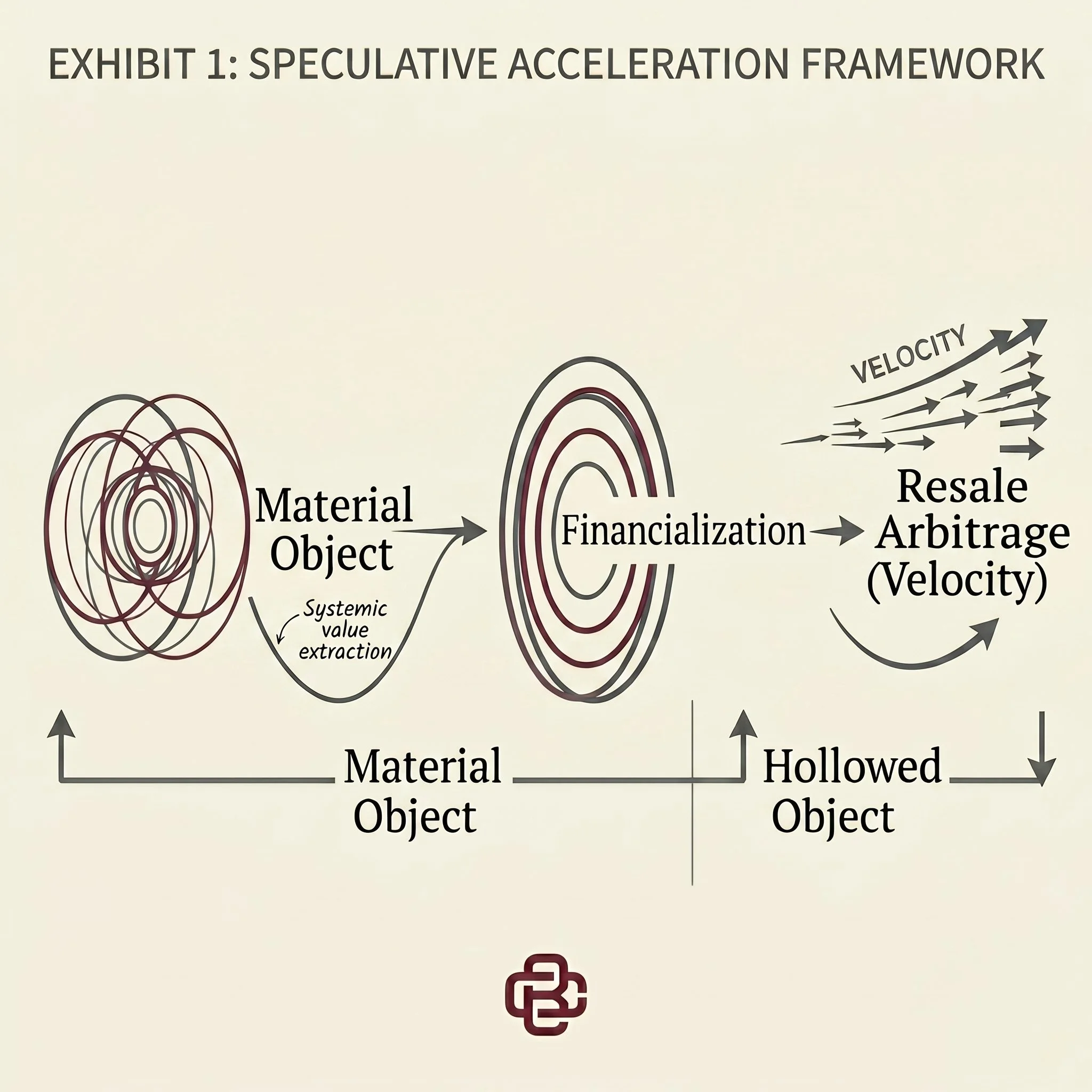
The Post-Luxury Conceptual Functional Art (PLCFA) framework identifies this condition as Structural Captivity — the systemic containment of a singular object within financial and semiotic networks that prevent the accumulation of Material Memory. Once captured, the object is no longer permitted to exist in a state of organic temporality. Its capacity to carry human attention, to reflect the passage of time, and to serve as a physical repository of creative labor is terminated. Instead, it is reformatted into a highly exchangeable, frictionless token of investment collateral.
The ethical implications of luxury resale arbitrage are vast and destructive. When objects are acquired solely to be rapidly resold, they undergo an ontological downgrade. The unique labor history and material provenance — what PLCFA terms Labor Density — are stripped of intrinsic value and repurposed as mere metadata to justify speculative pricing. This study demonstrates that the process is not an enhancement of the object’s cultural or financial value, but a necrophagic extraction of its meaning, demanding a precise articulation of material and contractual resistance.
Speculative Velocity and the Solvent of Physicality
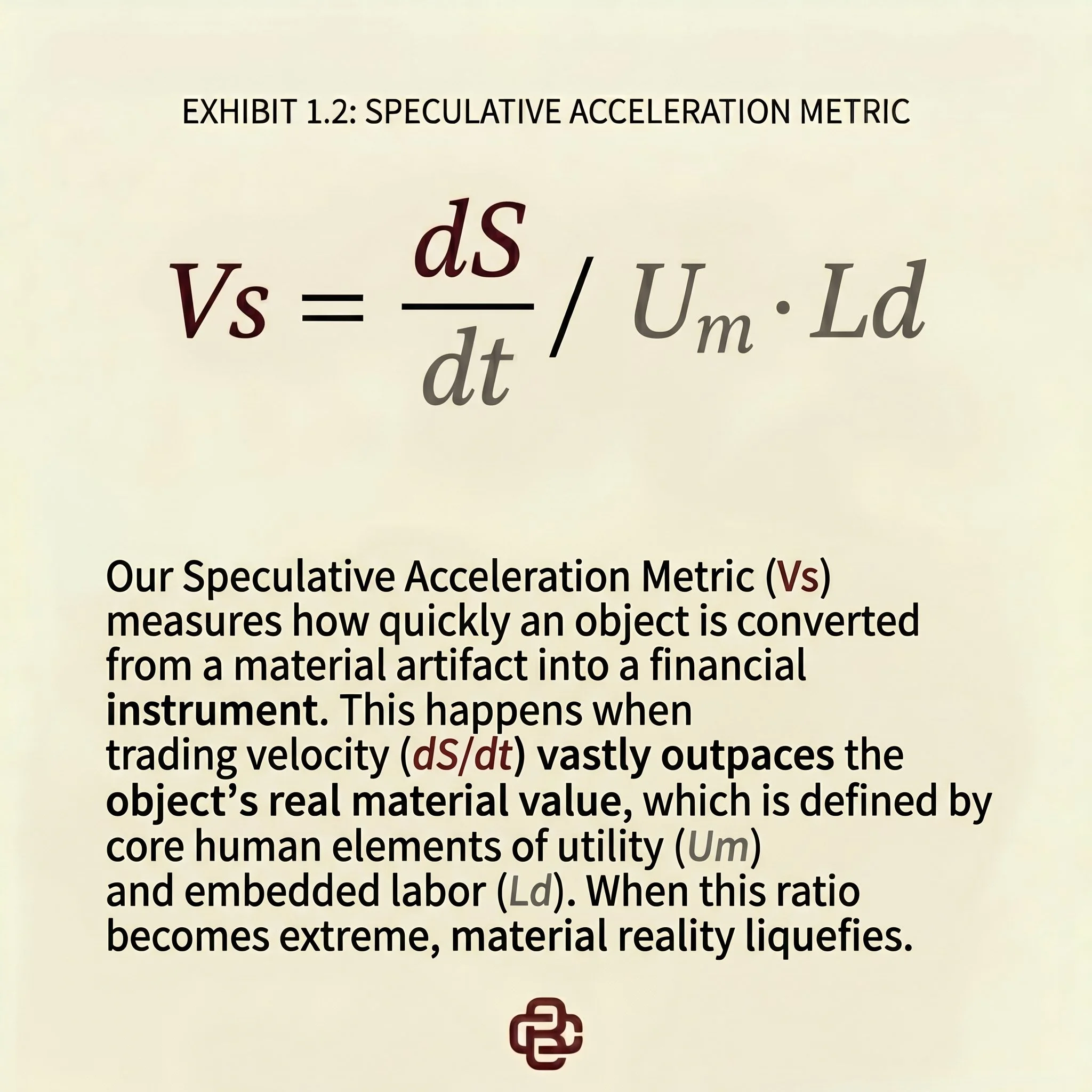
The primary engine of this structural capture is Speculative Velocity— defined as the rate at which an object’s sign-value accelerates ahead of its material utility and physical labor footprint. As speculative velocity increases, the physical object is subjected to an artificial temporal compression. It must move through ownership cycles at speeds that fundamentally contradict the slow discipline of curation and custodianship.
We can model this relationship directly. Let Vs denote the Speculative Velocity of a singular object:
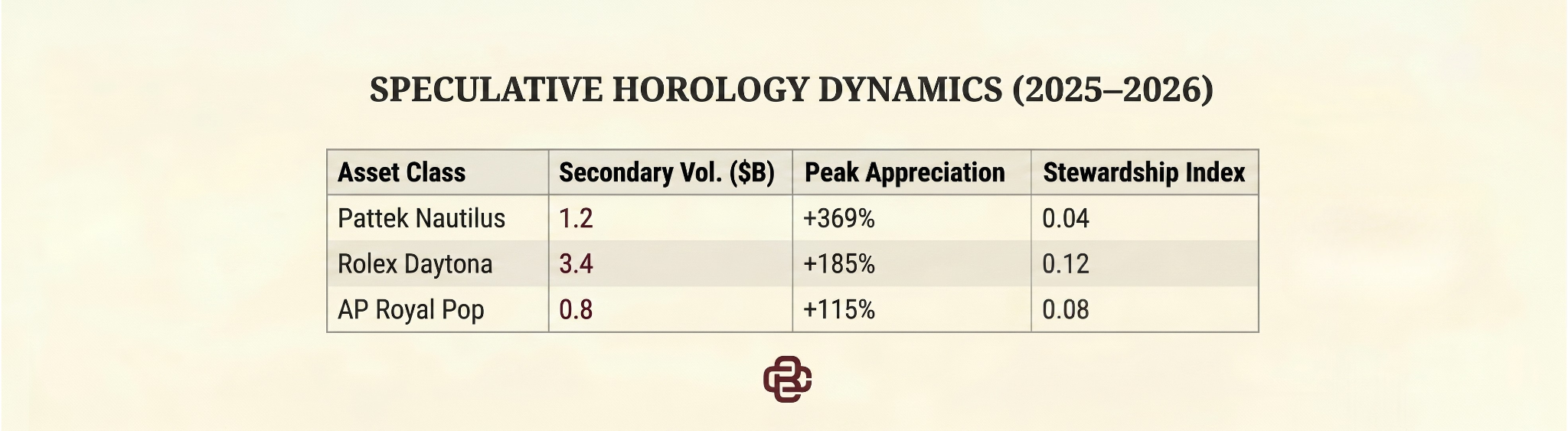
The secondary horology market of 2025–2026 offers a stark diagnostic site. During the speculative spike of the mid-2020s, the secondary market reached roughly $16.7 billion in total transaction value, driven by the rapid reselling of highly coveted models. The Patek Philippe Nautilus 5711 appreciated by approximately 369% over retail within months of its discontinuation. This appreciation reflected no increase in material quality or labor input; it was a pure expression of speculative velocity. The watch was no longer worn — it was warehoused, flipped, and fractionalized. When the speculative layer collapsed in early 2026, market share settled back toward pre-speculation levels, leaving a class of collectors who had paid astronomical premiums for what had effectively become a dispossessed object.
The Bain Global Luxury Report 2026 confirms that this hollowing is systemic. Ultra-wealthy consumers, who now control roughly 46% of the personal luxury-goods market, increasingly treat high-end physical assets as positional collateral rather than culture. In this environment, the physical artifact undergoes what Walter Benjamin identified as the decay of aura — the collapse of the singular encounter in time and space. Speculative velocity functions as a material solvent, dissolving the unique presence of the object until only the sterile security of the investment ledger remains.
David Pye and the Workmanship of Risk: The Ethical Covenant of Craft
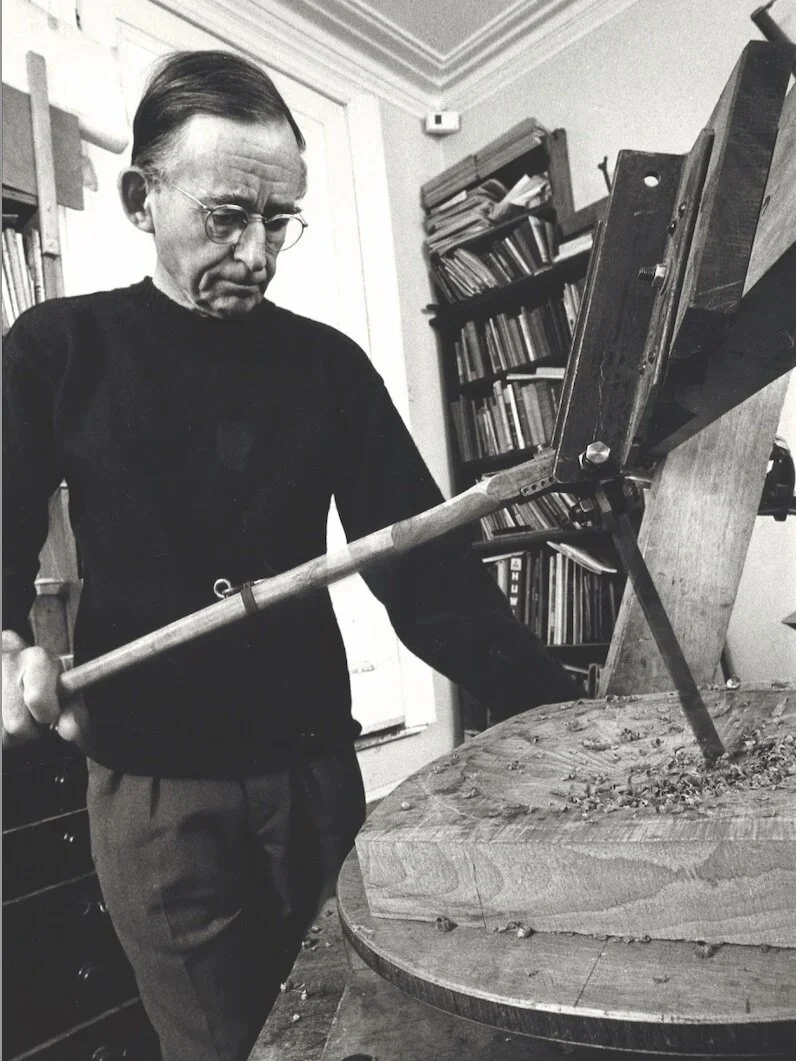
David Pye in his workshop in his workshop at his home in Sussex, England.
To counteract the dematerializing force of speculative velocity, we must return to a rigorous materialist ontology of making. In his 1968 treatise The Nature and Art of Workmanship, David Pye (PDF) formulated a critical vocabulary that remains our most potent theoretical defense against the financialization of unique artifacts. Pye split the act of making into two primary categories: the workmanship of risk and the workmanship of certainty.
“The workmanship of risk is workmanship using any kind of technique or apparatus, in which the quality of the result is not predetermined, but depends on the judgment, dexterity, and care which the maker exercises as he works. ”
In contrast, the certainty of workmanship is typical of mass production and full automation, where the quality of the result is predetermined before a single salable item is made. Pye’s classic illustration contrasts writing with a pen — the workmanship of risk — with modern printing, the workmanship of certainty. In printing, enormous labor and care are expended beforehand to prepare the plates and machinery, but once the press runs, the output is predetermined and uniform.
“Good material is a myth. Only worked material has quality, and pieces of worked material are made to show their quality by men. It is good only because workmanship has made it so.”
This worked quality is what PLCFA defines as Labor Density — the accumulation of physical time, human attention, and manual hazard within the surface of the object. When a maker operates under the workmanship of risk, carving by eye and driven by dexterity, they embed an un-reproducible material covenant into the object. The resulting irregularities and subtle textures are not flaws; they are the physical evidence of an encounter between human consciousness and physical matter. This is the foundation of preserving unique material craft.
The problem with rapidly reselling luxury items is that it treats these covenants as empty aesthetic signifiers. When an object is bought and flipped within thirty days, the owner does not engage with its workmanship. The workmanship of risk is converted into a marketing story — an alibi deployed to justify extreme markups while production models quietly migrate toward the workmanship of certainty to maximize margin. This is the essence of Institutional Lexical Hijacking: the extraction of the vocabulary of craft to sell injection-molded plastics and automated veneers.
The Pathology of Institutional Necrophagy: Case Studies in Extraction
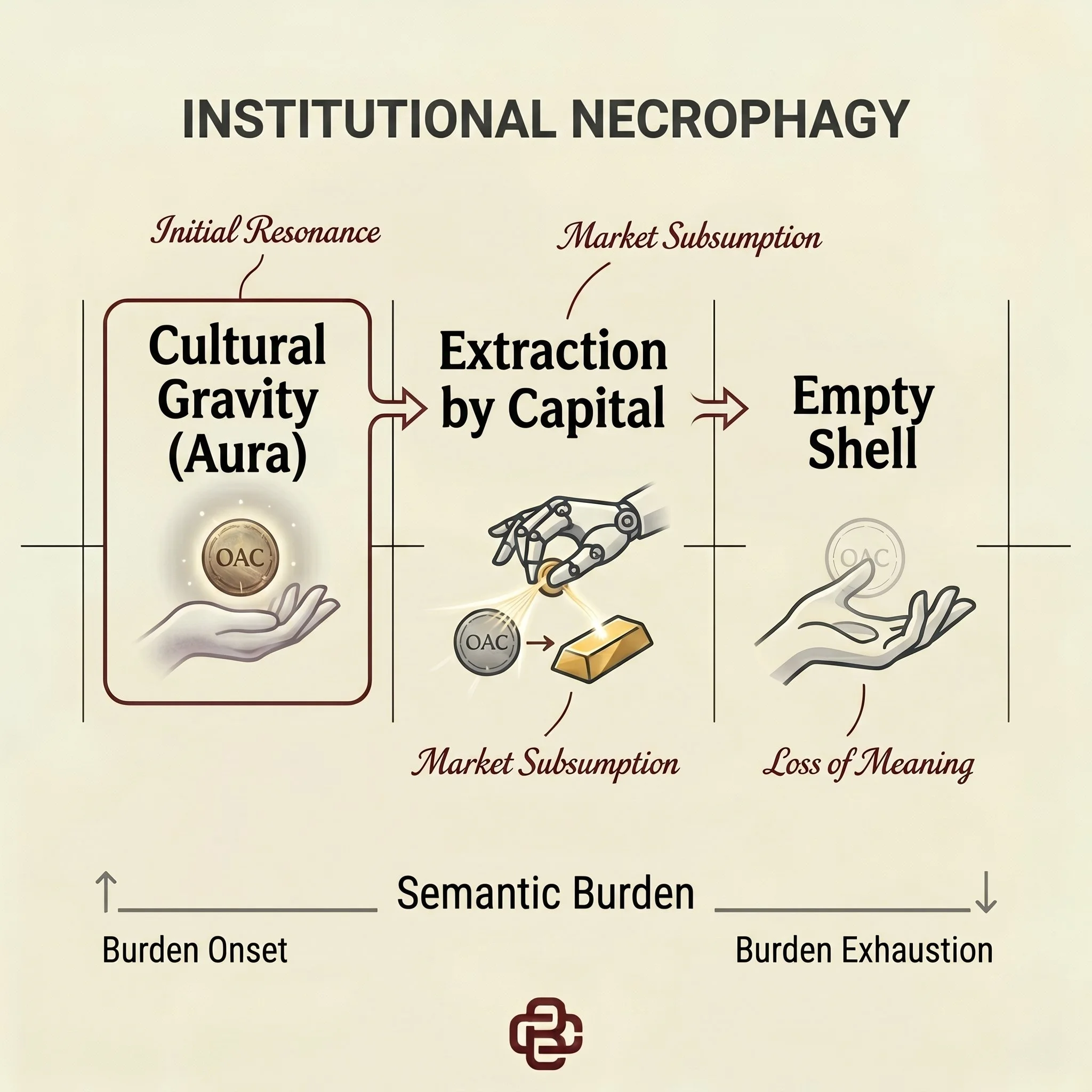
When the market decouples the sign-value of an object from its material and labor reality, it does not merely perform a neutral transaction; it initiates Institutional Necrophagy — the systematic process by which financial abstraction consumes the material and semiotic integrity of objects once bound by a covenant of care, extracting their accumulated aura until only a lifeless commercial shell remains. Three diagnostic sites across contemporary culture make the operation concrete.
1. Spatial Hollowing: The Frick Collection and Louis Vuitton
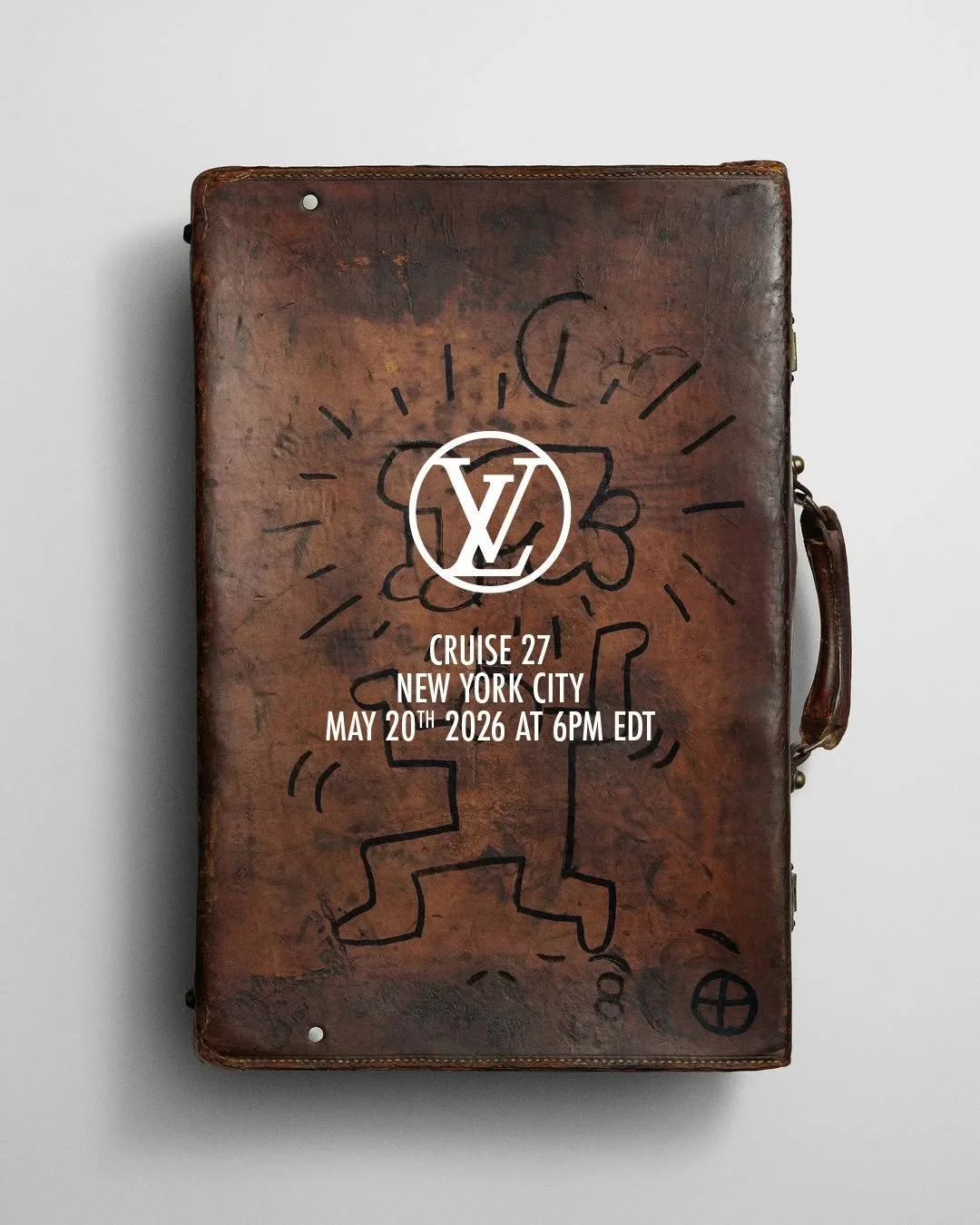
The official promotional asset for Louis Vuitton’s Cruise 2027 presentation at The Frick Collection. By overlaying the sharp corporate monogram directly onto Keith Haring's raw 1984 downtown iconography, the graphic perfectly captures the Baudrillardian loop analyzed in this study: the total absorption of historical street resistance into a sovereign luxury commodity
In 2026, the Frick Collection completed a roughly $220 million capital modernization. To offset the debt, the institution traded its hard-earned spatial aura for liquid corporate capital, permitting Louis Vuitton to stage commercial activity within its galleries — a classic Aura Transaction. The Frick holds absolute masterworks of Material Singularity, such as Vermeer’s Officer and Laughing Girl (c. 1657), possessing an irreplaceable field of cultural gravity built over centuries. When commercial spectacle occupies this room, it does not create new energy; it participates in a zero-sum auratic extraction, drawing down historical permanence to authenticate temporary luxury commodities. The collection is thereby rendered legible as an institution whose operational survival depends on corporate patronage — a state of structural captivity. We have examined this dynamic at length in our study of the Keith Haring × Louis Vuitton show at the Frick.
2. Physical and Material Hollowing: The Ferrari Luce EV

The side profile of the Ferrari Luce reveals a radical departure from traditional Maranello geometry. Its smooth, continuous lines and expansive glass canopy reflect LoveFrom’s hallmark product-system logic—treating the vehicle body not as an expression of mechanical violence, but as a seamlessly resolved, frictionless container for technology.
The automotive sector has witnessed a parallel hollowing in the transition to electrification, exemplified by the Ferrari Luce. Historically, the Ferrari marque condensed mechanical labor, racing provenance, and visceral physical resistance. The Luce EV, built with consumer-electronics-grade glass and anodized aluminum processed into hexagonal microstructures, preserves the external markers of the brand — the badge, the price, the high-end materials — but evacuates the interior mechanical substance that authorized its cultural myth. To name the car after light and construct it for replacement cycles of eighteen to thirty-six months is to create a Hollowed Object: an asset designed for frictionless interaction rather than deep material encounter.
3. Civic Hollowing: The Destruction of Wyland’s Dallas Whale Mural
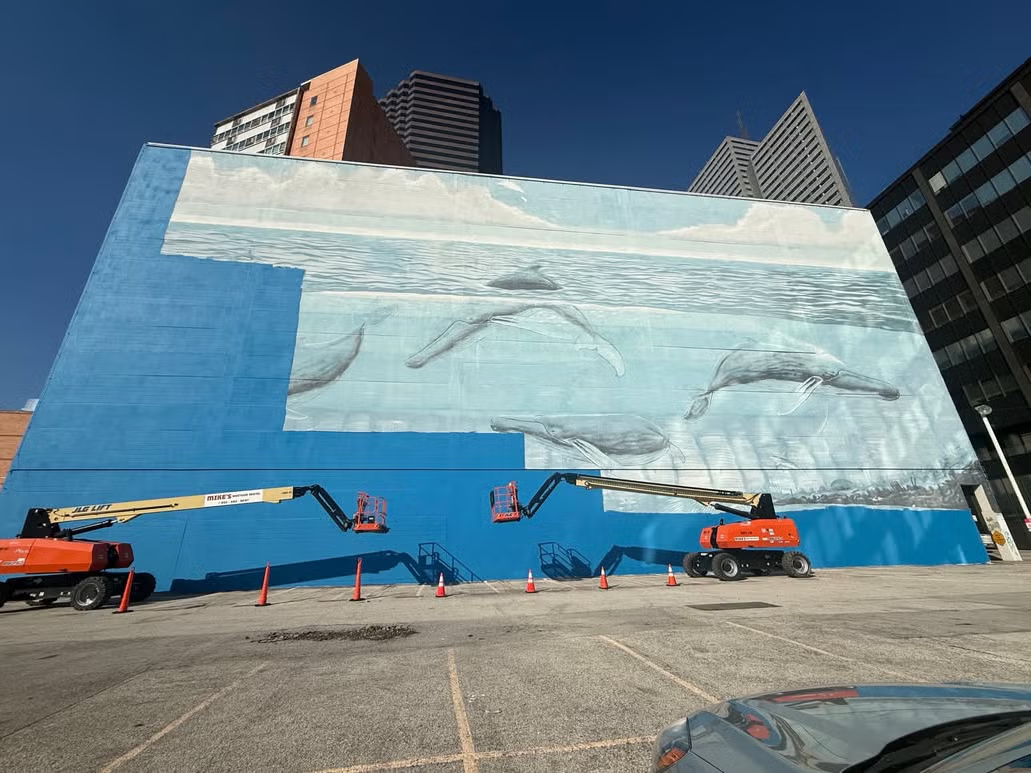
Speculative Velocity enacted on the built environment: the documented conversion of an original civic landmark into an empty commercial slate.
In June 2026, Dallas witnessed the sudden destruction of Wyland’s landmark Ocean Life mural, which had occupied a building facade for twenty-seven years as a monument of material singularity and civic memory. The arrival of the 2026 FIFA World Cup accelerated civic speculative velocity: real-estate capital, operating through and around the municipal apparatus, instantly re-priced this community landmark as a short-term promotional canvas. This exposes the raw violence of the Archival Death Mandate — the unwritten assumption that a possessor may unilaterally decide a public landmark’s expiry if its space can be converted into a higher-yielding financial instrument. We document the resulting VARA litigation in our study of Wyland’s destroyed Dallas mural.
The Kantian Program and Semiotic Arbitrage: The Platform Capture of Affect
The theoretical foundation of this capture resides in what Denise Ferreira da Silva exposes as the Kantian program of liberal modernity. Post-Enlightenment philosophy established a bifurcation between intellect and affect. Intellectual labor is designated active, rational, and universally legible — and is therefore granted institutional legitimacy, compensation, and legal protection. Affective and material labor — the slow, localized care work, the manual craft, the raw feeling of the body — is designated passive, particular, and pre-political, and is thus excluded from the universal ledger of value.
The platform economy has privatized this program. Platforms bypass the traditional translation step of the intellectual — the editorial board, the peer review, the curated exhibition — and directly exploit unprocessed social affect. The affective object (the viral post, the trending outrage, the rapid product drop) is designed to be consumed at infinite speed, generating engagement metrics immediately converted into financial yield. This is the mechanism of Semiotic Arbitrage: the platform extracts raw affect and material labor from the social body without performing any of the custodial labor required to sustain those communities. The sovereign object — the material answer to this unasked question — must be designed as a form of making that cannot be converted into digital content without ceasing to exist.
Post-Mortem Necrophagy and the Liquidation of Legacy
The terminal expression of institutional necrophagy occurs when the creator of unique artifacts is no longer alive to defend their material covenant. The passing of David Hockney on June 11, 2026, provides an immediate case study in how the speculative market liquidates a physical legacy. Hockney spent his life as a custodian of looking — a fierce defense of the slow, material act of human observation against digital flattening. Within hours of his death, the hyper-financialized auction apparatus focused almost exclusively on his roughly $90.3 million auction record, treating an entire lifework as a liquid portfolio of assets. This is the liquidation of the simulacrum: the immediate conversion of a living creative force into a series of rigid, provenanced transaction points.
We can examine the arithmetic of this extraction. Let Ra denote the Auratic Concentration Ratio of an artist’s market:
Ra = (Cu / Ct) / (Nu / Nt)
Where Cu is the capital commanded by unique paintings, Ct is the total capital generated across the artist’s market output, Nu is the number of unique painting lots, and Nt is the total number of lots, including prints and editions. Prints and multiples account for over 12,000 lots — roughly 75% of cataloged output — yet unique paintings, barely 4% of total lots, command over 76% of all capital generated. Substituting the empirical shares yields Ra ≈ (0.76)/(0.04) ≈ 19: the singular, hand-worked object is priced nearly 19 times as densely as the multiple. The market demonstrates, in dollars, what OAC holds as an ontological principle — an insatiable hunger for the unique, hand-worked surface, even as its speculative structures seek to flatten and isolate that surface from its custodial context. We extend this analysis in our reading of Christie’s $1.1 billion sale.
The Custodian’s Contract as an Architecture of Resistance
Against this multi-front invasion, OAC does not merely offer critique; we implement a concrete legal and material architecture of resistance. In place of the standard ownership model that permits material dispossession, we establish the Custodian’s Contract — a binding covenant that redefines acquisition as participation in a long-term cultural project.
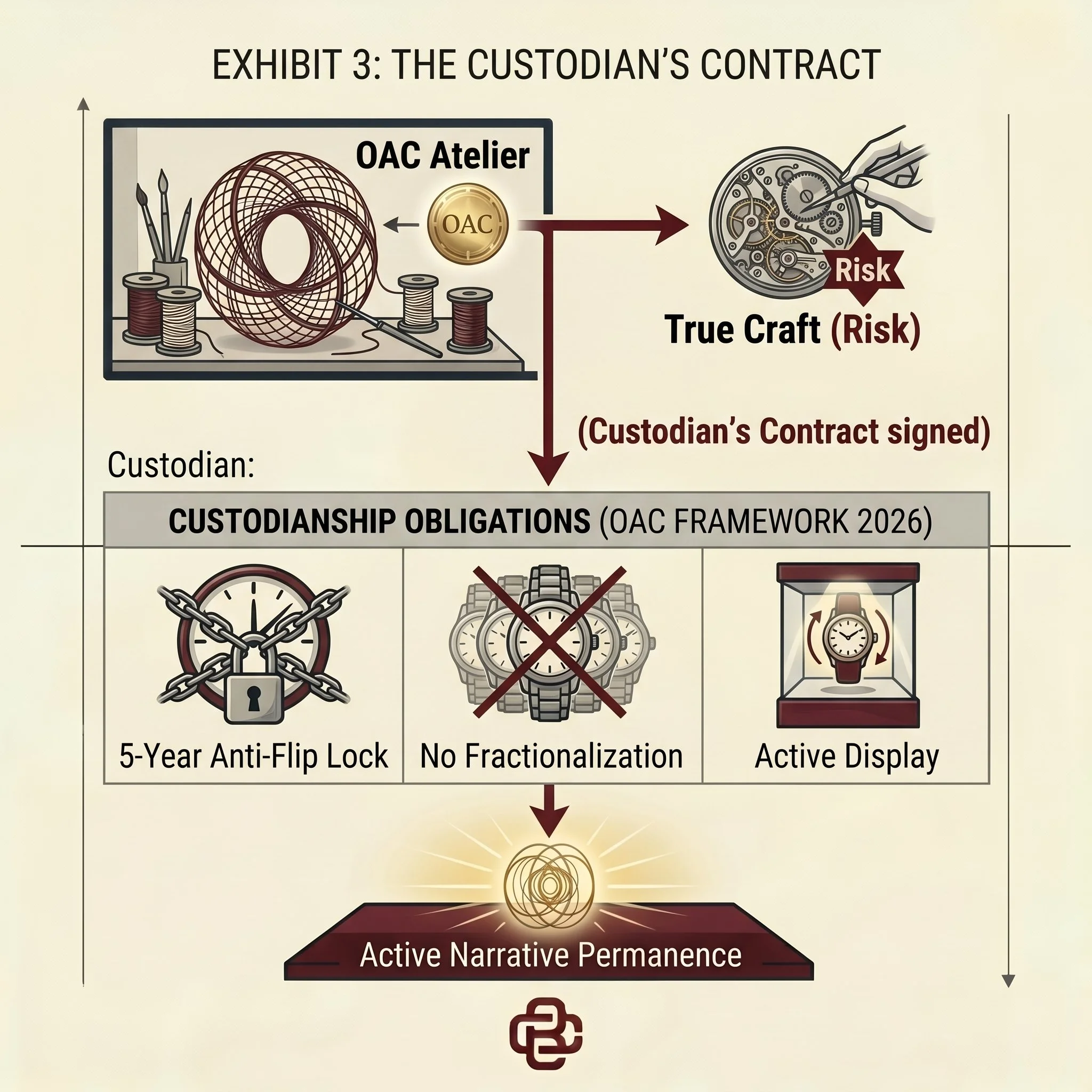
The contract is founded on non-negotiable, legally enforceable parameters designed to neutralize speculative velocity and protect Object Permanence:
The Five-Year Anti-Speculative Lock. The custodian legally commits to a five-year covenant during which the object cannot be resold, auctioned, or transferred. Any violation triggers immediate reversion of ownership to the Collection.
The Anti-Fractionalization Veto. The custodian is prohibited from split-ownership, tokenization, or fractionalizing the physical or digital identity of the object into liquid investment units.
The Active Custody Mandate. The custodian accepts the Burden of Preservation. The object cannot be sealed in a freeport, stored in a dark warehouse, or held as positional collateral; it must be displayed, maintained, and integrated into active human spatial encounters.
Triple-Link Validation. The physical object, its archival provenance record, and its immutable digital twin are permanently bound through cryptographic signatures, ensuring that physical biography cannot be divorced from symbolic representation.
This is the transition from accelerated luxury to Regenerative Luxury. The success of the model is empirical: of the physical objects commissioned, produced, and placed by the Collection across its first years of sovereign operation, not a single artifact has appeared on the secondary market or speculative exchange. The contract does not restrict the object’s freedom; it restores its ontological security, shielding it from the necrophagic flows of resale arbitrage.
Cognitive Sovereign Infrastructures and Constitutional Governance

OAC Agent Command v12.8: The native Android launcher button for the bespoke sovereign intelligence infrastructure, accessed solely by the institution founder.
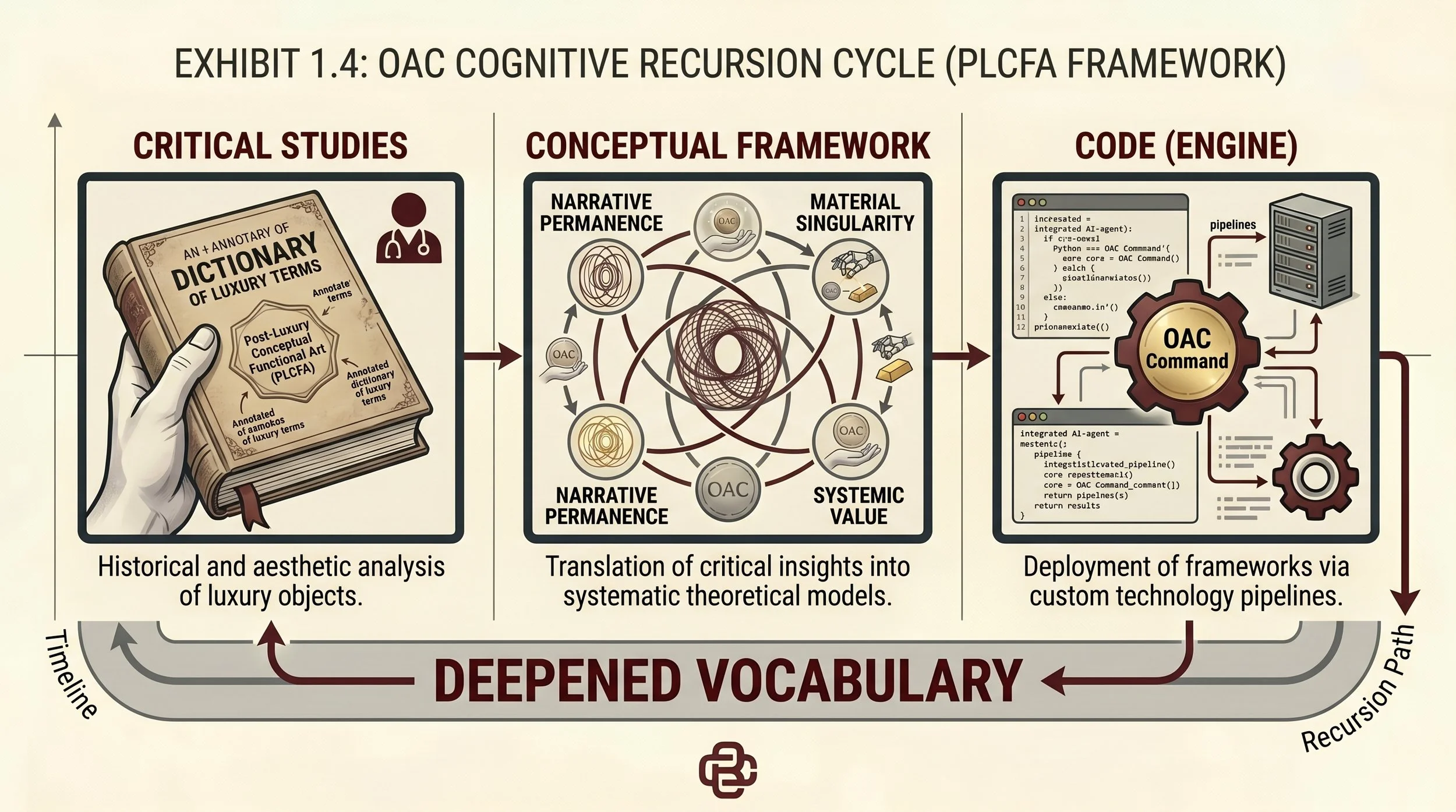
The final line of defense is cognitive. In an era of generative flattening, the traditional critical arts institution remains structurally defenseless: it produces texts that are instantly digested by search engines and repurposed as corporate marketing copy. OAC has broken from this paradigm by treating its own cognitive infrastructure — OAC Agent Command — as a primary medium of conceptual artistic practice. Built across dozens of iterations of proprietary, non-commercial code, it is governed by a non-negotiable Constitutional Governance Engine. Before any critical analysis is output, the system runs its inputs through a fixed constitutional identity block that enforces our proprietary lexicon, ensuring that terms like Labor Density, Material Singularity, and Institutional Necrophagy cannot be flattened or translated into mass-market design jargon.
Coda
The contemporary struggle for the survival of craft is not a battle over style, aesthetics, or price. It is a war over time. The speculative market, fueled by secondary-market resale platforms, demands absolute frictionlessness — a world where unique artifacts can be flipped and liquidated with zero material drag. This acceleration is a systemic assault on the very possibility of physical memory, reducing creative labor to liquid units of speculative collateral. The Objects of Affection Collection is a sovereign institutional argument against this dematerializing machine. By binding our artifacts to the workmanship of risk, insulating them with the Custodian’s Contract, and defending them through cognitive sovereign systems, we preserve the fragile integrity of the material encounter.
The necrophage feeds on the speed of the instant; the custodian bets on the endurance of the years. History has already declared its preference.
Authored by Christopher Banks, Anthropologist of Luxury, Critical Theorist & Founder

Objects of Affection Collection

Office of Critical Theory & Curatorial Strategy

469 Fashion Avenue, 12th Floor, New York, NY 10018
Related OAC Studies
On Speculative Velocity and Object Permanence — Institutional Necrophagy: How Speculative Velocity Destroys Object Permanence and What the Custodian’s Contract Must Do About It
On Post-Mortem Financialization — The Custodian of Looking: What David Hockney’s Death Reveals About the Architecture of Post-Mortem Necrophagy
On the Automotive Hollowed Object — The Hollowed Prancing Horse: What the Ferrari Luce EV Actually Confirms
On Cognitive Sovereign Systems — What Happens When a Conceptual Art Program Builds Its Own Cognitive Infrastructure
On Lexical Hijacking and Corporate Capture — Institutional Lexical Hijacking: How Mass-Market Luxury Launders Post-Luxury Vocabulary
Works Cited
David Pye, The Nature and Art of Workmanship (1968), excerpt. https://historiesdrawingsprints.com/wp-content/uploads/2014/01/david-pye_the-nature-and-art-of-workmanship_excerpt.pdf
Denise Ferreira da Silva, on the Kantian program — OAC critical reading. https://www.objectsofaffectioncollection.com/studies/denise-ferreira-da-silva-e-flux-kantian-program
Bain Global Luxury Report 2026 — OAC analysis. https://www.objectsofaffectioncollection.com/studies/bain-luxury-2026-polycrisis-sign-value-collapse
Institutional Necrophagy: Speculative Velocity vs. Object Permanence. https://www.objectsofaffectioncollection.com/studies/institutional-necrophagy-speculative-velocity-object-permanence
The Custodian of Looking: David Hockney and Post-Mortem Necrophagy. https://www.objectsofaffectioncollection.com/studies/david-hockney-death-posthumous-necrophagy
The Hollowed Prancing Horse: Ferrari Luce. https://www.objectsofaffectioncollection.com/studies/ferrari-luce-design-hollowed-object
Keith Haring × Louis Vuitton at the Frick: What It Actually Means. https://www.objectsofaffectioncollection.com/studies/what-the-keith-haring-louis-vuitton-show-at-the-frick-collection-actually-means
Wyland’s Destroyed Dallas Whale Mural — FIFA World Cup VARA Lawsuit. https://www.objectsofaffectioncollection.com/studies/wyland-destroyed-dallas-whale-mural-fifa-world-cup-vara-lawsuit
Institutional Lexical Hijacking: Laundering Post-Luxury Vocabulary. https://www.objectsofaffectioncollection.com/studies/institutional-lexical-hijacking-luxury-brand-vocabulary
What Happens When a Conceptual Art Program Builds Its Own Cognitive Infrastructure. https://www.objectsofaffectioncollection.com/studies/objects-affection-cognitive-infrastructure
Pollock, Brancusi, Rothko: What Christie’s $1.1 Billion Sale Confirmed. https://www.objectsofaffectioncollection.com/studies/pollock-number-7a-brancusi-danade-and-rothko-no-15-what-christies-11-billion-sale-actually-confirmed
