
The Custodian of Looking: What David Hockney's Death Reveals About the Architecture of Post-Mortem Necrophagy
The David Hockney death of 11 June 2026 entered the art market before it entered mourning. Within hours the headlines had a number — ninety million dollars — and a verb: to value. This study applies the PLCFA lexicon of Institutional Necrophagy, Speculative Velocity, the Hollowed Object, Material Singularity, Narrative Permanence, Labor Density, and the Aura Transaction to the post-mortem financialization of an artistic legacy. Its claim is narrow and exact: the velocity that follows an artist's death does not consume the work — the work cannot be hollowed — it consumes the public language around the work. OAC reads the auction record against its own headline, defends the object, and corrects two errors of chronology the necrophage's narrative depends upon.
The Life, Stated Plainly
David Hockney was born in Bradford on 9 July 1937, the fourth of five children, son of an accountant whom he drew at eighteen. He trained at Bradford School of Art and then at the Royal College of Art in London, leaving in 1962 with a gold medal and a reputation already taking shape. He was, from the start, an artist who refused the single manner. Pop Art associated him; he declined to belong to it. He moved to Los Angeles in 1964 and found there the subject that would make him famous — water, light, the still surface of a swimming pool, and the figure beside it. He worked, openly gay, at a time when that was still criminal in Britain, and made the fact of his looking inseparable from the fact of his loving.
He worked for seven decades without a fallow year. Oil and acrylic. Ink, pencil, charcoal. Photographic collage. Opera sets. And, in his ninth decade, an iPad. He returned to Yorkshire and painted its lanes at scale; he settled in Normandy and drew a single garden through every season. He died on 11 June 2026, one month before his eighty-ninth birthday, survived by his partner and studio manager, Jean-Pierre Gonçalves de Lima.
OAC records this not as an eulogy but as a register of Labor Density — six decades of accumulated looking and making, a corpus so large and so continuously worked that no market event can compress it into a single figure. That density is the first thing the velocity will try to erase. This study refuses the erasure
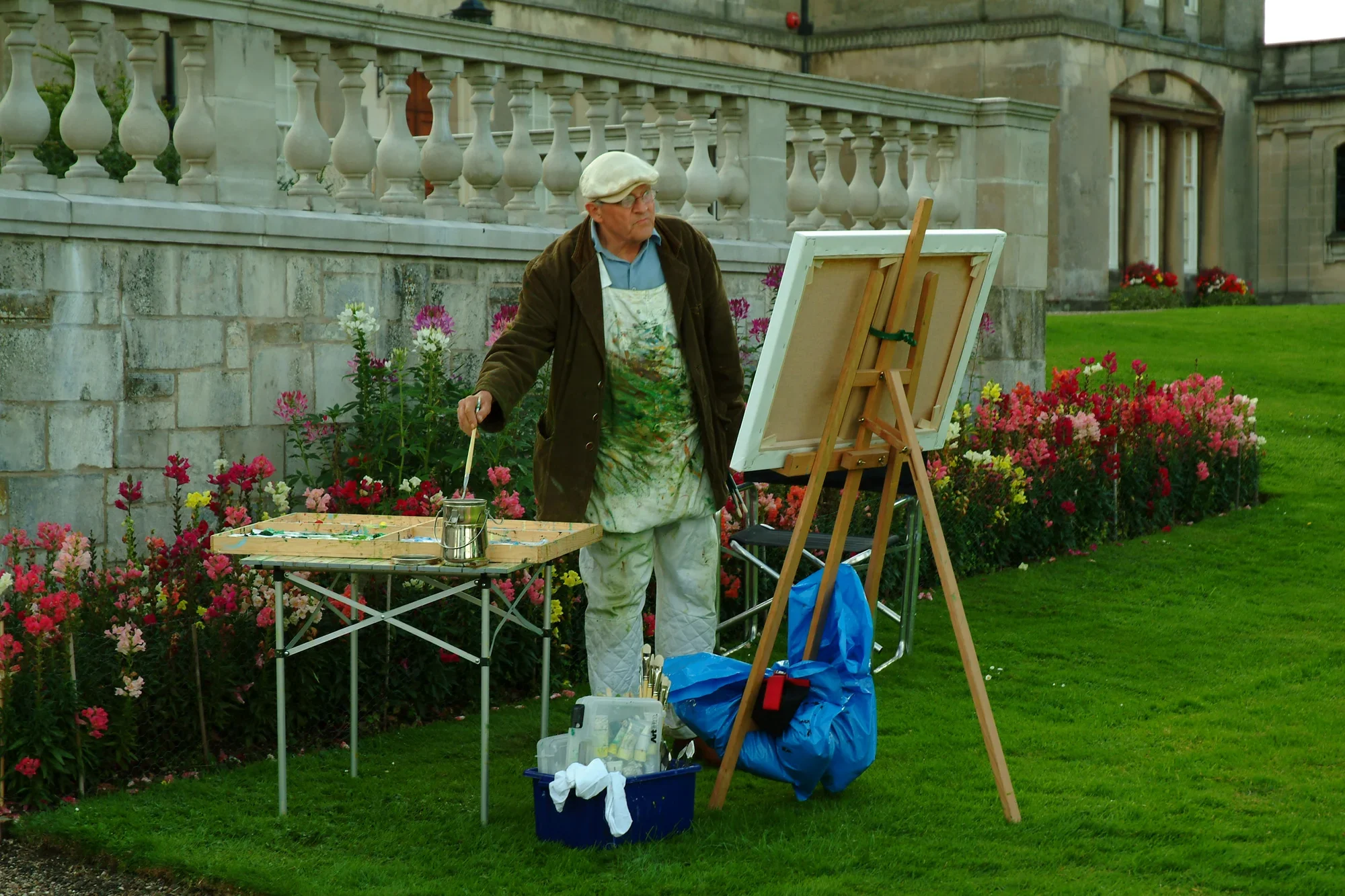
A register of Labor Density: David Hockney engaged in the slow, material act of observation, a physical lifetime of making that systematically resists compression into a headline market value.
The Work as Material Singularity
The temptation, in the days after a major artist dies, is to convert the oeuvre into a price. OAC's vocabulary exists precisely to resist that conversion. Hockney's paintings are not instruments; they are Material Singularity made visible — objects whose meaning is inseparable from their specific making.
Consider A Bigger Splash (1967): a flat California stillness disrupted by the one thing he could not photograph, the splash itself, painted slowly over two weeks to depict an event lasting a fraction of a second. Consider Portrait of an Artist (Pool with Two Figures) (1972), the double portraits Mr and Mrs Clark and Percy (1970–71) and My Parents (1977), the photographic “joiners” of the 1980s, the monumental Bigger Trees Near Warter (2007), and the 220-panel A Year in Normandie (2020–21).
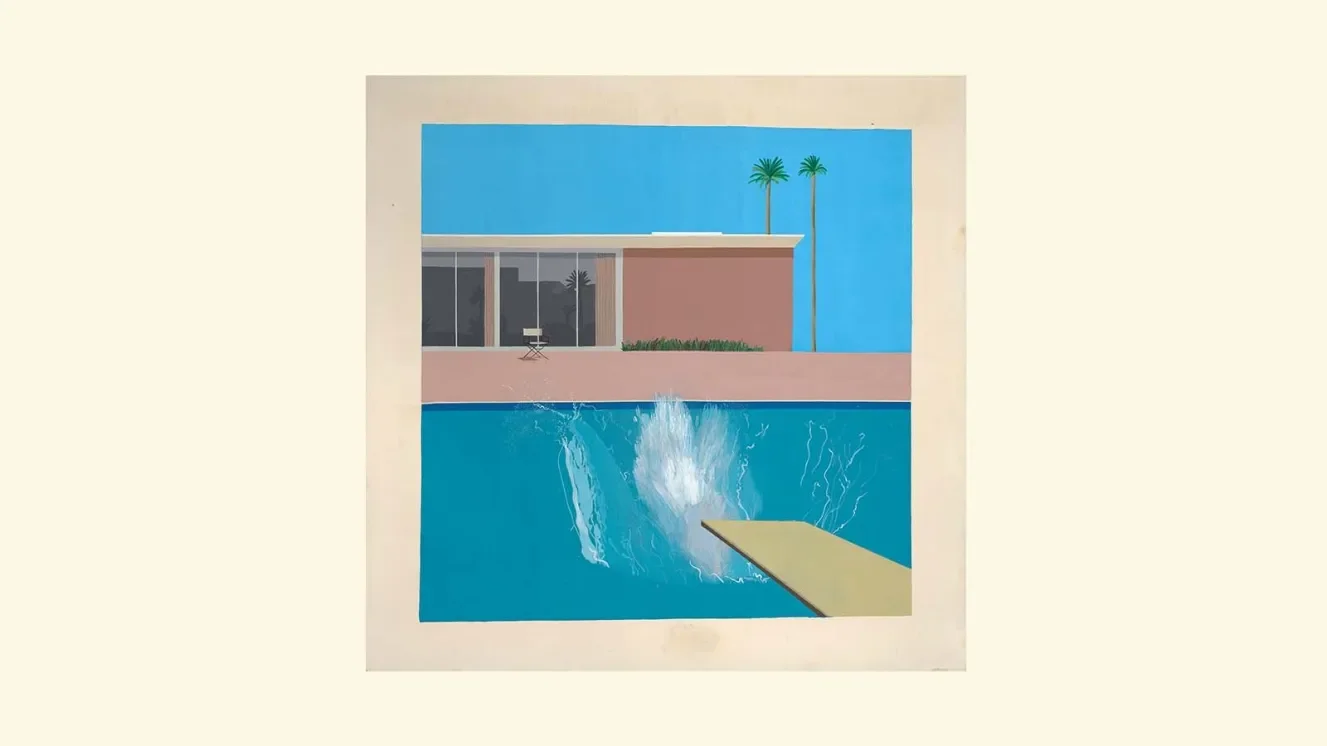
The painting as Material Singularity: David Hockney's 'A Bigger Splash' (1967)—an object whose structural meaning remains permanently bound to the slow, physical temporality of its making.
What unites them is not a style. It is Narrative Permanence: each object carries its own time of making and refuses to be detached from it. The market quotes his record as though the number were the meaning. OAC holds the opposite. The number is the Aura Transaction; the painting is the thing the transaction cannot touch.
The Exhibition He Authored
It is necessary to correct the record before it sets, because reverence requires accuracy. In the spring of 2025, the Fondation Louis Vuitton gave its entire building — eleven galleries, more than four hundred works spanning 1955 to 2025 — to David Hockney 25, the largest exhibition ever devoted to him. Hockney was personally involved in every aspect of it, sequencing the work with Gonçalves de Lima. “This exhibition means an enormous amount,” he said, “because it is the largest exhibition I've ever had.”
This is the fact the necrophage's reading must reckon with. A frame that treats the luxury institution's relationship to Hockney as a post-mortem consumption misreads the chronology and dishonors the artist's own authorship of his crowning retrospective. The Custodial Mandate was met in this instance while he was alive — he was the custodian, and he was heard.
“A retrospective an artist builds with his own hands, in his own lifetime, is not consumption. It is authorship. The necrophagy begins only after the breath stops.”
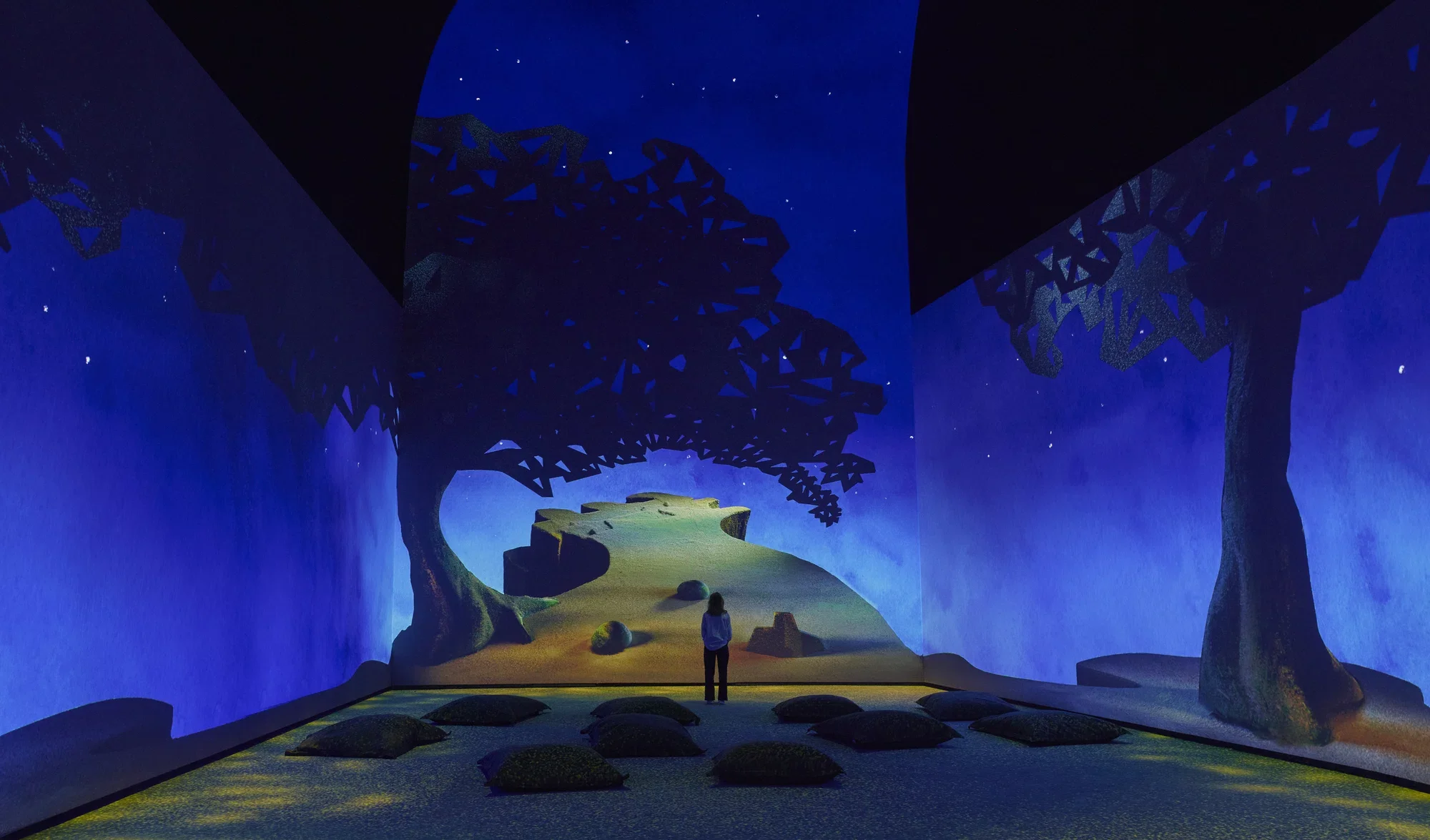
The architecture of authorship: The monumental 2025 Fondation Louis Vuitton retrospective, fully conceptualized and scaled by Hockney himself while alive, establishing the true timeline of his custodial mandate.
OAC's critique is therefore narrowed to its proper target. The object of analysis is not the exhibition Hockney built. It is the machinery that activates in the hours after the breath stops — and that machinery deserves to be named precisely, not smeared across a life's worth of legitimate celebration.
The Ledger, Read Honestly
A study that means to defend the work must read the market's own numbers, because the numbers do not say what the headlines say. The auction record, across 1966–2026, runs to 10,588 lots sold against 2,061 unsold — a sell-through rate of 83.7 percent and a cumulative hammer total near $1.44 billion. The highest single result is the one every obituary repeats: Portrait of an Artist, $90,312,500 at Christie's in 2018.
It is not even the measure of the market. The average Hockney lot sells for $135,993. The median sells for $10,108. A median near ten thousand against a mean near a hundred and thirty-six thousand means the public “Hockney market” is a story told almost wholly by its tail — four or five canvases dragging the average skyward while the body of the work, the thousands of prints that actually change hands, trades for the price of a used car.
“The average Hockney lot sells for $136,000. The median sells for ten. The distance between those two numbers is the only obituary the market will ever write — and it is a lie of averages.”
This is Speculative Velocity rendered as arithmetic. The velocity attaches not to the oeuvre but to a handful of objects, and the danger OAC names is the substitution: the ninety-million-dollar figure stands in for the work until the public inherits the number and forgets the seeing. That substitution is the Hollowing — not of the painting, which survives intact, but of the public language around it.
The record vindicates the thesis of singularity almost cleanly. By volume, prints and editions are the overwhelming majority of his catalogued output — more than twelve thousand of an estimated sixteen-and-a-half thousand known works — and roughly three-quarters of all lots sold. But by value, paintings, barely four percent of lots, command close to seventy-six percent of the money. The market prices the singular hand-made object far above the multiple, confirming in dollars what OAC holds as principle — and what Christie's billion-dollar sales have confirmed before.
One further figure corrects the chronology a second time. His second-highest result — Christopher Isherwood and Don Bachardy, $44.3 million — was reached at Christie's in November 2025, seven months before he died, with the Fondation Louis Vuitton retrospective still fresh. The market was already at full velocity in his lifetime. His death did not create the value; it sealed the supply — the same exhaustion of speculation OAC tracked across the 2025 market.
The Screen That Would Not Go Thin
Hockney spent his last two decades doing something the framework should pause on: he took the thinnest instruments of the age — the iPhone, the iPad, the printed digital composite — and used them to make looking deeper, not faster. A Year in Normandie is a ninety-meter digital scroll built panel by panel through a pandemic; it asks for more attention than a wall of oil, not less.
This matters because the dominant cultural use of the same tools is the opposite — the generative flattening that strips labor and produces a frictionless image at infinite speed. Hockney's digital work is the counter-proof: the most advanced infrastructure of the age, deployed to re-humanize the object rather than to hollow it. He proved, late, that the screen is only as thin as the looking behind it.
“He took the thinnest instrument of the age and made it carry more looking than the thickest. That is the whole refusal, in a single gesture.”
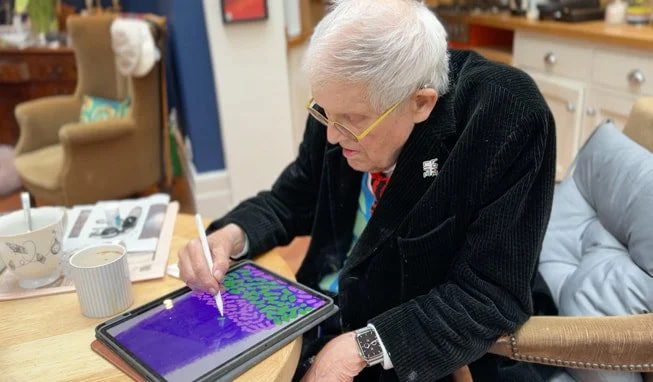
Re-humanizing the tool: David Hockney utilizing the modern digital screen not as an engine of unmediated speed, but as a deliberate canvas for deep, prolonged observation.
The Custody That Holds
If the market cannot hold the work, who does? The answer is the genuine Custodian's Contract in practice. The paintings are held by Tate, the Centre Pompidou, the Museum of Modern Art, the Los Angeles County Museum of Art, and his own David Hockney Foundation — institutional bearers of the Custodial Mandate the secondary market can neither hold nor honour.
This is the structural distinction OAC has drawn from Rothko's custodial strategy to the archival death mandate: custody is a relationship of obligation to the object over time; the market is a relationship of extraction from the object in the instant. The Provenance Chain Fracture the velocity threatens is repaired not by price but by stewardship — by the institutions that will still be showing A Bigger Splash when this week's hammer totals are forgotten.
What Hockney Defended, and What OAC Inherits
Hockney spent his last decades arguing, in paint and in print, for the act of looking. He insisted the eye was not a camera, that perspective was a choice, that the world was larger and slower and more worth attending to than the instruments built to capture it. His signature phrase, repeated throughout the late work, was simply "Love Life."
This is, in OAC's terms, a complete theory of the Hollowed Object's opposite. Where the hollowed object is stripped of its covenant and made to carry only capital, the Hockney object carries only attention — it is dense where the speculative instrument is empty. He was, for seventy years, a working argument against abstraction-into-price, made by a man who happened also to command the highest prices of any living painter. He held both and was confused by neither. OAC inherits the argument, not the estate.
The Tribute, Properly Composed
A tribute that flatters is a small thing. A tribute that defends is larger. OAC's offering, on the occasion of his death, is a refusal — a refusal to let the velocity have the final framing, the same refusal it brought to the necrophagy of the athlete persona and to every Aura Transaction it has named.
He made the splash slowly. He drew the trees through a plague. He took an iPad into his ninth decade and made it monumental. He authored his own largest exhibition and called it good. And then, a month short of eighty-nine, he stopped — peacefully, at home, among the work. The market will do what the market does. The paintings will not be noticed.
Coda
“The dead artist is the market’s favorite kind, because he cannot make anything new. We will write him instead as a question that never closes.”
The dead artist is the market's favourite kind, because the supply is sealed and the velocity is pure. What the Hockney event confirms about PLCFA is that the Hollowed Object is a fact of language, never of paint: the work survives every transaction performed upon it. What it leaves unresolved is the harder custodial question — whether an archive of attention can out-compound an archive of price over the long horizon. OAC's wager, study by study, is that it can. Look again. Look longer. Love life. That question does not close when the man does. It is, in the exact and unfashionable sense, permanent.
Authored by Christopher Banks, Anthropologist of Luxury, Critical Theorist & Founder Objects of Affection Collection Office of Critical Theory & Curatorial Strategy 469 Fashion Avenue, 12th Floor, New York, NY 10018
