Fernando Botero at Opera Gallery London: The Posthumous Bid
On volume, legacy, and the market that claims a maestro after his death...
Fernando Botero died in Monaco on September 15, 2023. He was ninety-one years old. Within months, the auction houses moved. Christie's New York set a new personal record for the artist. The secondary market for his work more than doubled in three years. And by the summer of 2026, two of the art world's largest institutions, Sotheby's in New York and Opera Gallery in London, had mounted simultaneous exhibitions celebrating the Colombian maestro's legacy. The posthumous market for Boterismo had arrived, fully formed and well-organized.
This study does not dispute the quality of Botero's achievement. His visual language is genuine, his formal commitment was total, and the best of his work earns serious critical attention. But the exhibition at Opera Gallery London, opening October 12, 2026, raises questions that celebrations of artistic legacy rarely ask: who benefits from the retrospective? What does the commercial gallery owe the artist whose works it sells? And what happens to the critical meaning of a body of work when the market for it accelerates precisely because no more of it will ever be made?
Boterismo as Material Singularity
The first thing to establish is that Boterismo is real. This matters because critics have sometimes dismissed Botero's voluminous forms as decorative, as a commercial formula, as a brand rather than a vision. The dismissal is wrong, and making it would be intellectually lazy.
Botero developed his distinctive visual language through sustained dialogue with the masters he studied as a young artist in Bogota and later in Madrid. At the Prado, he spent weeks before Velazquez and Goya. In Florence, he absorbed Piero della Francesca. In Mexico City, he encountered Diego Rivera's murals and recognized something: that the pre-Columbian and colonial traditions from which he came had never required the slenderizing conventions of European academic painting. Volume, in that tradition, was not excess. It was presence.
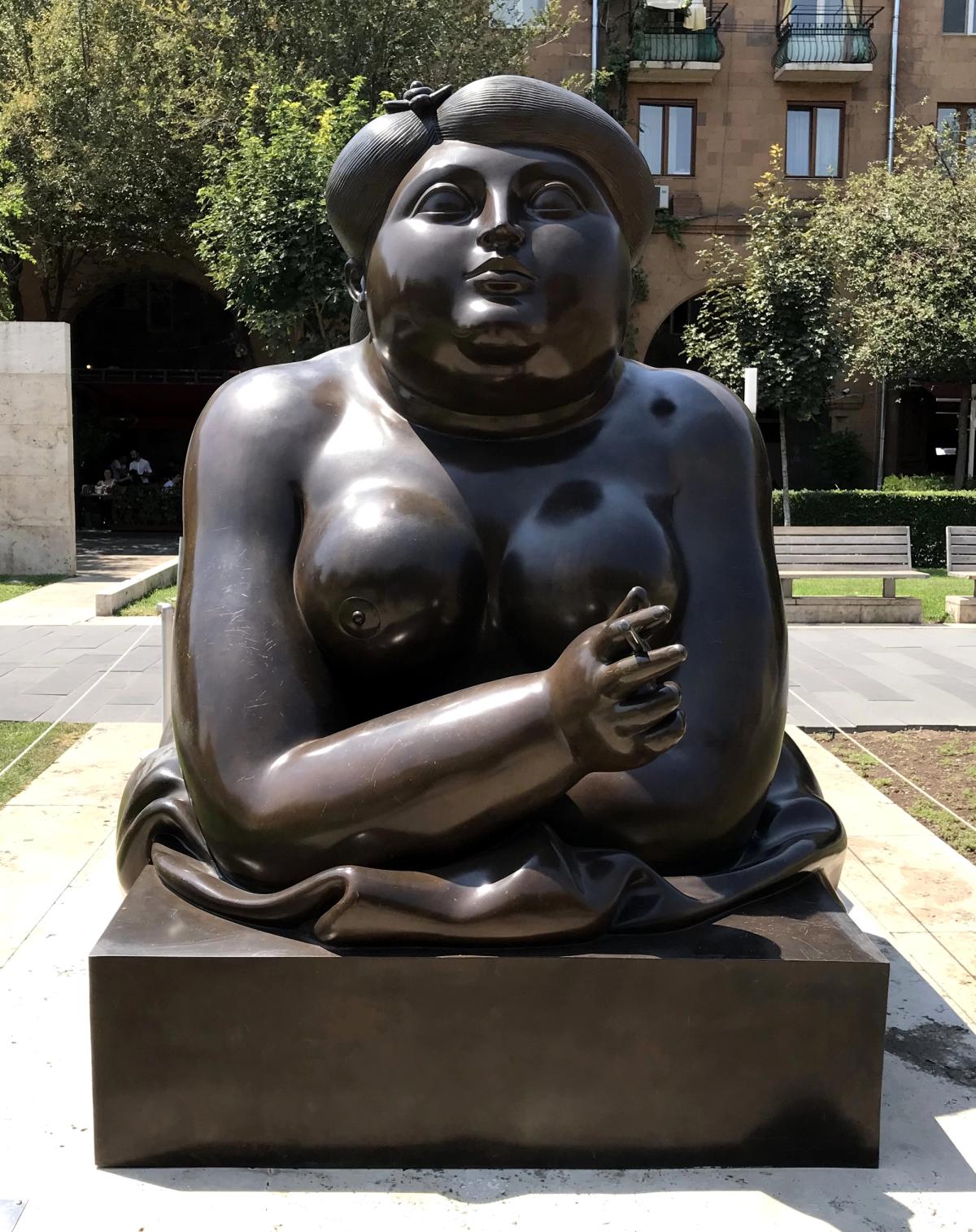
The resulting style is not stylization for its own sake. Boterismo is a formal argument about what the body means: its weight, its capacity for pleasure and suffering, its political visibility. Botero's rounded forms make his subjects impossible to ignore. A thin figure in painting can be elegant, distant, ghostly. A Botero figure occupies space insistently. It is always, unmistakably, there.
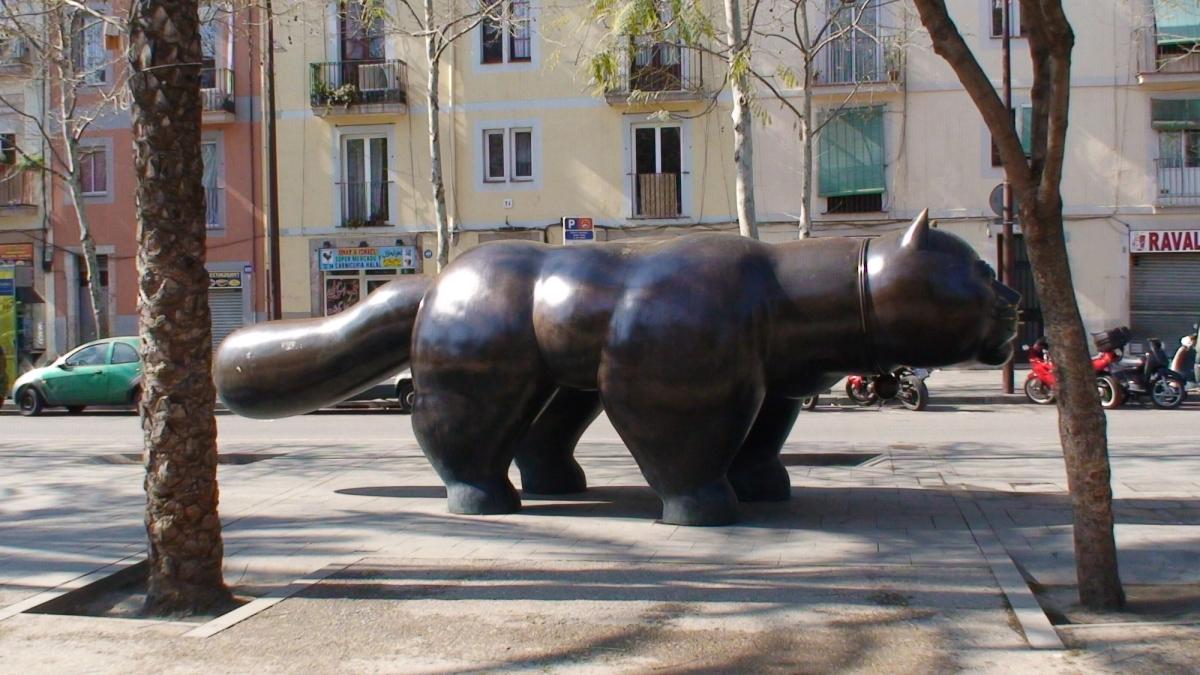
This formal insistence represents genuine Labor Density: decades of practice producing a coherent formal philosophy, not a trick repeated. The monumental bronzes he cast at Pietrasanta, weighing between 800 kilograms and four metric tons, required sustained physical and technical commitment. The sculpture does not emerge from a mold. It emerges from a process that Botero understood as deeply as any artist working in that medium in the second half of the twentieth century.
Boterismo is a formal argument about what the body means: its weight, its capacity for pleasure and suffering, its political visibility. This is not a brand. It is a language.
The Auction Architecture: Christie's, Sotheby's, and the Secondary Market
Against this genuine achievement, the secondary market has constructed an architecture that operates on different terms entirely. In 2023, the year of Botero's death, Christie's New York sold "The Musicians" (1979) for $5,132,000, setting a new personal record for the artist. In March 2024, his sculpture "Dancers" (2000) sold at Christie's for $3,920,000, exceeding its low estimate by 150 percent. In November 2024, Sotheby's sold a bronze "Horse" at its New York sale for $4,900,000. The pattern is consistent: two major houses competing, in real time, to establish price signals for an artist whose supply is now permanently fixed.
The broader market trajectory confirms the trend. Botero's total auction sales more than doubled from $9.7 million in 2020 to $21.2 million in 2023, the year of his death. This is not organic appreciation driven by new scholarly reappraisal. It is Speculative Velocity: the acceleration of market pricing around manufactured scarcity. The artist is gone. No new Boteros will be made. The auction houses understand this arithmetic, and they have begun to act on it.
The vehicle for this acceleration is the Aura Transaction: the institutional staging of Botero's reputation as a transferable asset. The retrospective exhibition, the curated selling show, the landmark auction lot, each of these is a mechanism for converting the artist's accumulated cultural authority into liquidity. The authority was Botero's. The liquidity belongs to whoever owns the work.
Fernando Botero at Opera Gallery London, October 2026
The exhibition at Opera Gallery London, running from October 12 to November 12, 2026, is the first major presentation of Botero's work in the British capital in over a decade. The gallery is located at 134 New Bond Street, Mayfair, which places it between auction houses and luxury flagships on the street that defines the upper end of the London art market. The show presents works spanning six decades, from the 1960s through the artist's final years.
Opera Gallery is a commercial gallery. This is not a criticism: commercial galleries are legitimate institutions, and they have played important roles in sustaining artists' careers. But the framing of a selling exhibition as a retrospective merits scrutiny. A museum retrospective is, at least in principle, organized around critical interpretation. A gallery retrospective is also organized around sales. These are not the same thing, and the difference matters more after an artist's death than before it, because the artist is no longer present to shape the frame.
The show arrives in the context of a coordinated institutional moment. Sotheby's New York mounted "Botero in New York" from July 22 to September 7, 2026, presenting 37 works from the artist's New York years (1960 to 1973) in partnership with the Fernando Botero Foundation. Opera Gallery follows in London two months later. The sequencing is not accidental. Together, the two exhibitions constitute the opening act of the posthumous market's most ambitious campaign: the revaluation of Boterismo as an investment-grade canon, timed to reach collectors on both sides of the Atlantic before the end-of-year auction season.
The Posthumous Acceleration: Three Years After the Maestro
The posthumous market is a well-documented phenomenon in the art world. After an artist's death, supply is permanently capped, estates assume control of licensing and authentication, and institutional curation creates urgency. Collectors who hesitated during the artist's lifetime, uncertain whether the work would hold, are reassured by the finality of the archive. The speculative calculus shifts: the question is no longer whether the artist will maintain quality and relevance, but whether the estate will manage the market well enough to sustain prices.
For Botero, the posthumous acceleration arrived quickly. Christie's set the record within months. Sotheby's mounted a major exhibition within three years. Opera Gallery follows. This speed reflects the scale of the Botero market and the clarity of his visual language: Boterismo is immediately legible, and legibility is commercially valuable. But it also raises questions about the Custodian's Contract: the obligation that institutions claiming stewardship of an artist's legacy actually honor that legacy's terms, rather than simply accelerating its financial conversion.
The question is not whether the exhibitions are legitimate. They are. The question is what they prioritize. Does the London show contextualize Botero within the Latin American artistic tradition from which he emerged? Does it present his Abu Ghraib series (2004 to 2005), more than fifty paintings and drawings responding to the torture photographs from Iraq, as the political intervention it was? Does it reckon with the full range of Boterismo, including its uncomfortable insistence on the body as a site of political meaning? Or does it present volume as an aesthetically pleasant commodity, safe for collectors who want a legible name and a recognizable form?
OAC has argued in prior studies that the estate, the foundation, and the commercial gallery occupy different positions in the Narrative Permanence of an artist's legacy. What Jean-Marc Bustamante built through his foundation was precisely this: an institutional structure designed to outlast the artist's body and protect the work's terms of meaning. The Botero Foundation's decision to partner with Sotheby's for a selling exhibition, rather than a museum retrospective, suggests a different orientation toward that task.
The "Picasso of Latin America": Institutional Necrophagy and the Colonial Frame
Botero has carried the label "the Picasso of Latin America" for decades. The comparison was intended as praise, and it has functioned as a market signal: a way of giving American and European collectors a reference point for an artist whose work might otherwise require them to engage with Latin American art history on its own terms. It is a short-hand, and like most short-hand, it erases more than it explains.
Picasso was Spanish. His formal innovations emerged from a European tradition, in dialogue with African masks that he encountered through the colonial structures that brought them to Paris. Botero was Colombian. His work emerged from a Latin American tradition: pre-Columbian sculpture, colonial portraiture, Mexican muralism, and the political realities of a country that spent much of Botero's lifetime in the grip of narco-violence, state brutality, and structural poverty. These are not the same tradition, and the comparison that positions one as the master and the other as the Latin American derivative is itself a colonial artifact.
The label performs a specific function in the market: it converts Botero's work into something familiar, something that fits existing collecting categories, something that can be evaluated by reference to an already-established price hierarchy. This is Institutional Necrophagy operating through nomenclature: the gallery systems that benefit most from Botero's market are the same ones that require his work to be legible within a Western European frame to reach their primary clientele.
The label "the Picasso of Latin America" converts Botero's work into something familiar enough to collect without the inconvenience of Latin American art history. This is market convenience dressed as tribute.
Botero himself was aware of this dynamic and resistant to it. He consistently spoke about his debt to Piero della Francesca, to the Sienese masters, to Velazquez, but also to the pre-Columbian traditions of his home country, to the Colombian popular imagination, to the carnival bodies of the coast and the mountain gravity of Medellin. The "Picasso" frame suppresses this plurality in favor of a single, monetizable comparator. The posthumous market has reason to perpetuate it, because it works. OAC has reason to refuse it, because accuracy matters more than convenience.
Park Avenue to the Champs-Elysees: Boterismo in the Public Sphere
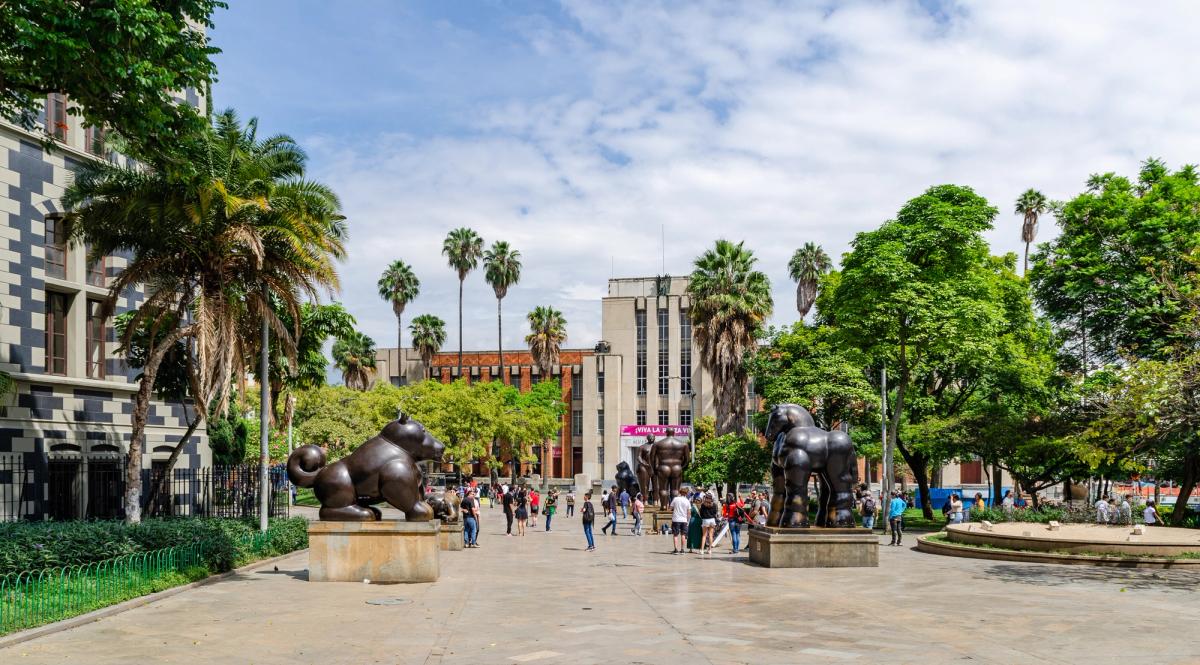
The most democratic aspect of Botero's practice is the one least discussed in the context of his market. In 1992, thirty-one of his monumental sculptures were installed along the Avenue des Champs-Elysees in Paris, from the Place de la Concorde to the Rond-Point, transforming the grand boulevard into an open-air exhibition. The bronzes weighed between 800 kilograms and four metric tons. They were, by any measure, impossible to ignore. In 1993, the Public Art Fund installed fourteen Botero sculptures along Park Avenue in New York, from 54th to 61st Streets. In 2000, he donated twenty-three sculptures to the city of Medellin, creating what is now Plaza Botero at the heart of the city's cultural district.
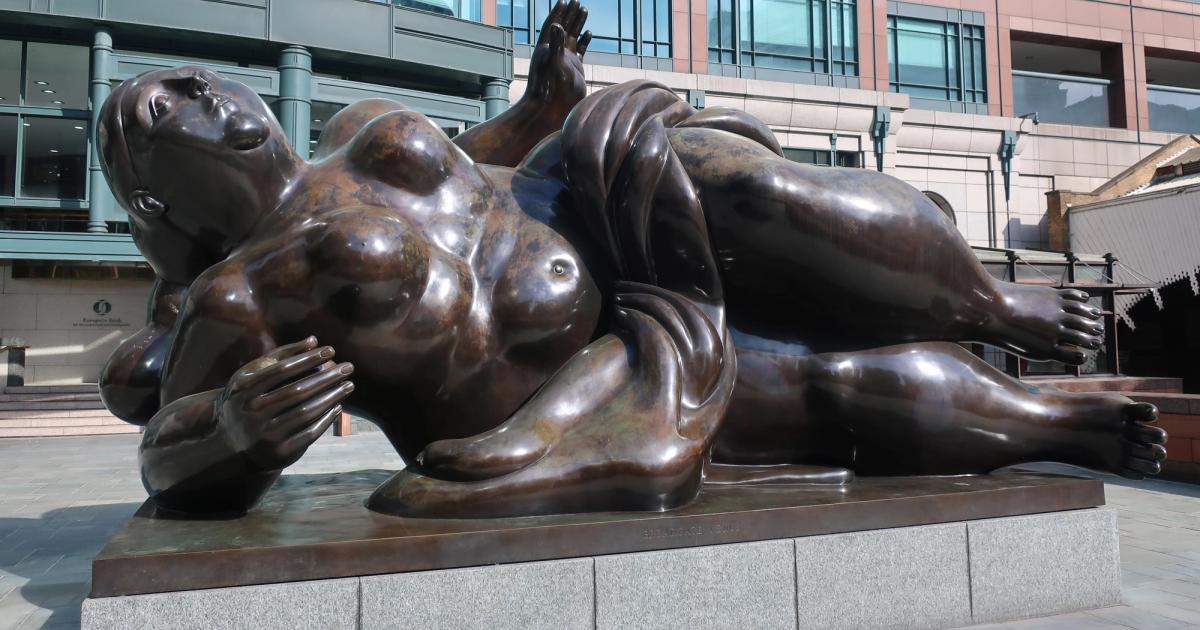
These are not the works that sell at Christie's for five million dollars. They are works that exist precisely because they cannot be sold: civic gifts, expressions of a relationship between the artist and the public that commercial galleries cannot replicate. The Broadgate Venus (1989), installed at Exchange Square in the City of London, has stood in that financial district for over three decades, free to anyone who walks past. It is the Botero that Londoners have always had access to. It is not the Botero that will be offered for sale in Mayfair this October.
The distinction matters because it illuminates the Zero-Sum Aura of the commercial retrospective. Every work that moves through the gallery to a private collection becomes less available to the public sphere that gave Boterismo its civic meaning. Botero understood this: he gave more works to cities than almost any artist of his generation. The posthumous market, by contrast, is organized entirely around the movement of works into private hands. These are not the same project.
The Custodian's Contract: What the Botero Foundation Must Decide
The Fernando Botero Foundation, established in Bogota to steward the artist's legacy, has partnered with Sotheby's for the "Botero in New York" selling exhibition. This is a meaningful institutional choice. Other foundations have taken different paths: the Rothko Chapel in Houston maintains strict licensing controls to protect the site's non-commercial character; the Jean-Marc Bustamante Foundation has oriented itself around archival protection rather than market acceleration, as OAC examined in Study 167. The Sundaram Tagore Gallery has built an explicit Anti-Sale Covenant into its institutional identity, as Study 165 documented.
These are not the only options available to an estate. But they represent a coherent position: that the commercial value of an artist's work is not the same as the cultural value, and that an institution that treats them as identical has confused its mandate. The Botero Foundation's partnership with Sotheby's for a selling exhibition suggests that the Foundation has made a different calculus: that market visibility serves the artist's legacy by keeping Boterismo present in the international art conversation.
This is a defensible position. It is not the only defensible position. And OAC notes that the terms of the Custodian's Contract apply to foundations as much as to private collectors. The question is not whether the Foundation should work with commercial institutions. The question is whether the frame that those commercial institutions apply to Botero's work is one that he would have recognized as accurate, or one that reduces Boterismo to a commodity legible enough to move in the current market.
The question is also structural. What provenance does not record is precisely the sequence of decisions that transforms a practice into a canon, and a canon into a market category. The Botero Foundation's decisions in the three years since the artist's death will shape the context in which his work is read for decades. This is not a small responsibility.
After the Record: Volume in the Speculative Archive
Auction records are not neutral data points. They are price signals, designed to function as market guidance: when Christie's achieves $5,132,000 for "The Musicians" and publicizes the result widely, it is telling the market what the floor for a major Botero has become. The Speculative Velocity this generates is not incidental to the auction. It is the auction's primary product, as OAC explored in the context of the price record as institutional instrument.
The risk for Boterismo is the risk that confronts any formally distinctive practice when it becomes too legible to the market: that the form becomes a Hollowed Object. The voluminous figure is immediately recognizable. It sells. It reproduces well in auction catalogues and gallery brochures. These are virtues from a commercial standpoint, and they were also genuine formal achievements on Botero's part. But the commercial legibility of the form can, over time, detach it from the argument it was making: about the body, about political visibility, about the Latin American presence in the world's cultural imagination.
When a Botero bronze is presented primarily as a five-million-dollar asset, the question of what it means, which Botero spent a lifetime answering in paint and in bronze across six decades of sustained practice, recedes behind the question of what it costs. This is not an accusation against any particular institution. It is a structural observation about how the speculative archive operates. The Semantic Burden of Boterismo is now being carried by a market that has different interests than the one Botero was addressing when he made the work.
When a Botero bronze is presented primarily as a five-million-dollar asset, the question of what it means recedes behind the question of what it costs. The form survives. The argument requires more deliberate protection.
Coda
Fernando Botero built one of the most recognizable visual languages of the twentieth century, from a Latin American tradition that the international art market spent most of his career treating as peripheral. He gave major works to cities. He made paintings about Abu Ghraib when most artists of his stature were producing work safe enough for corporate lobbies. He earned his canonical status through a practice that was genuinely committed, technically rigorous, and politically aware in ways that his market reception has consistently underemphasized.
The exhibition at Opera Gallery London this October will be, in all likelihood, visually generous and commercially effective. It will introduce new collectors to Boterismo and remind existing ones of the breadth of the artist's achievement. These are not nothing. But OAC's obligation is to ask what frame the exhibition places on the work, and whether that frame is adequate to the argument Botero spent his life making.
Volume, in Botero's practice, was never decoration. It was insistence: the formal claim that certain bodies, certain subjects, certain lives have weight in the world and will not be slenderized into invisibility. The posthumous market agrees that the work has weight. It is less clear that it agrees about what that weight means. The Custodian's Contract demands more than agreement on price.