Mary Heilmann: Abstract Painting and the Post-Mortem Market
On wobbly lines, labor-dense surfaces, and the machinery that moves in at midnight…
The Geometry That Never Straightened Out
Mary Heilmann painted the wrong way. She knew it, and she kept doing it. The lines wandered. The edges weren’t flush. The shapes bumped into each other with the easy awkwardness of furniture arranged for conversation rather than display. From her earliest canvases in Lower Manhattan in the early 1970s through her final major exhibition at the Whitney Museum of American Art, which ran until January 2026 just months before her death on August 14, 2026, Heilmann refused the correction that abstraction was supposed to impose.
This was not naivety. It was a structural argument. Heilmann had trained as a ceramicist, earning her Master of Arts in Ceramics and Sculpture from UC Berkeley in 1965, and she brought to painting the ceramicist’s understanding that form lives in the making of it, not in the ideal of it. Surfaces that read as imperfect are surfaces that record their own production. In the framework’s terms, this is Material Singularity: the irreducible presence of the object as a trace of a specific human act, resistant to simulation and therefore resistant to the kind of casual substitution the market prefers.
Now that she is dead, the market will test that resistance. Her estate, her gallery relationships with Hauser & Wirth and 303 Gallery, and the institutional commitments she built across five decades are about to face the most concentrated form of speculative pressure that the contemporary art market applies: the post-mortem correction. The instrument for that pressure is already assembled. The obituaries are its first movement.
From Clay to Canvas: The Ceramicist’s Grammar
Heilmann’s graduate training at UC Berkeley placed her at the center of California’s ceramics revolution in the early 1960s. The Berkeley ceramics program, shaped by the radical tactility of Peter Voulkos’s approach, understood the clay body not as a vehicle for decoration but as a medium that bore the full weight of the maker’s engagement. Voulkos treated the kiln as a partner in an improvisational dialogue, pushing ceramics toward an expressiveness that painting had claimed as its exclusive domain. What he discovered, and what his students absorbed, was that the gesture of making is as present in the finished object as the object itself.
Heilmann absorbed that premise and transferred it. When she arrived in New York in the late 1960s and began painting in the early 1970s, she was not entering painting’s discourse from within; she was bringing ceramics’ relationship to material into a medium that had largely forgotten it. The result was work that critics initially struggled to accommodate. Early notices described her canvases as lacking “real muscle,” which was a way of registering that the work did not perform strength the way painting was then expected to. What it did instead was register presence: the drag of a loaded brush, the deliberate incompletion at a corner, the color choices that arrived through the same intuitive process as pottery built by hand.
The Labor Density of Heilmann’s canvases is high, not in the sense of accumulated hours but in the sense that each mark is legible as a decision. The surface holds no empty passages. A Heilmann painting is as dense with intention as a handmade hem executed by a skilled workshop: you can see the craft thinking through the object, the moment where one choice foreclosed another and the maker held the less expected one.
Through the 1970s, Heilmann built the formal vocabulary that would define her practice for the next fifty years. She incorporated references drawn from surf culture, from her childhood moving between San Francisco and Los Angeles, where the Pacific’s color registered in the body before it registered as information. From jazz. From television: an acknowledged debt to the color palette of “The Simpsons” was not ironic distance but material, folded into canvases that were as formally rigorous as anything Josef Albers ever ruled but which wore that rigor lightly, the way a skilled potter holds the weight of a vessel without showing the strain. The abstraction this produced was democratic in its sources and demanding in its executions. The wobbly line was never a lazy line.
“To Be Someone”: Late Recognition and the Newport-New York Circuit
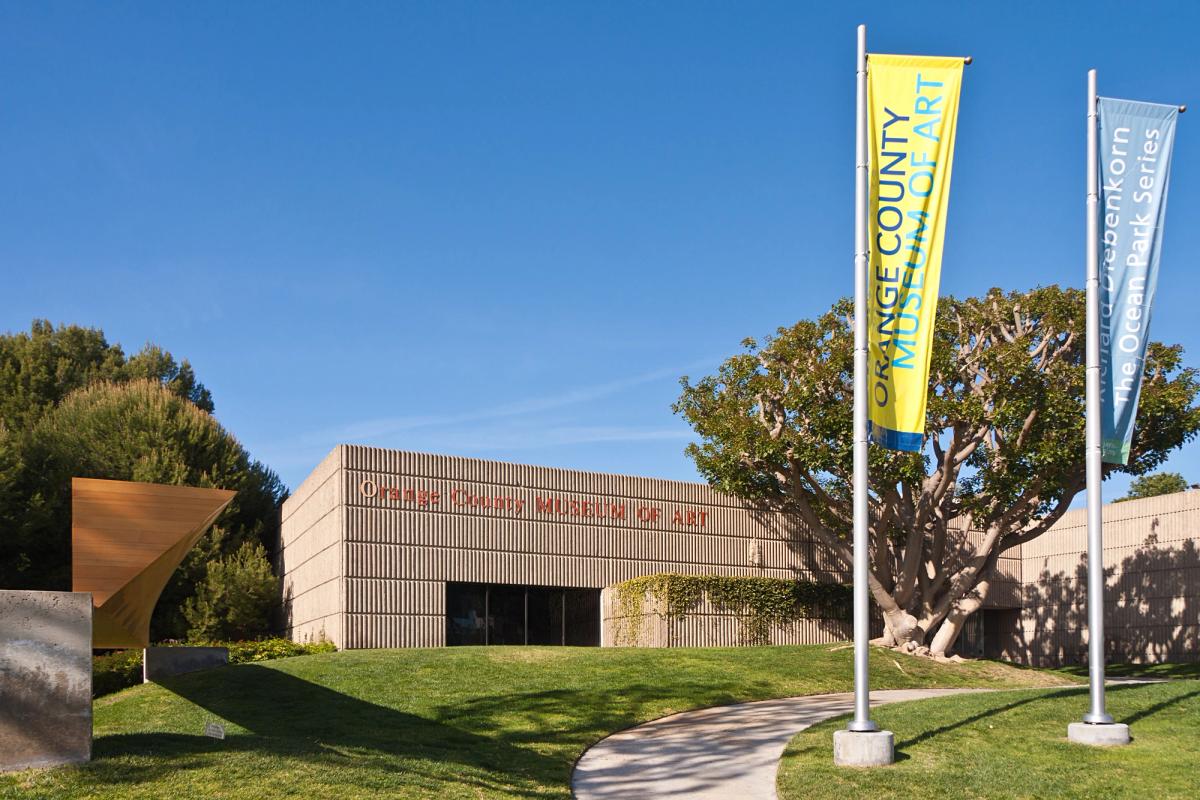
Heilmann was sixty-seven when her first major museum retrospective opened in 2007 at the Orange County Museum of Art in Newport Beach, California. “To Be Someone” traveled from OCMA to the New Museum of Contemporary Art in New York in 2008-09, where it introduced her practice to a generation of younger painters who had been working in her formal territory without always knowing the source. The show was well-received, the catalogue essays were substantial, and the retrospective function was genuine: it organized a long practice into legible form for an audience that had largely missed its formation.
This lateness was not incidental. The art world’s infrastructure for recognizing painters who worked outside the dominant institutional conversations was, and remains, slow. Heilmann had sustained her practice for thirty-five years before the retrospective arrived. The work was fully formed by the time OCMA showed it; the institution had caught up to a career that had not waited for it. Her first Whitney Annual inclusion had been in 1972, with a work titled “The Closet.” The Whitney noticed her before the market did, but institutional follow-through took decades.
There is a Semantic Burden to late recognition. It frames an artist’s career as one that required the institutional seal before it could be understood, which retroactively subordinates the work’s independent existence to the validation event. The critical writing around “To Be Someone” was often excellent. But the frame of discovery placed Heilmann in a narrative of triumph-over-neglect that was more satisfying than accurate. The work had not changed. The infrastructure had moved, and the distinction matters when the same infrastructure moves again, this time in response to her death rather than her career.
Recognition delayed is not only a career condition; it is a market condition. A body of work that receives its first major institutional survey in the artist’s sixty-seventh year is a body of work whose primary-market pricing has been suppressed relative to its eventual secondary-market valuation. The gap between what Heilmann’s canvases sold for before “To Be Someone” and what they will sell for in the years following her death is one measure of the speculative accumulation the retrospective set in motion.
The Whitney Installations and the Custodian’s Contract
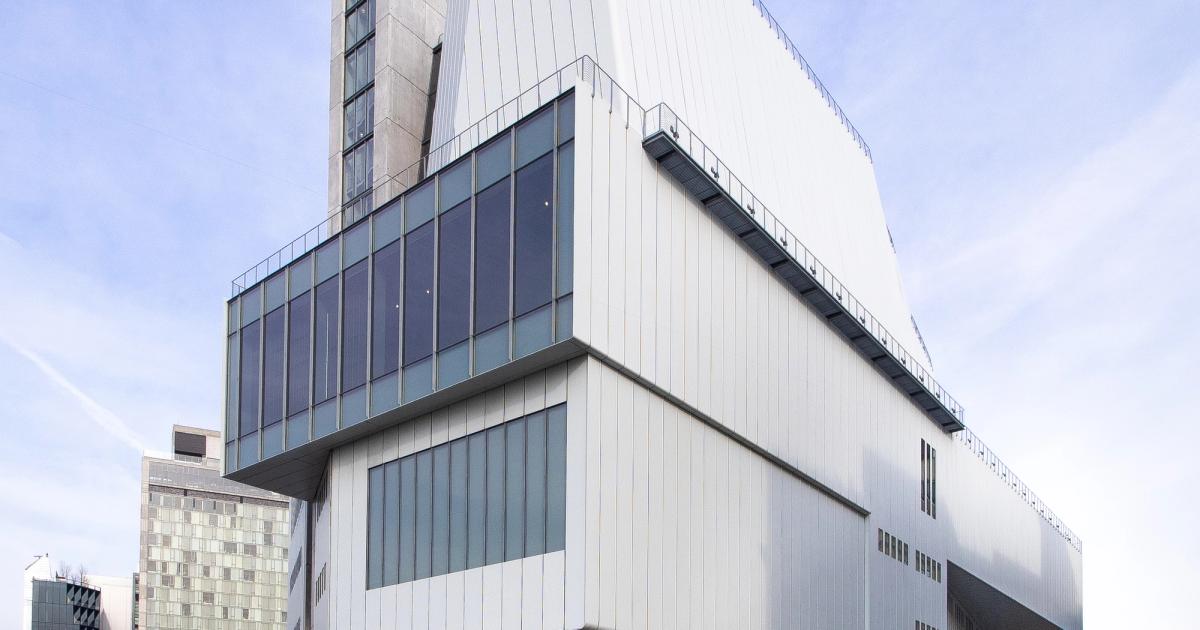
Heilmann’s relationship with the Whitney Museum deepened substantially in 2015, when the museum opened its new building at 99 Gansevoort Street in the Meatpacking District and invited her to inaugurate the fifth-floor outdoor terrace as an exhibition space. The resulting installation, “Sunset,” placed a large-scale reproduction of one of her canvases on the terrace wall and introduced her signature Monochrome Chairs as functional sculpture. Visitors could sit in them. The terrace became, exactly as Heilmann had always intended for her furniture, a place to be in a room with painting rather than a spectator of it. The museum’s largest outdoor gallery opened as a place to rest.
Ten years later, “Long Line” returned her to the same institution. Running from April 2025 through January 2026, the exhibition built a site-specific environment around her 2020 canvas of the same name, surrounding it again with chairs, creating the same inhabited quality. The exhibition was organized by Associate Curator Laura Phipps and was understood, in the months after its close, as a capstone. She died in August, seven months after it ended.
This is the logic of the Custodian’s Contract. The contract is not signed between an artist and a museum; it is enacted through repeated, intentional contact: the institution returning to the work, the work returning to the institution, the relationship demonstrating that one serious party is committed to the other’s preservation. Heilmann’s two Whitney terrace installations, a decade apart, are a case study in what the honored contract looks like in practice.
The institutional relationship at Dia:Beacon, where Heilmann’s “Starry Night” installation has been part of the permanent program since 2022, extends the same logic further. Dia’s model is duration: works are not rotated on seasonal calendars but installed for years at a time, and the relationship between a work and a specific institutional site becomes part of the work’s meaning. For an object whose owner has died, this kind of institutional embedding is as close to a material legacy provision as the non-legal world offers.
Speculative Velocity Moves In: The Post-Mortem Market
The market doesn’t grieve. It repositions.
Mary Heilmann’s auction record stands at $945,000, realized for “The Passenger” at Christie’s New York in 2022. That number matters less than what surrounds it: a documented trajectory of increasing institutional validation, permanent collection placements in more than thirty major museums including the Museum of Modern Art, the Whitney, and the Guggenheim, and a final Whitney exhibition that functioned, in retrospect, as a farewell retrospective. These are the structural conditions that precede a market correction.
Post-mortem price effects in contemporary art are well-studied precisely because they are so reliable. A career that combined late institutional recognition with genuine art-historical influence, represented by two galleries of significant market reach, with documented museum presence and a limited supply of works from a prolific but now finite production, is structurally primed for rapid secondary-market revaluation. The same dynamic was legible in the Ferrari Chassis 0 result this institution analyzed in early 2026: a market event in which scarcity perception was suddenly and permanently recalibrated, and in which the auction result told you something true about the market’s response while telling you relatively little about the object itself.
The mechanism is not sentiment. It is scarcity perception: death forecloses new production. Every existing canvas becomes simultaneously rarer and more final.
This is what the framework terms Speculative Velocity: the acceleration of an object’s value through the market’s response to a biographical event, detached from the material qualities that created the object’s worth in the first place. The wobbly line did not become more wobbly on August 14. The labor density of the surface did not change. The structural resistance of Heilmann’s practice to easy assimilation did not soften. But the scarcity calculus shifted overnight, and with it the attention of everyone whose interest in the work begins and ends with what it will bring at auction.
Institutional Necrophagy and the Obituary as Market Signal
There is a specific mechanism by which an artist’s death becomes legible in the information environment. The New York Times published its obituary. ArtNews published its own. The Art Newspaper ran a critical assessment. Hauser & Wirth issued a statement. 303 Gallery issued a statement. Her studio announced on Instagram. Social media activated. Each of these is a legitimate informational act. Together they produce something else: a synchronized signal that converts a life event into a market event.
The obituaries, the gallery statements, the art-press assessments arrive together and create an information environment in which the fact of Heilmann’s death is simultaneously a cultural note, an institutional marker, and an auction-house trigger. Any specialist in contemporary art who reads the Times obituary is reading it for its cultural content and its market content at the same time, because the two cannot be separated in the system that produces both.
This is Institutional Necrophagy: the consumption of an artist’s accumulated cultural capital by the institutions that feed on the event of their death. The process is not malicious. The obituaries are well-intentioned; some are excellent critical assessments of a significant career. But the system that produces them operates on the logic of the spectacle: the event of death is processed into consumable imagery, into the scroll that aggregates mourning and market signal in a single motion. The obituary is not separate from the market event. It is the market event’s first form.
The Zero-Sum Aura operates here too. Attention is finite. The attention that the obituary cycle generates for Heilmann’s work does not expand the total available attention in the cultural system; it redirects existing attention toward a newly scarce asset. The mourning note and the investment note are composed on the same page. The reader who cannot separate them is not failing to read correctly: the system has designed them to be inseparable.
Against the Hollowed Object
The risk in every post-mortem market correction is what this institution calls the Hollowed Object: the canvas that the market has claimed so thoroughly that its material specificity is no longer the point. The Hollowed Object is traded on provenance, auction trajectory, and position in the artist’s retrospective narrative rather than on the basis of what it does in a room. It is the painting that has become a financial instrument wearing the skin of a painting.
Heilmann’s work has a specific defense against this, and the defense is not the formal defense of difficulty. The canvases are not difficult in the way that challenges casual attention; they meet the eye with warmth and color and the pleasure of imperfect geometry. The defense is structural: the chairs.
Heilmann’s furniture, what she called her “home arts,” is functional. You sit in it. The chairs exist in the same artistic register as the paintings but cannot be traded the same way. A chair under auction-house lighting, not being sat in, is a chair that has already lost its argument. The decision to make functional objects alongside paintings was, structurally, an anti-speculative decision: it kept the domestic register of her practice present even as the market tried to elevate the paintings into pure financial instruments. The chairs insist on use. The market cannot easily accommodate insistence on use.
This resistance is not absolute. The chairs can be sold. The paintings’ value can be extracted from their materiality. But the coherence of Heilmann’s practice, across ceramics and painting and furniture, across five decades in the same register and the same domestic scale, gives the Narrative Permanence of her work its best argument: that what she was doing had an internal logic that the market cannot fully absorb because it cannot fully replicate. You can sell a Heilmann painting. You cannot manufacture another Heilmann. The Dia:Beacon installation, the Whitney terrace works: these are pieces that exist in relation to specific architectural spaces and specific institutional commitments, and they cannot be moved to Christie’s. The best parts of Heilmann’s practice are, by design, non-auctionable.
What the Estate Inherits
The estate of an artist is, in post-luxury analysis, the first test of whether the Custodian’s Contract holds without the artist to enforce it. Hauser & Wirth and 303 Gallery will, in the normal course of events, continue to represent the estate. Both galleries are sophisticated enough to manage the post-mortem transition, and both have handled comparable situations before. The structural question is not whether they will manage the market competently. It is whether the management of the market can preserve what the work actually is.
The Aura Transaction at the estate level works as follows: every time a canvas passes from private collection to auction block and back, a portion of its accumulated meaning is converted into market signal. Some of that signal reflects real information about the work’s quality; the market is not always wrong about what matters. But some of it reflects only the trajectory of the auction record, which tells you nothing about the wobbly line or the labor density of the surface that produced it.
The critical provision, which Heilmann’s career suggests she understood intuitively, is that an artist’s anti-speculative stance must be built into the work itself if it is to survive the artist. Conceptual art can leave instructions; painting generally cannot. But Heilmann’s furniture, her installation relationships with institutions like the Whitney and Dia, her preference for the inhabited over the merely observed: these constitute a set of stakes in the ground that the market would have to actively work to uproot. The One Original Principle for estates is this: preserve the conditions under which the work makes its argument. In Heilmann’s case, that means preserving the chairs alongside the paintings, honoring the installation relationships, and resisting the reduction of her fifty-year practice to its auction record. The institution has examined how reinvention hollows an archetype; the post-mortem market’s version of that operation is not reinvention but extraction, and the structural defense is the same in both cases.
Coda
Mary Heilmann died at 86 in Riverhead, New York, in the summer following the close of her final Whitney exhibition. She had been painting in approximately the same register for more than fifty years: without correction, without straightening the lines, without conceding that abstraction required the authority of perfection rather than the authority of presence.
The market that now moves on her estate will try to name that authority in financial terms. The obituary machine has already done its first work. The auction houses are paying attention. This is the system operating as designed, and the institution’s role is not to mourn it but to document it: to name the mechanism, to hold the specific gravity of what Heilmann actually made, and to resist the translation of fifty years of wobbly, deliberate, material thinking into a number at Christie’s.
She was, in the end, an underdog who kept the argument going long enough that the argument became the point. The canvases hold that. Whether the institutions holding the canvases hold it too is now the question that matters.