What Happens to an Object When Its Owner Dies
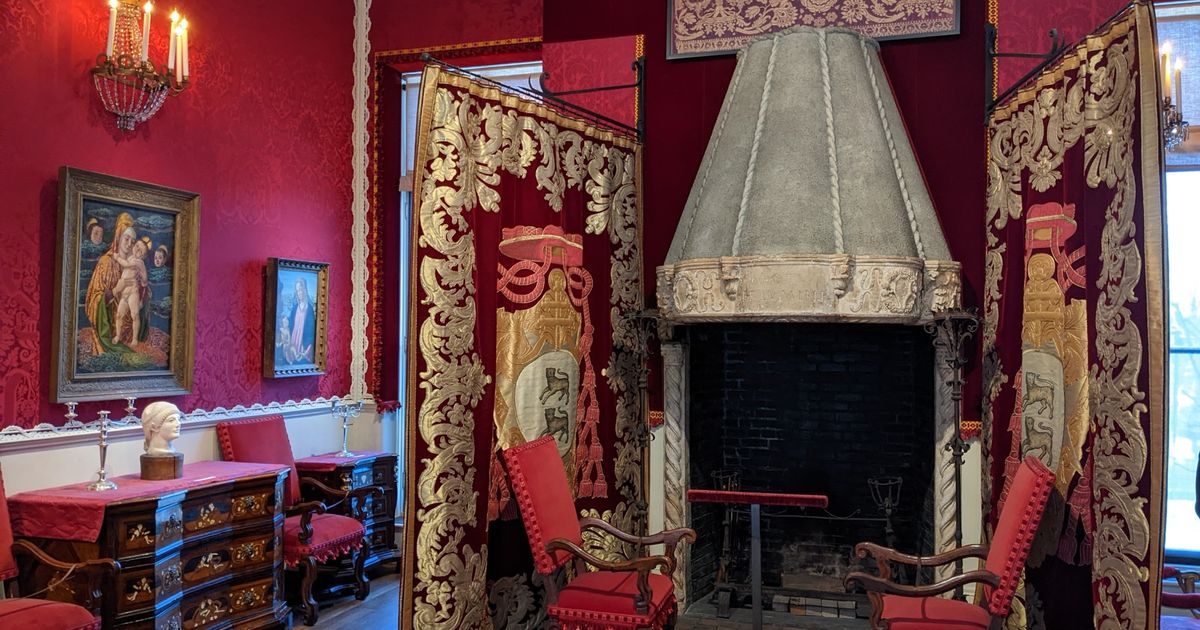
On instructions written to outlive their author, and on why one of them held
In the Dutch Room of the Isabella Stewart Gardner Museum in Boston there are empty frames on the wall. The paintings that were in them were stolen in March 1990 and have never been recovered. The frames were not taken down, not filled, not replaced with labels. They hang where they hung, holding nothing.
That is usually told as a story about a theft. It is better understood as a story about a document. Isabella Stewart Gardner died in 1924 leaving a will that required the arrangement of her collection to remain unchanged, and the museum's reading of that instrument is why the frames are still on the wall thirty six years after the works left them. A dead woman's sentence is the reason an absence is on display.
Roughly ninety miles away, Albert C. Barnes wrote an instrument of the same kind, with the same intent, and it did not hold.
This institution has an interest in this that is not academic. The Custodian's Contract, the instrument by which OAC binds obligations to an object rather than to a transaction, contains no succession clause. It says what a custodian owes while the custodian is alive. It says nothing about what happens when they are not, which makes Object Permanence a property the instrument asserts and does not yet secure. This study is about how that gap has been handled by people who had to handle it, and what it would take to close.
Two collectors who tried to write the future
Gardner and Barnes are the two standing American experiments in controlling a collection after death, and they are usually treated as a matched pair because they are.
Gardner assembled her collection, built a Venetian style palace to hold it, arranged it herself, and died in 1924. Her will endowed the museum and required that the galleries remain as she left them: nothing added, nothing sold, nothing moved.
Barnes assembled a collection of post impressionist and early modern painting at a scale that is still difficult to comprehend, installed it in Merion, Pennsylvania according to his own hanging principles, wrote an indenture of trust specifying that the works remain exactly where he had put them, and died in 1951.
Both men and women of this kind are usually described as controlling, and the description is accurate and useless. What matters is the mechanism each chose, because the mechanisms differed and the outcomes differed with them.

The Barnes indenture, and what a court can do to one
The Barnes Foundation collection is no longer in Merion. It is in a building on the Benjamin Franklin Parkway in central Philadelphia, opened in 2012, in galleries that reproduce the Merion room proportions and hanging but are not the Merion rooms.
It got there through a court. In 2002 the Foundation petitioned to alter the terms of the indenture on the grounds of financial necessity, and the petition succeeded. That was not the first such application and it was not the last: the Foundation has returned to court repeatedly since Barnes's death to modify one provision or another, and in 2023 secured the ability to lend works, which the indenture had forbidden.
The legal instrument at work here is deviation, the doctrine also reached through cy-près. Anglo American trust law permits a court to depart from the express terms of a charitable trust when circumstances have changed such that adherence would defeat the trust's purpose, and the classical formulation asks the court to approximate the settlor's intent rather than to obey his instructions. Once financial impossibility is credibly alleged, the question stops being what Barnes wrote and becomes what Barnes would have wanted, and that second question is answered by a judge.
This is not a scandal and treating it as one misses the point. A charitable trust that cannot pay to keep the collection safe is not honouring the collection. The instruction was not defeated by bad faith. It was defeated by being an instruction and nothing more.

The Gardner will, and the thing it has that the Barnes indenture did not
Gardner's will contains a provision that changes its character entirely, and it is the single most instructive detail in this study.
Her instrument does not only require that the collection remain unchanged. It provides that if the requirement is broken, the entire collection is to be sold at auction and the proceeds distributed to charity.
Read what that does. Under the Barnes indenture, a trustee contemplating a change weighs the founder's wishes against present necessity, and necessity is a live argument that a court will hear. Under the Gardner will, a trustee contemplating a change is contemplating the destruction of the institution they serve. The collection is the museum. Selling it ends the thing.
Barnes told his trustees what to do. Gardner told hers what it would cost. Only one of those survives contact with a board, a deficit, and a judge.
The instruction that held is the one with a penalty attached, and the penalty is aimed at the trustees rather than at the object. Gardner did not make the collection harder to move. She made moving it pointless, by ensuring that anyone who moved it would have nothing left to run.
The empty frames are the proof of concept. There is a perfectly good argument for taking down a frame with nothing in it: it is a permanent advertisement of an unsolved crime, and a curator could reasonably want the wall back. The frames stay anyway. Whatever one thinks of that, it is an instruction from 1924 governing a wall in 2026, and it is doing so without anyone alive being obliged to agree with it.
What the law actually offers a person who wants to bind an object
Set the two museums aside and the available mechanisms are few, and each fails in a characteristic way.
The conditional gift. Give an object to an institution on terms, with reversion if the terms are broken. This works and it is the strongest ordinary tool, but it requires a named party with both the standing and the appetite to sue, and heirs lose interest across generations at a rate that is well documented.
The charitable trust. As above. Durable in structure, deviable in substance, and the deviation is granted by a court that will ask what you would have wanted rather than what you said.
Usufruct, in civil law systems. A right to use and enjoy a thing without owning it, with the bare ownership held elsewhere and the usufruct extinguishing at death. This is the closest thing in law to what a custodial relationship actually is, and it is almost entirely absent from Anglo American practice, which is why English speaking discussions of stewardship keep reaching for contract instead of property.
Museum accession policy. Not law but professional standard, codified by bodies such as the American Alliance of Museums and ICOM, and the operative document for most objects that pass into institutions. It is where deaccession is governed, and its force is reputational rather than legal.
The artist's estate. A separate machinery again, concerned with authentication, reproduction and moral rights rather than with the fate of specific objects, and one where the disappearance of the artist reliably increases both the value and the contestation of what remains.
What none of these does is bind an obligation to an object in a way that travels with the object automatically. Anglo American law binds people, and people die.

One obligation already travels with the object, and nobody drafted it
Every mechanism above is something a person writes. There is one duty in the object world that binds without being written by the owner at all, that survives the death of the person it protects, and that a later purchaser cannot escape by buying in good faith.
Moral rights. Separately from copyright and from ownership of the physical thing, many legal systems grant an author rights of attribution and of integrity: to be identified as the maker, and to object to derogatory treatment of the work. The United Kingdom's guidance on rights in creative works sets out the general position, and the collecting society for visual artists administers the related resale right on artists' behalf. In France the moral right is perpetual and inalienable, which means it cannot be sold, cannot be waived, and does not end.
Read that against everything this study has found. Barnes wrote an instruction and a court modified it. Gardner wrote a penalty and it held, but only because she had a whole institution to put at stake. Moral rights need neither. They attach to the work by operation of law, they run against whoever holds it, and no clause in any sale contract disposes of them where they are inalienable.
That is precisely the property this institution wants for the Custodian's Contract, and finding it here settles a question rather than opening one. The reason no contract achieves it is that contracts bind parties, and the thing OAC is trying to bind is a thing. Only a legislature has ever managed to attach a duty to an object itself, and it did so once, narrowly, for authorship.
So the honest position is not that the Contract needs a better succession clause. It is that the strongest available instrument is contractual, contracts bind people, people die, and the gap this study describes cannot be fully closed by drafting. What a well drafted clause can do is make breach expensive and give somebody standing to notice it, which is what Gardner achieved without any special law at all.
What this means for the Custodian's Contract
OAC's instrument attaches obligations to an object rather than to a transaction. That is its whole design, and this study finds that the design has a hole in exactly the place the Field of Inquiry says it should be looking, since mortality is one of the seven named territories.
The Contract currently addresses a living custodian. On the evidence above, three things follow, and none of them is comfortable.
An instruction without a consequence is a wish. Barnes wrote a detailed instruction and it has been modified repeatedly. Gardner wrote an instruction with a penalty and it has held for a century. Any succession clause OAC writes that says the obligations continue, without saying what follows if they do not, will be a wish with a legal typeface.
The penalty must fall on the party with the power to breach. Gardner's penalty falls on the trustees, who are the only people who could move the collection. A clause that penalises the object, by requiring its destruction or return, hurts the thing the instrument exists to protect and gives the breaching party a reason to conceal rather than to comply.
Somebody has to have standing to enforce it and an interest in doing so. This is where private covenants ordinarily die. The named enforcer must outlive the custodian, which for an institution means the institution, and it must want to enforce, which means the obligation has to matter to it beyond the individual object.
A fourth follows from the three: the succession clause is not a paragraph, it is a design problem, and the honest first step is for the institution to say plainly that its instrument does not currently answer the question rather than to add a sentence that appears to.
The asymmetry nobody designs for
There is a further problem that both museums avoided by being rich, and that the Custodian's Contract will not avoid.
Gardner and Barnes each endowed their instructions. The obligations they imposed came with money to discharge them. A custodial obligation transmitted to an heir arrives with no such provision: the heir inherits the duty to maintain, insure, store and refrain from selling, and inherits no fund with which to do any of it.
An obligation that costs money to keep and yields nothing to hold is, for most heirs, a liability rather than a bequest. That is the ordinary condition of inherited objects and it is why so many of them are quietly sold, and it will be the ordinary condition of any object OAC places with a custodian whose children did not choose it.
The instruments that survive are the ones that arrive funded. That is an uncomfortable finding for a small institution and it is not avoided by declining to look at it.
What is not established here
The exact text of Gardner's will and of the Barnes indenture has not been read by this institution in full; both are described here from the public record and from the reporting of the litigation, and any drafting of an OAC succession clause must begin with the primary documents rather than with this study. The characterisation of deviation doctrine above is a summary of the general position, not legal advice, and the difference between jurisdictions is material. Whether the Gardner museum's retention of the empty frames is compelled by the will, adopted as policy, or both, is stated in the museum's own terms and has not been tested here against the instrument. The valuation figures that circulate for the Barnes collection are not repeated in this study because none could be sourced to a document.
This is a study of a gap and not a legal opinion, and the drafting question it raises is one this institution should route to counsel rather than answer in a study.
The moral rights material states the general position and names one jurisdiction where the right is perpetual and inalienable. Scope, duration, waivability and the treatment of works of applied art differ substantially between legal systems, no statute is quoted, and nothing here is legal advice.
Two references to a law database were removed from this study during a later pass. This institution's own linking standard forbids citing such databases inline, on the ground that a study cites the instrument rather than the site hosting it, and the standard had been broken in the study that most needed to observe it. The doctrine is now described without a link and the drafting question still belongs to counsel.
Coda
The frames in Boston are the only object in this study that does what the whole field of instruments is trying to do. They are not a rule, an indenture, a covenant or a clause. They are four sides of gilded wood holding a rectangle of wall, kept in place by a sentence written by a woman who died in 1924, visible to anyone who buys a ticket.
An instruction survives its author when breaking it costs more than obeying it. Everything else is a preference, and a preference dies with the person who held it.