The Choreography of the Clutch: How the Ferrari 12Cilindri Manuale Sells Mechanical Intimacy Through Digital Governance

On the gated shift that shifts nothing, the clutch that clutches nothing, and the €190,000 premium Ferrari charges to feel a machine that is no longer there.

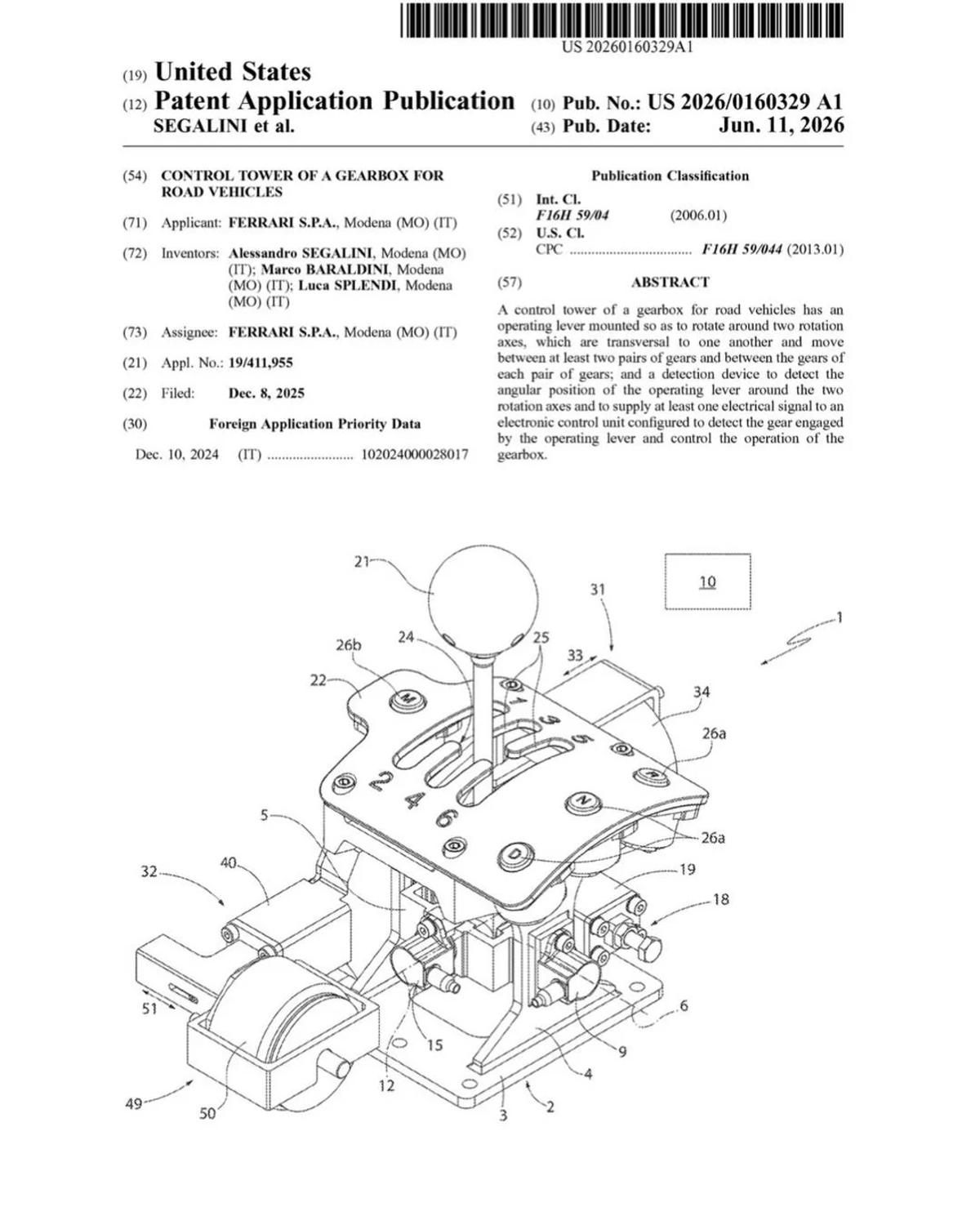
The Ferrari 12Cilindri Manuale arrives as a paradox machined out of billet steel: a car that restores the open-gate manual gearbox to the modern V12 while connecting that gearbox to nothing at all. Ferrari’s own engineers are candid about it: the clutch pedal and the aluminum wand of the gearstick are “connected by nothing but electricity.” This is the central fact from which every reading in this study proceeds, and it activates the full Aura Transaction lexicon at once: Sign-Value, Labor Density, Semantic Burden, Simulacrum, and the question of whether this object is a Hollowed Object refilling itself or merely a hollow one wearing a heavier costume. The Ferrari 12Cilindri Manuale by-wire manual gearbox is not the return of the old Ferrari manual. It is the manual reissued as a luxury ritual, and the question this study asks is whether ritual, once fully digitized, is still ritual or only its photograph.
Ferrari has built, in its own words, “the world’s most realistic sim rig,” and then sold it as a car. That phrase should be held very still, because it contains the entire argument. A simulator is a device for producing the sensation of an activity in the confirmed absence of the activity. To describe your flagship analog gesture as a simulator is to admit, in press copy, that the referent has left the building.
The Object, Stated Plainly and Verified
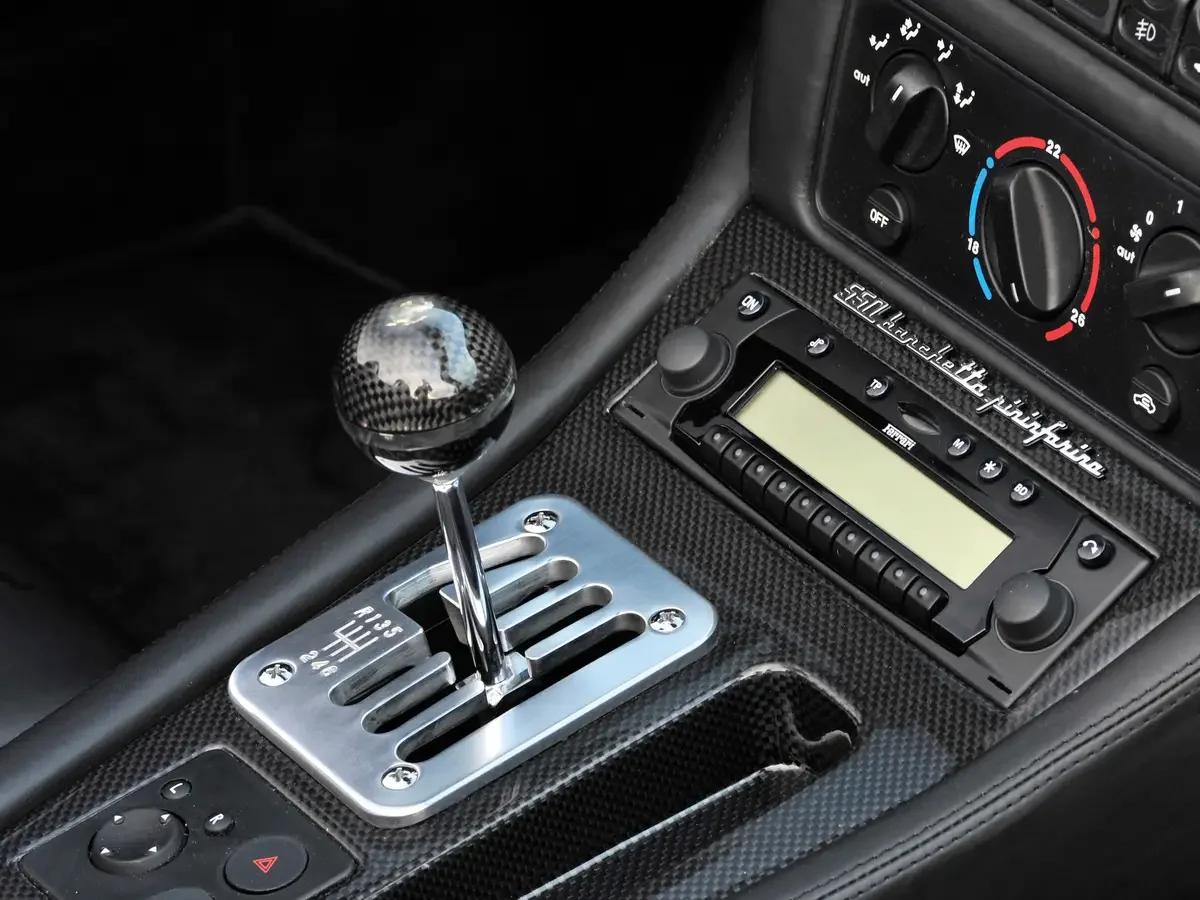
Before the theory, the record. The 12Cilindri Manuale pairs the 6.5-liter naturally aspirated V12 (820bhp, 500lb ft) with what looks, from the driver’s seat, like an iconic click-clack six-speed gated manual and a clutch pedal in the footwell. It is not one. Behind the shift plate sit the buttons P, R, N, D; a press converts the car into an eight-speed dual-clutch automatic and the engraved logo atop the gearstick shifts from amber (manual) to white (auto). The “manual” drives the first six ratios of the same Dual-Clutch Transmission; the top two gears are reserved for cruising. Neither pedal nor lever is mechanically linked to anything past its housing. Both are actuators. Both are theatre.
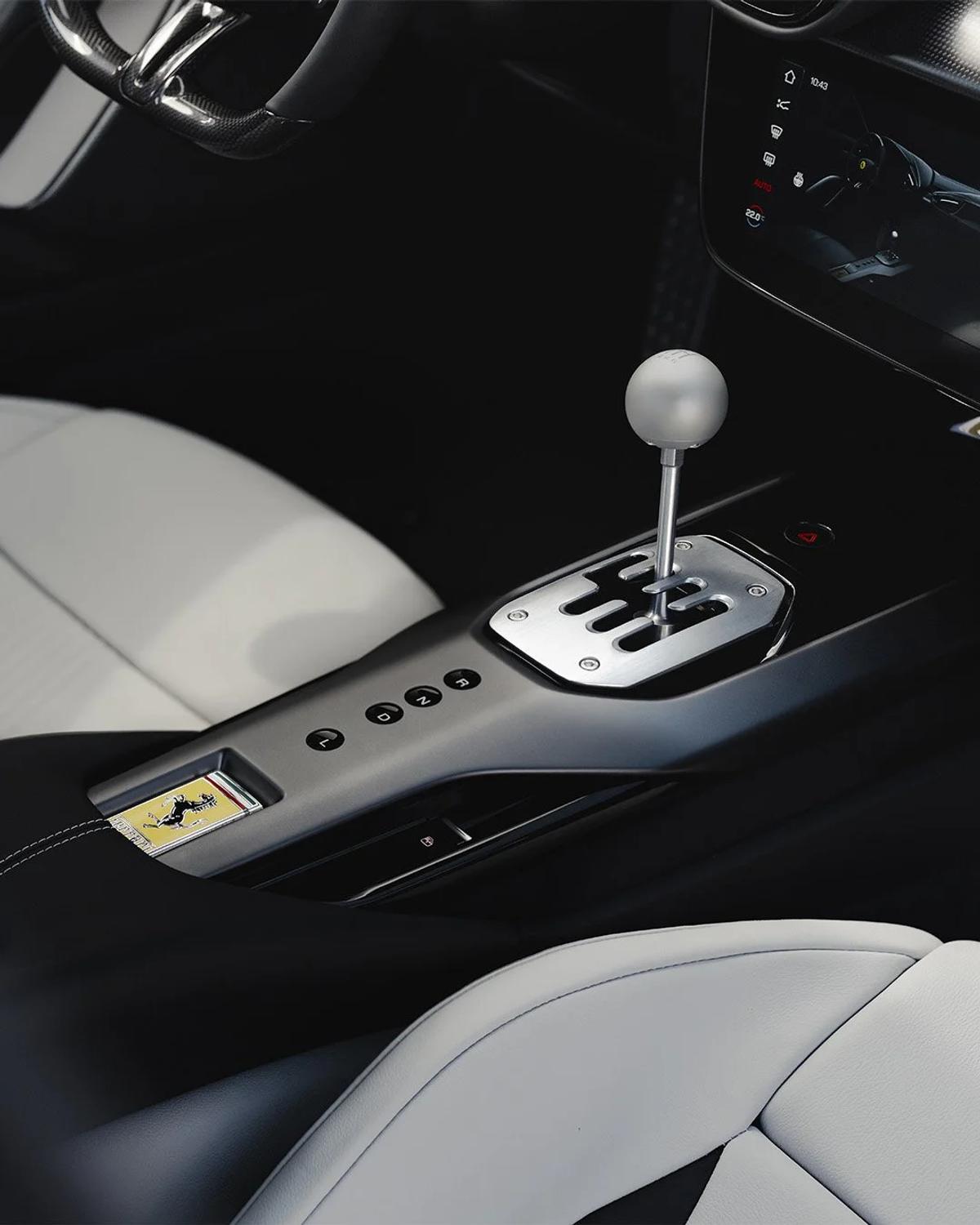
What Ferrari has engineered is not drive but feedback: a 15kg clutch weight identical to the 599, the last true manual Ferrari; a self-centering spring in the lever; near force-feedback in the pedal; a lockout that resists an impossible gear the way a real synchro would balk at second at 100mph; and, the tell, a deliberately preserved capacity to stall. Get your inputs wrong and the car will lurch or die, “all part of the experience,” Ferrari says. Performance with a skilled driver matches the paddle car: 0-62mph in 2.9 seconds, 211mph. The premium for this feeling is exact and enormous. The standard 12Cilindri is roughly €400,000. The Manuale is €590,000. Ferrari is charging €190,000 for the reintroduction of friction it spent two decades engineering out. Fifteen hundred cars, all routed through Tailor Made, all Special Series.
Ferrari did not restore the manual gearbox. It restored the feeling of one and then priced it at €190,000; the first time in the marque’s history that resistance itself has appeared on the invoice as a line item.
Aura Transaction: Benjamin and the Gated Ghost
Walter Benjamin taught us that the aura of an object is bound to its here-and-now: its unique presence in a single place, its embeddedness in a chain of tradition and material history. Mechanical reproduction withers the aura by severing presence from origin. The manual gearbox was, for the driver, an auratic instrument: its authority came from the fact that the hand and foot were physically continuous with the machine’s violence. When you missed a shift, the metal told you. The Aura Transaction at the heart of the Manuale is the attempt to manufacture that presence after the physical continuity has been cut.
This is the deep irony of the object. Ferrari has not reproduced a manual; it has reproduced the aura of a manual, precisely the thing Benjamin said could not survive reproduction. The billet-steel core block exists to generate authenticity signals, weight, spring, balk, stall, on demand, at will, identically, forever. Every car will stall the same way. Every clutch will weigh the same 15kg. The uniqueness that grounded the auratic gesture has been replaced by a spec, and a spec is by definition reproducible. What the driver receives is not aura but its citation: a quotation of presence, delivered with such fidelity that, as Ferrari boasts, “static, playing with the control surfaces, you really would never know.”
The Manuale does not transmit aura; it transmits a rendering of aura at extremely high resolution, and a rendering, however perfect, is a confession that the original is gone.
The Simulacrum of the Manual: Baudrillard’s Fourth Order
If Benjamin gives us the loss, Jean Baudrillard gives us the replacement. In his account, the Simulacrum passes through orders: the faithful copy, the perversion of reality, the masking of its absence, and finally the pure sign that bears no relation to any reality whatever, the simulation that precedes and produces the real. The by-wire gated manual is almost a laboratory specimen of the fourth order. There is no mechanical manual underneath to which the lever refers; the lever refers to the idea of a manual, an idea the driver has largely absorbed from previous cars, films, and games, from Gran Turismo as much as from the 599. Ferrari is not simulating its own gearbox. It is simulating the cultural memory of gearboxes.
This is where the marque’s own genealogy accuses it. In From the Aura to the Simulacrum, we argued that the luxury object completes its life cycle by becoming a simulation of itself. The Manuale performs that completion in a single component. Its Sign-Value, what it signals to owner and onlooker, has been fully decoupled from its Use-Value. The stick shifts, but shifting is no longer what it does; what it does is signify shifting. As we noted in The Simulacrum of Luxury, this is the precise mechanism by which consumer society converts function into code. The Manuale converts a mechanical operation into Symbolic Exchange without restoring it. It is symbolic exchange with the symbol left running, and the exchange quietly switched off.
The Algorithm of the Hand: Choreographed Imperfection
The most sophisticated, and most vulnerable, move Ferrari makes is the retention of the stall. In The Algorithm of the Hand, we located the last redoubt of Material Singularity in the ineradicable imperfection of embodied labour, the wobble, the misfire, the human error a perfect system cannot produce and therefore cannot fake. The Manuale is the first object we have encountered that attempts to fake the error. Ferrari’s algorithms are precise enough to reward a clumsy input with a jerky start or a stall. The imperfection is real to the body but authored by the code. This is imperfection as a designed output: the Aesthetics of Endurance reduced to a difficulty setting.
And here the pressure is genuinely ambiguous, which is why the object is worth a study rather than a verdict. On one reading, the choreographed stall is the deepest betrayal: even human failure has been annexed, optimized, and sold back. On another, more generous reading, the gesture is preserved because the machine could have removed it and chose not to. The driver’s foot still learns, still improves, still governs the launch, even if the drivetrain overrules the geometry. The embodied ritual survives as ritual; only its metallurgy has changed. The honest position is that the Manuale holds both truths in tension, and that Ferrari is banking, at €190,000 a car, on the buyer not needing to resolve it.
When the machine can choose whether to let you fail, your failure is no longer yours. It is a permission, and a permission is the opposite of an act of labor.
Labor Density Versus Its Rendering
Labor Density in the PLCFA lexicon names the amount of accumulated, legible human effort an object carries, the reason a hand-built movement outranks a printed dial. The manual gearbox was dense with the driver’s own labor: heel-and-toe, rev-matching, the earned competence of not stalling. The Manuale relocates that density. The driver’s labor is now partly simulated, the drivetrain does the hard synchronizing, while an entirely new and invisible labor is smuggled in: the labor of the engineers who spent, by Ferrari’s account, years making a manual system that could “handle the power and torque” of the V12 by not being a manual system at all. The density did not vanish. It migrated from the owner’s right foot to Maranello’s R&D department, and the owner is charged for a labor they no longer perform.
This migration is the object’s Semantic Burden: it must constantly carry the meaning of manuality while being administered by software. Every drive is an argument the car has to win against its own wiring diagram. That the argument is, by all accounts, won, that it “feels weirdly perfect”, does not dissolve the burden; it merely proves the burden can be borne at a very high engineering cost. The Byung-Chul Han reading is unavoidable: the Manuale is a post-luxury conceptual object whose real content is the concept of endurance and friction, staged for a clientele that wants the meaning of effort without its inconvenience, and can be trusted to want it only “when they want it, but not when they don’t.”
Sign-Value and the €190,000 Premium
The market structure makes the theory concrete. Ferrari has not priced the Manuale on cost, weight, or speed; it is no faster than the paddle car. It has priced it on Sign-Value alone. The €190,000 delta is the purest expression of commodity fetishism the marque has yet produced: a price attached not to a thing but to a feeling about a thing, and specifically to a feeling of resistance that the same company deleted from its range to sell paddle-shift speed. Ferrari is now selling, at a six-figure markup, the friction it once charged a premium to remove. The commodity has learned to sell its own negation.
Scarcity does the rest of the work. Fifteen hundred cars, Tailor Made, Special Series, Scudetto shields “laser-etched using the same process as the carving of valuable coins”, the language of numismatics deliberately imported to underwrite the sign. The Manuale is engineered to be, in our terms, a Sovereign Object: a possession that confers distinction by its constrained availability and its private code, legible only to “those who know.” But sovereignty here is conditional, and that condition is the whole subject of the next section.
The Manuale is the moment the commodity closes the loop: it removes friction to sell speed, then sells the memory of friction back to the same buyer at €190,000, each transaction dressed as the correction of the last.
The Hollowed Object, Reversed, or Redecorated?
Our sibling study, The Hollowed Prancing Horse, argued that the electric Luce made Ferrari a Hollowed Object: the external Ferrari signifiers survived while the internal semantic content, combustion, sound, mechanical drama, was replaced by optimization logic. The Manuale looks, at first, like the antidote: Ferrari reversing the drift, re-importing friction, ritual, heritage theatre, and the V12’s dinosaur-burning noise into a car that had been sliding toward the smooth. That the Manuale launched days after the “controversial” all-electric Luce is not lost on anyone; it reads as Maranello’s PR department insisting it still knows how to build a machine that resists you.
But reversal is not the same as restoration, and the Manuale may be less the cure for the Hollowed Object than its most refined symptom. The Luce hollowed the drivetrain and kept the shell. The Manuale keeps the gesture and hollows the linkage, the same operation performed one layer deeper and far more beautifully. In the Luce, the absence is honest: there is no engine, and everyone knows it. In the Manuale, the absence is concealed by exquisite feedback engineering designed so that “you really would never know.” A hollow you can feel is a critique. A hollow engineered to be imperceptible is a seduction. Ferrari is not the villain of this story; Ferrari is the symptom, a maker responding rationally to a customer base that has learned to want authenticity delivered as a service.
Structural Captivity: The Machine Stays Closed
The final tension is ontological. For all its restored ritual, the Manuale never reopens the machine. In a true manual, the drivetrain is available to the driver, you can, in principle, do the wrong thing, over-rev, money-shift, break it. Availability is what made the old gesture meaningful; the machine could be wounded by the hand. The Manuale forecloses this. The lockout prevents the impossible gear; the software mediates every input; the drivetrain remains a sealed, governed system that grants the sensation of access while denying access itself. This is Structural Captivity in its most elegant form: the object offers total feeling and zero reach.
The driver is sovereign over the interface and captive to the architecture. This is the same governance logic we traced in The Zero-Sum Aura: the aura requires a material host, and here the host has been reduced to a set of control surfaces atop a system that will never, under any input, actually be manual. Ferrari has solved the engineering problem of mechanical intimacy by abolishing the mechanism and keeping the intimacy, which is to say it has solved it by redefining the problem until the answer became software.
Coda
The Ferrari 12Cilindri Manuale is a luxury object that sells the aura of mechanical intimacy through digital governance, and it does so with a sincerity that makes it far more interesting than a cynical gimmick. It genuinely wants to give the driver back the ritual of the hand and foot; it genuinely restores weight, balk, and the dignity of the possible stall. But it accomplishes all of this by wire, inside a closed drivetrain, at a €190,000 premium, with resistance priced as an option. It is, at once, the most heartfelt and the most administered gesture Ferrari has ever made, a machined confession that in 2026 even conviction must be routed through a controller.
Whether that is preservation or embalming is the question the object refuses to answer, and Ferrari is wagering fifteen hundred times that its buyers would rather feel the machine than reach it. The proof, as Top Gear rightly says, will be in the driving. The proof, as we would add, is already in the wiring.
Ferrari has engineered the perfect manual gearbox for an age that no longer trusts itself to shift, a ritual with the risk removed, an aura with the origin deleted, and a price tag where the friction used to be.
Authored by Christopher Banks, Anthropologist of Luxury, Critical Theorist & Founder Objects of Affection Collection Office of Critical Theory & Curatorial Strategy 469 Fashion Avenue, 12th Floor, New York, NY 10018
Related OAC Studies
The Manuale sits at the intersection of several established OAC arguments. These studies form its immediate theoretical neighbourhood.
Direct Ferrari precedent: The Hollowed Prancing Horse: What the Ferrari Luce Actually Confirms
Authenticity & simulation: From the Aura to the Simulacrum: Benjamin, Baudrillard, and the Crisis of the Authentic
Sign-value & symbolic exchange: The Simulacrum of Luxury: A Guide to Jean Baudrillard’s Critique of Consumer Society
Human gesture & anti-smoothness: The Algorithm of the Hand: Re-Centering Human Imperfection and Labor as PLCFA’s Ultimate Materiality
Post-luxury endurance & the material host: The Aesthetics of Endurance: Byung-Chul Han and the Rise of Post-Luxury Conceptual Functional Art · The Zero-Sum Aura: Why Digital Immortality Requires a Material Host