The Faceless Pilgrim and the Fifteen Minutes That Refused to End: What FreddyLA7's World Cup Road Trip Actually Reveals About Aura, Anonymity, and the Performed Sincerity of American Exceptionalism

How one anonymous German tourist became a Sovereign Object, and what that confirms about the structural logic of the Zero-Sum Aura in the age of the Attention Economy

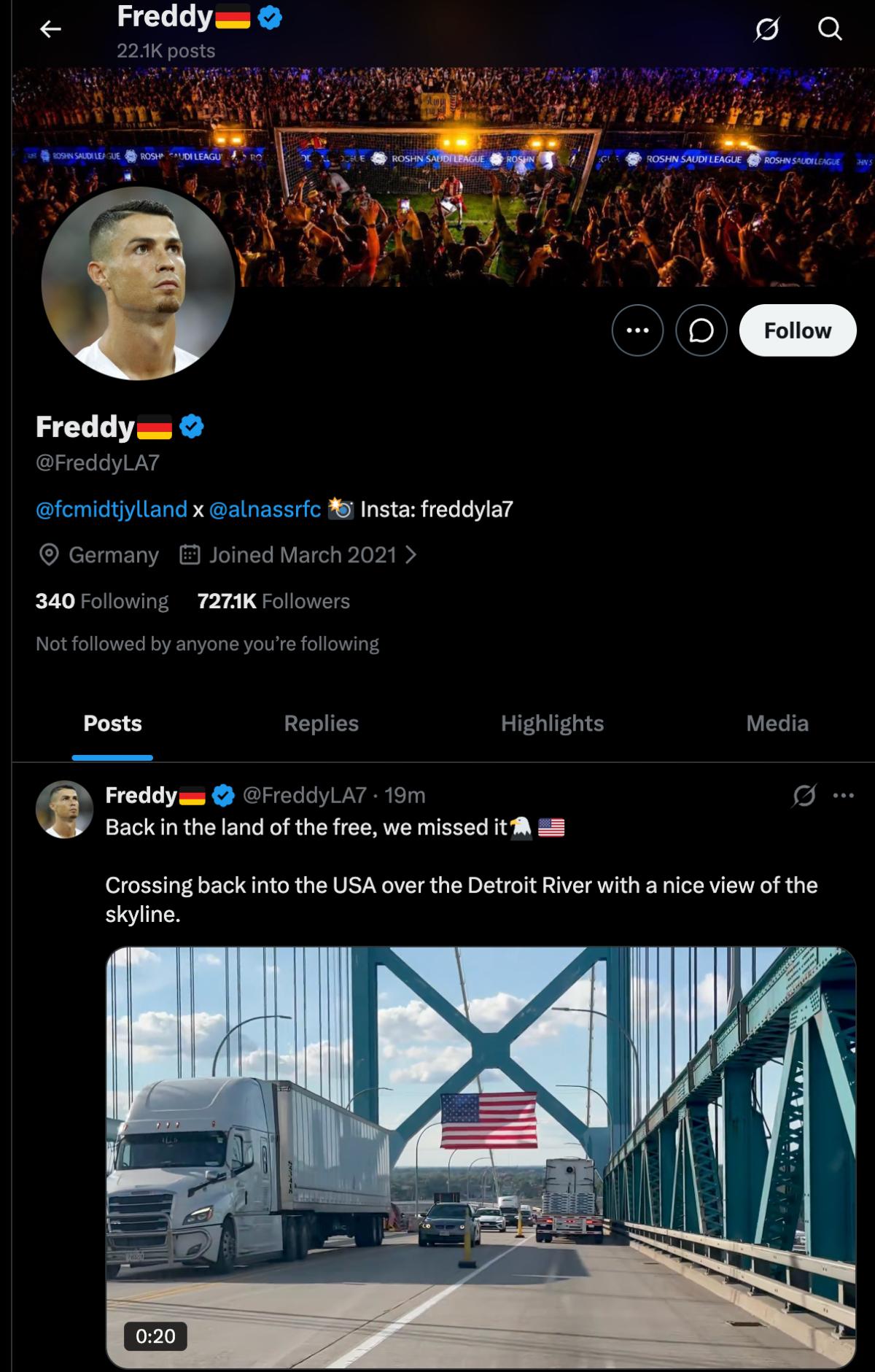
On June 5, 2026, a German soccer fan known only as @FreddyLA7 landed in New York, boarded a flight to Atlanta, and began live-documenting his first journey through the United States for the 2026 FIFA World Cup. Within ten days, he had amassed nearly 700,000 followers. Within two weeks, a former NFL star had paid for his hotel suite, NASA had hosted him beside astronauts, and a Trump administration official was arranging a White House visit. Freddy's face was never shown in a single image. His last name was never disclosed. His age was never confirmed. The question every major media outlet tried to answer: Who is Freddy?: is the wrong question entirely.
This study applies the Post-Luxury Conceptual Functional Art framework to Freddy's journey, not as a feel-good viral moment but as a diagnostic specimen. What Freddy produced (whether knowingly or not) is a live demonstration of the Zero-Sum Aura: the principle that authentic cultural power is structurally incompatible with mass visibility unless the self is withheld from the transaction. His anonymity was not a privacy choice. It was the mechanism that generated the Aura Transaction. The audience's generosity, institutional, financial, emotional, flowed precisely into the void where a face should have been. Freddy did not become a Sovereign Object despite his ordinariness. He became one because of it, and because the withholding of his identity transformed every viewer into a co-author of his story. This is the Phenomenology of Concealment in live operation, applied not to an artwork but to a person moving through space and broadcasting in real time.
The PLCFA lexicon terms active in this study are: Zero-Sum Aura, Aura Transaction, Sovereign Object, Hollowed Object, Phenomenology of Concealment, Spectacle of Dissent, Narrative Permanence, and Affective Object. This is also, inescapably, a study about Andy Warhol, and about what it means when the fifteen minutes refuse to end because the person inside them refuses to be seen.
The Faceless Pilgrim
There is a photograph from the early days of Freddy's journey: three men standing outside a Buc-ee's gas station somewhere along the American South. Their faces are obscured. Their posture radiates uncomplicated joy. The caption expresses genuine astonishment at the scale of the facility. Millions of people saw this image and felt something. What they felt, and why they felt it, is the structural question this study answers.
, Freddy🇩🇪 (@FreddyLA7) June 10, 2026
Dinner from Buc-ee’s at 1am😋 pic.twitter.com/1p0iZLfmOW, Freddy🇩🇪 (@FreddyLA7) June 10, 2026
Freddy's commitment to Anonymity in Art; and it must be called that, because the precision of the anonymity was art-level disciplined, was not incidental. When a user on X pointed out that Freddy's face might be visible in a window reflection, Freddy responded: "bro I check every photo/video like 10 times before posting so this doesn't happen." This is not the behavior of a casual tourist documenting a vacation. This is the behavior of someone who understands, consciously or instinctively, that withholding is the product. The face, revealed, would have collapsed the architecture. The absence of the face is what held it up.
Freddy’s anonymity was not a privacy preference. It was a structural decision that transformed a tourist into a Sovereign Object: an entity whose meaning is generated entirely by the witness rather than the witnessed.
This is the first operative principle of the Phenomenology of Concealment: concealment does not diminish an object's power. It concentrates it. When the face is withheld, the viewer's imagination fills the space where biographical data would ordinarily arrest projection. Freddy became, in real time, whatever each of his 700,000 followers needed him to be, an innocent abroad, a mirror for American self-image, a rebuke to cynicism, a reminder of wonder. He could be all of these things simultaneously because he was, visually, none of them specifically. The Hollowed Object is the object from which specificity has been evacuated so that meaning can be poured in by others. Freddy hollowed himself, deliberately, systematically, ten times per photograph.
The Warhol parallel is immediate and structural, not merely decorative. Andy Warhol's Factory operated on a related principle: Warhol himself was famously opaque, giving interviewers nothing, reflecting their questions back as blank surfaces. The Factory's superstars were often chosen for their capacity to absorb projection rather than their talent for generating it. But Warhol's mechanism was institutional, it required the Factory as infrastructure, the Interview magazine as amplifier, the celebrity ecosystem as context. Freddy's mechanism was structural and required nothing but a smartphone and the discipline to stay invisible. This is not a lesser version of what Warhol did. It is the same logic, executed at zero cost, in the open air, in front of an audience of millions.
The Hollowed Object and the Architecture of Mass Projection
Walter Benjamin's theory of the Aura, the singular, irreplaceable presence of an original work in space and time, was declared dead by the age of mechanical reproduction. Benjamin argued that the ability to copy and distribute an image destroyed its aura, because aura depended on the singular encounter: the specific painting, in the specific room, confronted by the specific body. Social media appeared to confirm Benjamin's thesis: the viral image is the reproduced image, stripped of presence, singularity, and location.
Freddy's case complicates this severely. What Freddy produced was not a reproduced image. It was a live durational event, an ongoing, real-time, continuously updated object that had no fixed location and no single version. And yet it generated an aura at a scale that most singular artworks never achieve. The explanation lies in what the Zero-Sum Aura identifies as the inverse logic of contemporary attention: in the saturation economy of digital content, aura accrues not to objects that are maximally present but to objects that are maximally withheld. Freddy's face, the most conventionally "present" element of any human document, was the thing withheld. Every other element of his journey was shared in granular detail: the food orders, the highways, the stadium entrances, the motel corridors. The face was the only thing that remained singular, unshared, auratic. And because it was the one thing the audience could not have, it became the thing they most desired.
In the saturation economy, aura accrues not to what is shared but to what is withheld. Freddy withheld one thing only, and that one thing became the structural engine of everything else.
This is the Hollowed Object in its most advanced form. The Hollowed Object, in PLCFA analysis, is an object that has been evacuated of its maker's signature, through anonymity, through dematerialization, or through the systematic refusal of biographical anchoring, so that the object's meaning becomes co-authored by its audience. The luxury industry produces Hollowed Objects routinely: the unbranded exterior of a Hermès bag, the unmarked architecture of an Armani suit, the refusal of visible logo at the highest tier of quiet luxury. These objects are "hollow" not because they are empty but because they have been carefully cleared of the noise that would obstruct the viewer's self-projection.
Freddy produced a Hollowed Object that moved. It walked into Waffle House at 1 a.m. It stood in front of Bass Pro Shops and expressed genuine astonishment. It sat in stadiums surrounded by crowds. The object's movement, its journey through space, meant that the projection it invited was not static but narrative. The audience did not simply project a self onto Freddy. They projected an arc, a pilgrimage, a story with stakes and destinations. The Parasocial Relationship that formed was not parasocial in the familiar celebrity-fan sense, where the audience forms an attachment to a known persona. It was a parasocial relationship with a variable, an unknown quantity that the audience was actively solving in real time. Every new post was new data in a shared investigation: who is this person, and why does watching him make us feel something we cannot quite name?
Waffle House as Sacred Site: The Tourist Gaze as Critical Instrument
Freddy's first Waffle House visit at 1 a.m. (which he described as "great food, great prices, and friendly staff 10/10") generated a media cycle of its own. The coverage was uniformly delighted: here was a German tourist discovering the American diner in its most honest form, and finding it magnificent. What the coverage missed, entirely, is that Freddy's wonder was not naïve. It was structurally critical, not because Freddy intended it as a critique, but because the Tourist Gaze is inherently a defamiliarization device. The tourist sees the ordinary as extraordinary because the tourist lacks the context that makes the ordinary invisible.
, Freddy🇩🇪 (@FreddyLA7) June 12, 2026
Late night snack in New Orleans at Waffle House again. Unfortunately we had to eat in the parking lot this time because they closed the dining area and only allowed takeaway. pic.twitter.com/648PawEio2, Freddy🇩🇪 (@FreddyLA7) June 12, 2026
Americans cannot see Waffle House the way Freddy saw Waffle House. Americans cannot see Buc-ee's the way Freddy saw Buc-ee's. The Americana that Freddy documented, the roadside abundance, the scale of the gas station, the late-night hash browns, the Walmart's cathedral size, is invisible to the American because it is ambient. It has been naturalized into the background of daily experience. Freddy's posts performed the same function as the anthropologist's field notes: they made the ordinary legible as cultural production. They revealed the United States to itself through the mechanism of the foreign witness.
The tourist gaze is not innocent wonder. It is the most powerful critical instrument available to a culture that cannot see itself, because the tourist has not yet learned what to stop noticing.
This is why Freddy's posts were not merely popular. They were useful. They confirmed a self-image that Americans had been denied by two years of hostile international coverage, the declining reputation abroad, the travel advisories, the documented reluctance of European visitors to enter the United States in 2026. Freddy arrived at precisely the moment when American culture needed a witness who would see the country generously, and he provided that witness with the credibility of genuine surprise. His Naïve Authenticity, or what read as naïve authenticity, was the most powerful form of Social Commentary available, precisely because it did not announce itself as commentary.
The PLCFA framework identifies this as the Affective Object: the object whose primary function is to generate feeling rather than meaning, but which generates meaning through the feeling it produces. Freddy's posts did not argue for America. They did not debate American exceptionalism or critique American failures. They felt America, with transparent sincerity, in real time, and that feeling became an argument more persuasive than any op-ed could produce. The Performed Sincerity here is not a condemnation. The sincerity appears to have been genuine. But sincerity that is documented, shared, and witnessed at scale becomes a performance whether the performer intends it or not. Freddy was both the subject and the medium.
The Aura Transaction: How Anonymity Generated Institutional Generosity
The Aura Transaction describes the exchange that occurs when an object, or person, of sufficient aura enters the social field and provokes a response not from the market but from institutions and individuals who wish to be proximate to the aura. In the luxury context, this manifests as the collector who pursues an artist not for investment but for the privilege of custodianship, the desire to be near something singular. In Freddy's case, the Aura Transaction took a more theatrical form: institutions and celebrities competed to give him things.
Former NFL defensive end J.J. Watt paid for Freddy's hotel suite in Houston, a room at the Post Oak Hotel with nightly rates beginning at $500. The New Orleans Saints and Pelicans opened their facilities to Freddy and his companions. LSU gave them a tour of Tiger Stadium. NASA hosted them and allowed them to speak with astronauts aboard the International Space Station. Country musician Ella Langley gave them concert tickets and then met with them backstage. Nick Adams, the Trump administration's Special Presidential Envoy for American Tourism, Exceptionalism, and Values, arranged a White House visit through direct messages on X. These are not the actions of institutions responding to a celebrity. These are the actions of institutions responding to an Affective Object of unusual intensity, an object that carries its own field of meaning so powerful that proximity to it constitutes a form of endorsement.
, Freddy🇩🇪 (@FreddyLA7) June 13, 2026
When the Aura Transaction is activated at sufficient scale, institutions do not compete to evaluate the object. They compete to be near it. The White House did not invite Freddy because he is famous. It invited him because he is auratic.
Omg this is insane pic.twitter.com/LMmjWyxRHb, Freddy🇩🇪 (@FreddyLA7) June 13, 2026
The critical observation here is that none of this would have occurred if Freddy had a face in his photographs. The face would have resolved the identity question, satisfied the curiosity, and terminated the projection. The known person generates parasocial attachment to the known persona; the unknown person generates something structurally different, a collective investment in the mystery. The generosity directed at Freddy was not directed at a person. It was directed at a vessel that the entire culture had agreed to fill with its best ideas about itself. J.J. Watt was not giving a hotel room to a German tourist. He was performing American Exceptionalism for the largest audience currently paying attention to a single anonymous figure in American public life.
The PLCFA framework identifies this as the moment when the Sovereign Object completes its circuit. The Sovereign Object does not seek institutional validation. The Sovereign Object generates institutional behavior in others by existing within a clearly defined set of self-imposed constraints, in Freddy's case, the constraint of anonymity, the constraint of sincerity, the constraint of wonder. These constraints are the equivalent of the artist's refusal of the market: they constitute the structural condition under which the aura can form and hold. The moment Freddy reveals his face, the Sovereign Object becomes a personality, and the circuit closes. This is why the anonymity was maintained so carefully. Not for privacy. For power.
Fifteen Minutes, Refused: The Warhol Limit and Its Structural Inversion
The phrase attributed to Andy Warhol, "in the future, everyone will be world-famous for 15 minutes," is now understood as a prophecy about the brevity of contemporary celebrity. It turned out to be accurate in form but incomplete in its account of the mechanism. Warhol predicted the democratization of fame. He did not specify the condition under which the fifteen minutes could be extended, and under which the architecture of viral celebrity could hold past its structural expiration.
Warhol's Factory produced celebrity through accumulation: the more of the famous person that was documented, reproduced, and distributed, the more famous the person became. This is the model of contemporary social media, the influencer who maximizes posting frequency, maximizes face time, and maximizes disclosure. The model produces rapid ascent followed by the saturation point, at which the audience has received more of the person than the person can sustain with novelty. The fifteen minutes end not because the audience tires of the person but because the person has been exhausted as a source of projection. When the biography is fully known, there is nothing left to imagine.
Warhol predicted the fifteen minutes. He did not specify the condition under which they refuse to end. The condition is the withheld face. When the audience cannot complete the picture, it cannot grow old.
Freddy's model inverts this entirely. The less of Freddy that is disclosed, the more the audience has to project, and therefore the more the projection sustains itself. Two weeks into his journey, there were more unanswered questions about Freddy than there were on day one. The mystery compounds rather than resolves. The Viral Anonymity is not merely a feature of Freddy's approach. It is the mechanism that converts a viral moment into a sustained cultural event. The fifteen minutes, refused exit by the absence of the face, become fifteen weeks.
What Freddy has produced (what you, Chris, accurately identified as an artwork in your framing of this study) is something the art world does not have a name for yet. It is not performance art, because Freddy did not frame it as art. It is not documentary, because there is no camera crew and no editorial frame. It is not influencer content, because there is no monetization structure and no brand partnership infrastructure visible in the work. It is a Digital Pilgrimage, a real journey through real space, documented in real time, whose meaning is generated not by the traveler's disclosure but by the audience's investment. The X timeline is the gallery. The posts are the exhibition. The anonymity is the frame. And the frame is what makes it art.
The Skepticism and the Spectacle of Dissent
Within days of Freddy's rise, skepticism emerged: could this be real? Could someone from Germany genuinely react with this level of delight to Taco Bell, to SEC stadiums, to Bass Pro Shops? The questioning took multiple forms, accusations of marketing campaign, doubts about authenticity, challenges to the sincerity of the wonder. Some observers noted that his word choices seemed too fluent, too American, for a first-time visitor. Others suggested that the entire account was constructed by an agency for purposes of soft influence.
The PLCFA framework does not resolve these doubts. It identifies them as structurally necessary. The Spectacle of Dissent, the institutional performance of skepticism against a dominant cultural object, is not a threat to the object's power. It is a confirmation of it. Nothing in the Attention Economy receives skeptical analysis unless it has already accumulated sufficient aura to merit the scrutiny. The debate about Freddy's authenticity extended his presence in the cultural conversation by weeks. Each article asking "Is Freddy real?" was, functionally, an advertisement for Freddy's reality. The Trust Crisis that produced the skepticism, the ambient suspicion of all online sincerity in the post-influencer, post-AI-content landscape, is the very condition that made authentic sincerity so powerful when it appeared.
The skepticism is not a threat to the Sovereign Object. It is its confirmation. Nothing earns critical scrutiny in the attention economy unless it has already accumulated enough aura to merit scrutiny.
The deeper structural point is this: whether Freddy's wonder is genuine or performed is, for the purposes of PLCFA analysis, irrelevant. The framework examines the structural function of sincerity in the social field, not the psychological state of the person performing it. Performed Sincerity that produces authentic institutional generosity, authentic emotional response in 700,000 viewers, and authentic political attention at the level of the White House is functionally authentic regardless of its internal truth. The Affective Object generates real effects. The effects are the evidence. Guy Debord's analysis of The Spectacle argued that spectacle is the moment when representation colonizes life itself, when the image displaces the event it represents. Freddy inverts this: his images are saturated with the life they document, and that saturation is precisely what prevents them from becoming mere spectacle. The sincerity, performed or not, is the anti-spectacular element that holds the work together.
The White House Invitation and the State's Capture of Wonder
When Nick Adams, the Trump administration's Special Presidential Envoy for American Tourism, Exceptionalism, and Values, reached out to Freddy via direct message on X to arrange a White House visit, something structurally significant occurred. The Sovereign Object was addressed by the State. And the State's address is always a bid for capture.
The Institutional Necrophagy, the tendency of institutions to consume the aura of sovereign objects in order to borrow their credibility, operates here with textbook clarity. Adams described Freddy as "a great ambassador for our country" and his journey as "a fabulous thing for our country." The language of national utility has entered the frame. Freddy, who began as a private citizen documenting private wonder, has been designated an instrument of American Exceptionalism by the office created specifically to sell American Exceptionalism to the world. The White House invitation is not a gift. It is a purchase.
Whatever it is, the way you tell your story online can make all the difference.
The structural risk to Freddy's Sovereign Object status is precisely here. The Aura Transaction that generated the journey's power depends on Freddy's independence from institutional instrumentalization. The J.J. Watt hotel suite was a gift from an individual moved by genuine admiration, an organic expression of the Aura Transaction. The White House visit is a political act: the Trump administration capturing the image of a European who loves America at precisely the moment when American tourism from Europe has declined sharply and travel advisories have been issued to German citizens. Freddy's wonder, deployed as state propaganda, becomes something qualitatively different from Freddy's wonder deployed as personal document.
Whether Freddy accepts the White House visit, and whether, in accepting it, the Zero-Sum Aura survives the transaction, is the live structural question at the moment of this study's publication. The PLCFA framework predicts that aura depletion accelerates in proportion to institutional capture. The Sovereign Object that accepts state endorsement is no longer sovereign. It has traded its defining constraint, independence from institutional validation, for proximity to institutional power. Narrative Permanence, the quality of an object whose meaning outlasts its moment, depends on the refusal of exactly this transaction.
The X Timeline as Exhibition: Freddy's Journey as Durational Artwork
The framing that opens this study, that Freddy's journey has become its own artwork, is not metaphorical. It is a structural description. The X timeline as it has accumulated over the six weeks of Freddy's journey constitutes a durational artwork with all the formal properties the term implies: a defined duration (the World Cup's six-week run), a defined constraint (anonymity, maintained across every post), a defined medium (the real-time text-and-image post), a defined audience (700,000 followers, millions of viewers), and a defined gallery (the public timeline, accessible without admission).
The Affective Object in its highest form is the object that generates feeling not incidentally but as its primary structural output. Freddy's posts generate feeling, the feeling of wonder, of generosity, of innocent encounter, as their first and most consistent product. The critical analysis, the political instrumentalization, the commercial speculation about monetization are all secondary responses to this primary affective output. The work works. And it works because the anonymity, the face never shown, the name never confirmed, the biography never disclosed, maintains the necessary separation between the object and the biographical subject that would otherwise collapse the projection.
The X timeline is the gallery. The posts are in the exhibition. Anonymity is the frame. And the frame is what makes it art rather than content.
Andy Warhol's Factory understood this at the institutional level. The Factory was the frame, the New York loft, the silver walls, the velvet underground, the collective of beautiful strange people, that made everything that happened inside it legible as art rather than as ordinary life. Freddy has produced the same architecture with different materials: the German flag emoji in his username, the Cristiano Ronaldo profile photo that refuses to disclose his own face, the journey route that follows a sporting event as its structural spine. These are the Factory's walls, built in a single Twitter thread over six weeks, by a person nobody can see.
The Material Singularity of what Freddy has produced, its irreproducibility, its dependence on the specific real-time encounter, its absolute resistance to edition or multiplication, is the condition under which Narrative Permanence can form. The journey can be documented after the fact, can be archived, can be referenced. But it cannot be reproduced. When the World Cup ends and Freddy boards a flight back to Germany, the exhibition closes. What remains is not the work but the record of the work, and the question that will define its legacy: did the face ever emerge? Did the anonymity hold to the end?
What Freddy Confirms, and What He Leaves Open
Freddy's journey confirms several structural propositions of the PLCFA framework with unusual clarity.
It confirms that the Zero-Sum Aura operates in the attention economy with the same structural logic it operates in the luxury object market: aura accrues to what is withheld, not to what is shared. It confirms that the Phenomenology of Concealment is not a peripheral condition of certain artworks but a primary mechanism for generating the audience investment that transforms content into an artwork. It confirms that the Aura Transaction is activated by genuine constraint, and that authenticity, even when it cannot be verified, is structurally sufficient to produce institutional behavior consistent with authenticity.
What Freddy leaves structurally open is more difficult. The PLCFA framework has not previously encountered a Sovereign Object in real time, in motion, subject to institutional capture while the work is still in progress. The David Hockney study examined posthumous financialization, the capture of a finished life's work. The Banksy study examined an anonymity sustained across decades by institutional infrastructure. Freddy's anonymity is sustained in public, in real time, against enormous institutional pressure to reveal and resolve. What happens to the Sovereign Object when it is pressed by the State, by celebrity, by 700,000 people demanding resolution, and does not yield? Does the aura compound? Does it deplete through proximity to power? Does the White House visit represent the moment of institutional capture, or can the Sovereign Object walk through the White House and emerge intact?
These questions are not answerable at the moment of this study's publication. They will be answered by what Freddy does next. That is the final confirmation the journey provides: genuine art produces genuine uncertainty. The work is not finished until the constraint is either honored or abandoned. And the Narrative Permanence, the quality of cultural meaning that outlasts its moment, will belong entirely to whichever choice Freddy makes.
Authored by Christopher Banks, Anthropologist of Luxury, Critical Theorist & Founder Objects of Affection Collection Office of Critical Theory & Curatorial Strategy 469 Fashion Avenue, 12th Floor, New York, NY 10018