Misha Japanwala, The Odyssey: The Object That Became a Prop

On a body cast in bronze, a $250 million gaze, and the object that survives both...
Something precise happens when a work of Material Singularity enters a Hollywood film. The object does not simply appear on screen. It is enrolled in a new system of valuation, a new chain of custody, and a new set of cultural meanings that it did not author and cannot control. When Misha Japanwala's handcast bronze shoulder plate and choker appeared on Lupita Nyong'o as Helen of Troy in Christopher Nolan's The Odyssey, released July 17, 2026, two objects born from Japanwala's sustained critique of bodily shame and material permanence became, simultaneously, something else: cinematic props in a $250 million spectacle machine. This study reads that transition with care, because the precise moment of that crossing is where the institution's analytical work begins.
The Practice Before the Frame
Misha Japanwala was born in 1995 and raised in Karachi. She completed a BFA in Fashion Design at Parsons School of Design in 2018. Her practice resists the fashion category at its foundation. Japanwala's work begins from a philosophy of radical shamelessness: her body casts are made by pressing living human forms into silicone, then casting the resulting impressions in bronze, resin, or copper, producing wearable sculptural pieces that carry the exact geometry of a real body, complete with its scars, asymmetries, and stretch marks.
This is not a design choice. It is a material argument. The body Japanwala casts is not an idealized body; it is the specific, unrepeatable body of a specific person, recorded at a specific moment. The piece that emerges is structurally singular: it cannot be reproduced without reproducing a different body, at a different time, producing a different form. Labor Density is baked into the method. The casting process is slow, physical, and intimate. It demands the maker's sustained presence and cannot be accelerated without destroying what makes it what it is.
Her "Beghairti ki Nishani" ("Mark of Shamelessness") collection drew explicitly on the visual language of Mohenjo-daro artifacts: the terracotta figurines and bronze objects of the Indus Valley Civilization (ca. 2600 to 1900 BCE), centered in what is now Pakistan. This reference is not decorative. It reconnects contemporary Pakistani body politics to an ancient material culture that predates, by millennia, the moral architectures currently imposed on it. The broken, weathered, imperfect forms of Indus Valley objects share with Japanwala's cast-from-body pieces a refusal of the idealized form: both record the body as it actually is, not as it is supposed to be.
Japanwala has been exhibited at Hannah Traore Gallery in New York, honored on the Forbes Under 30 list, and has created custom pieces for Cardi B, Lil Nas X, and Joy Crookes, in addition to her sustained collaboration with Lupita Nyong'o. Her practice operates at the intersection of fashion, sculpture, and political argument. That position makes her work simultaneously attractive to cultural institutions and legible to a mass-cultural audience: an ideally positioned practitioner for a moment when the fashion-art boundary is commercially valuable to disrupt. It is also, as this study will show, a position of significant structural vulnerability.
The Commission: From the Tony Awards to The Odyssey
The commission arrived through a friendship, not an open call. Lupita Nyong'o had been a patron and close collaborator of Japanwala's for years before The Odyssey. She wore one of Japanwala's silver breastplates to the 2023 Tony Awards, one of the most photographed red carpets of that year. She attended Japanwala's 2022 wedding in Karachi. She collaborated with Japanwala on styling for the opening of the Monsoon Wedding musical. When Oscar-nominated costume designer Ellen Mirojnick was assembling Nyong'o's wardrobe for her dual roles as Helen of Troy and Clytemnestra, Nyong'o named Japanwala specifically.
The brief that reached Japanwala in January 2025 was precise: Mirojnick wanted pieces resembling "a broken statue." Nolan wanted work that felt simultaneously ancient and eternal. Japanwala had approximately two weeks for initial delivery. She created the shoulder plate first. Nolan approved it. The choker followed.
The institutional structure of this sequence deserves analysis. Japanwala was not hired through a standard production sourcing process. She was brought in through an Aura Transaction conducted by an established patron: Nyong'o's endorsement converted Japanwala's cultural capital into access. This is the mechanism by which the subcontracted creative economy of high-end cultural production actually operates. The artist's work does not speak for itself into institutional structures; it speaks after someone with institutional standing has already spoken for it. The Italy luxury labor probe documented the structural invisibility of skilled artisanal workers inside the supply chains of major houses. Japanwala's case is structurally related, even if the cultural register differs: the artist is celebrated, even named in promotional materials, while the labor and material argument that give the pieces their meaning remain largely unexamined in the mainstream press coverage that followed the film's release.

The Objects: Singularity at the Seam
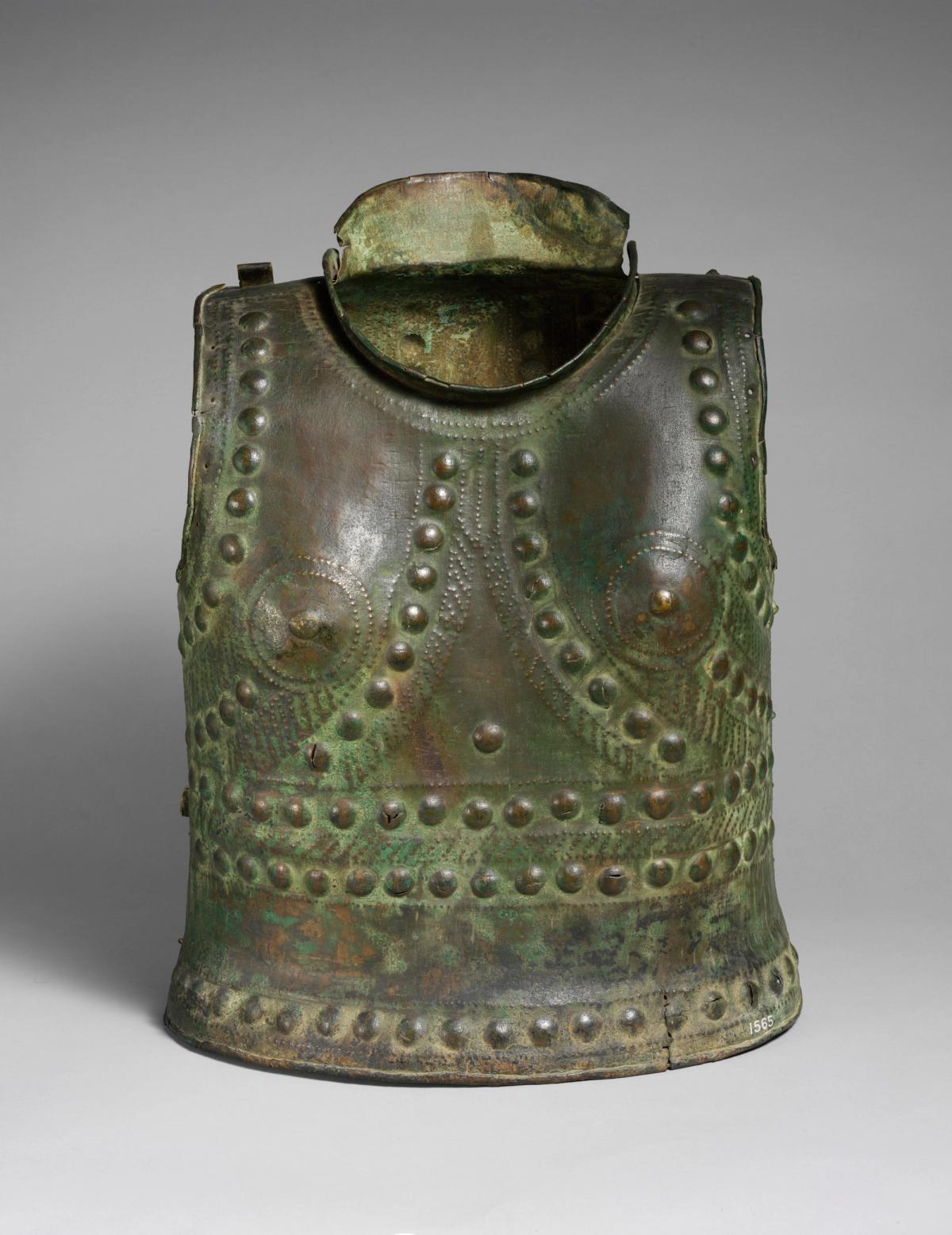
The shoulder plate is a 360-degree asymmetrical piece: copper and brass metallic coatings layered over silicone, treated with a brown patina to achieve the visual language of aged bronze. The seams are broken rather than polished. The form reads as a classical cuirass fragmented and recast around a living body rather than an idealized one. Worn as a capelet over a draped gown, it appeared in the scene where King Menelaus (Jon Bernthal) and Telemachus (Tom Holland) encounter Helen at the beginning of the film's Trojan cycle.
The choker carries the same visual grammar: broken edges, a bronze surface, a form that communicates ancient origin while being unmistakably contemporary in its material and making. It appeared during the farewell scene between Helen, Menelaus, and Telemachus.
What these pieces share is a Semantic Burden that predates the film entirely. Japanwala's practice is a sustained critique of imposed bodily shame; the broken-seam aesthetic references both the fragmented beauty of classical museum statuary (the truncated torso, the separated limb, the face worn to near-featurelessness) and the real scars, asymmetries, and stretch marks that conventional fashion conceals or corrects. When Mirojnick described the brief as "a broken statue," she was, knowingly or not, naming something Japanwala had been building for years. The language of the commission mapped precisely onto an existing artistic argument.
That coincidence is not coincidental. Nyong'o understood what she was recommending. Her years of wearing Japanwala's work in public contexts reflect a consistent engagement with what the work means, not just what it looks like. The commission was enabled by a patron who read the work correctly and specifically requested it for a role where its material argument would be legible. That is, in OAC's terms, an act of Custodian's Contract: a willingness to be responsible for the meaning of what you carry, not only its appearance. The structural question that follows is whether the broader apparatus into which the pieces were enrolled shares that responsibility.
The Absorption: Aura, Necrophagy, and the Hollywood Machine
Christopher Nolan's The Odyssey is one of the most extensively capitalized films in recent cinema history: a $250 million adaptation of Homer, filmed entirely on IMAX cameras across multiple countries, with a cast including Matt Damon, Tom Holland, Anne Hathaway, Robert Pattinson, and Zendaya alongside Nyong'o. It is not a neutral context in which to place two handcast bronze sculptures by a Pakistani artist. When Japanwala's pieces entered that apparatus, they crossed a threshold Walter Benjamin described more than eighty years ago: the work's aura, its here-and-now singularity, its material embeddedness in a specific body and argument, was brought into contact with a system designed to distribute images to hundreds of millions of viewers simultaneously.
The paradox Benjamin identified was that reproduction amplifies cultural reach while diluting material presence. In the case of Japanwala's pieces, the situation is more precise. The objects themselves appear in the film, not reproductions. They retain their physical singularity. But their meaning is now filtered through the film's narrative, the character of Helen of Troy, and the aesthetic apparatus of Nolan's direction. The viewer of The Odyssey does not encounter Japanwala's argument about bodily shame. They encounter Helen's beauty, articulated through a visual language they do not need to decode.
This is Institutional Necrophagy in its most complete and least malicious form. The film's apparatus does not destroy Japanwala's work. It consumes the work's subcultural capital, the critical vocabulary embedded in the broken-seam aesthetic and the cast-from-body process, and redistributes it as aesthetic value within the spectacle. The result is not a Hollowed Object in the technical sense; the material argument survives in the piece itself. But the object's public meaning has been partially evacuated and refilled with cinematic narrative. The parallel to institutional absorption in the art world is direct: just as MoMA absorbing Duchamp's radicalism neutralized the institutional critique while amplifying the aesthetic prestige, Nolan's film absorbs Japanwala's bodily critique while amplifying her global visibility.
The broken-statue language, born from a critique of imposed bodily shame, becomes, inside the film's frame, a signifier of mythic feminine power. The original argument is not suppressed. It is redirected.
Speculative Velocity operates here on two distinct axes. The cultural velocity is immediate and unprecedented: Japanwala's name, practice, and visual language were distributed through the global press cycle of one of the most anticipated films of 2026, generating coverage in W Magazine, Artsy, and publications across multiple languages and continents. That exposure will have lasting effects on her profile and market. The second axis is financial: screen-worn objects from Nolan productions carry documented premium valuations in the specialist auction market. The pieces, if they enter secondary circulation, will be priced as Nolan-associated artifacts, a valuation logic entirely disconnected from the labor, the body, and the critical intent that produced them. That displacement is the speculative event this study documents.
Helen's Armor: The Decolonial Contradiction
The casting decision is not incidental to this analysis. Lupita Nyong'o plays Helen of Troy: the woman whose beauty, in the Western epic tradition, is the proximate cause of the Trojan War, and whose function in Homer's narrative is almost entirely as object rather than subject. Nyong'o, a Kenyan-Mexican actress of formidable range and deliberate cultural intelligence, is not a passive vehicle for this role. Her choice to wear Japanwala's pieces is a reading of the material, not merely a costume decision.
The decolonial gesture is legible and worth naming explicitly. A Pakistani artist's sustained critique of imposed bodily shame, rendered in bronze that references both Mohenjo-daro and the fragmented aesthetics of classical statuary, placed on the body of a Black African actress playing the most mythologized woman in Western antiquity, inside a Hollywood epic directed by a British-American director adapting a Greek text: the layers are dense and potentially productive. The armor does not carry idealized beauty. It carries the marks of a practice rooted in bodily reality and the politics of shame. Something in Nyong'o's Helen refuses the role's traditional function, at least at the level of the costume.
This study does not dismiss that gesture. But it holds the gesture alongside the Structural Captivity it produces. Japanwala's pieces, inside the film's frame, cannot speak their own argument. They speak Helen's. The One Original Principle of the work, its insistence on the unidealized specific body, is overwritten by the narrative function it serves: Helen of Troy is, in the Western tradition, precisely the idealized body. The armor resists this in its material language. The narrative reasserts it through context. That is not a failure of the artist or the actress. It is the structural condition of ambitious art placed inside powerful institutions.
What remains after the contradiction is documented is a choice that belongs only to the artist. Japanwala framed the commission in terms of honor and historic opportunity: "The honor of a lifetime to contribute to Christopher Nolan's vision." That register is honest and appropriate. OAC's role is not to second-guess that choice but to document the structural conditions within which it was made, and to ensure the written record of the original argument survives the narrative that has been placed around it.

After the Credits: The Custodian's Contract in Cinema
The question of where these pieces go after production is not rhetorical. Film props from major productions have a documented and active afterlife in secondary markets. Screen-worn costumes from Nolan's films carry auction premiums commensurate with their cultural capital. A piece worn by Lupita Nyong'o as Helen of Troy in a $250 million IMAX epic adapted from Homer occupies the most premium tier of that market: it combines star provenance, auteur provenance, literary provenance, and visual distinction. If these pieces enter secondary circulation, they will not be priced as works by Misha Japanwala. They will be priced as Nolan artifacts, with Japanwala's practice footnoted, if mentioned at all.
The Custodian's Contract that should govern these pieces, as art objects entering a commercial production, does not exist in any publicly documented form. Without contractual provisions governing the future disposition of these objects, their next valuation will be determined by a studio property department, a specialist auction house, or a private collector's estate, none of whom are bound by Japanwala's material covenant or the critical arguments her practice embeds in the work.
What an adequate Custodian's Contract for cinematic art objects would require is a specific design problem that existing film production law does not address. It would need to include: provenance documentation formally binding the piece to its maker's stated critical intent and process; provisions governing secondary-market resale, including a right of first refusal or a percentage return to the artist; restrictions on reproduction of the piece's specific form for commercial licensing; and a requirement that any future institutional steward acknowledge the work's dual provenance as both art object and cinematic artifact. The Artist's Reserved Rights Transfer and Sale Agreement, first articulated in 1971 by Seth Siegelaub and Robert Projansky, provides the conceptual template. The adaptation of that template to film production contexts has not yet been systematically pursued.
OAC formally notes the archival gap: the custodial status of Japanwala's two pieces, as of this study's publication, is not publicly documented. The institution's position is that this gap is the structural norm, not an exception, and that the accumulation of studies documenting the making and meaning of specific objects is the first step toward a broader cultural pressure for better contractual architecture in cinematic commissions of artisanal work.
Narrative Permanence Against Speculative Velocity
Despite everything described above, there is a counter-argument this study takes seriously: the material survives. Japanwala's shoulder plate remains a cast made from a body. The broken-statue language still carries the specific argument of her practice, embedded in the material itself, irrespective of the narrative frame through which it has passed. The object has not been emptied. It has been relocated.
There is a form of Narrative Permanence that operates independently of the spectacle's reproductive logic. The documentation of the making of these pieces, the friendship that enabled the commission, the specific critical vocabulary they carry, the Mohenjo-daro reference, the broken-seam argument: all of this constitutes a provenance record. Future custodians, if they are serious, will have access to it. The institution's task is to ensure that record is specific, legible, and durable. That is what this study is built to produce.
Japanwala's practice also continues, and continues outside the Hollywood system. The pieces made for The Odyssey represent one chapter of a sustained practice that generates new work in contexts where the critical argument is not overwritten by another director's vision. The speculative velocity of the film's release will peak and decline on the standard curve of major cinema releases. The body of work, including the documented record of this commission, will remain. The parallel with body-based design practices that maintain their critical argument through material specificity, regardless of the contexts into which individual pieces are enrolled, is instructive: authority of this kind accumulates over time in ways that speculative placement cannot permanently displace.
There is, finally, the fact of Lupita Nyong'o's sustained patronage. Her advocacy for Japanwala's work across multiple years and contexts, and her demonstrated commitment to wearing work that carries its maker's argument rather than simply its aesthetic, represents an Aura Transaction that is more protective than extractive. The actress did not license an aesthetic. She sourced from a practice she understood, through a friendship she maintains, and recommended that practice into a context where its material language would be visible to hundreds of millions of viewers, many of whom will seek out the maker's name. That is a different custodial posture than institutional appropriation, even if the structural outcome (the object enrolled in a spectacle) looks similar from the outside.
Coda
The Objects of Affection Collection's position on Misha Japanwala and The Odyssey is not celebratory and not condemnatory. It is observational, in the specific sense this institution means that word: attentive to the material, the conditions of its making, and the consequences of its placement. What we document here is the precise moment when two objects of Material Singularity crossed a threshold between a practice rooted in bodily specificity and a global cinematic spectacle rooted in narrative ambition. That crossing is irreversible. The pieces will always be, simultaneously, Japanwala's critique and Helen's armor.
That simultaneity is not a failure. It is the condition of ambitious art in a world of powerful institutions. The question OAC raises, for Japanwala's work and for every comparable case that follows, is not whether the crossing was worth making: a question only the artist can answer. The question is whether the written record of that crossing exists, is specific, and is accessible to future custodians. The record now exists.
The material is not neutral. The gaze that falls on it, cinematic or institutional, changes nothing about what it was made from, or why.