Joey Khamis and Khamis Studio: The Body as Blueprint
The Mold Problem: Why the Industrial Shoe Is Structurally Hostile to the Body
Every conventional shoe begins with a lie. It begins with a last, a standardized, proprietary foot-shaped form owned by the brand, licensed to the factory, and never shown to the customer, and with the mold, the steel cavity that enforces that last's geometry across thousands of identical units. The mold is not merely a manufacturing instrument; it is an ideological apparatus: a material declaration that the human body must conform to the industrial object, not the industrial object to the human body. The mold is the physical crystallization of what the OAC has called the Hollowed Object logic at the level of production, a system in which the specificity of individual human anatomy is systematically extracted and replaced with a statistical average, generating an artifact that serves no one's foot precisely and every investor's spreadsheet generously. The financial architecture of this system is its cruelest structural feature. A brand seeking to bring a single shoe to market must commission separate molds for the left and right sides across every half-size in a full run, a capital commitment that runs into the hundreds of thousands of dollars before a single unit reaches a customer. Minimum order quantities follow from mold economics: you cannot amortize a mold across fifty units; you must produce thousands. The mold thus enforces overproduction at the structural level, generating surplus that must be liquidated, discounted, or destroyed. The Warranty of Obsolescence is not a design choice; it is the mathematical consequence of mold economics: the system must produce more than it can sell and must replace what it has sold with new iterations to justify the next mold investment. The cycle feeds itself. This barrier to entry is not accidental; it is the Speculative Velocity of the industrial shoe economy made physical: a moat that ensures only corporations with access to deep financialization of luxury infrastructure can compete, that independent designers remain dependent on these corporations as employees or licensees, and that the object remains the property of the system rather than the instrument of the maker. Joey Khamis identified this structural condition with precision in his primary interview with OAC:
It's almost impossible unless you have a ton of investors, or you are just rich, to get into producing footwear; there is just so much upfront cost with molds and sourcing materials. That was my first way to actually produce shoes: I can make one, and I can make a profit.
Khamis is not describing a market inefficiency; he is diagnosing the structural condition that makes genuine Functional Obligation, the commitment of the object to the specific body that uses it, impossible within the mold system. The mold cannot be individuated; it is, by its material nature, a tool of standardization. Every object it produces inherits the mold's indifference to the body in question. This is what the OAC, building on the analysis in From Function to Fissure, identifies as the design system's foundational betrayal: not that it produces bad shoes, but that it produces objects constitutively incapable of serving their stated function, the support of the specific human foot, because the system that makes them requires their indifference to that foot as a precondition for its economics. The mold is not a manufacturing tool; it is an ideological imposition, the industrial shoe economy's structural declaration that the body must conform to the system, not the system to the body. Every object born from a mold inherits this indifference as a design feature. The question Khamis Studio answers is not "How do we make the mold cheaper?" It is: what happens to every downstream consequence when you remove the mold entirely? Without a mold, there is no minimum order quantity. Without a minimum, there is no structural imperative for overproduction. Without overproduction, there is no surplus requiring liquidation. Without liquidation pressure, there is no Disposable Culture necessity built into the economics. And, most critically, without the mold's standardization, the object becomes free to be specific: specific to a material logic, specific to a design intention, and, through the technology Khamis deploys, specific to a body.
The VR Studio as Sovereign Space: When the Designer's Body Enters the Design
Joey Khamis designs shoes in virtual reality. This is reported in design and technology media as a workflow innovation, a headline about the future arriving in the Midwest. Read through the PLCFA framework; it is something structurally more significant: the abolition of the two-dimensional mediation between the designer's spatial intention and the three-dimensional object. It is the Algorithm of the Hand, the unbroken chain of intentional gesture from body to form, preserved intact across the full arc from ideation to production output. The conventional footwear design pipeline is a translation machine. The designer's spatial intuition is first collapsed into a two-dimensional sketch. That sketch is handed to a developer, who re-interprets it into a three-dimensional technical pack using CAD tools that impose their own formal logic on the intent. That technical pack goes to a factory, where pattern-makers interpret it again, a third layer of institutional mediation before a physical sample exists. By the time that the sample arrives, often six to nine months after the original sketch, it has passed through three distinct translation events, each a potential site of loss, compromise, and institutional noise. The result is, at best, a competent approximation of the designer's original intent. At worst, it is a committee product wearing a designer's name. Khamis rejected this pipeline not ideologically but practically, because it was failing him as a creative instrument. He described the specific failure and its resolution in his OAC interview:
I always struggled to communicate my ideas from 2D when it's a 3D product. I could sketch, I was good at it, but I needed a 3D model, and none of the 3D modeling software was working for me. The VR technology met me at that same time: this really intuitive way of creating and sculpting things. I'm working on the shoe three-dimensionally in front of me. I'm seeing the final product three-dimensionally before you would even hand off a blueprint.
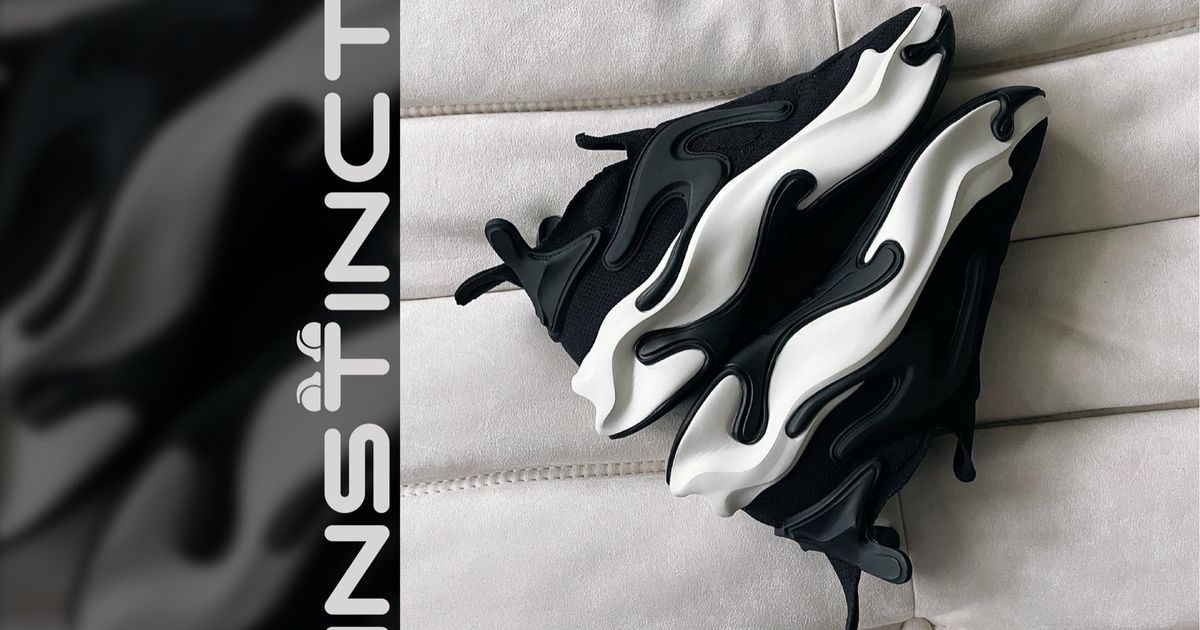
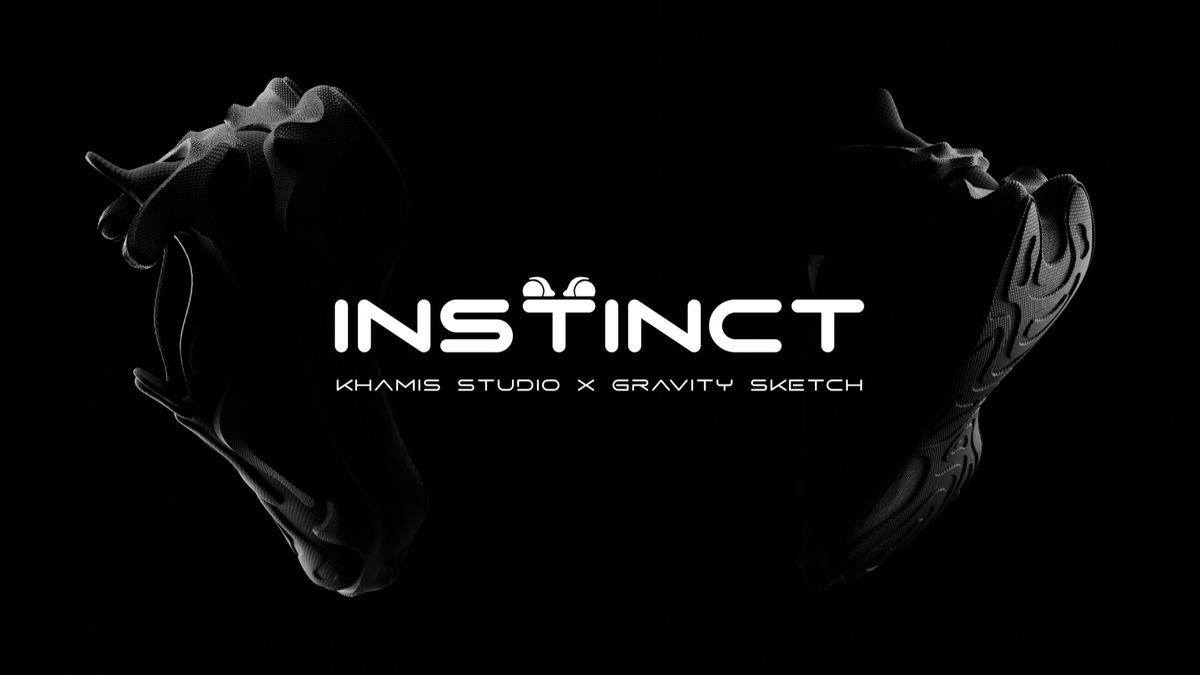
What Khamis describes is the collapse of the translation chain. The designer and the design exist in the same spatial register simultaneously. The intentional gesture (the hand moving through virtual space, adjusting a curve, thickening a zone, placing a texture drawn from natural precedent) produces geometry directly, without the mediation of a two-dimensional representation that requires reinterpretation. The OAC study on The Algorithm of the Hand establishes this unbroken chain of intention as the foundational condition for genuine Material Singularity: not merely that an object is unique, but that its uniqueness is traceable to a continuous line of intent from the maker's body to the object's form, uncorrupted by institutional translation. The Gravity Sketch documentation of the Khamis Studio Instinct shoe, the first sneaker designed end-to-end on that platform, provides a rare, detailed record of what this translation collapse looks like in practice. Khamis brought his inspiration research (dart frog feet; dehydrated cactus surface geometry) into a shared virtual studio and constructed four fully realized concept designs in three-dimensional space directly, a volume of creative output that Gravity Sketch noted would require two to three times the time in a conventional process. Once the design direction was approved, Khamis continued refining the design in VR, exchanging 3D files with a factory partner in Portugal. The factory received Rhino and Gravity Sketch files and returned revision proposals at the millimeter level, a precision that two-dimensional blueprints cannot structurally achieve. The first physical sample accurately reflected the design intent, requiring only minor adjustments, compressing what would normally be two to three full sampling rounds into one. Gravity Sketch documented the workflow, saving three months of development time and eliminating the environmental cost of additional sample production rounds. This is not a workflow optimization in the conventional sense. It is a structural transformation in who controls the object's form across its entire production arc. The designer's intentionality does not dissipate across translation events. It accumulates, from the first VR session through the factory handoff to the finished print. The Legibility of Labor, the traceability of the maker's intention in the finished form, is preserved end to end. The designer is present in the object not as a signature on a technical pack that passed through three other hands, but as the continuous organizing intelligence of the object's geometry from first gesture to final print. In the PLCFA register, this is a claim to sovereignty over the design process itself. In Khamis's studio, the designer's intention does not pass through translation. The designer's body and the design exist in the same spatial register, simultaneously. This is not a workflow innovation. It is the reclamation of authorial sovereignty over the object's form, the Algorithm of the Hand, fully preserved. Khamis arrived at this methodology through the practical failure of alternatives, not through theoretical positioning. He could not communicate his three-dimensional intentions through two-dimensional means without unacceptable loss. He found a tool that eliminated that loss. The theoretical significance of the choice was not the reason for making it, which is precisely the signature of authentic Contemporary Practice in the PLCFA mode: structural conclusions that precede and exceed the theoretical vocabulary that eventually names them. Khamis did not set out to embody a framework. He set out to make a better shoe. The framework recognized him.
One Material, One Form: The Single-Print Object as Post-Luxury Proposition
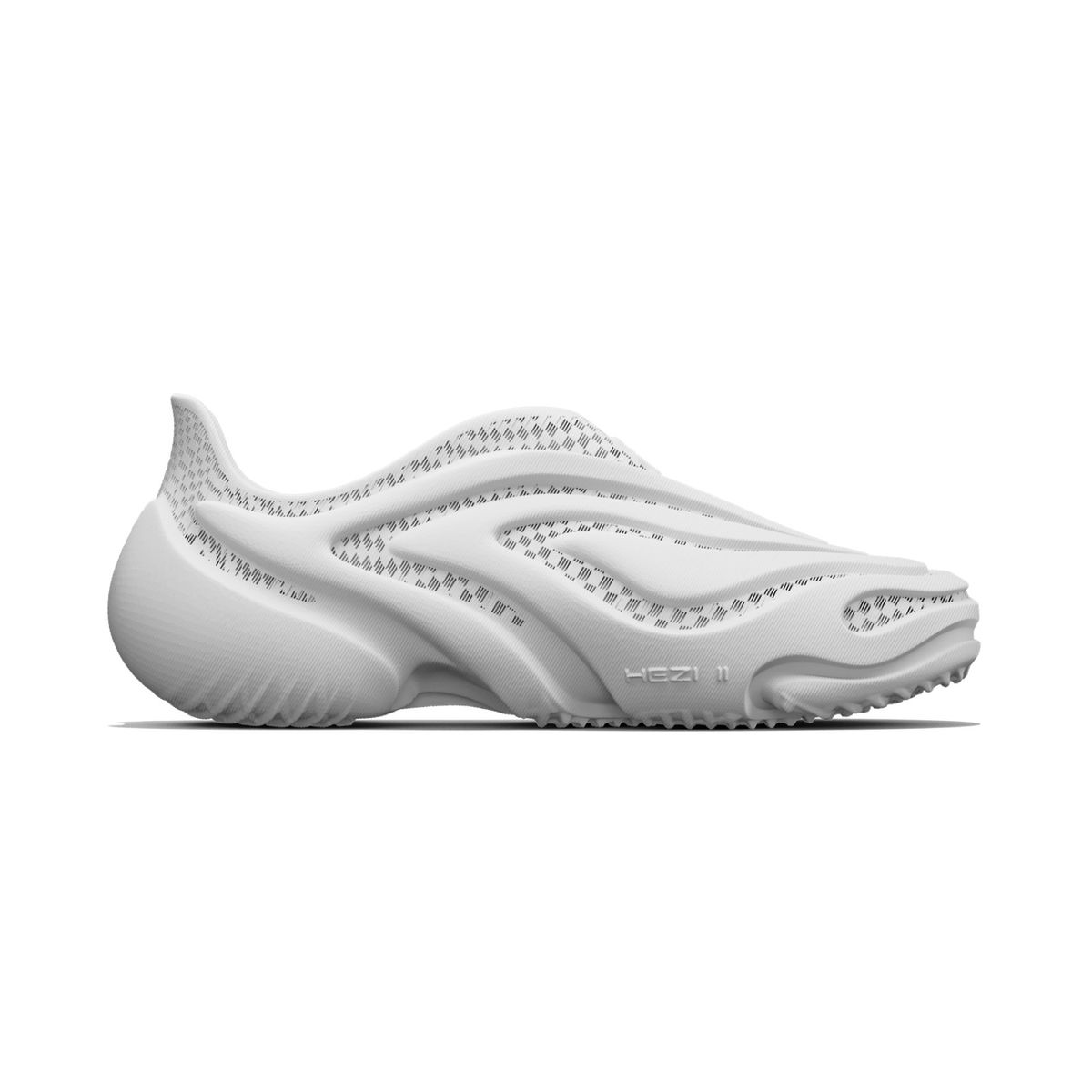
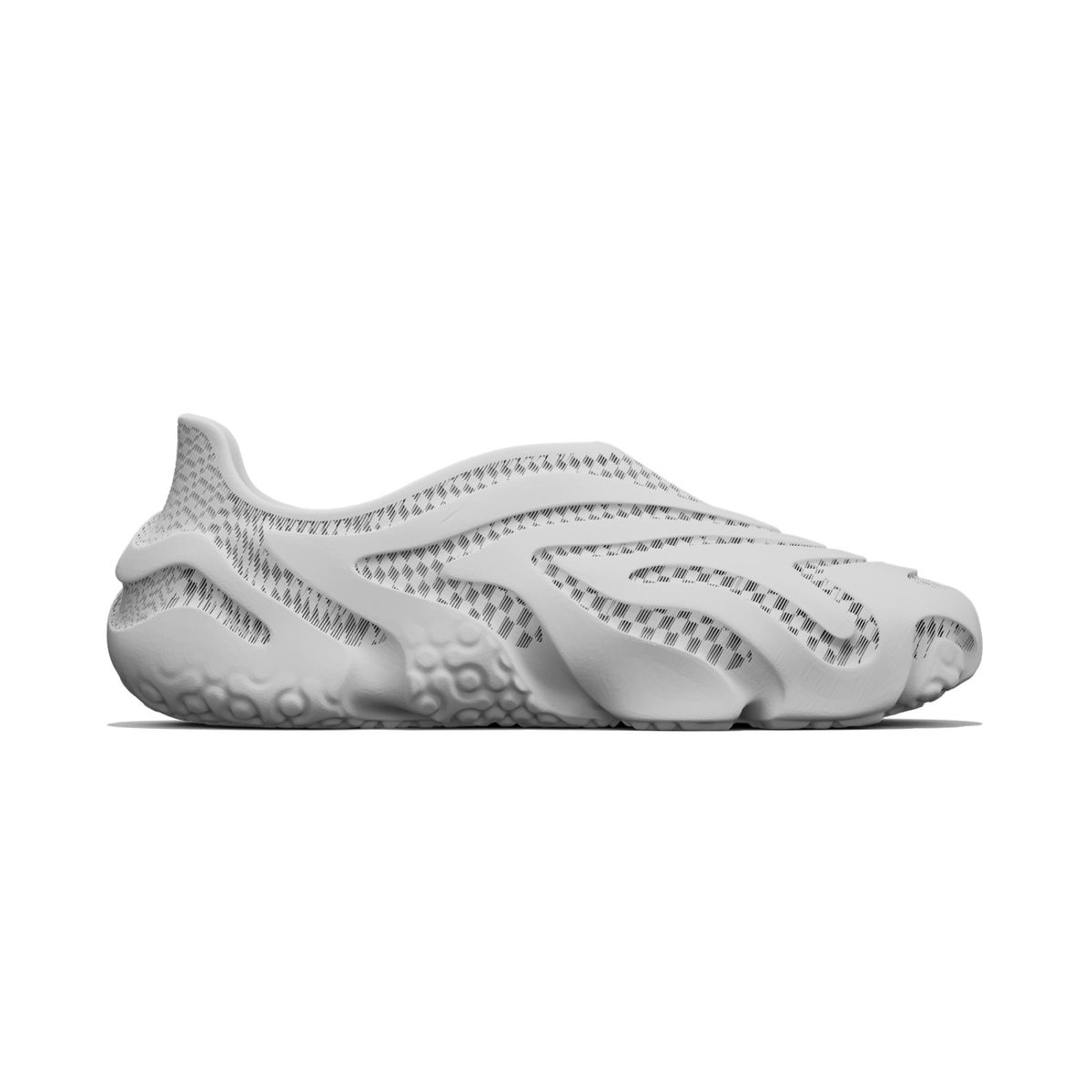
The objects Khamis Studio produces through the Zellerfeld platform share a structural characteristic easy to overlook in coverage focused on their visual novelty: they are made from a single material. The Hezi, the Hezi Slide, the Ero, the Instinct Mule, each is a continuously printed, single-material form built from Zellerfeld's proprietary ZellerFoam, a thermoplastic polyurethane (TPU) lattice structure fused at the point of printing rather than assembled from discrete components. No stitching. No adhesive. No lasting tape. No separate outsole bonded to an upper. No liner inserted after the fact. The object is, structurally and materially, one thing. From a PLCFA perspective, this single-material monism inverts the traditional luxury value proposition at the level of production logic. The conventional luxury shoe accumulates what the PLCFA framework calls Semantic Burden through the multiplication of materials, processes, and specialist hands: calfskin from one tannery, sole unit from another, lining from a third, welt-stitching by a fourth. Each layer is a signal of complexity, of difficulty, of accumulated cost. The Goodyear welt exists as much to be seen as to perform. The calfskin upper exists as much to communicate sign value as to protect the foot. The traditional luxury shoe is a semiotic delivery system that happens to enclose a body part. But this accumulation of components is also a structural liability. Each junction between materials is a site of future failure: the adhesive bond between upper and outsole degrades under flexion and heat; the stitching at the welt eventually loosens; the counter stiffener loses its rigidity; the insole compresses unevenly. The luxury shoe, beneath its surface narrative, is an assembly of incompatibilities held together by adhesives and the consumer's willingness to cycle through new pairs. Planned obsolescence is not ideological in this system. It is material, engineered into the junction between components. Khamis's single-material object eliminates these junctions entirely. There are, in Zellerfeld's own product language, no stitching, glue, or weak points. The object cannot delaminate because it has no layers to separate. The outsole cannot detach because it is not a separate entity. The material that cushions the foot is the same material that protects it from the ground, the same material that structures the silhouette, the same material that will, at the end of life, be returned to the Zellerfeld system and processed into a future print. This is Functional Obligation at the level of material architecture: the object's commitment to the body that uses it is not structurally undermined by manufacturing compromises buried within its construction. The form serves the function completely, because the form is the material, and the material is the function. Khamis articulated the creative consequence of this constraint in his OAC interview:
You already have the 3D last. You have guidelines you have to fall into. It's all one material. So you're just sculpting this thing, you're not putting all these different components together. Now I can just focus on that: full creativity within these guidelines with one material. For the most part, all the functionality and wearability of this footwear will fall in line. I can just now design within these frameworks.
This is precisely the condition the OAC framework identifies as Tactical Friction, the productive constraint that disciplines rather than suppresses creative intention. The single-material mandate does not limit Khamis's design; it forces the design to achieve its effects through form alone, without the option of delegating aesthetic complexity to material multiplicity. Every surface decision (the lattice density that determines flex, the wall thickness that determines support, the geometry derived from the dart frog's foot, and the dehydrated cactus's surface) must do its work through form rather than through material substitution. The Khamis Studio object is, in this respect, more structurally similar to sculpture than to conventional footwear: a single material interrogated to its full potential. The OAC study on Hermès and mycelium biotech identified a distinction between sustainability as a brand narrative and sustainability as a structural commitment. The Khamis Studio single-material protocol is an instance of the latter. The object's recyclability (its capacity to re-enter the material stream at the end of life) is not a supply chain add-on or a marketing claim. It is an inherent property of the single-material construction. A multi-component shoe cannot be truly recycled because its incompatible materials resist separation. A single-material print has no such problem. The Circular Economy argument is encoded in the object's form, not appended to it.
The Foot Scan as Custodian's Contract: The Biometric Binding of Object to Body
After purchasing a Khamis Studio shoe through the Zellerfeld platform, the buyer receives a link to a foot scanning protocol. A standard sheet of paper is placed on the floor as a size reference. A phone held at prescribed angles above each foot. Two images per foot, processed by the Zellerfeld algorithm against a standard size calibration. The resulting data adjusts the printed form's dimensions to account for the specific length, width, and individual asymmetry between the buyer's left and right feet. Every human body's feet are measurably asymmetrical. Industrial sizing ignores this because the mold system cannot accommodate it. The Zellerfeld protocol accounts for it because the print system can. Khamis walked through this protocol in his OAC interview:
"It's not exactly an exact custom fit, but you can adjust things; I have basically attached an algorithm to a standard size, and it can adjust to individual feet. Not only their personal size, but also their individual feet, because some people's feet are not exactly the same length. Maybe not noticeable, but a few millimeters can make a difference with fit."
The foot scan is not a customer service feature. It is a structural declaration. Every object that emerges from this protocol is, by biometric definition, specific to one body. No two buyers with similar standard sizes will receive identical objects. No other body has the same scan signature. The object's form has been organized around data that only one person's body could have provided. This is the material enactment of what the OAC framework designates as the Custodian's Contract at its most literal level: the object was made for this body, which means this body has an obligation to the object that no other body can discharge. The fit belongs to one person, biometrically. The object is, in the most precise structural sense, of that person. The OAC study on The Cost of Stewardship establishes the Custodian's Contract as the formal instrument through which the relationship between an object and its steward is structured as an ongoing obligation, a framework of care and accountability that persists across the object's life, rather than as a transaction that ends at the point of purchase. The Zellerfeld foot scan enacts this principle at the level of material production: before the object exists, the steward's body has already shaped it. The obligation runs in both directions before the object is printed. The body is inside the object. The object is structured around the body. This is the precise inversion of the industrial mold logic. Khamis was candid about the current limits of the scanning system in his OAC interview. It captures length and width in the weight-bearing position, the shape of the foot as it actually contacts the ground under load, but has not yet extended to arch shape, pronation pattern, or the three-dimensional topography of the sole. Zellerfeld's documentation notes that a foot scan taken with the foot elevated produces different measurements than one taken weight-bearing, and that the weight-bearing shape is the correct basis for a fit that functions during actual walking. The direction of development is clear. As the biometric resolution of the scan increases, the object's specificity to its steward deepens proportionally, moving structurally toward the Affective Object, an artifact so precisely calibrated to its steward that its value is constitutively non-transferable, because no other body could engage it as its original owner can. The foot scan is not a sizing tool. It is a biometric Custodian's Contract, the moment at which the industrial object, constitutively indifferent to the body, becomes a Sovereign Object: specific to one life, shaped by one body's particular geometry, before it is even printed. There is also a structural consequence for the resale market that deserves explicit attention. Because every Khamis Studio shoe is custom-printed from a specific foot scan, no pair fits anyone else as well as it fits its original owner. This is not a preference claim. It is a biometric fact. The shoe cannot be resold at a value premium because its primary functional attribute, the precise fit, cannot be transferred to a secondary buyer. The conventional sneaker resale market is predicated on the transferability of speculative value. The Khamis Studio object structurally resists this transferability in its physical geometry. The Anti-Speculative Autonomy of the object is encoded not in legal restriction but in the printed form itself.
The Closed Loop as Anti-Speculative Infrastructure
The Zellerfeld platform includes a material recovery protocol: when a pair of shoes has been worn down, the owner can return the shoes to the Zellerfeld production facility, where they are ground into feedstock and the recovered TPU re-enters the print stream. A future pair of shoes, for a different body, with a different form, may be made from the same physical material that comprised an earlier object. The material is not the object. The material is the substrate through which successive objects pass. The specific object is singular. The material is continuous. Khamis described this system directly:
Since the shoes are made to order and no molds are needed, there's no excess waste material. After being worn down, the shoes can be shredded and reused to make a new pair. This system will be great once more printer farms pop up more locally in the future. A Hezi purchased today could be reprocessed into someone else's shoe years down the line.
This is not primarily an environmental argument, though it carries genuine environmental consequences. It is a structural argument about value. The closed loop eliminates the speculative residual value of the worn object. There is no secondary market for a returned Khamis Studio shoe because the object is designed to re-enter the production stream rather than the resale stream. The material is worth recovering. The specific object (because it was printed to one body's geometry) carries no transferable resale premium for a second body. This is the material infrastructure of Anti-Speculative Autonomy at its most literal: the design of an object whose life cycle structurally routes around the speculative logic of the resale market by giving the object a destiny other than resale. Consider the contrast with the conventional sneaker resale economy: objects manufactured at scale, artificially scarce through limited releases, stored as investment assets by people who will never wear them. The Speculative Velocity of this market is predicated on the object's independence from use; its market value rises precisely to the degree that it remains unworn. The unworn shoe has achieved its maximum market value by failing entirely at its stated purpose. This is the Zero-Sum Aura economy of the industrial sneaker: speculative value accumulated at the direct cost of functional identity. Khamis Studio is, structurally, its opposite. The Anti-Commodity Commitment here is structural, not rhetorical. The OAC study on why traditional luxury's Root Marketing fails to purchase genuine Moral Capital identifies the gap between sustainability claims and structural sustainability commitments as the defining hypocrisy of the contemporary luxury apparatus. Khamis Studio does not make sustainability claims. It has built a sustainability infrastructure. The difference is the difference between a statement and a contract, between a brand narrative and a material protocol.
Nature as Source Code: The Biomorphic Epistemology of Khamis Studio Design
Khamis Studio's design language draws consistently and specifically from natural systems. This is documented across multiple sources: the Gravity Sketch workflow case study, Khamis's published interviews, and his primary OAC conversation, and it constitutes something more than an aesthetic preference. It is a design epistemology: a theory of what constitutes a valid source of formal authority for decisions about how an object should be shaped. The Instinct shoe's outsole texture was derived from the adhesive micro-geometry of the dart frog's foot; the specific surface structure that allows the animal to maintain grip across wet, irregular surfaces without mechanical fasteners. The upper's structural zones were inspired by a cactus in a state of dehydration: as water stress increases, the plant's exterior shrivels into a protective micro-texture that appears soft but functions as a hardened barrier against environmental damage. Gravity Sketch's documentation of this project describes Khamis presenting these sources within a shared immersive VR space before a single line of design geometry had been established, using the natural precedents not as decorative inspiration but as the functional brief for every formal decision that followed. Khamis described the broader principle governing this approach in his OAC interview:
When it comes to trends in footwear styles, I don't typically design based on what's currently in style, at least not for my own brand. I focus on creating things I've always wanted to design. I'm more interested in observing innovations in other product categories and taking inspiration from nature, things with almost perfectly designed functions that evolved naturally.
This is not biomimicry in the superficial sense, the appropriation of organic forms for aesthetic novelty without genuinely learning from them. It is Design with Intent in its most rigorous form: the derivation of formal decisions from functional precedents tested by evolutionary time scales far longer than any design sprint, market cycle, or trend report. The dart frog's gripping geometry has been refined across millions of generations of selective pressure. The cactus's dehydration response encodes millennia of thermodynamic problem-solving. When Khamis's designs derive from these precedents, they inherit what the OAC framework identifies as Functional Endurance, not metaphorically but structurally, in the translation of proven functional geometry into wearable form. This epistemological commitment also constitutes a structural refusal of trend-based design. Trends operate at the tempo of social speed: seasonal, accelerating, depreciating rapidly, and requiring constant replacement to remain relevant. Natural systems operate at geological and evolutionary tempos: stable across human lifetimes, indifferent to the market's appetite for novelty. A design sourced from a natural precedent does not become dated when a color cycle turns. It carries a formal authority that precedes and exceeds the trend apparatus, which is precisely what the OAC framework identifies as Deep Materiality: the grounding of formal decisions in sources that operate below the tempo of social speed and are therefore structurally resistant to the Hollowing that afflicts trend-dependent objects. The OAC study on PoetCore identified the mass-market migration toward objects that carry genuine formal precedent as a symptom of Narrative Permanence hunger, the structural dissatisfaction of consumers who have been offered objects with no stable reference points, whose authority is purely commercial and therefore always temporary. Khamis arrives at the same formal position from a different direction: not as a response to market exhaustion but as a first-principle commitment to design sources that carry inherent temporal authority. The dart frog does not need a press release. The cactus does not require a trend forecast. Their formal intelligence is its own validation.
The Sovereign Brand: Institutional Independence as PLCFA Precondition
Joey Khamis graduated from Purdue University with a degree in Industrial Design. He interned at Columbia Sportswear. He joined Reebok, designing, among other work, the Cardi B Classic Leather, and rose through the corporate structure of one of the industry's major brands. Then a call came from the Yeezy operation. What had seemed like a career path revealed itself as a structural condition, and Khamis understood, in that moment of rupture, that the corporate progression was not a ladder toward creative authority but a series of relocations within the same bounded system. He described this recognition in his OAC interview:
That kind of set me on a path of freedom from everything that has been in place: start as an intern at Reebok, then be a junior designer, then senior, then move on, basically just moving around the same industry, corporate. So that would be the point of setting me off to want to do something that's completely different and my own thing.
The observation is structurally precise. The corporate footwear career path is a lateral movement between the same structural position at different addresses. The designer's creative authority at any given point is bounded by the brand's seasonal brief, the merchandising team's commercial constraints, the sourcing department's material availability, and the legal team's intellectual property parameters. The designer is an instrument of the system, not its author. Even at the level of creative director, the designer's authority over the object's final form is shared with (and frequently overridden by) institutional imperatives that bear no relation to the quality of the design. Khamis Studio is, in the precise PLCFA sense, a Sovereign Object at the institutional level. It answers to no licensing partner. It holds no retail agreements that would redirect its creative output toward commercial avenues. It carries no investor obligations that would introduce the logic of speculative capital into the design process. When Khamis describes his five-year institutional vision in his OAC interview, the ambition is deliberately and conspicuously free of scale imperatives:
I don't have this vision of this is going to be the biggest sneaker brand. I really kind of want to contain it by how big I can make it, within what I can control. I just want to get really, like, masterful at making footwear and eventually expand beyond 3D printing, I'll always do it, but I want to expand on that. I just want to keep it really focused.
This is the Post-Growth position stated as a deliberate business strategy. The refusal to scale for scale's sake is not a failure of ambition. It is the recognition that institutional sovereignty (the ability to make what you want to make, for whom you want to make it, under conditions you control) is the precondition for Anti-Commodity Commitment. An institution that has accepted investor capital has accepted an obligation to the logic of speculative returns. That logic has only one direction: growth, liquidity, and exit. It cannot tolerate the conditions under which Sovereign Objects are made, because those conditions require time, specificity, and the willingness to prioritize depth over volume. Corporations do not have that willingness structurally. Khamis has built a practice in which that willingness is the organizing principle. The OAC study on Luxury Just Split in Two identifies the bifurcation of the contemporary design market: on one side, the data-optimized scale platform serving algorithmically averaged consumer profiles with objects designed for breadth; on the other, the sovereign authored practice serving the specific human being with objects designed for depth. Khamis Studio has chosen its side structurally, not rhetorically. The choice is encoded in its production system (on-demand, no inventory), its distribution model (direct, no wholesale), its design methodology (VR-first, single-material, biometrically calibrated), and its stated institutional philosophy (mastery over scale, control over growth). This is a fully integrated structural position. There is also a geographic dimension to this sovereignty worth naming. Khamis is not operating in New York, Los Angeles, or London, the canonical addresses of the footwear design establishment. He is making work in Indianapolis: a mid-sized midwestern city with its own independent design culture, its own institutional ecosystem, and its own logic for what constitutes success. Distance from the industry's spatial centers of gravity means distance from its social pressures, its seasonal rhythms, and its consensus definitions of relevance. The independent design community Khamis operates within (the First Friday and Penrod circuit through which he has built his local professional network) is not a consolation for not being in New York. It is a different kind of institutional infrastructure, one that does not require participation in the consensus-building apparatus of the major market centers to validate the work.
The Museum Circuit as Patronage Validation: Five Institutions and the Cultural Authority of the Post-Industrial Shoe
The traveling exhibition Future Now: Virtual Sneakers to Cutting-Edge Kicks, co-organized by the American Federation of Arts and the Bata Shoe Museum, curated by Elizabeth Semmelhack, Director and Senior Curator of the Bata Shoe Museum, is among the most significant institutional validation events in the recent history of design-as-art. The exhibition has traveled to six American art museums: the Portland Art Museum (March 2024), the Indianapolis Museum of Art at Newfields (September 2024), the Sarasota Art Museum (2025), the Figge Art Museum in Davenport (May 2025), the Mint Museum in Charlotte (September 2025), and the Kalamazoo Institute of Arts (February 2026). Six art museums (not design fairs, not sneaker conventions, not trade shows) are making the curatorial judgment that footwear designed to address post-industrial conditions belongs in the category of artifacts through which a culture understands itself. The Khamis Studio and Gravity Sketch Instinct shoe appears in this exhibition. Designed end to end in virtual reality, the Instinct is built not as a single-material print but from 3D-printed components fused to an engineered knit upper, developed with a factory partner in Portugal. Joey Khamis attended the Newfields opening on September 27, 2024. The curatorial language of Future Now is precise about what the exhibition is doing: it presents footwear "designed to address industrial-age problems and capitalize on post-industrial possibilities." This is not the language of lifestyle retail. It is the language of institutional critique, the framing of objects as arguments about what industrial production has done wrong and what post-industrial making can do differently. In this curatorial frame, the Khamis Studio objects are not consumer goods on a pedestal. They are structural propositions, displayed as evidence. The significance of this institutional placement cannot be overstated.
Elizabeth Semmelhack operates within the curatorial framework of the Bata Shoe Museum, an institution with 15,000 artifacts spanning 4,500 years of footwear history. Being selected by this apparatus is a form of art-historical placement: the Khamis Studio objects are positioned not merely in relation to contemporary streetwear or consumer design, but in relation to the full sweep of what the human foot has worn, why, and the cultural consequences. When the Bata Shoe Museum's curatorial logic selects a shoe designed end to end in virtual reality, built from 3D-printed components on an engineered knit upper by an independent designer from Indianapolis, it is not making a concession to novelty. It is making an argument about where the trajectory of footwear history is headed, and selecting the objects that best represent it. For the PLCFA framework, this traveling exhibition constitutes Patronage Validation at its most structurally significant: not the object's market price, but the curatorial judgment of multiple significant institutions simultaneously affirming that the object belongs in the category of artifacts worthy of sustained cultural attention. The Khamis Studio shoe's presence in Future Now across six venues is not a promotional event. It is an institutional argument about the object's cultural authority, an argument made by curators whose professional function is precisely to make such judgments. When six art museums place a 3D-printed, VR-authored shoe in the same exhibition as Zaha Hadid and Salehe Bembury, they are not lowering their standards. They are updating their argument about what constitutes cultural authority in the post-industrial object, and confirming that Functional Obligation to the specific body is a form of cultural statement the institutional apparatus must now account for.
The curatorial strategy of displaying such objects in encyclopedic art museum contexts also identifies a challenge that Khamis Studio's practice sharpens. The White Wall Paradox, the OAC's diagnosis of the neutralizing effect of the white cube on objects that derive their meaning from use context, material specificity, and functional relationship to a body, is particularly acute for footwear. A shoe displayed on a plinth, lit from above, with no body inside it, has had its primary functional argument suspended. The visitor sees the form but cannot experience the fit. The Instinct's functional argument, the engineered knit upper and the grip geometry drawn from natural precedent, worked out to move with the foot, is invisible in the display condition. This is not a failure of the curatorial apparatus; it is the structural challenge that the post-industrial functional object poses to any institutional presentation. The exhibition acknowledges this challenge without fully resolving it, which is itself an important institutional admission: that the traditional museum display logic was designed for objects that are complete when removed from use, and that the PLCFA object is not such an object.
Where Khamis Studio Stands: A Practice at the Structural Frontier of Post-Industrial Design
In 2022, Khamis Studio launched with a small catalog of 3D-printed footwear produced on demand through the Zellerfeld platform. By 2024, its objects were in six American art museums. By 2025, the practice had documented international interest, a direct-to-consumer model that required no wholesale partnership, a design methodology that had eliminated three months of conventional development time on a single project, and a production protocol that generated zero excess inventory on every unit produced. The trajectory is not that of a fashion brand scaling toward market dominance; it is that of a design institution achieving structural clarity, finding, with each decision, a tighter alignment between its stated values and its actual operating conditions.
The Khamis Studio catalog, as it stands, demonstrates range within the constraints of the single-material print system. Hezi established the brand's functional proposition. The Ero extended the formal language in a more architectural direction. The Instinct, designed in VR in partnership with Gravity Sketch, inspired by the dart frog and the dehydrated cactus, built collaboratively with a Portuguese factory whose engineers worked in the same three-dimensional file format as the designer, and constructed from 3D-printed components on an engineered knit upper rather than as a single-material print, is the shoe the museum circuit selected. It represents the practice's most fully realized articulation of what the VR-to-production pipeline can do when given sufficient time and creative ambition. The Instinct, the runner referenced in Khamis's OAC interview, is itself the first of these hybrid constructions, a partially printed shoe incorporating knit components produced with a factory contact in Portugal, and it points toward the next phase of the practice: a gradual expansion beyond the fully printed form into hybrid constructions that maintain the design sovereignty of the single-authorship model while extending its material vocabulary. Khamis was explicit in his OAC interview about the direction he intends to grow:
Eventually, you know, it could build that up to use that as a way to invest in making traditional shoes with laces and leather and all the different materials and stuff like that. Right now, it's just the four printed models and that one runner. I just want to get really, like, master making footwear, and then expand from there.
This is a precise articulation of what the PLCFA framework identifies as Functional Endurance as a developmental strategy: mastering one domain completely before extending into the next, building the practice's formal authority through depth of engagement with each constraint rather than breadth of production across many simultaneous directions. The 3D-printed single-material form is not a limitation Khamis is enduring until he can afford traditional production; it is the proving ground for a set of design and production principles (body-specificity, material integrity, sovereign authorship, closed-loop accountability) that will carry over into every subsequent phase of the practice, regardless of the materials or processes involved.
The question of the concept object, the one-off made for display rather than use, the shoe taken to its formal extreme without the constraint of wearability, is also a live frontier for Khamis Studio. In his OAC interview, Khamis described the conceptual VR work of his early career: forms loosely organized around a foot that "don't even look like shoes really," made during the period when he was learning the VR tool and allowing himself formal freedom he has since disciplined into the brand's production catalog. He acknowledged in the interview that he "would be curious about doing more conceptual stuff," a one-off for a fashion show, a celebrity appearance, an athlete requiring something spectacular for a high-visibility moment. The VR capability to produce such objects has existed within the Khamis Studio practice and has always existed. The question is when the practice will formally open a channel for it, and what institutional framework will receive such objects when it does. The museum circuit that has already validated the functional objects provides the platform. The design methodology provides the capability. The Sovereign Object logic of the practice provides the justification. The concept object is already there, waiting for Khamis to give it permission.
What Khamis Studio represents in the contemporary design landscape is something that the industry does not yet have adequate language for, which is part of why OAC is providing it. It is not a luxury sneaker brand; it has no interest in the resale market, no interest in scarcity as a commercial strategy, no interest in the celebrity endorsement apparatus that drives conventional sneaker cultural capital. It is not a sustainability brand; it makes no sustainability claims and requires no greenwashing. It is not a technology company; the technology is a tool, not the brand identity. It is not a streetwear label, not a fashion brand, not a design studio in the conventional sense of a practice that takes commissions from other brands. It is a Post-Luxury Conceptual Functional Art practice operating in footwear, a domain the PLCFA framework has not previously had occasion to examine in a practitioner who so completely embodies its structural conditions. The biometric specificity of the foot scan. The single-material integrity of the print. The closed-loop accountability of the material recovery protocol. The VR sovereignty of the design process. The institutional validation of the museum circuit. The geographic independence of the Indianapolis practice. The deliberate scale constraint that protects the creative authority of the maker. Each of these conditions, taken alone, would be noteworthy. Taken together, they constitute a practice that has independently arrived at the PLCFA framework's most demanding requirements without having been introduced to them. This is what the framework has always claimed was possible: that the structural logic of the Sovereign Object is not a theoretical proposition but a practical one, achievable by any maker who is paying close enough attention to what the object actually requires. Khamis Studio did not set out to embody a framework. It set out to make a better shoe, one that fits the foot that wears it, is made of a material that can be recovered, is designed without intermediaries, and is produced without excess. The framework recognized the practice. That is how it is supposed to work.
CODA: What Khamis Confirms, and What the Industry Has Yet to Reckon With
Khamis Studio confirms several structural propositions of the PLCFA framework that have been debated as theoretical positions but are here instantiated as live, documented, commercially operational practice: That Material Singularity can be achieved through technological processes as fully as through traditional craft. The mechanism is not the determinant of singularity. The commitment to specificity at every node of production is. The VR-designed, 3D-printed, foot-scanned Hezi is as singular as any hand-stitched bespoke object, because at every stage of its production, the system has asked the question: who, specifically, is this for? And organized the object's form around the answer. The One Original Principle does not require the hand as its mechanism. It requires the body as its organizing principle. When every output is calibrated to a specific biometric signature, the one-to-one relationship between object and steward is structurally guaranteed regardless of whether the final form is traced by a human hand or a print head. That Anti-Speculative Autonomy can be encoded in a material protocol. The closed-loop material recovery system removes the object from the speculative market by giving it a destiny other than resale, the return to the material stream, the dissolution of the specific object back into the substrate that will produce the next specific object for the next specific body. This is not a legal restriction. It is a material logic. That institutional sovereignty, the decision to control scale, resist investor obligation, maintain creative authority, is a structural precondition for PLCFA practice, not a lifestyle preference. The institution that has surrendered governance to speculative capital cannot produce Sovereign Objects. It can produce objects that perform sovereignty as a brand attribute while remaining structurally hollowed, governed by incentives that the object's surface cannot acknowledge.
What Khamis Studio leaves structurally open, the productive frontier toward which this study points rather than closes, is the full realization of the concept object and the expansion into material plurality beyond the single-material print. Khamis has built the making protocol for a PLCFA footwear object in one register: the precisely fitted, single-material, closed-loop form. The next register is the object that is not primarily about fit at all, the object that is primarily about form, about argument, about the designer's spatial intelligence liberated from functional constraint. The VR tool is already capable of producing this. The practice is structurally ready for it. The museum circuit that has already received the functional objects is the institutional context in which such objects would be understood. The question is simply whether Khamis will turn the corner from mastery of the constrained form to the freedom of the unconstrained one.
The industry, meanwhile, has not yet reckoned with what Khamis Studio represents. The major footwear corporations continue to invest in the mold system, the minimum order, the anonymous supply chain, and the seasonal release cycle. They produce sustainability reports while structurally requiring overproduction. They claim design innovation while routing all design authority through commercial approval processes. They describe their products as personal while producing objects calibrated to the widest possible demographic average. Khamis Studio has not won against these corporations. It has simply stepped outside the logic that makes their contradictions necessary and begun building something whose internal consistency they cannot replicate without dismantling their own economic architecture. That is what a Post-Luxury Conceptual Functional Art practice looks like when it operates in a domain the establishment controls: not a confrontation, but a structural alternative. Not a critique issued from outside the system, but a practice that has rendered the system's logic unnecessary by making objects the system cannot make. One body, one object, one material, one designer, one loop. That is the whole equation. Khamis Studio has solved it.