The Objects Are Not the Evidence: Will Higgins's The Speedway's Attic
On a wall label that tells you the evidence is fake, and on what that makes possible
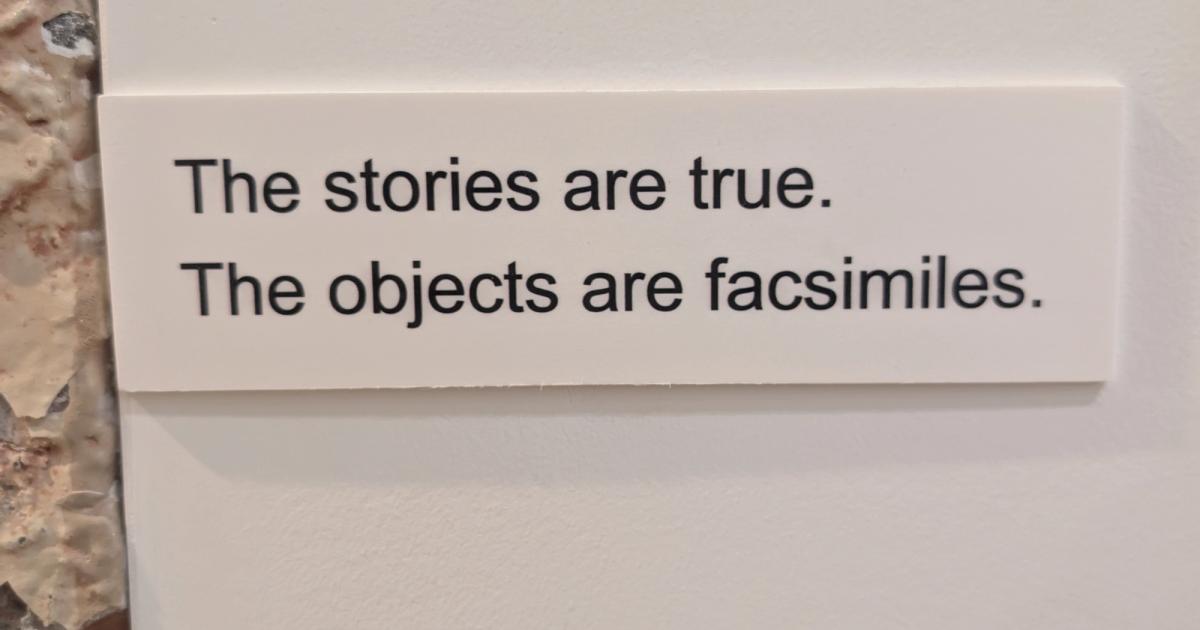
Mounted on the wall of the Research Gallery at CAMi in Garfield Park, Indianapolis, at roughly the height and weight of the title wall, is a label carrying two sentences and nothing else.
The stories are true. The objects are facsimiles.
It is positioned so that a visitor meets it while looking at the objects. Before anyone can be deceived, the exhibition tells them that everything they are about to examine is a reproduction, and insists in the same breath that the research behind it is true. This study is about what that label makes possible, and about what it does to a method this institution has been operating on since it was founded.
The show
Will Higgins, The Speedway's Attic, ran from 1 May to 16 August 2026 in the Research Gallery at CAMi, 1125 Cruft Street, curated by Shauta Marsh. CAMi is a programme of Big Car Collaborative. Admission was free. It closed on the day this institution's founder walked through it.
The exhibition's own card states its position without hedging. Every city has an official version of itself, and Indianapolis has the Indianapolis Motor Speedway: monument, mythology, Greatest Spectacle in Racing. Then: this is not that. The Speedway's Attic is unofficial. It is unsanctioned. The stories here are hard to believe, but believe them, they are true, all of them.
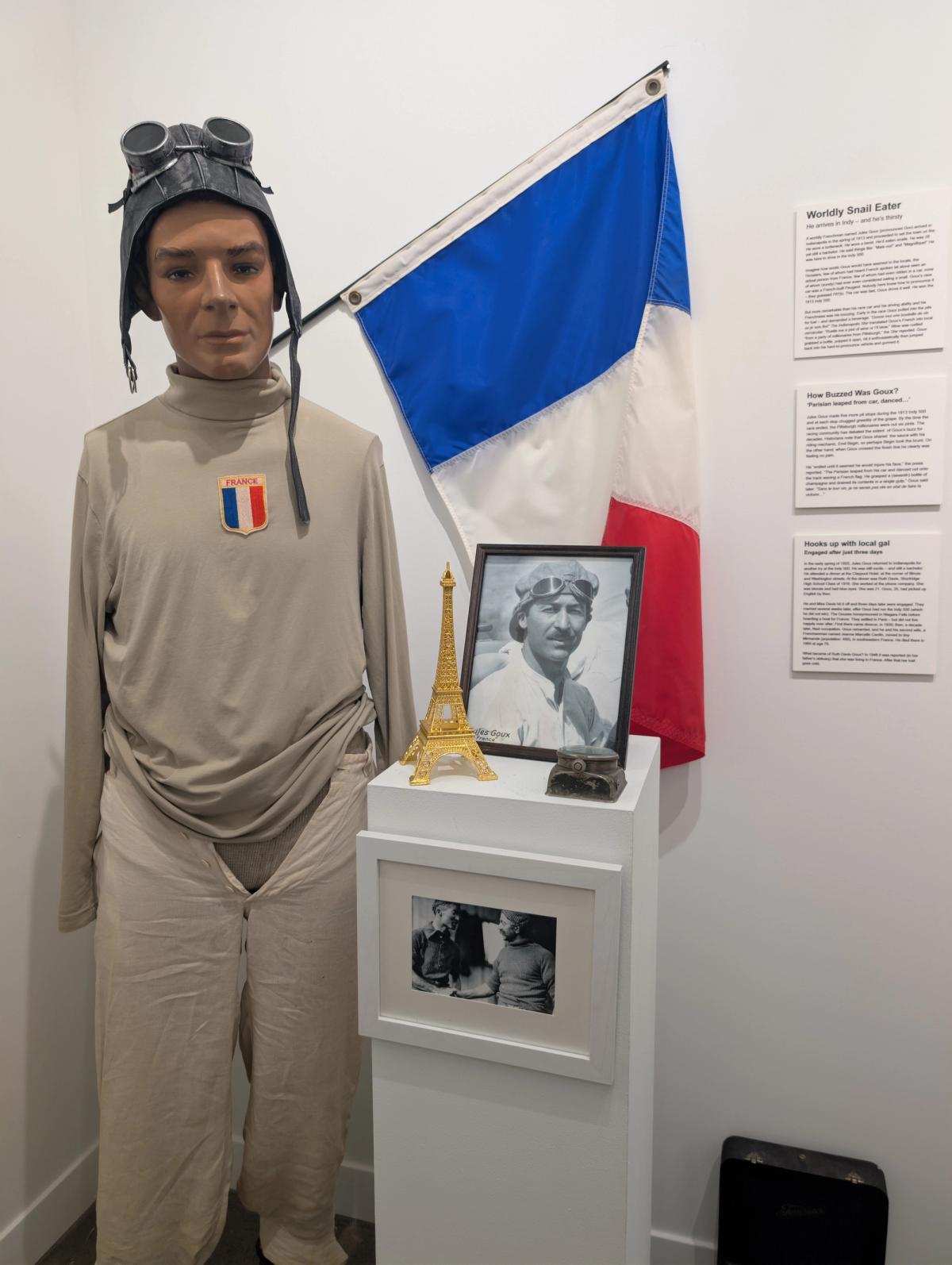
What it assembles, from newspaper archives, oral histories and what the card calls the margins of the official record, are the stories that did not make the monument. The hillbilly machine gunner who charged race fans twenty five cents to see Mrs Adolph Hitler's underpants. The French driver who drank six pints of wine mid race and won. The fan who mooned fifty thousand people and then delivered the photographic evidence himself on his paper round the next morning. The card's summary of its own purpose is the best sentence anyone has written about it: together they map what a city chooses to remember, what it lets fade, and what keeps surfacing anyway.
It is an object show. Mannequins in racing coveralls and leather flying helmets. A Mercedes grille with the three pointed star. Beatle boots on a plinth. Spectacles in a vitrine. Garments hanging on a wall under the heading The Snakepit. Framed portraits, dense wall text beside every group.
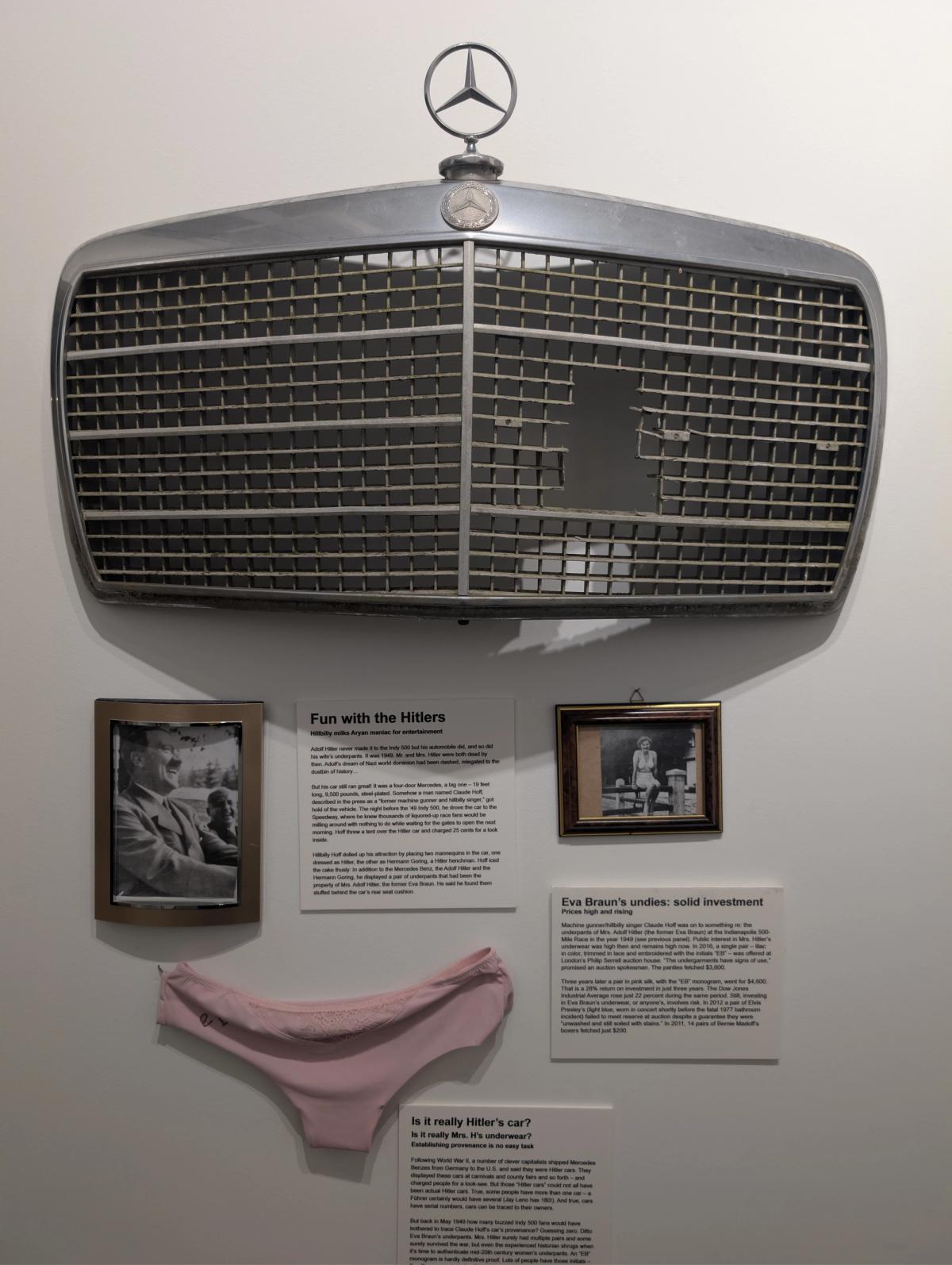
And every one of those objects is a facsimile, by the show's own declaration.
What the label does
Consider the exhibition's problem before the label solves it.
The research is real. Higgins spent decades in newspaper archives and in conversation with people who were there. But the material evidence for a story about a man selling glimpses of underpants attributed to Eva Braun does not exist in any acquirable form, and could not be authenticated if it did. No museum could exhibit that object as genuine. No provenance chain is available. No registrar would accession it. The stories that did not make the monument are precisely the stories whose objects were never kept, because keeping is what the monument does and these are the things it declined to keep.
An institution facing that problem has three ordinary options. Exhibit documents and photographs only, and accept that the show becomes a reading room. Exhibit objects and imply authenticity, which is fraud. Or exhibit nothing.
The label is a fourth option and it is the reason the show exists in the form it does. Declaring the objects facsimiles converts an insurmountable provenance problem into a design decision. Once the visitor has been told, the object stops making a claim about its own history and starts doing a different job: giving the research a body that a person can stand in front of. A pair of pink underpants in a vitrine, captioned and lit, is no longer a relic and is not pretending to be one. It is an illustration with the dignity of an exhibit and none of the deceit.
The objects in this show are not evidence and are not claiming to be. They are the research given a shape you can walk around.
The line this institution has to answer
Objects of Affection Collection holds, as its method statement, that the objects are the evidence. The whole apparatus follows from it: the object registry, the provenance record, the Custodian's Contract, the insistence on Material Singularity, that singularity be earned in the object rather than administered. This institution studies things because things are where the human relationship becomes checkable.
The Speedway's Attic holds the opposite and puts it on the wall. The research is the evidence. The objects are honest illustrations of it. And the show is not weaker for it. It is a serious piece of historical work whose objects carry no evidentiary weight whatsoever and do not need to.
This is a genuine challenge and it should not be absorbed with a qualification. The correct response is to be precise about the boundary rather than to widen the doctrine until the case disappears inside it.
Here is the boundary. This institution's method holds where the object is the thing under investigation: where what a person did with a specific thing, what it cost, who kept it, and what was promised with it is the question. It does not hold where the object is a device for communicating a finding reached by other means. Higgins is not investigating the grille. He is investigating a story, and the grille is how a wall makes the story stand up.
A framework that could not tell those two situations apart would call this show fraudulent, which would be both wrong and stupid. Stating the limit is more useful than defending the reach.
The attic is the reporter's, not the racetrack's
The title invites a reading it does not support, and the misreading matters because it changes who the study is about.
An attic implies an accession policy nobody wrote down: things that arrived without anyone deciding they were a collection. Read that way, the show would be about how the Indianapolis Motor Speedway ended up holding objects it never chose, and it would require this institution to make claims about how that organisation manages its collection.
The show is unsanctioned, and it says so twice on its own card. There is no racetrack attic here. The attic is Higgins's. It is what a journalist accumulated across a working life spent on the margins of an official record, and it exists in notebooks, archives and memory rather than in a store room.
That reframing sharpens the question and removes the exposure at the same time. The question is not how an institution manages what it kept. It is who holds an institution's history when the institution did not collect it. The show's answer, delivered as policy rather than argument: whoever did the research holds it, and the objects get made afterwards.
Unsanctioned, and paid for by the city
The card carries its funders in the ordinary place, at the foot, and the list is worth reading against the word unsanctioned two columns to its left.
The exhibition was made possible by The Efroymson Family Fund, The Andy Warhol Foundation for the Visual Arts, the Allen Whitehill Clowes Charitable Foundation, the Indy Arts Council, and the City of Indianapolis. CAMi itself, as a programme of Big Car Collaborative, carries a further wall of some forty supporting foundations and civic funders.
So the city of Indianapolis helped pay for an unofficial and unsanctioned account of the Indianapolis Motor Speedway. That is not a contradiction and it is not a scandal, and the interesting thing is why it is neither.
Unsanctioned, in the card's use, means one specific thing: not authorised by the Speedway. It does not mean unfunded, unhoused, or outside the institutional field. The show sits inside a museum, is curated by a named curator, is underwritten by a national visual arts foundation and a municipal arts budget, and lists both on its own literature. What it lacks is the permission of the single organisation whose story it tells.
That distinction is precise and it is the condition most critical work now operates in. An institution's history can be assembled, funded, curated and publicly exhibited without that institution's consent, and the only thing the missing consent removes is access to the institution's own objects. Which returns the study to the label. The facsimile is what the absence of sanction costs, and what it costs is exactly the objects. Lacking permission, you cannot borrow the collection. So you make the collection, and you say that you made it.
A man who founds institutions to hold what none of them will
Higgins, born 1956, was first a history major, then a tennis professional, then a repo man. As a journalist he covered Ku Klux Klan rallies in the rural Midwest, the war in Iraq, and a run of homicides in Gary, Indiana, alongside stories such as a woman who found on her back stoop what she believed, wrongly, to be a two headed ant, and considered how best to monetise it.
The exhibition card also records, without comment, that he is the founder of the Museum of Fabulosity, the American Association of Linear Bocce, and the American Society of Presidential Urine Collectors.
That list reads as a joke and should be read twice. It is the same gesture as the exhibition. Each is an institution founded to hold material that no existing institution would take: a museum for the fabulous, an association for a sport that does not exist, a society for a collection nobody sane would accession. A person who founds three institutions for unhousable material and then assembles an unsanctioned archive about the most institutionalised object in his city is not being whimsical in one activity and serious in the other. He is doing one thing consistently.
This institution recognises the move, because it is the move. An institution is what you build when the material you care about has nowhere to live.
What the facsimile costs
The label is not free and the study should say what it gives up.
An authentic object carries information its reproduction cannot. Wear tells you about use. Repair tells you about value. Material tells you what was available and what was afforded. A real garment from the Snakepit in 1969 would carry evidence about who wore it and how, in a form no maker of a facsimile could reconstruct, because the maker only knows what the story says. The facsimile can only contain what its maker already believed. It cannot surprise the researcher, contradict the story, or be re examined later by someone with a better question.
So the show has traded away the one thing an object is uniquely good for, which is being evidence against the account of it, in exchange for being able to tell the story at all. That is a real trade and the show is open about having made it. It is the same trade a reconstruction drawing makes, or a museum period room, and it is honourable when declared and dishonest when not.
What the label protects is the visitor's ability to know which they are looking at. That is the whole ethical content of the decision, and it is contained in six words on a wall.
What is not established here
This study rests on the exhibition's own printed card, on fifteen photographs made in the gallery on the closing day, and on the public listings. It has limits and they should be stated.
The facsimile label was photographed and read; whether identical wording appears elsewhere in the show, or whether individual object labels repeat it, is not known from this material. How the facsimiles were made, by whom, and to what standard is not stated on the card and has not been established. Whether any object in the show was authentic, with the label functioning as a blanket rather than a universal, is not something fifteen photographs can settle. The opening date is given as 1 May on the card and as 7 May in some coverage; the card is preferred here. Nothing in this study rests on the truth of any individual story Higgins tells, because this institution has not checked them and the show's claim that they are true is reported rather than verified.
Each of these is answerable by the artist or the curator and none is answerable by looking harder at what is already held.
The closing day, stated at its actual size
This institution's founder walked the show on 16 August 2026, its final day, and made fifteen photographs across six minutes and forty seconds. Those photographs, with the printed card, are the material this study rests on.
It would be self serving and untrue to describe that as the surviving record of the exhibition. Six minutes is a visitor's walk through. CAMi holds its own documentation, the curator has hers, the artist has his, and the funders have their reporting. What this institution holds is a record of the closing day, not the record of the show.
The distinction is worth making precisely because the temptation runs the other way. A study about who holds an institution's history, written by an institution that photographed the thing on its last afternoon, would find it very easy to conclude that the answer is itself. It is not, and noticing the pull is more useful than pretending it was not there.
Coda
The show closed on 16 August 2026. The objects were facsimiles, so nothing irreplaceable came down. The research remains, in the possession of the man who did it, which is where it was before the show and where it will be after.
That is the argument completing itself. An exhibition about what a city chooses to remember, assembled from what the monument declined to keep, built out of objects that were never the point, in a gallery that gave it three and a half months. The stories were the holding all along. The objects were how the holding was made visible for a season, and they were honest about it on the wall.