Frida Kahlo: Unmasking the Speculative Velocity Behind Her Icon Status
On five portraits, a self-authored image, and the machinery that converts a painter’s face into a financial instrument.
How Frida Kahlo became a cultural icon is usually told as a triumph: the Frida Kahlo portraits multiply across tote bags, murals, and museum banners until her icon status seems like the natural afterlife of a great painter. This study conducts a different accounting: a legacy deconstruction. Read through the PLCFA framework, the evolution of Kahlo’s iconography is a precise record of Speculative Velocity converting Material Singularity into a Hollowed Object: a face that circulates at maximum speed precisely because it has been detached from the paintings that earned it. The occasion is Tate Modern’s 2026 exhibition and the Artsy editorial that distills it to five works. The argument is a correction: of the market, and of our own institutional council.
The Council Assumed Five Paintings. The Record Shows Something Stranger.
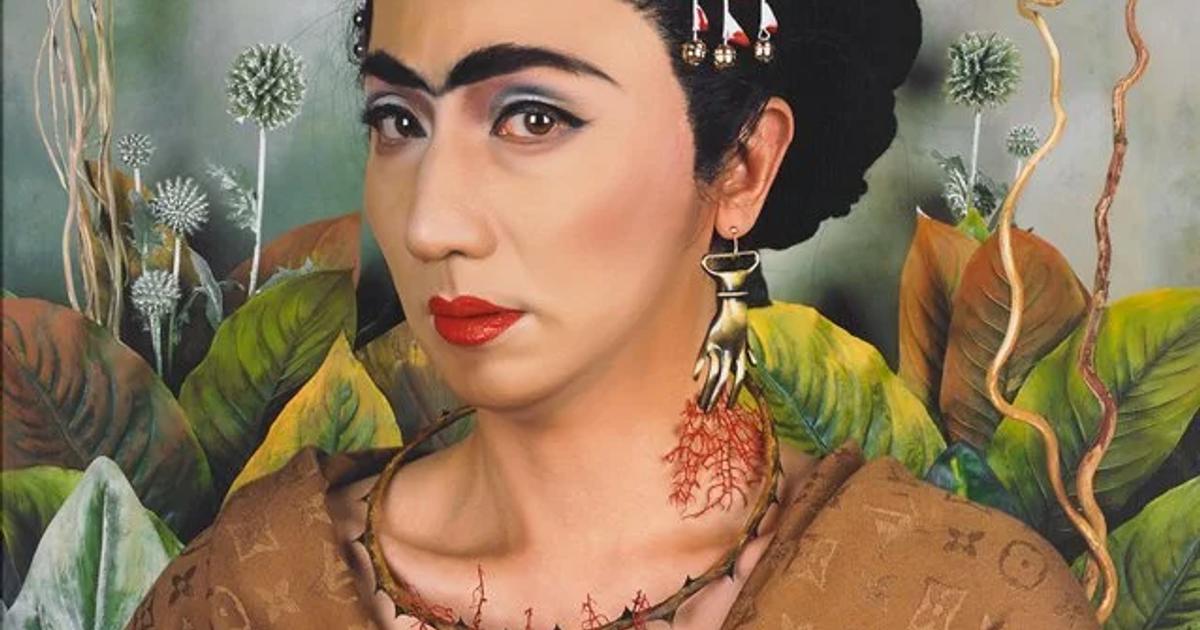
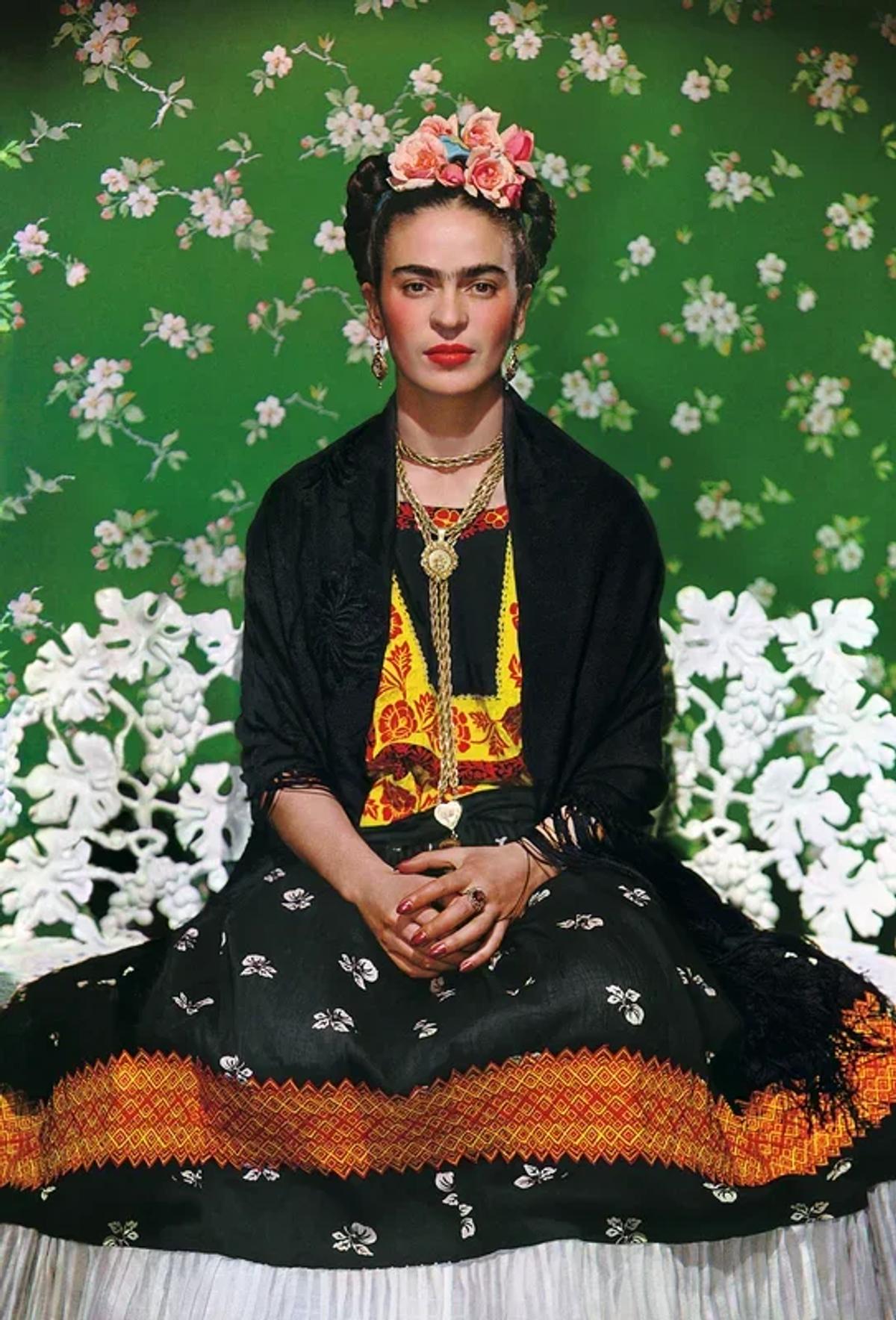
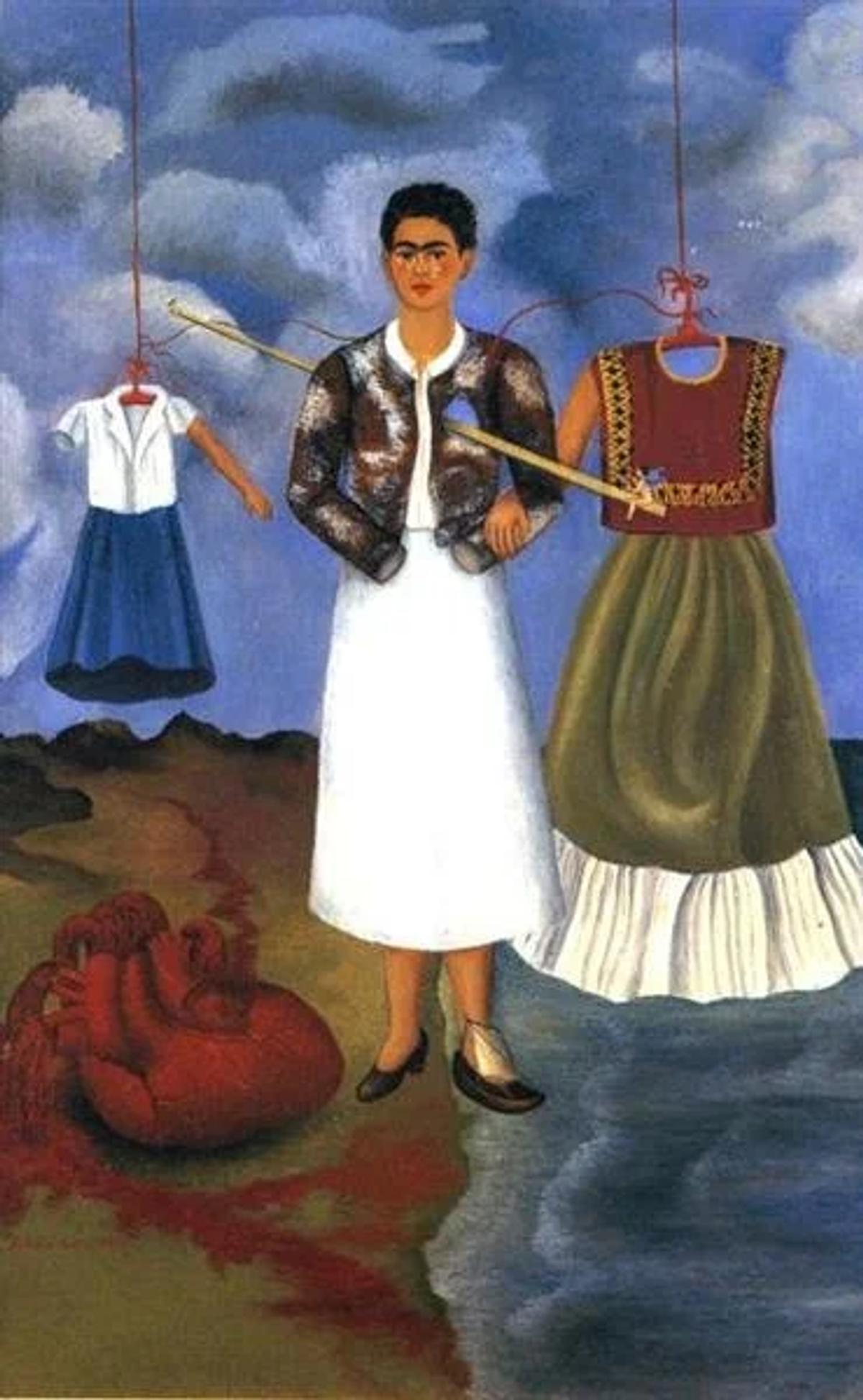
OAC’s twelve-agent Arena argued this signal as a case of reduction: five self-portraits selected from a complex oeuvre and atomized for consumption. Verification against the primary record corrects the premise, on the record. Of the five works, only three are paintings by Kahlo. Self-Portrait (With Velvet Dress) (1926), Memory (The Heart) (1937), and Self-Portrait with Loose Hair (1946). The fourth is a 1939 photograph of Kahlo by her lover Nickolas Muray; the fifth is Yasumasa Morimura’s 2001 photographic self-transformation into her.
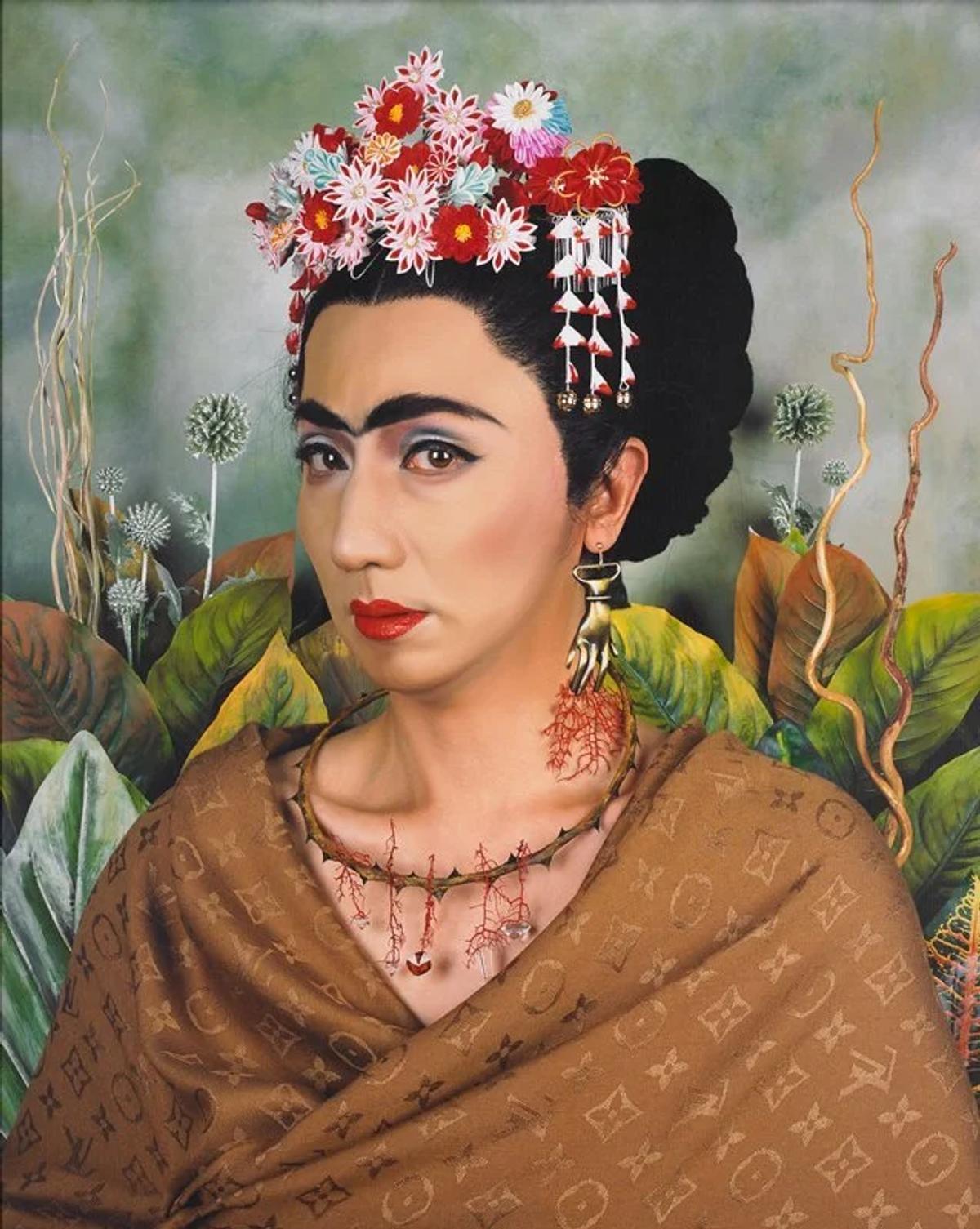
The correction matters because it dissolves the comfortable villain. The icon was never a compressed set of paintings; it was always a distributed image-system (canvas, photograph, reinterpretation) and Kahlo herself built its first circuits. Any honest cultural symbolism analysis of Frida Kahlo must begin there: the question is not whether the image would circulate, but who would govern the circulation once she could not.
An icon is not a successful painting. It is an image that no longer needs its painting.
1926: The First Self-Portrait Was Already an Instrument
Self-portraiture was never a neutral form of documentation for Kahlo. She painted Self-Portrait (With Velvet Dress) at nineteen, in the long convalescence after the 1925 bus accident that rebuilt her life around pain, and she made it for a specific transaction: to recover the affection of Alejandro Gómez Arias, the first love who had stopped visiting. She composed herself in the Renaissance manner he admired, the poise borrowed from Botticelli, dedicated the work to him on the reverse, and inscribed it “Today still goes on.”
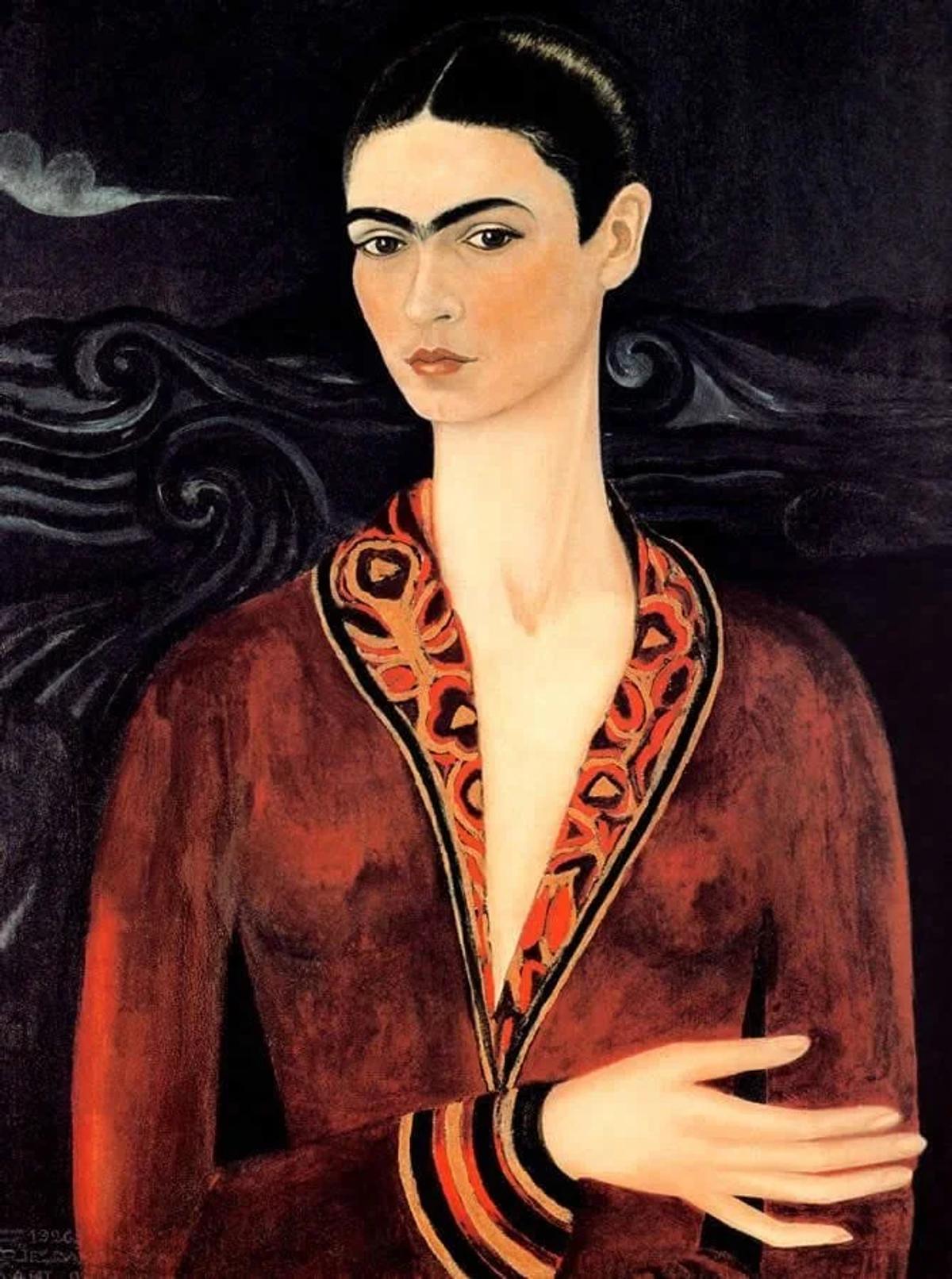
The origins of the Frida Kahlo brand identity are here, and they are not innocent of exchange: the portrait was made to move a particular viewer, to perform a self that could survive a broken body. What distinguishes it from everything the market later built is that the instrument and the Trauma Provenance were one object: the suffering, the labor, and the address were fused in a single canvas that could be owned by exactly one person. The painting is an argument that an image can carry a wound without abstracting it. Everything that follows in this study is the history of that fusion being taken apart.
The Architect of Her Own Icon
The second Arena correction: our council’s dominant frame treated iconization as something done to a passive subject: pure Institutional Necrophagy. The record shows Kahlo was the original architect. She adopted the Tehuana dress of her mother’s Indigenous heritage as a deliberate public grammar; she curated her braids, flowers, and jewelry into a repeatable visual signature; she collaborated with Muray for a decade, whose 1939 Frida on White Bench fixed that signature in Kodachrome. She staged her difference, the unconcealed brows, the faint mustache of Self-Portrait with Loose Hair, painted while her spine was fused and her sense of self was not, against every convention of femininity available to her. This was authorship, not accident: Mexican art’s most disciplined act of self-fashioning.
Fairness requires the distinction: the necrophagic phase is posthumous. It begins where her authorship ends, at her death in 1954, when the image she governed became an estate no one had prepared to govern. The living artist ran her own image at her own speed. The posthumous art market runs it at the market’s speed. That difference in velocity, not the existence of the image, is the entire diagnosis.
Kahlo built the image; the market built the instrument. Confusing the two is how the hollowing hides.
From Face to Sign: The Impact of Reproduction
The impact of reproduction on Frida Kahlo’s art follows the trajectory Walter Benjamin mapped for mechanical reproduction: each copy detaches the image a little further from the unique presence of the original, converting ritual value into exhibition value, and exhibition value into simulacrum. Kahlo’s case is the extreme instance because the reproduced unit is not a painting but a face: croppable, printable, wearable, meme-able, and the face circulates without the pain-economy the paintings insist on. Guy Debord’s spectacle completes the mechanism: the commercialization of Frida Kahlo’s image proceeds by separating the sign from the labor, then selling the sign as if it were the labor.
This is the Zero-Sum Aura dynamic in its purest form. The aura spent by ten million reproductions is withdrawn from a finite account: the roughly two hundred paintings, a third of them self-portraits, that constitute the actual estate of her hand. Reproduction did not spread the work. It replaced it: for nearly everyone, nearly everywhere, the encounter with “Frida” is now an encounter with a licensed surface.
$54.7 Million: The Price of the Dream
The market value of Frida Kahlo’s image has a hard number attached to its painted substrate. In November 2025, El sueño (La cama) (1940) sold at Sotheby’s New York for $54.7 million, the highest price ever paid at auction for a work by a woman artist, surpassing the $44.4 million Georgia O’Keeffe record that had stood since 2014, and outrunning Kahlo’s own 2021 record of $34.9 million for Diego y yo. The art market reported the number as a feminist milestone. The PLCFA reading is colder: records of this kind are the visible spike of post-mortem financialization, where scarcity is guaranteed by death and demand is manufactured by the very icon-circulation the paintings never authorized.
Note the asymmetry that the milestone narrative conceals. The painting that set the record depicts Kahlo asleep beneath a skeleton, a work about mortality made by a woman who spent her life strapped into orthopedic corsets. Its price was not produced by two hundred canvases; it was produced by the billions of impressions of a face on merchandise, each one compounding the auction provenance of the few objects left to sell. The legacy of Frida Kahlo beyond art, the activist symbol, the feminist shorthand, the national emblem, is the marketing department of the auction lot. This is Structural Captivity: the singular object held hostage by the liquidity of its own sign.
A record price does not measure the painting. It measures the velocity of everything that detached from it.
Who Owns the Face: The Custodial Fracture
Who owns Frida Kahlo’s image rights is a question with no clean answer, and the unclean answer is the diagnosis. Kahlo died intestate in 1954; her property rights passed to her niece, Isolda Pinedo Kahlo. In 2004, the Frida Kahlo Corporation was formed to commercialize the brand globally. By 2018, family members and the corporation were in open conflict over a Mattel Barbie bearing her face (a Mexican court halted its sale in Mexico) and the litigation over image rights and trademark claims has continued before a United States federal appeals court into 2026. The intellectual property apparatus meant to steward her name now administers the dispute over who may sell it.
The corporation is not the villain; it is the symptom. The family is not the villain; it is the residue of an inheritance no one designed. The structural failure is the absence of what OAC terms the Custodian’s Contract: a binding architecture that would have tied the artist estate’s commercial life to the Burden of Preservation; obligating every licensed impression of the face to fund, contextualize, and defer to the material works. Mexico understood half of this when it declared her paintings national patrimony; no equivalent instrument was ever built for her image. Cultural custodianship without a contract is just a queue of claimants.
An estate that cannot say who owns the face has already defaulted on the Custodian’s Contract.
The Hollowed Icon: Appropriation in Fashion and Merchandise
Frida Kahlo appropriation in fashion is by now its own genre: the unibrow as print motif, the flower crown as festival costume, the Tehuana silhouette as resort-collection reference, a repertoire of appropriation that extracts the visual grammar she built while discarding the two commitments that made it hers: communist politics and a body in pain. The commodification of identity here is doubly ironic, because the identity being sold was itself an anti-commodity argument: an Indigenous dress worn against European fashion, a disabled body displayed against the smoothness every market prefers.
This is the Hollowed Object at civilizational scale: an artifact carrying every external marker of value (recognition, reverence, price) while the internal structure of earned meaning has been evacuated and replaced with licensing. The hollowing is not disrespect; it is optimization. A face without politics clears customs in every jurisdiction. A wound without a body fits every product category. The icon circulates precisely because nothing inconvenient remains inside it.
What the Tate Show Actually Does
Here the study issues its third correction, against the reflex of its own thesis. The Tate Modern exhibition, more than two hundred works, paintings beside photographs beside contemporary reinterpretations, is not a reduction machine. It is the opposite: an attempt to re-embed the circulating face in its material and biographical sediment, to put the Surrealism-adjacent dream logic of Memory (The Heart) back beside the betrayal that produced it. Morimura’s inclusion is the exhibition’s sharpest instrument: by remaking her image with a luxury designer wrap and artificial blooms, he demonstrates, from inside the image, exactly which substitutions the market performs. The museum, at its best, is the anti-necrophage: it feeds attention back to the objects instead of feeding on them.
The distinction the PLCFA framework insists on is therefore institutional, not moral. Exhibition re-anchors Narrative Permanence in verified objects with provenance; licensing detaches it into pure velocity. The same face travels both circuits. Only one of them returns.
Coda
Frida Kahlo painted roughly fifty-five self-portraits because, as she said, she was the subject she knew best. The market has since produced billions more, and knows her not at all. The correction this study enters into the record is directional: her iconization was not theft all the way down; it began as the most rigorous self-authorship in modern portraiture, and it was hollowed only when stewardship of the face outlived the woman without inheriting her discipline. The remedy is not less Frida. It is the restoration of the ratio she herself maintained: image in service of object, sign in service of labor, face in service of the body that paid for it. Until an instrument exists that binds every license to that ratio, each reproduction remains a small withdrawal from a sealed account, and the account, unlike the icon, does not regenerate.
The correction to the Hollowed Object is not less Frida. It is more of a painting.
Authored by Christopher Banks, Anthropologist of Luxury, Critical Theorist & Founder Objects of Affection Collection Office of Critical Theory & Curatorial Strategy 469 Fashion Avenue, 12th Floor, New York, NY 10018
RELATED OAC STUDIES
Continue through the framework: four adjacent investigations:
Post-Mortem Financialization: The Custodian of Looking: What David Hockney’s Death Reveals About the Architecture of Post-Mortem Necrophagy
Foundational Theory: Structural Captivity of Material Singularity
Celebrity Aura Transactions: Taylor Swift Travis Kelce Wedding: Dior’s Hollowed Object & Speculative Velocity Exposed
Trauma Provenance & Authorship: Eileen Gray E.1027: Le Corbusier’s Vandalism and the Trauma Provenance Deconstructed.
Institutional Access Economics: Bayeux Tapestry British Museum Demand: Institutional Necrophagy’s High-Velocity Display.