Two Weddings in Centuripe: The Snapshot That Undid a Provenance, and What Actually Moves an Object Out of a Museum
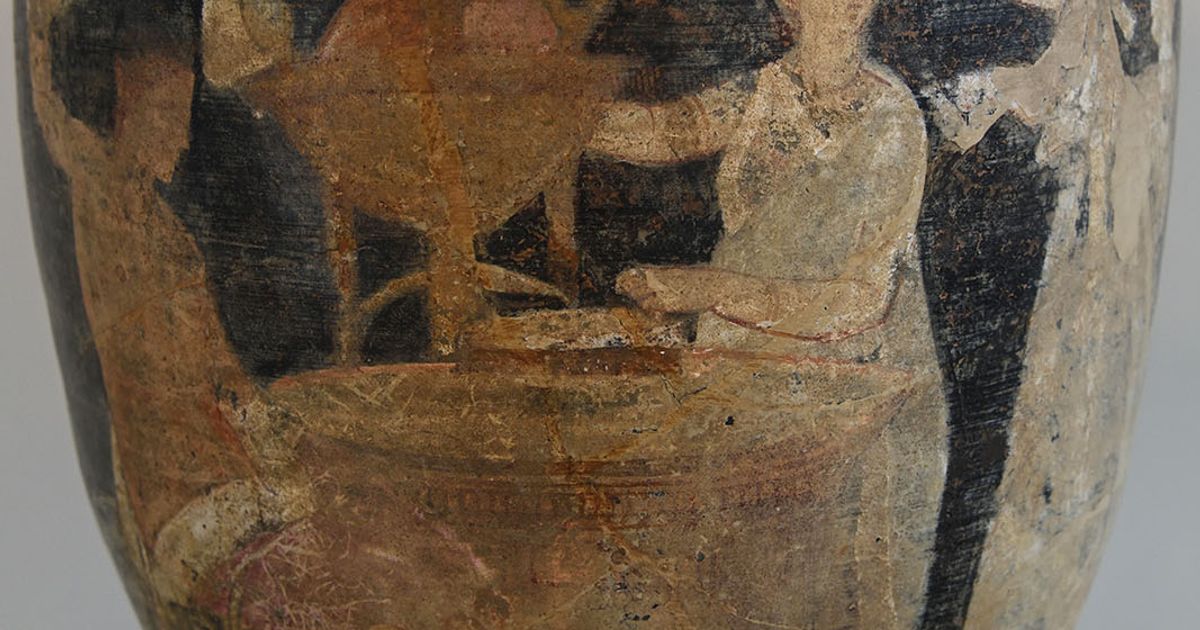
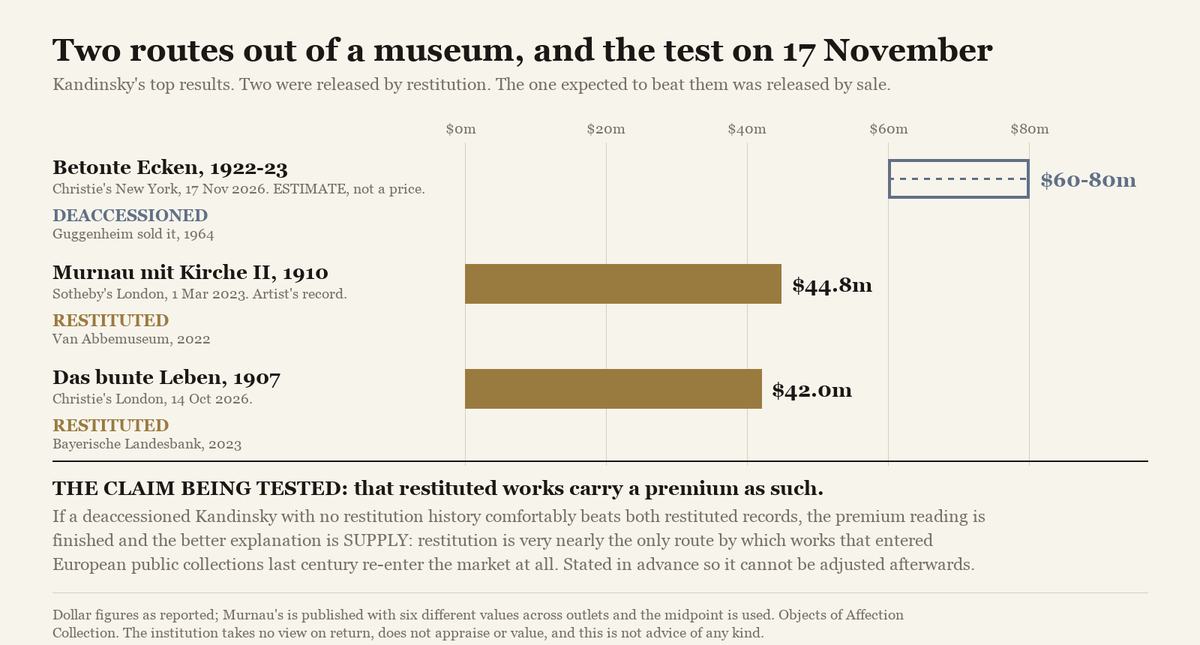
The vase is painted with a wedding. Apollo and the love gods look on, somewhere in Sicily, in the third century before Christ. The thing that proved it had been dug out of a tomb and sold with a false history was a photograph, on the same roll of film, of a wedding held in the same town in 1976.
Two weddings in Centuripe, two thousand two hundred years apart, and the second one is why the first one went home.
On a day in the first week of October 2026, the Allard Pierson museum of the University of Amsterdam handed a painted ceramic pyxis to representatives of the Sicilian cultural heritage department and the Carabinieri's cultural heritage protection unit. It will go on permanent display at the Regional Museum of Centuripe.
This institution takes no view on origin, export, return or restitution, and nothing below argues that any object should or should not go anywhere. What follows is about evidence: what the record held, what undid it, and what actually moves an object out of a museum.
What the Museum Bought, and What It Was Told
The Allard Pierson bought the pyxis in 1997, from a Swiss art dealer, at TEFAF Maastricht, the most prestigious art fair in Europe.
The seller said the object had been in private Swiss ownership since before 1970.
No further provenance documents were provided. No export licence. One sentence of assurance, from a dealer, at a fair, about a third century BCE object from Sicily.
That sentence was doing an enormous amount of work, and it is worth understanding exactly how much. 1970 is the year of the UNESCO Convention on the means of prohibiting the illicit import and export of cultural property. In the antiquities trade, a credible claim that an object left its country of origin before 1970 is the single most valuable sentence anybody can attach to it. It converts an object that might be loot into an object that is merely old.
The claim was unsupported, and for twenty nine years it held.
The Photographer Who Worked for the Tomb Robbers
What undid it was not an archive, a ledger or a customs record. It was a roll of negatives.
The historical society SiciliAntica found photographs showing the pyxis. They had been taken by a local photographer who also photographed recently excavated objects for local tombaroli, the grave robbers who worked the tombs around Centuripe. On the same roll, among the looted objects, was a group photograph of a wedding held in Centuripe in 1976.
Stop on the mechanism, because this is the whole thing.
A roll of film is a sequence. The frames were exposed in order, in a short window, by one camera. The wedding photograph carries a date that a wedding photograph always carries, because weddings are dated events that families remember. And that date attaches to every other frame on the roll.
So the vase is photographed in Sicily, among freshly dug objects, on a roll that also records a wedding in 1976. Six years after the date the Swiss dealer's assurance depended on.
The 1970 sentence was not contradicted by a better document. It was contradicted by a family snapshot that nobody took for evidentiary reasons and nobody kept because it mattered.
This institution has written that a document which asserts without pointing at something a reader can open is a claim wearing the clothes of evidence. The pyxis is the inverse case and it is the more hopeful one. The dealer's sentence asserted. The photographer's roll pointed, at a place, at a date, at a set of objects in a particular condition, and it pointed accidentally, which is why it could not be managed.
The most reliable records are frequently the ones nobody made on purpose. They carry no semantic burden, because nobody shaped them to mean anything, and that is exactly what makes them hold.
The Traffickers Kept Better Records Than the Market Did
The Centuripe roll is not a freak. It is a small local instance of the single most productive evidence source in the whole antiquities field, and the pattern is worth stating because it inverts every assumption about who documents what.
In 1995 the Carabinieri raided a storage room in the Geneva Freeport, rented by a company called Edition Services and controlled by the dealer Giacomo Medici). They found more than 3,800 antiquities, valued at some 35 million dollars, many still with soil on them.
They also found the photographs. An archive of roughly four thousand Polaroids, showing objects shortly after excavation and again later, after cleaning and restoration. A second archive, belonging to the dealer Gianfranco Becchina, was seized at his Basel warehouse at the start of the following decade: 140 binders, more than 13,000 documents, including shipping records, invoices and thousands more Polaroids.
Medici was sentenced in Rome to ten years and a fine of ten million euros. By one count, more than 350 objects have gone back to Italy from North American public and private collections, auction houses and galleries, traced through those images.
Understand what makes the Polaroids work as evidence, because it is precisely what makes the Centuripe roll work. The traffickers photographed each object twice: raw from the ground, and again after restoration. The second image is the one a museum would recognise, because it shows the object as sold. The first proves where it came from. The pairing is the proof, and it exists only because the people moving the material needed a sales catalogue.
So the position across this entire field is as follows. The looters documented their inventory. The dealers documented their stock. The museums accepted a sentence.
The Allard Pierson was told the pyxis had been in private Swiss hands since before 1970, and it wrote that down. A photographer in Centuripe, working for tomb robbers, made a dated visual record of the same object in the same year the claim denied. One of those two records survived contact with evidence, and it was not the one produced by the institution with a registrar, a budget and a conservation department.
What the Law Required of the Museum: Nothing
Here is the part that decides what this case means.
The Allard Pierson was under no legal obligation to return the pyxis, and says so in its own announcement. The Netherlands ratified the 1970 UNESCO Convention only in 2009. The implementing legislation took effect on 1 July 2009 and was incorporated into the Dutch Heritage Act in 2016. That legislation has no retroactive effect, and the museum bought the object in 1997.
So the position was: an object acquired lawfully under the rules then in force, held for twenty nine years, with evidence that the story told at purchase was false, and no statute requiring anything at all.
The museum returned it on moral grounds.
Set that beside the two cases this institution examined in the last week. The Parthenon Sculptures, where the obstacle is a statute with no category for the question being asked, and the Ségou Treasure, where a new French framework exists and a claim cannot yet be made because no complete inventory does. In both, the law is the terrain on which everything is fought.
Here the law was simply absent, and the object moved anyway. It is the only case in this sequence where that happened, and it happened at the bottom of the value scale rather than the top.
The Correction That Matters to How This Is Being Reported
The case is being described as the typical path: a museum's research finds a problem and the object goes back. That is the museum's policy now. It is not what happened here, and the difference is worth keeping.
Sicily found it. SiciliAntica located the photographs. The Carabinieri's TPC unit in Palermo investigated under the Public Prosecutor's Office in Enna. Sicilian authorities requested the return in 2017. The Allard Pierson's own provenance research then established that the Swiss ownership claim was untrue, and the museum agreed.
Nine years between the request and the handover.
What has changed is the posture going forward, and the head of provenance research, Rogier Kalkers, stated it directly: "Instead of waiting for source countries to knock on our door, we changed our approach." The museum now goes to source countries itself when its research turns up problematic provenance.
So the pyxis is the last case of the old model and the announcement of the new one, and it is more honest to describe it that way than to credit the museum with a discovery that a Sicilian historical society made.
Kalkers also said two other things worth recording. That the restitution is "a stepping stone towards further collaboration", and, of the object leaving: "We don't see this as a loss."
The collaboration is not decorative. The museum is forming a working group with Sicilian and Dutch experts to study the pyxis and related objects, combining clay and pigment analysis with stylistic analysis, with the curator Laurien de Gelder saying the aim is a better understanding of the production and authenticity of this type of pottery. The object will be better understood in Sicily than it was in Amsterdam, which is a research outcome rather than a diplomatic one.
The One Class of Pottery You Would Least Want to Buy Without Papers
There is a second risk in this purchase that the coverage has not mentioned at all, and it compounds the first.
Centuripe ware is among the most faked classes of ancient pottery in existence, and the reason is technical. The vases are polychrome, of the third and second centuries BC, and their decoration is applied in tempera after all firing is complete, on one face of the vessel only. Paint that sits on top of a fired surface rather than being fused into it is paint that can be added at any later date by anybody, which is why this class has been the object of falsification for nearly a century. By one count, of around 150 known examples, sixteen are of clandestine origin and therefore of unascertained authenticity.
Now read the 1997 purchase again. An object of a class notorious for forgery, offered with no provenance documents and no export licence, on a single verbal assurance, at Europe's most prestigious fair.
The two risks are not separate and they have one cause. A documented chain of ownership is the thing that protects a buyer from a looted object and from a forged one simultaneously. Lacking it, the museum was exposed on both flanks, and it is only an accident of which evidence surfaced first that this is a restitution story rather than an authenticity one.
Which is what makes the working group the Allard Pierson is now funding more interesting than a gesture. It will combine clay and pigment analysis with stylistic analysis, and the curator Laurien de Gelder has said the aim is a better understanding of the production and authenticity of this type of pottery.
That is the right instrument, and this institution has documented why: across the major forgery cases of the last forty years, not one was caught by reading the paperwork. Beltracchi was caught by titanium white in a picture dated 1914. The Knoedler forgeries were caught by a yellow pigment invented in the 1970s. The authentication literature on Centuripe ware works exactly the same way, by X-ray fluorescence and diffraction against the pigments actually available in antiquity, red ochre and lead white and lime white and Egyptian blue.
The material is examined after the object goes home. Twenty nine years in Amsterdam produced the attribution; the analysis that could test it begins now, in Sicily, under a collaboration that exists because the object left.
Now the Other End of the Scale
A pyxis is worth, at auction, some tens of thousands. The same month the Allard Pierson gave one away, the two highest prices ever paid for a Kandinsky were both held by paintings that had been taken from Jewish owners and returned to their heirs.
Murnau mit Kirche II, painted in 1910, sold at Sotheby's London on 1 March 2023 for £37,196,800, an auction record for the artist.
Its history is not a market story. Siegbert Samuel Stern, in Berlin, acquired the painting in 1924. His widow, Johanna Margarete Stern-Lippmann, inherited it in 1935. The work was obtained from the family by Myrtil Frank acting for the Mühlmann Agency, the clearing house for art appropriated in German-occupied Holland. Johanna Margarete Stern-Lippmann was deported from the Netherlands and murdered at Auschwitz on 22 May 1942.
The painting was acquired in 1951 by the Van Abbemuseum in Eindhoven, from the Austrian-born dealer Karl Legat. It hung there for seventy one years. The museum restituted it to the Stern heirs in 2022, and it sold the following March.
Two details from that sale belong in any record of it. The proceeds were shared among thirteen surviving heirs. And part of the money is to fund further research into what happened to the rest of the family's collection.
That is a mechanism nobody designed and it is worth naming: the resolved record pays to resolve the others. A single restituted painting generates the capital to do provenance research on the works still missing. Against the Ségou case, where a French law runs on provenance research that nobody has funded, it is the only self-financing restitution machinery this institution has found.
The second Kandinsky is the one that sold a fortnight ago, Das bunte Leben, at £31.56 million against an £18 to 25 million estimate, restituted in 2023 after a German commission finding. This institution examined that sale in detail last week and will not repeat the analysis here.
What Restitution Actually Does to a Price
The obvious reading is that restituted works carry a premium. Two of the three highest Kandinsky results are restituted Nazi-era works, which looks like proof.
It is not, and the reason is a question nobody asks about these sales: how else would a painting like that ever have come to market?
Murnau mit Kirche II was in the Van Abbemuseum for seventy one years. Das bunte Leben was held by a bank and hung at the Lenbachhaus for five decades. Neither was for sale at any price. European public collections do not deaccession; that is the whole subject of this institution's study of the 1963 British Museum Act, and French collections are inalienable by the same logic, which is why every French return until this May needed its own act of Parliament.
So restitution is not primarily a premium. It is a supply mechanism. It is, for works that entered European public collections in the middle of the twentieth century, very nearly the only route by which they re-enter the market at all. The prices are high because the supply is near zero and the quality is museum quality, not because buyers are paying extra for a moral provenance.
And there is a control, which is the useful part.
The Painting That Tests This on 17 November
Betonte Ecken, of 1922 to 1923, goes to Christie's New York on 17 November 2026 with an estimate of $60 to $80 million, and the house has told reporters it is guaranteed to sell at a record-setting level.
Its route to market is the other one. It was auctioned in Berlin in 1926 from the Schwarz collection, passed through Galerie Nierendorf, and reached Hilla Rebay, adviser to Solomon R. Guggenheim, probably in 1929. Guggenheim acquired it from her and the museum held it until 1964, when the Guggenheim sold it at Sotheby's London to the dealer Stephen Hahn. It went on to the Boston collectors Sandra and David Bakalar, and to the present anonymous owner at Sotheby's in 1986.
It left a museum by deaccession, which American museums may do and European ones generally may not. No restitution, no claim, no commission.
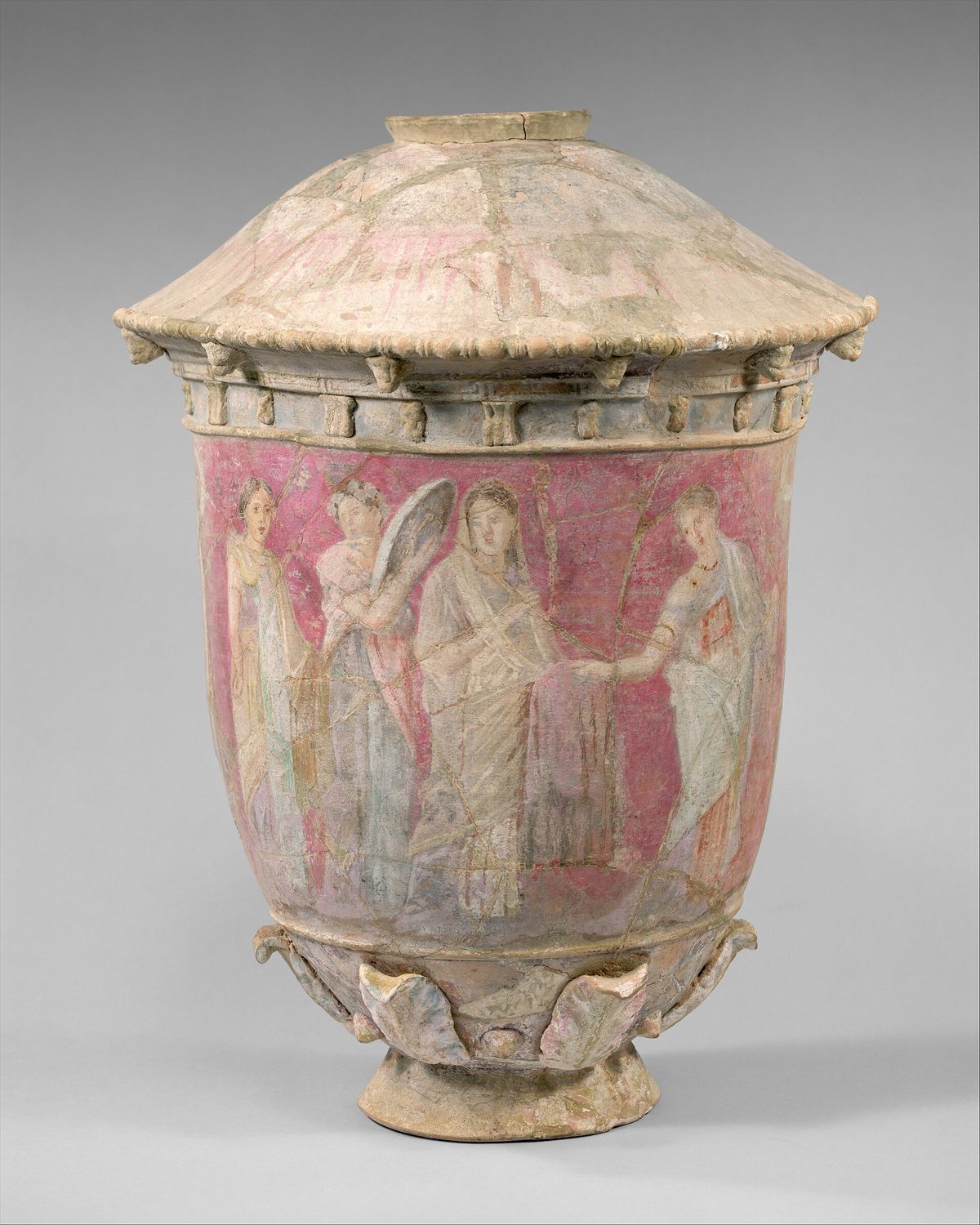
So on 17 November there is a clean test, and it can be stated in advance so that nobody adjusts it afterwards.
If restituted works carry a premium as such, a deaccessioned Kandinsky with no restitution history should not comfortably beat both restituted records. The estimate says it will, by a margin of a third to nearly double. If it does, the premium reading is finished and the supply reading survives. If it fails to reach the restituted results, the premium reading gains the first real evidence it has ever had.
This institution has no stake in which way it goes and will record the result either way.
Six Figures for One Hammer
A smaller finding, and this institution keeps meeting it.
Murnau mit Kirche II achieved one hammer price on one evening. The dollar figure reported for it includes $44.5 million, $44.55 million, $44.7 million, $44.77 million, $44.8 million and $44.9 million, depending on the outlet, and at least one market database carries a sterling figure that does not match the others at all.
Nobody is wrong. Conversion dates differ, some figures include the buyer's premium and some do not, and databases update at different times. But six published values for a single transaction, in the most documented corner of the art market, is the same defect this institution found in the Parthenon counts and in the Ségou manuscripts and in the Timbuktu rescue.
Heritage, at every scale and in every direction, resists being counted. A pyxis, 497 manuscripts or 518, a quarter of a million manuscripts or a third of a million, fifteen pedimental figures or seventeen or nineteen, and one hammer price with six values. The instinct to treat a published figure as a measurement is wrong more often than it is right.
What This Article Does Not Say
This institution takes no view on origin, export, return or restitution. Nothing above argues that the pyxis belonged in Sicily or in Amsterdam, that the Kandinskys should have been restituted, or that any future claim should succeed.
It does not allege that the Swiss dealer who sold the pyxis in 1997 knew the provenance to be false. The record establishes that the statement made at sale was untrue. It does not establish who knew what, and the dealer is not named here because the available sources do not name them.
It does not credit or criticise the Allard Pierson beyond the record. The museum returned an object it was not required to return, said publicly that it had been wrong about it, and is funding further study of it in the country it came from. It also took nine years from the request. Both facts are stated.
On the 17 November prediction, this is a falsifiable statement about a future auction and not advice of any kind. This institution does not appraise, authenticate or value, and does not advise anybody about art as an investment.
On sourcing. The museum's own announcement and The Art Newspaper's report were both read directly, and they differ: the museum's page states a handover ceremony on 7 October and The Art Newspaper, publishing on 12 October, says the vase was handed back last week. The originating brief for this study gave 13 October. We give the first week of October and name the discrepancy rather than choosing. An earlier search result described the film roll as discovered in 2016; the museum's own caption dates the roll itself to 1976 and does not give a discovery date, and the museum's version is used.
The Stern family history is taken from auction and press accounts of the 2023 sale, not from the restitution file, which this institution has not seen. The figures for Betonte Ecken are a published estimate and a reported guarantee, neither of which is a price.
The Thing Worth Keeping
The expensive paintings in this article moved because a legal mechanism released them from institutions that could not otherwise have let them go, and the market paid enormous sums for the result. That is a story about supply, and it will be tested in three weeks.
The vase moved for no legal reason at all, from a museum that was entitled to keep it, because a historical society in a Sicilian town found the negatives of a photographer who had worked for grave robbers, and because on the same roll there was a wedding.
One of those is a market event and the other is an institution deciding what it is. The second is cheaper, smaller, and harder to do. It is also the only one of the two that treats the custodian's contract as something that can be found to have been void from the start.
And the evidence that did it was a photograph that nobody involved in the art market took, kept, catalogued, authenticated or valued. It survived because somebody got married in Centuripe in 1976, and because the same man who photographed the bride had been paid, days or hours earlier, to photograph what had just come out of the ground.