Both Rose, and Only One Was Reported: What the Art Basel Survey Says About AI When You Read the Rest of It
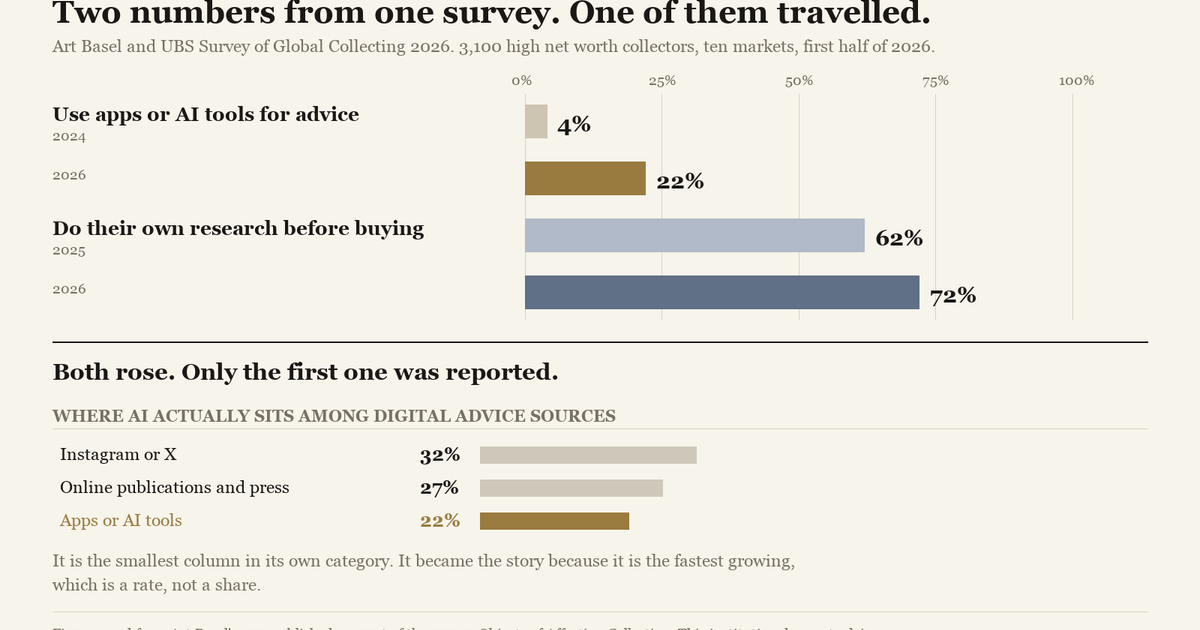
Collectors using apps or AI tools for advice went from 4 per cent to 22 per cent in two years. In the same survey, in the same population, the share doing their own independent research before buying went from 62 per cent to 72 per cent. Both rose. Almost nobody has reported the second one.
The Art Basel and UBS Survey of Global Collecting 2026, by Dr Clare McAndrew of Arts Economics, covers 3,100 high net worth collectors across ten markets through the first half of 2026. The AI figure travelled around the world in a week. The rest of the survey did not.
This institution has already published a correction to how that 22 per cent is being quoted, and will not repeat it at length. The short version: the 22 per cent covers apps or AI tools together, and what it measures is advice. The provenance figure people attach to it is a different question with a different answer.
What follows is the rest of the survey, which is more interesting than the headline and in one respect says the opposite of it.
The Smallest Number in the List
Start with where AI actually sits among the things collectors use.
Fifty eight per cent of these collectors used digital resources for collecting advice. Within that:
Instagram or X: 32 per cent. Online publications and press: 27 per cent. Apps or AI tools: 22 per cent.
Artificial intelligence is the least used digital advice source in the survey. More collectors take advice from a social media feed than from a model, and more take it from the trade press than from either.
It became the story because it is the fastest growing, which is a legitimate thing to report and a different thing from being the largest. A number that quintuples from a small base is a rate, and a rate is not a share. The growth figure acquired narrative permanence that the underlying share never earned. Four to twenty two is the most dramatic line in the survey and twenty two is the smallest column in its own category.
The Finding That Inverts the Story
Now the part that nobody picked up, and it is in the same document.
Seventy two per cent of these collectors did moderate or significant independent research before buying. In 2025 the figure was sixty two per cent.
Among Gen Z collectors it was eighty per cent.
Read that beside the AI figure and the popular reading collapses. The story everyone told was that collectors are handing judgment to chatbots. What the survey records is a population that picked up AI tools and simultaneously did more of its own homework than the year before, with the youngest collectors doing the most of it.
Those two facts are not in tension and the obvious explanation is probably the right one. A tool that produces a plausible answer in four seconds generates leads, not conclusions. It gives a collector something to check, and the survey suggests that is what they did with it.
It is also consistent with what they say worries them. Price transparency and the security of their personal, financial and collection data online were the two top concerns of 2026. This is not a population that has decided the internet is trustworthy. It is a population using more digital tools while trusting them less, which is an entirely coherent position and a difficult one to fit into a headline.
They Rate It Lowest Exactly Where There Is a Right Answer
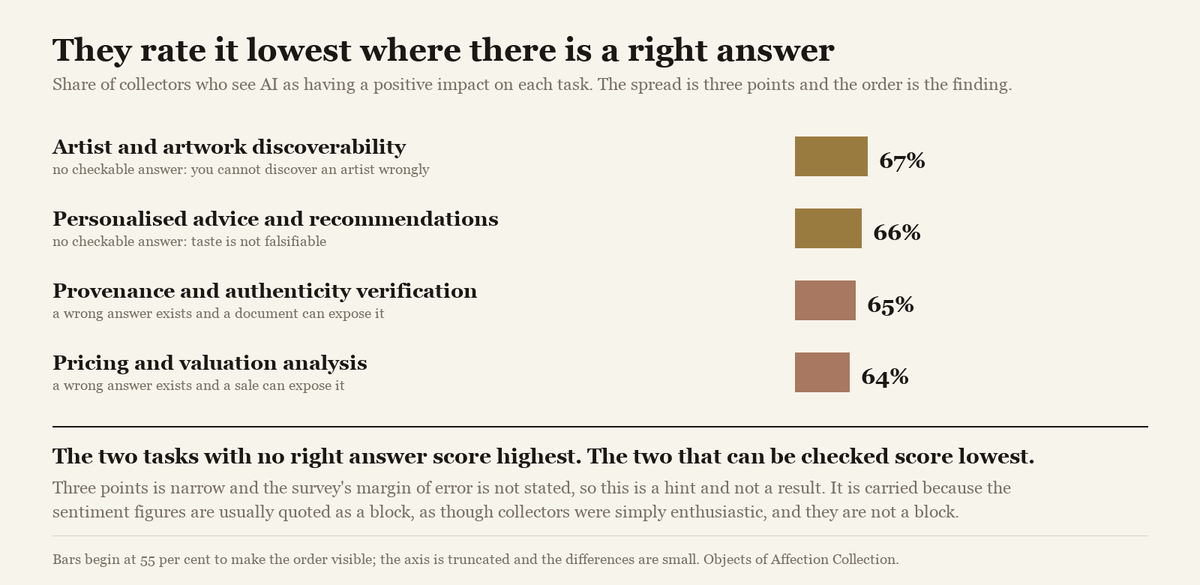
The sentiment figures are usually quoted as a block, as though collectors were simply enthusiastic. They are not a block. They are a ranking, and the order is the interesting part.
Discoverability of artists and artworks: 67 per cent see AI as having a positive impact. Personalised advice and recommendations: 66 per cent. Provenance and authenticity verification: 65 per cent. Pricing and valuation analysis: 64 per cent.
Three points separate the top from the bottom, which is narrow, and this institution does not know the survey's margin of error. But the order is not random and it is worth stating.
The two tasks collectors rate highest are tasks with no checkable answer. Discovering an artist you had not heard of cannot be wrong. A recommendation suited to your taste cannot be wrong.
The two they rate lowest are the two where a wrong answer exists and can be discovered. A provenance claim is either supported by a document or it is not. A valuation is either borne out by a sale or it is not.
Collectors are, very slightly, more sceptical of the machine precisely where the machine can be caught. That is a more sophisticated population than the coverage assumes, and the margin is small enough that a reader should treat it as a hint rather than a result.
The Digital Shift Is in the Transaction, Not the Trust
There is a second misreading available here and the survey closes it off.
Eighty seven per cent of these collectors bought through a dealer in some form over the past year: seventy five per cent directly and sixty two per cent at an art fair. Dealers remain the preferred purchasing channel at twenty nine per cent, ahead of buying straight from the artist at nineteen and art fairs at sixteen. By value, dealers took twenty seven per cent of spending through direct sales and forty two per cent including fairs.
But look at how that dealer relationship is now conducted. About two thirds of the collectors who prefer dealers transact by website, telephone, email or Instagram rather than in the gallery.
So the digital shift in this market is in the channel, not in the counterparty. Collectors moved online to do the buying. They did not move online to decide whom to trust. The relationship is still with a named dealer who can be telephoned; what changed is that the transaction now happens through a screen.
That distinction matters for the AI question, because it suggests what the twenty two per cent is probably being used for. A tool consulted alongside a dealer is a second opinion. A tool consulted instead of one would be a replacement, and nothing in this survey shows the second thing happening.
The Most Digital Generation Is the Most Private
One more pattern, because it complicates every assumption about where this is going.
Gen Z collectors are the heaviest users of social media for advice, the most likely to buy an artist they have never heard of, and the most likely to do independent research before buying, at eighty per cent.
They are also the most private generation in the survey.
Thirty six per cent keep their online content within private circles. Forty two per cent prefer restricted or invitation-only group sharing, the highest of any generation. They are the least likely of any age group to share details of their collection publicly online.
Across all collectors, sixty four per cent keep their ownership of art private within their household or a closed circle, and only ten per cent seek wide recognition. Among those who lend to museums, thirty per cent want full anonymity, forty seven per cent want discreet acknowledgment, and seventeen per cent want full public credit.
That is a market whose youngest and most digitally fluent participants are its most guarded, in the same year that data security became one of its two leading concerns. Whatever is happening to collecting, it is not a simple story of openness arriving with the technology.
Sixty Five Per Cent Believe It. Nobody Has Measured It.
Here is the hole at the centre of this subject, and it is a hole in the literature rather than in the survey.
Sixty five per cent of these collectors think AI has a positive impact on provenance and authenticity verification.
This institution went looking for any study that tests whether it does, on art, and could not find one. No benchmark of language models against documented provenance chains. No evaluation against a catalogue raisonné. No published accuracy figure for the specific task that two thirds of wealthy collectors have formed an opinion about.
What exists is adjacent and not encouraging. Provenance is source attribution, which is the thing citation benchmarks measure, and the citation literature is now substantial.
A 2026 benchmark of thirteen language models on citation generation found hallucination rates ranging from about fourteen per cent to ninety five per cent depending on the model. A separate large audit of roughly 2.5 million papers and 111 million references identified on the order of 146,900 fabricated citations arising in a single year, with the problem reported as worst in the social sciences.
The best model in that benchmark invented roughly one reference in seven.
None of that is a measurement of AI on art provenance and this study does not present it as one. It is the closest available proxy for the underlying operation, which is producing a specific, checkable claim about where something came from and who said so.
So the honest statement of the position is this. Two thirds of surveyed collectors hold a favourable opinion about a capability that has not been tested in their field, and the nearest measured analogue has a floor of about fourteen per cent fabrication in its best case. Whether art provenance is better or worse than academic citation for this purpose is unknown, and anybody who tells you otherwise is guessing.
The Number That Should Have Been the Story
While everyone was reporting the AI figure, the same survey recorded a collapse.
The share of collectors who bought work by an artist they had not previously known fell to 45 per cent in 2026, from 66 per cent in 2025.
That is a drop of twenty one points in a single year, and it is a much larger movement than anything in the AI data. Gen Z was at 56 per cent and boomers at 36 per cent, so the appetite for the unfamiliar is generational, but it fell across the board.
Set it beside the rest and a coherent picture appears that has nothing to do with chatbots. Collectors did more research, bought fewer unknown artists, named data security as a top concern, and overwhelmingly kept buying through dealers: eighty seven per cent bought through a dealer in some form, and dealers remained the preferred channel at twenty nine per cent, ahead of buying directly from artists.
This is a cautious market using more tools, and the gap between how it is described and how it behaves is a plain case of the semantic burden a single statistic can be made to carry. The tools are the novelty and the caution is the news, and the caution got almost no coverage because sixty two to seventy two is not as good a headline as four to twenty two.
What a Real Test Would Have to Do
Since the measurement does not exist, it is worth saying what it would take, because the absence is fixable and the shape of the test is not mysterious.
It would need a set of provenance questions with known, documented answers, drawn from published catalogues raisonnes and archival records rather than from the open web, since a model trained on the web will reproduce the web rather than check it.
It would have to score the pointer and not the prose. A response that names a 1927 purchase is worth nothing unless it names the document establishing it, and the document has to exist. This institution has argued that a result which asserts is indistinguishable from a forgery downstream, while a result which points at a primary source is a finding aid even when wrong, and a benchmark that marks fluency rather than resolvability would measure the wrong thing entirely.
And it would have to include questions whose correct answer is that the record does not say. Provenance is full of gaps, a gap is the single most consequential feature of a chain, and a model that cannot produce the answer unknown will fill it. That is the failure mode with the largest consequences and the one a conventional accuracy score is least likely to catch.
None of that is difficult. It is a weekend of work for anyone with the catalogues, and until somebody does it the sixty five per cent is a belief about an untested instrument.
What This Article Does Not Say
This institution does not advise anybody on collecting, does not appraise or value, and takes no position on whether collectors should use these tools.
It does not say AI is bad at provenance. It says the question has not been studied in this field, which is a statement about the literature and not about the technology, and it may well be studied next year and found to perform respectably.
It does not say the Art Basel and UBS survey is misleading. The survey is clearly reported and its own text distinguishes the questions properly. The conflation is in the repetition, which is where this institution has repeatedly found that errors enter.
On the margin of error. The order of the four sentiment figures is treated here as a hint and not a finding, because a three point spread across an unstated margin of error may be noise. If it is noise, that paragraph is wrong, and it is flagged rather than buried.
On sourcing, including a mistake this study nearly made. The citation-hallucination figures went through two rounds of checking. A widely circulated blog attributes a 2.2 million citation analysis of 56,381 papers to researchers at ETH Zurich and the National University of Singapore and pairs it with the fourteen to ninety five per cent range. That attribution could not be verified and appears to conflate two separate pieces of work: a thirteen model citation-generation benchmark, and a distinct large-scale audit of published papers. The figures above are given from the two studies separately and the composite claim is not used. In a study about a number being misquoted, this seat came within one draft of misquoting a number.
The 2026 survey figures are taken from Art Basel's own published account, read directly.
The Thing Worth Keeping
Two numbers from one document, six months old, about the same three thousand one hundred people.
Use of AI for advice: four per cent to twenty two. Doing your own research before buying: sixty two per cent to seventy two.
One of those went around the world. The other did not leave the report.
And the second one is the better guide to what is actually happening, because it says what collectors did rather than what they adopted. A tool was taken up and the homework went up with it, which is not the story of a market outsourcing its judgment. It is the story of a market acquiring one more thing to check, and then checking it.
The question nobody has answered is whether the thing they are checking is worth checking against, and on the evidence available the honest answer is that in this field it has never been measured.