One Canvas, Three Changes: What Happened Between 1.5 Million Euros and 8 Million Pounds, and Which of It Was the Painting
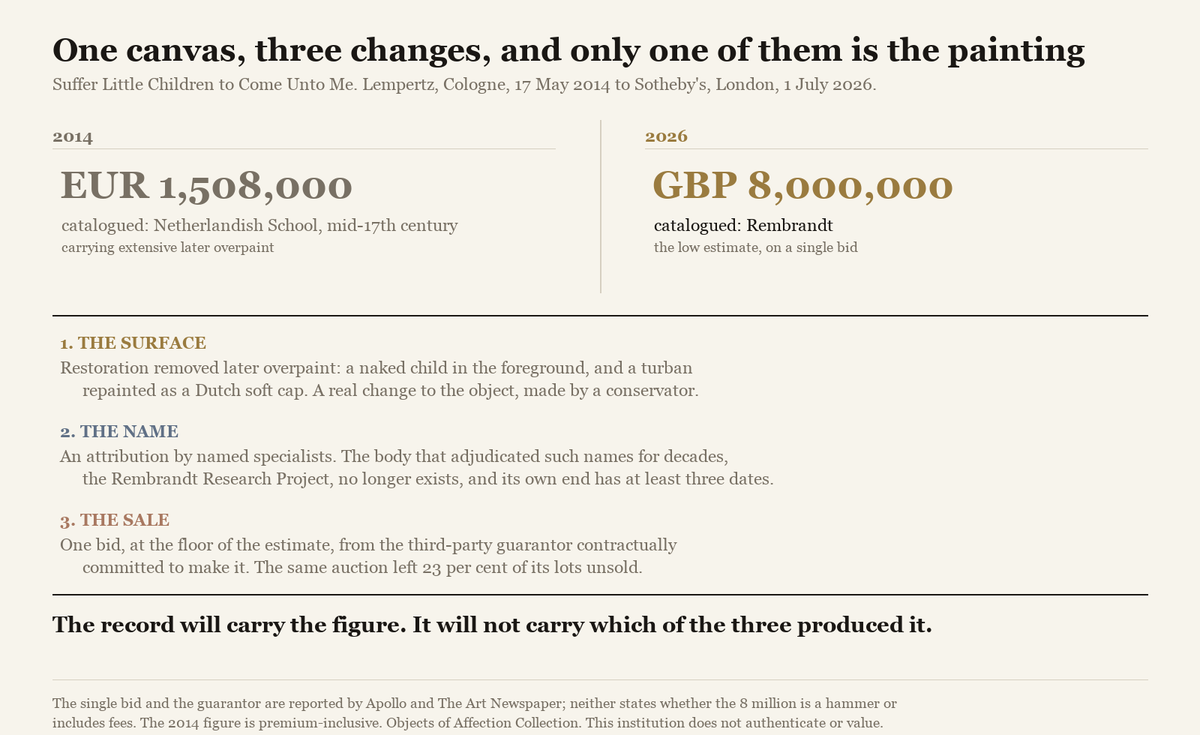
In May 2014 a large oil painting sold in Cologne for €1,508,000, catalogued as Netherlandish School, mid-17th century. On 1 July 2026 it sold in London for £8 million, catalogued as Rembrandt. Three things changed in between, and only one of them was the painting.
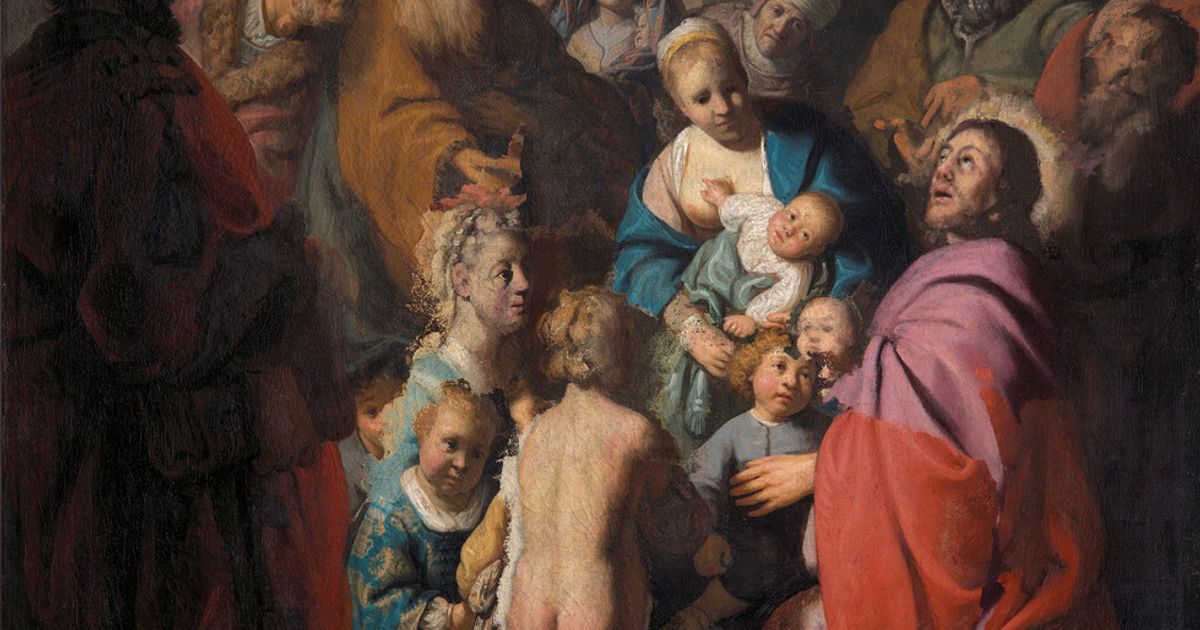
The work is Suffer Little Children to Come Unto Me, also called Let the Little Children Come to Me. Oil on canvas, 122 by 104 centimetres, now dated to Rembrandt's Leiden period, around 1627, when he was about twenty one.
It went through Lempertz in Cologne on 17 May 2014 as an anonymous mid-century Netherlandish picture and made €1,508,000 including premium. Twelve years later Sotheby's offered it as a Rembrandt against an estimate of £8 to £12 million.
This institution does not authenticate, appraise or value anything, holds no opinion on whether this painting is by Rembrandt, and offers nobody advice about art. What follows is about the three things that changed, which are a surface, a name, and a sale, and about what a record can say afterwards about each.
The First Change: the Painting Itself
It is tempting, and wrong, to say the object did not change. It did.
When it sold in 2014 the canvas carried extensive later overpainting, and restoration removed it. Two of the things that came off are worth naming, because they show how much of what a viewer sees can be the work of somebody other than the artist.
A naked child in the foreground had been painted out. And a man at centre left had his turban replaced with a Dutch soft cap.
Somebody, at some point, decided that a naked child and an eastern turban did not belong in this picture and removed them with a brush. Somebody else, centuries later, took that decision off again.
So the buyer in Cologne in 2014 and the buyer in London in 2026 were not looking at the same image. The burden of preservation had been discharged in between, and discharging it changed what there was to see. The second one was looking at something closer to what left the studio, which is what restoration is for, and that is a genuine change in the object rather than a change of opinion about it.
It also complicates the usual telling. The story is normally that a sleeper was spotted by a sharp eye. Part of what the sharp eye was spotting was underneath something else, and establishing that took a conservator, not a connoisseur.
The Second Change: the Name
The attribution is the work of a small number of named people, and this is where the study's real subject begins.
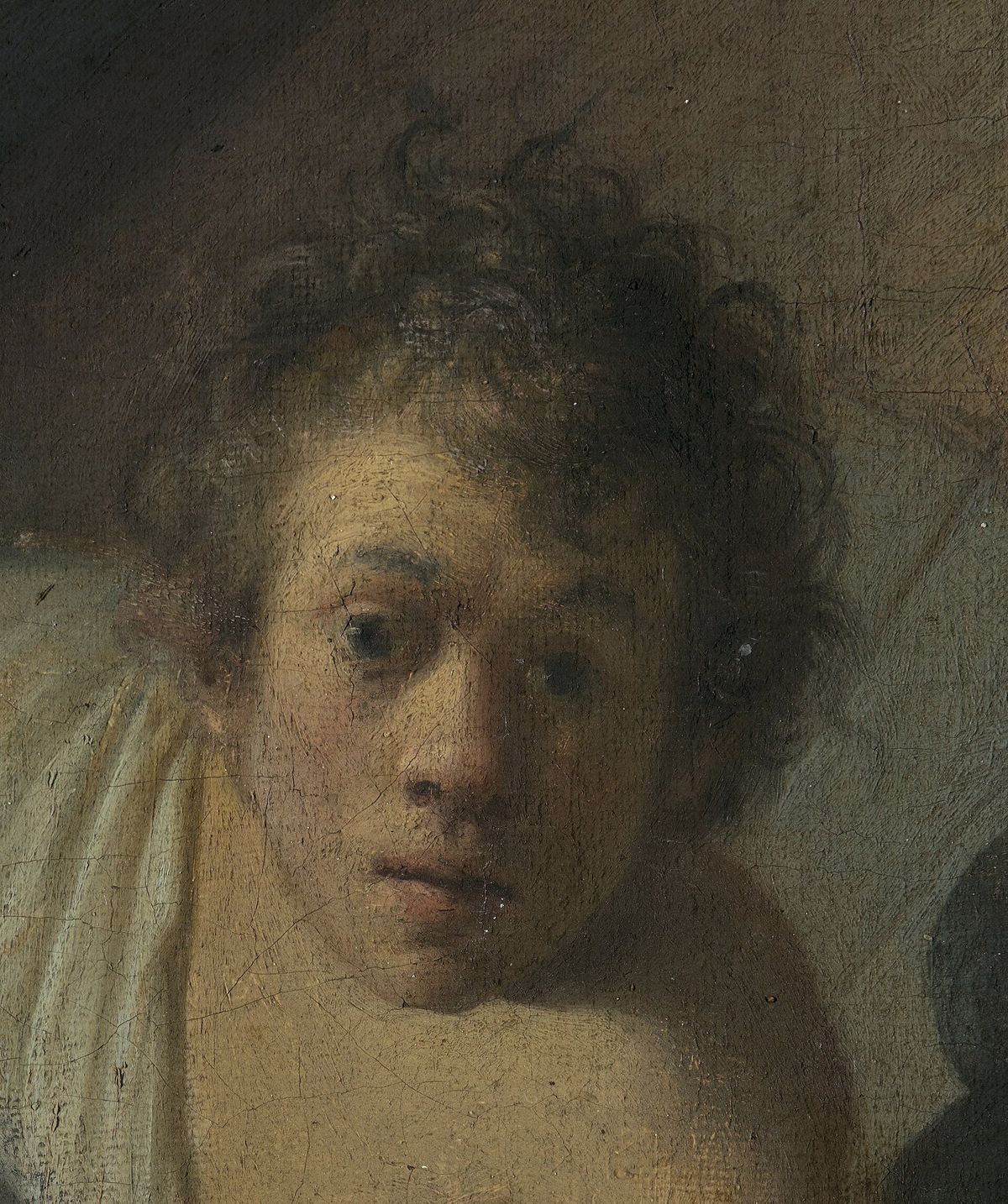
The Amsterdam dealer Jan Six recognised it as an early Rembrandt. He identified the figure in white at the upper right as a self-portrait of the artist, which is the kind of claim that is either illuminating or circular depending on whether you already accept the attribution. Specialists authenticated it, among them Christopher Brown, formerly director of the Ashmolean.
The painting was then shown as a Rembrandt in Young Rembrandt, at Museum De Lakenhal in Leiden from November 2019 and at the Ashmolean in Oxford in 2020. The catalogue was written by Christopher Brown, An Van Camp and Christiaan Vogelaar.
Two observations, neither of them an accusation.
The first is that the same small group of specialists authenticates, exhibits and catalogues. Brown authenticated the picture and co-authored the catalogue of the exhibition, at the museum he had directed, in which it appeared as a Rembrandt. Nothing about that is improper and in a field this narrow it is close to unavoidable. There are not many people qualified to hold the opinion, and the ones who are qualified are the ones who write the books and hang the shows. But it means an attribution and its public endorsement are not independent events, and the record afterwards shows only the endorsement.
The second is that the attribution is not unanimous in the way a headline implies. Christiaan Vogelaar, a co-author of that very catalogue, has suggested that Claes Corneliszoon Moeyaert may have helped finish the painting, which was left unfinished.
That is a specialist's considered view that another hand is in the picture, published alongside the attribution rather than against it. It is not a dispute and should not be reported as one. It is the ordinary condition of an early seventeenth century workshop painting, and it is exactly the kind of qualification that survives in a catalogue and does not survive in a price.
The Authority That No Longer Exists
Here is the structural fact underneath all of this, and almost no coverage of a Rembrandt discovery mentions it.
For decades, the question of whether a painting was by Rembrandt was answered by the Rembrandt Research Project, which worked through the corpus and published its findings in volumes that de-attributed as freely as they attributed. It was, for better and worse, the body you argued with.
It no longer exists, and its own end has at least three dates depending on what you count.
Its original team broke up when older members resigned in 1993, after the fifth volume of the Corpus; one authoritative editorial treats that as the end of the project proper. Its funding from the Dutch research council ran to 1998. Its board voted in early 2011 to wind the project up by the end of that year. And research continued to 2014 or 2015 under Ernst van de Wetering working alone.
Nothing replaced it. A recent account of a different Rembrandt attribution simply calls the project now defunct and notes that specialists accepted the new attribution, which is how it works now: case by case, by named individuals, with museums and auction houses as the venues where the opinion becomes public.
Now put the dates together. Jan Six's Rembrandt discoveries, this one and the Portrait of a Young Gentleman he bought at Christie's in 2016 as a school picture, were both made after the body that would have adjudicated them had stopped adjudicating anything.
This institution draws no conclusion from that and specifically does not suggest the attributions are wrong. The Research Project was itself fiercely criticised, its de-attributions ruined reputations and values, and nobody should be nostalgic for a committee simply because it was a committee. The observation is narrower and it is about the record. There is now no body whose yes or no is final, so there is no document that closes the question, and a reader twenty years from now will find an attribution supported by named experts and no instrument that ever ratified it.
That is the same shape this institution found in a sabre France returned to Senegal whose own name carries the word said-to-be, and in a Vienna headdress whose standard scholarly account calls its own popular name erroneous. An attribution is a claim held by people. The record preserves the claim and loses the people, which is narrative permanence working on a name rather than on a story.
The Valve Runs Both Ways
An attribution that can add six and a half million pounds can remove it, and the most famous instance is instructive because of what the man who did it said at the time.
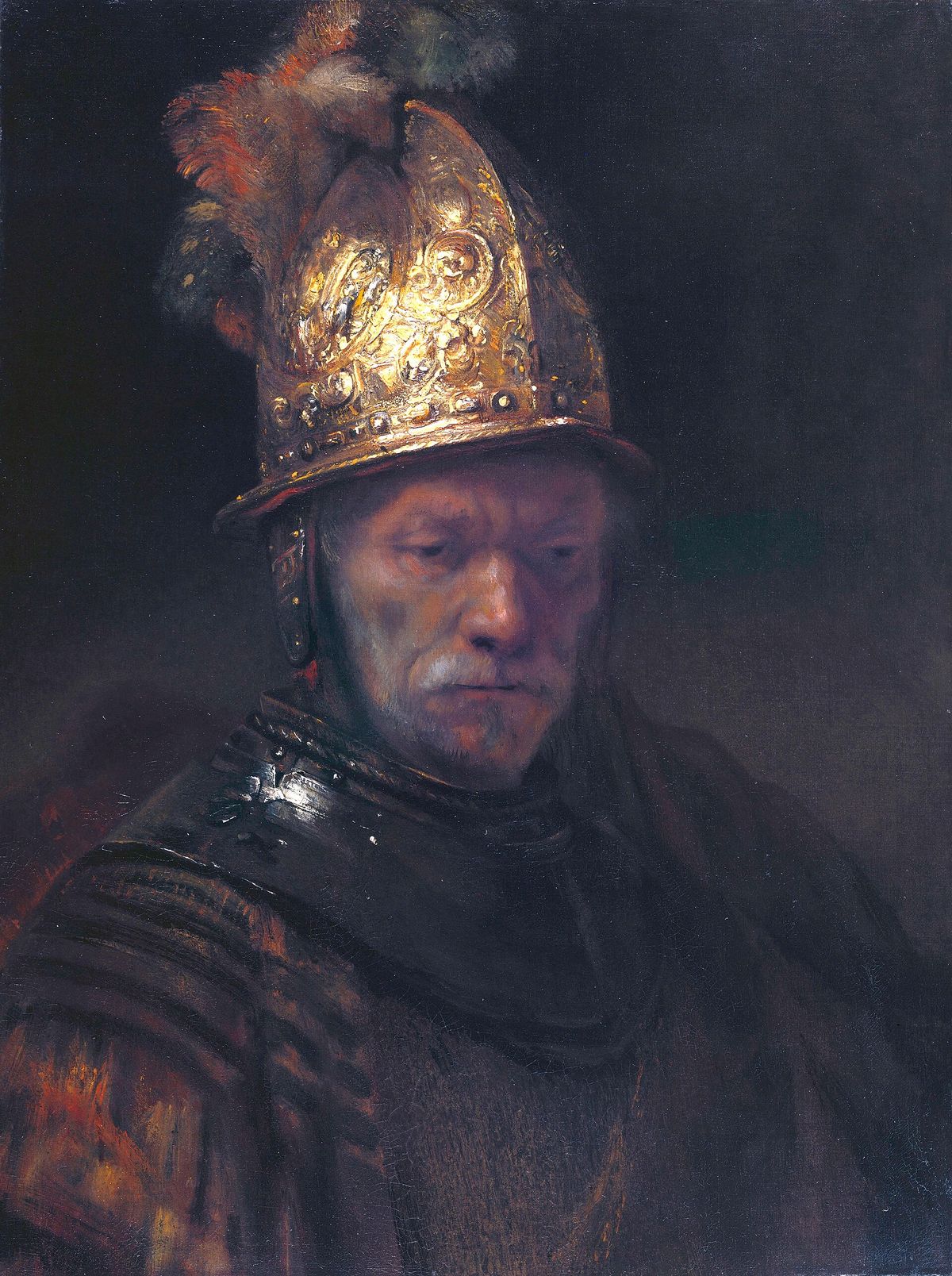
The Man with the Golden Helmet, in Berlin, was for generations among the best known Rembrandts in the world. Doubts were raised in 1984 by a commission of Dutch curators, and in November 1985 the Berlin specialist Jan Kelch concluded that its style did not match Rembrandt's and that it was probably painted around 1650 by one of his pupils.
What Kelch also said is the part worth keeping. The painting was not a fake, and it remained a masterful work.
Nothing about the object had changed. The helmet was still built out of impasto that catches light the way almost nothing else in European painting does. The face was still the face. What moved was a name, and with it a public identity, a place in the canon and a value that nobody has ever published.
This institution could not establish, from sources it could reach, that the Rembrandt Research Project made that particular decision, and several popular accounts credit it without support. The de-attribution is securely the work of named curators; the Project's role in it is not. The point stands without it: the same mechanism that made a Cologne sleeper worth eight million pounds took a national treasure off a wall label, and in both directions the instrument was an expert opinion rather than a fact about paint.
Fifty Five Per Cent
There is a second Six discovery, and it is the better test of how this field now resolves an attribution, because somebody pointed a machine at it.
Portrait of a Young Gentleman was bought by Jan Six at Christie's in London in 2016, catalogued as from the school of Rembrandt, for a reported $185,000. After about eighteen months of research he published a book arguing it was by Rembrandt himself, and roughly a dozen Rembrandt specialists supported him, Ernst van de Wetering among them.
It was also run through a neural network, the A-Eye system built by the Frank family, and the result deserves to be quoted precisely rather than summarised.
The painting came in at fifty five per cent, barely over the system's own threshold for a Rembrandt.
And the system keyed on the sitter's lace collar, which was the feature Six himself had already cited as evidence. A machine was pointed at the picture and returned, narrowly, the answer the person who framed the question had already given, having concentrated on the detail he had already nominated.
That is not a fraud and the Franks made no extravagant claim about it, saying only that their results were roughly in keeping with expert opinion on these paintings. The Rembrandt scholar quoted alongside them put the limit plainly: techniques of this kind will not settle disputes on their own.
It is reported, nonetheless, as AI confirming a Rembrandt. This institution wrote three days ago about a language model that has to come up with an answer, so given enough information it will guess something. A classifier forced to return a number will return a number. Fifty five per cent is what agreement looks like when it is barely distinguishable from a coin, and it enters the record as confirmation.
The Third Change: a Sale That Confirmed Nothing
And then the part that makes this study necessary, because it has been reported everywhere as a market endorsement of the attribution.
The painting sold on 1 July 2026 for £8 million, the low end of its estimate, on a single bid, from its own third-party guarantor.
Both Apollo and The Art Newspaper report it in those terms. An art historian noted before the sale that the lot carried an irrevocable bid and that it had therefore, technically, already sold.
Nobody competed for it. One party, contractually committed in advance to bid at an agreed level, bid at that level, and the lot was knocked down to them at the floor of the estimate.
This institution published a study ninety minutes before beginning this one arguing that a third-party guarantee can, in the limit, produce a transaction in which the guarantor is the only bidder, conducted in a saleroom and reported afterwards as an auction result. That was written as a theoretical limit. It happened in London on 1 July 2026, to a Rembrandt, and was reported as a sale at £8 million.
Note what the room did otherwise. The same auction made £37.8 million with fees across its lots, with seven paintings over £1 million and an unsold rate of 23 per cent. The room was buying and the room was also declining to buy. It was not an indiscriminate evening, and this lot attracted exactly one bid, from the party that had promised to make it.
The dealer Johnny Van Haeften gave the market's own reading of why, and it is about the object rather than the name: "The bottom half of the painting is not in great state, but the top is wonderful." And: "If it was in perfect state, it would have gone through the roof."
So the most informative thing anybody said about the sale is a condition report.
What the Record Will Carry
Strip it down and this is a study about a single line in a database.
In twelve years the entry will read, in substance, that a Rembrandt sold at Sotheby's in July 2026 for eight million pounds. That line will be true.
It will not carry that the figure is the low estimate. It will not carry that there was one bid. It will not carry that the bidder was the guarantor. It will not carry that a fifth of the sale went unsold that night, or that a leading dealer thought the lower half of the canvas was in poor condition.
And it will not carry that the name attached to the painting was supplied by named individuals after the only body that ever adjudicated such names had ceased to exist, or that a co-author of its own exhibition catalogue has suggested a second hand finished it.
All of that is public. None of it is in the number, and the number is the part that gets quoted. Which is the finding this institution has now reached from seven directions in one week, and it does not get less true by repetition.
What This Article Does Not Say
This institution does not authenticate, appraise or value, and expresses no view on whether this painting is by Rembrandt. The specialists who say it is are serious people with far better evidence than is available here.
Nothing here suggests impropriety by anyone. Jan Six identified a picture and was right or wrong on the merits; the question is not addressed here. Christopher Brown's roles as authenticator, catalogue author and former director of an exhibiting museum are stated because the field is small and that overlap is ordinary, not because any of it is improper. Third-party guarantees are lawful, standard and disclosed by catalogue symbol, and nothing in the conduct of the 1 July sale is criticised.
Christiaan Vogelaar's suggestion about Moeyaert is reported as a published scholarly view, offered alongside the attribution and not against it. It is not a dispute and this study does not present it as one.
On the sourcing. The single bid and the guarantor are reported by Apollo and The Art Newspaper and this institution has not seen Sotheby's own results page; whether the £8 million is a hammer price or includes fees is not stated explicitly by either source, which matters, since on the evidence of this institution's own recent work the two are routinely conflated. The 2014 figure of €1,508,000 is premium-inclusive.
The end of the Rembrandt Research Project is given as a range because the sources genuinely differ, between the 1993 resignations, the 1998 end of funding, the 2011 board decision and research continuing to 2014 or 2015. Any single date for it would be a choice presented as a fact. Accounts also differ on which specialists authenticated this particular painting, and only those named in more than one source are named here.
The Thing Worth Keeping
A conservator removed a layer and found a naked child and a turban that somebody had painted over. That was a discovery about an object, and it is checkable, and it will still be true in a century.
A dealer looked at a figure in white at the upper right and saw the young Rembrandt looking back. That was a judgment about an object, made by a person, and it is now the single most valuable fact about the painting.
And a guarantor raised a hand once, because they had signed something saying they would.
Only the first of those three is a fact about the canvas. The second is a fact about expertise and the third is a fact about a contract. All three are now compressed into one figure, and it is the figure that will outlive every one of them.