The Record Was Agreed Before the Bidding: What a Guaranteed Sale Can Record, and What It Cannot

Christie's has told reporters that Kandinsky's Betonte Ecken is guaranteed to sell at a record-setting price. Read that sentence slowly, because it describes something that has already happened. A record that is guaranteed is a record that was agreed before anyone in the room raised a hand.
The painting comes to Christie's New York on 17 November 2026 with an estimate of $60 to $80 million. The current record for the artist is $44.8 million, set at Sotheby's London in March 2023. So the house is not predicting a record. It is reporting one, three weeks early.
This institution does not appraise, authenticate or value, and nothing here is advice about art as an investment. What follows is about the record in the other sense: what an auction result preserves, what it cannot preserve, and what the published figure will and will not be able to tell anybody who looks it up in ten years.
What a Guarantee Actually Is
A guarantee is a contract that removes the risk of a lot going unsold, and it comes in two shapes.
A house guarantee means the auction house itself undertakes to pay the consignor a minimum sum whatever happens in the room. If the bidding falls short, the house owns a painting it did not want at a price it set.
A third-party guarantee moves that risk outside. An outside party agrees, before the sale, to place an irrevocable bid at an agreed level, in exchange for a fee. If nobody bids past it, that party buys the painting at their bid, less the fee. If the bidding goes higher, the guarantor typically takes a share of the excess. The guarantor may also keep bidding in the room on their own account.
Both are ordinary, both are legal, and both are disclosed in the catalogue by a printed symbol next to the lot. None of that is in question here. The point is narrower and it concerns what the arrangement does to the meaning of the number that results.
Because a guarantor is not a bidder in the ordinary sense. They know the reserve. They usually know the specialists. They frequently know who else is likely to be interested. They are the one party at the sale who knows the floor is theirs, and they agreed it in private, weeks earlier, with the house.
The financial journalist Felix Salmon put the consequence in one phrase, describing heavily guaranteed auctions as less like price-discovery tools and more like dressed-up private sales. In the limit case a third-party guarantee produces a transaction in which the guarantor is the only bidder, conducted in a saleroom, reported as an auction result.
The One Fact Nobody Has Published
Here is what is known about this guarantee: that it exists, and that Christie's has told ARTnews the work is guaranteed to achieve a record-setting price.
Here is what is not known. Whether it is a house guarantee or a third-party irrevocable bid. What the guaranteed figure is. Who the guarantor is.
This institution looked for the lot in Christie's own online catalogue, where that information is conveyed by symbol, and could not find it published at the time of writing. The sale is three weeks out and the catalogue is not yet up. Every account in circulation traces to the same statement given to reporters.
So the only number the public has is the estimate, $60 to $80 million, and the estimate is not the guarantee. An estimate is a published opinion. A guarantee is a contract. The second one determines the outcome and the first one is the only one anybody can see.
What the Record Will Say, and What It Will Not
This is the part that belongs to this institution rather than to the market pages, and it outlasts the sale.
On 18 November there will be a number. It will enter Christie's results, the price databases, the artist's auction history, the next catalogue's comparables, every article written about Kandinsky for a decade, and eventually the provenance line of the painting itself.
That number will not record how many people wanted it. It will acquire narrative permanence that its own circumstances never get.
An auction database preserves the hammer price, the date, the lot, the sale. It does not preserve the count of bidders. A painting that four collectors fought over to $75 million and a painting that one contracted guarantor took at $75 million with no competition produce an identical entry, and nothing downstream can tell them apart.
This institution has argued that a document which asserts without pointing at something a reader can open is a claim wearing the clothes of evidence. An auction result is the most trusted number in the art market and it is exactly that kind of claim. It looks like a measurement of demand. It is a record of a transaction, and the transaction may have had one willing party or forty, and the record does not say which.
The symbol in the catalogue is the only disclosure, it appears in the document least likely to be consulted years later, and it does not travel with the price. A figure quoted in a 2036 article about Kandinsky's market will carry no trace of it.
It Has Already Happened Once, and It Took Nineteen Years and a Hack to Find Out
This is not a hypothetical about what a record might conceal. There is a case, it is the most famous single-owner sale of the twentieth century, and the way its circumstances surfaced is the entire argument of this study delivered as history.
In November 1997 Christie's sold the collection of Victor and Sally Ganz. It made $206.5 million, a record for a single-owner sale, and it entered the literature immediately as the proof that provenance itself carries value: bidders, everyone said, were buying the Ganz name.
In 2016 the Panama Papers showed what had actually been arranged.
The Ganz heirs had sold the collection months before the auction, to a company called Simsbury International Corp, incorporated in April 1997 and buying the collection a month later. Simsbury was controlled by Joseph Lewis, the British billionaire who was then the richest man in England and the largest shareholder in Christie's. The structure was an early form of auction guarantee: if the works failed to sell, Lewis would pay for them. Lewis and the dealers Spink were to split equally any proceeds above $168 million, and when the sale reached $206.5 million the difference was divided between them.
The catalogue carried a disclosure. It read: Christie's has a direct financial interest in all property in this sale. The terms of that interest were never explained.
So for nineteen years the record stood as a demonstration of open-market demand for a great collection. The property had already changed hands. The underwriter was the auction house's own biggest shareholder. The upside was pre-divided. None of that was discoverable from the result, from the catalogue line, or from any database, and it became public only because a law firm in Panama was hacked and journalists read eleven million documents.
That is what it takes to recover the circumstances behind a number the market had been quoting for two decades.
Nothing in that history is alleged against anyone here. The disclosure line was printed, and the practice has since become both more common and better disclosed; the trade press has been asking for years whether guarantees are the next big art market scandal, and the mechanics of the irrevocable bid are now written about openly rather than whispered.
The point is only this: the Ganz number and the Ganz circumstances travelled at completely different speeds, and the number got a nineteen year head start. The academic literature on whether guarantees change prices at all remains genuinely unsettled, which is itself worth knowing before anybody treats a guaranteed record as a market signal.
A Correction to This Institution's Own Study, Published This Evening
Ninety minutes before this study was written, this institution published an argument that restitution functions less as a premium than as a supply mechanism, and set this sale as the falsifiable test. The claim was that if a deaccessioned Kandinsky with no restitution history comfortably beat both restituted records, the premium reading would be finished.
That test is weaker than it was presented as being, and the reason is the guarantee.
A result produced under a guarantee is not a clean reading of what the market would pay. If Betonte Ecken makes $70 million on 17 November, part of that number is a contract signed in October. The comparison with the two restituted Kandinskys is therefore not like for like, because this institution does not know whether those sales were guaranteed and has not established it.
The test is not worthless. A guarantor who commits to a record level is still making a judgment about demand with their own capital, and a result far above the guarantee would be real evidence. But the earlier study stated the test more confidently than the market structure supports.
It is corrected here, before the sale rather than after it, which is the only time a correction to a prediction costs anything.
Why the Painting Is Available at All
The other half of this is a sixty two year old decision, and the arithmetic is worth doing slowly.
Kandinsky painted Betonte Ecken, Emphasised Corners, in Weimar in 1922 to 1923, while teaching at the Bauhaus. It was auctioned in Berlin in 1926 from the Schwarz collection, passed through Galerie Nierendorf, and reached Hilla Rebay, Solomon R. Guggenheim's adviser, in about 1929. Guggenheim acquired it from her. It entered the museum that bears his name.
In 1964 the Guggenheim sold it.
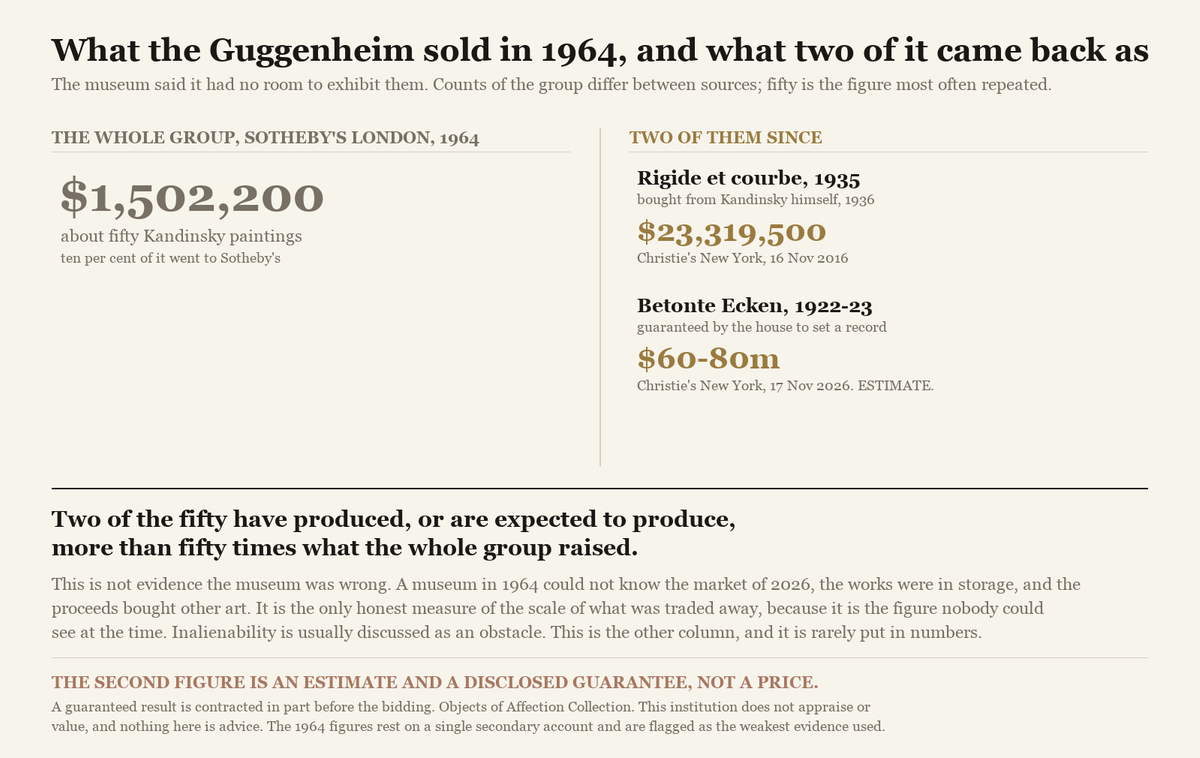
It was not sold alone. By the account that circulates, Sotheby's auctioned fifty Kandinsky paintings from the Guggenheim collection that year, fifteen years after Solomon Guggenheim's death. The stated reason was that the museum had no room to exhibit them, and that the proceeds would buy other works. The sale is reported to have raised $1,502,200, of which ten per cent went to Sotheby's.
It caused an uproar in the New York art world. Hilla Rebay, who had built the collection with Guggenheim, is reported to have told the New York Times that Solomon would have been horrified to see what was happening.
Now the arithmetic. Fifty Kandinskys raised about one and a half million dollars. One of those fifty is estimated at sixty to eighty million dollars sixty two years later, and the house says it is guaranteed to set a record.
A single painting from the group is expected to make around forty to fifty times what the entire group raised.
A Second One From the Same Fifty
One painting could be a fluke of taste. There is a second from the same dispersal, and it has already been tested in a saleroom.
Rigide et courbé, Rigid and Curved, of 1935, was bought by Solomon Guggenheim directly from Kandinsky in 1936. Not through a dealer, not at auction. From the artist. It was exhibited repeatedly in American museums through 1949, went out in the 1964 sale, and was not seen on the market again for fifty two years.
It returned at Christie's New York on 16 November 2016, with an estimate of $18 to $25 million, and sold for $23,319,500. It briefly held the auction record for the artist.
So two works from one group, traced:
Rigide et courbé, bought from Kandinsky himself, sold by the museum in 1964, $23.3 million in 2016.
Betonte Ecken, sold by the museum in 1964, estimated at $60 to $80 million in 2026.
Two of the fifty have produced or are expected to produce somewhere above eighty million dollars between them. The entire group of fifty raised about one and a half million.
And the dates have a symmetry nobody arranged. Both came back through Christie's New York in a November evening sale, ten years and one day apart, from the same afternoon in London in 1964.
Forty eight others went somewhere. This institution has not traced them.
What That Number Is Evidence Of, and What It Is Not
It is not evidence that the Guggenheim was wrong, and this institution does not say that it was.
A museum in 1964 could not know the market of 2026. The works were in storage. The stated reason, wall space, is a real constraint that every museum lives with and that almost nobody outside museums takes seriously. The proceeds bought other art. Deaccession was then, and remains in the United States, a legitimate and regulated instrument of collection management.
What the number is evidence of is the scale of the quantity being traded away, and it is the only honest measure of it, because it is the one nobody could see at the time.
Set it against the two cases this institution examined in the past week. The Parthenon Sculptures, where a 1963 statute permits disposal only of duplicates, printed matter and objects unfit to be retained. The Ségou Treasure, where French public collections were inalienable to the point that every return until this May required its own act of Parliament.
Those rules are usually discussed as obstacles, and in restitution cases they are. The 1964 sale is the other side of the same ledger, and it is rarely put in numbers. Inalienability is the rule that would have stopped the Guggenheim selling fifty Kandinskys for one and a half million dollars because the walls were full.
This institution takes no view on whether any collection should be alienable. It observes only that the argument is normally conducted with one column of figures, and that the second column exists and is large.

The Chain After the Museum
The painting's route since is ordinary and worth recording, because it is the part that the guarantee will join.
The Guggenheim sold it at Sotheby's London in 1964 to the New York dealer Stephen Hahn. It passed to the Boston collectors Sandra and David Bakalar, who consigned it to Sotheby's in 1986, where it was bought by the present owner, who is anonymous. It has been in private hands for forty years and out of a museum for sixty two.
It is described as a direct forerunner of Komposition VIII of 1923, which hangs in the Guggenheim and is not for sale, because the museum kept that one.
Two paintings, one lineage, one wall. The difference between them is a decision taken in 1964 about which pictures there was room for.
What This Article Does Not Say
This institution does not appraise, authenticate or value any work, does not forecast prices, and offers no advice to anybody about buying or selling art. The estimate and the reported guarantee are stated as what they are: a published opinion and a disclosed contract, neither of which is a price.
Nothing here alleges impropriety by Christie's, by any guarantor or by the seller. Guarantees and irrevocable bids are lawful, standard, and disclosed by catalogue symbol. The criticism in this study is directed at what the resulting figure is capable of recording, which is a property of the instrument and not the conduct of anybody using it.
It does not say the Guggenheim was wrong to sell in 1964, and it does not say that European inalienability rules are correct. It puts a number beside a decision and leaves the reader to weigh it.
On sourcing. The 1964 figures, the stated reason and the Rebay reaction all trace to a single secondary account of the sale, which this institution has not corroborated against the 1964 New York Times or Sotheby's own records. And the count of what was sold is not agreed even between secondary sources: one gives fifty paintings, another twenty nine works to European museums and private collections, a third fifty of which twenty six went to European museums and collectors. This study uses fifty because it is the figure most often repeated, and records that it is contested. The arithmetic comparing one picture to the whole group depends on that number and is weaker to the extent the number is. Renderings of Rebay's words differ between sources, one giving horrified and another terrified, so the sense is given rather than a quotation. Anybody relying on those figures should check the primary record, and this study flags them as the weakest evidence in it.
The guarantee is reported from Christie's statement to ARTnews. This institution could not locate the lot in Christie's published online catalogue at the time of writing and therefore could not read the symbol that would disclose the guarantee's structure. If the catalogue, when it appears, shows a third-party interest, that is a material fact this study did not have.
The Thing Worth Keeping
In three weeks a number will be produced, and it will be true. Somebody will have paid it and somebody will have received it.
It will then begin a second life as evidence, in databases and comparables and provenance lines, where it will be read as a measurement of how much the world wanted this painting on a Tuesday evening in November. It may have been exactly that. It may also have been one contract, executed in a room with an audience. The record cannot hold the difference, and in ten years nobody will go back to the catalogue to look for a symbol.
Which is the same finding this institution keeps arriving at from different directions. The number survives. The circumstances that made it do not. That is speculative velocity in its purest form: a figure moving through the world faster than, and eventually independently of, anything that produced it.
And underneath that, a quieter one. The reason this painting can produce a record at all is that a museum decided in 1964 that it had nowhere to hang it, sold it with forty nine others for one and a half million dollars, and kept the one next to it. Everything the market will say about Betonte Ecken next month is downstream of a decision about wall space.