What Was Bid, and What Was Reported: The Twenty Four Million Dollars of a Pollock Record That Was Never About the Painting

The record price for a Jackson Pollock is $181,185,000. The amount the buyer agreed to pay for the painting is $157,000,000. The difference is the commission, and the man whose name was part of the painting's sales pitch went to prison for conspiring to fix exactly that charge.
On 18 May 2026 Christie's New York sold sixteen works from Masterpieces: The Private Collection of S.I. Newhouse. The sale made $630.8 million against an estimate of $450 to $595 million, every lot sold, in under an hour. Combined with the evening sale alongside it, Christie's took about $1.1 billion in a night.
This institution does not appraise, authenticate or value, does not forecast prices and advises nobody about art. What follows is about what these numbers are made of, and about one line of provenance that was used to sell a painting.
What Was Actually Bid, and What Was Reported
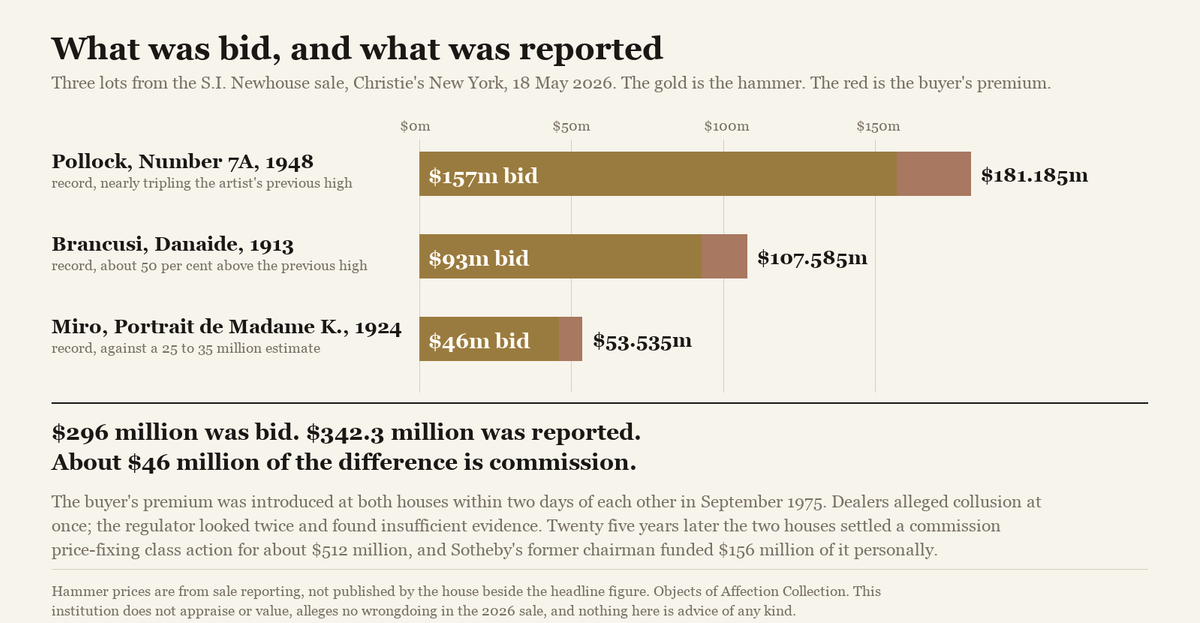
The Pollock is Number 7A, 1948. Christie's announced the result as $181,185,000, nearly tripling the artist's previous auction record of $61.16 million, set at Sotheby's in November 2021 for Number 17, 1951.
The hammer fell at $157 million. The remaining $24.2 million is the buyer's premium, the commission the house charges the buyer on top of the winning bid.
The Miró the same evening is the same shape. Portrait de Madame K. of 1924 was estimated at $25 to $35 million. Bidding opened at $14 million and ran for about four minutes. The hammer fell at $46 million. The announced result was $53,535,000, a record for the artist, against a previous high of $37.04 million set at Sotheby's in 2012.
Roughly $7.5 million of that is commission.
Neither figure is misreported. Premium-inclusive totals are the convention, every house uses them, and anyone in the trade reads them correctly.
But the convention has a consequence that is almost never stated. A headline price is a bid plus a fee charged by the party who ran the sale and announced the number. The record is not what somebody was willing to pay for a Pollock. It is what somebody was willing to pay for a Pollock, plus what Christie's charged them for the privilege of having been allowed to.
This institution argued three weeks of studies ago that an auction result cannot record how many people wanted a thing. This is the narrower and more mechanical version of the same defect. The published number does not even record what was bid. It is speculative velocity with a service charge folded into it, travelling onward as though the whole of it were the object.
Where That Twenty Four Million Came From
The buyer's premium is not an ancient feature of auctions. It has a birthday, and the circumstances of its birth are the reason this study exists.
The modern buyer's premium was introduced in London in September 1975, at ten per cent, by Christie's and Sotheby's.
Not by one of them, followed eventually by the other. A debate in the House of Lords in 1991 described it as having been brought in by two great auction houses within two days of one another. One account has Christie's moving first and Sotheby's matching immediately. Smaller houses followed.
The dealers did not accept it quietly, and the objection they raised was collusion. The Society of London Art Dealers and the British Antique Dealers' Association instructed counsel to try to stop the premiums, arguing that the two houses had acted together unlawfully. The Office of Fair Trading received the complaint, twice, and found insufficient evidence. Dealers brought a High Court action in 1981 making the same allegation. The dispute ran for something close to seven years and the houses kept the charge.
So the fee that accounts for twenty four million dollars of a Pollock record arrived simultaneously at both houses in the same week of 1975, was immediately alleged to be the product of collusion, and survived the allegation unproven.
Twenty five years later the two houses were investigated, and one of them convicted, over fixing commissions.
This study makes no claim about 1975. The regulator looked and did not find enough, which is where the matter rests. The point is only that the charge has been accompanied by this particular suspicion since the fortnight it was invented, and that almost nobody reading a record price knows the charge has a history at all.
The Name in the Provenance
Now the part that makes this more than an accounting note.
The chain of ownership was part of the pitch for the Pollock. S.I. Newhouse bought Number 7A privately in 2000 from A. Alfred Taubman.
Taubman was the chairman of Sotheby's from 1983 to 2000, and its controlling shareholder.
In February 2000, the month the painting changed hands, he gave up the chairmanship. The announcement came as the United States Department of Justice investigated the two great auction houses. Michael Sovern, formerly president of Columbia University, replaced him. Diana Brooks, Sotheby's president and chief executive, was removed on the same day and replaced by William Ruprecht. Taubman kept his controlling stake and his seat on the board.
What the investigation concerned was this: two occasions, in 1992 and 1995, on which one house changed its commission structure and the other closely followed.
Brooks pleaded guilty in October 2000 to conspiring with Christie's to fix commissions. Her testimony was central to what followed. In December 2001 a jury convicted Taubman. In April 2002 he was sentenced to a year in prison and a criminal fine of $7.5 million, prosecutors having sought three years. He served about ten months. He maintained his innocence throughout. He died in 2015 at ninety one.
Anthony Tennant, his counterpart at Christie's, was charged and never tried. He declined to come to the United States, and he could not be extradited on an antitrust charge.
The criminal fine was the smallest part of the cost, and this institution's first draft of this study got that wrong before checking. In September 2000 the two houses agreed to pay about $512 million to settle a class action brought on behalf of buyers and sellers, and Taubman's own role is on the public record. Taubman personally funded $156 million of it. Sotheby's separately paid $45 million in United States criminal fines and about $70 million to shareholders, and was fined roughly $20.1 million by the European Commission in 2002.
Christie's paid no European fine, because it was first to give evidence to the authorities and received amnesty for it.
Put the Three Facts in One Sentence
The painting's provenance, offered as part of its value, runs through the man convicted of conspiring to fix auction commissions.
The house that sold it in May is the house he was convicted of conspiring with.
And the record figure that made headlines is a hammer price plus an auction commission.
Not one of those three things is improper. The provenance is accurate and houses are entitled to cite it; Taubman was a serious collector and the painting is a great painting. Christie's conduct in 2026 has nothing to do with its conduct in the 1990s, and the firm cooperated with the investigation under an amnesty. Premium-inclusive reporting is the universal convention.
They are simply never put next to each other.
And when they are, the proportions are not what a reader expects. The criminal penalty on the individual was $7.5 million. The civil settlement was $512 million, of which he found $156 million himself. The conspiracy was not a technicality and it was not cheap.
What is striking is the other direction. The commission on a single painting on a single evening in May 2026 was about $24 million. Seven lots at that level would exceed what Taubman personally paid. The charge at the centre of the largest antitrust prosecution the art market has ever seen is now, per object, an ordinary line in an invoice.
Three Lots, One Evening, Forty Six Million in Commission
The Pollock was not alone, and the pattern repeats exactly.
Brancusi's Danaide, a bronze of 1913, hammered at $93 million and was announced at $107,585,000, a record for the sculptor and roughly fifty per cent above his previous high. Miró's Portrait de Madame K. hammered at $46 million and was announced at $53,535,000. The Pollock hammered at $157 million and was announced at $181,185,000.
Three lots. $296 million bid. $342.3 million reported. About $46 million of difference, which is the commission on one evening's work on three objects.
Then look at what Newhouse paid for them, because two of the three were bought in the same room they were sold in.
He bought the Miró at Christie's in 2001 for $12.7 million. He bought the Brancusi at Christie's in 2002 for $18.2 million. Both returned to Christie's in May 2026 and made $53.5 million and $107.6 million.
The house sold him the objects and then sold them again, taking a commission at each end, which is not a criticism but is a description of the business and is invisible in either headline figure.
And the marketing was explicit about what was being sold. Christie's engaged Nicole Kidman to front the campaign for the Brancusi. A sculpture inspired by a Hungarian artist Brancusi met in Paris in 1910 was promoted to the public by a film star in 2026, because the thing being offered was never only the bronze.
Provenance as the Product
The Newhouse sale is the clearest recent demonstration of something this institution has written about from the other direction all month: the chain of owners is not metadata about the object. It is part of what is being sold.
In the Miró's case this is explicit and attractive. Portrait de Madame K. was owned by Max Ernst, Miró's fellow Surrealist, who lived near him in Paris. It passed to the Belgian collector René Gaffé. Newhouse bought it at Christie's in 2001, from the Gaffé collection, for $12.7 million.
He paid $12.7 million. It made $53.5 million. Both times at Christie's, which took a commission at each end.
A chain that runs artist to artist to collector to collector is genuinely interesting and genuinely rare, and nobody is being deceived when a catalogue makes something of it. The object really did hang in Max Ernst's rooms.
The question this institution keeps arriving at is a narrower one: what is being paid for, and can the record tell you afterwards?
Elsewhere this month we examined a Kandinsky whose price was high because restitution was the only mechanism that could release it from a museum, and a Centuripe vase whose documented history turned out to rest on one unsupported sentence from a dealer. In both, provenance was decisive and in neither did the final number record why.
Here the same thing happens in the open. Two paintings set records. The published figures include the auctioneer's fee. One of the two was sold partly on the strength of having belonged to a man convicted of fixing that fee. All of it is on the record, none of it is in the number, and in five years the number is all that will be quoted.
What the Sale Says About the Rest of It
A note on the sale as a whole, because single-owner sales behave differently and the difference is instructive.
Sixteen lots, $630.8 million, against a pre-sale estimate of $450 to $595 million. Every lot sold. In the trade that is called a white glove sale and it is rare at this level.
A collection sold under one name does better than the same objects sold separately. That premium is attributed to provenance, and the attribution is probably correct, but it is worth being precise about what the mechanism is. A single-owner sale concentrates attention, guarantees that comparable works will not appear at a competitor the following week, and gives every lot the endorsement of having been chosen by somebody whose judgment is being celebrated that evening.
It is, in other words, an event constructed to make provenance legible, and the legibility is the product as much as the paintings are.
Whether a buyer paying $181 million for a Pollock is paying for the picture, for the fact that Newhouse owned it, for the fact that Taubman owned it before him, or for the certainty that nothing comparable is coming to market soon, is not a question the record will ever answer. It records one composite number and attributes the whole of it to the painting.
What This Article Does Not Say
This institution does not appraise, authenticate or value any work, does not advise on art as an investment, and expresses no view on whether any of these prices was justified.
Nothing here alleges wrongdoing by Christie's, by the Newhouse estate, by any buyer, or in connection with the May 2026 sale. The price-fixing conspiracy was prosecuted a quarter of a century ago, Christie's cooperated with the investigation, and no person involved in the 2026 sale is suggested to have done anything improper. The observation is about what a published record price is composed of, which is a feature of the convention and not the conduct of anybody.
A. Alfred Taubman was convicted in December 2001 and sentenced in April 2002. He consistently maintained his innocence and that is stated here alongside the conviction. Diana Brooks pleaded guilty in October 2000, and reporting indicates prosecutors offered her a non-custodial outcome in exchange for her testimony, which is a material fact about the evidence against him. Anthony Tennant was charged and never tried.
On the sourcing. Hammer prices are reported by the trade press rather than published by the house alongside the headline figure, and this institution has not seen Christie's own breakdown. The $157 million and $46 million hammers are taken from sale reporting. If either is wrong the arithmetic above moves, and the general point, that a headline is a bid plus a fee, does not.
The characterisation of the Justice Department investigation as concerning two commission changes in 1992 and 1995 is taken from contemporaneous reporting of the February 2000 management changes, not from the indictment, which this institution has not read. The resignation and the private sale of the Pollock both occurred in 2000 and this study does not suggest any connection between them.
One outlet reported the Pollock at $182.2 million in a headline while giving $181.2 million in its text; the figure used here is Christie's own, $181,185,000.
The Thing Worth Keeping
Somebody will write, correctly, that a Jackson Pollock sold for a hundred and eighty one million dollars in May 2026. The figure will go into the databases and the comparables and the next catalogue, and it will be read for decades as a measurement of what the world thought the painting was worth.
Twenty four million dollars of it was never about the painting at all.
And the provenance that helped produce it reaches back, through a private sale in the first weeks of 2000, to a man who left the chairmanship of the other great auction house that same month, and who was convicted the following year of conspiring to fix the very charge that makes up the difference between what was bid and what was reported.
All of that is public. None of it is in the number. And the number is what survives, with the narrative permanence that only a figure ever gets.