No Jewels, and No Empty Cases: A Year After the Louvre, the Absence Has Been Taken Off Display
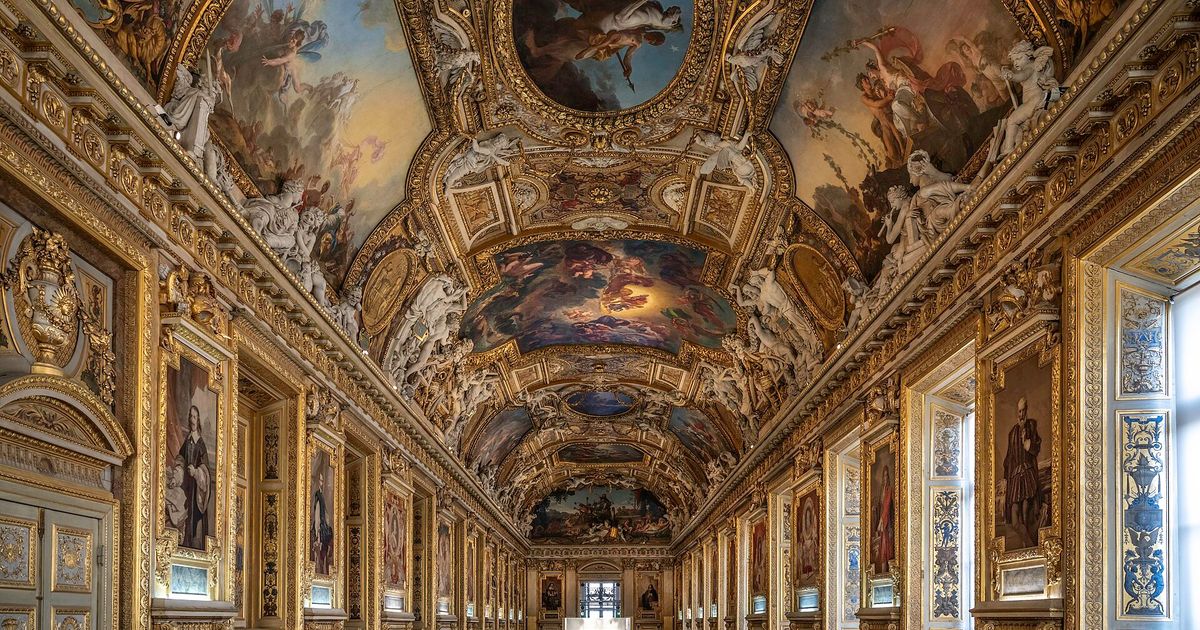
The Louvre reopened the room the crown jewels were taken from, and put nothing in it. Not the jewels, which are gone. Not the surviving jewels, which were moved. Not the cases, which were removed. One year on, the most completely documented art theft of the decade has produced a gallery with no record in it that anything was ever lost.
The Galerie d'Apollon reopened on 22 July 2026, nine months after four people took eight pieces of the French Crown Jewels out of it. Visitors can walk the room and look at the ceiling. There are no jewels. There are also no empty cases. The vitrines were taken out, the remaining objects were moved, and the museum has described the room as returning to its seventeenth century purpose as a ceremonial hall.
That is a defensible decision and this institution is not here to second guess a security judgment made by people with access to a threat assessment nobody outside the Louvre has read. What interests OAC is narrower and it is not about security at all.
An empty case is a record. It is the shape of a thing that is not there, held in the place where it was, with a label beside it. Remove the case and the absence stops having a location. The room no longer says that eight objects used to be in it. It says that this is a ceremonial hall, which it was, three hundred years ago, before the objects arrived.
The institution did not lie about anything. It simply stopped displaying the gap. And a year after the theft, the clearest public images of what that room looked like with its cases in it are photographs taken by visitors and uploaded to Wikimedia Commons.
What the year actually produced
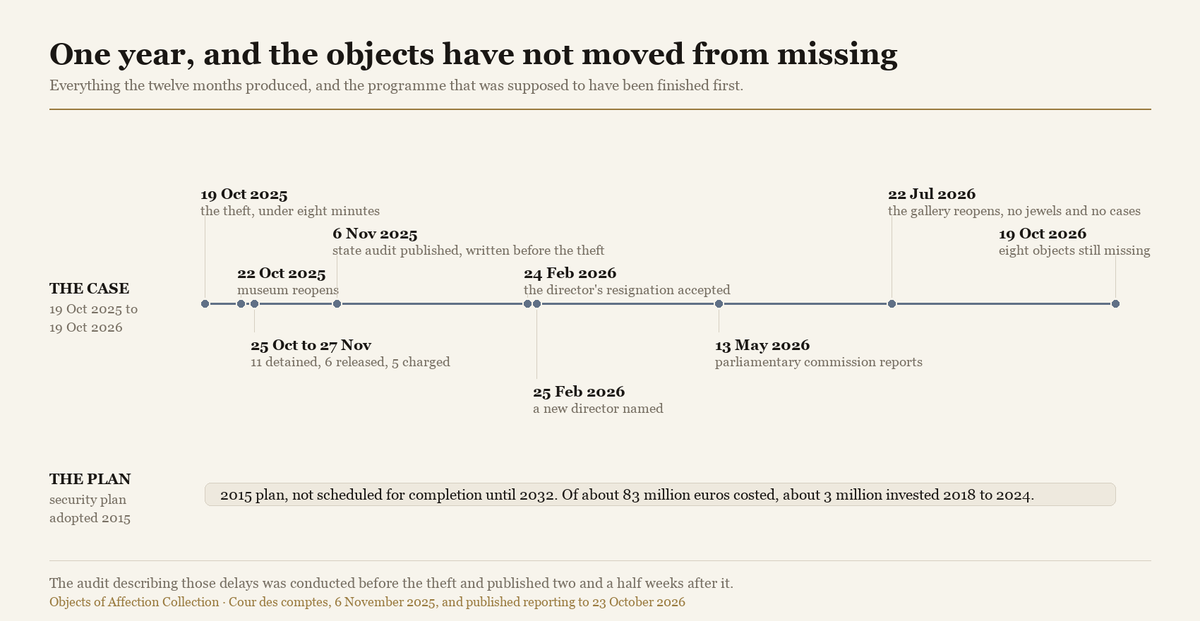
The theft was on 19 October 2025, at about half past nine in the morning, roughly thirty minutes after the museum opened. Two masked men rode a furniture lift to a first floor balcony and cut through a window with a disc cutter. Two more waited outside on scooters.
Eight objects were taken, according to the French Ministry of Culture: a tiara, a necklace and a single earring from the sapphire set associated with Queen Marie-Amélie and Queen Hortense; an emerald necklace and a pair of emerald earrings from the set of the Empress Marie Louise; and three pieces associated with the Empress Eugénie, a reliquary brooch, a large corsage bow brooch and a tiara.
A ninth object, the Crown of the Empress Eugénie, was dropped during the escape and recovered. It is the only one of the nine that is accounted for.
In the twelve months since: a state audit, a parliamentary inquiry, the resignation of the museum's director, the appointment of a new one, eleven people detained, five charged, a gallery reopened empty, and a crown sent for restoration. The eight objects are still listed as missing in Interpol's stolen works of art database.
Not one of them has been seen since. According to the investigation, the last known sighting of anything connected to the jewels is closed circuit footage from an underground lock up in Aubervilliers. A team variously reported as sixty and as more than a hundred investigators has searched the homes, cellars, garages and attics of suspects and their families, and found nothing.
What a case does, and what a visitor photograph now has to do instead
A museum vitrine is not furniture. It is an argument about an object, made in glass and brass and light, and it does several jobs at once that nothing else in the building does.
It fixes the object in a place, so that the object has an address a person can walk to. It sets a distance, and that distance is the whole physical content of the relationship between a visitor and a thing they will never touch. It carries the label, which is the only point in the museum where the object's record meets the public in the object's presence. And it holds a volume of empty space that is exactly the size of what is inside it.
That last property is the one that matters after a theft. A case with nothing in it is not a failure of display. It is a display of a different fact. It says, here, this size, this shape, gone. A visitor who has never read a prosecutor's file understands it immediately and does not need a single number explained to them.
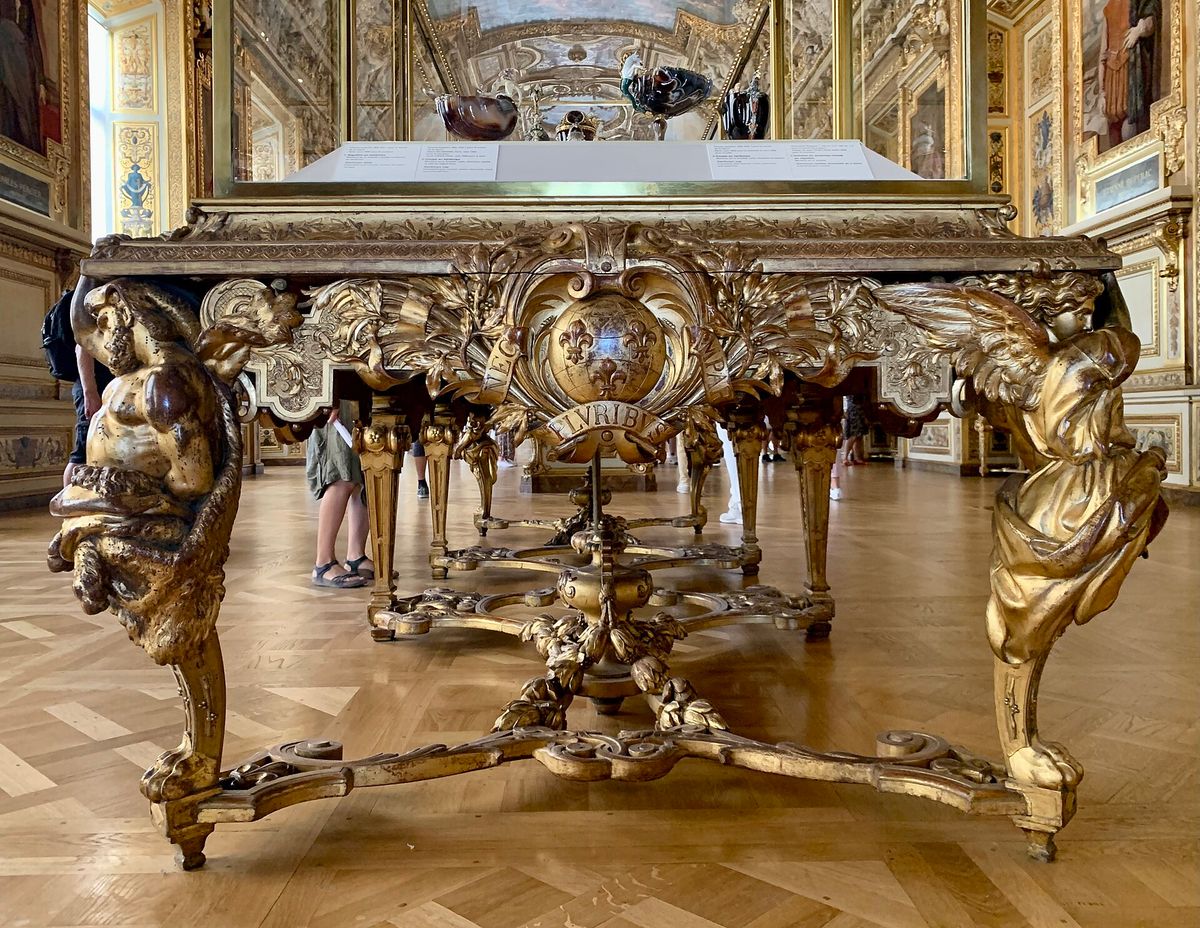
The Galerie d'Apollon held the French Crown Jewels and a celebrated collection of hardstone vessels, in vitrines standing on gilded tables down the length of the room, beneath a ceiling by Delacroix and Le Brun. After 22 July 2026 it holds the ceiling, the panelling and the floor.
The clearest public images of what the room looked like with its cases in it are now photographs taken by members of the public. There is a set on Wikimedia Commons, made by a visitor in July 2021 and released under an open licence, showing a vitrine on its carved stand with a label panel on top and objects behind the glass. A visitor's snapshot, made for no institutional purpose at all, is now a primary record of a museum display that no longer exists.
This institution finds that worth sitting with. Not as a criticism of the Louvre, which owes the public a secure building before it owes anyone a photograph, but as an observation about where records of institutional configurations actually survive. Nobody photographs a display case on the assumption that the display case is the thing worth recording. It gets into the frame as the context for something else, and then one day it is the only evidence of how the something else was held.
The audit that was already written
The French state auditor, the Cour des comptes, published a report on the Louvre on 6 November 2025, about two and a half weeks after the theft. The audit had been conducted before it.
Its findings are not a reaction to the heist. They are a description of the conditions the heist happened in, written by people who did not know it was coming.
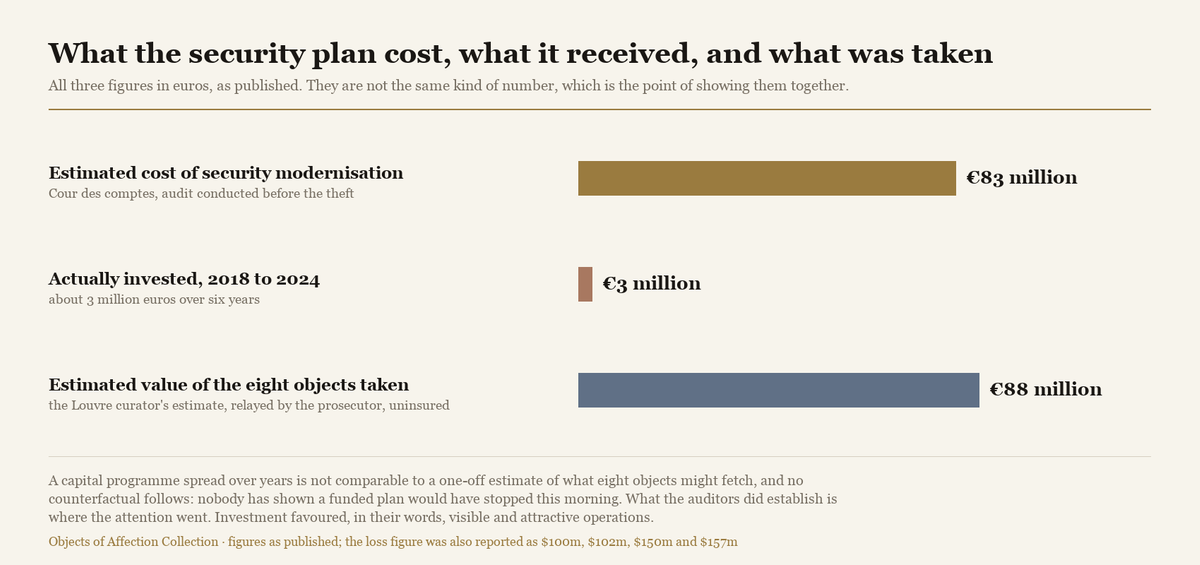
The report put the cost of modernising the museum's security systems at approximately 83 million euros. It found that approximately 3 million euros had actually been invested in that work between 2018 and 2024. It found that camera coverage reached about 39 per cent of the museum's rooms as of 2024, with the Richelieu wing far worse than that, and it recorded repeated postponements of a modernisation plan dating back to 2015 and not scheduled for completion until 2032.
On where the money went instead, the auditors were specific. Investment had favoured what they called visible and attractive operations, acquisitions and visitor experience, at the expense of maintenance and of technical installations including safety and security. Pierre Moscovici, who heads the court, said the pace was far too slow, and called the theft of the crown jewels a deafening alarm bell.
A parliamentary commission reported separately on 13 May 2026. Laurence des Cars offered her resignation on the day of the theft, it was refused, and its acceptance was announced on 24 February 2026. She said it had been her job to act as a lightning conductor. Christophe Leribault was announced as her successor the following day.
Eighty three million not spent, eighty eight million gone
Put the two figures next to each other and then immediately say what the comparison is worth, because this is the kind of juxtaposition that does rhetorical work it has not earned.
The security modernisation was costed at about 83 million euros and received about 3 million. The objects taken were valued at 88 million euros.
These are not the same kind of number and the comparison is not an accounting. One is a capital programme spread over years; the other is an estimate of what eight objects might be worth, made once, after they were gone. A fully funded security plan would not necessarily have stopped four people with a furniture lift and a disc cutter, and nobody has demonstrated that it would. The right conclusion from the audit is the one the auditors drew, which is about pace and priority, not a counterfactual about this particular morning.
What the comparison does legitimately show is the shape of an institutional preference, and the auditors named it before the event: money went to what could be seen rather than to what held it. That is a statement about where an institution's attention sits, and attention is the thing this study is about. The jewels were in a room whose ceiling is one of the most photographed in France.
The number came from inside the museum, and nobody will ever pay it
The 88 million euro figure has been reported around the world for a year as the value of the theft. Its provenance is worth stating precisely, because almost nobody who repeats it states it.
The Paris prosecutor, Laure Beccuau, gave the figure. She attributed it: it was the estimate of the Louvre's own curator. And she said, in the same breath, that the greater loss was to France's historical heritage, which is to say that she offered the number and declared its inadequacy at the same moment.
Then consider what kind of number it is. The jewels were uninsured. The French state acts as its own insurer for works held in national museums in their usual place. The culture ministry's stated reasoning is that commercial insurance is expensive when the loss rate is low. There is no policy, no claim, no adjuster, no settlement, and no counterparty. The state will not be reimbursed.
So the 88 million is a figure produced by the institution that lost the objects, relayed by a prosecutor who said it understated the loss, covering property that no insurer underwrote and no one will ever pay out on. It is not a price. It is not a claim. It is not a reserve. It is a number that exists in order to be reported, and it has no mechanism anywhere behind it that could ever test whether it is right.
It has not stayed still either. The same loss has been published as 88 million euros, as 100 million dollars, as 102 million dollars, as 150 million dollars and as 157 million dollars. The lowest and highest dollar figures differ by more than half again.
This institution does not appraise and will put no figure of its own on these objects. The observation is about the figure's status, not its size. The most useful remark anyone made about a comparable figure came in the Renoir theft at Cagnes-sur-Mer, where an auctioneer in Nice said the number could not be formed at all, because value depends on being able to resell the work and theft removes that. The section below returns to the published valuations in that case, because this institution got part of them wrong.
That last point applies here with far more force, and it is the hinge of the whole case.
The fame is the protection, and the fame is the danger
These objects are unsellable. Every expert quoted in the anniversary coverage agrees on that, and so does common sense: there is no buyer for the tiara of the Empress Eugénie who could ever show it to anyone.
The reason they are unsellable is their record. Not their beauty, not their materials, not their craftsmanship. It is the documentation, the photographs, the catalogue entries, the Interpol listing, the century of publication. Provenance is what makes an object impossible to launder.
And that is precisely what puts them at risk of destruction. Arthur Brand, the Dutch art detective, put the logic plainly: it is mainly diamonds, so they would have to dismantle them, recut them and sell them. Tobias Kormind of 77 Diamonds said that once recut, a stone re-enters the legitimate supply chain fairly easily, and that unless it has unusually distinctive internal inclusions even the strongest gemmological laboratories would struggle to flag a freshly polished diamond as stolen. Christopher Marinello of Art Recovery International has suggested the pieces may simply be buried or inside a wall.
Hold the two halves together, because they are the same fact seen from two sides. The record is what stops the objects being sold. The record is therefore the reason to destroy them. An anonymous diamond has a market. A documented one does not. Everything that makes these pieces matter is also the specific obstacle a thief removes with a saw.
This is the hardest thing in the provenance argument and OAC should state it rather than step around it. A complete record does not protect an object. In this case it is the thing that makes the object worth more in pieces than whole. What a record actually does is guarantee that if the objects survive, they can be identified, and that if they do not, what was lost is known exactly. It is an instrument of identification and of memory. It is not armour.
The common fate that nobody has measured
The fear that the jewels have been broken up and melted is in every piece of coverage, usually in the form of a claim about what usually happens to famous stolen jewels.
This institution went looking for the measurement behind it and did not find one. There appears to be no published rate for how often stolen high profile jewellery is recovered intact, broken up, or never seen at all. What exists is expert judgment, which is worth having and is not the same thing. Corrado Catesi, who heads Interpol's stolen art unit, says objects can take from three months to forty years to come back. One specialist has put the odds of recovery here at around half, as an individual estimate rather than a measured rate.
And the two most comparable documented cases run the other way. The Dresden Green Vault jewels, stolen in 2019 in a theft of the same character, were recovered, with damage described as barely visible and restoration needed. Brand himself, while describing the melting scenario, noted that although most stolen gold, silver and diamonds are never seen again, some are, and cited both Dresden and a 2022 recovery.
Then there is the ninth object. The Crown of the Empress Eugénie came back. It was damaged, and how badly is itself reported two ways. The museum has said it retains all its elements except one of its eight golden eagles, and that restoration is possible without reconstruction or recreation. Other accounts describe it as crushed, and as missing an eagle and ten diamonds, where the museum's account has nine diamonds detached but preserved. In February 2026 the Louvre began a competitive process to select a restorer.
Even how the crown was damaged has two official versions. The museum has said it was harmed being pulled through the narrow opening the thieves had cut in the glass. Des Cars said it was likely damaged on removal through that small cut rather than when it hit the ground.
So the single object that has come back is the one the melting thesis has least to say about, and it is also the object about which the record disagrees with itself most. None of this means the eight are safe. It means the sentence everyone is repeating about their likely fate is an expectation held by informed people, not a finding, and that the nearest documented comparison contradicts it.
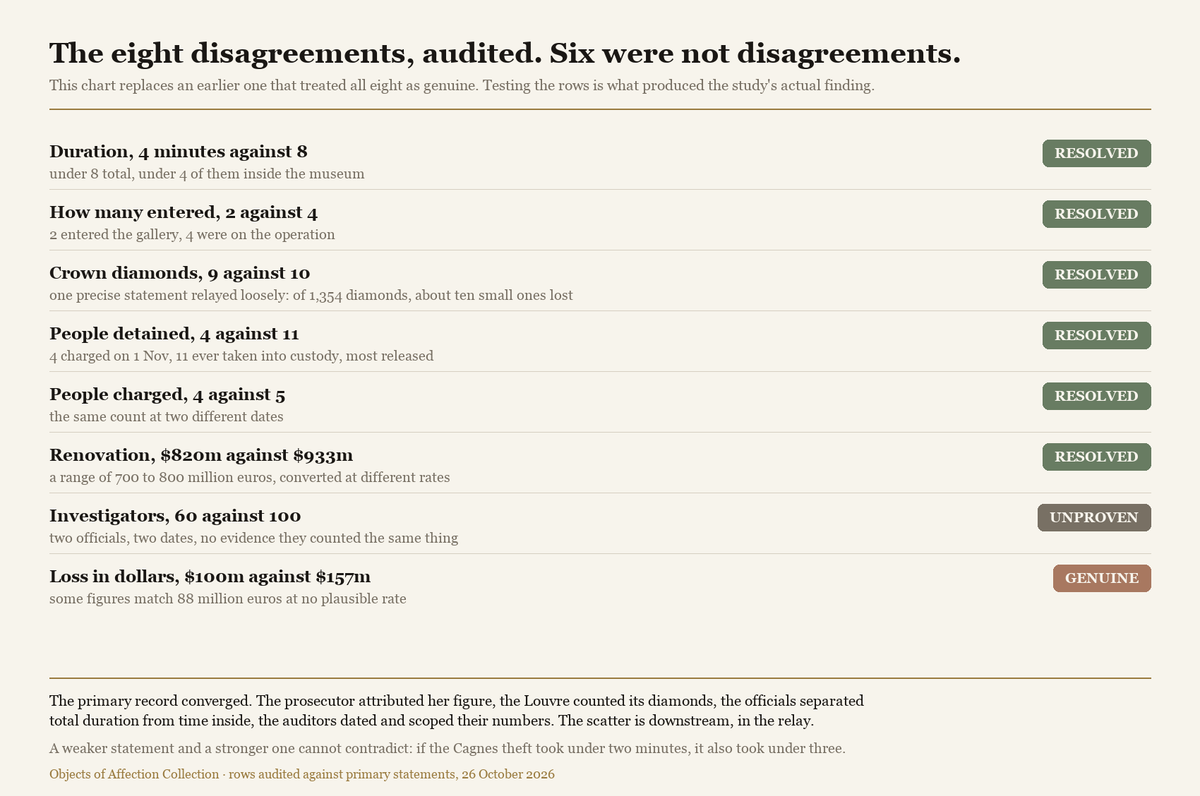
The record did not scatter. The relay did.
This section was written twice, and the first version was wrong.
OAC published a study earlier the same day about the theft of two Renoirs from Cagnes-sur-Mer, in which ten separate facts were each reported more than one way five weeks after the event. Assembling the same list for the Louvre was easy. Eight quantities, each with a largest and a smallest published figure, the widest differing by nearly three times. It made a clean chart.
Then this institution tested it, which it should have done before drawing the chart and not after, and most of it fell apart.
Here is what the rows actually were.
Four minutes against eight minutes was not a disagreement. Officials said the operation lasted under eight minutes in total, of which fewer than four were spent inside the museum. The culture minister's four minutes is the time inside. The seven minutes in the French record is the closed circuit window, a break in at 9:35, the thieves gone by 9:38. Three figures, one timeline, all correct, measuring different things.
Two people against four was the same error. Two entered the gallery by the lift. Four took part in the operation. Nobody disagreed with anybody.
The crown was the worst of them, and it is the one that should have warned me. The Louvre's own statement is extremely precise: of 1,354 diamonds, about ten small ones were lost; all 56 emeralds remained in place; the diamond and emerald globe was intact and still attached to the frame; one of eight gold eagles was definitively lost; the palmettes were all present, four of them detached. A restoration is possible without reconstruction or replacement. The nine against ten I had recorded as a contradiction is two outlets relaying one precise sentence imprecisely.
The arrest figures are denominators at different dates. On 1 November 2025 the prosecutor said four people were under formal investigation. Counting every person taken into custody across the operations of October and November gives a larger number, most of whom were released. Those are different questions with different answers, correctly reported.
The renovation figures are a range, converted. The programme was announced at 700 to 800 million euros, which various outlets converted to dollars at various rates, and a later audit estimate for a possibly different scope sits above both. Quoting a range at its two ends and calling the result a discrepancy is not a measurement.
What survives the audit is small and real: some dollar figures published for the loss correspond to 88 million euros at no plausible exchange rate, which is a genuine error by the outlets that printed them.
So the finding inverts, and the inverted version is both truer and more useful.
The primary record in this case is precise and it is consistent. The prosecutor gave a figure and attributed it. The Louvre counted its diamonds. The officials separated total duration from time inside. The auditors published numbers with dates and scopes attached. The scatter is not in the record. It is downstream of it, in the relay, and it happens by a small number of repeatable mechanisms: a partial list read as a competing claim, a denominator dropped, a range quoted at one end, a currency converted, a precise sentence retold loosely, and a weaker statement set against a stronger one as though they contradicted.
That last mechanism is worth isolating because it cannot be a contradiction and it got past this institution anyway. In the Cagnes study, one source said the theft took under two minutes and another said under three. Those are not in conflict. If it took under two minutes it also took under three. One is simply a looser statement of the same fact, and it was recorded as a disagreement on a published chart.
Applying the same test to that earlier study damages it in the same places. The hiding place reported as a laundry room and as a space beneath a staircase comes from the press conference and from a wire relaying the accused man's own words. The town reported as Clermont-l'Hérault and as Montpellier is one place and its nearest city. The investigative methods listed differently across outlets are partial lists, not rival accounts. The figure in that study overstates, and it carries a correction.
The value comparison in it survives only in part, and the honest version is narrower: the 4.2 million euro figure covers the two works taken and the nine million figure covered all four, which is a denominator difference the chart itself labelled, so the chart undercut its own claim. What is genuinely wrong there is the English coverage that reported roughly nine million euros per painting, which no source supports.
Being wrong about this is cheap. Publishing it and leaving it would not have been. The thing that makes the inverted finding worth more than the original is that it tells a reader what to do: when quantities about a case disagree, do not treat the disagreement as a property of the case. Go and find the primary statement, because in both of the events this institution has examined this week, it existed, it was precise, and it did not disagree with itself at all.
The money going forward disagrees with itself as well
The divergence is not confined to the past. The figures for what the Louvre will now spend are published more than one way too, and these are plans rather than estimates of a loss, which makes the spread harder to explain.
The security master plan Leribault inherits has been reported at about 92 million dollars. The Cour des comptes costed security modernisation at approximately 83 million euros, which converts to roughly 95 million dollars. Those may be the same programme described twice or two different scopes, and published coverage does not say which.
The wider renovation, the programme announced as the Louvre New Renaissance, has been reported at about 820 million dollars and at up to 933 million dollars, with a dedicated gallery for the Mona Lisa by 2031. Around a hundred cameras are to be installed by the end of 2026 as part of more than twenty emergency measures, against a backdrop in which 134 digital cameras were installed over the three years before the theft and coverage still stood at about 39 per cent of rooms.
A loss can be estimated loosely because nobody has to pay it. A capital programme has a budget line, an approving authority and a procurement process, and it is still being reported with a gap of more than a hundred million dollars. That is harder to attribute to the fog of a fast moving story, because none of these numbers is moving fast.
There is also a structural point under the camera figures that the audit made and the coverage mostly did not. The auditors noted that cameras had historically been added when rooms were renovated, which ties security coverage to an entirely unrelated schedule. A protection programme that advances only where a decorating programme happens to go will produce exactly the pattern the audit found, which is strong coverage in recently refreshed spaces and almost none in a wing nobody has got to yet.
The mastermind the record does not contain
One phrase recurs in every summary of this case: the mastermind has not been caught.
Read the record for what it actually establishes. No mastermind has been identified. Two suspects have claimed a ringleader was on their team, and according to a source close to the case, investigators treat that claim with scepticism. Separately, two suspects told investigators in June 2026 that an unnamed sponsor had recruited them.
"They have not caught the mastermind" asserts that a mastermind exists. The record supports something weaker and more interesting: accused people have said somebody else organised it, and the investigators who have heard them say so are not persuaded. Those are claims by defendants about their own degree of responsibility, which is the category of statement that warrants the most care, and the professionals assessing them in context are unconvinced.
It is entirely possible there is an organiser. It is also possible there is not. What the sentence does is convert an unproven assertion by interested parties into a known fact with a gap in it, and the gap then shapes how everyone understands the case, including how the recovery is imagined: somewhere out there is the person who knows where the jewels are. Maybe. Nothing published establishes it.
This is the same grammatical move this institution has documented in a different register, where a goal written in a plan becomes a credential in copy because nobody rewrites the tense. Here an allegation becomes a character.
What is left
Eight objects, uninsured, valued at a figure supplied by the institution that lost them and declared insufficient by the prosecutor who relayed it, unsold because their record makes them unsellable and therefore at risk precisely because of that record, missing for a year, with the last trace a camera in an underground lock up.
A ninth object, dropped, recovered, damaged in a manner described two ways, missing one eagle and either nine or ten diamonds, awaiting a restorer chosen by competition.
A security plan costed at 83 million euros that received 3 million over six years, documented by auditors who finished their work before the theft and published it afterwards.
A director who resigned twice, the first time on the day and refused.
And a room, reopened, with its ceiling intact and its cases gone.
The Louvre has not hidden anything. It has done something subtler, and it is the thing that puts this case in OAC's field rather than in a crime reporter's. It has removed the display apparatus through which the public related to those objects, and in doing so it removed the only place where the loss was visible to a person standing in the building. The gap now exists in the prosecutor's file, in the Interpol database, in a parliamentary report and in the press archive. It does not exist in the room.
There is a grammar for this. Provenance records have a settled way of writing down a gap, which is to mark it, state its extent, and leave it marked, because an unmarked gap and a complete record look identical to everyone who comes after. An empty case does the same work in three dimensions. It is a declared absence, standing in the place the absence occurred.
The jewels may be recut by now, or buried, or in a wall. Nobody outside the investigation knows, and the people inside it have searched the obvious places and found nothing. If they are gone, then the record is all that will remain of them, and the record is in good order: photographed, catalogued, described, attributed, dated, and listed as stolen with an international body.
That is the burden of preservation doing the only part of its job that is still available to it. It could not keep the objects. It can keep what they were, exactly, and keep the fact of their loss precise and permanent.
Which is what makes the empty room worth noticing. The record of these objects is excellent everywhere except the one place a person might stand and feel it.