The Brackets Were Dropped: Edward Hopper's First Oils and the Notation That Carried the Whole Record
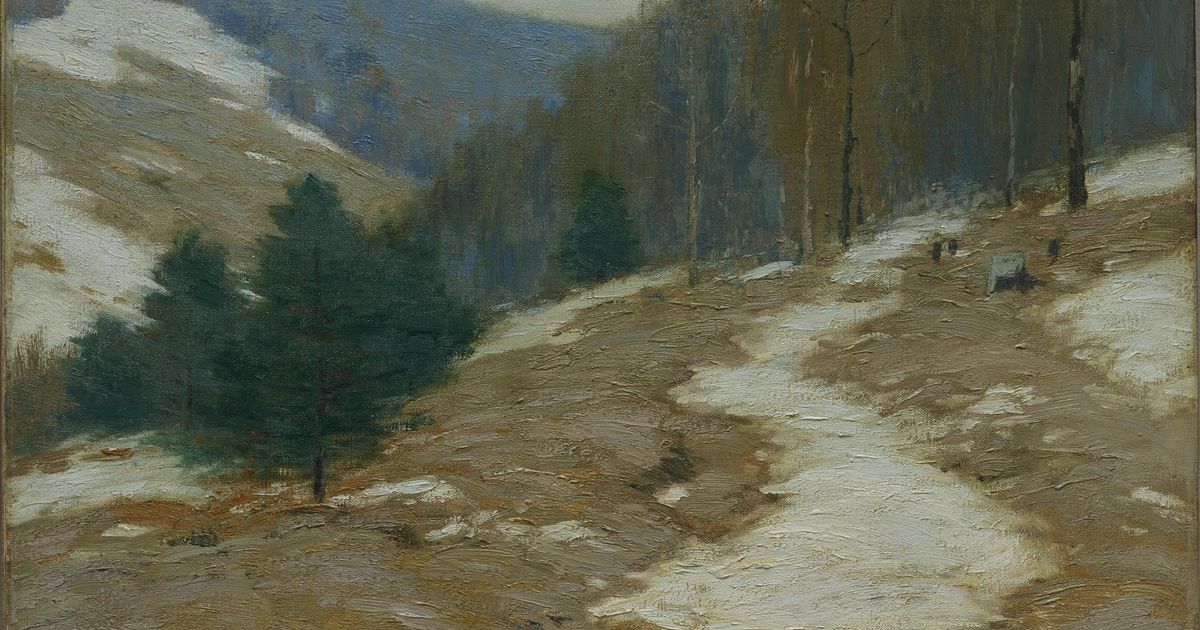
In October 2026 the story went round the art press in a single sentence: all six of the oil paintings Edward Hopper made before he went to art school, long held to be his first original works, are copies of paintings by other artists. The sentence is true. It is the best attribution finding of the month and the scholar who produced it, Louis Shadwick, did the work that nobody else did, which was to go and look at the magazines a middle class American family would have had in the house in 1890.
This study is not about whether the finding is right. It is about the six words in the primary literature that explain how the mistake lasted a century, and about what happened to the finding itself as it travelled.
The six words belong to Shadwick, in a footnote-dense article in the Burlington Magazine. Writing about the exhibition history of the painting at the centre of the case, he notes that it appeared in two shows at the museum in Hopper's home town, and that for both of them, in his phrase, the brackets were dropped.
A catalogue that said so, in punctuation
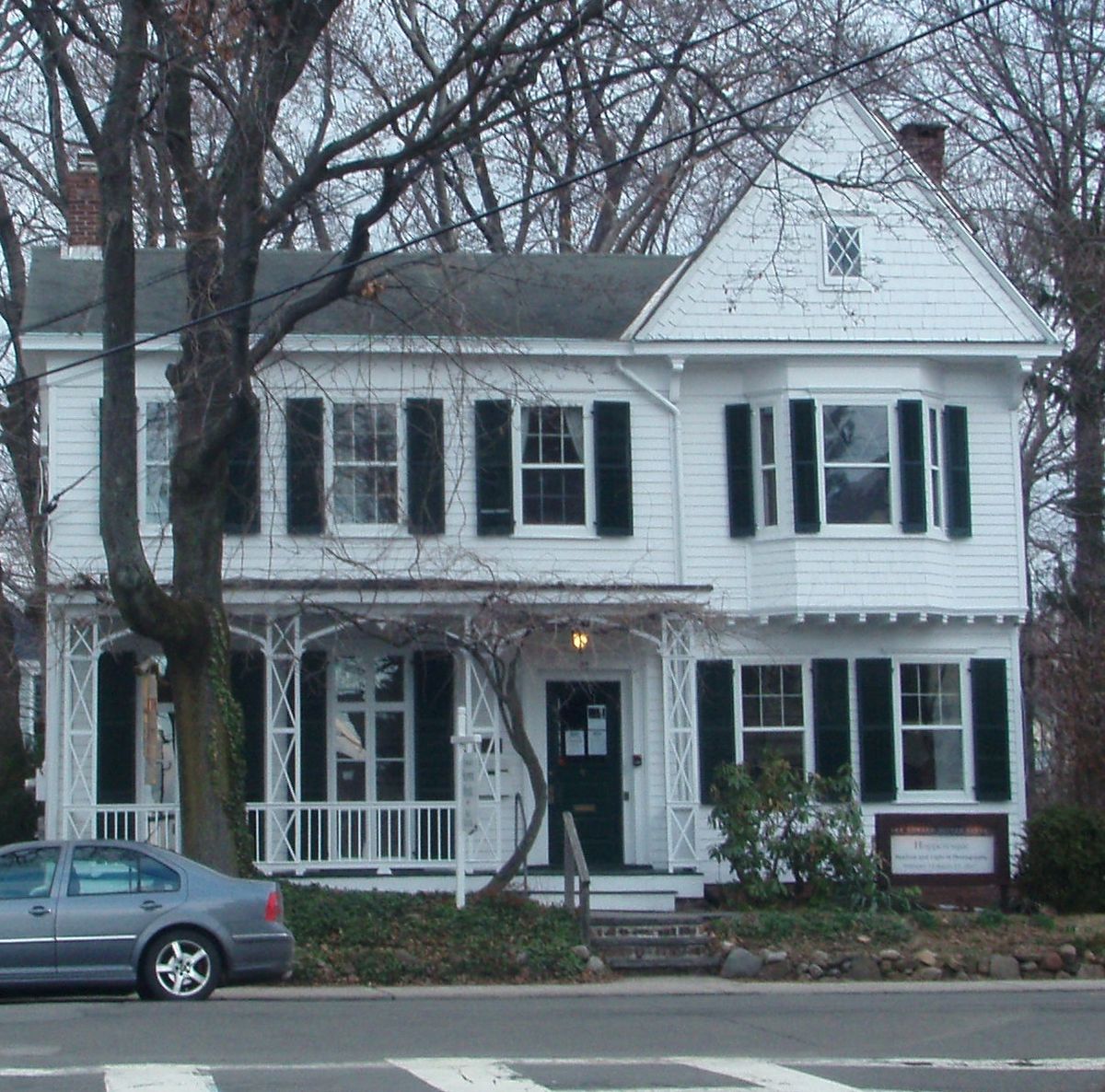
The painting is Old Ice Pond at Nyack. For decades it was treated as one of very few oils in which Hopper painted the town he was born in, and as such it carried a particular weight: Hopper left almost no record of his childhood, so the paintings had to do the work that documents could not. A title naming a specific local landmark, the skating pond at the top of Main Street, a short walk from the family house at 82 North Broadway, is a strong piece of evidence about a boyhood.
It is also a title the artist never gave it.
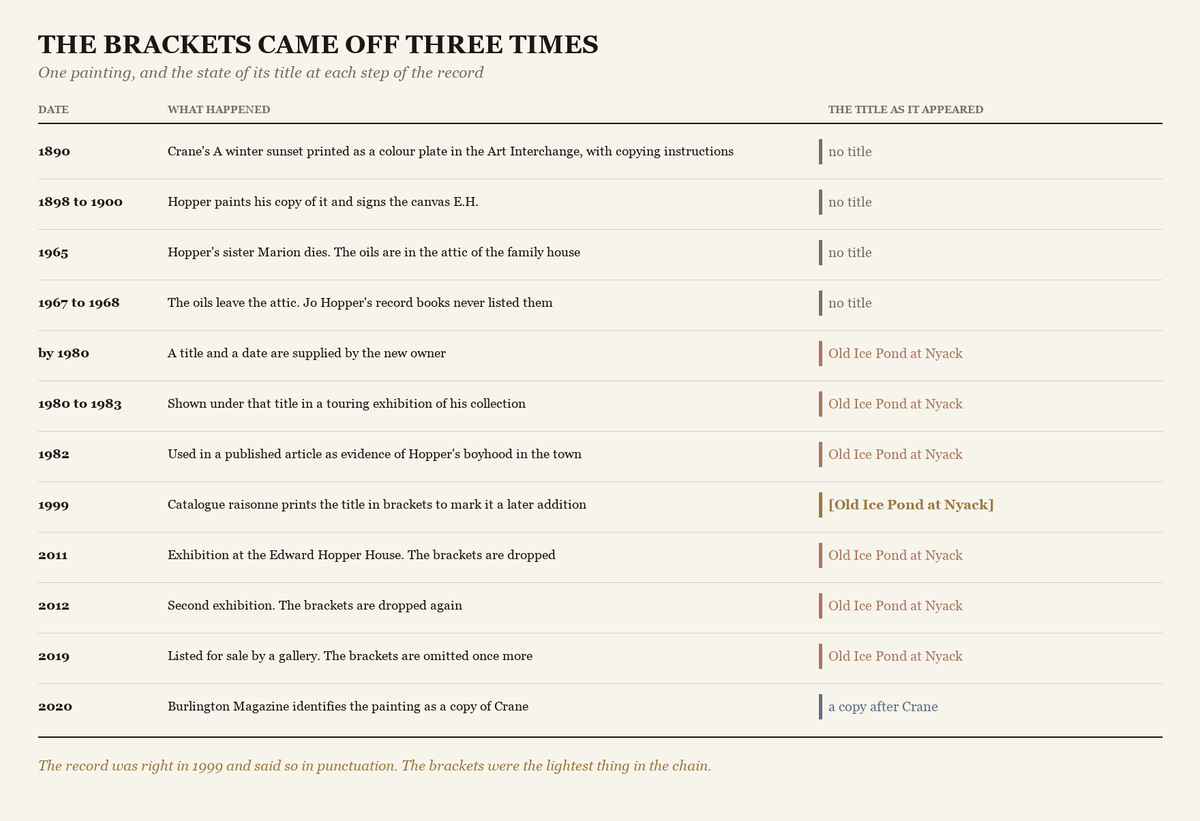
When Gail Levin published her catalogue raisonné of Hopper's work in 1999, she printed the title inside square brackets. The brackets are a notation. They mean that the title is a later addition and not the artist's own. The same notation appears around Rowboat in Rocky Cove, with Shadwick recording that the title was bracketed to show that it was not Hopper's.
So the record was correct. It carried the fact that the titles were supplied by somebody else, and it carried that fact in the only place a reference work has to put it, which is beside the object. A reader of the catalogue in 1999 could not have been misled.
Then Old Ice Pond at Nyack was shown at the Edward Hopper House in Nyack in 2011, in an exhibition called Prelude: The Nyack Years, and again in 2012 in Edward Hopper: Early Nautical Scenes. For both exhibitions the brackets were dropped. Both drew attention to parallels between the painting and Hopper's mature work. In 2019 the painting was listed for sale by a gallery in Jackson Hole, Wyoming, alongside other items from the same collection, and Shadwick records that the brackets were once again omitted.
Nobody forged anything. Nobody asserted a false fact. A pair of square brackets fell off a title three times, and each time the thing that fell off was the only part of the record that said where the title came from.
What the brackets were protecting
Hopper's wife Josephine, known as Jo, kept record books of her husband's output. They are a genuine artist's register: she used them to account for each work's provenance, its exhibition history and other information. They are the nearest thing this body of work has to a primary ledger kept by someone with first-hand knowledge.
The pre-art-school oils are not in them.
That absence is not a failure of the register, and reading it as one is the error this institution exists to argue against. Jo Hopper recorded works that were deemed suitable for the art market. Most of Hopper's early drawings, illustrations and art school works are absent for the same reason. The six oils sat in the attic of the Nyack house, where Hopper's sister Marion lived until her death in July 1965. They were never offered for sale in the Hoppers' lifetimes, and Shadwick draws the consequence precisely: it is for this reason that the paintings had remained untitled and, with one exception, undated.
Untitled because unsold. The gap in the ledger is an accurate statement about the status of the objects, and anybody reading it correctly would learn something true.
What happened next is the part that matters for anyone building a record today. The works left the attic and entered a market. A market requires a title and a date. Neither existed, because the honest register had correctly declined to invent them. So the title and the date were supplied by the person who then held the paintings, and within twenty years the supplied title was being read as the artist's description of his own hometown.
An absence in a record does not stay empty. It gets filled by whoever needs it filled, and the filling inherits the authority of the thing it was added to.
Who supplied them
The paintings were found in the attic by Arthayer R. Sanborn, the preacher of the Nyack Baptist Church, who died in 2007. His relationship to the family was close and documented: he helped Marion during her last years alone in the house, became a friend of hers and then of Edward and Jo's, drove them between New York and Nyack, and officiated at Edward's funeral. He was named in Jo Hopper's will as one of six beneficiaries who were to divide the residue of her estate. Jo died on 6 March 1968, ten months after her husband. Sanborn continued to look after the Nyack house on behalf of her estate until it was sold in 1970, and during that period he acquired the contents.
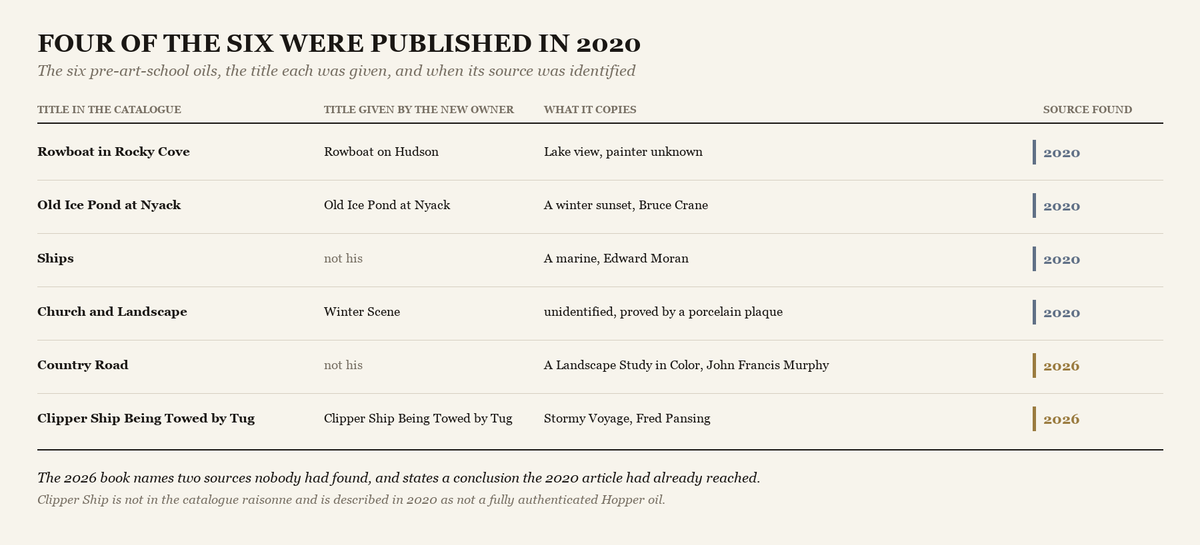
Four of the six titles are his. He called the first signed oil Rowboat on Hudson. He called Old Ice Pond at Nyack by that name, and he gave it its date. He titled the work the catalogue raisonné calls Church and Landscape as Winter Scene, and he titled Clipper Ship Being Towed by Tug.
Exactly two of those four titles point at Nyack, which is the number the brief that commissioned this study gives, and it is correct. Sanborn used the paintings to document the artist's connection to the town, in a travelling exhibition of his collection that visited more than ten galleries between 1980 and 1983, in an article he published in 1982, and in talks.
Shadwick's conclusion is that neither painting bears any relation to Nyack, because both are copies: Old Ice Pond at Nyack of A winter sunset by the Tonalist painter Bruce Crane, and Rowboat in Rocky Cove of a watercolour called Lake view by a painter nobody has identified, inscribed only Athelstane. The further conclusion is the one the headlines carried, and it is a strong one honestly reached: that Hopper did not produce a single original oil until he enrolled at the New York School of Art, still known then as the Chase School, in the autumn of 1900, and that no boyhood oils of Nyack by him exist.
The ledger that was silent, and the ledger that spoke
How Sanborn came to hold the works is disputed, and the dispute is a matter of public record rather than an inference drawn here.
Levin, who was a curator of Hopper's work at the Whitney Museum and is the author of the catalogue raisonné, has argued publicly that he was a thief and that works he later sold, including to a museum in Boston, were never rightfully his. She has also argued that the Whitney failed to defend the public interest. The Whitney has said that it is aware of claims made by a former curator, that those claims were considered when first made and were researched again more recently, and that it has found no basis to pursue the matter and is satisfied with what it received. Sanborn's family disputes the characterisation. According to his son, one of the works in question was a gift from the Hoppers.
Objects of Affection Collection takes no view on who holds title to these works, on whether anything should be returned, and on whether any wrong was done. Those are questions for the parties, their counsel and the institutions concerned. What is inside this study's competence is narrower and, for anyone designing a record, more useful.
The work at issue in that exchange is City Roofs, painted in 1932, which hung in Sanborn's dining room. His son's account is that it was a gift. Levin's answer is a line from Jo Hopper's register, which last labelled it as here in studio.
Set the two halves of that register side by side. On the pre-art-school oils it is silent, and its silence is correct, and because it is silent there is no way to test a title supplied thirty years later. On City Roofs it speaks, and because it speaks there is something to test a claim against, and the claim and the register disagree.
This is the whole argument for keeping a provenance record, and it is not the argument usually made for one. The usual claim is that a complete record prevents disputes. It does not. What a record does is decide which claims are checkable. Jo Hopper's books are incomplete by design and they are still decisive, in one direction on one object, because on that object she wrote down where the thing was. A register earns its keep not by covering everything but by being honest about what it covers, which is the property this institution calls the burden of preservation and which no amount of later scholarship can retrofit.
The finding is six years old, and that is not a criticism of the finding
Here the study turns on the coverage rather than the paintings, because the coverage repeated the error the paintings illustrate.
The identification of Old Ice Pond at Nyack as a copy of Crane was published in the Burlington Magazine, volume 162, in October 2020, at page 870, under the title The origins of Edward Hopper's earliest oil paintings. The article is by Shadwick. It is eight pages long, it carries forty-eight notes, and it is freely available as a PDF.
That article identified sources for four of the six oils. It named A winter sunset by Crane for Old Ice Pond at Nyack; Lake view by an unknown painter for Rowboat in Rocky Cove; A marine by Edward Moran for Ships; and, for Church and Landscape, it established that the work is a copy without finding the source, by locating a Victorian porcelain plaque painted with the same scene. On the remaining two it was explicit that it had not closed the question, saying that Country Road and Clipper Ship Being Towed by Tug must be regarded with similar suspicion, and noting that Country Road was merely reminiscent of landscapes by American followers of the Barbizon school such as John Francis Murphy.
It then stated the conclusion that ran as news in 2026: that it is possible to advance the new conclusion that Hopper did not produce a single original oil painting until the autumn of 1900, and that no boyhood oils of Nyack by him exist.
So what is genuinely new in Shadwick's book, published by Yale University Press in the United States on 13 October 2026 and in the United Kingdom on 24 November, is real and is specific. It closes the two open cases. Country Road is identified as a copy of A Landscape Study in Color by Murphy, reproduced in the Art Interchange on 27 March 1886. Clipper Ship Being Towed by Tug is identified as a copy of Stormy Voyage by Fred Pansing, published as a lithograph in the Sunday supplement of the New York Recorder on 7 May 1893. The book also adds corroboration for Church and Landscape in the form of two 1893 paintings of the same scene by Edgar Barnes Gilson.
Naming two previously unknown sources, one of them in a newspaper supplement rather than an art magazine, is a substantial piece of scholarship. It is a smaller and harder claim than all six revealed to be copies, and it is the claim the author actually made.
Two of the outlets that covered the story in October 2026 were checked here for any mention of the 2020 article or of earlier publication of the research. Neither mentions it.
And the curator's sentence is six years old too
The brief that commissioned this study closes with a curator saying the finding cuts through the popular image of Hopper as an American original. That sentence is real, it is accurately paraphrased, and it was said in 2020.
It belongs to Kim Conaty, curator of drawings and prints at the Whitney, quoted in Smithsonian magazine on 1 October 2020, two weeks after the Burlington article went to press. She said the research cuts straight through the widely held perception of Hopper as an American original. She was describing a finding about four paintings. In the brief it arrives as a comment on a finding about six.
Nothing was invented. A true quotation from a named person at a named institution was moved six years and two paintings from where it was given. The quotation survived; the date and the scope attached to it did not. That is the same operation as dropping the brackets, performed on a sentence instead of a title.
The quotation that makes the story land, and where it comes from
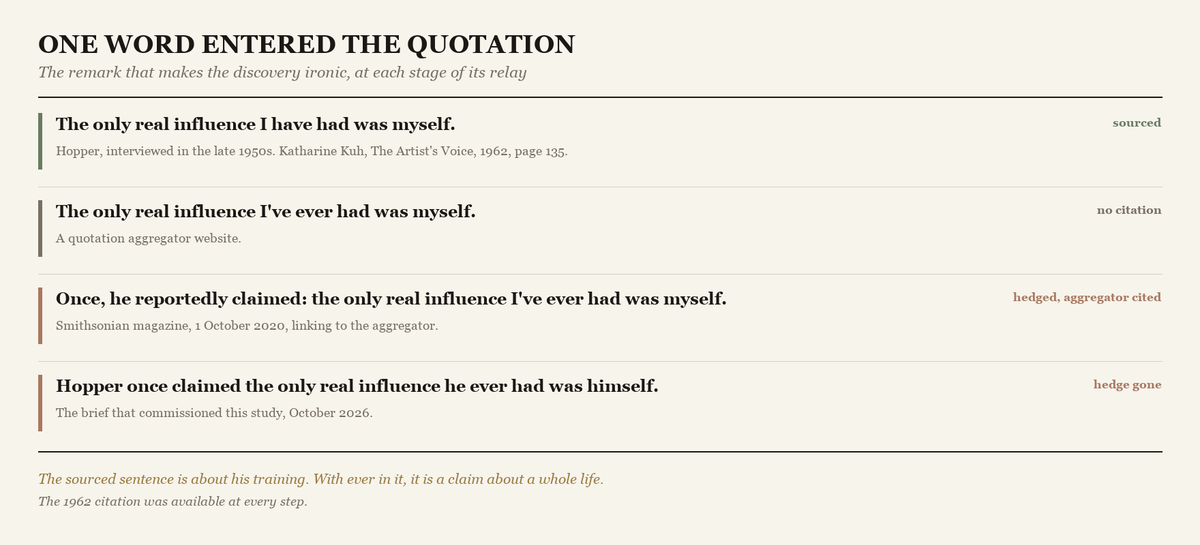
The hook of the whole story is that Hopper claimed to have had no influences. The brief gives it as: the only real influence he ever had was himself.
The remark is genuine and it has a proper citation. It comes from an interview Hopper gave in the late 1950s, published by Katharine Kuh in The Artist's Voice in 1962 at page 135, and reprinted in the 2006 volume Kuh assembled with Avis Berman. The wording there is: the only real influence I have had was myself.
Not ever. The sourced sentence is a statement about his formation as a painter. The circulated sentence, with ever inserted, is a claim about his entire life, and it is the inserted version that makes the discovery ironic. One word, added somewhere in transit, converts a remark about training into a boast about a career.
The Smithsonian article that carries the curator's verdict also carries this quotation, hedged as something Hopper reportedly claimed, and the source it links for the artist's own words is a quotation aggregator website. A 1962 book of interviews with seventeen artists, conducted by a serious critic and still in print in a 2006 edition, was available the entire time. The real citation was never missing. It was simply not reached for.
The source paintings lost their titles as well
A smaller detail, and the most exact instance of the pattern, because here the drift happens to the titles of the works whose titles are the subject of the story.
Shadwick's article gives Crane's painting as A winter sunset and Moran's as A marine. In the 2026 coverage, Crane's becomes Winter Sunset and Moran's becomes Marine View. Indefinite articles fall away and a generic noun is replaced by a more descriptive one. The works are the same works. Searched for under the printed 2026 titles, in a library catalogue or a period index, they are harder to find than they were under the titles the scholarship gave them.
A study about titles supplied by people other than the artist was reported in prose that supplied new titles for the source paintings.
Testing this before publishing it
This institution published a study earlier this month built on a method that had been described rather than tested, and the method failed when it was finally exercised. The correction is on the public record. So the claim above, that a relay degrades a fact's sources rather than the fact, was tested against this case before it was written down, and it was tested in a way that could have returned the opposite answer.
Fifteen separable claims in the commissioning brief were each checked against a primary or near-primary source. Nine came back confirmed. Six came back corrected: the date of the finding, the title of the Crane painting, the number of other known copies, the wording of the Hopper quotation, the date of the curator's remark, and the status of Clipper Ship Being Towed by Tug, which is not in the catalogue raisonné and is therefore described in the 2020 article as not a fully authenticated Hopper oil.
Every one of the six corrections is drift in a source, a date, a wording, a count or a status. Not one is drift in the substance. The paintings are copies. That claim held at every layer of the relay, from an eight-page article with forty-eight notes down to a one-page brief.
The method also had to survive being wrong about the brief, and in one place it was. The claim that two Nyack-linked titles came from Sanborn looked like an error, because he supplied four titles in total. Checking showed that exactly two of the four point at Nyack. The brief was right and the first reading here was wrong, which is recorded because a test that only finds faults in the other document is not a test.
The instructions, and the two paintings signed Bruce Crane
The Art Interchange was a widely read periodical for amateur artists, advertised as the most progressive art and household monthly magazine, with a middle class and largely female readership. Its colour plates carried copying instructions. The instructions for Lake view, the plate behind Hopper's first oil, described it as a very simple subject and well adapted to beginners, which Shadwick observes leaves little mystery as to why a thirteen year old chose it.
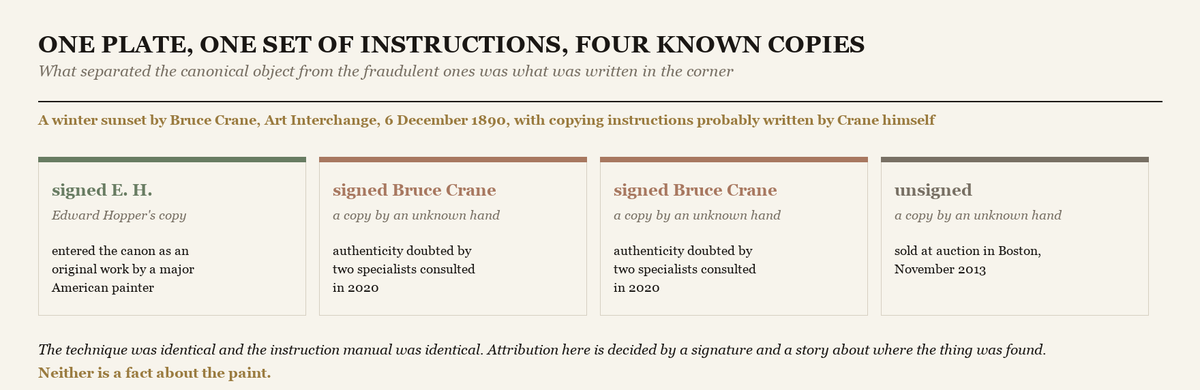
The instructions for the Crane plate were probably written by Crane himself. Shadwick infers this from a parallel case: when another Crane work was reproduced in the Art Amateur in March 1897, the accompanying text records that the magazine asked him to say what had attracted him to the subject. His advice elsewhere ran from the choice of canvas to paint application, colour mixes and drying methods.
Now the part of the 2020 article that nobody has reported, and that carries further than the Hopper story.
Shadwick records in a note that three other copies of Crane's A winter sunset were identified while he was writing. Two of them are signed Bruce Crane. Two specialists he consulted expressed doubts about the authenticity of at least one, pointing to a number of fake Cranes that appeared on the market in the artist's own day, which they suppose were copied from the reproductions using the accompanying instructions. The third, unsigned, was sold at auction in Boston in November 2013.
So one printed plate with a set of instructions, possibly written by the painter it reproduced, produced at least four known copies. One was signed with a teenager's initials and entered the canon as an original work by a major American painter. At least two were signed with the source painter's name and entered the market as fakes. The technique was identical, the instruction manual was identical, and the only thing that separated the canonical object from the fraudulent ones was what was written in the corner.
Attribution, in this case, is decided by a signature and a story about where the thing was found. Neither is a fact about the paint.
The cheapest objects in the chain are the evidence
Two pieces of evidence in this case did more work than any connoisseurship, and both are humble.
The first is the porcelain plaque. Church and Landscape is the one unsigned oil, and its source is still unidentified. What establishes that it is a copy at all is a nineteenth century painted porcelain plaque showing the same scene, which sold at a Sussex auction house in July 2018 for fifteen pounds. A plaque worth less than a paperback settled whether a painting attributed to Edward Hopper depicts a real place. It also disposed of the published claim that the picture shows a snowy Nyack Baptist church.
The second is a supplier's mark. Shadwick dates the paintings partly from a drawing Hopper made around 1900, later titled Artist's Studio, which shows the finished Old Ice Pond at Nyack standing on an easel in the attic. A second canvas in the drawing faces away from the viewer, and Hopper sketched the stamp on the back of it: the palette-shaped mark used by the New York art supplier F. W. Devoe from the early 1890s. Because that stamp does not appear on the back of Old Ice Pond at Nyack, it is possible to infer an order between the two canvases.
A trade stamp on the reverse of a stretcher, drawn by a teenager in a sketch of his own bedroom, is load-bearing evidence about the sequence of an artist's first works. The information was on the object the whole time, in the part nobody frames.
There is a further reading of that drawing worth keeping. Hopper put his copy of a Crane landscape on the easel, in the middle of a carefully arranged picture of himself as a painter, shortly before enrolling at a school run by a teacher who moved in the same clubs and societies as Crane. On Shadwick's account it functions as a manifesto. The copy was not hidden. It was displayed, by the artist, as the best thing he had made.
What this case is actually about
The popular version of this story is that a famous painter was caught copying. That is the least interesting thing in it, and it is not even a charge: Shadwick reads the signatures as youthful pride rather than an attempt to mislead, and copying from instructional plates is what the plates were sold for.
The interesting thing is that a century of interpretation rested on two pieces of information that were never part of the object. A title, and a place. Both were added after the artist's death by a man who had a documented and close relationship with the family, who had reason to connect the work to the town he preached in, and who said so openly in exhibitions and articles under his own name. The catalogue of record then marked that title as a later addition, in brackets, correctly. And the brackets came off.
That is narrative permanence in its ordinary form. Not a lie, and not a conspiracy. A story attached to an object, outliving the evidence for it, because the notation that carried the evidence was the lightest thing in the chain and therefore the first thing to go.
The lesson for a record built now is specific and it is not about punctuation. If the only thing distinguishing an attested fact from a supplied one is a mark that a designer can drop, a curator can omit for a wall label, or a gallery can leave out of a listing, then the distinction will be lost, and it will be lost silently, and the loss will look like nothing at all. The grade has to be part of the field, not an ornament on it. A record that cannot be reproduced without its uncertainties is a record whose uncertainties survive being reproduced.
Jo Hopper did not have that. She had a notebook, and she wrote down where things were, and sixty years later one line in it is the only thing that can be set against a claim about how a painting left a house.
What is not claimed here
OAC does not authenticate, appraise or value, and nothing above should be read as an opinion on whether any of these six paintings is by Edward Hopper, on what any of them is worth, or on the merits of the dispute about how they were acquired. The attribution findings are Shadwick's, published in the Burlington Magazine in 2020 and extended in a book from Yale in 2026, and the reader should go to those rather than to this study for them.
What is claimed is narrower. The record in this case worked. It was the relay that failed, four separate times, in four different materials: a pair of brackets around a title, a date attached to a quotation, a word inserted into a sentence, and an indefinite article removed from the name of a painting. In every instance the fact came through intact and the account of where it came from did not.