They Picked Counterparties That Could Not Answer: Two Forgery Cases and the Free Checks Nobody Ran
Two federal cases closed this year in which the thing being forged was not a painting. It was the paperwork that says where a painting came from.
On 2 October 2026 a Miami dealer was sentenced to forty six months in federal prison for selling counterfeit Andy Warhol works, having pleaded guilty in June to conspiracy to commit wire fraud. On 28 April a father and daughter pleaded guilty in the federal courthouse in Brooklyn to wire fraud conspiracy and to a second charge most of the coverage did not mention, over more than two hundred counterfeit works consigned for auction between 2020 and 2025.
Both schemes are usually described as forgery cases. They are better read as attacks on verification, and when you read the two charging documents side by side they turn out to have used the same technique. Neither of them forged a document that was hard to check. Both of them forged documents that nobody could check, and in one case the government says that was the point.
The signatures belonged to a body that had been dissolved
The Miami dealer, Leslie Roberts, is the only person this study names, and he is named because he has been sentenced and because his own record is part of the finding. The others are referred to by their roles.
According to the Department of Justice, Roberts told buyers the works came directly from the Andy Warhol Foundation. He used forged authentication documents bearing the name of the Andy Warhol Art Authentication Board, with what the government calls the purported signatures of its authorised representatives. He used fraudulent foundation identification numbers inscribed on the backs of the works, and counterfeit stamps.
Here is the fact that is absent from every account of the case this seat could find.
The Andy Warhol Art Authentication Board does not exist. The Foundation announced in October 2011 that it was closing the board, and it was dissolved in 2012. The decision was not a scandal and was not hidden: the Foundation's president said at the time that the cost of defending lawsuits brought over works the board had rejected had made it untenable, and the board had cost several hundred thousand dollars a year to run in any case. It stopped accepting submissions. It has been gone for well over a decade.
So the documents Roberts produced were signed, in effect, by nobody. There was no office to telephone, no registrar to write to, no authorised representative whose signature could be compared against a specimen, because there were no longer any authorised representatives.
A dead counterparty cuts both ways, and that is the finding
The obvious reading is that this made the forgery strong. A certificate from a body that no longer exists cannot be contradicted by that body.
That reading is half right, and the other half is more damning.
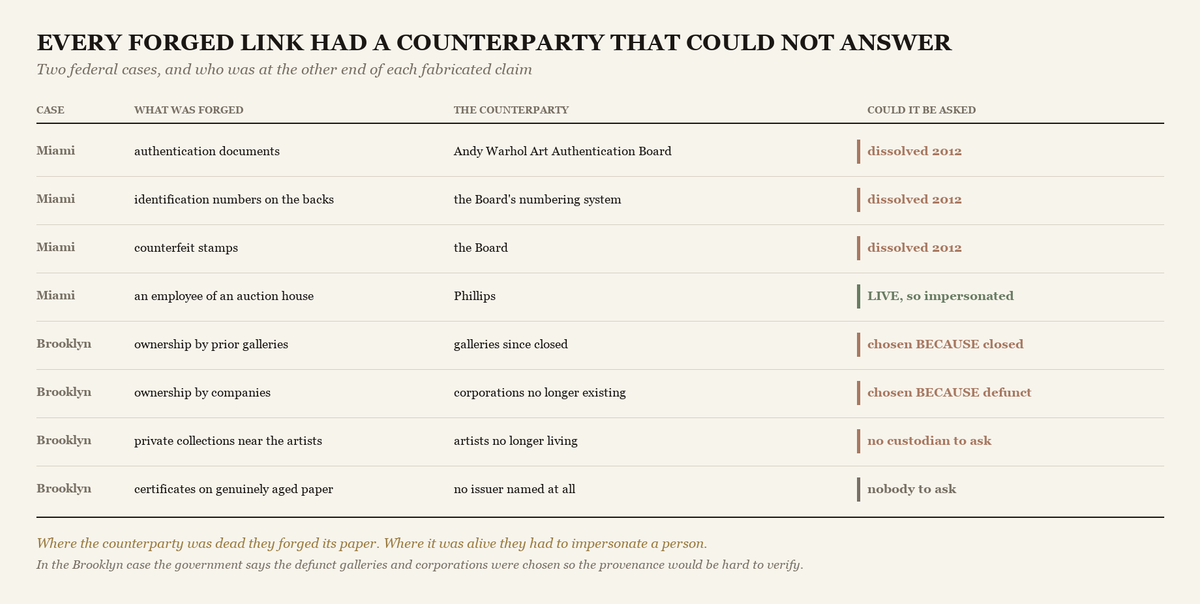
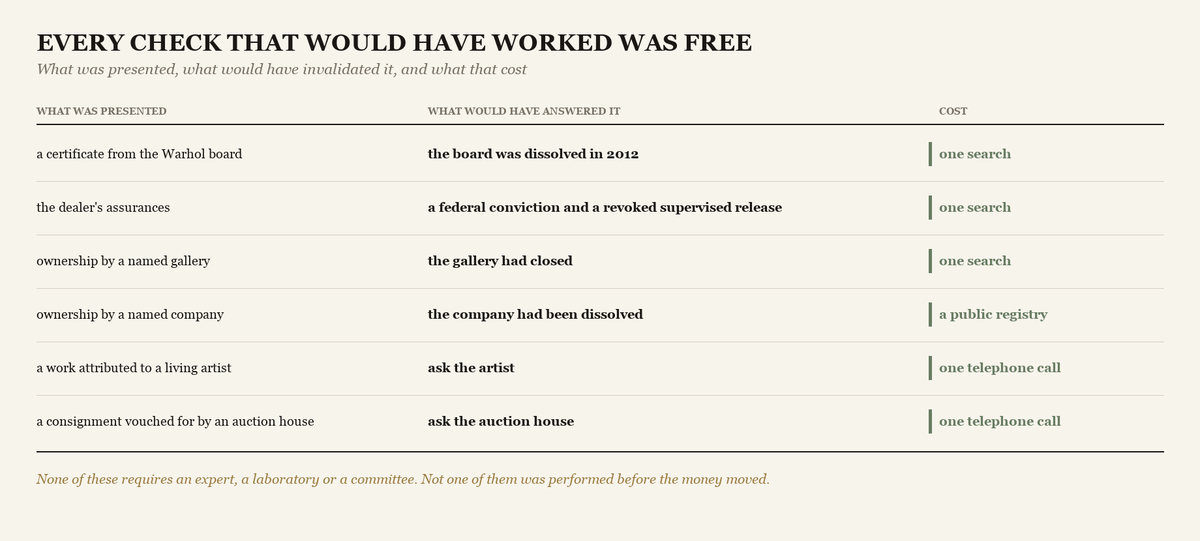
A dissolved board cannot confirm a document, so there is no route to positive verification. But the date of its dissolution is a single public fact, free to anyone with an internet connection, and that fact invalidates an entire class of document at once. Any authentication purporting to come from that board after 2012 is impossible on its face. One does not need to examine the signature, the stamp, the paper or the painting. One needs to know what year the board closed.
So the forgery was not difficult to detect. It was simply never tested. The check that would have destroyed it was not an expert examination costing thousands of dollars and taking weeks. It was a single question with a published answer, and the question was never asked.
This is the pattern the rest of the study is about, and it recurs in the second case in a form the government describes explicitly.
The government says the defunct counterparties were chosen on purpose
The Brooklyn case is the one worth reading closely, because the charging material describes the method rather than only the result.
The father and daughter, both residents of New Jersey, admitted conspiring between 2020 and 2025 to consign more than two hundred counterfeit works for auction, defrauding buyers of at least two million dollars. The government's account says they generated false histories of prior custody and ownership, and then uses the word: provenance.
How they built those histories is the part that matters. According to the government, they claimed works had been in private collections connected to the artists, had been owned by galleries that had since closed, or had been held by corporations that no longer existed. And the government states the reason plainly: those galleries and corporations were chosen so that buyers and galleries would find the provenance hard to verify.
That is not an inference drawn here. It is the prosecution's characterisation of the defendants' method, and it describes, with precision, an attack on the ability to check rather than on the appearance of the document.
A closed gallery cannot confirm a sale. A dissolved corporation cannot produce its records. A collection connected to a dead artist has no custodian to ask. Each of those is a link in a chain that looks exactly like a good link and has the particular property that pulling on it produces nothing.
The paper was genuine. Only the words were false
One detail in the government's account deserves to be lifted out, because it defeats the most obvious technical defence.
The pair bought antique books and used them to obtain genuinely old paper, onto which they imprinted custom-made stamps of forged certificates of authenticity before affixing them to the works.
Dating the substrate is one of the standard tools for catching a forged document. Paper has a manufacturing history, and paper that is too young for the date on the document is a conclusive answer. That test fails entirely here, because the paper is not too young. It is real nineteenth or early twentieth century paper, bought at a bookshop, which will pass any test aimed at the material.
The lesson generalises past this case. A physical test can only tell you about the physical object. The paper was authentic, the ink was applied with a real stamp, the aging was not simulated because it did not need to be, and none of that says anything about whether the sale it records ever happened. The claim lives in the words, and the words are only checkable against a counterparty.
A number that resolves, and a number that does not
The Miami scheme used fraudulent foundation identification numbers, inscribed on the backs of the canvases. It is worth asking what such a number is actually for, because the answer explains why forging one was so cheap.
An identifier can do one of two things. It can be a label, in which case it is a string of characters that looks official and carries whatever authority the reader is willing to lend it. Or it can be a handle, in which case there is somewhere to put it that answers back.
A number inked on the back of a canvas, referring to a numbering system operated by an organisation that stopped operating in 2012, is a label. There is no register to query, no issuing authority to confirm the number was ever assigned, and no way to discover that the same number appears on four other works. It is a claim written in a format that resembles a reference. Forging it requires nothing but a plausible number of digits, because the forgery and the genuine article behave identically when examined: both of them resolve to nothing, because nothing is there to resolve against.
Compare an identifier that answers. A reader who wants to check whether a digital object is what it claims to be can put its identifier into a resolver and be sent to a record held by a party that is still in business. The check takes seconds, costs nothing, and requires no expertise. Crucially, it fails loudly. A handle that does not resolve tells you so immediately, whereas a label that refers to nothing looks exactly like a label that refers to something.
That is the operative distinction, and it is not about technology. It is about whether, at the far end of the reference, there is an institution still answering the telephone. A catalogue number from a living foundation is a handle. The same number from a dissolved one is a label, and it became a label on the day the foundation dissolved, without a single character of it changing.
This institution should apply that to itself before recommending it to anyone, and applying it honestly produces an uncomfortable result. Objects of Affection Collection uses persistent identifiers for its own published work, and those identifiers resolve because a registry agency continues to exist and continues to be funded. That is the same dependency, carrying the same risk, differing in degree and not in kind. A persistent identifier is persistent for exactly as long as somebody pays to keep the resolver running. The Warhol board's numbers were persistent too, until they were not.
The correct conclusion is not that one system is sound and the other was not. It is that every identifier is a promise by a third party, and the useful question about any reference is not whether it looks official but who is keeping that promise and what happens when they stop. A record that names the party behind each identifier, and records when that party was last confirmed to exist, is doing something a stamp cannot do at any level of craftsmanship.
The document nobody checked was the man
Now the part of the Miami case that changes how the whole thing reads.
Leslie Roberts had been here before. He was sentenced to twenty two months in federal prison in a case involving forged works attributed to Romero Britto and Peter Max. A civil matter concerning Britto some years earlier had ended in a permanent injunction against him. His supervised release from that federal sentence was revoked in 2018 after he was alleged to have tried to sell a counterfeit Jean-Michel Basquiat. His gallery was raided by the FBI and he was indicted in 2025.
He then sold more than two and a half million dollars of counterfeit Warhols, and has been ordered to repay close to two and a six hundred thousand dollars of it.
Every buyer in that scheme was, in some fashion, checking the paperwork. They were looking at authentication documents, at stamps, at identification numbers on the backs of canvases. Not one of those documents was the one that mattered.
The decisive document in this case was a federal criminal docket with the seller's name on it, and it was public, free and searchable the entire time.
This is the same failure as the dissolved board, pointed at a person instead of an institution. The market examined the object's history in detail and did not examine the history of the party handing it over. A record of custody is a record of who held a thing and who passed it on, and the identity and reliability of those parties is not background to the record. It is the record.
The one live counterparty in the case was impersonated
There is a piece of the Miami scheme that proves the argument from the other direction.
A co-conspirator, who pleaded guilty the previous year and received a year of probation, posed as an employee of the auction house Phillips as part of the scheme.
Phillips exists. It has a telephone number, a press office and an employee directory. Of every entity invoked across both of these cases, it is the one that could have answered a question on the day it was asked. And it is the one the scheme had to impersonate rather than invent, because a famous living auction house cannot simply be asserted into a provenance the way a defunct corporation can.
Set that beside the Warhol board and the shuttered galleries and the pattern is complete. Where a counterparty was dead, they forged its paper. Where a counterparty was alive, they had to impersonate a person. The second is far more work and far more risk, and they only did it where they had no choice.
The money was not where the headlines are
The coverage of the Brooklyn case leads, almost without exception, on Warhol and Banksy. The brief that commissioned this study does the same, and it is following the reporting rather than making an error.
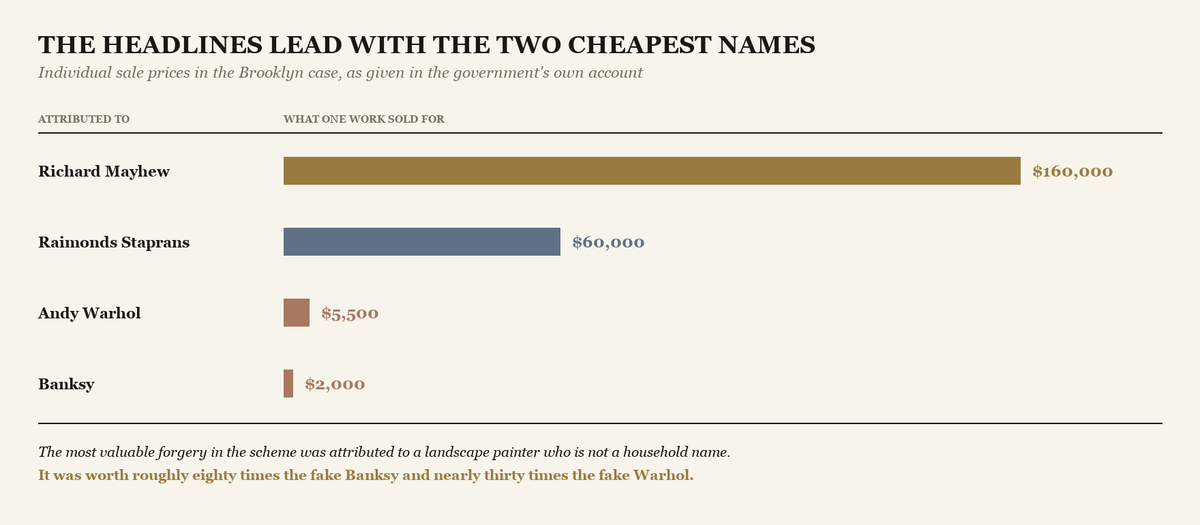
The government's own account lists what individual works sold for. A work attributed to Raimonds Staprans went for sixty thousand dollars. A work attributed to Richard Mayhew went for one hundred and sixty thousand dollars. The counterfeit Warhol went for five thousand five hundred dollars. The counterfeit Banksy went for two thousand dollars.
The most valuable forgery in the scheme was attributed to Mayhew, an American landscape painter of African American and Native American descent who is not a household name, and it was worth roughly eighty times the fake Banksy and nearly thirty times the fake Warhol.
This is worth more than a correction to the emphasis. A scheme running on famous names would be constrained by how closely famous names are watched. This one made its money on artists with real markets and thinner scrutiny, which is a different problem with a different defence, and it is invisible if you read the headline rather than the schedule of sales.
A counterparty died inside the scheme
Mayhew is also where the argument acquires a date.
He died on 26 September 2024, aged one hundred. The scheme ran from 2020 through 2025.
So for most of the period in which works were being falsely attributed to him, the artist himself was alive. A living artist is the strongest counterparty there is for a work attributed to him. He is not a registry, not a board, not a foundation, and not a stamp. He is a person who can look at a painting and say whether he painted it, and that route existed for roughly four of the five years the scheme operated.
Then it closed, permanently, on a date that had nothing to do with the fraud.
That is the single clearest illustration this institution has found of why a provenance record has to treat verifiability as a property that changes over time. The same document, attached to the same object, supported by the same chain, was checkable in 2021 and was not checkable in 2025. Nothing about the document changed. A person died.
The counterparties did not fail. They won, and quit
Everything above treats the dissolved Warhol board as a fact about one artist. It is not. It is one instance of something the art market did to itself over roughly fifteen years, and once that is on the table the Miami case stops looking like an anomaly.
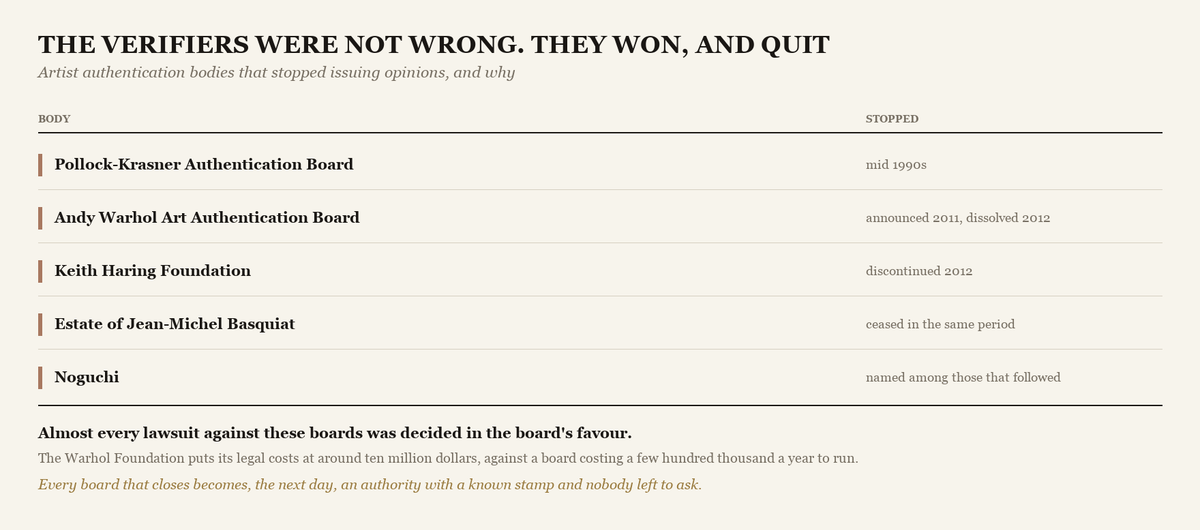
The Pollock-Krasner Authentication Board stopped work in the mid 1990s. The Warhol board was announced closed in 2011 and dissolved in 2012. The Keith Haring Foundation discontinued authentication in 2012, after a group of collectors sued over claimed losses in the tens of millions. The estate of Jean-Michel Basquiat ceased authenticating in the same period, and the Noguchi board is named among those that followed. Published dates for several of these vary by a year or so depending on the source, and the pattern does not depend on resolving them.
The reason they closed is the part worth sitting with, because it is the opposite of what one would assume.
They were not closed because they got it wrong. By the account of the sources here, almost every lawsuit brought against an authentication board was decided in the board's favour. The Warhol Foundation has said it won every single one. What made the work untenable was the cost of winning. Its president put the legal bill at several million dollars for a single antitrust action and the total at something on the order of ten million, against an operating cost for the board itself of a few hundred thousand a year. The litigation cost an order of magnitude more than the function.
The action usually named as decisive was brought in 2007 by a collector who had bought a Warhol self-portrait and submitted it for review. His account, as set out in his complaint, was that the board stamped the work DENIED in red ink which bled through to the front, and rejected it again on a second submission. He alleged that the foundation and the board were rejecting works to create artificial scarcity. The suit was, by several accounts, the first antitrust action against an authentication board to survive a motion to dismiss, and it was ultimately settled. No finding was made against the foundation, which has consistently maintained it prevailed in the litigation brought against it.
This study takes no position on the merits of that dispute. What matters here is structural and is not contested by anyone: the act of rendering a verdict on an object created the exposure that destroyed the body rendering it.
And notice what the complaint describes the board doing. It wrote its verdict on the object, in red, hard enough to come through the other side. That is an authentication practice in its purest form: a judgment about a thing, applied to the thing, by an authority, at a moment. Whatever one concludes about that particular case, a system in which the verifier marks the artefact and can be sued for the mark is a system with a short life expectancy.
So the supply of dissolved authorities whose signatures cannot be checked is not an accident of history. It is manufactured, it was manufactured deliberately and rationally by institutions protecting themselves, and it is still growing. Every board that closes converts, the following day, into exactly the kind of counterparty the Miami scheme forged: an authority with a known name, a known stamp, a known numbering system, and nobody left to ask.
There is a conclusion in this for the kind of record this institution is trying to build, and it is not a comfortable one for anybody selling authentication. A body that issues verdicts about objects acquires liability with every verdict and eventually stops. A record that states what happened, who held a thing and when it passed, issues no verdict and acquires no such exposure. That is the whole distinction between authenticating an object and recording its custody, and the history above is the market's own demonstration of why the second is the more durable instrument. Not because it is more rigorous. Because it is survivable.
The second count, reported and not interpreted
The Brooklyn defendants pleaded guilty to two things. The first was wire fraud conspiracy. The second, which most coverage omitted, was misrepresentation of Native American produced goods and products.
That is a distinct federal offence, and it is notable here for one structural reason: it is an offence about a false claim concerning an object's origin, as such, rather than a fraud offence about money obtained. Among the artists named in the government's account is Fritz Scholder, whom the release describes as a Native American artist of the Luiseño people.
The release does not state which artist or works the second count covers, and this study does not infer it. Scholder is the only artist described in those terms in the material read here, and that is an observation about the document, not a conclusion about the charge.
Objects of Affection Collection takes no view on questions of origin, and does not offer a reading of what that statute covers or how far it reaches. Those are questions for counsel and for the court. It is recorded here because a study about provenance documents should note when a legal system has already made a false statement about an object's origin a criminal matter in its own right, separately from whether anyone was defrauded of money.
Testing this before publishing it
This institution published a study earlier this month on a method it had described rather than tested, and the method failed when it was finally exercised. Since then the test runs before composition.
Eleven separable claims in the commissioning brief were checked against government releases and primary reporting. Nine came back confirmed, including every detail of the forged board signatures and the fraudulent identification numbers. One was incomplete: the Brooklyn scheme covered Picasso, Staprans, Mayhew and Scholder as well as Warhol and Banksy, and the sale figures invert the emphasis. One was corrected on sourcing rather than substance: the detail that an artist in Poland was commissioned to produce the works appears in press coverage and not in the government release read here, and it is reported on that footing.
The brief is accurate. Its limitation is depth, not error, and that is a different result from the test run on the previous study, where the facts were sound and the citations had drifted. A test that returns the same answer every time is a template rather than a test, so the difference is worth recording.
The thesis itself was also put at risk before it was written down, and it changed under the test. The first formulation was that forgers attack verifiability rather than documents. The obvious objection is that a dissolved authentication board makes a forgery easier to spot, not harder, since any certificate from it postdating 2012 is impossible. That objection is correct, and rather than refuting the thesis it produced the sharper version carried above: positive verification was impossible and negative verification was trivial, and neither was performed.
A second objection also has to be carried. Both schemes were caught, so verification did work. It did, by federal investigation, after the money had moved. It did not work at the point of sale, which is the only point at which it protects a buyer.
What a record cannot do, and the one thing it can
An institution that is building a provenance standard has an obvious temptation at this point, and it should be refused.
A provenance record would not have prevented either of these frauds. Both schemes consisted of forged documents, and a record made of documents is forgeable by anyone willing to forge documents. Writing the chain down more carefully does not help if the chain is invented, and claiming otherwise would be the sort of overstatement this institution exists to object to. That is the honest limit and it is not a small one.
What a record can do is narrower and is suggested by the two cases themselves.
Every link in both of these fabricated chains shared one property, and the government says in the Brooklyn case that the property was selected deliberately: the counterparty could not be asked. A dissolved board. Closed galleries. Corporations that no longer existed. Collections attached to artists who had died. The single exception was a living auction house, and that one had to be impersonated by a human being pretending to be an employee.
So the field that matters is not a better signature or a harder stamp. It is a plain statement, carried beside each link, of whether the counterparty to that transfer can still be reached, and when that was last true. That field would not have made the documents unforgeable. It would have made the shape of these chains visible, because a provenance composed entirely of parties who cannot answer is a describable pattern, and in both of these cases it was the whole chain.
It also has the property, unusual in this area, of being cheap. It does not require an expert, a laboratory or a committee. It requires asking, of each link, whether anyone is still there, which is the same question the dissolution date of the Warhol board answers for free and which nobody asked.
This is what the burden of preservation means applied to a document rather than an object. A record is not preserved by being stored. It is preserved by remaining answerable, and answerability decays on a schedule that has nothing to do with how well the paper is kept. The custodian's contract is an attempt to put a name and an obligation on the other end of each transfer, for exactly this reason: a chain of custody with nobody at either end of a link is not a chain, it is a sentence about one.
What is not claimed here
OAC does not authenticate, appraise or value, and nothing above is an opinion on whether any particular work is genuine or on what any work is worth. The sale figures are the government's, reported as such.
The Miami dealer has been sentenced and his conduct is a matter of conviction. The father and daughter have pleaded guilty and have not yet been sentenced, and they are not named here because naming them adds nothing to the argument. The artist said in press reports to have produced the works has not been charged so far as this seat could establish, and is not named. Nothing here should be read as a legal conclusion about any statute, including the second count, and OAC takes no view on questions of origin.
The findings above are drawn from two government releases, the published record of the Warhol Foundation's decision to close its authentication board, and contemporary reporting, all of it linked. What is new here is not a fact about either case. It is the observation that the same structural feature runs through both, that the government named it in one of them, and that in every instance the check which would have exposed the fraud was public, free and never run.