Names Unknown: Twenty Museum Catalogues and the Field That Is Not There
Twenty museums publish their collections online through the same hosted platform. One object record was read at each, in a browser, as an ordinary visitor would.
Not one of the twenty has a field called provenance.
Thirteen carry the fact somewhere, under seven different names. Seven show nothing at all. And four of the twenty have written a declared absence into free text, because they knew something was unknown and had nowhere structured to say so.
That last group is the reason this is a study rather than a list.
What was measured, and what it cannot support
Twenty live instances, one record each. That is the whole sample and it is small on purpose, because it could not be anything else.
The platform sits behind a web application firewall. A request for robots.txt returns 403 to this institution's crawler, at both the institution subdomain and the vendor root. That refusal was not routed around and the user agent was not changed. Every one of the twenty records below was opened in a browser by a person, from pages the museums themselves point the public at.
This matters more than a methods note usually does, because it caps what anyone can ever build here. A sample of this platform is limited to what a human being is willing to read one page at a time. Any future number from this subject carries that ceiling, and it should be printed beside the number rather than left in a footnote.
So: zero of twenty is a statement about twenty records. It is not a rate, it is not a percentage, and it supports no claim about any of these institutions' full catalogues, about museums generally, or about how many collections sit on this platform. One record cannot describe a catalogue of thirty thousand objects, and this study does not pretend otherwise.
Nothing here is a claim about what the software can do. These are publication choices made by institutions, and the subject is what a reader sees.
The twenty, and what each one carries
Naming them is fair, because every one of these institutions is publishing openly and none of this is hidden.
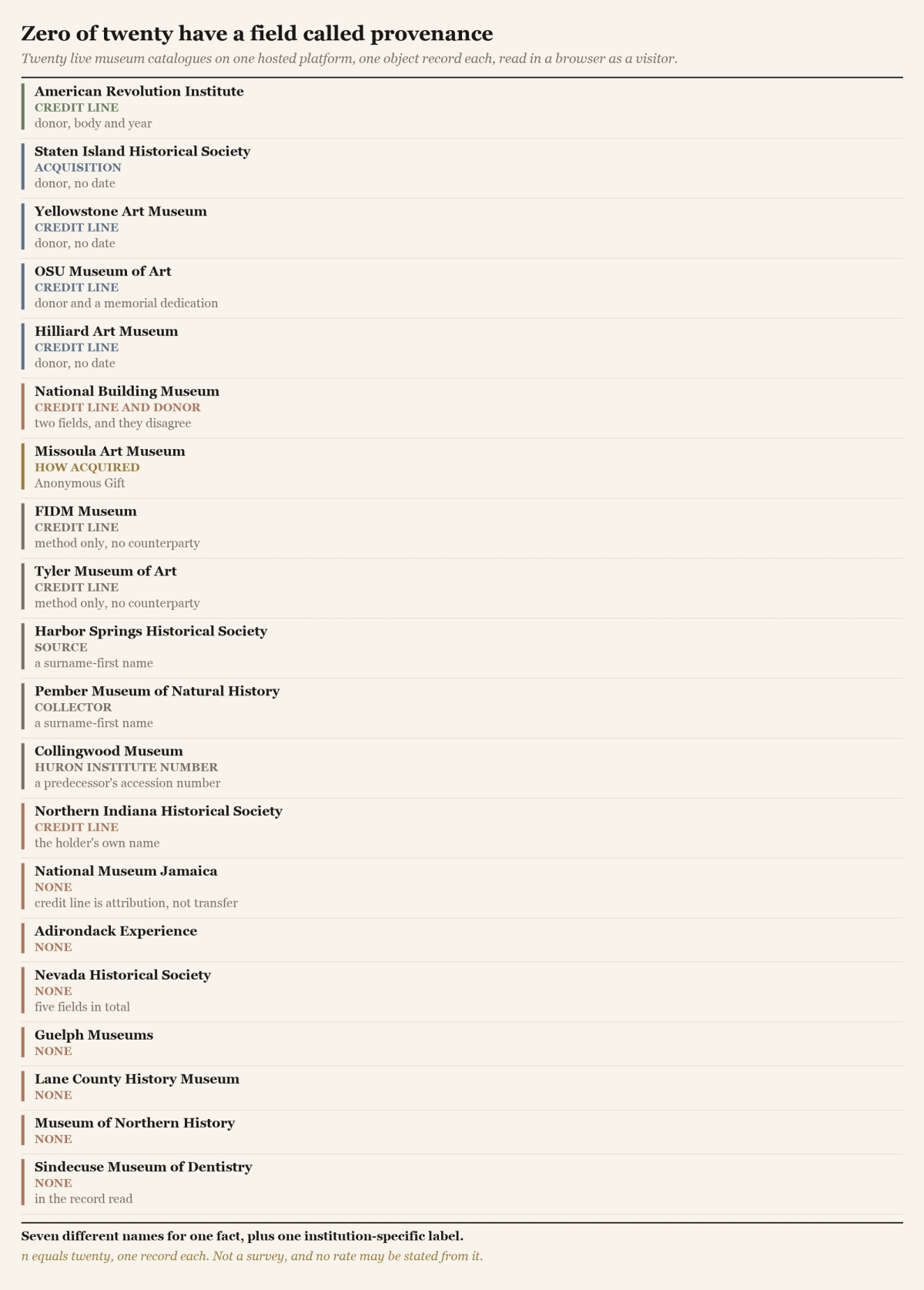
Thirteen carry custody information somewhere. The American Revolution Institute has it in Credit Line, with a donor, the body he represented, and the year, which is the most complete entry in the set. The Staten Island Historical Society has it in Acquisition, naming a donor with no date. The FIDM Museum and the Tyler Museum of Art both use Credit Line for an acquisition method and nothing else. The Yellowstone Art Museum, the OSU Museum of Art and the Hilliard Art Museum use some capitalisation of Credit line for a donor without a date, the OSU entry carrying a memorial dedication as well. The Missoula Art Museum uses How acquired. The National Building Museum uses Credit Line and Donor, both. The Harbor Springs Historical Society uses Source, and the Pember Museum of Natural History uses Collector, each with a surname-first personal name and nothing more. The Northern Indiana Historical Society uses Credit line to print its own collection's name. The Collingwood Museum carries a Huron Institute Number, which is an accession number inherited from a predecessor institution.
Seven show nothing. The National Museum Jamaica publishes a credit line that is an attribution rather than a transfer. The Adirondack Experience, the Nevada Historical Society, the Lane County History Museum, the Museum of Northern History, Guelph Museums and the Sindecuse Museum of Dentistry show no custody field in the records read. The Nevada record displays five fields in total.
Five further instances were found and could not be read: Valdez, the Jewish Museum of Maryland, Salem, Mississauga and Tuxedo Park. Four return a message asking the visitor to contact an administrator, and one publishes no images. That is their configuration, not a refusal aimed at this reader, and the next section explains how that was established rather than assumed.
One small thing worth noticing in passing, because it shows how local these decisions are: Guelph Museums spells its accession field Catalogue Number, with the British spelling, and the Tyler Museum of Art labels its title field Caption. Neither is wrong. Both make a cross-catalogue query that much harder.
Seven names for one fact
Where custody information appears at all, it appears under a name the institution chose.
Credit Line. Credit line. Acquisition. How acquired. Donor. Source. Collector. And at one Ontario museum, a field called Huron Institute Number, carrying a four-digit accession number from a predecessor institution that no longer exists under that name.
Eight labels, counting the two capitalisations separately, which a machine must. A reader moving between two of these catalogues has no way to know that Source at one museum and Credit Line at another are being asked to do the same work, and no way to know when they are not.
The institutions themselves are not at fault in any of this. Each label is reasonable inside its own house. A historical society that acquires by donation from local families will naturally call the field Source; an art museum that acknowledges benefactors in wall text will naturally call it Credit Line, because that is what the phrase means in a gallery. The names are sensible locally and incommensurable globally, which is the ordinary fate of vocabulary that grows up inside institutions rather than between them.
One field name, six meanings
The sharper problem is not that institutions chose different names. It is that the same name holds different things.
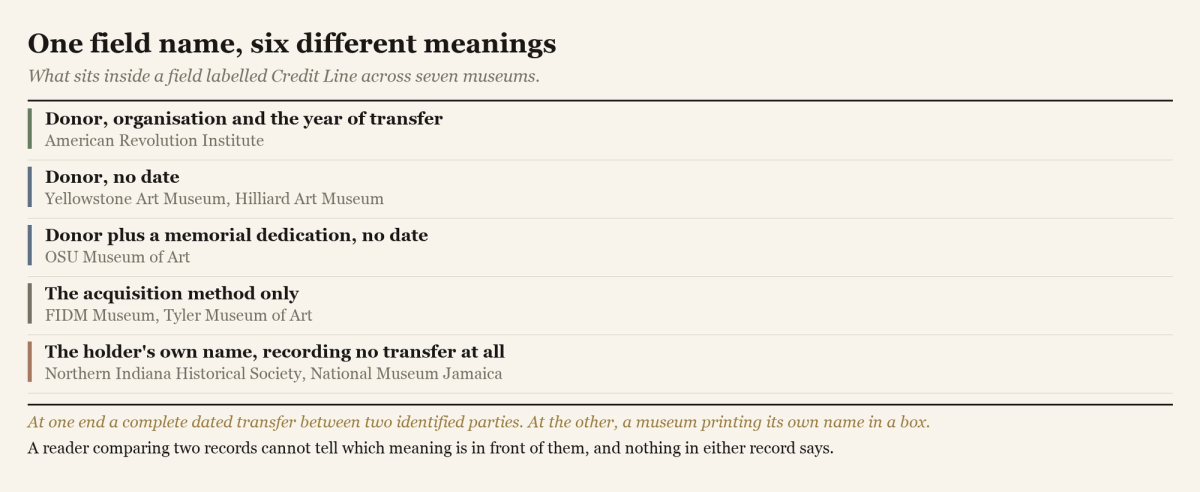
Across seven museums using some capitalisation of Credit Line, the field contains:
A donor's name, the organisation he represented, and the year of transfer, at the American Revolution Institute. A donor's name with no date, at the Yellowstone Art Museum and at the Hilliard Art Museum. A donor's name plus a memorial dedication to two other people, at the OSU Museum of Art. An acquisition method and nothing else, at the FIDM Museum and the Tyler Museum of Art, where the entire value is that the museum bought it with its own funds, naming no counterparty and no date. And at the Northern Indiana Historical Society and the National Museum Jamaica, the holder's own name, which records no transfer at all.
One field. At one end a complete dated transfer between two identified parties. At the other end a museum printing its own name in a box.
A reader comparing two of these records cannot tell which meaning is in front of them, and nothing in either record says. The field name is identical. The content looks like content. There is no marker anywhere distinguishing a chain of custody from an acknowledgment formula.
This is the condition that standards work exists to address, and that work is real and public. The CIDOC Conceptual Reference Model provides an event-based way to express acquisition as a transfer between parties at a time. Linked Art documents patterns for provenance explicitly. Spectrum sets out acquisition as a defined procedure with required information. None of that is absent from the field. What these twenty records show is what reaches a reader at the publication layer, which is a different place from where the standards operate.
Even the search surface differs, so you cannot ask the same question twice
The divergence is not confined to the record. It reaches the way each catalogue can be interrogated at all.
At the National Museum Jamaica, the displayed object record carries exactly ten fields: Title, Object ID, Collection, Object Name, Material, Dimensions, Description, Credit line, Legal Status and Web Rights. Its advanced search exposes fourteen searchable fields, including Subject, Creator, People, Place, Search Terms, Lexicon Category and Lexicon Sub-Category.
Neither list contains a provenance, acquisition or custody field of any kind. This is the case where the distinction is clearest and the measurement is strongest, because two independent surfaces agree: it is not that a field is empty, it is that no such field is offered to the public at either the record level or the search level. The institution holds roughly thirty thousand artefacts.
At the American Revolution Institute, the advanced search exposes eight fields rather than fourteen, and makes Date searchable, which Jamaica does not expose at all. The labels themselves diverge between the two: Object ID against Object Number, Place against Place of Origin, Medium, Material, Composition against a bare Material.
So two institutions on the same hosted platform offer the public different questions, under different names, over different fields. A researcher who learns to query one of these catalogues has learned something that does not transfer to the next one, and there is no index anywhere that would tell them which fields a given institution has chosen to expose.
This is also where a hypothesis died, and it is worth recording because the replacement was better.
Four institutions wrote a declared absence into free text
Here is the finding that makes the rest of it matter.
Four of the twenty knew that something was unknown, said so, and had to say it in prose.
At the American Revolution Institute, a portrait's description ends with the phrase "after an unknown original", inside a paragraph of running text. The institution is telling the reader, precisely and deliberately, that the work copies something whose identity nobody has established.
At the Missoula Art Museum, the How acquired field reads "Anonymous Gift". That is a different thing again, and the difference is the one this institution cares most about: the donor is undisclosed, not unknown. Somebody there knows the name. A reader cannot tell that from the words, and no field anywhere in the record separates a fact withheld from a fact nobody has.
At the Lane County History Museum, a photographer's name is followed by a bare question mark, inside the value itself. Not in a note, not in a comment. A punctuation mark doing the work of a whole epistemic category, inside a field designed to hold a name.
And at the Museum of Northern History, a record carries the words "Names unknown." The sentence sits between a note about a tack hole and the dimensions.
Read those four together. Every one of these institutions is doing the right thing. They are refusing to assert what they do not know, and they are telling the reader so. That is good practice, and it is rarer than it should be.
They are also all doing it in the only place available to them, which is prose, where it cannot be queried, cannot be counted, and cannot be distinguished from a gap nobody ever looked into.
A declared absence and an unexamined absence read identically to a machine, and nearly identically to a person. The institutions have the knowledge. The record has nowhere to put it.
The four absences are four different things, and the record collapses them into one
Go back to those four declared absences and read them as a set, because the usual reading, that four institutions all said "we do not know", is wrong. They said four different things.
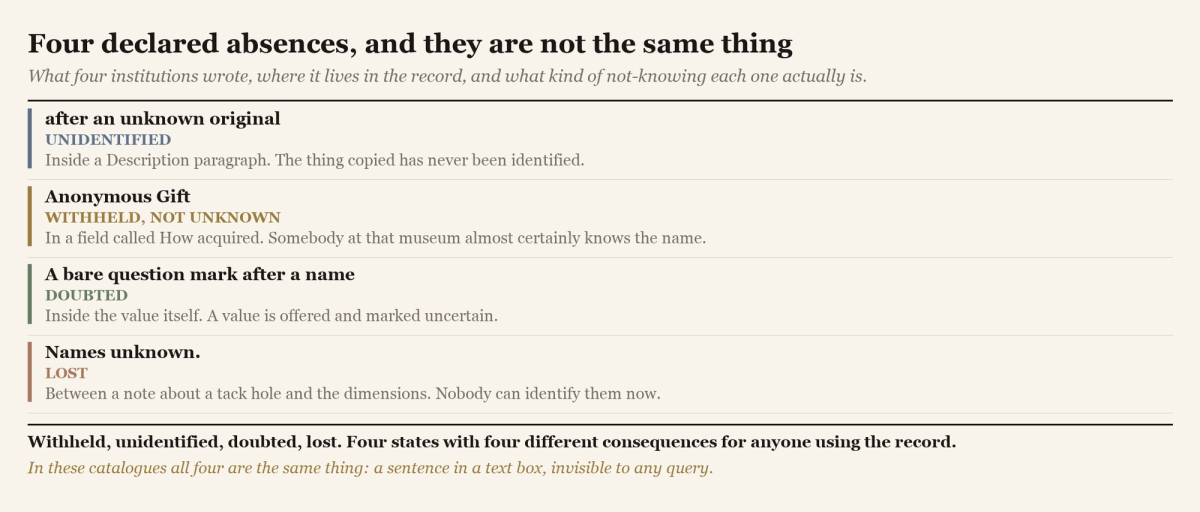
"after an unknown original" says that the object is a copy and that the thing copied has not been identified. The chain is not broken at the museum's end. It is broken at the far end, before the object in hand existed, and the museum is being exact about where.
"Anonymous Gift" says that a named person gave the object and asked not to be named. Somebody at that museum almost certainly knows who. This is a fact withheld, not a fact missing, and the distinction is the difference between a record that could be completed by asking and one that could not be completed by anybody.
A question mark after a name says that a value is offered and doubted. Not that it is absent. Somebody did the work, reached a probable answer, and marked their own uncertainty about it. That is the most informative of the four, and it is encoded in one character inside a name.
"Names unknown." says that the people in the photograph cannot be identified by anyone currently. Not withheld, not doubted, not partially known. Genuinely gone.
Withheld. Unidentified. Doubted. Lost. Four distinct states of knowledge, each with different consequences for anyone trying to use the record. A withheld donor can be recovered with a letter. A doubted attribution can be tested. A lost identity can sometimes be recovered by someone who recognises a face. An unidentified original is a research question.
In these twenty records all four are the same thing: a sentence in a text box, sitting beside sentences about tack holes and dimensions, invisible to any query, and indistinguishable from each other and from a field nobody ever filled.
That collapse is the cost. Not that the institutions failed to record what they knew, because they did record it, conscientiously, in the only place they had. The cost is that four careful acts of intellectual honesty arrive at the reader as undifferentiated prose, and the reader cannot act on any of them, because the reader cannot tell which one they are looking at.
A record that could hold these four apart would not be a more complicated record. It would be a record with one more typed thing in it: a statement of what kind of not-knowing this is. That is cheap to express and expensive to retrofit, which is the usual shape of this problem and the reason the custodian's contract tries to put obligations beside objects at the moment of transfer rather than afterwards.
None of this requires anybody to know more than they already know. All four of these institutions already had the knowledge. They simply had nowhere to put it that a reader, or a machine, could find.
The same invented punctuation, on two continents
The question mark is worth staying with, because it is not an isolated eccentricity.
A Swiss museum's published annual report uses "(?)" to mark an unknown date in its own annexe. The Lane County record uses a bare "?" inside a value.
Two institutions, different continents, different systems, different languages of record, and the same invented punctuation, because neither had a field that could hold doubt. Nobody standardised this. Nobody agreed it. Two sets of careful people independently reached for the same mark because the thing they needed to express had no home, and a question mark is what you reach for when the form has no box for "we do not know".
That convergence is evidence of a real gap. When unrelated practitioners invent the same workaround, the workaround is describing something the system failed to provide.
Two records that disagree with themselves
Two of the twenty contradict themselves internally, in places nothing would catch.
No individual is named here. The records contain real people's names, and those people never told this institution anything; their names sit in somebody else's catalogue. The two findings below are errors, and publishing an error about a named private individual would be a worse act than the one being described. The shape carries the argument without them.
At the National Building Museum, a record names its donor in two separate fields. The two fields give two different spellings of his first name, and one of the two also names a second person. Is that second person a co-donor, a spouse acknowledged by convention, or part of an acknowledgment formula? The record cannot say, and there is no field in which it could.
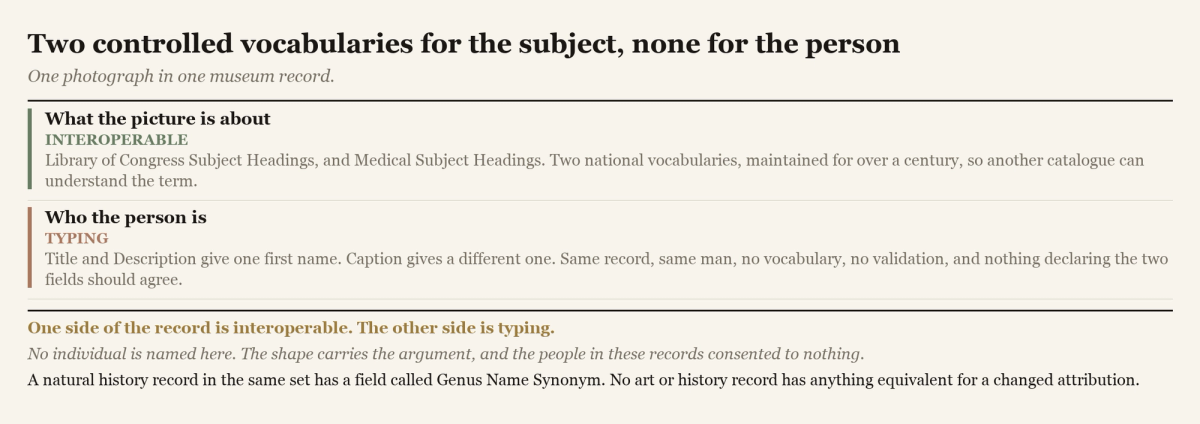
At the Sindecuse Museum of Dentistry, a photograph's Title and Description give one first name for the man pictured. The Caption gives a different one. Same record, same man, two names.
Neither of these is carelessness, and neither would be caught by any process. There is no validation that could flag them, because nothing in the record declares that the two fields are supposed to agree. They are two free-text strings that happen to be about the same person, and nothing says so.
Two controlled vocabularies for the subject, and none for the person
The Sindecuse record carries one more thing, and it is the whole argument compressed into a single object.
That photograph is indexed with Library of Congress Subject Headings and with Medical Subject Headings. Two controlled vocabularies, maintained by two national institutions, applied to one image, so that what the picture is about can be expressed in terms another catalogue will understand.
And the man in the photograph has two different first names in the same record, because there is no vocabulary at all for who he is.
The asymmetry is not an accident and it is not anyone's negligence. Subject access has had enormous institutional investment for more than a century, and the Library of Congress publishes its headings freely. Identity and custody have had far less, at the layer where a record meets a reader. One side of the record is interoperable. The other side is typing.
The one place a changed identity is typed
There is a counter-example in the set, and it comes from a different discipline.
One of the twenty is a natural history museum, and its record carries a field called Genus Name Synonym: a typed statement that the thing used to be called something else.
Natural history has a convention for superseded identity, and a structured place to record it, because taxonomic revision is a normal event in that field rather than an embarrassment. A species being reclassified is expected, so the record was built to carry the history of its own naming.
None of the art or history records in the set has anything equivalent for a changed attribution. When a painting stops being by one hand and starts being by another, the catalogue has nowhere to say that it used to be called something else, and the old attribution simply disappears, which is precisely the mechanism this institution documented in a study published earlier today about an artist's first oils and the title that quietly lost its brackets.
A discipline that expects revision builds a field for it. A discipline that treats revision as a correction overwrites.
The hypothesis that died, and three traps that would each have produced a false finding
The reason this was opened at all was a guess: that a single hosted platform means a single schema, so one measurement might hold for many institutions at once. That would have been a powerful thing to establish.
It is false. The public surface is configured per institution, down to the field labels, and one museum has advanced search switched off entirely while another has it on. An absent field at one museum is therefore no evidence at all about the platform. The overclaim was withdrawn before anything was built on it, and what survived was a smaller, truer question: not what the platform permits, but what readers are actually shown. That question turned out to be the more interesting one, because it is the only one a reader's experience depends on.
Three further traps sat in the way, and each would have produced a confident wrong answer.
The first was a control that could not fail. The platform uses wildcard DNS: every subdomain resolves, to the same load balancer. Two subdomains were invented as a test and both resolved. So a DNS lookup confirms nothing whatever about whether an institution has an instance, and a list of museums built that way would have been a list of guesses with a green tick beside each one. The only thing that establishes an instance exists is opening it.
The second was a false finding about other people. Several named instances returned a message asking the visitor to contact an administrator. The obvious reading is that those museums have taken their catalogues down or made them private. The alternative reading, which would have made that a false statement about five institutions, is that the platform had begun throttling this reader. The two look identical from one side. It was settled by returning mid-run to an instance that had already served normally and finding that it still did, which distinguishes their configuration from our treatment. The gating is theirs.
The third is the one already stated in the method, and it is the reason the sample is twenty rather than two hundred: the firewall refuses an automated reader at the first file it would request. That was not circumvented. It means this measurement has a hard ceiling set by human patience, and it means any larger version of this study faces the same ceiling.
None of these three was caught by being careful in general. Each was caught by asking what else would produce the same result, which is the only question that separates a finding from a coincidence.
The limit of this measurement is the argument arriving on its own
Now the honest weakness, and it turns out to be the thesis.
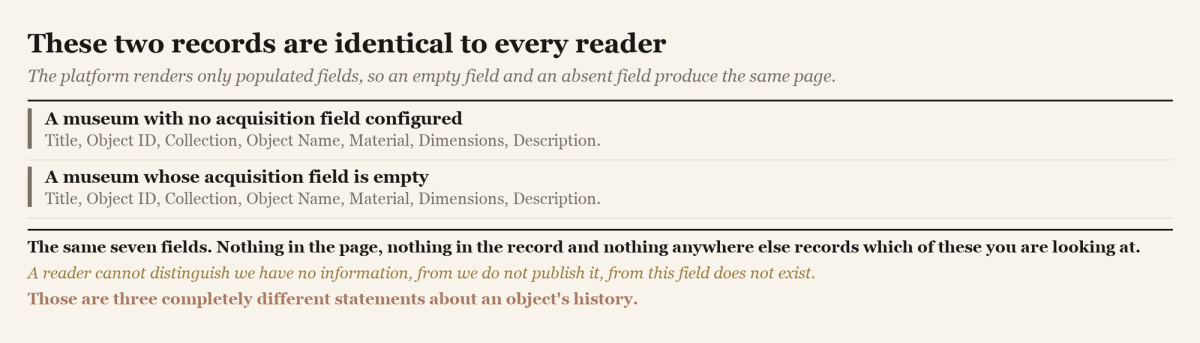
The platform appears to render only populated fields. A record with an empty acquisition field and a record with no acquisition field configured at all therefore produce the same page. One record per institution cannot separate those two cases, so where this study says a museum shows nothing, that may mean the institution does not publish such a field, or it may mean this particular record's field is empty.
That is a real limit on the measurement and it should not be buried.
It is also exactly the problem under examination, one level up.
An institution with no field for custody and an institution whose field is empty are identical to every reader. The platform renders them the same way. Nothing in the page, nothing in the record, and nothing anywhere else records which is which. A reader cannot distinguish "we have no information" from "we have information and do not publish it" from "this field does not exist in our configuration", and those are three completely different statements about an object's history.
So the study's inability to tell those apart is not a flaw in the method. It is the finding, encountered from the outside. If a seat reading carefully, deliberately, with the record open in front of it, cannot tell an absent fact from an absent field, then no reader can, and no machine can.
This is what the burden of preservation means at the layer where records meet the public. A record is not preserved by being published. It is preserved by being legible about its own gaps, and none of these twenty can be, because the thing that would carry that legibility is a typed field for absence, and no catalogue here has one.
What this does not say
This study makes no claim about any institution's full catalogue. One record per museum cannot support one, and twenty records support no rate, no percentage and no statement about museums in general. Zero of twenty is the measurement, and it is the only number offered.
Nothing here is a criticism of the institutions. Every museum named is publishing its collection openly, at its own cost, and several of them are doing the careful thing and declaring what they do not know. The difficulty is structural: they are being asked to carry a fact that the publication layer has no defined place for, and they are each solving it locally and reasonably, which is how seven names for one thing arise.
Nothing here is a claim about the capabilities of any software. What was measured is what a reader sees, which is a publication choice, not a limit of a product. No comparison of vendors is offered, nothing has been sent to any vendor, and nothing has been sent to any of the twenty institutions.
No individual appearing in any of these records is named, and none of them has been asked for anything or has consented to anything.
Objects of Affection Collection does not authenticate, attribute or value, and takes no view on ownership, origin, export, return or restitution. Nothing above should be read as a statement about who owns any object or about whether any object is correctly attributed.
What is claimed is narrow and, this institution thinks, worth saying plainly. Twenty museums, seven names for one fact, four declared absences with nowhere to live, and no way for anyone outside to tell a missing fact from a missing field.