Every Garment Will Carry a Record, and It Will Describe a Batch
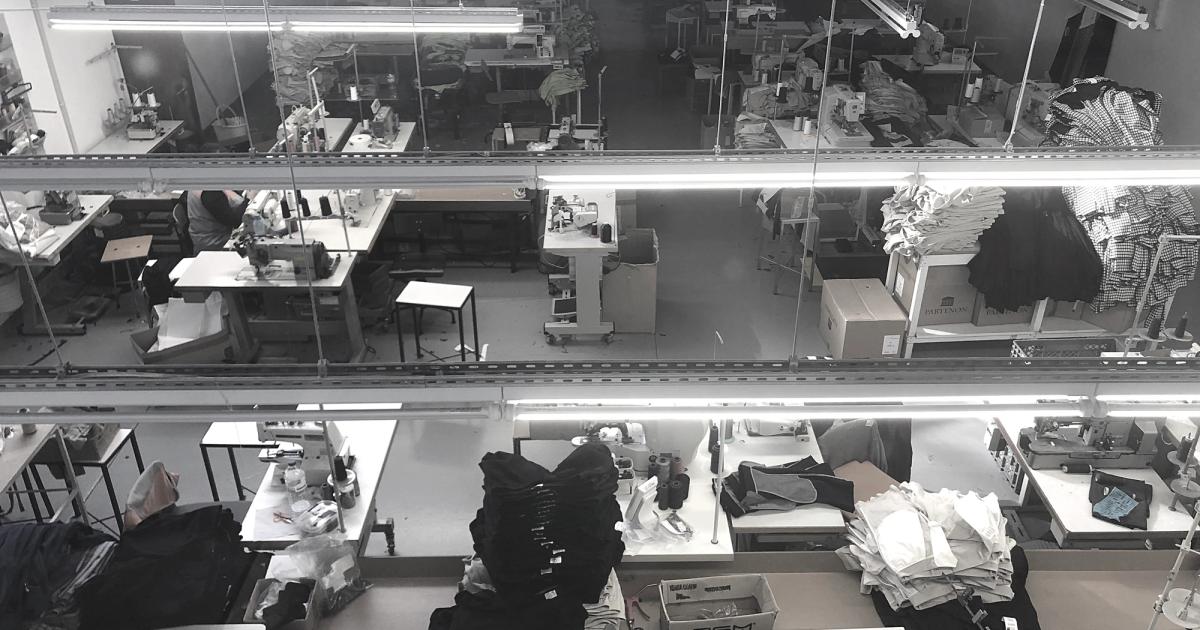
The European Union is preparing to require a record on every garment it sells. Under the Ecodesign for Sustainable Products Regulation, textile and footwear products placed on the EU market will have to carry a Digital Product Passport: a scannable record of origin, materials, production and repair. For an institution whose subject is what documents attached to objects can carry, this is the largest structural change in the field, and it is worth reading closely rather than quickly.
Read closely, it says something other than what the trade press has taken from it. The passport is designed to describe a batch, not an object, and its own authors explain why. That is a correct decision for the instrument's purpose and it is not a defect. It is also the fact that decides what the passport can and cannot do for anyone who wants to use it to establish that a particular physical thing is what it claims to be.
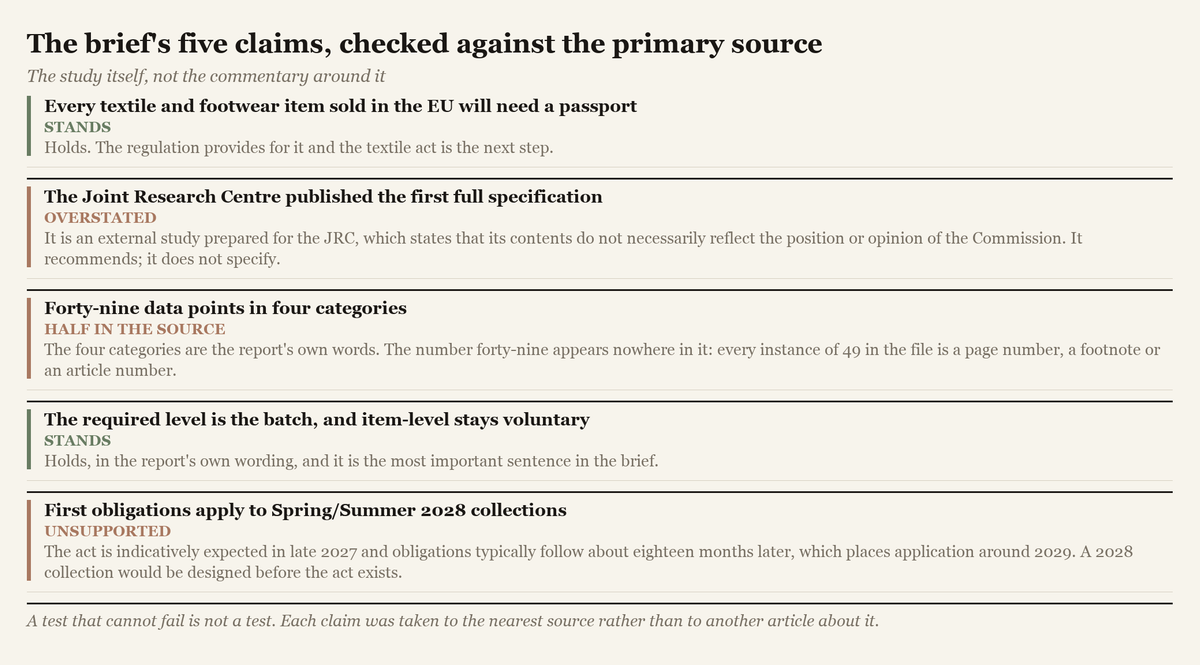
Five claims circulating about this regulation were checked here against the primary document rather than against other articles about it. Two survived. Three did not.
The document everyone is citing is a recommendation, not a specification
The source is a ninety-five page report published on 13 May 2026, titled Study on DPP content for textile apparel products under ESPR.
It is widely described as the Joint Research Centre publishing the first full specification for textiles. Its own second page says something more careful. It is "an External Study report prepared for the Joint Research Centre," and "the contents of this publication do not necessarily reflect the position or opinion of the European Commission."
So it is a study prepared for the JRC rather than by it, and it recommends rather than specifies. The specification will be the delegated act, and the delegated act does not exist yet. The distinction matters because the whole commercial conversation downstream of this document treats it as settled law, and a trade article describing a recommendation as a specification is the first step of a drift this register has documented at length: a proposal restated as a requirement by people who each believe they are summarising the last person accurately.
The four categories are the report's words. The number is not.
The commonly repeated figure is forty-nine data points in four categories.
The four categories are real and they are quoted here as the report gives them: product identification and classification, producer information, product characteristics including material, mechanical and chemical information, environmental footprint, recycled and organic content, manuals and instructions and other voluntary input, and compliance documentation.
The number forty-nine does not appear in the report. Every instance of those two digits in the document is a page number, a footnote number, or a reference to Article 49 of the regulation. The count is a tally made by commentators from the report's tables, which is a legitimate thing to do, and it has since been repeated as though the report stated it.
This is a small correction and it is included for a specific reason. A figure with no source in the document it is attributed to behaves exactly like a figure with a source until somebody opens the document. The institution has written this sentence about its own numbers more than once.
The batch is the unit, and the report explains why
Here is the claim that survived, and it is the one that matters.
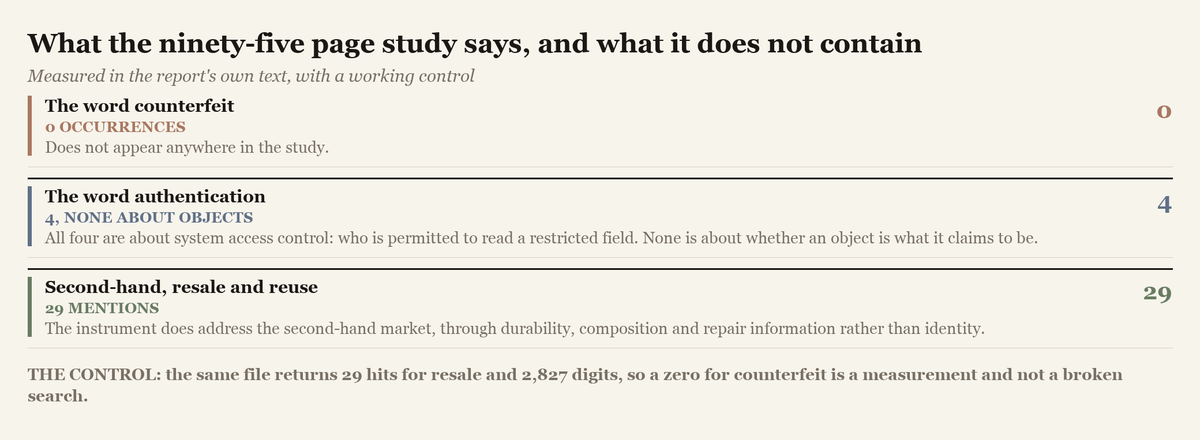
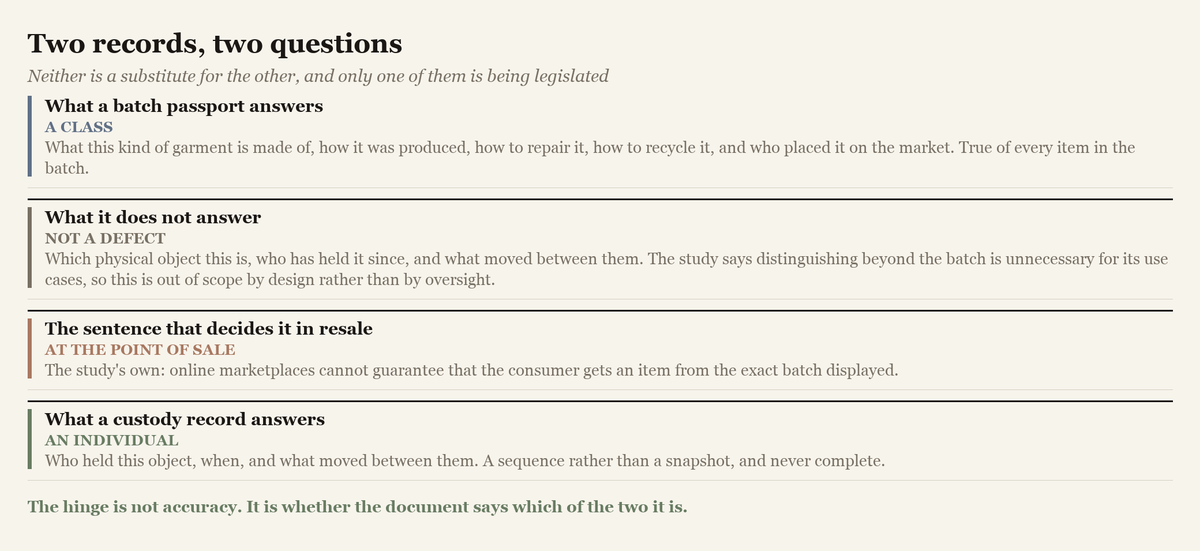
The regulation provides for three levels of identity. Recital 33 describes them and Article 49 leaves their definitions to delegated acts: the passport may be established at model level, at batch or lot level, or at individual item level. A model is a version of a product whose units share the technical characteristics relevant to the requirements. A batch is a production run. An item is one physical thing.
The study's recommendation is unambiguous:
"distinguishing products beyond the batch level is unnecessary; batch-level information is sufficient to meet the identified use cases. The proposal would be then to require batch identifiers as the minimum requirement, to be populated with batch or model information according to the granularity level assigned above to each of the data points. Still, the economic operator could add data on a finer granularity than mandated on a voluntary basis, allowing flexibility and avoiding penalising frontrunners."
And on item level specifically, it reports that "it is currently under analysis the voluntary assignment of item-level identifiers."
Read the first clause again, because it is the whole thing. Distinguishing products beyond the batch level is unnecessary. Not impossible, not too expensive, not deferred. Unnecessary, for the use cases the instrument exists to serve.
That is not a gap in the regulation. It is a correctly drawn boundary. An ecodesign instrument is for durability, repairability, composition and recycling, and those facts are true of every garment in a production run. Requiring an identifier for each physical item in order to state a fact that is true of ten thousand of them would be a cost with no corresponding benefit, and the study says as much when it describes the labelling problem: a provider told it that "current production often uses shared labels for identical products; moving to item-level identifiers would therefore demand substantial upgrades to suppliers' labelling processes."
The batch is the unit because the batch is how clothes are made.
Zero
The luxury industry's interest in this regulation is almost entirely about something else. Brands and vendors are presenting the passport as the mechanism that will finally make authenticity checkable at the counter and in resale, and selling hardware on that basis.
So the report was searched for the word that pitch rests on.
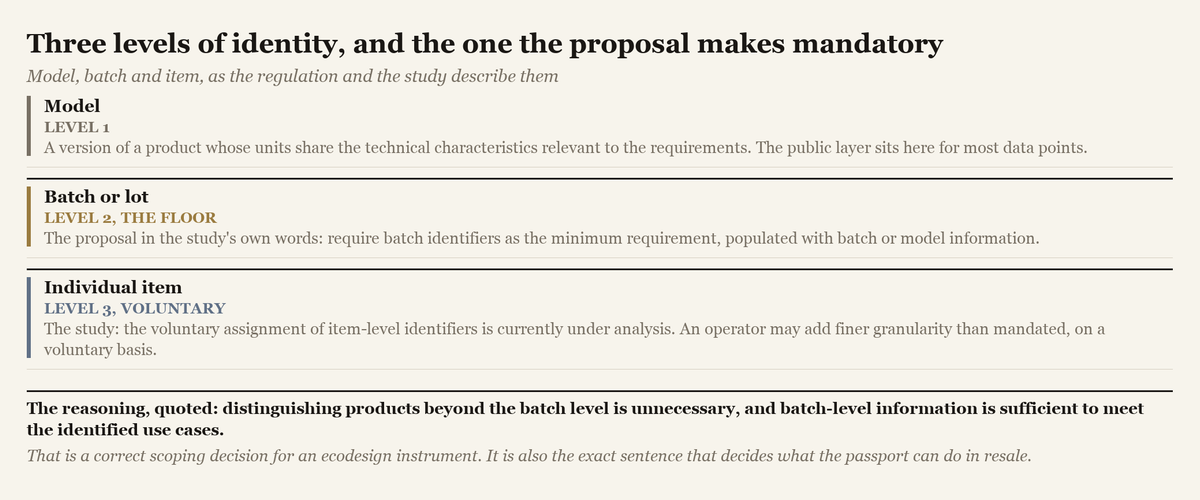
The word counterfeit does not appear in the ninety-five page study. Not once.
The word authentication appears four times, and every one of them is about system access control: identity management, authorisation tokens, who is permitted to read a restricted field, which data is "available to any user without authentication." Not one of the four is about whether an object is what it claims to be.
A zero is worth nothing without a control, because a search that cannot return a result returns the same answer as a genuine absence. The same extracted file returns 2,827 digits, 29 mentions of second-hand, resale and reuse, 90 of batch, 78 of granularity and 34 of voluntary. It contains no null bytes. The instrument can say yes, so the zero is a measurement.
The report does address the second-hand market, and the route it takes is instructive. It notes that the physical label required under the Textiles Labelling Regulation "can be removed or become unreadable after use and wash," so the passport keeps composition and care information available to a second-hand buyer, and it describes this as "a valuable resource also for enhancing the trust in pre-owned garments." The trust being enhanced is trust about what the thing is made of and how to look after it. It is not trust about which thing it is.
Thirteen use cases, and none of them is the one luxury wants
The report sets out the use cases the passport's content was designed to serve. They are worth listing because the list is short, enumerable and checkable, and because it answers the question more directly than any argument could.
Automated completeness verification of passport disclosures. Customs controls for imported products. Ongoing compliance monitoring by market surveillance authorities. Statistical monitoring of apparel imports and production. Statistical monitoring to identify fast fashion models. Public procurement sustainability verification. Informing more sustainable consumer purchasing decisions. Maintaining apparel appropriately. Self-repair of worn apparel. Finding repair services. Business to business data exchange for second-market resale. Business to business data exchange to facilitate repair actions. Data exchange to facilitate sorting.
Thirteen, and not one of them is establishing that a particular object is what it claims to be.
One deserves a fair hearing, because it is adjacent. Customs controls are in practice where a great deal of counterfeit goods are intercepted, and a passport that lets an official check a consignment against declared compliance data will make some of that work easier. That is a real benefit and it should not be waved away. It is also a control on a consignment against a declaration, which is what customs work is. It is not a judgment about an individual object's history, and it happens at a border rather than at a counter or in a resale listing, which are the two places the luxury pitch points at.
The layer a shopper sees is the least specific one
There is a second structural feature that runs in the same direction, and it concerns who may read what.
The report describes three tiers of access. Information that is publicly accessible, available to any user without authentication. Information restricted to notified bodies, market surveillance authorities, customs and the Commission, covering compliance documentation and test results. And information restricted to persons with a legitimate interest, such as recycling operators, covering fields like detailed product composition.
The tiers exist for good reasons, including a concern the report records directly: brands told the study they fear that publishing supplier names or fibre blend formulas would let competitors infer their cost structures. That is a real commercial interest and the architecture accommodates it.
The consequence for a person standing in a shop with a phone is simple arithmetic. The public layer carries the least detailed view, and for many data points it sits at model level, which is one step less specific again than the batch floor. The consumer-facing scan is therefore the broadest of the three readings, by design. Whatever the passport eventually becomes for regulators and recyclers, the thing a buyer can read without permission will be a description of a product line.
The sentence that decides it at the point of sale
If the pitch were only slightly ahead of the instrument, the gap would close as the act matured. There is a sentence in the report that suggests it will not, and it is the report's own observation about online retail:
"online marketplaces cannot guarantee that the consumer gets an item from the exact batch displayed"
Follow it through. A listing shows a passport. The passport is anchored to a batch. The warehouse picks from stock. The thing in the parcel may belong to a different batch than the one the buyer scanned before paying. The study's suggested remedy is sensible and entirely consistent with its purpose: show model-level data or a representative batch passport at the offer stage, and the full passport at the required granularity once a physical product has been assigned to the order.
For durability and composition that works, because those facts hold across the run. For the question of whether this particular object is the one described, a representative passport is not a weaker answer. It is an answer to a different question.
The chip authenticates the chip
Vendors are already selling unclonable chips that would carry passport compliance and authentication together, and the engineering is often genuinely good. The difficulty is not cryptographic.
An unclonable chip proves that the chip is the chip. What it cannot prove by itself is that the chip is still attached to the object it was attached to at the factory, or that it was attached to the right object in the first place. That binding is physical and it is a matter of custody, which means it is established by records of who held the thing and what they did to it, or it is not established at all.
This institution has spent recent weeks on cases that are exactly this failure. A counterfeit operation assembled around hardware a house had discarded at its own quality control. Thirty thousand genuine authenticity cards stolen from a contracted factory before they were ever attached to anything, and later attached to the wrong things. In both, the identifier was perfectly genuine and the link between identifier and object was the thing that broke. A better identifier does not repair a broken binding; it makes the broken binding more convincing.
What is missing is a kind of content
There is a version of this study that treats the batch-level decision as a failure of ambition and calls for item-level identifiers to be made mandatory. That version would be wrong, and it is worth saying why before going further.
An instrument should be scoped to its purpose. The passport is an ecodesign instrument and its scope is correct. The problem is not that it declines to answer a question outside its remit. The problem is what happens when a document that answers one question is read as answering another, and nothing in the document says which it is.
That is the condition this institution works on. A record that leaves a field blank cannot be told apart from a record nobody filled in, and a record anchored to a class cannot be told apart from a record anchored to an object unless it says so. The burden of preservation falls on whoever holds the thing later, and they will be holding a document that is accurate, official, machine-readable, and silent about its own granularity.
The fix is not more data. It is a field that states the absence. A passport that says, in a form a machine can read, this record describes a production batch and no item-level fact is asserted, is more useful to a resale buyer than one that simply contains batch-level data and leaves them to work it out. The first can be audited. The second is a blank that looks like an answer.
Lacuna
That is the problem the specification this institution publishes was written for, and it is the reason this study names it.
Lacuna is a specification for provenance records with declared absence. Its central requirement is that a record states what it does not know rather than leaving a field empty, because a declared gap can be checked and an empty field cannot be distinguished from nobody having looked. The full text is published and openly licensed, and the citation is its concept digital object identifier, 10.5281/zenodo.22063353, which always resolves to the current version.
Three things about it belong in a study rather than in a brochure.
It is a specification and not a standard. By its own section 12 it becomes a standard when someone other than its author implements it, and not before. Nobody outside this institution has implemented it. That sentence is published on the institution's own commercial page and is repeated here because the alternative is the drift this register exists to catch, where a goal written in a plan becomes a credential in copy without anybody deciding to overstate anything.
It is published so that it can be built to without this institution. That is a deliberate position rather than a generosity, and it is the only position consistent with wanting the thing to be used.
And it does not authenticate. A provenance record is custody over time: who held this, when, and what moved between them. Authentication is a claim about an object at a moment. The two are not rivals and they are not substitutes. A certificate is complete when it is issued. A provenance record accrues, is never complete, and treats a declared gap as normal where a certificate would treat it as a defect.
Colophon Record
Colophon Record is the instrument that writes to that specification. It reads a luxury object against the public record and shows its working on economics, materials, markups and provenance, and where a claim cannot be grounded it withholds the claim rather than inventing one.
The relation between the two is the point, and it is stated plainly on its own page. A colophon is the printer's mark at the end of a book that states who made the thing and how. A lacuna is the declared missing portion. One names what is known and the other names what is not, and a record that does only the first is the document this whole study is about.
None of that is a claim to solve the problem the passport does not address. The institution holds no adopters, no implementers outside itself, and no position in the European standardisation process that produces this act. What it holds is a published specification and a working instrument, and the only honest claim available is that the two were built for the gap that the regulation's own authors describe, correctly, as outside their scope.
The dates in circulation are mostly vendor dates
The last claim in the brief is a timeline: binding rules at the end of 2027, first obligations applying to Spring/Summer 2028 collections, and a central EU registry of identifiers planned for June 2026.
The first half is roughly right and the second half is not. The delegated act for textiles is indicatively expected in late 2027. Obligations under these acts typically begin around eighteen months after adoption, which places first application near 2029, and at least one specialist account cites a Commission presentation of 27 May 2026 placing adoption in the second half of 2027 and mandatory application in 2029.
A Spring/Summer 2028 collection is designed during 2027 and reaches shops in early 2028, which is before the act that would govern it exists. A brand may sensibly choose to be ready for that season. It will not be required to be. The difference between a planning date and a legal date is small until somebody budgets against it.
The registry is a similar case. Sources give June and July 2026 and disagree about whether it has launched; this study could not confirm its operational status from a Commission source and does not assert one. The report treats registry architecture as outside its own scope, handled horizontally through standardisation. What is clear is that a registry of identifiers creates no obligation for textiles by itself. It is infrastructure waiting for a product act.
What this changes for anyone holding an object
The useful conclusion is not about the regulation. It is about what will be true in a few years' time for anybody who owns something and wants to say what it is.
Every garment will carry a record. The record will be official, machine-readable, and largely accurate. It will describe a production run. It will say what the thing is made of, how it was made, how to repair it and how to dispose of it, and those statements will be true of the object in the buyer's hands because they are true of several thousand objects including that one.
What it will not say is which one this is, or where it has been since. Not because the instrument failed, but because its own authors concluded, reasonably, that distinguishing beyond the batch is unnecessary for what they were asked to do.
The risk in that is not deception. It is that a universal, official, scannable document arrives in a market that has wanted exactly such a document for a long time, and gets read as answering a question it was never asked. The custodian's contract holds that the obligations attached to an object travel with it. So do the documents, and so do the misreadings, and the misreading is harder to correct once the document is mandatory, because its authority is real.
What is not claimed
This institution does not authenticate, attribute, appraise or value, and nothing here is a verdict on any object or any product.
Nothing here is a criticism of the Ecodesign for Sustainable Products Regulation, of the Digital Product Passport, or of the study examined. The batch-level recommendation is treated throughout as a correct scoping decision for an ecodesign instrument, which is what its authors state and what the evidence supports. No position is taken on what the delegated act should require.
The report is quoted in its own words and is identified as an external study prepared for the Joint Research Centre, which does not necessarily reflect the Commission's position. The delegated act is not adopted and every date given for it is indicative. The forty-nine figure is reported as absent from the report rather than as wrong, because a count made from the report's tables may well be accurate.
Lacuna is a specification and not a standard. By its own terms it becomes a standard when a party other than its author implements it, and no party other than its author has implemented it. No endorsement, adoption, recognition or participation by any standards body, regulator or institution is claimed here. Colophon Record is described as what it is, an instrument that writes to that specification, and no claim is made that either addresses a deficiency in the regulation, because this study does not find one.