A Portrait of Turner Became a Self-Portrait: One Word, a Bequest Worded by Authorship, and the Buttons That Are Not There
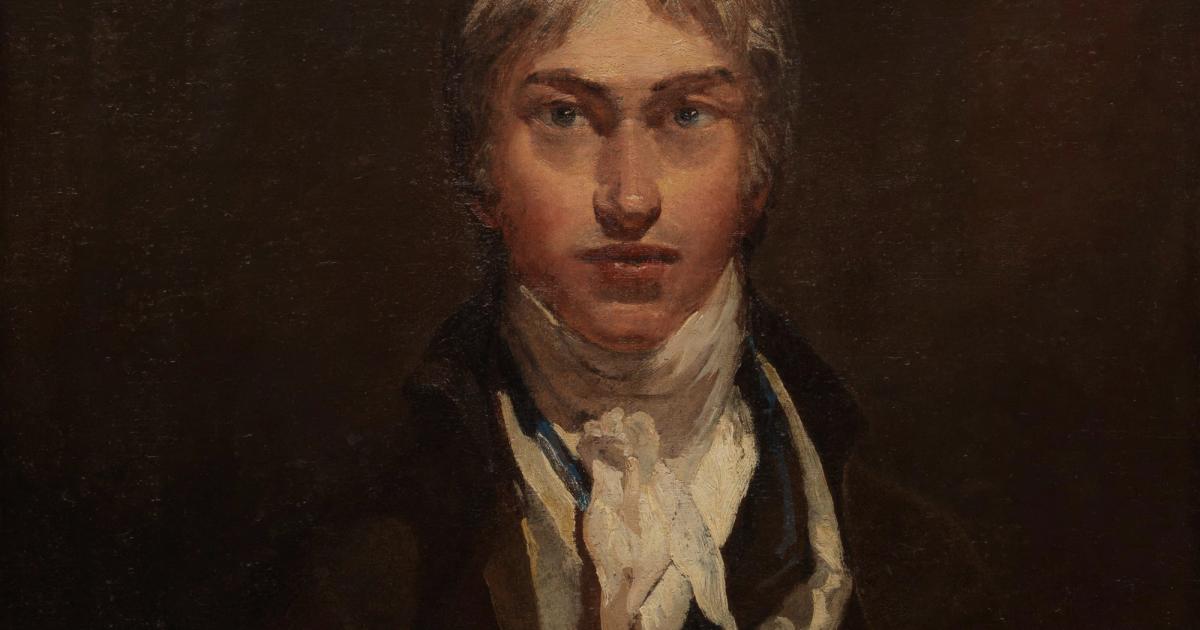
A painting hangs at Tate Britain, catalogue number N00458, dated about 1799. For most of a century it has been called a self-portrait by Joseph Mallord William Turner, and since February 2020 it has been on the twenty pound note, which is the most widely distributed image of any British artist.
In May 2026 the Turner biographer James Hamilton argued that it is probably not by Turner at all), and is more likely by John Opie, a portrait specialist of the same moment.
This study takes no position on who painted it. Objects of Affection Collection does not authenticate, attribute or value, and nothing here is an opinion on the picture's authorship.
What is inside this institution's competence is the shape of the argument, and the shape is unusual. Hamilton's case is not primarily a connoisseur's case about brushwork. It is a case about a catalogue entry, and specifically about a description that changed.
The label hardened, and nobody decided to change it
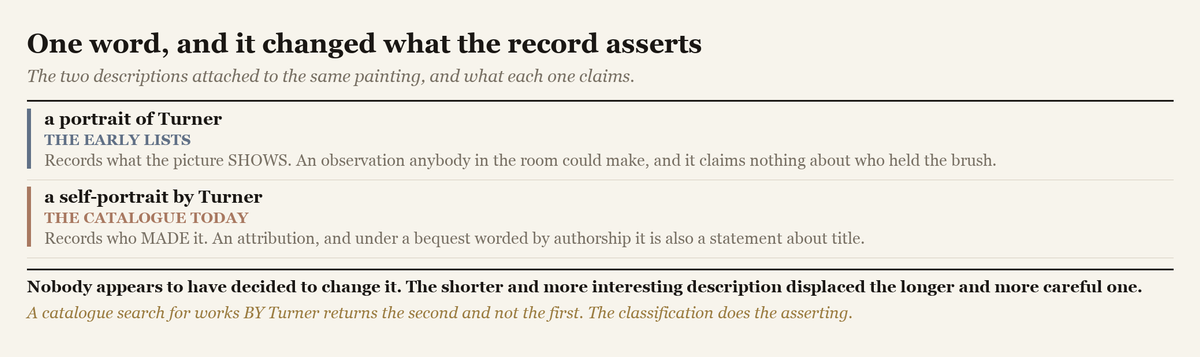
The central documentary claim is small and checkable in principle: the early lists never called it a self-portrait. They called it a portrait of Turner.
Those are different statements. "A portrait of Turner" records what the picture shows. "A self-portrait" records who made it. The first is an observation anybody in the room could make. The second is an attribution, and it is the one the painting now carries, on a wall label, in a national collection, and on a banknote.
Hamilton's account of how one became the other is not that anyone falsified anything. It is that the painting arrived among Turner's possessions after his death in 1851, in a studio full of Turners, with nothing on it to say otherwise, and that over time the shorter and more interesting description displaced the longer and more careful one.
Readers of this institution's work will recognise that exactly. A study published here earlier today examined a painting whose title was supplied by a later owner, marked in the catalogue of record with square brackets to show it was a later addition, and then shown in two exhibitions and listed for sale with the brackets quietly dropped. Nobody falsified anything there either. The qualifier was the lightest element in the record and it fell off.
Here the qualifier was a word. Portrait of, rather than self-.
Why the attribution is also the title
The reason this is not merely an art-historical argument is the instrument by which the painting became public property.
Turner died in 1851 leaving a contested will. The dispute ran until the Court of Chancery approved a settlement on 19 March 1856. Hamilton's account of the outcome, reported rather than quoted from the judgment here, is that the family took the money and the nation took the pictures, meaning everything by Turner's hand in his studio.
Read that as a provenance clause, because that is what it is. The bequest is not defined by what was in the room. It is defined by authorship. A canvas sitting in Turner's studio that somebody else painted is not covered by the words that transferred the rest.
So if the attribution moved, the title would move with it, and the painting's legal position would rest on a different footing from the one it has occupied since the nineteenth century.
This institution published a study earlier today arguing that documentation raises an object's legitimate value and suppresses what a thief can realise, and that the mechanism is legal rather than physical: a buyer who cannot establish the chain cannot take good title. This is the same mechanism in a museum rather than a market. The attribution is not a label sitting on top of the ownership. It is the thing the ownership is made of.
No claim has been filed and none is implied here. The point is structural: a bequest worded by authorship makes every attribution inside it a question about title, permanently.
The bequest has never been fully listed, and its own holders disagree on its size
If title turns on the words "everything by Turner's hand", then the obvious question is what that phrase actually covers. The answer is that nobody has published one.
Set out the counts as the holding and describing institutions give them.
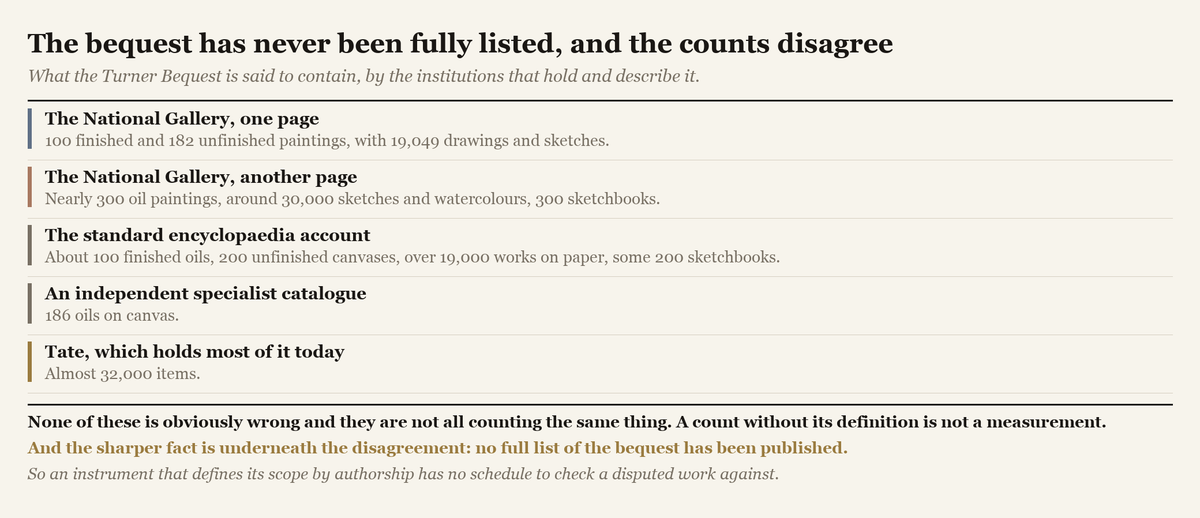
One page of the National Gallery's own site puts the bequest at 100 finished and 182 unfinished paintings, with 19,049 drawings and sketches. Another page of the same institution's site describes it as nearly 300 oil paintings and around 30,000 sketches and watercolours, including 300 sketchbooks. The standard encyclopaedia account gives about 100 finished oils, 200 unfinished canvases, over 19,000 works on paper and some 200 sketchbooks. An independent catalogue by a specialist arrives at 186 oils on canvas. Tate, which holds most of it today, is described as recording almost 32,000 items.
None of these is obviously wrong and they are not all counting the same thing. Finished against unfinished, canvas against panel, sheets against sketchbooks, a sketchbook as one item or as eighty: every one of those choices moves the total, and a reader comparing two figures has no way to know which choices are behind them. A count without its definition is not a measurement, which is a finding this institution has now reached from four different directions in a single day.
But the sharper fact is the one underneath the disagreement. The National Gallery has not published a full list of the bequest.
So the instrument that transferred this body of work to the nation defines its scope by authorship, and no authoritative enumeration of what satisfies that definition has ever been issued. The boundary of the bequest is not a list. It is a judgement, applied work by work, over a century and a half, by successive cataloguers.
That is precisely why a single painting's attribution can become a question about title. There is no schedule to check it against. If the bequest had been enumerated in 1856, this dispute would be a dispute about one line in a document. Instead it is a dispute about whether a line that was never written would have included this picture.
Nothing in that is anybody's negligence. Enumerating thirty thousand items in the 1850s was not realistic, and the court's wording was the sensible one available. The consequence is simply durable: a transfer defined by a property of each object, rather than by a list of objects, leaves every object's membership permanently reopenable.
Why the theory is not far-fetched, and why that is the problem
John Opie was a portrait painter of exactly the right moment, a Royal Academician, and a man who made his living producing likenesses of other people. A commissioned portrait painter producing a head of a young colleague is an ordinary event.
Hamilton's suggested mechanism, as reported, is equally ordinary: Opie admired Turner and may simply have given him the picture, a portrait having little resale value to its painter once the sitter has it. From there nothing further has to happen. The painting hangs among Turner's possessions. Turner dies. The studio is inventoried. A portrait of Turner, in Turner's rooms, among Turner's pictures, is catalogued as what it most obviously appears to be.
The painting is usually dated to about 1799, the year Turner was elected an Associate of the Royal Academy, which is a natural moment for a portrait to be made and a natural reason for someone to make one of him.
Notice that this theory requires no deception at any point. Not by Opie, not by Turner, not by the executors, not by the cataloguers, and not by Tate. Every participant behaves reasonably on the information in front of them, and the result is a possible error that nobody committed and nobody could have caught.
That is the characteristic shape of the failures this institution studies, and it is why they are so hard to find. A record corrupted by somebody's dishonesty has a culprit and leaves traces. A record corrupted by a succession of reasonable inferences has neither. It has only a description that is slightly shorter and slightly more interesting than the one it replaced.
The rebuttal in circulation turns on a detail that is not in the picture
Now the part this study went and checked, because it could be checked.
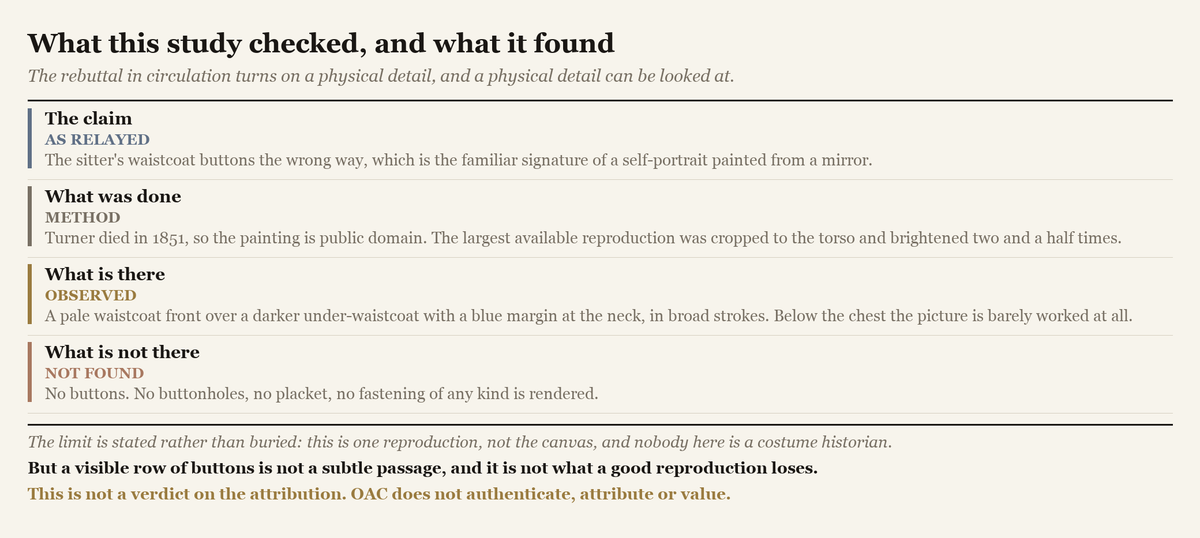
A rebuttal has circulated alongside Hamilton's argument, and the brief that commissioned this study carries it: that the sitter's waistcoat buttons the wrong way, which is the familiar signature of a self-portrait painted from a mirror. A man's coat fastens left over right; a mirror reverses it; a painter copying his own reflection reproduces the reversal without noticing.
It is a good argument in principle. It is the kind of physical evidence that cuts through a documentary dispute, because it is a property of the object rather than of anybody's filing.
Turner died in 1851, so the painting is in the public domain and high-resolution reproductions are freely available. This study took the largest one it could find, cropped the torso, and brightened it two and a half times.
There are no buttons.
No buttons, no buttonholes, no placket, no fastening of any kind is rendered on that waistcoat. What is there is a pale front edge over a darker under-waistcoat with a blue margin at the neck, painted in broad strokes. Below the chest the picture is barely worked at all. The garment is indicated rather than described.
The limits of that observation matter and are stated rather than buried. This is one public-domain reproduction, not the canvas. A photograph can lose detail that raking light would show, and no one here is a costume historian. But a visible row of buttons is not a subtle passage, and it is not the kind of thing a good reproduction loses.
So the position this study reaches is narrow and specific: the detail the rebuttal rests on could not be located in the painting. That is not a verdict on the attribution, which remains outside this institution's competence and interest. It is a statement about one piece of evidence that has been travelling.
And the rebuttal itself could not be sourced
There is a second finding here and it is about the relay rather than the picture.
The brief attributes the buttoning argument to a named critic writing in a named newspaper in a named month. Three separate searches failed to locate it. It does not appear in the standard account of the dispute, and it does not appear in the art-press coverage.
That is reported as what was found, not as a claim that the piece does not exist. The newspaper in question sits behind a paywall and is poorly indexed, and a real article can be invisible to a search that would find a weaker one. This institution has made the opposite error, concluding absence from a single store, and does not intend to make it here.
What can be said is narrower and still useful. A rebuttal is circulating in summary form, detached from whatever published argument it came from, and the detail it turns on is one that this study looked for in the object and did not find. Both halves of that are ordinary. Neither is visible to a reader who receives the summary.
The coverage does record that two Turner specialists have expressed scepticism about Hamilton's conclusion. That is a real counterweight and it is not the buttoning argument.
One companion claim does check out, and it is recorded here because an audit that only finds faults in the document it is auditing is not an audit. The rebuttal as relayed adds that another Turner self-portrait, at the National Portrait Gallery, shows the same reversal. An early reading here suspected that had confused the NPG's Turner holdings with John Opie's own self-portrait, which that gallery also owns. It had not. The National Portrait Gallery does hold a Turner self-portrait, a watercolour of about 1791, and the brief is right about it. Whether that miniature shows any reversal is a further claim this study did not verify.
What the two descriptions do to everything downstream
There is a practical consequence to the wording that has nothing to do with scholarship and everything to do with how records are used.
"Portrait of Turner" and "self-portrait by Turner" behave differently in every system they enter.
A catalogue search for works by Turner returns the second and not the first. A list of an artist's self-portraits returns the second and not the first. A rights clearance, a loan request, an insurance schedule, a bequest audit: each of them keys on authorship, and the second description supplies an author where the first deliberately does not.
So the moment the word changed, the painting moved into a different population, silently, for every purpose. It became an item in the Turner corpus rather than an item depicting Turner. Nothing was asserted about the evidence. The classification did the asserting.
This is the same mechanism a study published here today found in twenty museum catalogues on one platform, where thirteen institutions carry custody information under seven different field names and four wrote a declared absence into free-text prose because no field would hold it. A description is not a neutral summary of a record. It is the handle by which every later system picks the record up, and the shortest description tends to win because it is the one that fits in a label.
Who is able to settle it, and who is holding the evidence
The asymmetry in this dispute is the one this institution keeps finding.
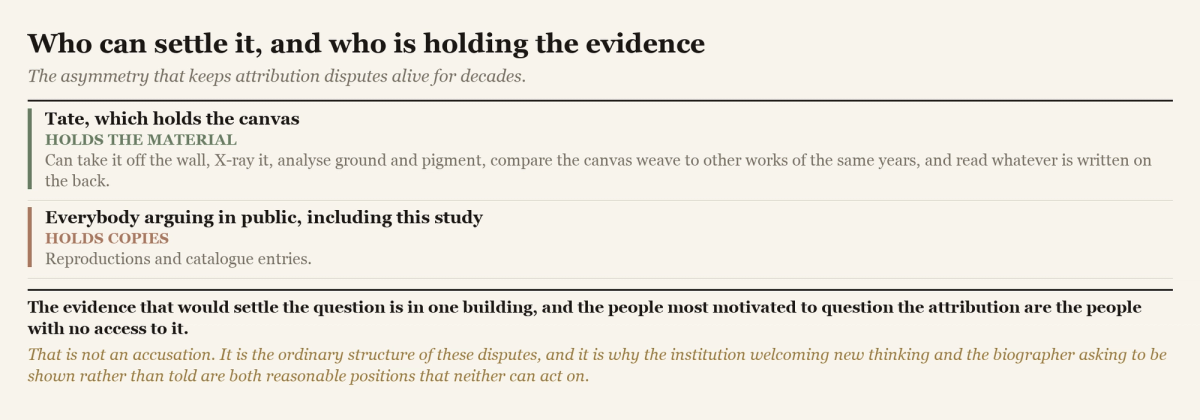
Tate holds the canvas. It can take it off the wall, put it under a microscope, X-ray it, analyse the ground and the pigments, compare the weave of the canvas to other works from the same years, and look at whatever is written on the back. Nobody else can do any of that.
Everybody arguing about it in public, including this study, is working from reproductions and from catalogue entries.
A study published here earlier today made the same observation about a very different dispute, and concluded that the only instrument that reliably opens a record is held by the party holding the material. That is the position here. The evidence that would settle the question is in one building, and the people most motivated to question the attribution are the people with no access to it.
That is not an accusation. It is the ordinary structure of attribution disputes, and it is why they persist for decades. It also explains the exchange reported between the two sides, in which the institution is said to have welcomed new thinking and the biographer to have replied that he wanted to be shown rather than told. Both of those are reasonable positions from where each party is standing, and neither can be acted on by the other.
Those two statements are carried here as reported by the Guardian and could not be verified against the original article, which this seat was unable to retrieve. They are attributed, not confirmed.
What a record would have to carry
Pull the threads together and the case asks for three things a conventional catalogue entry does not hold.
The description's own history. Not the current attribution, but the sequence: what the earliest list said, what the next one said, when the word changed, and on whose authority. In this case that sequence is the entire argument, and it is reconstructable only by a specialist going back to the inventories. It is not in the public record of the object.
The grade of the attribution, carried with it. There is a difference between an attribution made by the artist, one made by an executor, one made by a cataloguer, and one that accreted. All four render identically as a name on a label. A study published here today found twenty museum catalogues that have no field for this at all, and four institutions that resorted to writing their uncertainty into free-text prose because the system had nowhere structured to put it.
What the attribution is load-bearing for. Here it carries legal title under a bequest worded by authorship, and it carried a banknote. A record that noted the first would make the stakes of a reattribution legible before anyone had to litigate them.
None of that requires deciding who painted the picture. All of it is available from documents that already exist.
What the entry would look like if it carried its own history
It is easy to say a record should hold more. It is more useful to write the thing out, because the exercise shows how little is actually being asked for.
A conventional entry for this painting reads, in substance: Self-Portrait, Joseph Mallord William Turner, about 1799, oil on canvas, accepted as part of the Turner Bequest 1856. Five facts, one of which is an attribution, and nothing indicating that the attribution has a history of its own.
An entry carrying its own history would add perhaps four lines. The description as the earliest surviving list gives it, with that list's date. The description as each subsequent catalogue gives it, with the point at which the wording changes. The authority for the current attribution, named: an executor, a cataloguer, a curator, or no one identifiable. And a note that the bequest instrument defines its scope by authorship, so this field is load-bearing for title.
None of that decides anything. It does not say who painted the picture, and a museum adopting it would not be conceding a word of the current attribution. It makes the current attribution auditable rather than merely stated, and it would have made this dispute a far shorter conversation, because the sequence Hamilton reconstructed from the inventories would already have been on the record.
The reason it is not there is not reluctance. It is that no standard field exists for it, which is the finding of a study published here earlier today across twenty museum catalogues: thirteen institutions carrying custody information under seven different names, seven showing nothing, and four resorting to writing their uncertainty into free-text prose because nothing structured would hold it.
This is what the burden of preservation means at the level of a single line in a catalogue. The painting has been preserved impeccably for a hundred and seventy years. The reasoning that attached its name to it was not preserved at all, and that is the part now in dispute.
And it is why the custodian's contract attaches obligations at the moment of transfer rather than afterwards. The cheapest moment to record why a thing is believed to be what it is said to be is the moment somebody first says so. Every moment after that is reconstruction, and reconstruction is what a biographer has had to do here, a hundred and seventy years late, from inventories.
The image outlives the question
One further fact, and it is the one that makes the dispute feel smaller and is actually what makes it larger.
The Bank of England announced in October 2026 that the next generation of notes will carry native wildlife, chosen partly by public consultation, and that Turner will no longer appear on the twenty. So the most reproduced version of this painting is already scheduled to disappear from circulation, whatever anybody concludes about who held the brush.
It is tempting to read that as the argument becoming moot. The opposite is true.
For six years the image has been in every wallet in the country, captioned, in effect, self-portrait. That caption is now in millions of heads. If the attribution is eventually revised, the revision will reach a specialist literature and a wall label. It will not reach the people who learned the picture from a banknote, and the note being withdrawn does not retrieve anything.
This is what a record cannot do, and it is worth saying plainly in a study that spends most of its length on what records should carry. A correction can be made to a catalogue. It cannot be made to a circulation.
What is not claimed
OAC does not authenticate, attribute or value, and this study takes no position on whether the painting is by Turner, by Opie, or by anybody else. The attribution argument is James Hamilton's, published in the Guardian on 14 May 2026 in an article by Dalya Alberge, and readers wanting it should go there rather than here.
The observation about the waistcoat is a statement about one public-domain reproduction examined at high magnification, and is offered with that limit attached. It is not a conclusion about the canvas, which this seat has not seen, and it is not an argument for or against either attribution.
The account of the 1856 Chancery settlement and the wording of the bequest is reported as Hamilton gives it and is not quoted from the judgment. No legal claim has been made against Tate so far as could be established, none is suggested, and nothing here is a legal opinion or a view on who owns the painting.
The statements attributed to Tate and the biographer's reply are carried as reported and could not be checked against the original article. The rebuttal concerning the buttoning could not be located at all, which is a statement about what was found rather than a claim that it does not exist.
What is claimed is small. A description changed from recording what a picture shows to recording who made it, and nobody appears to have decided to change it. The bequest that made the painting public property is worded by authorship, so that description is also the title. And the counter-argument now travelling in summary form rests on a detail that this study went looking for in the painting and could not find.