The Parts Were Real: What an Authenticity Verdict Carries, and What It Cannot
A piece published on 2 October 2026 summarising a Wall Street Journal investigation reported that counterfeit handbags, the ones the trade calls a superfake, have become good enough to pass in front of people whose job is to know. It carried four claims worth checking: that seven former employees of a French leather house were convicted over an insider counterfeit operation, that hybrid bags assembled from real and false parts had been issued certificates by an artificial intelligence authentication service, that the house does not authenticate bags for the public, and that the quality of the copies is now the heart of the problem.
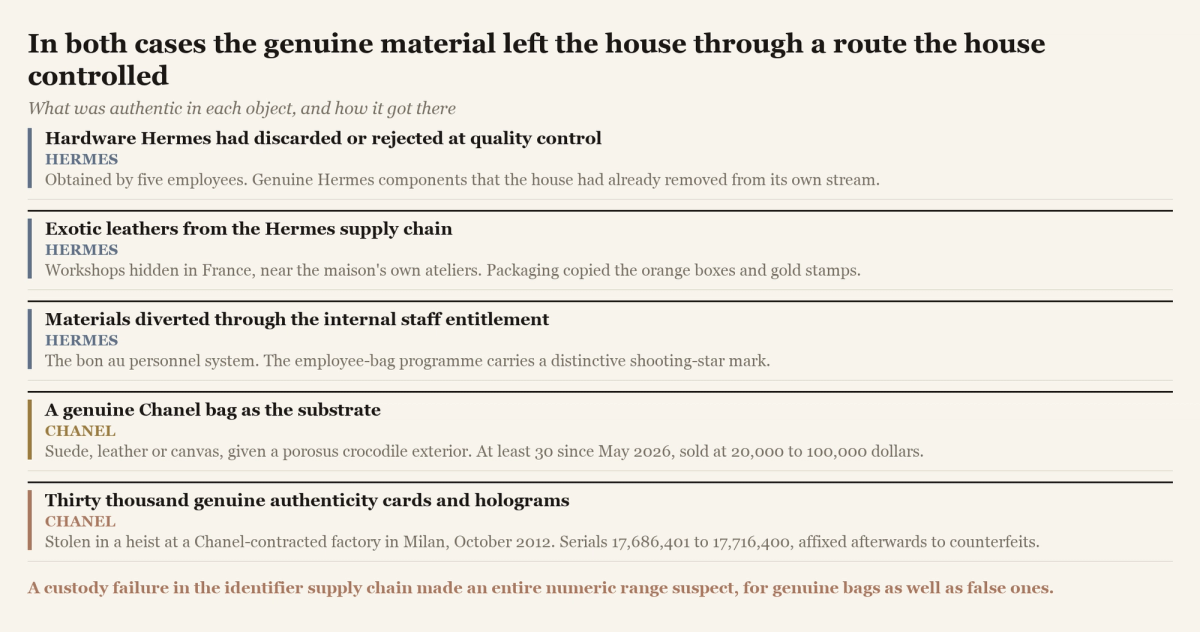
Three of the four did not survive a check against a source nearer the event than that article. The fourth survived in a form that points somewhere else entirely.
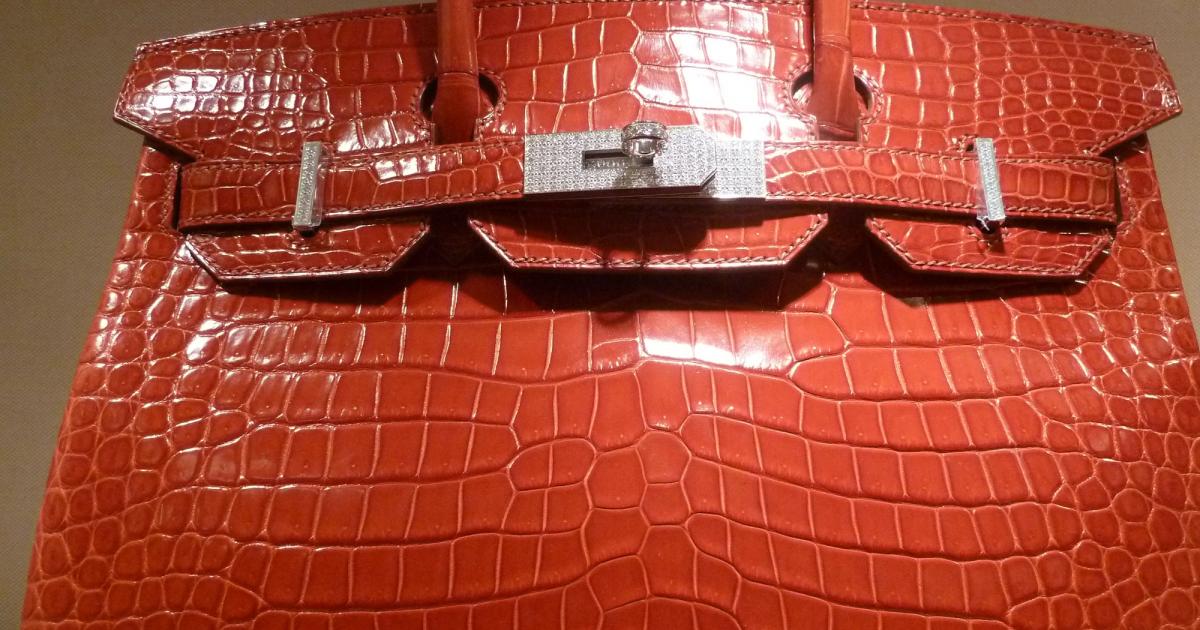
Objects of Affection Collection does not authenticate, attribute, appraise or value. Nothing in this study is a verdict on any object, including the bag in the photograph above. No record this institution builds is claimed to prevent, detect or resolve any of the cases described. What is in scope is narrower and is the thing this institution exists to look at: what a document attached to an object can carry, what it cannot, and which of the two the market is actually buying.
The number is right, and it belongs to the smaller case
Seven former employees is a real figure from a real judgment. A Paris criminal court sentenced ten people on 24 September 2020 after a trial that June, seven of them former staff of the maison. Sentences ran from six months suspended to three years. The ringleader was sentenced in absentia to three years and fined 200,000 euros, with a warrant outstanding. The house was awarded 580,000 euros against the two million it had sought.
That is a complete and accurate account of one proceeding. It is not the largest one, and it is not the most recent.
The case the number is not
Twenty-three defendants were convicted in 2021, nine of them former employees of the house. Civil damages exceeded ten million euros. Prosecutors put the operation's revenue above twenty-two million dollars. Twelve of the convicted appealed, and in 2023 the Paris Court of Appeal reduced some of the sentences.
So an article published in October 2026 carries a count that was superseded in 2021, by a judgment roughly twenty times larger in damages. Nobody invented anything. The smaller number is simply the one that travelled, and it travelled for six years.
This is a pattern with a name in this register. A figure enters circulation attached to an event, the event moves, and the figure does not. There is nothing in the sentence that signals it has aged, because the sentence is still true of the thing it originally described.
And the judgment is still not final
On 27 May 2025 the Court of Cassation ruled. It upheld the remaining convictions, the civil damages, joint and several liability, and both the profit-based award to one entity of the house and the royalty-based award to another. It also annulled one defendant's conviction and sentence, over contradictions about where his sales took place and an aggravating circumstance he had not been charged with, and returned that part of the case to a newly composed panel of the Paris Court of Appeal.
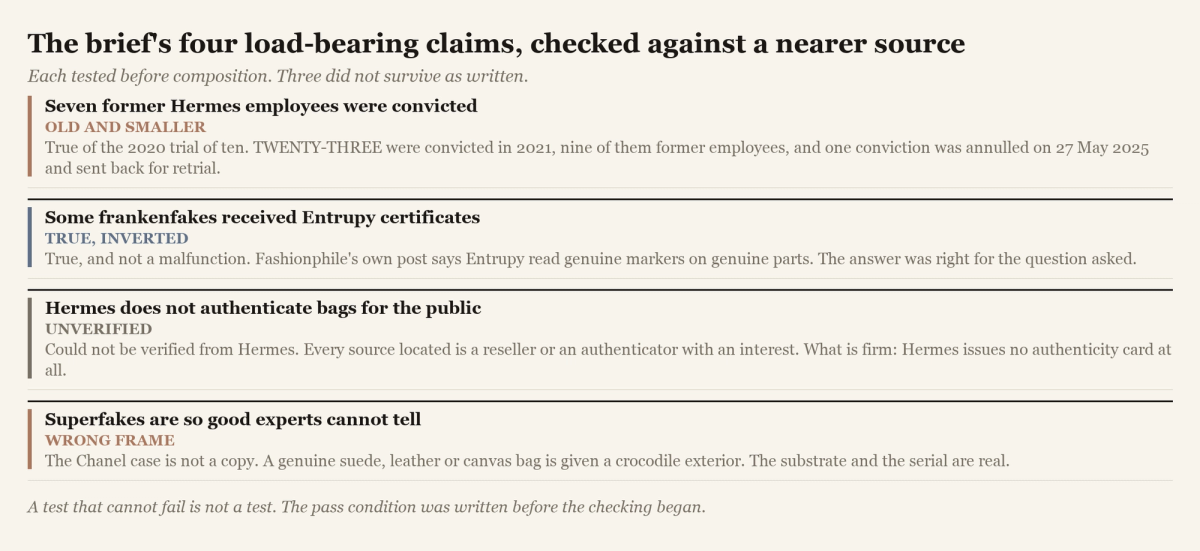
Fourteen years separate the complaint filed in 2011 from that ruling, and at least one defendant has still not reached a final judgment. He is not described here as convicted, because at the moment of writing that is not his status.
Where the material actually came from
The reporting frames this as a story about skill. The counterfeiters understood how the bags are built, recruited leatherworkers, cutters and assemblers who had worked for the house, sourced good leather, and produced objects that buyers could not distinguish from the genuine article. Members of the operation are reported to have called them real-fakes.
The court record describes something more specific than skill, and it is the reason this study exists.
Five employees obtained hardware the house had discarded or rejected at its own quality control. Exotic leathers came from the house's supply chain. Workshops were hidden in France, close to the maison's own ateliers. The packaging copied the orange boxes and the gold stamps. And some workers used the internal staff entitlement, the bon au personnel, to divert materials out of the building. That staff programme supplies a limited number of personal-use bags carrying a distinctive shooting-star mark.
Read those together and the object stops being a copy. A substantial part of what the buyer received was genuine material that had left the house through a route the house itself controlled. The hardware was not imitated. It was recovered from the reject stream. The exotic skins were not substituted. They came down the same supply chain as the ones used upstairs.
That is a custody failure, not a detection failure. No amount of looking harder at the finished object recovers the fact, because at the level of the component there is nothing false to find.
The bags that were real underneath
The second case in the brief makes the same point without a crime ring, and more plainly.
A reseller reported in 2026 a rise in what the trade calls frankenfakes, which it defines as any bag combining authentic components with non-original ones. Its account is specific. Since May 2026 at least thirty vintage Classic Flaps and Kellys have been reworked out of a factory in China and sold on to collectors, dealers and other resellers at twenty thousand to one hundred thousand dollars.
The method is the part worth slowing down for. They take a genuine suede, leather or canvas bag and give it a porosus crocodile exterior.
The substrate is real. The serial number is real and was really issued. The construction of the body is the house's own. What is false is the material identity of the finished thing, and the price that identity commands, because the house stopped using exotic skins in 2018 and the vintage examples are consequently scarce.
A bag like that is not a forgery of an object. It is a genuine object carrying a false account of itself, which is a different problem with a different remedy.
Thirty thousand genuine cards
The same account supplies a precedent that the October coverage does not mention at all, and it is the sharpest thing located in this research.
In October 2012 there was a heist at a factory contracted to one of these houses, in Milan. Thirty thousand genuine authenticity cards and hologram stickers were stolen, carrying serials between 17,686,401 and 17,716,400. They were afterwards affixed to counterfeits. The consequence is that any secondhand bag bearing a serial in that range is now treated by authenticators as a red flag.
Consider what that means for the honest holder. The identifier was authentic. It was issued by the house, printed on the house's stock, in a numbered sequence the house controls. It was stolen before it was ever attached to anything, and the thing it was eventually attached to was false. The remedy available to the market was to treat the whole range as suspect, which quietly damages every genuine bag that legitimately carries one of those numbers.
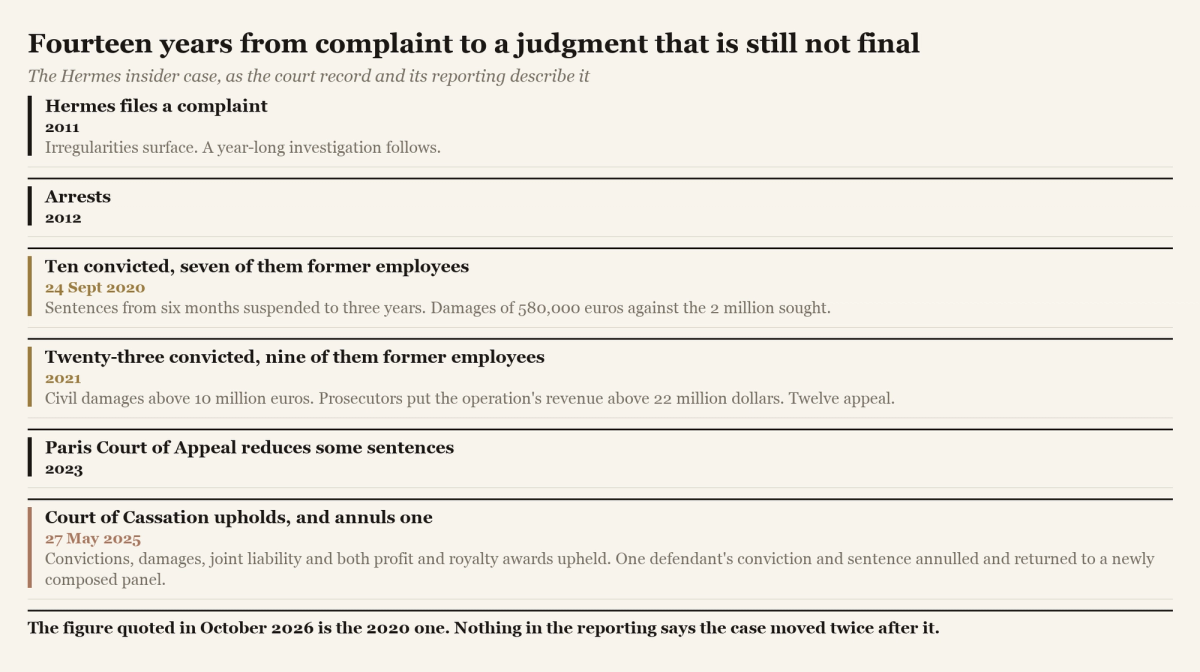
An identifier is only as good as the custody of the identifier. When the chain breaks upstream of the object, the document and the object come apart and both are left standing, each looking exactly as it did before. This is the burden of preservation landing on a party who did nothing wrong and cannot discharge it, because the evidence that would clear the bag is the very thing that was compromised.
The price is the tell, and it points away from the usual story
The counterfeit story the market tells itself is a story about discounts. A copy exists because somebody wants the look without the cost, and the reported price ladder supports that reading at the bottom end. The October coverage describes exotic-skin copies starting at a few thousand dollars against more than fifty thousand for the genuine bag, and a six hundred dollar version of an eleven thousand dollar flap.
The hybrids do not sit on that ladder. They were sold at twenty thousand to one hundred thousand dollars, which is not a discount on the vintage exotic market. It is that market's actual price.
Follow what that means. A buyer paying one hundred thousand dollars is not economising and is not knowingly buying a replica. They are paying the full price of a scarce object, and what they are buying with that money is the account of the object: that it is of a particular period, in a particular skin, from a house that stopped using that skin in 2018. The leather on the outside is the whole premium. Take the account away and the thing underneath is a real bag worth a fraction of it.
So the hybrid is not aimed at a buyer who wants to look rich. It is aimed at a buyer doing exactly what the market tells them to do, which is to buy scarcity and to check the documents. That buyer is the one with the most at stake and the least able to protect themselves, because the parts their protection examines are genuine.
Scarcity by allocation, and the market it creates
The last element of the brief is the one that gets least attention and explains most of the rest.
The October account describes an allocation system in which the most sought-after pieces are reserved almost exclusively for the house's established clients, and in its own phrasing, not everyone is invited to come buy one. It does not set out how the system works and this study does not assert any particular mechanism, which is the house's business and is reported inconsistently by interested parties.
What follows from allocation of any kind, though, is structural and does not depend on the details. If the object cannot simply be bought at the counter, then a large share of buyers are outside the shop by design. Outside the shop there is no counter, no sales assistant and no transaction record from the maker. There is a seller, an object, and whatever paper travels with it.
The same arithmetic runs on the other case from the other direction. A house that withdrew exotic skins in 2018 did not ration its vintage stock, it simply stopped adding to it, and the existing examples became the entire supply. Scarcity arrived by withdrawal rather than by allocation, and the effect on the secondary market is identical.
An allocated or withdrawn object is one whose buyers are mostly meeting it for the first time in the second-hand market, where the document is doing the work the counter would otherwise do. That is not a criticism of either practice. It is a description of where the weight falls. The scarcer the thing and the harder it is to buy directly, the more of its value rests on a piece of paper that the maker did not write.
The machine answered the question it was asked
The brief's most quotable claim is that some of these hybrids came through an artificial intelligence authentication system with certificates attached. That is accurate, and the reason is the opposite of the implication.
The reseller's own post says it directly: the system "was able to identify traditional authenticity markers" and the components it read were genuine, so the bag came back authentic. The hybrid defeated it because every individual part passes in isolation. The leather is real. The stitching on the body is period-correct. The hardware is what the house was using.
The system did not malfunction. It returned a correct answer to a question that was the wrong one for that object. An authentication verdict is a claim about a thing at a moment. It is not a claim about where the thing's parts came from, and it was never offered as one.
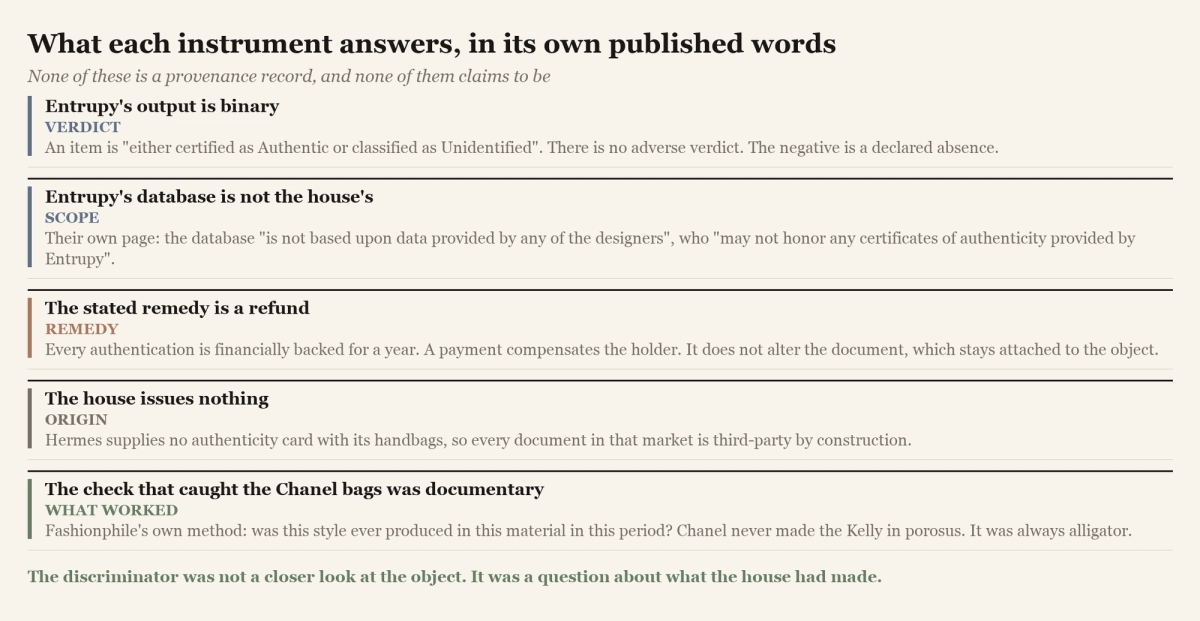
It is also worth noting what that service's negative result actually is. By its own description an item is either certified as authentic or classified as unidentified. There is no adverse finding available. The negative is a declared absence rather than a denial, which is a careful piece of design and is often read as a weaker thing than it is.
The certificate the house need not honour
The clearest statement of the limit is published by the authentication service itself, in a notice on its own product page that nobody quotes.
It states that the service is based solely on its own detection algorithm, that the database relied upon is not based upon data provided by any of the designers listed, and that those designers "are neither responsible for nor bound by any of" its findings and "may not honor any certificates of authenticity" it provides.
That is an unusually honest disclosure and it should be read as such rather than as an admission. It says, in the vendor's own words, that the certificate is a third party's opinion, that it is not derived from the maker's records, and that the maker is free to disagree with it. Everything the service claims for itself sits inside that boundary, including its stated accuracy and its marketing line that the newest copies come from the same factories with the same materials as the real thing and that its technology catches inconsistencies the experts miss.
Set that beside the third claim in the brief. The widely repeated statement that the house does not authenticate bags for the public could not be verified from the house. Every source located for it is a reseller or an authenticator, each of whom has a commercial interest in the answer, and the maison's own published wording was not reachable through the tools used here. It is recorded as unverified rather than repeated.
What is firm, and more useful, is the adjacent fact. The house issues no authenticity card with its handbags at all. So the only party with the production records is also the party that puts no document into the world and does not undertake to speak about the object later. Every document in that market is third-party by construction, which is a structural fact about the market rather than a complaint about anyone in it.
A remedy that pays the holder and leaves the record alone
The service's guarantee is explicit and generous on its face. If the technology gets it wrong the customer's money comes back, no questions asked, and every authentication is financially backed for a full year.
Look at what that remedy does and does not touch. It compensates the party who paid. It does not reach the certificate, which stays attached to the object and travels with it to the next buyer, and the next. The object outlives the warranty. A year is a short time in the life of a handbag and no time at all in the life of a vintage one.
This is not a criticism of the instrument. A refund is a perfectly good answer to a commercial loss. It is simply not an answer to a documentary one, and the two get sold in the same transaction.
What actually caught them was a question about a record
The most instructive detail in the whole episode is how the hybrids were eventually identified, because it was not by looking harder.
The reseller lists its checks, and the decisive one is documentary. It cross-references style against material and hardware and asks whether this particular bag was ever actually produced in this material during this period. Houses did not offer every skin on every style in every era, so the combination itself either confirms the piece or flags it.
Applied here, the reseller's account states the decisive fact plainly: the house never made that style in porosus crocodile, and had always made it in alligator. This institution has not independently verified the production history and reports it as the reseller's statement. What matters for the method is that no measurement of the object produces a fact of that kind at all. It comes from knowing what was made, and when, and in what.
So the discriminator that worked was a query against a production record, run by a human who held one. The examination of the object narrowed the field. The record closed it.
Each professional hand that touched it confirmed the last one
There is one more property of these cases that only shows up when you ask how far the objects travelled.
The hybrids did not go straight from a workshop to an unsuspecting buyer. By the reseller's account they were sold on to collectors, dealers and other resellers, and some were being offered by reputable platforms alongside disreputable ones. They passed through professional hands, more than once, and each of those hands checked them.
That should have been the market's strength and it was the opposite, because of what each check was. A later buyer does not usually re-derive the object's history from scratch. They look for whether it has been examined already, and a certificate from a recognised service is exactly the thing they are looking for. The first check produced a document. Every subsequent check found that document and was reassured by it.
A verdict that is wrong does not decay as it travels. It accumulates corroboration, because each new party is confirming the presence of the previous verdict rather than repeating the work behind it. By the fourth transaction the object has a history of having been approved, which reads like a history of the object and is not one.
This is the practical reason the distinction in this study is not academic. A record that states who held the thing and what moved between them gets stronger as more of it is filled in, and a reader can see where it is thin. A chain of verdicts gets more persuasive as it lengthens whether or not the first one was right, and a reader cannot see which it is. The two look similar on a listing page and behave in opposite directions.
What a verdict carries, and what a record carries
Two different instruments are being sold into the same gap, and the vocabulary flattens them together.
An authentication verdict answers the question is this what it claims to be, right now, as judged by whoever is holding it. It is a snapshot. It is reusable, it scales, it can be produced in seconds, and the services that produce it are clear in their own documentation about its scope. It is genuinely useful. It is also, by its nature, defeated by an object assembled from authentic parts, because it is reading the parts.
A provenance record answers a different question: who held this, when, and what moved between them. It is a sequence rather than a snapshot. It does not pronounce on authenticity and it is not a substitute for a verdict. Where it bears on these cases is narrow and specific. A record of custody has a place to put the fact that a component entered the market through a staff entitlement, or that a serial number belongs to a range stolen before it was ever issued, or that a body and an exterior have different histories. A verdict has nowhere to put any of that, and does not pretend to.
Neither instrument is the other's rival. A verdict is an input to a record, graded as what it is, sourced to the issuer and the date. The error is not in using one. It is in buying one and believing you hold the other, and that error is easiest to make at precisely the moment the object is most expensive.
The custodian's contract is built on the premise that the obligations attached to an object travel with it. The material facts here cut the same way. A hybrid bag assembled around genuine components is an object whose history has been edited rather than invented, and an edited history is harder to detect than a fabricated one for the same reason a frankenfake is harder to spot than a copy: most of it is true.
What is not claimed
This institution takes no view on the authenticity of any particular object, and does not authenticate, attribute, appraise or value. No object discussed here has been examined by anyone at this institution. The photograph above is a crocodile Birkin as described by the person who took it, and no claim whatever is made about it.
The convictions described are as the published reporting and the appellate record describe them. One defendant's conviction was annulled in May 2025 and that part of the case was sent back, so he is not described as convicted. No individual is named.
The reseller whose account supplies the frankenfake detail sells authentication and says so in the same post. Its description of what defeated an artificial intelligence system is its own, reported here as its account and corroborated only in that the vendor's published documentation is consistent with it. The authentication service's position is given in its own published words throughout, including its accuracy claim, its guarantee and its disclaimer, and it is not characterised here as a competitor to anything this institution does. The two answer different questions and both say so.
The statement that the house does not authenticate for the public is carried as unverified. It is widely repeated by interested parties and the maison's own wording was not located.