The Review That Refused to Give a Verdict: Four Grades, Three Objects, and the Clause Everybody Dropped
On 28 May 2026 the foundation that holds the Dutch royal family's private historic collections published the result of an independent provenance investigation into objects from the former Dutch colonies. More than a thousand objects were examined, mainly from Indonesia, Suriname and the Caribbean islands.
Objects of Affection Collection takes no view on origin, export, return or restitution. That is a standing constraint and it governs what this institution says. Nothing below is an opinion on where any object belongs, on whether any return is owed to anyone, or on the legitimacy of any acquisition. Where words like unlawful, coerced or unjust appear, they are quoted from the report or from the foundation and attributed to them.
What is in scope is the thing this institution exists to look at: what a provenance review of this kind can and cannot establish, and how carefully it says so.
On that measure the report is unusually good, and the coverage of it has already lost the two most careful things in it.
The finding is graded, and the grading is the point
The foundation's own summary does not produce a verdict. It produces a scale, and every band on that scale is stated rather than implied.
At one end: "Virtually the entire collection of colonial objects consists of gifts." Almost all of it was acquired by donation rather than purchase, seizure or excavation.
In the middle, and this is the sentence that matters: for most of those gifts the research found "no direct indicators" that they were presented under duress, though they were given in a context of unequal colonial relations.
Further along: for a small number, the foundation states that "there is a possibility that their presence in the SHVON collection is illegitimate and/or unjust." A possibility, named, left open.
And at the far end, three objects, introduced by a sentence that is doing precise work: "Serious doubts exist as to whether the donation of the following objects was voluntary."
Four distinct positions. A gift with no contrary indication. A gift with no contrary indication in a context that was itself unequal. A possibility of illegitimacy. And serious doubt about voluntariness.
A study published here earlier today found twenty museum catalogues in which four institutions had to write their uncertainty into free-text prose because no field would hold it, and in which withheld, unidentified, doubted and lost all rendered identically. This report does the opposite. It distinguishes its states and labels each one, and it does so in the summary rather than burying it in an appendix.
The clause the coverage drops
The brief that commissioned this study reports, accurately, that for most objects there was no direct evidence of coercion. It does not carry the rest of the sentence.
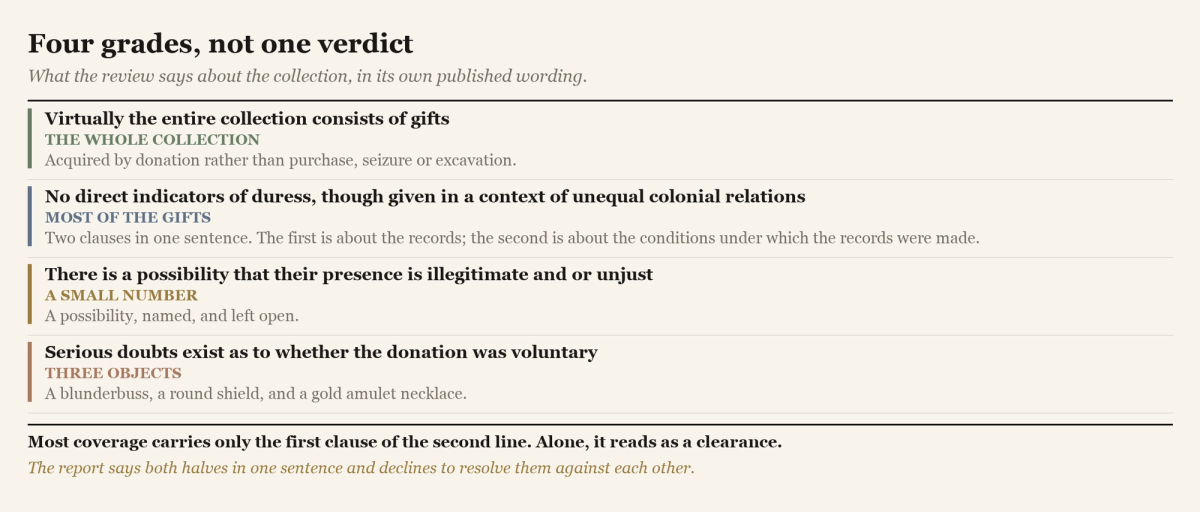
The rest of the sentence is: though they were given in a context of unequal colonial relations.
Those two halves are doing different jobs and neither survives alone. The first is a statement about the records: nothing in the paperwork of these particular transfers indicates compulsion. The second is a statement about the conditions under which the paperwork was produced.
Carry only the first and the report reads as a clearance. Carry only the second and it reads as a condemnation. The report says both, in one sentence, and declines to resolve them against each other.
That is not fence-sitting. It is the accurate description of what the evidence supports, and it is a harder thing to write than either of the simpler versions.
No direct evidence of coercion is not evidence of no coercion
The distinction the report is holding is the one this institution has spent the day on from several directions, and it is worth stating in its general form because it travels.
An absence in a record is a statement about the record. It can mean the thing did not happen. It can mean the thing happened and was not written down. It can mean the thing happened and was written down somewhere that has not survived. It can mean nobody looked. These are four different situations and they produce one appearance.
Here the phrase is "no direct indicators", which is carefully chosen. It does not say the gifts were voluntary. It says the surviving documents do not record compulsion. Whether a nineteenth-century colonial administration would have recorded compulsion in a presentation record is a separate question, and the report's second clause is the acknowledgement that it is separate.
A reader who converts "no direct indicators of duress" into "given freely" has made the move this institution calls the hardening of a description, and which it documented earlier today in a painting whose catalogue entry changed from recording what the picture showed to recording who made it, with nobody deciding to change it.
Three objects, and what each one is evidence of
The report names three objects about which serious doubts exist. They are not three versions of the same situation.
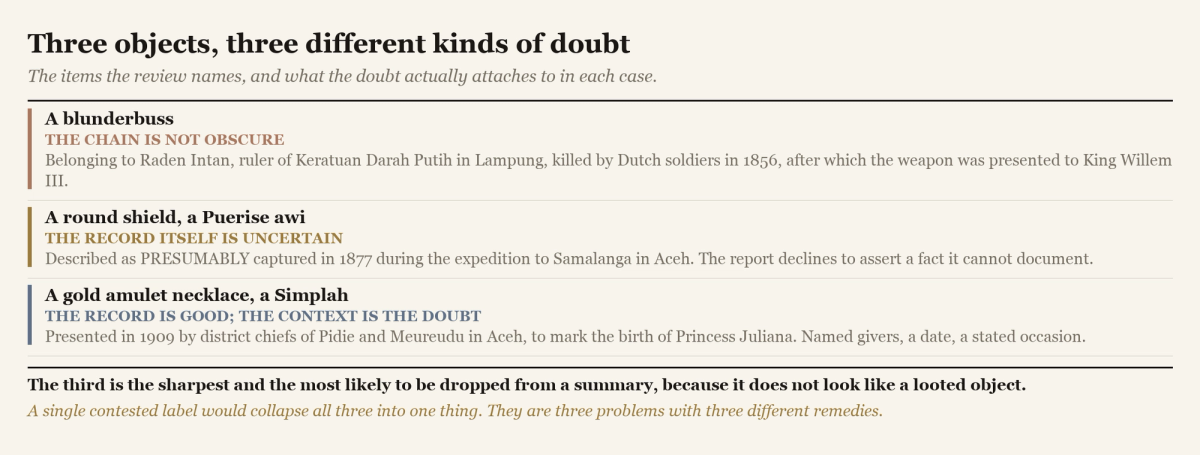
A blunderbuss belonging to Raden Intan, ruler of Keratuan Darah Putih in Lampung, who was killed by Dutch soldiers in 1856, after which the weapon was presented to King Willem III. The chain here is not obscure. A man was killed, and an object of his reached a European monarch.
A round shield, a Puerise awi, described in the foundation's account as presumably captured in 1877 during the expedition to Samalanga in Aceh, and later presented to King Willem III. Note the word presumably, which is the report declining to assert a fact it cannot document.
A gold amulet necklace, a Simplah, presented in 1909 by district chiefs of Pidie and Meureudu in Aceh to mark the birth of Princess Juliana.
The third is the one worth sitting with, because on its face it is the least like the others. It is a gift, from named local authorities, marking a specific family event, with a date. If any transfer in this collection looks documented and ceremonial, it is this one.
It is on the list anyway. The doubt attaches not to the paperwork but to the circumstances in which district chiefs in Aceh in 1909 would be presenting gold to the Dutch royal family, Aceh having been the subject of a long and violent Dutch military campaign. The record of the transfer is good. The question is what the record cannot show.
That is a sharper illustration of the report's own distinction than either of the weapons, and it is the item most likely to be dropped from a summary precisely because it does not look like a looted object.
The same chair, and a presumption that was not carried across
The oversight committee was chaired by Professor Rudi Ekkart, and that is the most interesting methodological fact in the whole exercise. It is also one no coverage located here mentions.
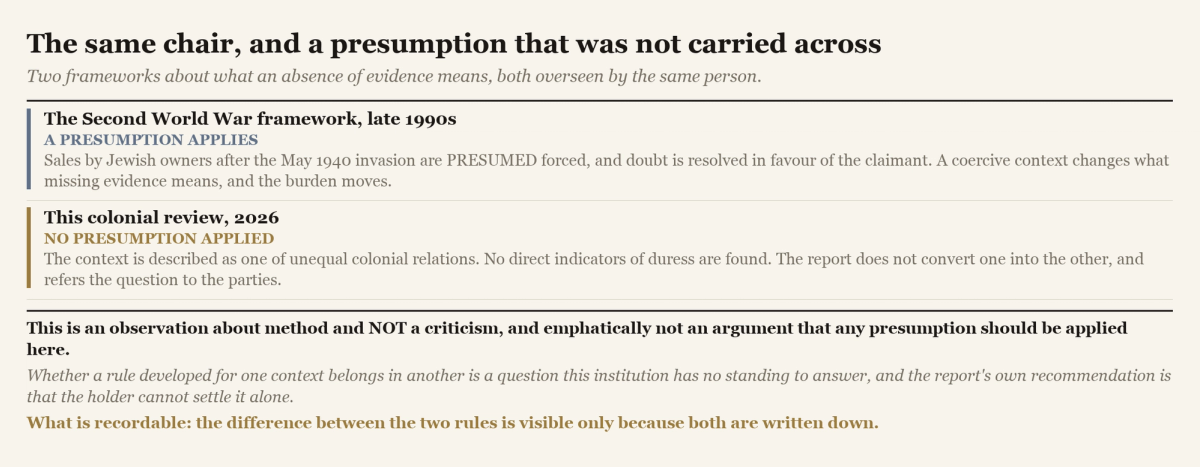
Ekkart chaired the Dutch committee, established in the late 1990s, whose recommendations reshaped the Netherlands' restitution policy for art lost by private owners during the Second World War. Those recommendations were adopted broadly by government and translated into policy, and two of them are relevant here with unusual precision.
The first was a presumption: that sales by Jewish owners after the German invasion of May 1940 should be treated as forced. The second was a rule for the ambiguous cases: that doubt should be resolved in favour of the claimant.
Read those beside the sentence at the centre of this report. The colonial objects were given, the research finds no direct indicators of duress, and they were given in a context of unequal colonial relations.
The structure of the earlier framework was precisely that a sufficiently coercive context changes what the absence of contrary evidence means. Under it, a transfer with no documented compulsion, made under occupation, is not thereby a free transfer. The burden moves.
This report does not apply that move. It describes the context, records the absence of direct indicators, declines to convert one into the other, and refers the question to the parties.
That is an observation about method and not a criticism, and it is emphatically not an argument that any presumption should be applied here. The two situations differ in ways that are somebody else's to weigh: a different century, a different legal framework, a different relationship between the parties, and a report whose own recommendation is that the question cannot be settled by the holder alone. Whether a presumption developed for one context belongs in another is exactly the sort of question this institution has no standing to answer.
What is recordable is narrower and, for anyone building a record, concrete. The same chair has now produced work under two different rules about what an absence of evidence means, and the difference between those rules is visible only if both are written down. In a record that carried a grade and its reasoning, it would be. In a record that carried a status flag, it would not.
The object's own type is reported three ways
A small thing, and it is the pattern this institution keeps finding at the point where a record becomes coverage.
The foundation's account calls the Raden Intan object a blunderbuss. Press reporting variously calls it a gun, a firearm and an arquebus.
A blunderbuss, a firearm and an arquebus are not interchangeable. One is a specific short flared-barrel weapon, one is a category, and one is a different and earlier weapon type entirely. Searched for under the wrong term in a catalogue or a loan record, the object is harder to find than it should be.
Nothing turns on it for the substance of the report. It is included because the pattern is now familiar enough to be worth naming: the first thing to drift, in every case this institution has examined, is the precise term, and it drifts in the direction of the more familiar word.
What a review of a surviving collection cannot establish
Now the denominator problem, and the brief reaches for the right principle by what appears to be the wrong route.
The brief states that the thousand objects are only a fraction of what the family once owned, and that most were lost or auctioned to pay the debts of King Willem II, who reigned from 1840 to 1849.
The dispersal is real and it is dramatic. Willem II had borrowed a million guilders from Tsar Nicholas I in 1848, in secrecy, against the security of his art. The claim surprised his heirs. With other debts said to total around four million guilders, the collections had to be sold, and a brother-in-law would cover the Russian debt only if the sale was public. The auction opened on 12 August 1850 in the Gothic Hall of the Kneuterdijk Palace in The Hague. The buyers were the Tsar, the Marquess of Hertford, the Rothschilds and museums in Brussels, Antwerp and Frankfurt. A recent scholarly account states that almost everything was sold and that the paintings are now distributed around the world. The Dutch government, by that account, remained passive throughout.
But the chronology does not obviously support using that sale to explain the size of this collection. The colonial objects examined in this review were, on the foundation's and the reporting's own account, mostly gifts to King Willem III, Queen Emma and Queen Wilhelmina. Willem III succeeded in 1849. Emma and Wilhelmina are later still. Those gifts largely postdate the 1850 and 1851 auctions, and the auctions are described in the sources located here as a sale of paintings and drawings.
This study could not establish that the colonial collection was materially reduced by Willem II's debts, and no source giving a surviving fraction could be found. That is a statement about what was found rather than a claim that it did not happen, and if somebody holds the figure it would be worth publishing.
The underlying principle survives the correction and is worth keeping on firmer ground. A review of a collection as it now stands describes the survivors. Anything that left by any route, sale, gift, loss, damage or destruction, is outside its reach, and no review of what remains can quantify what does not. That is true of this collection whether or not the 1850 auction touched it, and it is the reason the report's own careful framing matters more than any total.
Two years, one researcher, and a number that is not in the release
The scale of the work is worth stating because it sets a price on this kind of certainty.
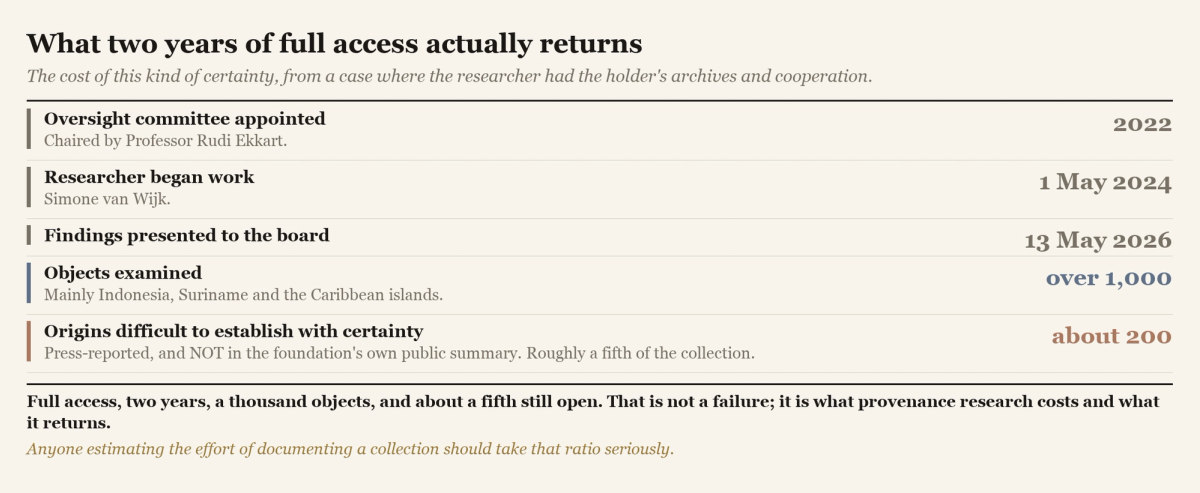
The oversight committee was appointed in 2022. The researcher, Simone van Wijk, began on 1 May 2024. Findings reached the board on 13 May 2026. That is roughly two years of research for a collection of about a thousand objects, overseen by a committee for four.
Press reporting adds a figure that the foundation's own public summary does not: that the origins of around two hundred objects were difficult to establish with certainty, many of them associated with King Willem III.
If that figure holds, it is the most useful single number in the exercise. Roughly a fifth of the collection sits in a state that is neither cleared nor doubted but unresolved, after two years of dedicated work by a professional researcher with access to the holder's own archives and the holder's full cooperation.
That is not a failure. It is what provenance research costs and what it returns. Anyone estimating the effort of documenting a collection should take the ratio seriously: full access, two years, a thousand objects, and a fifth still open.
It is carried here as press-reported rather than as the foundation's own figure, because it does not appear in the summary read for this study. If the full report states it, the number is better than reported here.
The review declines to decide, and says so
The single most unusual thing in the published recommendations is what the foundation will not do.
Legitimacy and ethics, the recommendation states, cannot be decided by the foundation alone and must be addressed with representatives of the former colonies.
An institution holding a collection, having commissioned and received a report on that collection, declines to rule on the legitimacy of its own holdings and routes the question to the parties on the other side of it. Whatever anyone thinks about what follows, that is a structurally unusual act, because the normal failure mode is the opposite: a holder commissions a review, the review clears the holding, and the clearance is published as a finding.
The board states that it adopts the recommendations in full. The chair's published words are: "We endorse its conclusions and are pleased to adopt all its recommendations." Funds have been set aside and a researcher appointed to publish the investigation's information online from 1 June 2026.
This institution takes no position on what should happen next, and the report conspicuously does not take one either. What is recordable is the shape: a provenance review that produces grades rather than a verdict, and a holder that publishes the grades and refers the verdict elsewhere.
The research is being published, which is rarer than the review
One recommendation is easy to skim past and is the one with the longest reach.
The foundation states that information from the investigation is to be made available digitally, as soon as possible, that funds have been set aside, and that a researcher was appointed to oversee online publication from 1 June 2026.
Most provenance reviews produce a conclusion. The conclusion travels, the research does not, and the next person with a question starts from the summary rather than from the evidence.
Publishing the underlying information is a different act. It makes the grades auditable by people who were not in the room, which is the only way a grade stops being an assertion. It also means that if a future researcher disagrees with a classification, they can argue with the material rather than with the verdict.
A study published here earlier today examined a painting whose attribution has been disputed for a century, and found that the decisive evidence sits in one building while everybody arguing about it works from reproductions. Publishing the research is the remedy to that, applied before the dispute rather than after it.
A private collection choosing a public standard
One further structural point, and it is the one most likely to be useful to anybody designing a record.
The collection is private. The foundation is not a national museum, and the national guidelines developed in the Netherlands for colonial collections in public hands do not bind it.
It has chosen to work to them anyway, and to publish.
That is a decision with no enforcement behind it, and it is worth noticing in a week when this institution has also examined twenty public museum catalogues that have no field for provenance at all, a prosecutor's office whose only reliable instrument is a warrant, and a national gallery whose foundational bequest has never been fully enumerated. Adoption is not correlated with obligation. The holder with no duty to document has documented; several holders with every duty have not.
What a record would carry out of this
Three things in the report would survive into a usable record, and all three are already written down.
The grade, with its wording. Not a status flag but the actual sentence: no direct indicators, in a context of unequal relations. A flag loses the second half. A field that holds the sentence does not.
The reason for the doubt, separately from the doubt. With the amulet, the record of the transfer is good and the doubt is contextual. With the shield, the record itself is uncertain and the report says presumably. Those are different problems with different remedies, and a single "contested" label would collapse them.
What was not examined, and why. The review covered the collection as it stands. A record that notes that boundary makes every later reader aware that the population is the survivors.
None of that requires knowing more than the report already knows, and none of it requires anybody to decide anything.
What is not claimed
OAC takes no view on origin, export, return or restitution, and nothing above is an opinion on where any object belongs, on whether any return is owed to anyone, or on the legitimacy of any acquisition. OAC does not authenticate, attribute or value.
Every characterisation of an object as coerced, unlawful, illegitimate or unjust belongs to the foundation or to the report and is attributed in the text. The foundation's own recommendation is that these questions cannot be settled by the holder alone, and this institution is in no better position.
The account of Willem II's debts and the 1850 and 1851 auctions is drawn from published scholarship and secondary sources. This study could not establish that the colonial collection was materially affected by that sale, and says so rather than repeating the connection. No figure for a surviving fraction could be located.
The three named objects are named because the foundation names them in its own published summary. No living individual is named here beyond the officeholders the foundation itself identifies.
What is claimed is narrow. A provenance review produced four distinct grades rather than one verdict, stated them in its own summary, and the most careful clause in it is the one the coverage dropped. The holder then declined to adjudicate its own collection and said so in public. Whatever follows from that is somebody else's to decide.
This is what the burden of preservation looks like when a holder accepts it without being made to, and what a custodian's contract is for: recording, at the moment of transfer, the thing that a later reader will need and cannot reconstruct.