A Replica of a Witness: Selva Aparicio's Childhood Memories
On a covering rendered as a surface, on subtraction as a way of making, and on what survives when the object does not
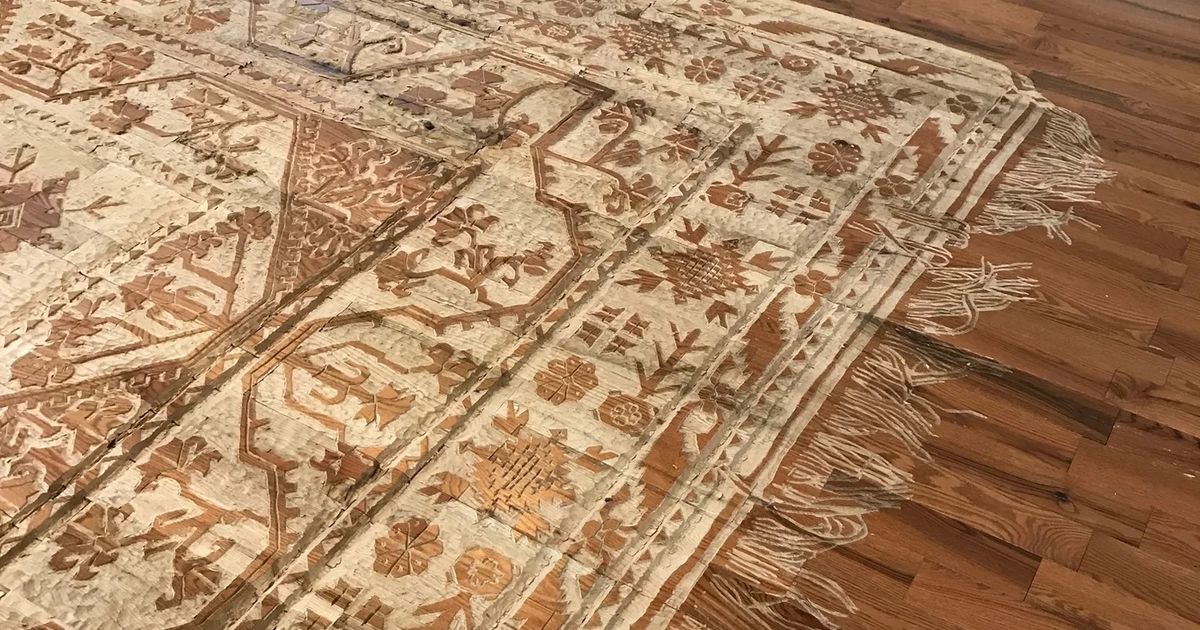
The work is a Persian carpet, ten by fifteen feet, and it is not a carpet. Selva Aparicio cut it into discarded red oak flooring with a mallet and a chisel: the field, the borders, the floral medallions, the tassels lying in different directions, one corner turned over as though someone had caught it with a foot. From standing height it reads as textile. The illusion fails only on approach, and what fails it is the grain of the floor running straight through the pattern, uninterrupted, board join to board join.
The artist's own listing gives the material as her mother's rug, carved into oak floor. Her statement for the piece is short, and it is worth quoting whole rather than paraphrasing, because paraphrase would soften it:
Rugs are typically adorned with sacred gardens and oases, and can be moved around the home. This rug is a replica of one that quietly participated in years of familial abuse. This piece is about covering up violence and exposing trauma. I strive to find beauty in peril and bear witness to the progression of ephemerality to permanence to loss.
This institution's subject is objects and what humans do with them, and this study stays there. The disclosure is the artist's. It is public, it is hers to make, it is not this institution's to interpret, and nothing below adds to it or reads behind it. What follows concerns the object logic she built, which is unusually precise, and which she has described more clearly than most of the writing about the work has managed.
One term belongs here, because it is the one under which this institution files the work. Trauma Provenance is its name for an object whose history cannot be separated from harm done in its presence. It is a property of the record, not a diagnosis of a person. The rug carries it, the carved floor is a record of the rug, and the artist has described that relation more precisely than the term ever has.
Every property of a rug, reversed
Begin with what a rug is, because the work is built by negating it term by term.
A rug is soft. It is portable, and among the objects in a house it is close to uniquely so: it can be rolled, carried, and put down in another room by one person in an afternoon. Its function is to cover. It is the standard means by which a household makes a floor mean something other than a floor, and it is a surface that absorbs, holding dust, hair, spill and wear inside its pile where none of it can be seen.
The carving reverses all four. It is hard. It cannot be moved, because it is not on the floor, it is the floor. It does not cover anything; the cutting away is what produces the image, so the pattern exists only as material removed. And it absorbs nothing, because there is no pile to absorb into. A carved surface can only show.
The artist has been exact about this. Speaking about the work she has described memories as permanently etched and the soft fabric as represented in scars on discarded wood. That is not a metaphor reaching for a material after the fact. It is a description of a technique, and the technique enforces the meaning rather than illustrating it.
The one object in the house that could be picked up and moved has been rendered as the one surface that cannot. The covering is now the thing underneath.
Weaving is additive. Carving is not. That is the whole argument.
This is the observation that seems to this institution the most important thing in the work, and it is largely absent from the coverage.
A carpet is made by addition. A knotted rug is built knot on knot, weft on weft, each element placed onto a warp that did not previously carry it. Every gesture puts something there. A mistake is a knot in the wrong place, and it can be cut out and retied. The object accumulates, and its accumulation is the reason a rug can absorb a household for decades: it was made by a process of adding, and it goes on adding, in dust and wear and repair, for as long as it is underfoot.
A carving is made by subtraction. Every gesture takes something away. There is no equivalent of retying a knot, because the material that would have to be restored no longer exists. A cut in the wrong place is permanent at the moment it is made, and the only available correction is to remove more.
So the work converts an additive object into a subtractive one, and it does so at a scale of ten by fifteen feet, with the fineness of a carpet pattern, by hand. Whatever the labour was in hours, the structural fact is that it was uncorrectable throughout. A rug that can be repaired has been reproduced in a form where nothing can be repaired.
Read against the artist's stated subject, that is not a technical footnote. It is the argument stated in the grammar of the making, before any image appears. A thing that could be added to and mended has been remade as a thing that could only be cut away from and never mended, and the surface that results is the one thing in the room that will not close over.
The carpet was a garden, and she says so
Her statement opens with iconography rather than with biography: rugs are typically adorned with sacred gardens and oases. That is accurate to the tradition and it is doing work in the sentence.
The classical Persian carpet is a garden made portable. Its formal vocabulary of watercourses, borders and flowering compartments derives from the walled paradise garden, and the point of putting it on a floor is that a person in a room with no garden can stand in one. It is an object invented so that an enclosure of safety and abundance can be carried indoors, unrolled, and stood upon.
Aparicio names that convention and then holds the specific rug against it. The garden that can be moved around the home is the type. The rug in her account did not move. What she has made is the type's opposite: a paradise garden that has been fixed to the ground it sits on and cannot be taken anywhere, rendered in a material that is the floor of the room rather than a covering laid over it.
A portable enclosure of safety, made unportable. That is a harder sentence than the one about scars, and it is entirely hers.
The material is always something already released
The carved floor is not an isolated technical experiment. It belongs to a practice with a consistent and unusual rule about what may be used.
Aparicio, born in 1987 and working between Barcelona and Chicago, has made work from cicada wings, from human hair, from flowers, seeds and parts of trees, and from human bodies. Her 2024 survey at the DePaul Art Museum, In Memory Of, which ran from 14 March to 4 August 2024, included a mourning veil of the kind traditionally worn by widows, formed from 1,365 individual seventeen year cicada wings sewn together with hair from the artist, her mother and her niece. Reviewing the exhibition, Hyperallergic observed that she treats unwanted things with extreme sensitivity. In an interview with Studio International she put the continuity in one line: she has worked a lot with mourning, and it is her whole life.
The rule those materials share is not that they are found, and calling them found materials misses it. They are released materials. A cicada wing is shed by an insect that has completed a seventeen year cycle. Hair is separated from a living head. A donated body has been released by the person who lived in it and by the law that governed them. Discarded flooring has been released by a building, usually during a renovation, usually to a skip.
Each of those materials arrives at the studio only because some system finished with it. The work then confers on the released thing exactly the care that the releasing system withdrew: the wing is sewn rather than swept, the flooring is carved rather than burned. That is a custodial operation, and it is performed on material whose custody had formally lapsed.
Seen from there, the choice of discarded oak for this particular piece stops being incidental. A rug that stayed in a room through years it should not have had to witness is restated in boards that a building threw away. Two things that were kept longer than they should have been, and then let go, in the same object.
A replica, and the word is hers
The carved floor is not the rug. It is, in her own wording, a replica of the rug. That distinction is easy to lose in the coverage, which frequently reports that she carved her childhood rug into the floor, and it carries most of the work's difficulty.
The rug that stood in the house is a witness in the plainest sense of the word: it was present, it was underfoot, and it accumulated the household around it. It has no aesthetic authority. It chose nothing, framed nothing, and asserted nothing. Its entire standing comes from having been in the room.
What the carving does is move that standing into an object made deliberately, at scale, by hand, over a long and uncorrectable labour, in a material chosen for its refusal to close. The witness is not preserved and is not present. It is restated in a form that can be exhibited, and the restating is the work.
That is a provenance operation of a kind this institution's vocabulary can describe but did not anticipate. Standing is carried across a copy, without the original present, and without the copy pretending to be the original. The usual provenance question asks whether an object is what it claims to be. Here the object openly claims to be a replica, and its authority is not diminished by the admission, because what is being transmitted is not the rug's identity but its position in a room.
The fact most of the coverage leaves out
Childhood Memories was presented as the artist's MFA thesis at Yale in 2017. It was remade for the DePaul survey in 2024, and her own site now dates the work 2024.
So it has been carved at least twice, into at least two floors, seven years apart, in two cities and two institutions.
It would be easy and wrong to present that as a contradiction of a work about permanence. Reading it as a contradiction would require ignoring the sentence the artist has already written, in which she names the sequence herself: ephemerality, then permanence, then loss. A carved floor is permanent until the building changes hands, and then it is a floor. The permanence is real and it is local. The loss is structural, it arrives later, and it arrives at this work in precisely the way it arrived at the rug that is no longer in the house.
What survives the loss is the capacity to make the cut again. That is the honest description of where the permanence lives, and it is not in any particular floor. The work is not a monument, which would have to stay; it is closer to a rite, which has to be performed, and can be performed again, and means the same thing each time it is. Object Permanence, as this institution uses the term, assumes that the thing which persists is the object. Here what persists is the capacity to make the object again, which is the same property kept in a different place.
An object that cannot be acquired without the building
There is a commercial fact underneath this that is rarely stated and that this institution is well placed to state.
A carving in a floor cannot be collected in the ordinary way. To acquire it a buyer would have to acquire the boards, which means lifting a floor, which means either destroying the installation or purchasing the room. Nothing about the work is portable, and its refusal of portability is not a side effect of the medium; it is the subject of the piece. The object resists the market by the same property that carries its meaning.
This is the condition that this institution's instruments were designed to produce artificially. A Custodian's Contract binds obligations to an object so that the object cannot be treated as a pure asset. Here the binding is structural rather than contractual: no covenant is required, because the work is a building component.
And yet it has been remade. So the work is, at the same time, unownable in any single instance and entirely repeatable by its author. Those two facts sit together uncomfortably and they are both true, and an institution that has argued at length that singularity should be material rather than administered has to say what it makes of that rather than choose the half that is convenient.
What this complicates for us
This institution holds that singularity must be material, earned in the object, rather than administered by a certificate or a serial number. Childhood Memories is a genuine test of that position rather than an illustration of it.
The work is unambiguously singular in meaning. It refers to one rug, one house, one set of years, and no second person could make it. It is also, demonstrably, not singular in instance. Two floors carry it. Neither is a reproduction in the printmaking sense, because each was cut by hand and each cost the full uncorrectable labour. Neither is the original in the usual sense either, because the first holds no priority of meaning over the second: the 2024 carving is not a copy of the 2017 carving, it is a second performance of the same act on the same subject.
Material Singularity, as this institution has used the term, cannot cleanly account for that. The concept was built for objects whose singularity is threatened by administrative duplication: the edition, the certificate, the serial number, the licence. Here the duplication is manual, expensive, authored, and identical in cost to the first instance, and it does not threaten the meaning at all. If anything it confirms it, because the artist's stated sequence requires that the permanent thing be lost.
The correct response is to record the gap rather than to widen the term until it swallows the case. A framework that explains everything put in front of it has stopped measuring. What Childhood Memories shows is that there is a category of object whose singularity is neither material nor administered but performative: it lives in an act that only one person is positioned to carry out, and it survives the destruction of every instance so long as that person is able to carry it out again.
Where it sits, and where the comparison stops
Two comparisons will occur to anyone who works in this area, and both are useful up to a point that should be marked.
Rachel Whiteread casts the space inside and underneath domestic objects and architecture, making solid what was void. The procedure is the reverse of this one. Whiteread adds material to an absence in order to make the absence visible; Aparicio removes material from a presence in order to make an absence permanent. Both produce a hard object where a soft or empty condition was. They arrive from opposite directions.
Doris Salcedo, whose work this institution has examined elsewhere, embeds domestic furniture in concrete and cuts into the floor of a museum, and works explicitly on political violence and its household residue. The nearer comparison is structural: the floor as the site, the domestic object as the carrier, the refusal of portability. The distinction worth holding is that Salcedo's subject is collective and historical, and the objects stand for many households at once. Aparicio's account of this piece is specific to one rug in one home, and the study should not enlarge it into a general statement about domestic violence on her behalf. She has not made that move, and it is not this institution's to make for her.
What is not established here
Several details circulate in the coverage of this work that this institution could not source, and they are not asserted above.
The duration of the carving is given variously as days and as months. A trip to Barcelona to trace the original rug onto translucent paper is widely repeated and this institution has not found it in the artist's own words. The relationship between the 2017 and 2024 carvings is unstated, including whether the first survives, whether the second reproduces the first pattern exactly, and whether the salvaged oak differed. Whether the rug itself still exists is unknown here.
Each of those would change the reading materially. Whether the pattern was traced from the actual rug or worked from photographs is the difference between a rubbing, which is contact with the object, and a rendering, which is not, and the whole question of what is transmitted turns on it. Whether the first floor survives decides whether the loss in her sequence has already happened once or is still ahead. These are questions for the artist, and they are recorded here as open rather than filled in, because a study that completed them from the internet would be doing the exact opposite of what this work is about.
Coda
The most useful thing in the piece is the tassel.
A carpet's fringe is the loose end of its own structure. It is the warp, left unwoven, which is to say it is the part of the object where the making is visible and unfinished. It frays first. It is the first thing a restorer repairs and the first thing an owner notices going.
Carved into a floor, the fringe cannot fray. It also cannot be straightened, combed, or tucked under, and in this work it has been rendered lying in several directions at once, exactly as a real fringe lies after somebody has walked across it. It has been fixed mid disorder. That is what a photograph does to a moment and what a floor is not supposed to do to anything.
The rest of the work argues that a covering can be turned into a surface. The tassel is where the argument is proved, because a fringe is the one part of a rug that exists only in order to move.