Three Greens on One Bracelet: What a House Calls a Rock That Has No Species
On a rock that three houses now set in gold under a name a gemmologist coined for it in 2016, a name that states where it was found because the paper that named it could not say what it is
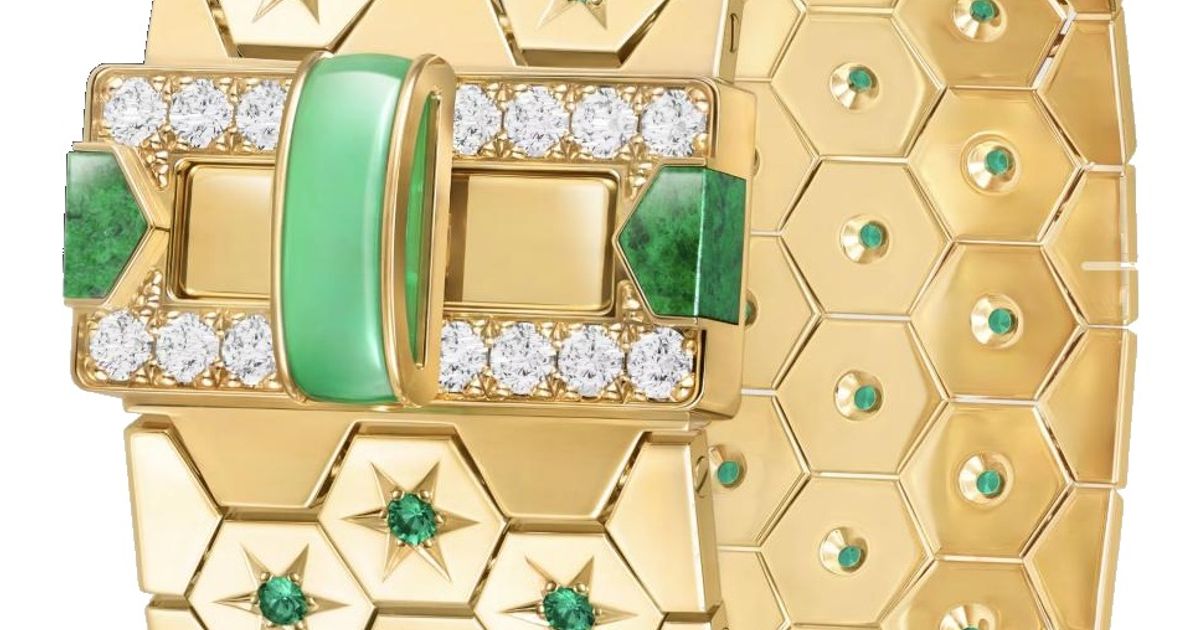
A Van Cleef and Arpels Ludo bracelet in 18K yellow gold is listed on the Maison's own site at ninety thousand five hundred dollars. The materials line reads, in this order: Chrysoprase, Diamond, Emerald, Sannan Skarn.
Three of those four are green. They are green in three different ways, they are visible in the same photograph, and the names they carry make three different kinds of claim. One names a mineral species. One names a variety of another species. The third names a place in Balochistan.
What Is Established, With Its Dates
In September 2015 a green rock from western Pakistan was offered at the Hong Kong Jewellery and Gem Fair under the name Maw Sit Sit. Maw Sit Sit is a chromium rich rock from Kachin State in Myanmar, named after the village near the deposit, and it is not the same material.
In 2016 the gemmologists H. A. Hanni and L. Franz published a description of the Pakistani material in Gemmologie, the journal of the German Gemmological Association, volume 65, numbers 1 and 2, pages 41 to 46. The paper states that the material has nothing in common with Maw Sit Sit. It proposes a name, and it is unusually direct about the obligation: the material shall be sold under its correct name, Sannan-Skarn.
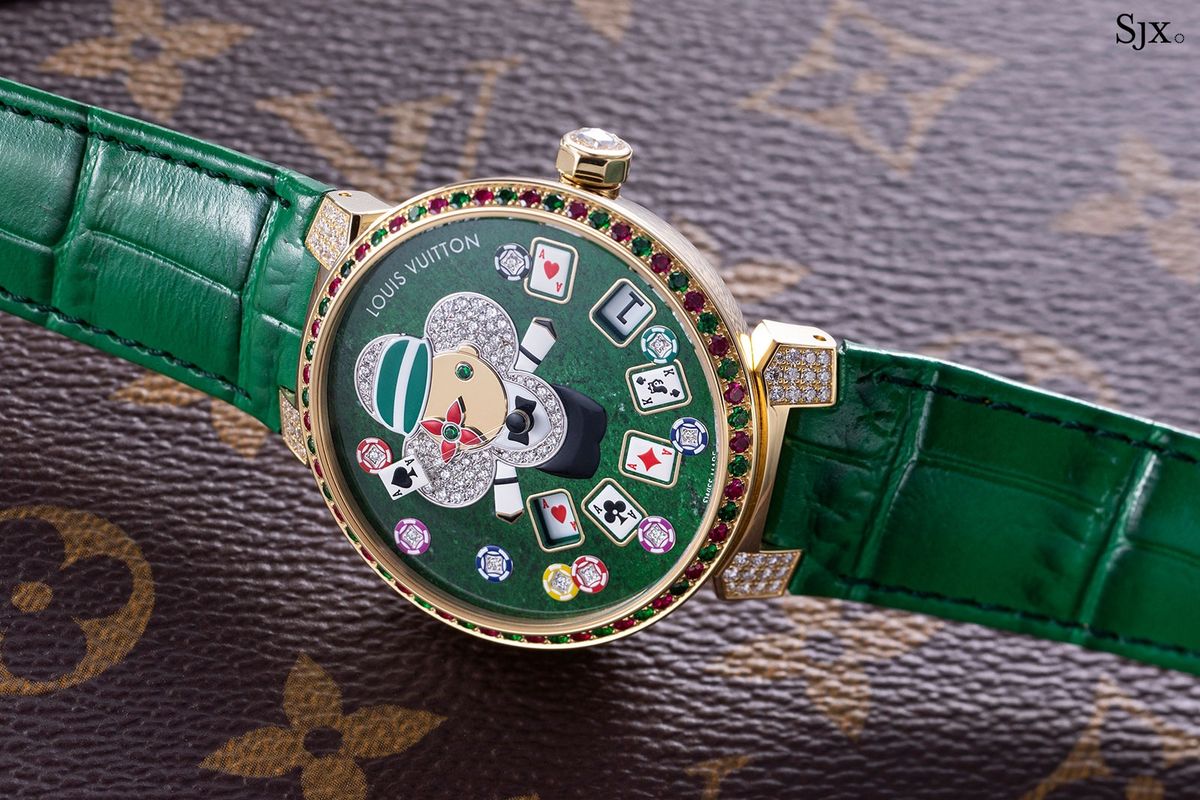
In March 2022 Louis Vuitton released the Tambour Slim Vivienne Jumping Hours Casino, caliber LV 180, at ninety eight thousand five hundred Swiss francs. Watch coverage records it as the first wristwatch with a green skarn dial, its texture read as the baize of a card table, with Vivienne as croupier. Technical coverage of the release carries the date, the caliber and the stone.
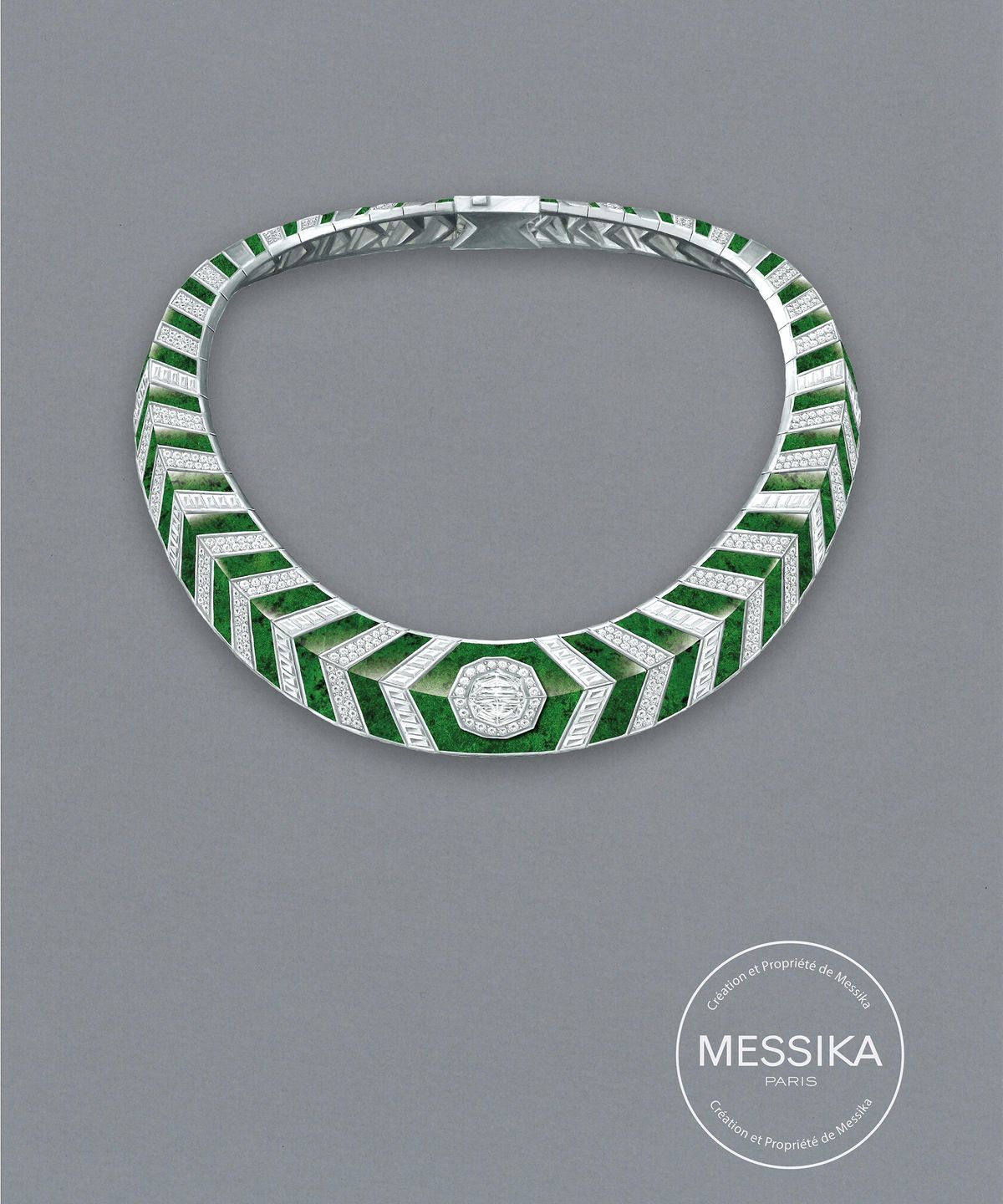
In 2025 Messika used the material in the Zebra Luhlaza choker from Terres d'Instinct, the twentieth anniversary collection drawn from Namibia, twenty three sets. The piece won the Design prize at the Grand Prix de Haute Joaillerie in Monaco. The house's own collection copy reads: onyx and diamonds trace the zebra's stripes, while Sannan Skarn shades the foliage of its concealment. Valerie Messika, asked directly, said the house used Sannan Skarn, a green ornamental stone discovered a decade ago in Pakistan, for that necklace.
In 2026 Van Cleef and Arpels introduced five new High Jewelry Ludo bracelets, the design dating to 1934. One of them, reference VCARPSA300, carries the material for the first time in the collection. It is listed publicly, with a price, under the name the 2016 paper asked for.
The Name That Was Borrowed
A material entering a market has to be called something before anyone can decide what it is worth, and the fastest available name is always one that already means something. In 2015 that name was Maw Sit Sit.
The borrowing was not subtle and it was not arbitrary. Both materials are green because of chromium. Both are rocks rather than minerals, which is to say aggregates of several minerals rather than a single species. Both are cut as cabochons and carvings rather than faceted. A dealer holding an unfamiliar green rock and reaching for the nearest established name was reaching for a real resemblance.
What the borrowing did was transfer value that belonged to a different deposit, a different country and a different geology. The institution's term for this is the Zero-Sum Aura, and the Hong Kong fair is the cleanest instance of it we have published. The aura available to Maw Sit Sit is finite and attached to Kachin State. Selling Balochistan under that name does not create aura. It moves some.
What the Paper Actually Found
The 2016 description is six pages and its central finding is not the name. It is that the material resists being one thing.
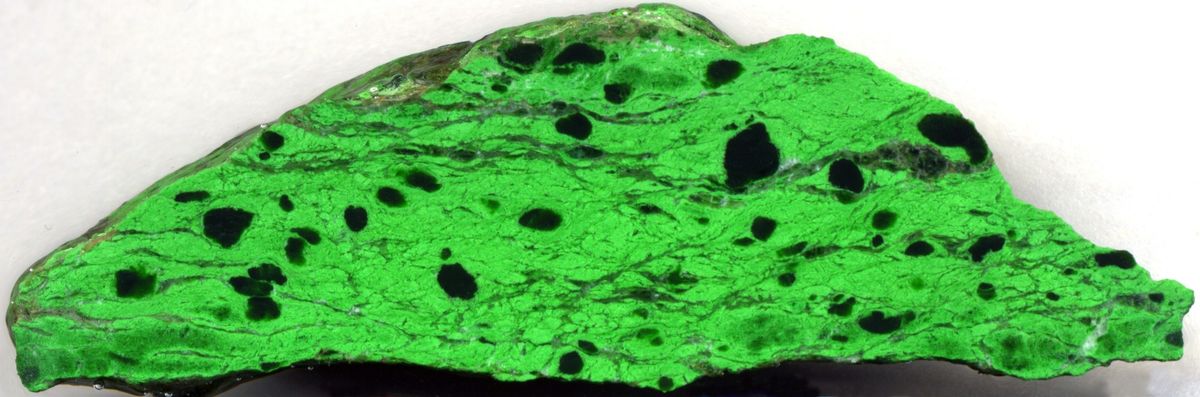
Three samples were examined by polarization microscopy, micro-Raman spectroscopy and qualitative energy dispersive X-ray fluorescence. The first, specific gravity 3.26, is a calcite, chlorite, hydrogrossular and diopside skarn. The second, 2.98, is a chlorite, pectolite and aegirine skarn. The third, 2.67, is an aegirine, natrolite and winchite skarn with sodalitic parts.
**Those are three different rocks.** The specific gravity spans from 2.67 to 3.26, which is a wider range than separates many materials the trade treats as entirely distinct. The paper states that the mineral components vary strongly over short distances, and notes that several of the minerals identified, hydrogrossular, diopside, sodalite, are not well known to gemmologists.
Chromium is present throughout and calcium is a main constituent, and that is most of what the three share. A skarn, by definition, is a rock formed by metasomatic replacement of a parent rock. The category is a process, not a composition. **There was no species available to name, because there is no species.**
The Name That Describes a Place
Faced with a material that could not be defined by what it is made of, the paper named it by where it came from. Sannan is a modifier specifying the skarn from this particular occurrence, about sixty kilometres from the Muslim Bagh chromite mine in Balochistan. The name says: this rock, from here, formed this way.
That is a provenance record. It is not a description of the object, it is a statement about the object's history and origin, offered precisely because a description was unavailable. **The gemmologist's solution to an unidentifiable material was to declare its origin and stop**, and he wrote the obligation into the paper as an instruction to the trade rather than a suggestion.
This institution publishes a specification arguing that a declared absence is worth more than a confident blank, and that a record should carry what it cannot establish rather than leave the field empty. Hanni was not making that argument. He had never encountered it. He arrived at the same place because the rock gave him no other honest option.
Three Greens on One Bracelet
The Ludo bracelet makes the whole problem visible in one object, which is why it is at the top of this page.
The emeralds are set in star motifs across the gold hexagons. Emerald is a variety of beryl, a mineral species with a defined chemical formula, a crystal system, a global grading apparatus and several thousand years of continuous nomenclature. The name is a claim about composition that can be tested and, if false, falsified.
The curved bar at the buckle is chrysoprase, a green chalcedony coloured by nickel. Chalcedony is a cryptocrystalline quartz, so chrysoprase names a variety of a species rather than a species. It is one step less specific than emerald and it is still a claim about what the material is made of.
The pairing of chrysoprase with emerald was already in the house vocabulary. A Ludo Secret watch at three hundred and twelve thousand dollars lists chrysoprase, diamond, emerald, mother of pearl and sapphire, with no skarn in it. **The new material was not introduced into an empty palette. It was added to an existing green**, which is the circumstance in which a reader is least likely to notice that a different kind of name has entered the list.
The two cabochons flanking the buckle are the Sannan Skarn, and they do not look like the chrysoprase beside them. They are mottled, opaque, variegated across their own surfaces. **The property the 2016 paper measured in a laboratory, that the components vary strongly over short distances, is legible to the naked eye on a ninety thousand dollar bracelet.** The rock is visibly not one thing, in a setting that names it as though it were.
The point is not confined to photographs of finished pieces. The gouache for the Zebra Luhlaza necklace, the painted rendering by which high jewellery is designed and sold before it exists, shows the green panels mottled, dark veined and clouded. A painter rendering an emerald paints it even, because evenness is what an emerald is supposed to be. Rendering this material, the painter reproduced the variation instead. **The property the 2016 paper could not resolve into a composition is the property the trade has settled on as the material's identity.**
The Stones You May Discover, and the Stones You May Not
On the Maison's product page for that bracelet there is a link, and the link is the sharpest single fact in this study. It reads: Discover the stones: Emerald, Diamond.
Four materials are named in the title of the page and in the line under the product name. Two of them can be discovered. Chrysoprase and Sannan Skarn, which are the largest coloured elements on the object and the reason the bracelet looks the way it does, are not in that list.
**The interface sorts its own materials into two classes.** There are stones with an encyclopaedia entry, a lore, a grading language and a page of their own, and there are stones that appear in a materials line and nowhere else. The distinction is not between precious and ornamental, because the house sells chalcedony, lapis lazuli, turquoise, coral and onyx across the same collection. The distinction is between materials the house has something to say about and materials it can only list.
That is a disclosure hierarchy, published, on a commercial page, without comment. It is not concealment. Every material is named, in the page title, in the product line and in the image description. **The hierarchy is in what gets elaborated, and the rock that cannot be defined is the one that gets no elaboration.**
And there is a fifth name, which is the one the watch press uses. Coverage of the Casino model calls the dial green skarn, then corrects itself in the same paragraph: more accurately known as sannan-skarn, a metamorphic rock first discovered in Pakistan in 2015, easily mistaken for jadeite or maw sit sit. **The writer knows the correct name, prints the loose one first, and the loose one is the name with the locality removed.** Green skarn describes a colour and a rock type and nothing else. It is the equivalent of calling an emerald a green beryl, except that here the discarded word is the only part of the name that was ever doing any work. The same passage calls a rock a mineral, which is the category the 2016 paper spent six pages declining to claim.
What We Already Published, and Why This Is Not That
This institution has written about hollowing in luxury goods, about aura as a finite quantity transferred between objects, and about the gap between what a record states and what a buyer can verify. It has not written about gem materials. Across the published corpus, jade, jadeite, skarn, Maw Sit Sit, nephrite, chromium and lapidary return nothing.
The nearest neighbours are a study of mineral weight in sculpture and a study of stone furniture, and both are about objects a maker made. This is about a name a market assigned, which is a different kind of artefact and sits in a territory the corpus had not entered.
The Hollowed Object in this institution's vocabulary is a thing stripped of its original content while retaining the exterior signs of value. The operation is usually performed on objects. **Here it is available to perform on a name**, and the market has already started: the material is now also sold commercially as Sannite, an -ite coinage borrowing the suffix convention of approved mineral species, for a rock the describing paper showed is three assemblages. The suffix is the exterior sign. The species is the absent content.
What Would Have to Be True for This Reading to Be Wrong
If the houses were using the name loosely, as a marketing label detached from the 2016 paper, the argument about a scientific recommendation reaching the top of the market would fail. They are not. Van Cleef and Arpels prints Sannan Skarn, Messika prints Sannan Skarn, and Valerie Messika names the Pakistani origin and the decade unprompted.
If the material had a species definition that the 2016 paper missed, the claim that the name stands where a composition cannot be stated would fail. No later description establishing one has been located, and no record of the name in the official mineral nomenclature has been found.
If the three samples were unrepresentative, the heterogeneity argument would weaken. The paper itself states the variation occurs over short distances rather than between samples, which is the stronger version of the finding, and the cabochons on the Ludo bracelet show it.
One account of the award winning Messika pieces describes their green as anodized titanium rather than Sannan Skarn. The house says Sannan Skarn and its founder says so on the record, so the likeliest explanation is that a twenty three set collection contains both materials and a summary collapsed them. **It is recorded here unreconciled**, because two accounts of one green in coverage of a prize winning piece is the disclosure question this study is about, and resolving it from two sources would be the error the institution keeps writing down.
Several things this study does not claim. It does not claim any house has misdescribed anything. Every house named here uses the name the describing gemmologist asked the trade to use, which is the opposite of misdescription. It does not claim the material is of poor quality, which would be a judgment this institution is not equipped to make and has no interest in making. It does not claim Sannite is deceptive, only that its suffix implies a category the material does not occupy. And it does not claim the 2015 Hong Kong sale was fraudulent rather than mistaken, because nothing located establishes intent.
What the Record Would Have to Carry
A buyer of the Ludo bracelet receives a materials line of five words and a price. The line is accurate. It is also the entire public account of a rock whose own describing paper could not state a composition, and it gives a reader no way to know that the fourth name in the list is a different kind of name from the third.
A record adequate to this object would not need to be longer. It would need to state, for each material, what kind of claim its name makes: a species, a variety, or an origin. Three words, one per stone. **Emerald, species. Chrysoprase, variety. Sannan Skarn, origin.** A reader could then see at a glance that the last of these is a provenance statement and know to ask what it is standing in for.
That is not a demand for more disclosure. It is a demand that the existing disclosure declare its own type, which is what Object Permanence requires of any record meant to survive the moment it was written. **The difficulty is not that the houses say too little. It is that a flat list makes four unlike things look alike, and flatness reads as equivalence.**
Coda
In 2015 a rock was sold under a name that belonged to a different country. In 2016 a gemmologist examined three pieces of it, found three different rocks, declined to invent a species, and named the place instead. He wrote that it shall be sold under its correct name.
Nine years later that name is set in gold between an emerald and a chrysoprase, on a bracelet designed in 1934, at ninety thousand five hundred dollars, on a page that offers to tell you about the emerald.
**The trade took the honest name.** It did so because the honest name was the only one available, which is the condition under which this kind of thing usually happens. A material that cannot be defined forces whoever handles it to say where it came from, and saying where something came from, when you cannot say what it is, turns out to be a workable substitute for knowing. That is not a lesson about a rock from Balochistan. It is the argument this institution has been making about objects in general, arriving from a direction nobody here was watching, in the materials line of a product page.