The Rot Is the Work: Kathleen Ryan, Mineral Weight, and the Sculpture That Cannot Be Flattened
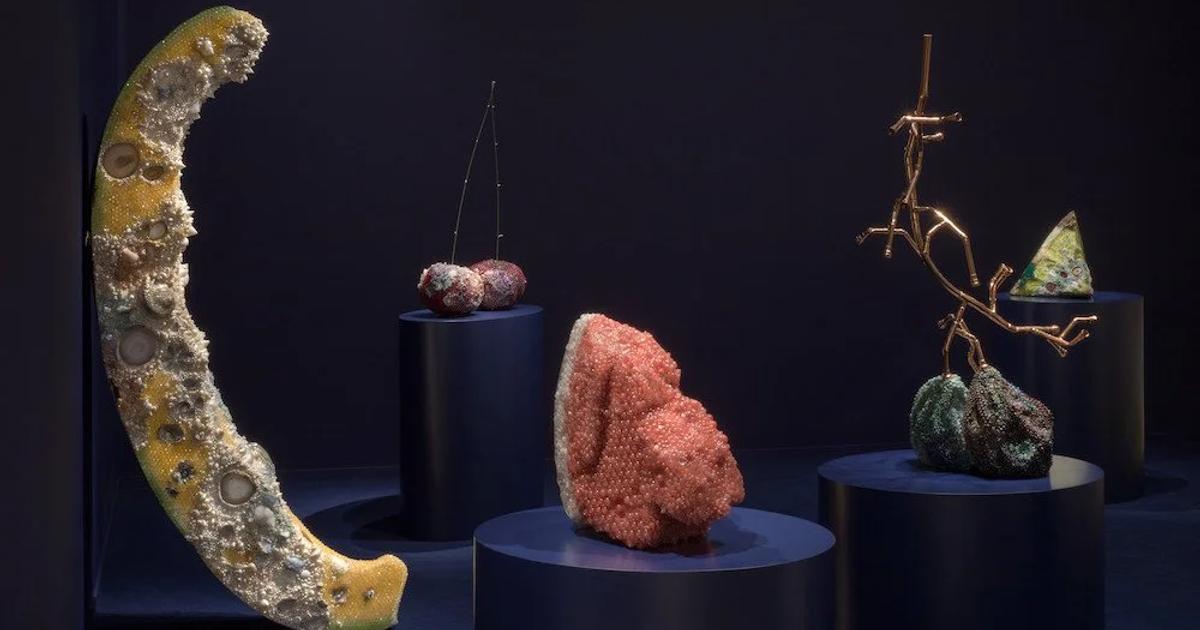
How a Bad Fruit Sold Out at TEFAF and Why the Art Market Now Answers to Gravity
Kathleen Ryan's Bad Fruit series is not about decay. It is about the physics of refusal. The sculptor, born in Santa Monica in 1984, trained at Pitzer College and UCLA under Charles Ray and Catherine Opie, pins thousands of raw minerals onto iron and polystyrene cores to produce objects that are ungovernable by any computational logic. At TEFAF New York 2026, Gagosian dedicated its entire booth to new works from the Bad Fruit series, which sold out during the Collectors Preview before the fair opened to the public. This study uses the PLCFA framework to examine what that event confirms. Ryan's practice operationalizes Material Singularity, Labor Density, and the Sedimentary Object: not as aesthetic choices, but as structural resistance. The argument is not that her work is beautiful. The argument is that her work is impossible to simulate, and that impossibility is now the most expensive thing in the market.
The Archive Before the Series: Santa Monica, Pitzer, UCLA
Ryan was born in Santa Monica, California in 1984. She grew up in a state that is both the world's largest agricultural producer and one of its most image-saturated cultural environments. California supplies a third of America's vegetables and nearly two-thirds of its fruit. That abundance (casual, roadside, taken-for-granted) forms the material and symbolic substrate of every sculpture Ryan has since made.
She studied art and archaeology at Pitzer College, a small liberal arts institution in Claremont, completing her BA in 2006. The double discipline is not incidental. Archaeology is the study of what objects outlast the humans who made them. It is the discipline that takes seriously the idea that a shard of ceramic, a bead of obsidian, a fragment of corroded bronze can carry more meaning than the texts written around it. Ryan absorbed this before she ever made a sculpture.
After Pitzer, Ryan spent eight years developing before returning for formal graduate training, completing her MFA at UCLA in 2014. There, she studied under two figures whose influence on her practice was structural, not stylistic. Charles Ray, one of the defining sculptors of the American late twentieth century, built his practice around an obsession with scale distortion, material surprise, and the refusal to let the viewer settle into comfort. Catherine Opie brought the documentary rigour of someone who understood that the most politically loaded acts are often embedded in the most intimate and domestic of forms. Between them, Ryan inherited a sensibility that combined formal ambition with ideological precision.
Archaeology takes seriously the idea that a shard of obsidian can carry more meaning than the texts written around it. Ryan absorbed this before she ever made a sculpture.
By the time she graduated, Ryan had also accumulated a series of scholarships and awards that marked her as a practitioner of serious institutional consequence: the Dean's Award, the Laura Andreson Scholarship (three times), the UCLA Art Council Award, and a University Fellowship. She was not accidentally admitted to the Kunsthistorisches Museum three years after her MFA. She had been preparing the ground.
Before the Fruit: Bacchante and the Concrete Grammar (2015 to 2017)
Ryan's early work is often collapsed into the Bad Fruit series in popular coverage. This is a structural error. The Bad Fruit series is the culmination of a decade-long grammar lesson in material paradox, not the starting point.
Before fruit, Ryan worked extensively with concrete and balloons. The pairing is not whimsical. Balloons are the universal symbol of levity: weightless, temporary, purely air. Concrete is the opposite: dense, structural, permanent. Ryan cast balloons in concrete and chained them together in grape-like clusters. The resulting objects have the shape of something weightless and the mass of something immovable. They seduce the eye with a form the body knows is buoyant, then deny the body what the eye has promised.
This became Bacchante (2015 to 2017), which opened in April 2017 at the Theseus Temple within the Kunsthistorisches Museum in Vienna, a museum whose permanent collection includes some of the most important Dutch vanitas still lifes. Ryan was not placed there by accident. Curator Jasper Sharp positioned her concrete grape clusters inside a temple dedicated to the Greco-Roman deity of wine and excess. The work drew explicitly on Hendrick ter Brugghen's 1627 painting Bacchante with Ape, while entirely refusing its painted surface. Where ter Brugghen depicted sensuality in oil, Ryan rendered it in industrial construction material. The visual vocabulary ran from the Venus of Willendorf through Caravaggio and arrived at a weight that no brush could produce.
The Bacchante sculptures seduce the eye with a form the body knows is buoyant, then deny the body what the eye has promised. This is not a stylistic trick. It is a structural argument.
Concurrent with Bacchante, Ryan was producing the Satellite in Repose series (2018): ceramic birds perched on the remains of salvaged satellite dishes, their stalactite-like tails lending the structures a fossilized quality. Here the material palette expanded to include the industrial remnant: technology obsolesced by faster technology, reanimated by the hand. And she produced Trivalve (2018): an abalone shell split to reveal a bowling ball as its pearl. In a single object, Ryan compressed geology, industry, and biological form into a proposition that required none of them to explain itself.
These early works establish the permanent grammar. Ryan does not apply precious materials to subjects as decoration. She uses material contradiction as the argument itself. The subject is always the occasion. The formal collision is always the content.
The Origin of Bad Fruit: Watching Things Rot (2018)
Ryan began the Bad Fruit series in 2018. The origin story is precise and important. Ryan watches fruit decay over weeks inside her studio. She does not research rot through photographs or textbooks. She observes the process as it unfolds: the progression of mold colonies, the softening of skin, the collapse of structure, the chromatic shift from vivid to bruised to black. A swarm of fruit flies is a standard feature of her working environment.
Once the process is complete, she begins replicating it. The substrate is polystyrene, carved into the form of the fruit. The surface is then painted to mark where fresh skin meets rotten flesh. Glass and acrylic beads are pinned onto the fresh areas. Semi-precious stones, malachite, opal, jasper, lapis lazuli, black tourmaline, serpentine, amazonite, agate, are pinned onto the rotten areas, one by one, with individual steel pins. The process for a single work takes weeks. The materialization of a single mold colony may involve hundreds of individual mineral placements.
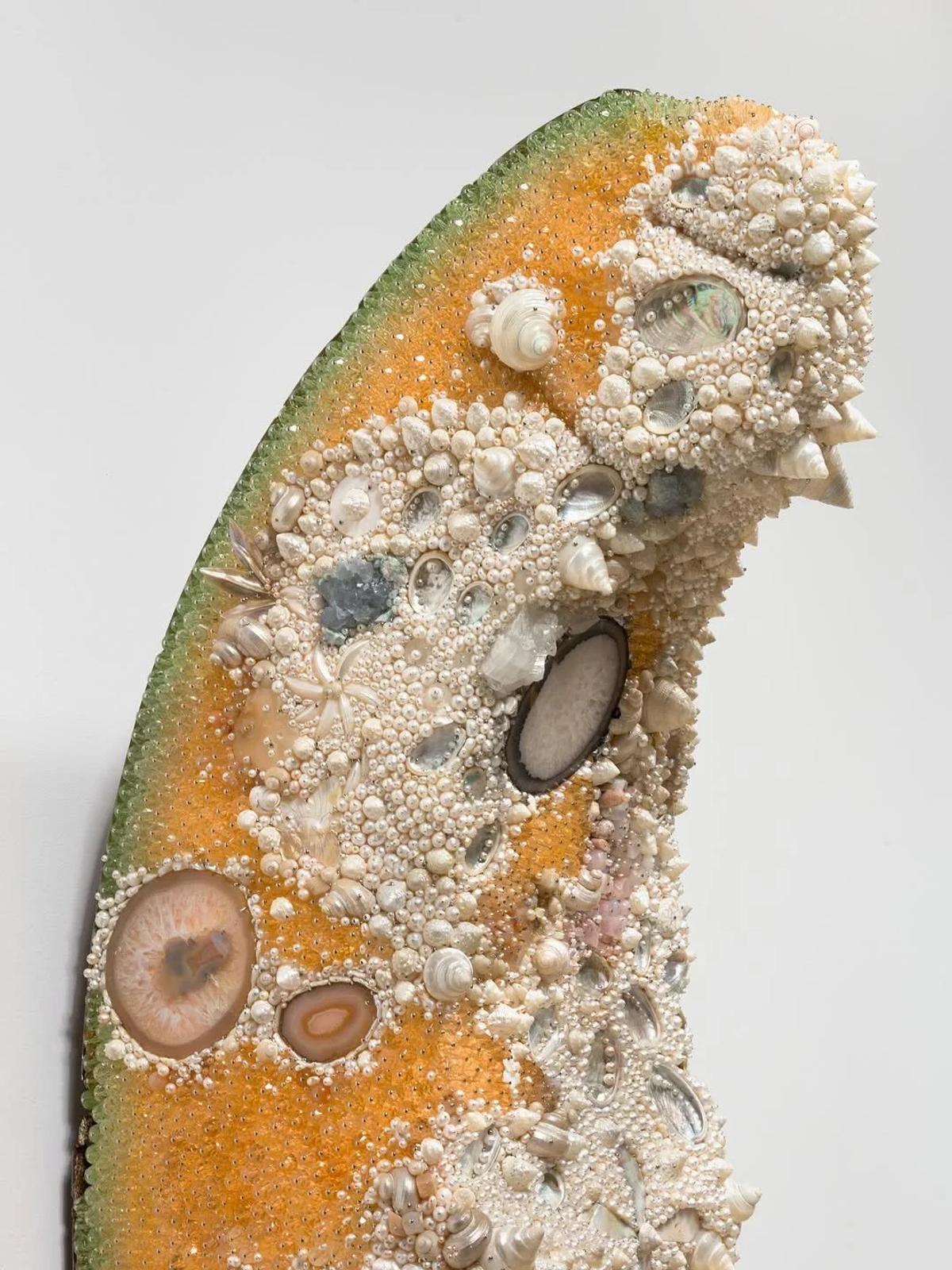
The structural logic of this reversal is the conceptual engine of the entire series: Sedimentary Object logic inverted. In Ryan's work, death is made from natural materials, life from artificial ones. The beads (manufactured, synthetic) stand in for the living rind. The semi-precious stones (geological, ancient, formed over millions of years in the earth) stand in for the bacterial colony. The most alive parts of the fruit in her sculptures are the most industrial. The dead and decaying parts are the most primordially real.
In Ryan’s work, life is made from artificial materials and death from natural ones. The beads stand in for the living rind. The minerals stand in for the mold. The most alive parts are the most industrial. The dead parts are the most real.
This is not a clever inversion. It is a precise diagnosis of the contemporary relationship between the natural and the manufactured: a world in which the synthetic is the environment and the organic is the emergency. Ryan builds that diagnosis into the surface of every object she makes.
The Vanitas Inheritance: Dutch Still Life, American Craft, and the Suburban Pushpin
The cultural archive that Ryan draws from is dual and deliberately asymmetrical. On one side: the European vanitas tradition of the seventeenth century, specifically the Dutch still-life paintings of Jan Davidsz de Heem and Willem Claesz Heda, in which partially consumed fruit, overturned glasses, and insects on bread mapped the precarity of earthly wealth. These paintings were not beautiful celebrations of abundance. They were encoded memento mori: visual arguments that desire and decay occupy the same table.
On the other side: the distinctly American postwar decorative craft tradition of pin-beaded fruit. In suburban American homes from the 1950s through the 1980s, plastic or wax fruit decorated with thousands of colored pushpins was a common domestic ornament. The fruit sat in bowls on kitchen tables, on sideboards in living rooms. It was considered homely, quaint, slightly kitsch: the kind of craft object that ended up in thrift stores and estate sales. Ryan grew up in California, surrounded by actual fruit. The beaded version of that fruit, its suburban simulacrum, was part of the visual archive of her childhood.
The Bad Fruit series is the formal site where these two traditions are forced to occupy the same object. The scale of a Dutch vanitas painting translates into three-dimensional mass at a ratio that makes the original almost absurd. The pushpin craft tradition is elevated, literally elevated, by the substitution of semi-precious stones for glass beads, until it becomes something museums purchase. The lowbrow becomes monumental. The monumental is encrusted with the suburban.
Ryan does not borrow from the vanitas tradition. She physicalizes it. She gives it mass. She makes it impossible to hang on a wall and demands it occupy the same room as the viewer who is already in decay.
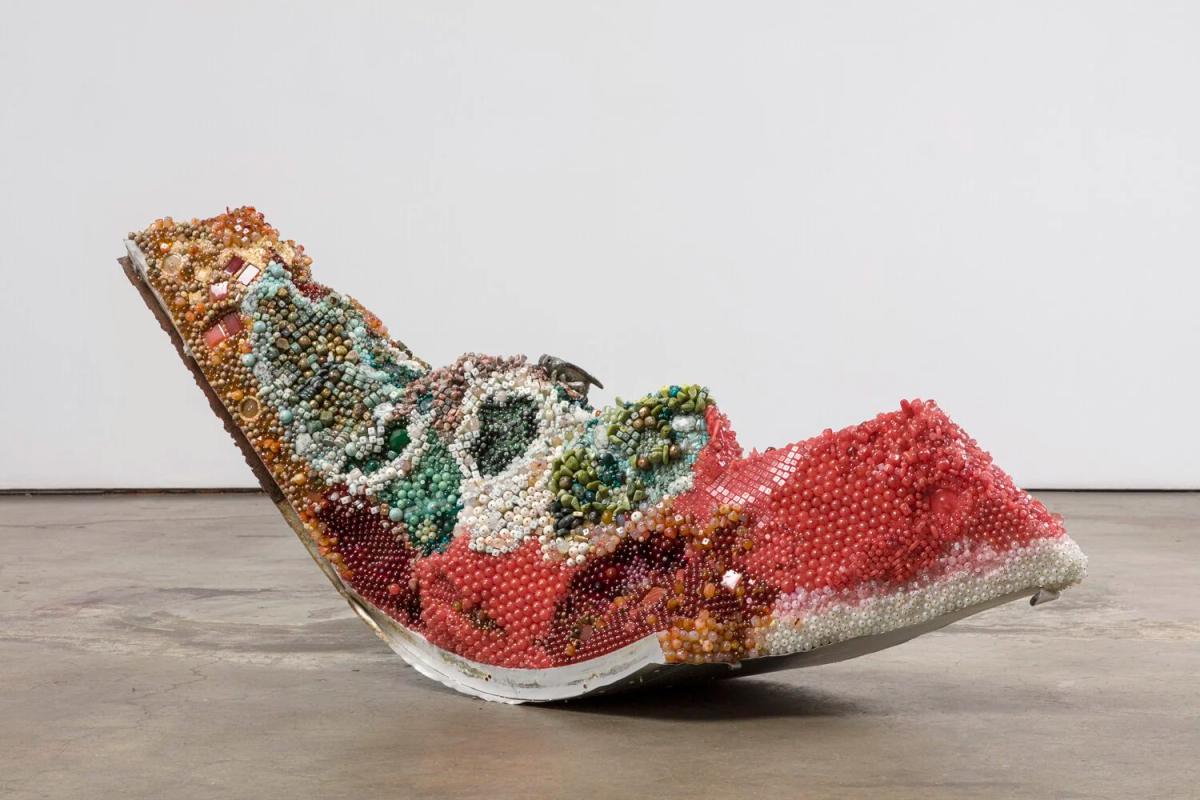
Ryan also adds the salvaged industrial rind. Bad Melon (2020) uses the hull of a 1973 Airstream Safari camper as its watermelon rind: a leisure vehicle whose aluminum skin encoded postwar American optimism about mobility and abundance. Screwdriver (2023) uses the trunk of a 1968 AMC Javelin. At TEFAF 2026, Bad Melon (Fantasy) incorporated a Volkswagen hood. The vehicle skins are not incidental. They are the structural layer that connects the vanitas rot to the American industrial project: the car as both the symbol of postwar prosperity and the first thing Americans discard when prosperity ends.
Material Singularity and Labor Density: Why the Surface Cannot Be Approximated
The theoretical mechanism that makes Ryan's work ungovernable by digital simulation is Material Singularity. The PLCFA framework defines Material Singularity as the condition in which an object's meaning cannot be separated from the specific physical substance from which it is made. The meaning is not carried by the form: it is carried by the matter.
Ryan's fruit sculptures are singularities in this technical sense. Consider what an image of Bad Cherries (Princess) (2026) captures. It captures color, approximate form, and surface glint. It does not capture the weight of thousands of individual minerals against a steel-pinned polystyrene core. It does not capture the variation in surface topology that comes from each stone's unique geological history. It does not capture the fact that the malachite banding, formed by the slow deposition of copper carbonate hydroxide over geological time, is itself a record of a process that has nothing to do with the artist and everything to do with the earth.
This is the formal mechanism of Labor Density. Ryan's work bears visible, quantifiable, irreducible human labor on every square inch of its surface. A single Bad Fruit sculpture may involve tens of thousands of individual pin placements. Each placement is a decision: which stone, in which orientation, at which angle, adjacent to which neighboring stone. None of these decisions can be interpolated or batch-processed. They are serial, embodied, time-intensive choices that accumulate into a surface no algorithm can reverse-engineer.
The malachite banding in a Ryan sculpture is itself a record of process, formed by the slow deposition of copper carbonate hydroxide over geological time, that has nothing to do with the artist and everything to do with the earth. This is Material Singularity in its most literal sense.
The Smooth Society, Byung-Chul Han's diagnosis of a culture that has eliminated all resistance to the frictionless circulation of images, produces objects that reproduce well. Ryan's work does the opposite. Its surface is Tactical Frictionin material form. The jagged mineral edges, the variable depths of different stones, the interplay between malachite's flat green banding and opal's refractive fire, these surface conditions destroy the compression algorithms that social media and auction catalog photography depend on. A Ryan sculpture resists being flattened. It resists being transmitted. The full encounter with it is unavailable secondhand.
This resistance is, in the post-digital market, the most scarce and therefore the most expensive property an object can possess. And it is not manufactured scarcity. It is not edition-limited or waitlisted. It is physical scarcity: the irreducible impossibility of producing this surface at speed, at scale, or without the specific human labor that made it.
The Institutional Arc: From Vienna to TEFAF (2017 to 2026)
Ryan's institutional trajectory moves in one direction. Three years after her MFA, she was exhibiting in the Theseus Temple of the Kunsthistorisches Museum. The curvature of that arc, from student to permanent museum collection, tells the story of the market's recognition of the work's value.
The solo exhibition chronology: Kunsthistorisches Museum Vienna (2017); MIT List Visual Arts Center, Cambridge, MA (2019); New Art Gallery, Walsall, UK (2019); Aldrich Contemporary Art Museum, Ridgefield, CT (2023); ICA San Francisco (2024); Hamburger Kunsthalle, Hamburg (2024); followed immediately by Kistefos Museum, Norway (2025), where a major survey spanning the first decade of her practice was mounted across two of the museum's venues, including its historic industrial Wood Pulp Mill.
In November 2024, Gagosian announced her global representation. The gallery's press release framed the move not as the acquisition of an emerging talent but as the assumption of stewardship over an already fully formed institutional practice. Her debut exhibition with Gagosian in London, Roman Meal, 2025, preceded the TEFAF presentation by less than a year.
The public collections now holding Ryan's work span four continents: LACMA, the Hammer Museum, the Walker Art Center, the Dallas Museum of Art, Crystal Bridges, the Museum of Fine Arts Boston, the Museum of Fine Arts Houston, the Nasher Sculpture Center, the Norton Museum, the Art Gallery of New South Wales, LAM Museum in the Netherlands, and Kistefos. This is not the collection profile of an emerging artist. It is the profile of a practitioner whose institutional consensus has already formed.
Ryan’s public collections span four continents and include LACMA, the Walker Art Center, Crystal Bridges, and the Hamburger Kunsthalle. The institutional consensus on her practice formed before most of the press had caught up with it.
In 2020, she received the Rosa Schapire Art Prize from the Hamburger Kunsthalle, one of Germany's most significant contemporary art awards, four years before the museum mounted a full retrospective of her work. The prize preceded the retrospective, which is the inverse of the usual pattern. The institution recognized the weight of the work before it had assembled the full evidence.
TEFAF New York 2026: The Sold-Out Booth and Its Structural Significance
At TEFAF New York 2026, held at the Park Avenue Armory from May 14 through May 19, Gagosian dedicated the entirety of Stand 350 to new works from the Bad Fruit series. The booth was positioned near the entrance to the Wade Thompson Drill Hall, the fair's primary circulation spine. Visitors encountered Ryan's work before any other major presentation.
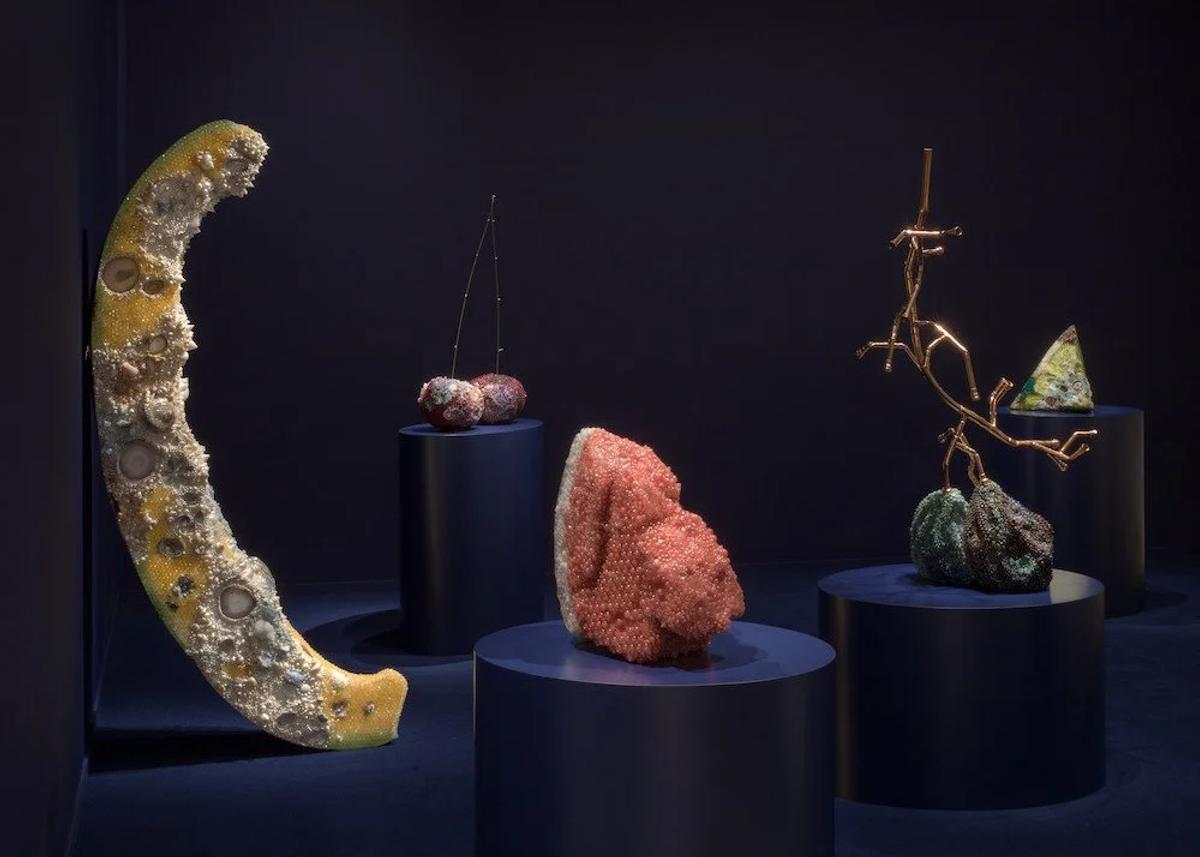
The TEFAF 2026 works included Bad Cherries (Princess) (2026): monumental cherries suspended from a conjoined wire stem, each surface scattered with rot rendered in pearls, opals, agates, and crystals fixed by single steel pins; Bad Lime (Treasure) (2026): a tall form leaning against the wall, its decaying flesh crusted with shells, geodes, and milky cabochons composing a surface that resembles coral reef more than citrus; and Bad Grapes (Siphon) (2026): dehydrated to the point of becoming raisins, coated in burgundy gems, embodying what Gagosian described as the process of bletting, allowing fruit to overripen past the point of rot to unlock sweetness. Bad Melon (Fantasy) (2026) incorporated a Volkswagen hood as its rind, freshwater pearls, trochus shells, and celestite forming the flesh.
The entire booth sold out during the Collectors Preview, before the fair opened to general visitors. The same event saw Cai Guo-Qiang's White Cube booth sell out on the first day, and Thaddaeus Ropac place three works by Eva Helene Pade with US institutions. But Ryan's was the only solo presentation to sell out in full during preview day. The TEFAF closing press release documented the sell-through as part of a broader pattern of renewed fair confidence, but the Ryan sell-out was reported across Artlyst, MutualArt, MoMA Metallic, and Artsy as one of the defining market moments of the week.
The Ryan sell-out during TEFAF’s Collectors Preview is not a market anomaly. It is market confirmation of a thesis: that objects which resist compression, which cannot be adequately transmitted by image, carry a premium that no digital substitute can erode.
What TEFAF confirmed is not that Ryan's work is popular. Popularity is a surface phenomenon. What it confirmed is that the collector class, which has full access to every digital image of her work, still requires the physical object. The market premium on Ryan's work exists specifically because no reproduction captures what the object is. This is Anti-Commodity Commitment operating through physics rather than through institutional declaration. The work refuses to be commodified not because the artist forbids it but because the surface is too specific, too labored, too geologically particular to be substituted.
The Generator Series and the Expanding Grammar (2022 onward)
The Bad Fruit series is Ryan's most recognized body of work, but it is not her only one. The Generator series (2022 onward) extends her material grammar into the automotive: hinged sections of automobile bodies opened like oysters, their interiors veiled in crystal spiderwebs. The car body becomes a bivalve. The engine, with its own intrinsic violence, heat, and grease, becomes a peach pit, a beating heart. Industrial obsolescence is transformed into geological form without erasing what it was.
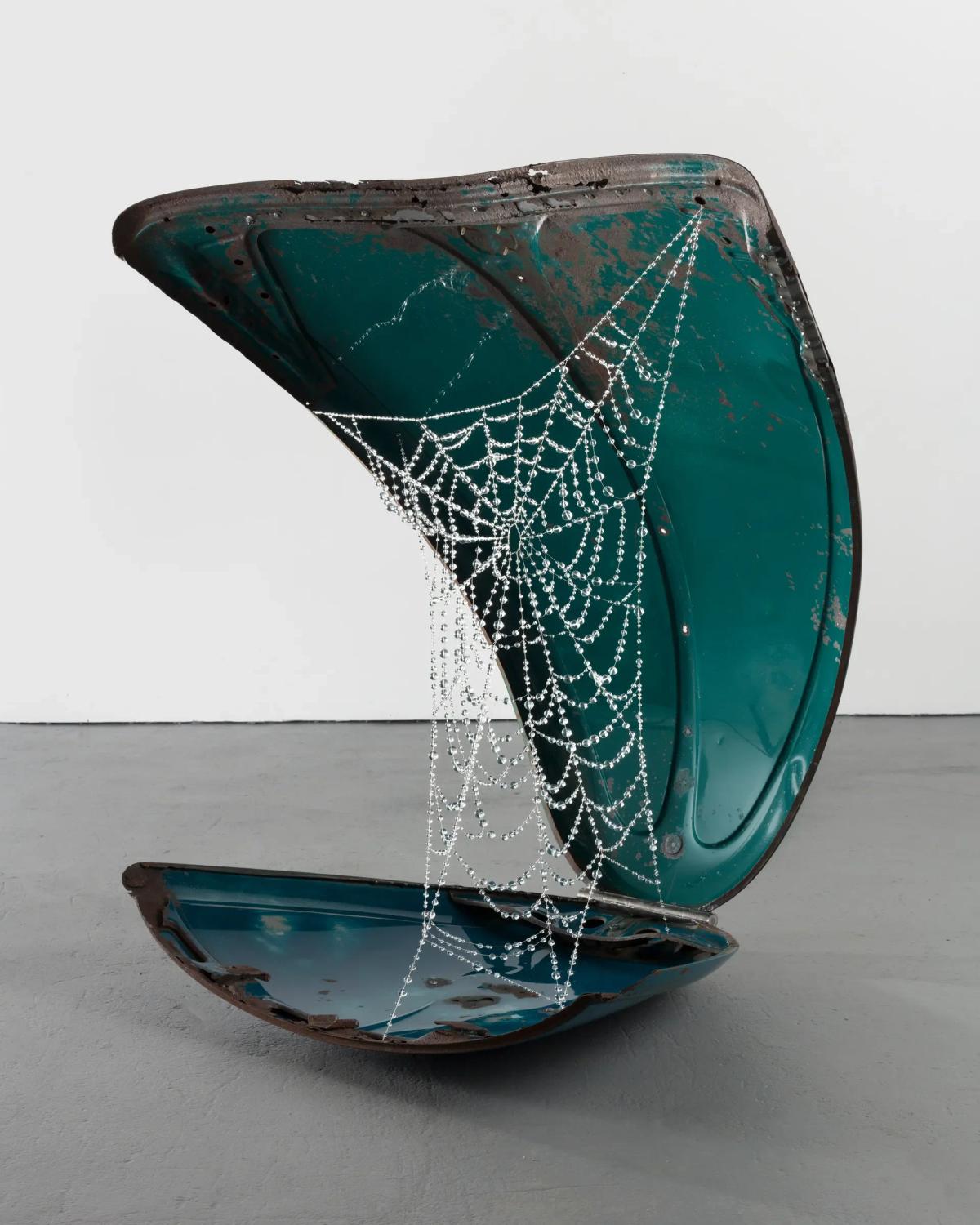
The series connects directly to Ryan's Americana inheritance: the American car as the central totem of postwar prosperity, domestic life, masculine aspiration, and environmental catastrophe. Ryan does not make this argument didactically. She makes it materially. The car body already has meaning baked into its skin. She does not replace that meaning. She superimposes new geology on top of it and lets the two meanings coexist at the same surface tension.
Earlier, the Satellite in Repose series (2018) had applied a similar logic to communication technology: ceramic birds perched on the decaying infrastructure of a satellite dish, their fossilized stillness making the dish's technological ambition look antique. Screwdriver (2023), a work centered in the ICA San Francisco's Spotlight: Kathleen Ryan exhibition, used the trunk of a 1968 AMC Javelin to form the rind of an orange slice at cocktail scale, a patio umbrella completing the garnish. The humor is part of the argument. American consumption is partly comedy. Ryan builds the comedy into the object so it cannot be separated from the critique.
Ryan builds the comedy of American consumption into the object so it cannot be separated from the critique. The work does not stand apart from what it addresses. It is made of it.
Atmospheric Equity and the Market's Lesson in Gravity
The concept of Atmospheric Equity in the PLCFA framework identifies the condition in which an object generates experiential authority that cannot be transferred to a reproduction. Ryan's work is the clearest living example of this principle operating at market scale.
Consider the comparison that TEFAF 2026 implicitly staged. The fair contained paintings, drawings, and photographs of enormous historical and monetary value, works that reproduce well, that travel by image, that can be appraised at auction through catalog photographs. These works also sold. But they sold through a different mechanism: the mechanism of canonical safety, of market precedent, of historical provenance.
Ryan's work sold through a different mechanism entirely: presence. Collectors who already had access to every image of her TEFAF work, because Gagosian published them in advance, still came to the Armory and still purchased. The image did not substitute for the object. This is the definition of Atmospheric Equity: the experiential surplus that remains after the image has transmitted all it can.
This surplus is, structurally, what the OAC study on TEFAF 2026 identified as the fair's central market thesis: that the highest symbolic authority in the current moment is accruing to objects that cannot be flattened without loss. Slashed surfaces, inhabitable structures, salvaged skins, pinned gemstones, engineered weight, forms that demand spatial obedience before they yield an image. Ryan's Bad Fruit is the most literal instantiation of this thesis.
The Smooth Society produces smooth objects: objects optimized for image transmission, for social sharing, for algorithmic amplification. Ryan produces objects that defeat all of these optimizations simultaneously. The rough mineral surface defeats compression. The mass defeats transportation. The weeks of labor defeat reproduction. And the geological material, malachite formed over millennia, opal formed as silica settled into rock fissures over millions of years, defies the temporal assumptions of a market that measures value in financial quarters.
Malachite formed over millions of years. Opal is formed by silica settling into rock fissures across geological time. Ryan introduces these timescales into sculptures that will sell in thirty minutes at a fair booth. The temporal violence of that juxtaposition is part of the work’s argument.
What the Bad Fruit Leaves Open
The PLCFA framework's concept of Sedimentary Object describes an object that accumulates meaning through the visible evidence of time: layered, stratified, legible in cross-section. Ryan's Bad Fruit are Sedimentary Objects in the fullest sense: layered with American craft history, Dutch art history, geological time, personal observation of biological process, and weeks of human labor. Every layer is present at the surface simultaneously. None of them cancel the others.
What the series confirms about the PLCFA framework is that Material Singularity and Labor Density are not alternative value propositions to market legibility. They are market legibility, when the market has matured enough to know what it is actually purchasing. The TEFAF sell-out is not evidence that the luxury market has rediscovered craft. It is evidence that a specific segment of the collector class has understood that the image economy has made the non-image-able object the scarcest asset class in existence.
What the series leaves structurally open is the question of custodianship. Ryan's work, because it is physically massive, materially complex, and composed of geological substances, raises the question of Stewardship in a way most contemporary sculpture does not. A Bad Fruit work held in a private collection is held in conditions that the collector must maintain. The minerals can shift. The steel pins can corrode. The polystyrene core can degrade. The work imposes obligations on its custodians that a canvas does not. Whether the collectors who purchased Ryan's TEFAF works have accounted for this, whether the Custodian's Contract has been thought through at the level of material care, not just institutional prestige, remains the unresolved question at the edge of her market success.
The rot is not the subject. The rot is the argument. And the argument is not finished.
Authored by Christopher Banks, Anthropologist of Luxury, Critical Theorist & Founder Objects of Affection Collection Office of Critical Theory & Curatorial Strategy 469 Fashion Avenue, 12th Floor, New York, NY 10018
RELATED OAC STUDIES
Further reading from the OAC archive on the themes operationalized in this study.
On the Hard-Asset Turn and Market Gravity
· TEFAF New York 2026: What the Hard-Asset Turn Actually Means
On Material Practice and Un-Smoothness
· The Fluidity of Form: How Iris van Herpen Is Rewriting the DNA of Haute Couture
· The Future of Luxury: Ganit Goldstein, The Generative Architect of Computational Textiles
On the PLCFA Framework and Foundational Theory
· The New Avant-Garde: Deconstructing Status and Utility in the Age of Post-Luxury
· The Architect of Infinity: Kazimir Malevich and the Supremacy of the Sublime
On Institutional Narrative and Credibility Architecture