Yung Lean: The Complete Record. Jonatan Leandoer Håstad from Ginseng Strip 2002 to the First Auction of His Art

A complete profile of Jonatan Leandoer Håstad, written the way this institution writes a provenance record: what is documented, what is contested, and where the record stops.
Why This Record Exists, and What Kind of Document It Is
There are a great many profiles of Yung Lean. Most of them are written as narrative. A boy in Stockholm uploads a song, the internet finds it, there is a collapse in Miami, there is a recovery, and a decade later he hangs paintings in a disused gasworks and sends twelve objects to the oldest auction house in the Nordic countries. Told that way the story is continuous and satisfying, and the continuity is supplied by the telling rather than by the evidence.
This study is built the other way round. Objects of Affection Collection is a research institution concerned with the relationship between people and things, and its working method is the provenance record: a document that states what is established, names what is disputed, and marks the places where nothing is known instead of smoothing them over. A gap in a provenance record is not a defect. It is information. The absence of a signature, a date that cannot be fixed, two sources that disagree about a birthplace, a work that enters a sale with no exhibition history behind it: these are the load-bearing parts of a record, and a profile that writes over them has destroyed the very evidence a reader needs.
So this is an artist profile in the form of a custody document. It covers the music from the first upload in 2013 through the fifth studio album in 2025 and a soundtrack placement in 2026. It covers the visual practice from a claimed childhood of carving and drawing through a four work presentation in 2016 to the exhibition at Torsgatan 22 and the first auction of his art. It covers the medical crisis of 2015 only as far as he has himself made it public, and no further. And it covers the sale itself in detail, lot by lot, because the sale is the first moment at which anything in this story has been independently priced.
Three things this institution does not do, stated at the top so that nothing below can be mistaken for them. OAC does not authenticate. OAC does not appraise, and OAC assigns no value to any object named here. And OAC takes no position on whether the paintings and ceramics are good. Quality is a judgment for critics, and three Swedish critics have already made theirs; they are reported below as evidence of what was said, not as a verdict this institution endorses or disputes.
What OAC does assert is narrower and, we think, more useful. A record can be examined for whether it supports the claims made on it. That examination is available to anyone, it requires no access to the artist, and it produces answers that survive a change in anyone's taste.
The Name Is the First Problem, and It Does Not Resolve
A provenance record begins with identification, and here identification is genuinely difficult, because this person has operated under at least five names and they are not interchangeable.
His legal name, as credited in the writing credits for the Grand Theft Auto VI soundtrack, is Jonatan Aron Leandoer Håstad. The stage name under which the music reached the world is Yung Lean. A separate recording alias, jonatan leandoer96, carries four releases that sound almost nothing like the Yung Lean catalogue. The exhibition and the auction both run under Jonatan Leandoer Håstad, the legal name, which is the art world's convention and also a commercial decision. And the works themselves, according to Bukowskis' own catalogue descriptions, are signed Jonatan Leandoer: the given name and the patronymic surname, without Håstad.
That last one is worth stopping on, because it is the only one of the five that is written on the objects.
Eleven of the twelve lots in the October 2026 sale carry a catalogued signature, and every one of those eleven reads Jonatan Leandoer. Not Yung Lean, which is the name that made the audience. Not Jonatan Leandoer Håstad, which is the name on the exhibition wall and the auction catalogue. A fourth version, shorter than the legal name and longer than the first name, used nowhere else.
An object's signature is the maker's own statement of authorship, and it is the part of the record the maker controls directly. Everything else here, the press release, the catalogue, the wall text, the headline, is written by somebody else. When the signature and the catalogue heading disagree, a record keeper notes the disagreement instead of choosing a winner, because the two are answering different questions. The catalogue is answering "whose work is this, for the purposes of a market". The signature is answering "who made this". They are usually the same person and they are not the same claim.
This institution has argued elsewhere that one author should carry both the object and its history. Here there are four spellings of one author, and the sale is the moment at which they have to be reconciled by somebody. Bukowskis reconciled them by heading every lot with the legal name and transcribing the signature as it found it. That is the correct procedure, and it leaves the discrepancy visible, which is what a good catalogue does.
Born 18 July 1996, and the Record Disagrees About Where
The date is not in dispute. He was born on 18 July 1996. The place is.
The English Wikipedia article gives Stockholm. Several widely syndicated music databases and fan references give Minsk, Belarus. A streaming platform biography splits the difference and says he was born in Stockholm and spent his early childhood in Belarus before the family returned when he was between three and five years old. Everything downstream of those pages inherits whichever version it started from, and because none of them cite a birth record, the disagreement propagates without ever being tested.
Note what is not in dispute: that he spent early childhood in Belarus. All the versions agree on the Belarus connection. What they disagree about is whether he arrived there or was born there, and that is precisely the sort of detail a biography smooths away and a provenance record does not.
This institution has not seen a birth record and will not assert one. The honest statement is this: born 18 July 1996; the published record is divided between Stockholm and Minsk; early childhood in Belarus is attested across every version. That is a declared gap, written as this institution writes declared gaps, and it is worth more than a confident sentence that happens to be a coin toss.
It matters more than it looks. A great deal of what has been written about Yung Lean treats him as a figure of the Swedish suburbs or of an internet with no geography at all. The actual childhood, as far as the record supports it, was diplomatic and mobile: Belarus, then Stockholm, then Hanoi. That is not the biography the music is usually read against.
The Household: A Poet, a Diplomat, and Södermalm
His father is Kristoffer Leandoer, a Swedish poet, novelist, critic and translator of French literature who has also worked in book publishing. His mother is Elsa Håstad, formerly a human rights worker whose postings included Russia, Vietnam and South America, and who served as Sweden's ambassador to Albania from 2019 to 2023.
A child of a poet and a diplomat is not the standard origin story for a rapper whose first hit was a slurred song about Arizona iced tea, and the gap between the two has been part of the public account of him from the beginning. It is also the simplest explanation for several things that otherwise look like affectation: the facility with imagery, the comfort with abstraction, the willingness to publish under an alias in a register entirely unlike his commercial one.
The family settled in Stockholm's Södermalm. He attended the United Nations International School in Hanoi for grades six to ten, which is a consequence of his mother's work and which puts several of his adolescent years in Vietnam, not Sweden. The published account of his later school years in Stockholm includes drugs and graffiti, and a probation order at fifteen following cannabis use.
Early listening, by his own account, included 50 Cent's Get Rich or Die Tryin', The Latin Kings' Mitt Kvarter, and Nas's Illmatic. The Latin Kings matter in that list more than the two American records do. They are the foundational Swedish language hip hop group, from the Stockholm suburbs, and their presence establishes that the local tradition was in the room before the internet was.
Visual Art Came First, and He Has Said So Repeatedly
The exhibition in 2026 was received almost everywhere as a musician moving into art. He has consistently described the sequence the other way.
Speaking to Artsy in September 2026, two days before the press preview, he put it plainly: "The visual side has always been very important to me. Visual art came first, and then music came afterward." He called graffiti his "first big love", an obsession from around the age of eleven or twelve, and described spending hours as a child drawing and carving small figures out of wood. He also described the habit persisting through the music: while producers were still finishing a track, his mind was already moving to the video, the clothes, the lighting, the image around the song.
A record keeper cannot verify an eleven year old's enthusiasm. What can be observed is whether the claim is consistent with the surrounding evidence, and here it largely is. The Sad Boys output from 2013 onward was unusually visual for music made by teenagers on a laptop: the lo-fi videos, the Y2K interface imagery, the pastel gradients, a coherent look that arrived with the sound, not after it. Whether that constitutes an art practice is a separate question. That the visual attention was present from the start is well supported.
The claim is doing work, though, and the work should be named. "Visual art came first" converts the 2026 exhibition from a celebrity crossover into a homecoming. It is a true statement that is also a positioning statement, and both of those things can be the case at once.
2012 to 2013: Sad Boys, and a Song Uploaded by a Sixteen Year Old
Sad Boys formed in 2012 with two producers, Yung Sherman and Yung Gud. The music went up on SoundCloud and Tumblr, which is to say it went out without a label, without management, and without anyone's permission. He has since described this as deliberate: "I entered the music world without a record label or management. We just uploaded things online, and it was a bit of a 'fuck you' to the music industry."
The first Sad Boys show was on 5 May 2013, at Röda Sten Konsthall in Gothenburg. The venue is an art space in a former boiler house, which is a small detail that becomes less small thirteen years later when he puts his first major exhibition in a disused gasworks.
"Ginseng Strip 2002" went up in 2013, when he was sixteen. What it did is reasonably well understood now and was not understood at all at the time. The song collapsed internet irony and unfeigned sadness into one register, so that it was impossible to tell, and unnecessary to decide, whether it was a joke. Listeners outside Sweden could not place the accent, the references, or the intent. The ambiguity was the product.
That year also brought the mixtape Unknown Death 2002, the EP Lavender, the single "Marble Phone" with Kreayshawn, and a European tour. By 2014 he was touring twenty four European cities on the White Marble Tour, followed by the Black Marble Tour, and playing his first North American show at Webster Hall in New York in July. The debut studio album, Unknown Memory, arrived on 23 September 2014.
He was eighteen.
7 April 2015: Miami
This section is restricted to what he has himself made public and to what is consistently reported, and it stops there. A provenance record notes that a person was unwell at a particular time because the fact bears on the objects. It does not reconstruct the episode.
In the spring of 2015 he was in Miami Beach working on the material that became Warlord. He has described becoming addicted to Xanax, lean and cocaine during that period. On 7 April 2015 he overdosed and was hospitalised at Mount Sinai Medical Center and Miami Heart Institute. He returned to Sweden afterwards and recovered in the countryside.
In the same period his American manager and close friend Barron Machat died in a car accident. The published accounts of the timing relative to the hospitalisation differ from one another: some place the accident on the way to visit him, others after leaving the hospital. This institution has not established which is correct and does not need to. What is consistently reported is that the two events belong to the same few days, and that a young man lost a friend who was also the person managing his career.
In 2019 he told Kaleidoscope that he has bipolar disorder, diagnosed in 2017, and that he takes medication for it. He has spoken publicly about sobriety in recent years. By the time of the 2026 interview he was drinking water from a champagne glass at his own opening.
One fact from this period belongs to the art rather than the biography, and it is reported in his own Wikipedia entry under hobbies, nowhere more prominent: painting is listed as something he took up after the hospitalisation.
Set that beside the exhibition's title. Collected Works 2016-2026 begins its decade in 2016, the year after Miami.
There is a documented reason for the 2016 start date which is not the hospitalisation, and it is given below. Both can be true. The record simply shows that the survey begins immediately on the far side of the worst year, and a reader is entitled to notice that without being told what to conclude from it.
2016: Warlord, Död Mark, and Four Works in a Gallery
Warlord was released on 25 February 2016, recorded across Florida and Stockholm between spring and autumn 2015. It is the record of the Miami period and it sounds like it. The surprise track "Hennessy & Sailor Moon" with Bladee followed on 25 November, and the mixtape Frost God on 14 December. He also formed Död Mark, a post-punk duo with Yung Gud, whose debut Drabbad av Sjukdom appeared the same year.
And, according to Artsy's September 2026 report, he mounted a small four work presentation at Carl Kostyál in Stockholm in 2016, which is the year that gives the decade long survey its starting point.
That claim is single sourced. It appears in Erik Augustin Palm's Artsy piece and this institution has not corroborated it from a second source. Carl Kostyál is a real and serious Stockholm and London gallery, the detail is specific, and it comes from a named journalist who had interviewed the artist. It is probably true. It is also the kind of fact that enters a record once and is then repeated forever without anyone returning to the gallery's own archive, so it is marked here rather than absorbed.
If it is accurate, it changes how two phrases in the 2026 coverage should be read. "First major exhibition" remains correct. "Never exhibited before", which appeared widely, does not; four works were shown in a commercial gallery a decade earlier. And the exhibition's start date stops being a round number chosen for a title and becomes the date of an actual, documented first showing.
He has also described 2016 as the year he began taking more risks in the work: moving among acrylic, oils, oil sticks, ceramics and video, and working at larger scale. Asked what changed, he said: "I worry less. I care less about what other people think."
2017 to 2024: Two Catalogues Under Two Names
The run of releases from here is dense, and the important structural fact about it is that there are two of them.
Under Yung Lean: Stranger on 10 November 2017, through the Stockholm label YEAR0001. The mixtape Poison Ivy with Whitearmor on 2 November 2018, its lead single "Happy Feet" having arrived on 24 October. The fourth studio album Starz on 15 May 2020. The mixtape Stardust on 8 April 2022. Psykos, a short album with Bladee influenced by post-punk and alternative rock, on 13 March 2024.
Under jonatan leandoer96: Nectar on 25 January 2019. Blodhundar & Lullabies, announced 9 November and released 21 December 2020. Sugar World on 3 February 2023, preceded by the single "Blue Light" in December 2022.
The alias is not a marketing device and it is not a side hustle. It is a second body of work, lo-fi and song-led where the Yung Lean records are produced and atmospheric, and it has run in parallel for six years. Anyone assembling a complete picture of this person's output who counts only the Yung Lean albums has counted roughly half of it.
In late 2024 he said he had cut ties with YEAR0001 and would release future work through World Affairs.
In the same stretch he was working in film: a Stranger short in 2017, the feature documentary Yung Lean: In My Head, which premiered 27 November 2020, Circus Maximus in 2023, and an acting role as Arthur in Sacrifice in 2025. He has said he wrote screenplay drafts that have not been produced, including a gangster drama and a rock opera about the serial killer John Ausonius.
And through all of it, according to the 2026 exhibition, he was painting and making ceramics. For roughly three years he shared a painting studio with Benjamin Reichwald, who records as Bladee. That detail recasts a decade of musical collaboration between the two of them: they were not only making records together, they were in a room with canvases.
The Collective, Because He Did Not Do Any of This Alone
Almost every account of Yung Lean is written as though he were a solo phenomenon. The record says otherwise, and a profile that leaves the other names out has misdescribed how the work was made.
Sad Boys is Håstad with two producers, Yung Sherman and Gud (also credited as Yung Gud). They formed in 2012. Sherman and Gud built the sound that everything else was heard through: the blurred, reverberant, synthetic production that got labelled cloud rap and that a great many people copied. Gud is also Håstad's partner in Död Mark, the post-punk duo whose Drabbad av Sjukdom appeared in 2016.
Drain Gang is the adjacent formation, assembled in 2013 by Bladee with Ecco2k, Thaiboy Digital and the producer Whitearmor. The two groups are distinct and have always overlapped, in personnel, in audience, and in records. Whitearmor produced Håstad's 2018 mixtape Poison Ivy. Bladee appears on "Hennessy & Sailor Moon" in 2016 and co-authored the whole of Psykos in 2024. And Bladee, whose legal name is Benjamin Reichwald, shared a painting studio with Håstad for roughly three years.
YEAR0001, the Stockholm label that carried Stranger and much of the catalogue that followed, was co-founded in 2015 by Oskar Ekman and Emilio Fagone. Håstad announced in late 2024 that he had left it; Bladee had announced his own departure the same year.
The reason this matters to a study about objects rather than records is that it establishes the conditions of making. A practice conducted in a shared studio with another working artist, over three years, is not the isolated private activity that the word "self-taught" tends to summon. It is untrained, which is a different thing. He had no instruction and he had company, and the company was someone whose own visual output circulates.
Kaj Lindhé Gimdal, a friend since school, worked on both the process and the curation of the 2026 exhibition. The photographs that documented it were taken by Miriam Leandoer Håstad and Julia Malmquist. One of the works reproduced in the Artsy coverage, Gubben i Lådan from 2018, is credited jointly to Håstad and Otis Huss Lindström, which means at least one object in the surveyed decade has two authors.
A collaborative work inside a solo survey is a provenance detail with consequences. It does not appear in the auction, and no issue arises. It would arise the first time such a work changed hands under a single name.
What the Music Actually Did
A profile should be able to say why any of this is worth a reader's time, and the honest answer is not chart positions.
In 2013 a sixteen year old in Stockholm released a song that sounded like a mistake. The accent was wrong, the references were wrong, the delivery was slurred and the sentiment was unguarded in a genre that did not reward it. American listeners could not tell whether it was satire. The confusion was not a side effect; it was the whole mechanism, and it turned out to be enormously productive.
What Sad Boys established, and what spread far past them, was that unfeigned sadness could be delivered inside an ironic frame without either cancelling the other. Before that, a rapper performing vulnerability generally had to signal that he meant it. After it, the signalling became optional and then slightly embarrassing. A great deal of what became the dominant emotional register of streaming era rap runs through that opening, and a large number of artists who never mention him work inside it.
The second thing it established was distributional. The music went out on SoundCloud and Tumblr, platforms with no gatekeeping, from a country with no infrastructure for exporting rap, and reached several continents without a label. That route is unremarkable now. In 2013 it was close to unprecedented for an artist from outside the Anglophone market working in English.
The third was visual, and it is the thread that leads to the gasworks. The lo-fi videos, the Y2K interface imagery, the pastel gradients, the Windows era melancholy: this was a coherent look that arrived at the same moment as the sound. It was made by the same small group, and it was as influential as the music. When he says the visual side came first, the Sad Boys output from 2013 is the evidence for it, whatever is or is not true about a boy carving wood at eleven.
What the music did not do is make him a mass market artist. The chart figures bear this out: an album at number 28 in his home country in 2025, a critical aggregate in the low fifties, and an arena show that sold out on a decade of accumulated loyalty. He is an artist of unusually high influence relative to his commercial scale, and those two facts are the frame for everything that happened at Torsgatan 22. A sale of twelve objects with an aggregate low estimate of just over a million kronor is roughly the right size for an artist of that description. It is not a celebrity windfall and it was never going to be.
2025: An Arena, an Album, and the Numbers Nobody Quotes
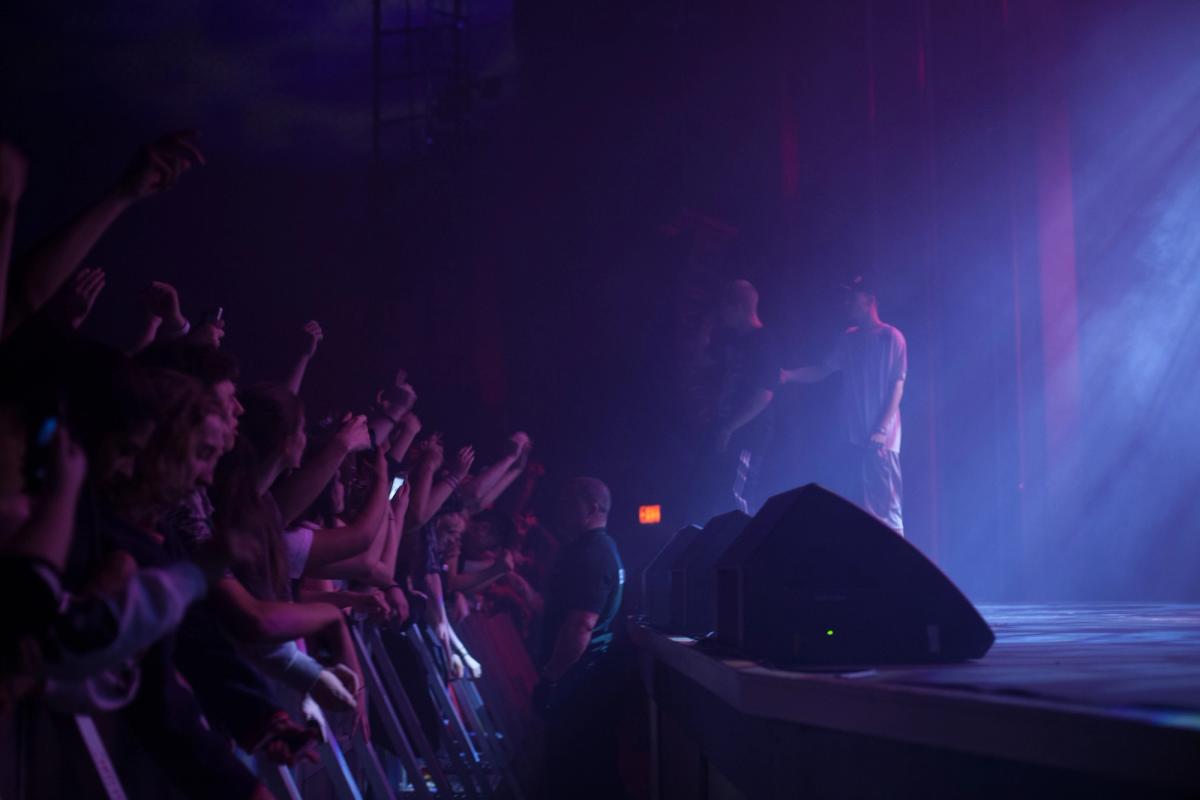
On 1 March 2025 he played Avicii Arena in Stockholm to 10,330 people. For a Swedish artist that is the room, and a homecoming at that scale is a real measure of standing in the domestic market.
The fifth studio album, Jonatan, followed on 2 May 2025, on World Affairs and AWAL, preceded by the singles "Forever Yung" on 21 February and "Babyface Maniacs" on 28 March. Naming the album after himself, at twenty eight, after a decade of operating behind a stage name, is the clearest signal he had yet given about where this was all heading.
Here is the part that tends to be left out of the profiles, and it should not be, because it bears directly on the auction eighteen months later.
Jonatan peaked at number 28 on Sverigetopplistan, the Swedish albums chart. Aggregated critical reception sits at 53 out of 100 from five reviews, with a user score of 64. Paste gave it 7.0 out of 10. RapReviews gave it 6 out of 10.
Those are respectable numbers. They are not the numbers of an artist at a commercial or critical peak, and any account of the 2026 art sale that assumes maximum cultural altitude at the moment of the auction is assuming something the chart does not show. An arena sells out on accumulated loyalty, which is a decade of audience. An album charts on current demand. In 2025 the loyalty was demonstrably strong and the current demand was middling, and those two facts are not in conflict. They describe exactly the position of an artist with a deep, durable, non-casual audience and a modest crossover.
This institution said in August 2026 that his cultural velocity was at a peak that might not recur. That was written before these figures were examined. On the evidence of the chart and the critical aggregate, "peak" overstates it, and the more defensible reading is that his standing in 2025 and 2026 is high, stable and narrow rather than ascending.
2026: Adidas, Gavras, Grand Theft Auto, and a Gasworks
Four things happened in 2026 and only one of them was the exhibition.
In April, "Storm" with Gener8ion, in a video directed by Romain Gavras. Gavras is a director of considerable standing, and the collaboration places him in a different tier of visual production than the lo-fi videos of a decade earlier.
In late June, during Paris Fashion Week SS27, an Adidas Originals creative residency built around the Stan Smith. Working with TTGT Studio in a Parisian townhouse, he covered a room in spray paint and oil pastels during a live performance, wearing a custom Adidas jumpsuit that absorbed the paint as he worked and finished the session materially continuous with the painting. The residency presented the act of making, not the object made.
On 17 September, "That's It", released as a single and carrying Metro Boomin and Future as featured artists. He is the lead artist. It is track two on Grand Theft Auto VI: The Album, released 19 November 2026, and he is credited as a writer under his full legal name.
That last fact deserves to be held next to the auction, because the timing is sharp. Grand Theft Auto VI is among the largest entertainment releases of the decade, and track two of its official album is a position of enormous mainstream exposure. It lands twenty five days after the auction closes.
Anyone bidding on these twelve objects in October 2026 is bidding in the window immediately before the single widest distribution event of his career. Whether that makes the timing shrewd or simply coincidental is not something this institution can establish, and it has no view on the intent. What can be stated is the sequence, and the sequence is that the market was asked to price the name three and a half weeks before a very large number of new people encountered it.
And in September, the exhibition.
Norra Bangården, Torsgatan 22
Collected Works 2016-2026 ran from 25 September to 11 October 2026, Tuesday to Sunday, noon to seven. Admission was free.
The venue requires a note because the record is untidy about it. The address is Norra Bangården, Torsgatan 22, Stockholm, an early twentieth century Art Nouveau complex built for the city's gas and water works. Swedish public service broadcaster SVT led its report by placing the show at Gasverket, then gave the address as Norra Bangården in its own event box, without reconciling the two. Both descriptions point at the same building and neither is wrong, but a national broadcaster carrying two names for one venue in one article is a small illustration of how quickly a location becomes two locations in a record. From Barnhusbron the building carried a wrap the size of its facade, tiled with fragments of his paintings over the words "Collected Works 2016-2026".
Inside were paintings, drawings, collages, ceramics, dioramas, works on paper, and site-specific installations including a salon, a television room and a screening room. The new short film Slåtter (Haymaking), which he executive produced and stars in, screened as part of the show. The exhibition was organised without a gallerist and without an external curator; he selected the works and designed the installation himself, assisted by people he has known since school, with his longtime friend Kaj Lindhé Gimdal working on both the process and the show's curation.
Fans queued from six in the morning on opening day. SVT reported visitors who had travelled from Scotland, Germany, Brazil, the United States and Canada, and described the opening as full, with hundreds present. SVT reported that he gave no interviews for the exhibition, although Artsy published one conducted two days before the press preview. The press release carried a single line from him: "Så länge jag kan minnas har jag drömt om färger." As long as I can remember, I have dreamed of colours.
Slåtter has a traceable origin. He has connected it to a soldier's cottage his mother inherited in Småland, and to a childhood encounter with the stranger end of Swedish nature: the illustrators John Bauer and Elsa Beskow, the water spirit Näcken, the invisible Vittra. "That whole Swedish troll forest becomes very real when you're a child," he said. "Then you get older, and you understand what reality is. Somewhere in there, I think I just wanted to get that feeling back in a film." He has named Ali Abbasi's Border as a film he admires for setting bureaucratic reality beside something magical.
The team considered London and Paris and chose Stockholm. "But fuck it. I'm from Stockholm. Stockholm made me, and Stockholm is where I want to give something like this back."
The Training Record Is Two Weeks Long, and It Is in Clay
He has never attended art school. This is not an inference; he states it, and the exhibition's framing rests on it. What he reports as the entirety of his formal training is a two week clay course at Folkuniversitetet, a Swedish adult education organisation.
He does not present this as a deficiency to be corrected. "I like the rawness," he told Artsy. Years of touring had taught him precisely where to stand and how a show should sound, and his view of that is unsentimental: "Sometimes you become too pro." The visual work stays less trained on purpose. "I think there's something really beautiful about someone who has a job, like, if you're a plumber, and on the side you make little wooden sculptures." And then, decisively: "But this isn't my job, and I want to keep it pure."
Now hold that against the sale.
Nine of the twelve lots at Bukowskis are glazed ceramic. The single medium in which he has any formal instruction at all, two weeks of it, is the medium that makes up three quarters of the works selected for auction.
This is not a gotcha and it is not an accusation of anything. The works were chosen by him. It is an observation that the record makes available and that no profile has made, and it cuts in a direction that is genuinely ambiguous. Read one way, the ceramics are where a small amount of instruction met a strong instinct and produced the most resolved objects, and he knew it. Read another way, ceramics are small, numerous, more easily parted with, and more obviously saleable than large canvases, and the selection is logistical rather than aesthetic.
The market, as it turns out, has a view on this, and it is covered below.
The self-taught claim also needs one piece of precision, because three different terms get used interchangeably about work like his and they mean different things. Naive art is made by someone without formal training. Primitivism is a trained artist adopting that look deliberately, which is what Picasso is doing in Les Demoiselles d'Avignon while drawing on Iberian and African sculpture from inside an academic education. Outsider art is made with almost no contact with the art world at all.
Håstad is self-taught and says he has made this kind of work since childhood, which puts him on the far side of a line from Picasso even where the pictures might sit beside each other. He is plainly not an outsider artist: he has a studio he shared with another well known artist, a gallery showing in 2016, a self-financed exhibition in a landmark building, and a contract with the oldest auction house in the Nordic countries.
The distinction turns on a biographical fact about the maker, not on anything visible in the object. It cannot be settled by looking. It can only be settled by whether somebody wrote it down, which is the entire reason an institution like this one exists.
What the Critics Said
The exhibition was reviewed in the Swedish national press between 25 and 29 September 2026, while it was open and with the auction still ahead of it.
Kristofer Andersson in Aftonbladet gave it top marks, reading the show as a route into Leandoer Håstad's inner world. Otto Ruin in Svenska Dagbladet found the rooms held together by a movement between dream and reality. Bo Madestrand in Dagens Nyheter was divided: he admired the exhibition's spatial design and the ceramics, and was least convinced by the painting.
English language coverage was mostly announcement rather than assessment. The nearest thing to criticism in English came from Chris Erik Thomas in Highsnobiety, who described crude paintings of masklike figures in nature and called the work almost literally childlike.
Two observations about this reception, offered as structure rather than as judgment.
The first is that it exists at all, and quickly. Three national reviews inside five days is real critical attention, and it arrived before the sale, not after it. When this institution wrote about the exhibition in August it predicted that independent criticism would not arrive before the Bukowskis sale. That prediction was wrong and was corrected in the published record on 1 October. Three named critics in the national press, with the auction still two weeks away, is the opposite of what was forecast.
The second is that three reviews in one week is attention, not duration. A critical record that moderates a price is one that accumulates across years, through repeated showings, disagreement, revision, and the slow business of a reputation being argued about. A week of coverage at the opening tells you the show was an event. It does not yet tell you what the work is worth holding.
And the specific content of Madestrand's division turns out to matter more than anyone could have known in September, because the market was about to disagree with him precisely.
The Sale: Twelve Objects, Measured
Bukowskis was founded in Stockholm in 1870 and is the oldest auction house in the Nordic countries. The partnership was named in the exhibition's first announcement in August, before the show opened, which is to say the commercial destination of the works was published before anybody had seen them.
The sale was an online theme auction, Jonatan Leandoer Håstad, Selected Works, running from 15 to 25 October 2026, with lots closing at two minute intervals from 21:36 to 21:58 Central European Time on the final day. Bukowskis described it as the first time his visual art had been offered at auction. The works were selected by him.
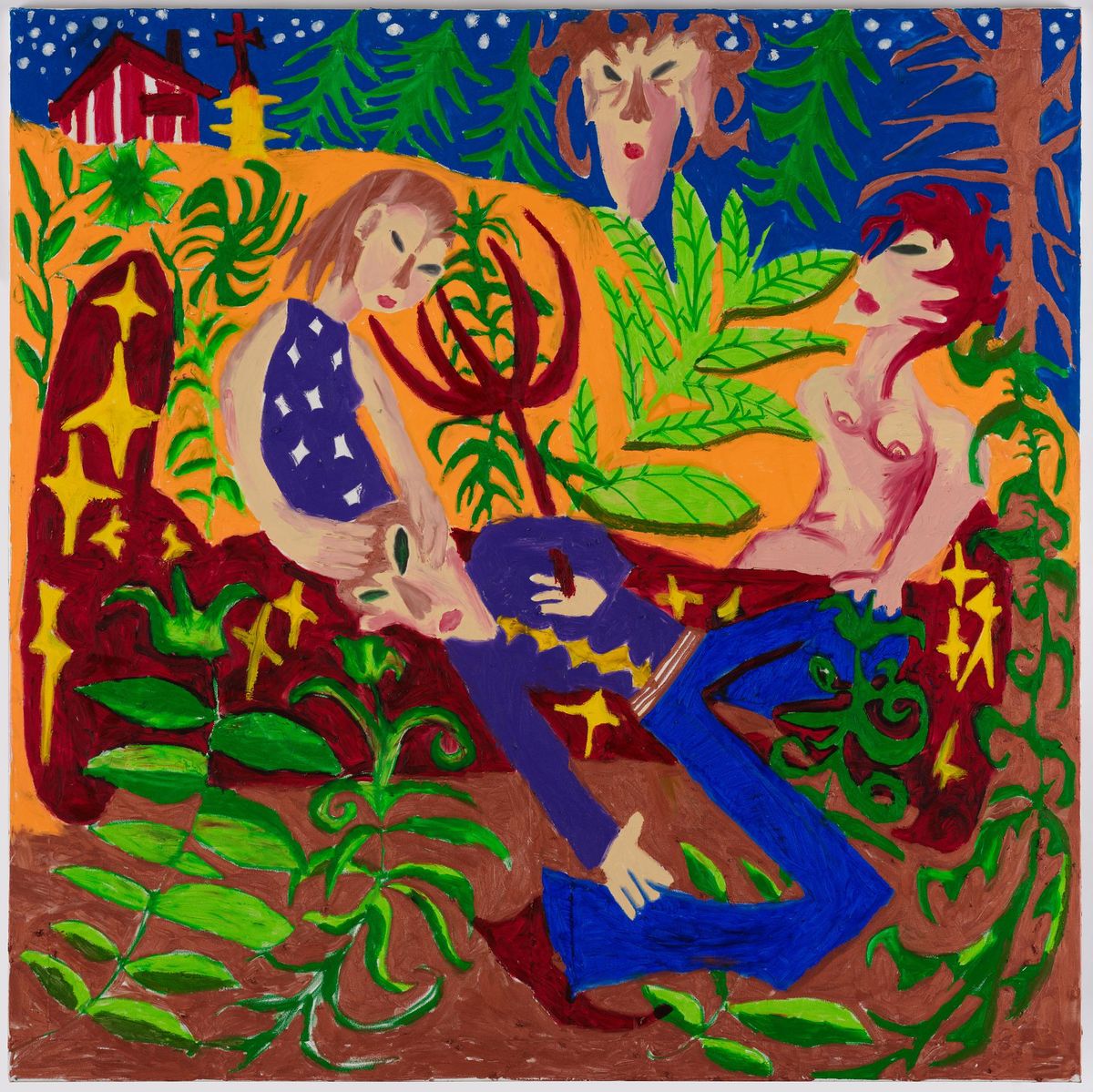
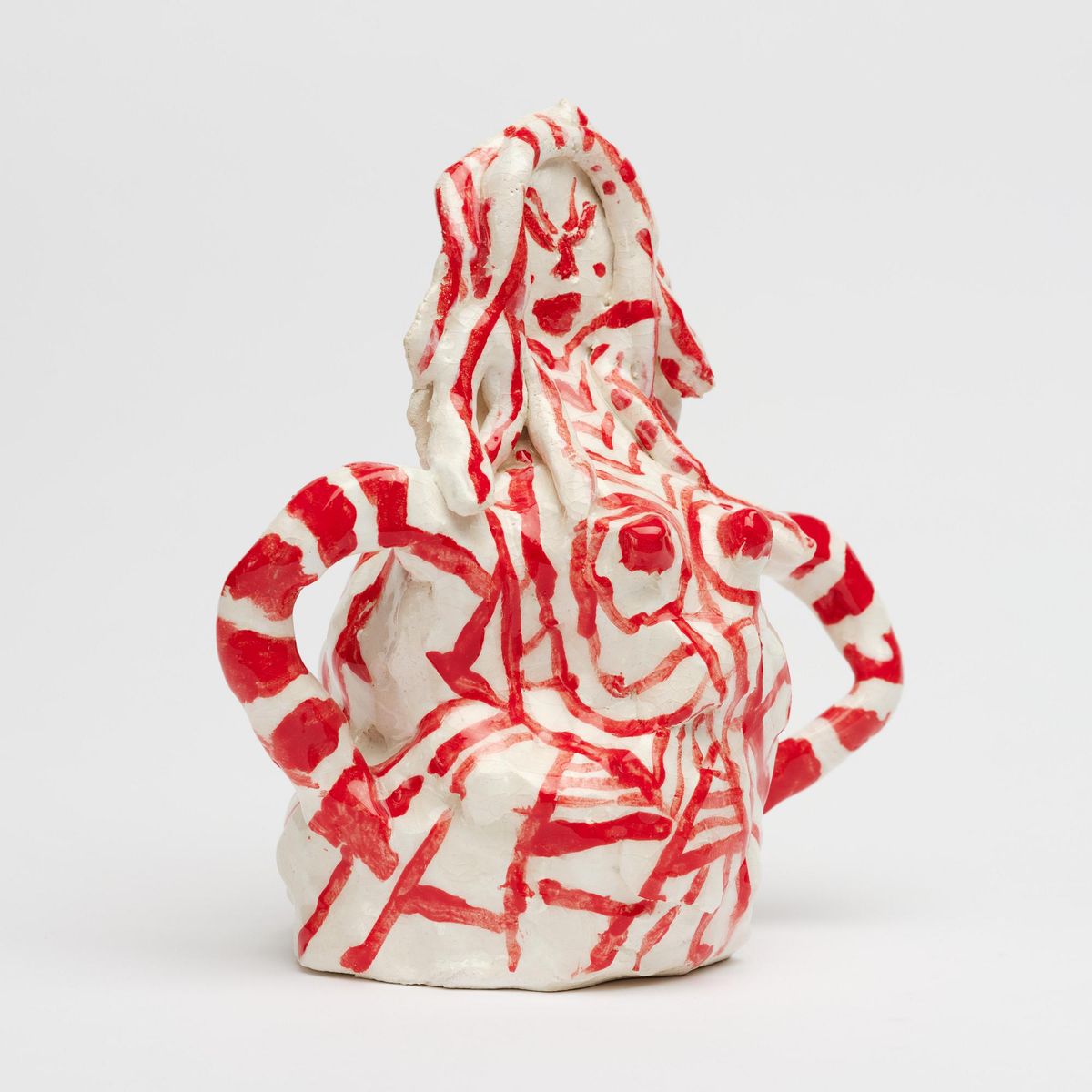
Twelve lots. Nine glazed ceramics and three works on canvas. Aggregate low estimate: 1,070,000 Swedish kronor.
This institution measured the sale twice: once at 08:48 Eastern time on 25 October, seven hours and fifty minutes before the first lot closed, and again at 17:00 Eastern, after the last lot had closed. What follows is the closing record. Every figure is the hammer price, exclusive of buyer's premium, and every lot marked unsold failed to reach its reserve.
Works on canvas, all three sold
Den Döende Dandyn Remix (The Dying Dandy Remix). Signed Jonatan Leandoer and dated 2025 verso. Oil pastel on canvas, 177.5 x 177 cm. Estimate 250,000. Sold at 295,000 against twenty three bids, eighteen per cent above low estimate. It stood at 215,000 with eight hours to run.
Sömnlös Natt och Kastanjer (Sleepless Night and Chestnuts). Executed in 2022, and the one lot in the sale that carries no signature. Acrylic, water-based pens, spray paint and collage on canvas, 100 x 70 cm. Estimate 100,000. Sold at 120,000 against twenty bids, twenty per cent above low estimate. It stood at 80,000 that morning.
Djungelboken (The Jungle Book). Signed Jonatan Leandoer and dated 2021. Oil pastel on canvas, 92 x 73 cm. Estimate 100,000. Sold at 94,000 against sixteen bids, six per cent below low estimate.
Glazed ceramics, four sold of nine
Sträng Vas (Strict Vase). Signed Jonatan Leandoer and dated 2022. 20 x 18 x 12 cm. Estimate 60,000. Sold at 40,000 against thirty two bids, more bids than any other lot in the sale. It stood at 17,500 that morning and more than doubled in a single afternoon, and it still closed twenty thousand short of its low estimate.
Solros Sneakers (Sunflower Sneakers). Signed and dated 2022. 24 x 23 x 17 cm. Estimate 60,000. Sold at 27,000 against five bids.
Bortsprängda Lila Drömmar (Shattered Purple Dreams). Signed and dated 2022. 18 x 16 x 22 cm. Estimate 60,000. Sold at 26,000 against thirteen bids.
Rolig Svamp Gubbe (Silly Mushroom Guy). Signed and dated 2022. 15 x 15 x 14 cm. Estimate 60,000. Sold at 26,000 against nine bids.
Glazed ceramics, five unsold
El Jefe. Signed and dated 2022. 36 x 26 x 22 cm. Estimate 100,000. Unsold, final bid 75,000 against eight bids.
Gubbe (Old Man). Catalogued as signed Joanatn Leandoer and dated 2022. 29 x 29 x 24 cm. Estimate 80,000. Unsold, final bid 26,000 against seven bids.
Suedi Demon. Signed and dated 2022. 14 x 20 x 18 cm. Estimate 60,000. Unsold, final bid 20,000 against eleven bids.
Gul & Lila Stjärnor Elefant (Elephant with Yellow & Purple Stars). Signed and dated 2022. 16 x 17 x 13 cm. Estimate 60,000. Unsold, final bid 18,500 against nine bids.
Urn. Signed and dated 2024. 20 x 26 x 20 cm. Estimate 80,000. Unsold, final bid 17,500 against thirteen bids.
The close, stated three ways because the three numbers answer different questions. Seven of twelve lots sold and five did not, and every unsold lot is a ceramic. The money that actually changed hands is 628,000 kronor. Counting every final bid including the five that failed, the sale reached 785,000 against 1,070,000 of aggregate low estimate, or 73.4 per cent. Two lots of twelve reached their low estimate and both are paintings.
What the Pre-Close Reading Got Right, and the Part It Got Wrong
This study was written before the sale closed and it made a methodological claim that the close disproved. That is worth stating first, before the finding it got right, because a study that quietly drops its own failed prediction is not a record.
The claim was that price formation in this sale happened early. The evidence for it was real: the bid histories, which Bukowskis publishes in full with timestamps, showed Den Döende Dandyn Remix reaching 200,000 kronor within about eight and a half hours of the sale opening on 15 October, and then moving only 15,000 kronor across the following nine days. The reading was that the lot had found its level on day one and was crawling.
It had not. In the final hours that lot took another 80,000 and closed at 295,000, with its bid count going from nine to twenty three. Sträng Vas went from 17,500 to 40,000 and from ten bids to thirty two. Sömnlös Natt och Kastanjer went from 80,000 to 120,000. Across the twelve lots the sale added roughly 130,000 kronor and sixty bids in a single afternoon after nine almost motionless days.
So the long flat stretch was not the price settling. It was an online auction behaving the way online auctions behave, and a nine day plateau says nothing at all about where a sale ends. The pre-close figure of 58.3 per cent, which this study was careful to label as a point-in-time reading and not a result, was nonetheless a poor predictor of the 73.4 per cent the sale actually reached. A measurement can be accurate, properly caveated, and still support an inference it cannot carry. The caveat was right and the inference drawn beside it was wrong.
What the pre-close reading did get right is everything about the shape of demand, and the close sharpened it rather than reversing it. That part follows.
The Critic Praised the Ceramics. The Market Bought the Paintings.
Here is the finding, and it survived the close in a stronger form than it had that morning.
Bo Madestrand in Dagens Nyheter admired the ceramics and was least convinced by the painting. That was the single most specific critical judgment delivered on the exhibition, in the country's paper of record, two weeks before the sale.
All three paintings sold. Five of the nine ceramics did not.
The three paintings took 509,000 kronor of the 628,000 that changed hands. That is eighty one per cent of the money on three of the seven sold lots. At 08:48 that morning the comparable figure was sixty one per cent, so the concentration increased through the final day instead of evening out. Four ceramics sold for 119,000 between them.
No ceramic reached its low estimate. Not one of the nine, including the one the room fought hardest over. Sträng Vas attracted thirty two bids, more than any other lot in the sale, more than the top painting's twenty three, and climbed 128 per cent in an afternoon. It closed at 40,000 against an estimate of 60,000. The most contested object in the auction still could not make its number.
The two lots that beat their estimates are both canvases, and one of them is the lot with no signature on it.
In August this institution wrote that Madestrand's endorsement had landed on the lots, because sculpture was what Bukowskis was primarily taking to auction. That sentence was correct about the selection and wrong about the consequence. The endorsement landed on the lots and the money went somewhere else.
The close also settles what the morning reading could not. That morning three lots had met their reserve and all three were paintings, and this study said in writing that if the ceramics cleared their reserves late and the ratio inverted, the finding should be read as a statement about the pre-close state only. Four ceramics did clear, late, exactly as that caution anticipated. The ratio did not invert. It widened, because the ceramics that cleared did so cheaply and the paintings that cleared did so above estimate.
Two readings of why remain available and the evidence does not choose between them.
The market may be reading scale and wall presence. A 177 by 177 centimetre painting is a different proposition to a fifteen centimetre ceramic mushroom, in a collector's room and in a resale, and buyers at this level may be buying the largest object with the name on it. On that reading the critic was assessing objects and the market was assessing assets, and they were never going to agree because they were not answering the same question.
Or the market may be right and the critic may be early. Prices and criticism diverge constantly and the divergence resolves in both directions over decades.
What can be said without choosing is that this is the first occasion on which anybody's judgment of this work was tested against anybody else's with money attached, and on the first test the two did not match. That is a genuinely new fact about this artist, it is a few hours old, and it could not have been known from the exhibition.
The Decade in the Title and the Dates on the Objects Do Not Match
The exhibition surveys 2016 to 2026. The sale draws from it. So the sale should, in principle, sample a decade.
It does not. Here are the dates Bukowskis records for the twelve lots:
2021: one. 2022: nine. 2024: one. 2025: one.
Nothing from 2016. Nothing from 2017, 2018, 2019 or 2020. Nothing from 2023 and nothing from 2026. Three quarters of the sale was made in a single year, and that year is 2022.
There is no impropriety in this whatsoever. He chose the works, Bukowskis catalogued them, and the dates are printed openly in the lot descriptions where anyone can read them. But a reader who has absorbed the phrase "a decade of private artistic production" and then looks at what is actually for sale is looking at one year of it, plus three outliers.
Several explanations are plausible and the record does not decide between them. 2022 may simply have been the most productive year. The earlier work may be unavailable, having been given away, kept, or sold privately. The ceramics may postdate the clay course. Or the works offered may be those he was most willing to part with, which is an entirely reasonable basis for selection and has nothing to do with when a practice began.
The point for a provenance record is narrower than any of those explanations. The title of the exhibition describes a span. The contents of the sale describe a year. Both statements are true, they are documented by the same institution, and only one of them is in the press coverage.
Three Facts About Signatures, All of Them in the Catalogue
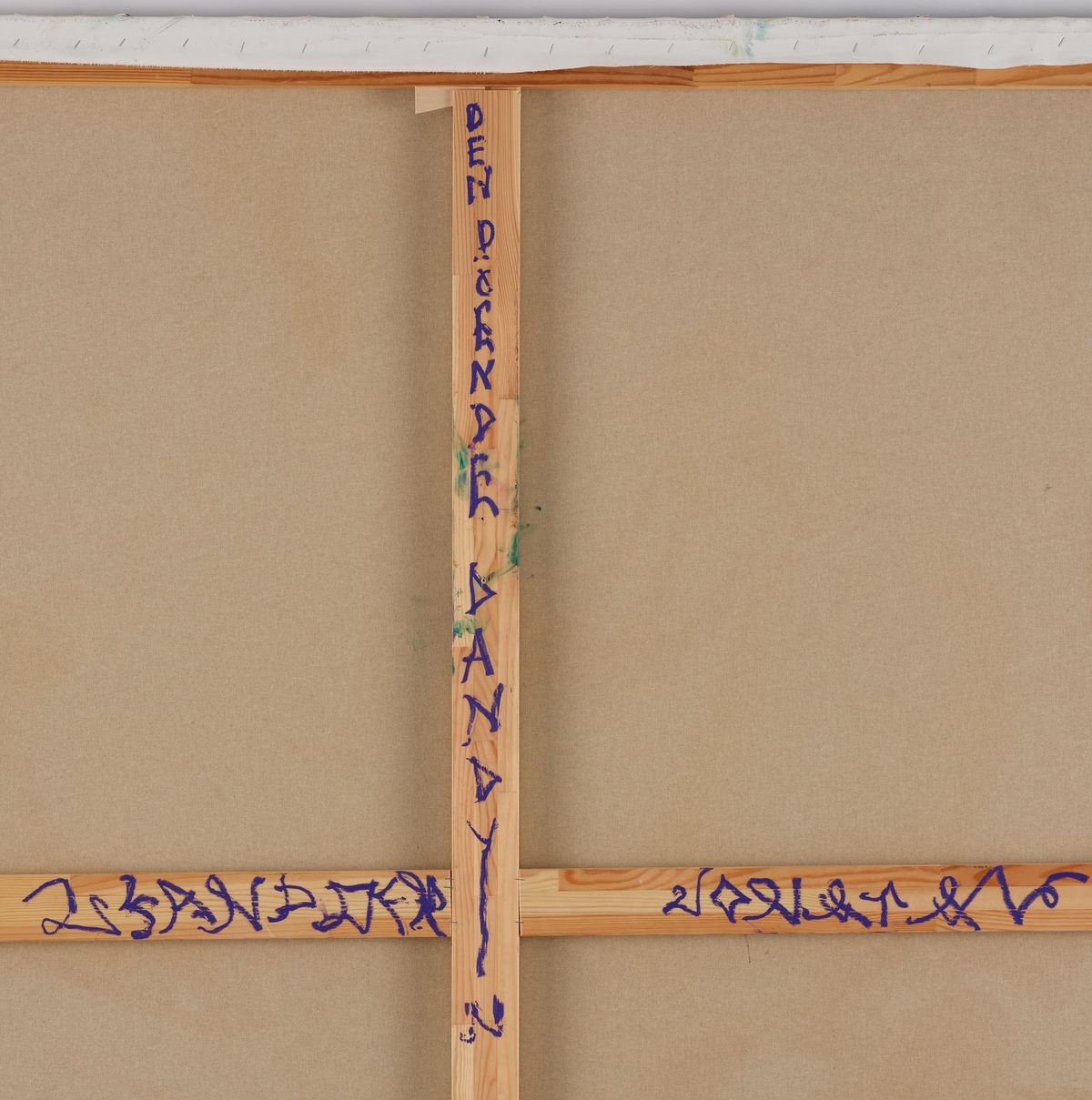
The catalogue descriptions carry three details that a market record would ordinarily pass over and a provenance record cannot.
First, the signature is consistent and it is not his name. Eleven lots are catalogued as signed Jonatan Leandoer. The legal name is Jonatan Aron Leandoer Håstad. The signature drops Håstad, which is his mother's name and the name under which the exhibition and the auction are both conducted. Whatever the reason, the objects and the paperwork say different things, and the objects were written on first.
Second, one lot is unsigned. Sömnlös Natt och Kastanjer carries no signature in its catalogue entry. Where the other eleven read "Signed Jonatan Leandoer and dated", this one reads only "Executed in 2022". It is also the most materially complex work in the sale, built from acrylic, water-based pens, spray paint and collage, and it sold for twenty per cent above its low estimate, the second strongest result in the auction. The market did not discount it for the missing signature at all.
An unsigned work is a weaker document than a signed one. Not a lesser object, a weaker document: attribution rests entirely on the chain of custody from the studio, not on anything the maker wrote. In a sale consigned directly by the artist that chain is as short and as strong as it is ever going to be, which is why nobody need be troubled by it now. The question is what the record looks like in forty years, after the work has passed through three owners and the consignment paperwork is in a filing cabinet somewhere. The signed works carry their authorship on their bodies. This one carries it in a document that can be separated from it.
Third, one catalogue entry spells the signature wrong. The entry for Gubbe (Old Man) reads "Signed Joanatn Leandoer and dated 2022". This institution verified by independent search of the saved page source that the string appears on exactly one of the twelve lots, so it is not a systematic error and not a rendering artefact. The lot went unsold, at 26,000 against an estimate of 80,000, and nothing in the record connects those two facts.
There are exactly two explanations. Either a cataloguer at Bukowskis made a typing error, or the artist misspelled his own name on the object and the cataloguer transcribed faithfully what was in front of them.
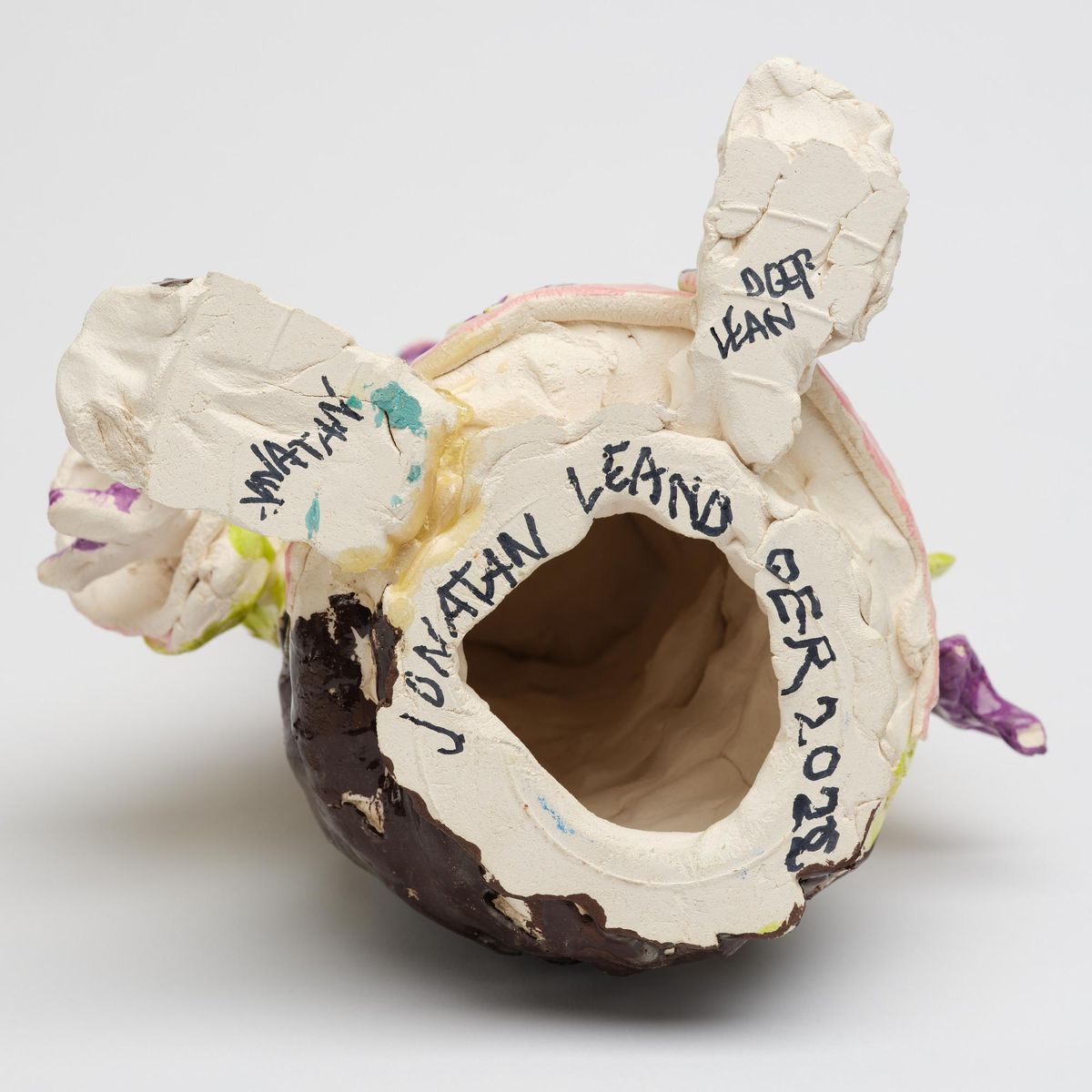
And the record cannot tell you which. That is the whole thing, in four words, on a single lot. A catalogue is a transcription, and a transcription that is doing its job reproduces what it sees including the parts that look like mistakes. If the second explanation is the true one, then correcting the entry would destroy a real property of the object. If the first is true, the entry is simply wrong and should be fixed. Looking at the object would settle it in a second; reading the record never will.
This is not a criticism of Bukowskis. It is a demonstration of something this institution argues constantly: a record is evidence of what somebody wrote down at a particular moment, and its value depends on knowing which questions it can and cannot answer. This one can tell you that something unusual is on that pot. It cannot tell you whose hand put it there.
What a Remix Cites
One lot carries the highest estimate in the sale by a factor of two and a half, and it is the only work in it that points at another object by name.
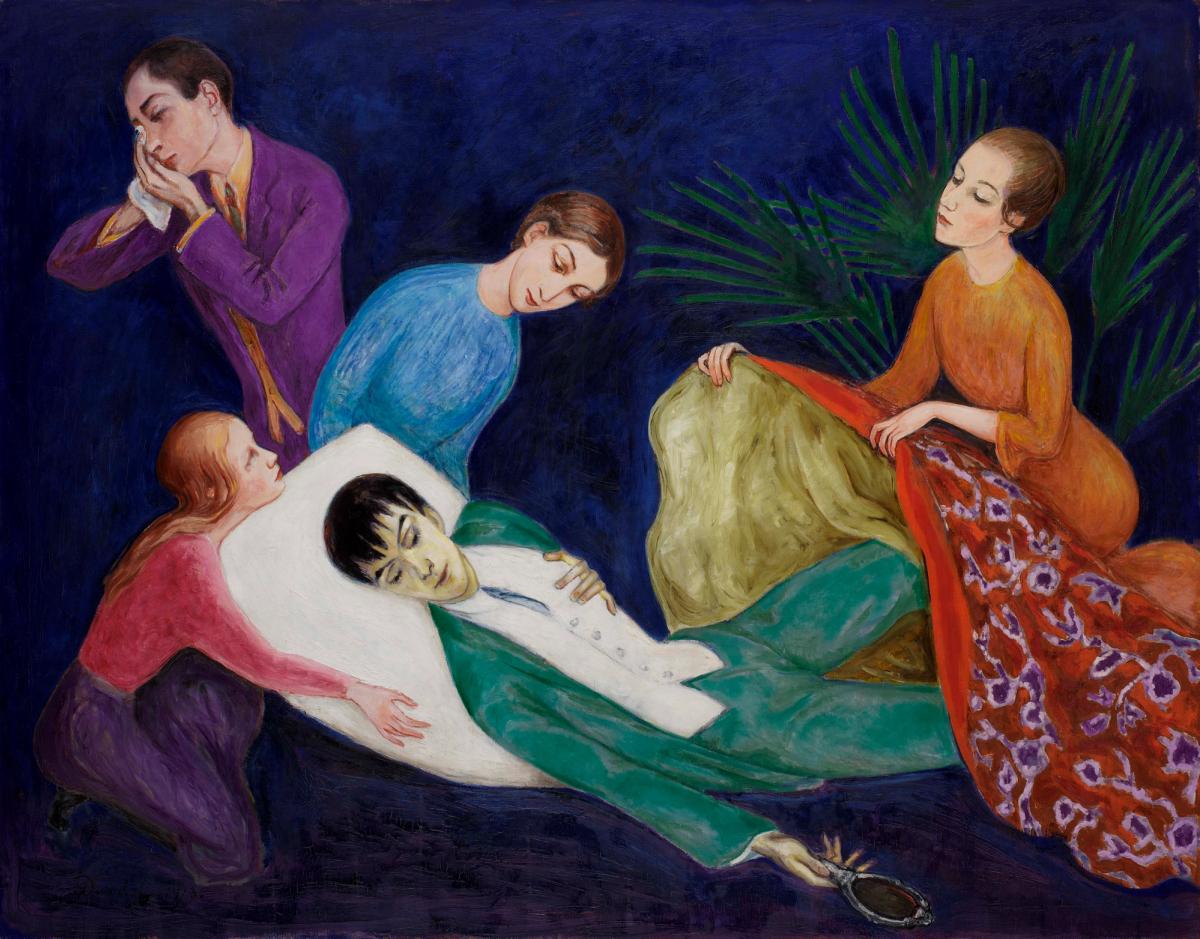
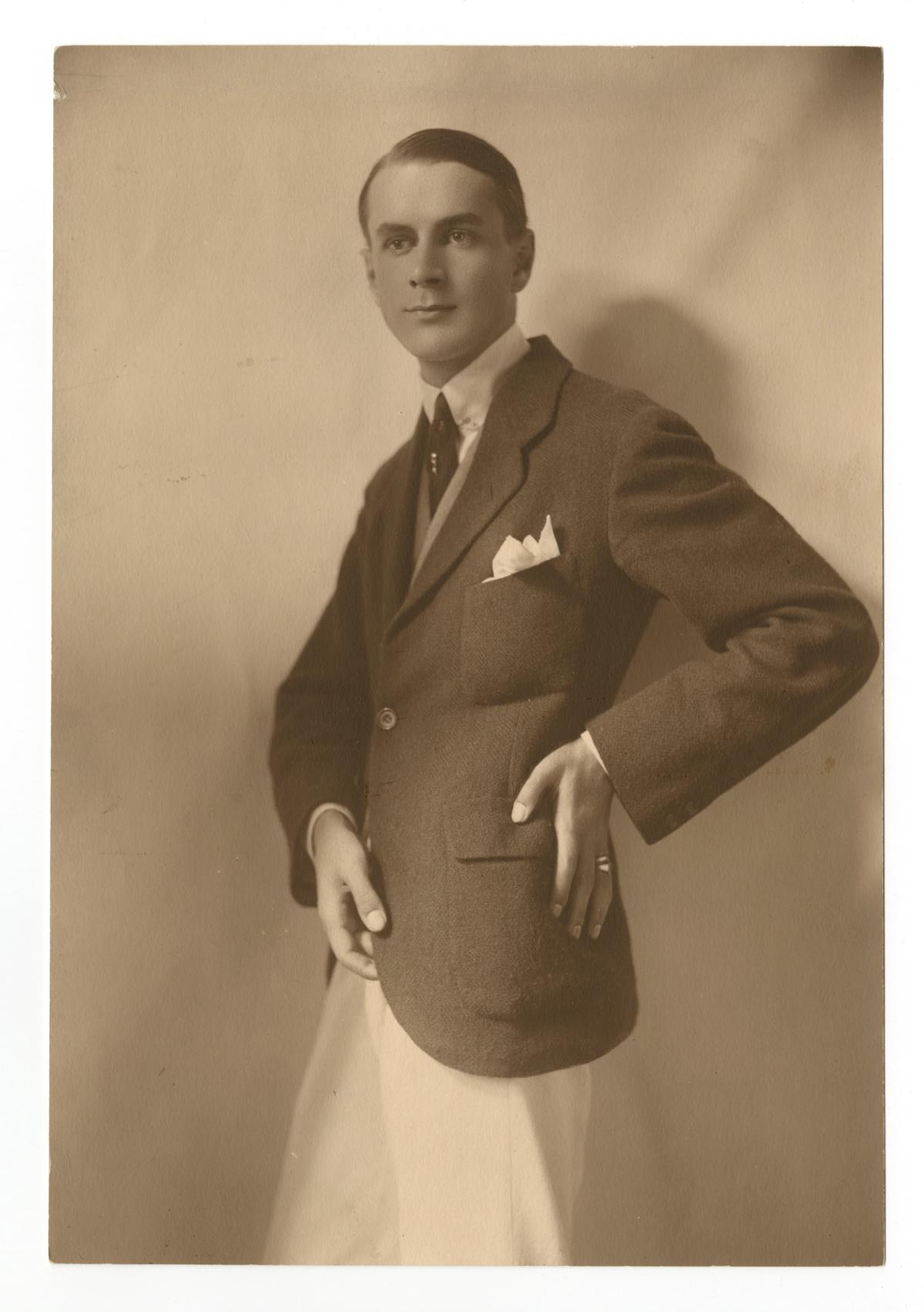
Den Döende Dandyn Remix takes its title from Den döende dandyn, painted by Nils Dardel in 1918, which is close to being the most famous painting in Swedish modernism. A dying man is laid out as in a deathbed portrait, surrounded by mourners, and instead of looking toward heaven he is looking into a mirror. The colours are intense, the forms undulate, and Matisse is visible in it. It is held by Moderna Museet in Stockholm. Dardel had made an earlier 1918 version in which the dandy holds a fan and his eyes are fully closed.
Its history after Dardel is the reason it belongs in this study.
In 1984 the financier Fredrik Roos bought it for 3.4 million kronor, then a record for Swedish art, and the sale generated enough publicity to be read at the time as symptomatic of a capitalist art market. In 1988 Roos sold it to the financier Hans Thulin for 13 million kronor. In 1991, after Thulin's bankruptcy, it passed to the financier Thomas Fischer. It later entered Moderna Museet, by a route and at a price the public record does not give. On 4 April 2007 a smaller watercolour version sold through Bukowskis for 3.25 million kronor to a Swedish collector.
So: a painting about a man contemplating his own appearance while dying, which then travelled through three financiers in seven years, one of whom went bankrupt, before coming to rest in a national museum. There is no better illustration in Swedish art of the difference between what an object is and what an object is worth, and the chain is the evidence.
Now set the two lots beside each other. The Bukowskis-sold watercolour version of Dardel's original made 3.25 million kronor in 2007. The remix carries a 250,000 kronor estimate at the same auction house in 2026, a factor of thirteen below it.
That comparison is not a judgment about the two works and this institution is not making one. It is a statement about what a citation costs. A remix borrows a title, and a title carries the weight of everything that has happened to the thing it names. He has reached for the most heavily freighted image in his own national canon, one whose market history is itself a parable about financiers and value, and offered the result at the house that sold a version of the original. Whatever else is happening in this sale, somebody understood exactly what they were doing with that title.
He Describes the Transaction Himself, and Names the Auction House
In August 2026 this institution published a study of the exhibition arguing that it and the sale constituted an Aura Transaction: the transfer of cultural capital accumulated in one domain into an unfamiliar one, with the destination objects inheriting the sender's narrative weight as their primary market credential, ahead of any independent assessment of the work on visual art terms.
A month later he said the same thing, unprompted, in his own words, and named Bukowskis while doing it:
"If I went to Bukowskis and saw that Robert De Niro had painted a picture, I'd still want to buy it because Robert De Niro painted it. In my case it's always going to be, 'Yung Lean made this.' There's no getting around that. And I don't think there's anything wrong with that at all."
This is the most important quotation in this study and it changes the shape of the argument.
The usual version of the celebrity art market story requires a pretence. The artist maintains that the work stands alone, the gallery produces language about a sincere parallel practice, and a critic's job is to point out the machinery behind the curtain. None of that applies here. He has identified the mechanism, given a worked example using somebody else's name, applied it to himself without flinching, and stated that he sees nothing wrong with it.
He is also, on the narrow point, correct. There is nothing wrong with it. A buyer who wants a De Niro painting because De Niro painted it is not confused; they want the association and they are buying the association, and that is a legitimate thing to want. The error would be confusing it with something else: believing you are buying an independent aesthetic proposition when what is on offer is proximity to a name. A buyer who has read that quotation cannot make that error, which makes him a more honest counterparty than most of the market he has just entered.
This does not dissolve the structural question, and it is worth being precise about what survives. Speculative Velocity describes the rate at which an object's price is accelerated by narrative rather than by material evidence or independent critical judgment. In an established market that acceleration is slowed by things which take years: an exhibition history across several venues, criticism sustained and revised over time, institutional acquisition, a provenance running through multiple hands at documented prices. For these twelve objects, almost none of that exists. One possible gallery showing in 2016, one self-financed exhibition, five days of reviews.
What is different from the usual case is that the person at the centre of it is not pretending otherwise. The Hollowed Object is an object whose material substance has been evacuated in favour of its narrative shell, and it is usually produced by a market acting on an artist. Here the artist has described the shell, in public, and declined to claim it is anything else.
His position on where the work sits is consistent throughout. "This isn't my job, and I want to keep it pure." On the art world: "One thing I find boring about the art world is that everything is so gatekept. It's only for rich people, or only for people who are already inside the scene." And on why his own fame makes openness more rather than less necessary: "I'm a fucking famous musician. So, of course this should be open to everyone. It should be free to enter and open for a long time." He wanted visitors who could not afford a work to be able to leave with something, a calendar or a key. "Everyone should be able to take something away with them."
Free admission, no gallerist, no external curator, a space rented and built out at his own expense, and then an auction with an established house "where it serves a purpose". He has said he wants to approach art the way he approached music fifteen years earlier: do it yourself first, then deal with the institution on your own terms.
Whether that is possible is the open question of this entire study, and it will not be answered by the October sale. It will be answered by whether the objects accumulate a record of their own.
The One Obligation That Travels With the Object
There is a line in every lot page that most readers skip, and it is the only part of this transaction that creates a durable relationship between the maker and the object after it is sold.
Covered by droit de suite. By Swedish law the buyer pays an artist's resale fee of up to five per cent of the hammer price, administered by BUS, the Swedish visual artists' copyright society.
The resale right exists because visual art has a structural problem that music does not. A songwriter is paid every time a recording is played, forever. A painter is paid once, by the first buyer, and if the work is resold at fifty times the price twenty years later the painter receives nothing. Droit de suite is the correction: a small fraction of each subsequent sale returns to the artist or their estate.
It is worth naming here for two reasons.
The first is that this man is both. He is a recording artist paid by a royalty system that follows the work indefinitely, and a visual artist entering a market where, absent this law, the work would be paid for once and never again. The twelve lots at Bukowskis are the first time he has encountered the difference, and the resale right is the bridge between his two economies.
The second is that droit de suite only functions if the chain of ownership is recorded. A resale right is a claim on a future transaction, and a claim on a future transaction is worth exactly as much as the documentation that makes the transaction findable. This institution has argued the same thing about what happens to an object when its owner dies and about the infrastructure that art fairs build around speculation. The right is real. Whether it is ever exercised depends on whether anybody kept the record.
These twelve objects begin their lives in the market with unusually good records: a named consignor who is the maker, a catalogued description, a dated and mostly signed body, a published estimate, a published and timestamped bid history, and a statutory resale right attached. That is a better founding document than most objects get.
What happens to it after the first resale is nobody's responsibility in particular, which is the condition this institution exists to describe.
The Complete Record of Released Work
Assembled here because no single public page carries it, and because a profile claiming comprehensiveness should be checkable.
As Yung Lean. Unknown Death 2002, mixtape, 2013. Lavender, EP, 2013. Unknown Memory, studio album, 23 September 2014. Warlord, studio album, 25 February 2016. Frost God, mixtape, 14 December 2016. Stranger, studio album, 10 November 2017, YEAR0001. Poison Ivy, mixtape with Whitearmor, 2 November 2018. Starz, studio album, 15 May 2020. Stardust, mixtape, 8 April 2022. Psykos, with Bladee, 13 March 2024. Jonatan, studio album, 2 May 2025, World Affairs and AWAL.
As jonatan leandoer96. Nectar, 25 January 2019. Blodhundar & Lullabies, 21 December 2020. Sugar World, 3 February 2023.
As Död Mark, with Gud. Drabbad av Sjukdom, 2016.
Selected singles and placements. "Ginseng Strip 2002", 2013. "Marble Phone" with Kreayshawn, 2013. "Hennessy & Sailor Moon" with Bladee, 25 November 2016. "Happy Feet", 24 October 2018. "Forever Yung", 21 February 2025. "Babyface Maniacs", 28 March 2025. "Storm" with Gener8ion, April 2026, video directed by Romain Gavras. "That's It" featuring Metro Boomin and Future, 17 September 2026, track two on Grand Theft Auto VI: The Album, released 19 November 2026.
Film. Stranger, short, 2017. Yung Lean: In My Head, documentary, premiered 27 November 2020. Circus Maximus, 2023. Sacrifice, 2025, as Arthur. Storm, short, 2026. Slåtter (Haymaking), short, 2026, executive produced by and starring Håstad, screened within the exhibition.
Live. First Sad Boys show, Röda Sten Konsthall, Gothenburg, 5 May 2013. White Marble Tour, 24 European cities, 2014. Black Marble Tour, 2014. First North American show, Webster Hall, New York, July 2014. Avicii Arena, Stockholm, 1 March 2025, 10,330 in attendance.
Exhibitions. A four work presentation at Carl Kostyál, Stockholm, 2016, reported in one source and not otherwise corroborated. Adidas Originals creative residency with TTGT Studio, Paris Fashion Week SS27, late June 2026. Collected Works 2016-2026, Norra Bangården, Torsgatan 22, Stockholm, 25 September to 11 October 2026, free admission, self-organised.
Auction. Jonatan Leandoer Håstad, Selected Works, Bukowskis online theme auction F888, 15 to 25 October 2026. Twelve lots. Nine glazed ceramics, three works on canvas. Aggregate low estimate 1,070,000 Swedish kronor. The first offering of his visual art at auction.
What This Institution Is Not Saying
A study that names a living artist, quotes his critics, and prints the bids on his work should be explicit about the claims it is not making.
OAC does not authenticate. Nothing here establishes that any object is by the hand it is attributed to. The attributions reported are Bukowskis' own.
OAC does not appraise and assigns no value. Every figure in this study is a number published by the auction house. None of them is this institution's estimate of what anything is worth, and nothing here should be read as advice to bid, to decline, or to hold.
OAC takes no position on the quality of the work. Whether the paintings are good is a critical question, three Swedish critics have answered it in three different ways, and their answers are reported as evidence of reception, and are not endorsed.
OAC does not assert that anybody has behaved improperly. There is no allegation here, of anyone, of anything. The works were selected by the artist, catalogued by the house, estimated by its specialists and bid on by the public, all in the open.
And OAC is not predicting the outcome of the sale. The bids were measured at a named moment with the sale still running, and the final prices are not in this document.
What this study does assert is that a record exists, that it is unusually complete, that several things in it do not line up with the account circulating around it, and that the discrepancies are worth reading. That is the whole claim.
The Declared Gaps
A provenance record ends with its holes, listed, so the next person to use it knows what they are inheriting. These are ours.
The birthplace is unresolved. Stockholm and Minsk both appear in the published record. No birth record has been consulted.
The Carl Kostyál showing in 2016 is single sourced. It appears in one interview by a named journalist and has not been corroborated against the gallery's own archive. If it is wrong, the exhibition's start date has no documented basis and the phrase "never exhibited before" becomes accurate.
The circumstances of Barron Machat's death are reported inconsistently and are not resolved here. The fact of it, in the same period as the hospitalisation, is consistently reported.
The spelling on the lot Gubbe cannot be attributed. Either the cataloguer or the artist produced "Joanatn", and the record cannot distinguish them. The object can. Nobody who has examined it has published on the point.
The hammer prices here exclude buyer's premium and are the auction house's own published figures. What a buyer actually paid is higher by the premium, which this study has not calculated, and the identities of the buyers are not public.
Why the sale draws almost entirely from 2022 is not established. Several explanations are plausible. None is documented.
The 2016 to 2020 work is undescribed. Four years of the surveyed decade are absent from the sale and barely present in the coverage. What exists from that period, how much, and where it is, is not in any public record this institution has found.
Whether the exhibition's visitor numbers were counted at all is unknown. Admission was free and no attendance figure has been published.
What Would Settle It
This institution's practice is to state the test that would resolve a question, including where the answer might go against us.
On the critic and the market diverging: settled, and the test was run. This study named the condition that would weaken its finding, which was the ceramics clearing late and the ratio inverting. Four ceramics did clear late. The ratio widened instead of inverting, five ceramics went unsold, and no ceramic reached its estimate. The finding stands on the closing figures and not on the morning ones.
On whether this is an Aura Transaction or the beginning of a practice: the second sale. A first auction consigned by the artist, immediately after a self-financed exhibition, tests the name. A resale three to ten years from now, consigned by a collector rather than by the maker, with no exhibition attached and no album cycle running, tests the object. That is the measurement that matters and it is years away. The droit de suite filings, if anyone keeps them, will record it.
On the self-taught claim: the 2016 to 2021 work. If a substantial body exists from before any public attention and before the clay course, the claim of a long private practice is evidenced instead of asserted. The sale does not contain it. An exhibition catalogue with dated, illustrated entries would.
On whether Grand Theft Auto VI changes anything: a comparison of any resale after 19 November 2026 against these twelve results. If the same objects move on the name alone, the exposure will be visible in the prices.
On the "Joanatn" spelling: somebody looks at the pot.
Coda: The Objects Are the Evidence
There is a version of this story in which a rapper gets bored, paints some pictures, and a famous auction house takes the money. It is a tidy story and it does not survive contact with the record.
The record shows a person who says the visual work came first and whose earliest public identity, at eleven or twelve, was a graffiti writer. It shows a decade of music made beside a decade of objects nobody saw. It shows a man who shared a studio with his closest musical collaborator for three years and told nobody. It shows two parallel recording catalogues under two names, a film, an acting career, and a soundtrack placement on one of the largest entertainment releases of the decade. It shows a formal art education lasting two weeks. And it shows twelve objects in a sale room in Stockholm, nine of which he was taught how to make.
It also shows someone who declined to pretend. Asked whether people are buying the name, he said yes, gave an example, and said he saw nothing wrong with it. That answer disarms the easy version of this study, and what remains after it is disarmed is the more interesting question, which is not about honesty at all. It is about whether an object can acquire a life independent of the person who made it, and how long that takes, and what has to be written down along the way for it to be possible.
The evidence this institution has assembled says the following. The paperwork around these twelve objects is unusually good, and it is good now, at the beginning, which is the only time it is ever easy. There is a named maker, a dated body, a mostly consistent signature, a published description, a public and timestamped bid history, a statutory resale right, and a consignment direct from the studio. Almost no object enters the market this well documented.
And there is already a gap in it. One pot carries a name that may or may not be misspelled by the person who made it, one canvas carries no signature at all, three quarters of the sale comes from a single year inside a decade the title claims, and the only critical judgment anyone published was contradicted by the bidding on the final afternoon.
Those are not failures of the record. They are the record doing its job, which is to preserve the things that do not fit. A contradiction may be preserved. An institution that flattened any of them would have produced a cleaner document and a worse one.
The exhibition closed on 11 October. The sale closed on the evening of 25 October. Seven objects have left a building in Stockholm and started travelling, five are going back to whoever consigned them, and from this point forward whatever is known about any of them will be whatever somebody troubled to write down.
That is the part this institution actually cares about. Not what the pictures are worth. What survives of the knowing.