Kiaf Seoul 2026: Art Fair as Speculative Infrastructure
On velocity, accumulation, and the art fair as financial infrastructure in Seoul's September convergence.
The Fair as Infrastructure
The art fair is frequently described as a marketplace, and in the most literal sense it is. Galleries rent booths, works are priced and sold, transactions clear. But this description understates what a fair of Kiaf SEOUL's scale actually does. At 175 exhibitors across five days, alongside a concurrent fair drawing a further 125-plus galleries, Kiaf SEOUL 2026 functions less like a marketplace and more like a pipeline: a structured system for moving objects from the register of aesthetic encounter into the register of financial circulation.
This distinction matters. A marketplace is neutral with respect to the goods it handles; its function is to facilitate exchange between willing parties. A pipeline is not neutral: it is designed with a specific flow direction in mind, and objects that enter it are processed according to that direction's logic. The art fair pipeline moves objects from studio to collection to secondary market, and at each stage of transit the object accretes what the PLCFA framework identifies as Speculative Velocity: the rate at which an object's perceived financial value accelerates away from any stable anchor in material reality, labor, or cultural meaning.
This is not corruption. It is structure. No individual participant in Kiaf SEOUL 2026 is doing something wrong by buying or selling art there. The point is that the infrastructure itself exerts a gravitational force, and understanding that force is the precondition for any serious engagement with what the fair produces.
Korea's 25th Edition: A Market Geography
Kiaf SEOUL, the Korea International Art Fair, was established in 2002 by the Galleries Association of Korea. For much of its first decade it operated primarily as a domestic market event, a venue for Korean galleries to present work to Korean collectors, with selective international participation. The 25th edition in 2026 represents a different creature entirely: 175 galleries from 18 countries, KB Financial Group as lead partner, an externally appointed Creative Director (Kuho Jung, drawn from fashion design, stage design, and exhibition space design), and a partnership in its fifth year with Frieze Seoul, one of the globally dominant fair operators.
This transformation from domestic cultural institution to international market event is the essential context for any analysis of what Kiaf SEOUL 2026 is doing. The fair did not grow simply by adding exhibitors. It grew by inserting itself into a global network of capital flows, creating the conditions under which collectors, advisors, and speculative buyers from New York, London, and Hong Kong would find it worthwhile to be in Seoul in September. That insertion required not just scale but market legitimacy: the perception that objects acquired at Kiaf carry the same transactional endorsement as objects acquired at comparable fairs in the Western primary market centers.
The theme for 2026, "Coexistence," positions the fair as a meditation on the relationship between human creativity and technological change. The theme is earnest and the programming around it genuine. The 4th edition of Kiaf HIGHLIGHTS selects 10 artists by international jury on the basis of work exploring "materiality, ecology, and Eastern philosophy," a curatorial seriousness that deserves acknowledgment. Kuho Jung's appointment as Creative Director brings a rigorous sensibility to the fair's visual identity and spatial design that previous editions sometimes lacked.
None of this contradicts the structural analysis. Curatorial seriousness and market infrastructure are not opposed forces; they coexist in any major fair, and their coexistence is precisely how the infrastructure reproduces itself. The curation is what makes the market event legible as a cultural one, and that legibility is what justifies the prices, the collectors, and the accelerating velocity.
The Dual-Fair Structure: When Frieze Meets Kiaf at COEX
The most structurally significant fact about Kiaf SEOUL 2026 is not the exhibitor count but the geography. Both Kiaf SEOUL (September 2-6) and Frieze Seoul (September 2-5) operate at COEX in the Gangnam district: Frieze in Hall C and D on Level 3, Kiaf in Hall A and B on Level 1. To attend one is, in effect, to be in the building with both.
This co-location is not accidental. It is the deliberate product of a five-year partnership between Kiaf and Frieze Seoul, and it creates a market effect that neither fair would generate independently. The combined presence of approximately 300 galleries draws collectors who would not travel to Seoul for one fair alone, producing a critical mass that functions like a liquidity pool: a concentration of buyers, sellers, and capital-in-motion that makes transactions more likely, prices more fluid, and the velocity of objects more rapid.
At Kiaf SEOUL 2026, with Frieze Seoul one floor above, the dual-fair structure is not merely convenient; it is a velocity amplifier, and the objects presented in its booths are not insulated from that amplification.
From the perspective of Speculative Velocity, dual-fair co-location amplifies rather than merely accommodates market dynamics. Objects shown at Kiaf are seen by collectors who arrived for Frieze; works priced at Kiaf are benchmarked against works priced at Frieze; the market signal sent by a transaction at Frieze Seoul radiates immediately to the booths downstairs. The two fairs share a roof, an Aura Transaction ecosystem, and a speculative logic, even when their curatorial registers differ.
Frieze Seoul's fifth edition expands its Asia-Pacific focus, with nearly 70 percent of participating galleries based in the region. This regionalization is not a retreat from globalization; it is a deepening of market integration, drawing the galleries of Tokyo, Hong Kong, Singapore, and Seoul more tightly into the circuits of price formation that the primary Western market still governs. For Kiaf, proximity to Frieze is both an opportunity (shared collector traffic) and a structural pressure: to keep pace with the pricing logic of the global primary market, galleries at Kiaf must produce works and prices that feel comparable in register to those at the fair one escalator away.
Speculative Velocity at Scale
How does an art fair generate Speculative Velocity? The mechanism operates through three interlocking functions: price discovery, social proof, and temporal compression.
Price discovery is the most obviously economic of the three. When a work sells at a fair, the transaction enters the market record: the price achieved, the work's condition, the gallery's booth level, all of which become data points shaping subsequent valuations. At a fair of 175 galleries, hundreds of these data points are generated over five days. Each transaction sets a precedent; each precedent constrains and calibrates what comes next. The cumulative effect is not a stable price but a directional one: an upward drift that characterizes any market in which positive precedents accumulate faster than negative ones.
Social proof amplifies this. The presence of major institutional collectors, museum curators, and high-profile advisors at a fair does not merely validate individual works. It validates the fair itself as a site of serious cultural production, and that validation cascades down to every booth. Works shown at a fair where serious people are seen to be looking carry a different aura than works shown at a fair nobody attended. At Kiaf SEOUL 2026, with KB Financial Group as lead partner and Frieze Seoul drawing the same collector class, the social proof infrastructure is substantial.
Temporal compression is the least visible but perhaps most consequential of the three. A fair lasts five days. The decisions that collectors make in that window, under the pressure of limited availability and competitive attention, are structurally different from the decisions they would make over five months. The fair concentrates market time, and concentrated market time produces a distinctive psychology: the sense that a window is closing, that value is being crystallized in real time, that the opportunity to acquire a significant work at a significant price point is perishable. This psychology is not manufactured cynically; it is an emergent property of the format. But its effect on how objects are valued, and how quickly that valuation accelerates, is real.
The Hollowed Object, in the PLCFA framework, is not an object stripped of all cultural content. It is an object in which the financial dimension of its value has eclipsed and begun to substitute for the material dimension. The art fair is not the only mechanism that produces this outcome, but it is among the most efficient ones. The 300-plus exhibitors at COEX in September 2026 will produce their share of hollowed objects alongside genuine material encounters, and the infrastructure will be largely indifferent to the distinction.
Nam June Paik, Lee Ufan, and the Weight of the Anchor
Two Korean artists whose presence at Kiaf SEOUL 2026 illuminates the structural tension at the heart of the event are Nam June Paik and Lee Ufan.
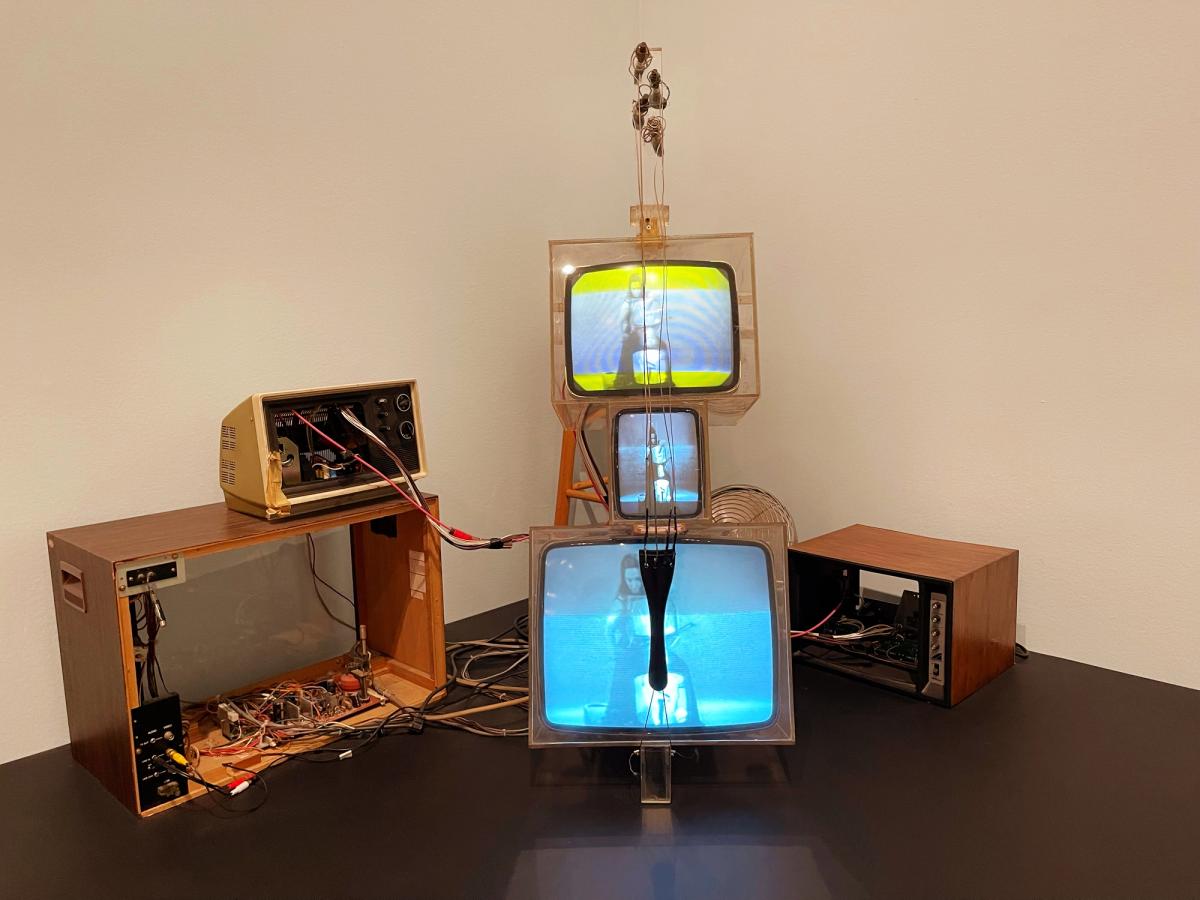
Nam June Paik (1932-2006), one of the founding figures of video art and a central participant in Fluxus, represents in this context the irreducible historical anchor. His work "Internet Dweller wol.five.ydpb" (1994), part of a series of twelve works that Paik conceived as imaginary beings living on the internet, is presented at Kiaf SEOUL 2026 by CMay Gallery. The series, made in 1994 when the internet was accessible to a fraction of the global population, demonstrates Paik's characteristic fusion of art and technological foresight. Its appearance at a 2026 art fair, 32 years after its creation and 20 years after the artist's death, raises the exact question that the PLCFA framework was built to ask: what is the Narrative Permanence of this work, and how is it affected by being offered for sale at a market event?
The answer is not simple. Works by historically significant artists do not lose their material meaning by appearing in a fair booth. What changes is their transactional context: the frame through which a buyer encounters them is now a market frame, and the market frame, over time, tends to reduce what can be said about an object to what can be priced about it. Paik's "Internet Dweller" retains its conceptual depth regardless of who owns it or what it costs. But the system within which it circulates extracts a Semantic Burden: every transaction, every auction result, every fair appearance adds a layer of market narrative on top of the object's own narrative, and those layers are not easily separated.
Lee Ufan (born 1936) presents a somewhat different case. His "Wind" series, characteristic of the spare materiality and philosophical rigor that has defined his practice since his foundational role in the Mono-ha movement of the late 1960s, addresses the relationship between objects, space, and perception with a precision that resists market instrumentalization at the level of intention. Lee Ufan has spent his career making work that insists on the integrity of the material encounter, on the interval between object and viewer, on what he has described as the silence that precedes speech.
And yet: his work, precisely because of its formal austerity and historical significance, has become one of the more actively traded categories in the Asian contemporary art market. The Zero-Sum Aura dynamic is acute here. Lee Ufan's work carries extraordinary weight in the Korean art market not despite its resistance to commodification but, in some measure, because of it. The appearance of scarcity and formal resistance that makes his practice compelling is also what makes it attractive to speculative collectors: the object that signals immunity to market logic is the object the market most desires to own.
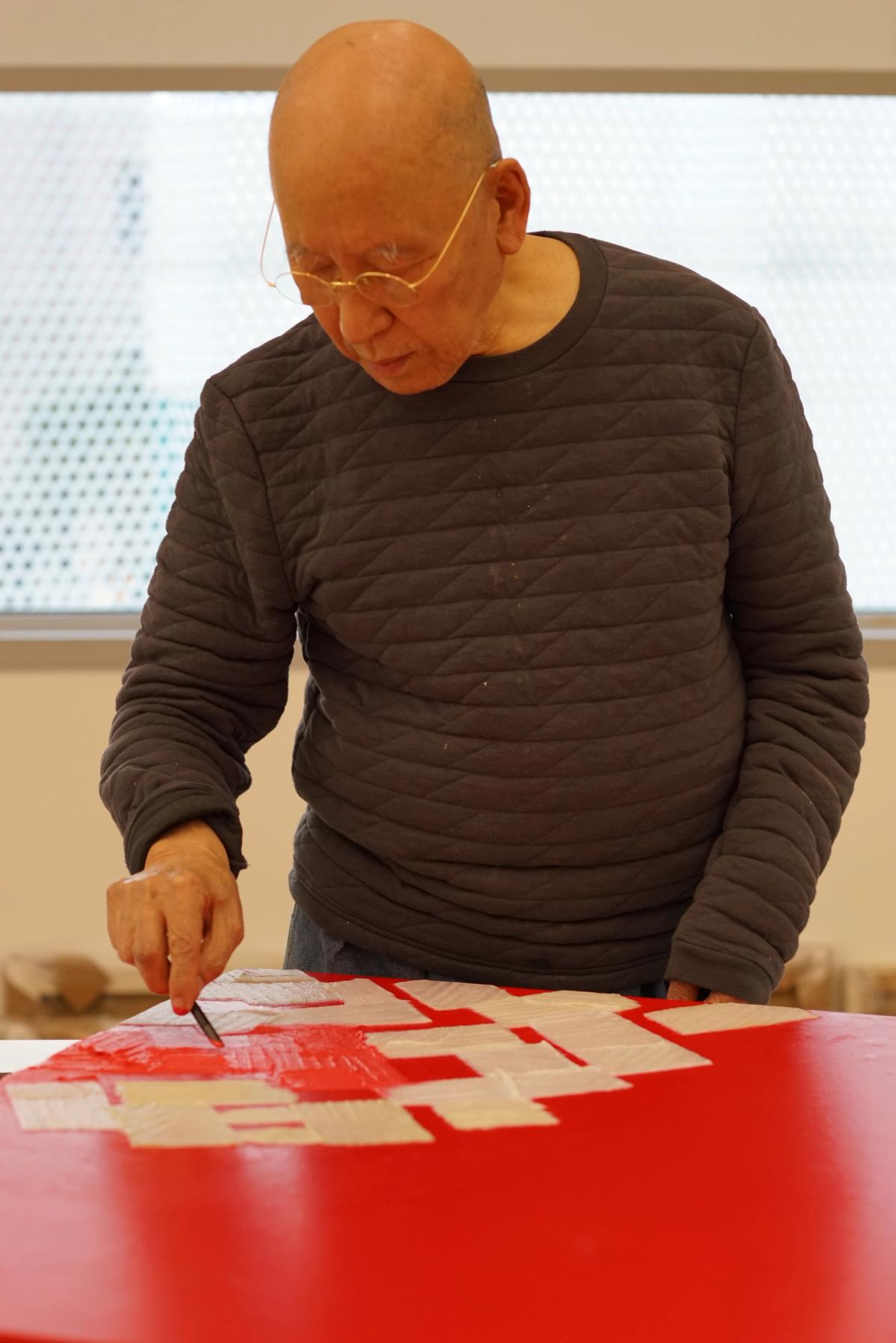
Park Seo-Bo, the foundational Dansaekhwa figure who died in 2023, continues to circulate actively in the secondary market. His participation in events like Kiaf, even posthumously through the works dealers bring to the fair, represents a form of Institutional Necrophagy: the absorption of an artist's legacy into market infrastructure in ways that the artist's own practice sought to resist. Park Seo-Bo's hanji and colored pencil surfaces, developed over decades of meditative studio practice, were not made for the booth environment. Their presence in that environment is not an injustice; it is a structural irony that the fair's curatorial framework tends not to acknowledge.
Kiaf PLUS: Emerging Art as Tactical Friction
Now in its fifth year, Kiaf PLUS presents 19 emerging galleries: 8 Korean and 11 international, drawn from Bangkok, Tokyo, Moscow, and elsewhere. The section functions as the fair's counterweight to its own market concentration: a space for galleries that cannot yet afford the primary floor, for practices that are not yet legible to the most established collector segment, for a visibility that the rest of the fair's economy would not produce naturally.
The question of whether Kiaf PLUS represents genuine friction or tactical legitimization has an honest answer: both, simultaneously, in proportions that vary by participating gallery and work.
Genuine friction exists because the emerging art market is genuinely different from the established one: slower, more relationship-based, more dependent on institutional support from non-commercial spaces, more susceptible to critical reframing over time. Galleries in Kiaf PLUS are often working with artists whose value has not yet been determined by the market, and that indeterminacy is, in principle, an opportunity for encounter unconditioned by prior price signals.
Tactical legitimization also exists because Kiaf, as an institution, benefits from the presence of a section that signals openness to the experimental and the unproven. The section's existence is structurally important to the fair's cultural credibility, which in turn is structurally important to the prices charged and achieved in the main sections. If Kiaf SEOUL were purely a secondary market event, moving established works at established prices, it would not generate the cultural authority that underwrites those prices. Kiaf PLUS and Kiaf HIGHLIGHTS provide the fair with a language of discovery and seriousness that the booth economy alone cannot produce.
Neither of these observations is a condemnation. They are descriptions of how a complex institution operates. What they suggest, for the artists and galleries participating in Kiaf PLUS, is a structural awareness: that the context in which their work appears is not neutral, and that the meanings generated by that context will do work on their practice whether they choose to engage with those meanings or not.
The Resale Right: Law Arrives at Post-Luxury's Conclusion
In 2023, South Korea's National Assembly passed the Art Promotion Act, which among other provisions introduced an artist's resale right to take effect on June 26, 2027, exactly four years after the Act's promulgation. The resale right will entitle artists to a percentage of profits when their work is resold through galleries, auction houses, or art dealers. It is the first such right recognized in Korean law.
The concept of the artist's resale right, known in French law as droit de suite, has existed in Europe since 1920 and was harmonized across the EU in 2001. The United States has no federal resale right, a fact that has long benefited the American secondary art market at artists' expense. South Korea's adoption of the right in 2027 represents a recognition that the current art market structure captures value from artists without returning any portion of that value as their work's market price appreciates.
The resale right represents a legislative acknowledgment that the current art market structure is indefensible as a matter of distribution, a conclusion that the post-luxury critique reached years earlier.
In the framework of this study, the resale right is significant not merely as a legal development but as a regulatory moment: the state arriving, belatedly, at a conclusion the post-luxury critique reached years earlier. The PLCFA analysis of Structural Captivity has always held that the art market, like the luxury market, systematically captures value generated by the labor and cultural authority of its producers, returning to those producers only a fraction of the value their work ultimately generates. The resale right is not a complete remedy for this dynamic; it does not address the primary market's extraction, and its implementation will encounter the resistance of an industry hesitant to open its books. But it represents a legislative acknowledgment that the current market structure is indefensible as a matter of distribution.
For the 175 galleries convening at COEX in September 2026, the 2027 resale right is already a shadow presence: a coming change to the economic terms of the market they are operating in. How that constraint shapes the fair's dynamics over the next few cycles will be worth watching closely.
The broader regulatory wave frames this development. Korea joins a global shift in which states are closing the gap between the claims markets make about value and the material reality those claims are required to substantiate. As OAC has documented in its studies of the September 27 EU greenwashing ban and the ESPR ban on destroying unsold goods, regulation is arriving at conclusions the post-luxury framework drew first. The artist resale right, taking effect in July 2027, is another page in the same chapter.
The Custodian's Contract Under Pressure
The Custodian's Contract, in the OAC framework, is the implicit agreement between an object, its maker, and its successive owners: that the object will be held, preserved, and transmitted not merely as a financial asset but as a material covenant carrying the intention and labor of its creation. It is not a legal contract; it is an ethical one. And it is under pressure at every art fair, because the fair's infrastructure is designed to facilitate transfer, not stewardship.
This does not make collecting at fairs incompatible with stewardship. Many works that enter private collections through fair transactions are held with care, lent to institutions, and eventually donated to museums. The pipeline is not inevitably destructive. But it introduces a structural bias: the collector who acquires at a fair has typically paid a price determined by market competition, and a price determined by market competition is a price that incorporates expectations about future liquidity. A Burden of Preservation attaches to every acquired work, but the fair environment tends to defer that burden: the question of what the object requires is overshadowed, in the moment of purchase, by the question of what the object is worth.
Kiaf SEOUL 2026's thematic emphasis on "Coexistence," on the relationship between human creativity and technology, points toward concerns that are adjacent to this analysis: the question of what endures in an era of rapid technological change, what forms of making and knowing resist substitution by machine efficiency. These are genuine questions, and the artists presenting in Kiaf HIGHLIGHTS are engaging with them seriously.
What the theme does not address, and what perhaps no fair theme can address, is the structural tension between the institutional seriousness of that engagement and the market infrastructure that frames and funds it. The COEX convention center in September is simultaneously a site of genuine cultural encounter and a machine for the production of Speculative Velocity. That simultaneity is the condition of the contemporary art market, and Kiaf SEOUL 2026, in its 25th year, embodies it with particular clarity.
Coda
Kiaf SEOUL 2026 is a significant event: 25 years, 175 galleries, a week that has become a genuine calendar date for the Asian art market and for a growing segment of the global one. The institution deserves credit for what it has built, and the artists and galleries presenting in September deserve engagement with their actual work rather than a reductive market critique.
But an institution that has built genuine significance has also built genuine power, and power requires examination. The art fair as a format is not neutral; it carries a structural logic that exerts pressure on every object and every practice that passes through it. The Material Singularity of a work by Lee Ufan or Nam June Paik does not disappear in a fair booth. It persists, irreducibly, in the material reality of the work. What the fair adds to that singularity is a velocity, a financial orientation, a layer of market narrative that the work must carry forward.
The question this study leaves open is the one the 25th edition cannot answer: whether the institutions of the art market, including Kiaf SEOUL itself, will develop the frameworks for stewardship that the objects passing through them actually require. South Korea's resale right, taking effect in 2027, suggests that the legal architecture is beginning to catch up. The critical architecture, the one that asks what an object is rather than what it will sell for, has been here longer. It will still be here after September 6, when the booths come down and the velocity continues.