Stacey Bendet Manhattan Home Living Art Installation: Luxury Reimagined A Critical Perspective
On Custodial Stewardship, Material Singularity, and the Domestic Hollowing of Irreplaceable Objects…
The Dakota as Institutional Frame
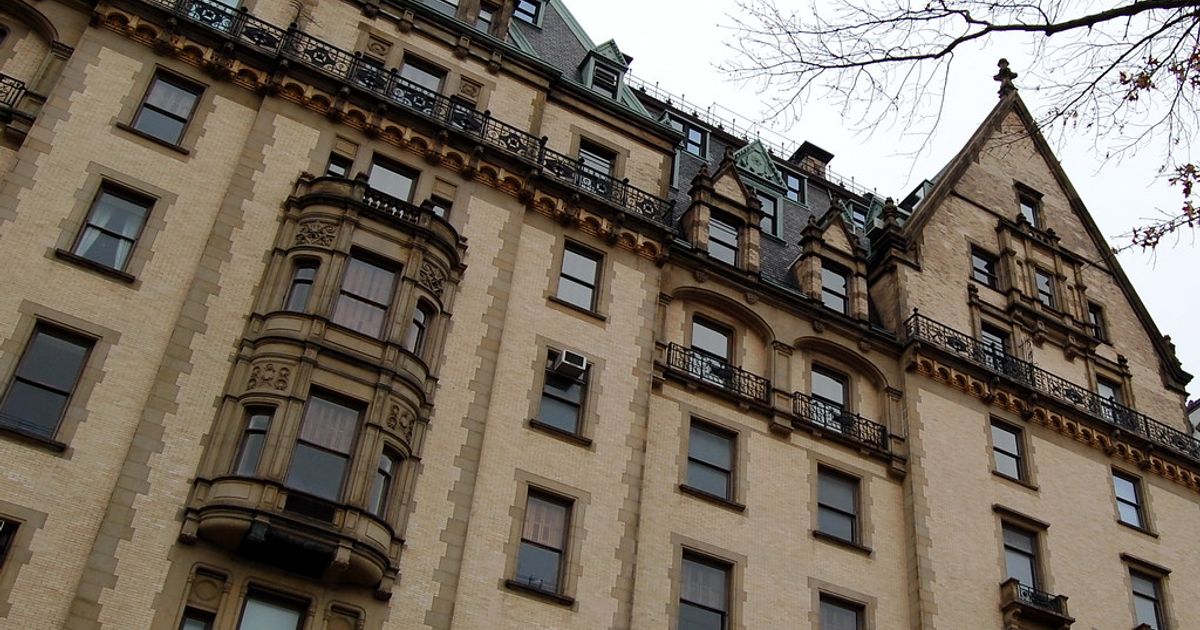
The Dakota, completed in 1884 by Henry Janeway Hardenbergh, occupies one of New York’s most symbolically charged addresses. Its German Renaissance facade rises at the corner of 72nd Street and Central Park West with the gravity of a civic building masquerading as a residence. John Lennon lived here. Leonard Bernstein practiced here. The building’s history is inseparable from the cultural mythology of Manhattan itself, and it is precisely this mythological weight that Stacey Bendet (fashion designer, founder of Alice + Olivia, and what the press reliably calls a “tastemaker”) chose as her institutional frame.
The choice was not passive. When Bendet and her husband, film producer Eric Eisner, purchased two adjacent apartments and undertook a three-and-a-half-year renovation combining them into a single 6,800-square-foot residence, they were not simply acquiring real estate. They were acquiring the oldest and most formidable of New York’s Semantic Burdens: an address that arrives pre-loaded with cultural authority, the kind that no amount of money can manufacture from scratch. The Dakota’s walls remember. And into those walls, Bendet has embedded a collection of singular objects that demands the most rigorous application of the Custodian’s Contract.
To transform a Dakota apartment into a “living art installation,” as Artsy described it, is to issue a declaration: these objects are not merely possessed; they are stewarded. Whether that declaration holds under scrutiny is the precise question this study pursues. The collection at hand: a Francesco Clemente fresco painted directly into plaster, a Julian Schnabel portrait of the family’s daughters, a 12-foot dining table of hand-painted volcanic tiles by Lola Montes Schnabel, twelve Claes Oldenburg color lithographs, Spanish rugs from the 1930s, and contemporary paintings by Jorge Galindo, is not decorative accumulation. It is a thesis about how singular objects can be lived with rather than merely owned. OAC’s task is to determine whether the thesis is structurally sound.
The Clemente Fresco: Narrative Permanence and the Architecture of Feeling
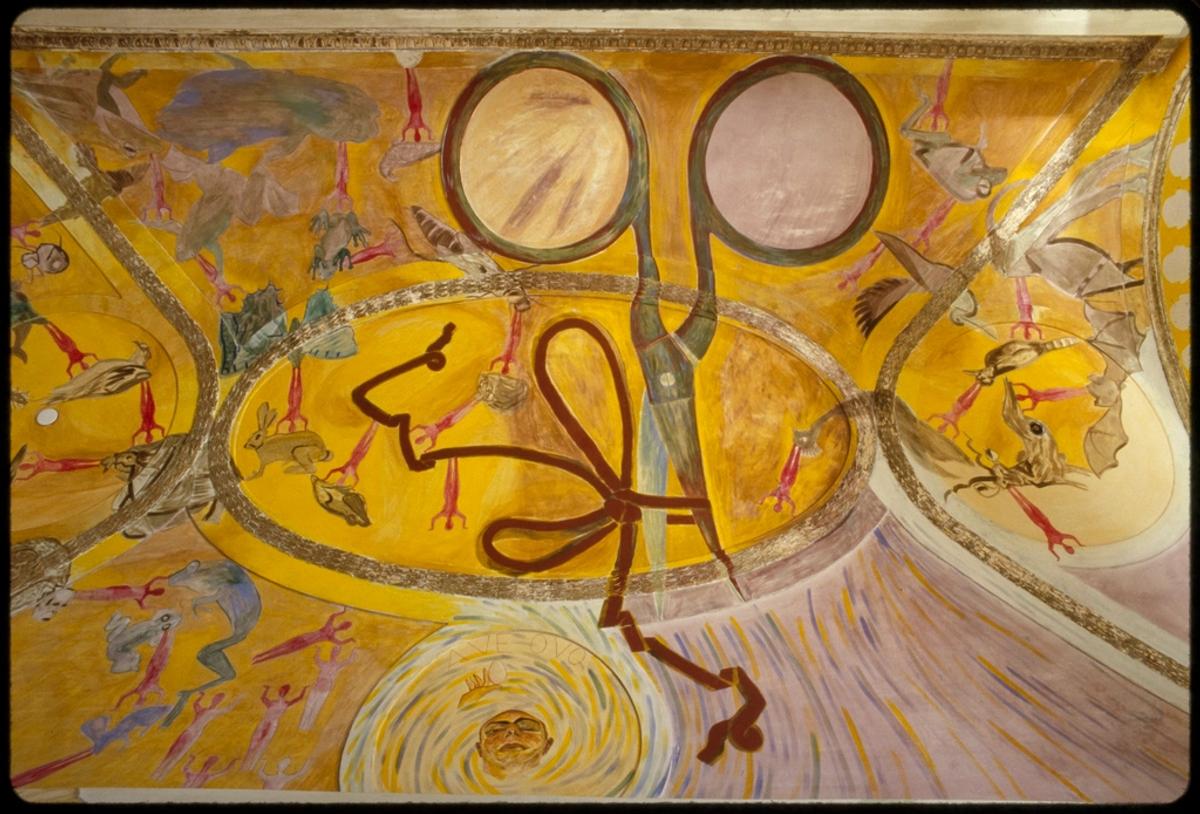
The most consequential work in Bendet’s collection is not the most monetarily significant. It is the most architecturally committed: a monumental fresco by Francesco Clemente, anchoring the living room of the Dakota apartment with the permanence of a decision that cannot be reversed.
Fresco is the most anti-speculative medium in the Western canon. A fresco is painted into wet plaster; it cannot be rolled up, crated, consigned to auction, or shipped to a secondary buyer. When Clemente painted his fresco into Bendet’s living room wall, he enacted something close to the One Original Principle in its most absolute form: the work is inseparable from its site, and the site is inseparable from the work. Any future sale of the apartment would require either the extraordinary and expensive extraction of the fresco or its abandonment; a provision that imposes real custodial cost on any future owner and effectively forecloses speculative exit for as long as the fresco survives.
Clemente, an Italian artist associated with the transavanguardia movement and long resident in New York and Rajasthan, brings to this commission a practice rooted in Narrative Permanence. His work draws from Hindu mythology, Jungian psychoanalysis, and the figural traditions of both Eastern and Western painting, producing images that accrue meaning across time rather than exhausting it. Clemente is among the few artists of his generation whose work remains legible on multiple registers simultaneously: the mythological, the psychoanalytic, the erotic, the spiritual, without collapsing any of them into the others. A Clemente fresco is not an illustration of a moment; it is a site of ongoing interpretation.
The fresco imposes on Bendet the most rigorous of custodial obligations: not the annual insurance premium but the architectural commitment to permanence, a commitment that money alone cannot discharge and that a change of address cannot dissolve.
The Custodian’s Contract, as OAC defines it, is the responsibility that accrues to those who possess objects of singular cultural weight. The fresco exceeds this contract. Bendet has not merely acquired a Clemente; she has become part of Clemente’s material record. The living room wall on which his pigment sits is now a primary document of his practice, and any future failure of preservation: water damage, structural modification, careless renovation, would constitute an irreversible loss to the art-historical record. This is a burden of extraordinary seriousness, and it is not clear that living with art in the manner of a “living installation” adequately acknowledges it.
The Burden of Preservation here is architecturally encoded. But it must also be consciously honored: documented, conserved, and legally protected against the contingencies of future ownership.
Julian Schnabel, Louise Kugelberg, and the Ethics of Intimate Commission
The first object a visitor encounters upon entering Bendet’s home is a portrait of her three daughters: Eloise Breckenridge, Scarlet Haven, and Athena Belle, painted by Julian Schnabel. It is a threshold work, an act of declaration before the first interior space is reached. In a home that aspires to the condition of a living installation, the choice of entry piece is a curatorial statement of the highest order: you are being told, before you see anything else, whose image this house considers primary.
What makes this commission more structurally complex than it first appears is the identity of the home’s interior designer: Louise Kugelberg, who is Julian Schnabel’s wife. The domestic and the artistic here are not merely adjacent; they are familially entangled. Kugelberg designed the space; Schnabel painted its threshold work; their daughter Lola Montes Schnabel fabricated its dining table. The renovation was, in a structural sense, a family project, a fact that the press coverage of the home has largely absorbed without examining. OAC examines it directly, because the nature of the commission changes the nature of the obligation.
This entanglement does not diminish the works. Julian Schnabel is among the most significant American painters of the late twentieth century, best known for his plate paintings (canvases onto which he fixed broken crockery before painting over it), his velvet works, and his tarp paintings. His practice is irreducibly tied to material specificity and Labor Density. A Schnabel portrait is not a decorative object. It is a claim of figuration made against the grain of abstraction’s dominance, a declaration that the human face, and in this case, the faces of three specific children in a specific household, matters enough to be painted with the full weight of a serious formal practice.
Bendet did not acquire these works at auction. She commissioned them from artists with whom she shares domestic proximity. This is a categorically different relationship to art than the collector’s accumulation, and it carries obligations that the market cannot discharge on the patron’s behalf.
The intimate commission is, in fact, the oldest form of the Custodian’s Contract: a relationship in which the artist entrusts the patron with the material record of a specific act of making, and the patron accepts the obligation to honor it, not merely to display it, but to preserve it, to document it, and to ensure that the conditions of its commissioning are available to future interpreters of the work. The Renaissance patron who commissioned a fresco was not purchasing an object; he was assuming a stewardship. Bendet’s position is formally identical.
The risk, as OAC’s pre-study analysis identified, is that intimate familiarity can slide into aesthetic convenience: the work becoming ambient, its formal propositions absorbed into the wallpaper of daily life. A Schnabel that you pass every morning on the way to breakfast occupies a different attentional register than one you visit by appointment at the Pace Gallery. Whether Bendet’s home sustains the discipline to avoid this absorption is a question that only sustained attention to the objects themselves, not to the press coverage of them, can answer.
Lola Montes Schnabel: Labor Density at the Dining Table
The 12-foot dining table in Bendet’s home is made entirely of hand-painted tiles by Lola Montes Schnabel. Lola Montes (Julian Schnabel’s daughter, who works primarily in Sicily with tiles made from volcanic ash and clay from Mount Etna) produces objects at the intersection of painting, craft, and furniture design. Her tiles carry a Labor Density that is structural rather than decorative: each piece requires hand preparation of volcanic material, individual firing, and painted marks that cannot be mechanically reproduced. The table is, in the strictest sense of the term, a singular object.
A 12-foot dining table of hand-painted volcanic tiles is an extraordinary daily object. It is not a display piece, segregated from use by a velvet rope. It is set for meals. Glasses are placed on it. Children do homework on it. The surface accumulates the ordinary trauma of domestic life: heat rings, scratches, the specific pressure of a morning coffee cup. This daily contact is, in one sense, the highest possible form of the Custodian’s Contract; the object is not protected from life but integrated into it. In another sense, it is the condition that most threatens the object’s material preservation. Lola Montes Schnabel’s tiles are fired volcanic ceramic; they are not fragile. But hand-painted surfaces, used daily over decades, are not permanent. The marks of her hand will fade.
OAC’s concept of the Hollowed Object becomes relevant here. The Hollowed Object is one in which the original conditions of Material Singularity have been evacuated by overexposure, over-use, or by the subsumption of the object’s identity into a larger aesthetic system. The risk for the Lola Montes Schnabel table is not overexposure in the market sense; it is overexposure in the domestic sense. When a singular craft object becomes the ground on which everyday life takes place, there is a real danger that its specific material claims: the volcanic origin of its tiles, the individual marks of a specific artist’s hand, become invisible, absorbed into the background of the domestic image.
The press coverage of Bendet’s home has been particularly vulnerable to this absorption. Multiple publications have described the dining table without noting that its tiles are made from volcanic material sourced from Mount Etna, a geological specificity that transforms the table from a decorative object into a territorial document: a piece of Sicilian volcanic earth, carried by hand to a Dakota apartment dining room. The Custodian’s Contract requires that this history be preserved in the object’s record: its provenance, its material composition, the name and practice of its maker, even, and especially, when the object is used every day.
Twelve Oldenburg Lithographs and the Intelligence of Pop
On a corner wall of the living room, twelve color lithographs by Claes Oldenburg form a serial installation of the kind that Oldenburg pioneered in his engagement with multiples, editions, and the reproducible image. The selection is significant for what it reveals about the collecting logic at work in Bendet’s home.
Oldenburg’s lithographs are editions, not unique works. A lithograph exists in multiple copies; it is, by definition, a challenge to the One Original Principle that governs OAC’s analysis of singular objects. The choice to hang twelve of them in a single installation, however, reframes their status: individually reproducible, they become collectively specific. The twelve lithographs, arranged in this particular corner of this particular wall in this particular Dakota apartment, constitute a unique configuration that cannot be duplicated. The installation is original even if each component is not.
This is a curatorial intelligence of considerable sophistication. Oldenburg, who died in 2022 at the age of ninety-three, was one of American Pop Art’s most formally rigorous practitioners. His lithographs are not decoration in the Warhol sense of celebrity-image amplification; they are graphic propositions about scale, material, and the relationship between the handmade and the manufactured. Placing twelve of them in serial arrangement is a statement about accumulation and sequence, about how a single image changes meaning when viewed in relation to eleven others, a curatorial insight that belongs to the tradition of the artist’s book and the installation more than to the tradition of the salon hang.
The risk, of course, is that the serial installation, twelve images covering a corner, becomes wallpaper. The eye normalizes repetition. What begins as a curatorial act becomes, over time, ambient pattern. This is the fundamental tension of the living installation: the works that demand sustained attention are precisely the ones most vulnerable to the domestication of daily familiarity.
As OAC’s study of James Turrell’s Skyspace at ARoS demonstrated, immersive spatial installations require a specific kind of attentional discipline to resist the degradation of familiarity. A Turrell Skyspace in a museum can be visited with intention; twelve Oldenburg lithographs in a family living room are encountered daily and without intention, by children doing homework and guests awaiting dinner. The attentional conditions of the domestic space are structurally hostile to the sustained looking that these works require.
The Ritz Hotel Rugs: Trauma Provenance and the Burden of Objects
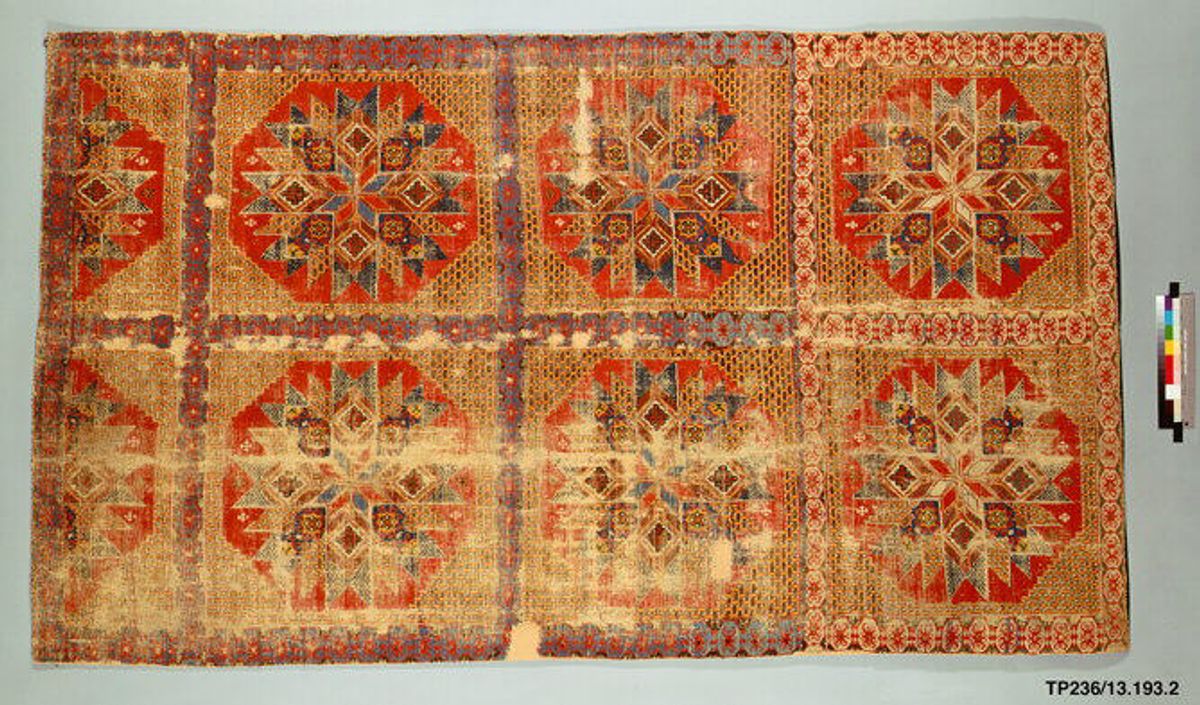
The Spanish rugs in Bendet’s home are described as originating from the Ritz Hotel in Madrid, dating to the 1930s. This description, offered in the home’s press coverage as a detail of decorative provenance, the kind of detail that signals connoisseurship and historical depth, carries a weight that demands more careful attention than it has received.
The Ritz Hotel Madrid, inaugurated in 1910, was by the 1930s one of Spain’s most prominent luxury establishments, frequented by diplomats, royalty, and international elites. The decade in which these rugs were woven and placed was not politically neutral. Spain in the 1930s moved from the fall of the Bourbon monarchy (1931) through the turbulent years of the Second Republic, to the military coup of July 1936, to three years of catastrophic civil war (1936 to 1939) that killed approximately five hundred thousand people, triggered the largest displacement of civilians in Spain’s modern history, and resulted in the confiscation, looting, and forced sale of property on an enormous scale. The Ritz itself was requisitioned as a military hospital for Republican forces during the war. Objects that passed through Spanish luxury institutions during this period carry a provenance gap that is not merely decorative.
OAC does not assert that these rugs were illicitly acquired. We assert only that the standard of the Custodian’s Contract requires that the question be asked and answered with documentary rigor, and that the press coverage of Bendet’s home has offered none. The Burden of Preservation here extends beyond material conservation to ethical documentation: when was the transition of ownership from the Ritz to wherever these rugs have been since, and does that chain of custody survive scrutiny?
An object’s beauty is not a defense against its history. The 1930s Ritz Hotel rugs arrive in Bendet’s home carrying a Semantic Burden that the aesthetic register of “decorative provenance” is wholly insufficient to address.
This is not a peripheral concern. It is central to whether Bendet’s collection constitutes a genuine commitment to custodial stewardship or a sophisticated performance of it. The distinction is precise: the steward asks what the object has been through; the accumulator asks only what it looks like. Bendet’s commitment to the Clemente fresco and the Lola Montes Schnabel table suggests the former disposition. The absence of documented provenance for the Ritz Hotel rugs leaves open whether that commitment extends to objects whose histories are less aesthetically convenient to examine.
Atmospheric Equity and the Danger of the Total Installation
The term “living art installation” is not a neutral descriptor. It is a genre claim, and like all genre claims, it carries both a promise and a risk. The promise is that the ordinary domestic environment has been elevated to the condition of art through intentional curation. The risk is the one OAC identifies as Atmospheric Equity: the conversion of singular objects into aggregate atmosphere, in which the individual Material Singularity of each work is subordinated to the cumulative aesthetic effect of the whole.
The danger of the total installation, an environment in which every surface, every wall, every functional object has been aesthetically determined, is that it produces a kind of Zero-Sum Aura among the works and their context. When everything is equally artful, nothing is singularly so. The Clemente fresco, the Schnabel portrait, the Lola Montes Schnabel table, the Oldenburg lithographs, the Ritz Hotel rugs, the Venetian chandeliers, the Jorge Galindo canvases, each is an object of considerable individual weight. But when arranged as components of a single unified “living installation,” their individual claims compete with each other for attentional priority and, in competing, risk diminishing one another.
This is not hypothetical. It is the precise dynamic that OAC’s analysis of Chrome Hearts identified in the context of brand environments: when singular craft objects are integrated into a totalizing aesthetic system, their material specificity is routinely absorbed into the identity of the system. The Chrome Hearts environment is not experienced as a collection of individual masterworks; it is experienced as an atmosphere, and in that atmospheric absorption, the distinction between a handcrafted silver cross and a mass-produced accessory is functionally erased. The risk for Bendet’s home is identical in structure, if different in register.
The Zero-Sum Aura operates at the level of the environment: each additional work of singular quality added to the installation must compete for the finite attentional resources of anyone within the space. The resolution of that competition is not always in favor of the most significant work. It is in favor of the most visually dominant, or the most recently acquired, or the one currently positioned in the path of domestic traffic. A Clemente fresco and a Venetian chandelier do not exist in a hierarchy of significance within the domestic experience; they exist in a competition for visual priority that the domestic environment assigns without intention, in the ordinary chaos of family life.
The Anti-Speculative Domestic: Structural Captivity Without Exit
The most significant structural feature of Bendet’s collection is also its most frequently overlooked: many of its most important works are functionally unsaleable in their current configuration. The Clemente fresco cannot be removed without destroying it. The Lola Montes Schnabel table is, in practical terms, architecturally embedded by its scale and material specificity. The commissioned portrait of the daughters is not a work that would normally appear at auction; intimate commissions of this kind carry social obligations that complicate market exit. The Spanish rugs, embedded in the decorative logic of a specific interior, would lose considerable meaning, though not necessarily monetary value, outside of it.
This unsaleability is not an accident. It is the structural consequence of commissioning works that are materially specific to their location. In this sense, Bendet’s collection enacts a form of the Monastic Veto: an implicit refusal to participate in the secondary market, not through contractual prohibition but through material irreversibility. You cannot sell what you cannot move.
The connection to Structural Captivity is precise: these objects are, in the strict sense, captive to their site. They cannot be liquidated without catastrophic loss to their material integrity. This is, from OAC’s analytical framework, a genuinely anti-speculative position, not because Bendet has signed an anti-speculation covenant, but because the physical nature of the works she has commissioned renders speculation structurally impossible. The fresco cannot be financialized; it can only be inhabited or destroyed.
This is the positive reading of Bendet’s curatorial practice: the prioritization of site-specific and materially embedded works over portable, market-ready acquisitions constitutes a genuine commitment to long-term custodial engagement rather than short-term Aura Transaction. The fresco, the table, the threshold portrait, these are not investments in the conventional sense. They are commitments. And commitments cannot be easily reassigned.
But structural captivity without conscious stewardship is not the same as genuine custodianship. The absence of explicit contractual frameworks: documented maintenance protocols for the embedded works, verified provenance research for the historical objects, legal protections against the decontextualization of any works that do eventually change hands, leaves the collection without the institutional scaffolding that would transform material commitment into formal stewardship. A commitment honored by habit is more fragile than one honored by contract, and the Custodian’s Contract is precisely that: a contract, not a sentiment.
Institutional Necrophagy, the conversion of genuine artistic value into brand capital, does not require market transactions to operate. It can occur entirely within the domestic sphere, through the gradual subsumption of an object’s material identity into its function as a component of a personal brand’s aesthetic image. When Bendet’s home appears in Artsy, in Architectural Digest, in Pinterest reshares, the Clemente fresco and the Schnabel portrait are not experienced as independent works of art. They are experienced as elements of the Stacey Bendet aesthetic: collateral for the brand identity of a fashion designer who “lives with art.” The fact that Bendet’s Alice + Olivia has collaborated with the estates of Jean-Michel Basquiat and Keith Haring on fashion collections makes this dynamic structurally explicit: art, in Bendet’s professional world, is already a brand strategy. The question is whether her private collection operates on a categorically different logic, or whether the home tour is another form of the collaboration.
The Speculative Velocity at work here is not market velocity; it is brand velocity. The home tours accelerate the conversion of these works from singular objects into components of an image economy. Whether Bendet is aware of this acceleration, and whether she has taken structural steps to resist it, is not something the press coverage has examined. It is the question that the Custodian’s Contract most urgently demands she answer.
Coda
Stacey Bendet’s Manhattan home is not a cynical object. The Clemente fresco was not commissioned for its investment value; its investment value was actively foreclosed by its commissioning. The Schnabel portrait was not acquired to signal proximity to power; it was painted by a family friend whose wife designed the room in which it hangs. The Lola Montes Schnabel table was not purchased as a status symbol; it was made by hand, tile by tile, in volcanic clay from a specific Sicilian hillside. These are the marks of a genuine engagement with material culture, not a performance of it.
What OAC asserts is not that Bendet’s stewardship is fraudulent. It is that stewardship of this scale and seriousness requires institutional rigor that personal intention alone cannot supply. The Clemente fresco deserves a documented conservation protocol, filed with a conservator and updated at regular intervals. The Spanish rugs deserve a provenance investigation that accounts for the specific political history of 1930s Spain, with its civil war, its forced displacements, and its documented appropriation of private property. The commissioned works deserve contractual protections against the dispersion and decontextualization that will inevitably follow any future transfer of the property. The “living art installation” framing, as appealing as it is, is not a substitute for the structural mechanisms of genuine custodianship.
The most consequential question the home raises is also the simplest: what happens to the fresco when the apartment is eventually sold? The answer to that question will reveal, with more precision than any press tour, whether Bendet’s commitment to these objects is custodial or atmospheric, whether she understands herself as the work’s guardian or merely its most recent host.
The Custodian’s Contract requires permanence of commitment, not permanence of residence.