Lucien Pellat-Finet: The Skull on the Softest Thing in the Room
He put marijuana leaves and skulls on some of the finest cashmere ever knitted, and charged accordingly. The joke was never the sweater. The joke was that the sweater was real.
There is a kind of luxury that announces itself by subject matter. A silk scarf with horses on it. A cashmere sweater in oatmeal. The material is precious and the image agrees with the material, and the whole object nods in one direction.
Lucien Pellat-Finet spent thirty years doing the opposite, and he did it without lowering the material by a single grade.
He was born in Nice on 11 February 1946 and grew up on the Côte d'Azur. He came into fashion sideways rather than through a school: he was discovered as a model by Pierre Cardin, and in the 1970s he worked on the staging of Thierry Mugler's shows, which is an education in spectacle rather than in cutting. He founded his own label in 1994, comparatively late, at forty-eight.
The first collection was ten pieces of four-ply cashmere knitwear, shown in New York.
Ten pieces. Not a runway argument, not a season. A small number of extremely good sweaters.
The material, which is the part people skip
Everything interesting about Pellat-Finet depends on the cashmere being genuinely exceptional, so it is worth being precise about what that means, because the word has been degraded almost to meaninglessness by the high street.
Cashmere is graded by fibre length, fineness and colour. Long, fine, pale fibres can be spun into yarn that resists pilling; short, coarse ones cannot, whatever the label says. The distinction between carded and combed yarn matters too: combing removes the shorter fibres and produces a smoother, denser, more durable yarn, and it wastes a great deal of expensive material doing it.
The house's own account of its yarn is that it is Italian, carded, tightly knitted, and lightly washed in the Scottish tradition. The knitting is intarsia, which is the technique that lets a motif be built into the fabric as a block of coloured yarn rather than printed onto it or embroidered on top, and the intarsia was done by knitters in Edinburgh, a region whose entire reputation rests on high-end cashmere.
That combination is not a marketing sentence. Carded Italian yarn, Scottish finishing and intarsia knitting are three separate expensive decisions, and each one is visible in the object decades later.
It is worth walking through why each of them costs money, because this is the part of a designer profile that usually gets waved through, and in this case it is the entire foundation of the argument.
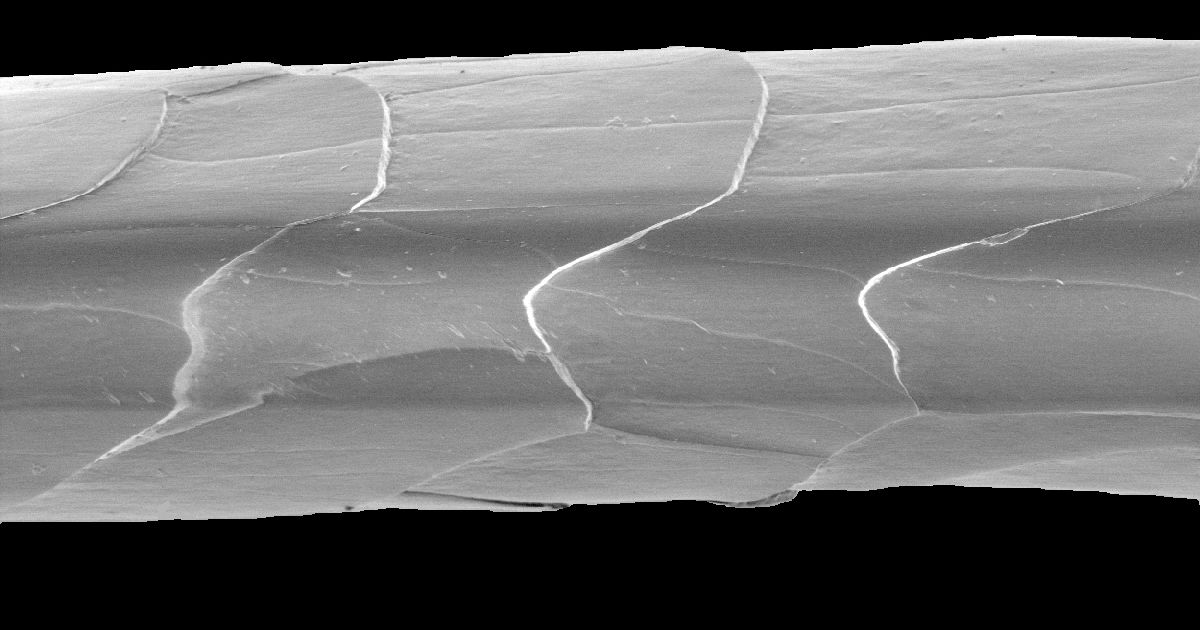
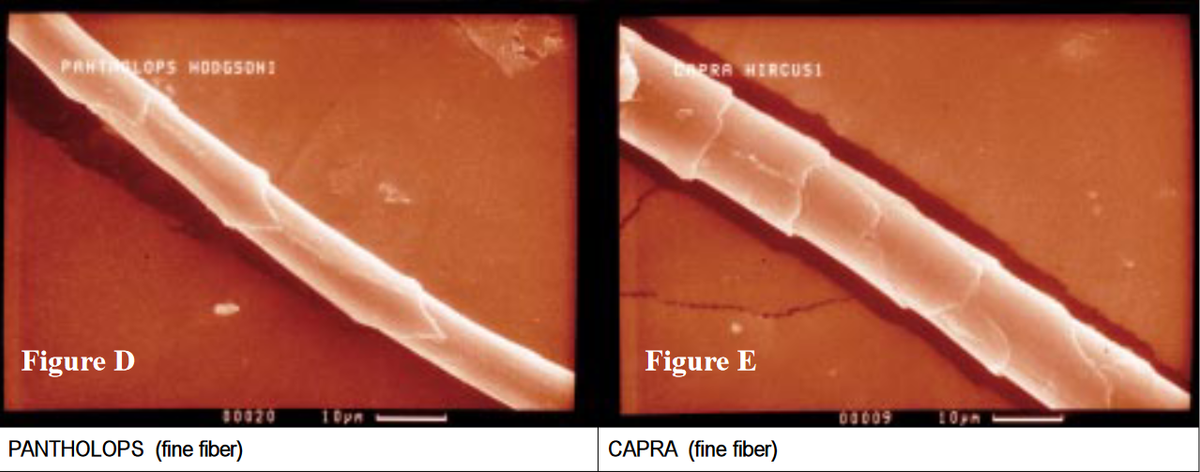
The fibre. Cashmere is the fine undercoat a goat grows for winter and sheds in spring. It is not shorn like wool so much as harvested, by combing, in quantities measured in a few hundred grams per animal per year. A single sweater can take the annual yield of several goats. The fibre is finer than sheep's wool, typically well under twenty microns, and the fineness is what produces the handle people pay for. The trade-off is that fine fibres are weak individually and the garment's durability comes from length rather than thickness: long fibres are held securely in the twist of the yarn, while short ones work loose under friction, migrate to the surface, and tangle into the small balls everyone recognises as pilling. Pilling is not wear. It is a purchasing decision made months earlier, showing up on the elbows.
Carded against combed, which is where this gets interesting. Carding disentangles the fibres and aligns them roughly. Combing goes further and removes the short ones, which is why combed yarn is smoother and more durable, and why it is dearer: the discarded short fibre is expensive material being thrown away. Carded yarn spun from long fibre produces a fuller, softer, loftier hand, which is why a house that wants warmth and body rather than a flat worsted finish chooses it deliberately.
But carding leaves the short fibres in, and short fibres are the direct cause of pilling. Carded cashmere is the construction more prone to pill, not less. The trade knows this. It is the standard objection to carded yarn.
Now hold that against the twenty-year-old sweater that had not pilled.
A carded garment that survives two decades without pilling is not evidence of gentle ownership. It is evidence that the fibre going into the yarn was long enough that the shorter ends carding leaves behind were not short enough to matter. The premium threshold in the trade is a staple length above roughly thirty-four millimetres, and fibre below about twenty-eight millimetres raises pilling sharply. Fineness alone does not do this: a very fine cashmere with short fibre will pill faster than a slightly coarser one with long fibre, which is why the micron number printed on a swing tag proves almost nothing on its own.

So the house chose the softer, riskier construction and then had to buy its way out of the risk with fibre length. That is an expensive way to arrive at a hand you could have approximated more cheaply and more safely, and it is exactly the kind of decision that never appears in a campaign.
The Scottish wash. Scottish cashmere finishing is a genuine regional technology and it depends on local water. The knitted panel goes into the water soft and comes out having bloomed: the fibres relax and open, the surface fills, and the fabric acquires the density that makes a Border or Elgin sweater feel unlike the same yarn finished elsewhere. It is a finishing step that cannot be rushed and cannot be relocated without changing the result.
Intarsia. Almost every motif on almost every sweater in the world is applied after the fact, by print, embroidery, applique or patch, because those are fast and forgiving. Intarsia is none of those things. The coloured areas are knitted as part of the fabric itself, each colour fed from its own bobbin, the yarns twisted around one another at every colour change so the panel holds together. There is no float of yarn carried across the back, which means the fabric is a single thickness and reversible in a way jacquard is not. It is slow, it is skilled, it is difficult to automate at the quality end, and it is unforgiving of error because a dropped twist is a hole rather than a flaw.
Set those four decisions beside one another and a picture emerges of someone who was not, in any sense, being casual. Every one of them is a choice to spend more for a result that is invisible in a photograph and obvious in the hand, and obvious again in twenty years.
The most useful review of a Pellat-Finet sweater ever written is a passing remark in AnOther, that a twenty-year-old example looked brand new and had not pilled. That is the whole quality argument, made by time rather than by copy. A sweater that does not pill after twenty years was made from the right fibre by people who knew what they were doing, and no amount of branding can produce that result retroactively.
He was called the king of cashmere, and in another account the pope of it. The titles are journalistic. The twenty-year-old sweater is evidence.
And then he put a cannabis leaf on it
Onto that ground, Pellat-Finet knitted skulls. Marijuana leaves. Peace signs. Sometimes crystals.
Take the sequence seriously, because the order is the argument. First, an obsessive, expensive commitment to a material associated with discretion, inherited money and the avoidance of attention. Then, worked into the fabric itself by the most laborious available method, an image from a poster on a teenager's wall.
The tension is deliberate and it was described at the time as exactly that: a precious fabric carrying symbols that trigger shock and attraction at once. He was, by his own book's title, engaged in something he considered (anti) fashion.
It is important to see what he did not do, because that is where most people misread him.
He did not make cheap clothes with rebellious graphics. That is an entire industry and it requires no courage. He did not make luxury clothes that gestured at rebellion through styling, colour or a moody campaign. That is most of the market.
He kept the material at the very top of what is physically achievable and put a disreputable image on it, at full price, permanently, knitted in rather than printed on.
A printed skull can be read as a season's idea. A skull built into the intarsia is a structural decision about what the object is. You cannot remove it without unmaking the sweater.
Inspirations, and the Murakami decade
His visual world was pop, Japanese, and unembarrassed by kitsch.
From 2002 he collaborated with Takashi Murakami, a relationship that ran until 2019 and came about through the dealer Emmanuel Perrotin, who was showing Murakami's work. That is a seventeen-year collaboration, which in fashion terms is not a collaboration at all but a shared practice.
The pairing makes sense the moment you look at both bodies of work. Murakami's Superflat argument is that the distinction between high art and commercial character design is a Western imposition that Japanese visual culture never accepted. Pellat-Finet was making the same argument in yarn: that the hierarchy separating a luxury material from a low image is a convention, not a law, and that you can simply decline it while keeping the material standards absolutely intact.
Japan understood him early and thoroughly, which is not incidental. A culture entirely comfortable with the coexistence of exquisite craft and cartoon iconography had no difficulty with a four-ply cashmere sweater carrying a grinning skull.
The skull deserves more than a passing mention, because it is the motif he returned to most and it is much older than streetwear.
The skull in European art is the memento mori, and it arrives with a specific job: to sit inside a picture of wealth and remind the owner that the wealth is temporary. It appears in Dutch still lifes among the lemons and the silver, in portraits beside the sitter's books, in the anamorphic smear across the bottom of Holbein's The Ambassadors. Its entire function is to be the one element in an expensive image that refuses to celebrate.
Now put it on cashmere.
A skull knitted into a luxury sweater is not simply a rock reference, though it is also that. It is the oldest available device for undercutting a display of means, applied to a display of means, and made permanent by the technique. The object contains its own commentary and cannot be separated from it.
Whether Pellat-Finet intended the art-historical reading is not something this study can establish, and it does not especially matter. He was working with an image that carries five centuries of exactly this function, in a category built on the opposite instinct.
The cannabis leaf does something different and simpler. It has no lineage in this register. It is contemporary, faintly illegal, associated with leisure rather than labour, and completely undignified. Where the skull undercuts the display, the leaf refuses to take it seriously at all, which may be the more difficult of the two things to do at that price.
What his approach actually was, in this institution's terms
Post-Luxury Conceptual Functional Art holds that an object's value can be traced to what is materially true about it rather than to what is claimed on its behalf. Most luxury fails that test in a specific way: the material is ordinary and the story is extraordinary, and the price attaches to the story.
Pellat-Finet inverts the failure, and that is why he belongs in this register.
His Material Singularity is real and it is verifiable by anyone. The fibre grade, the carding, the Scottish wash, the intarsia labour: these are not narrative claims. They are decisions with costs, and they leave physical evidence that survives the marketing entirely. Twenty years later the sweater either pilled or it did not.
His semiotics, meanwhile, actively refuse the aura the material would otherwise confer. The cannabis leaf is not there to make the sweater cool. It is there to prevent the sweater from being solemn. It blocks the object's route to the kind of reverence that lets a luxury house charge for atmosphere.
The result is unusual: an object whose price is defensible on material grounds and whose imagery declines to help justify it. The customer is not buying a heritage narrative, a founder myth, or a lifestyle. They are buying an extremely good sweater with a skull on it, and the skull is doing the work of making sure nobody mistakes the transaction for anything more dignified than it is.
That is a coherent post-luxury position, arrived at in 1994, without any of the vocabulary that now exists to describe it.
And it has a limit that should be stated rather than admired past. This was still a very expensive object sold to people who could afford irony. The transgression was aesthetic and it was priced. Nothing about a skull on cashmere redistributes anything, and the position works precisely because the material underneath is beyond reproach. Take away the fibre quality and the whole argument collapses into a graphic tee.
What happened to it
The label entered bankruptcy proceedings and was acquired in 2019 by Thierry Gillier, the founder of Zadig & Voltaire.
In 2021 the new ownership introduced a rebrand, developed by Lolita Jacobs and Jean-Baptiste Talbourdet-Napoleone, and it did one thing worth pausing on: it stripped the founder's first name. Lucien Pellat-Finet became Pellat-Finet.
He was alive when that happened. He had another three years.
The brand then appointed Dryce Lahssan as creative director of collections and image, ahead of its thirtieth anniversary. That arrangement did not last. The label reverted to being designed by an in-house studio team, separate from Zadig & Voltaire, and the owner does not expect to appoint another creative director, favouring a collaboration strategy instead.
Lucien Pellat-Finet died on 26 February 2024, at seventy-eight, in an accidental drowning at Trancoso in Brazil, fifteen days after his birthday.
Where the name is today, measured rather than assumed
On 13 August 2026, pellatfinet.com is a single page.
It shows a black t-shirt with a white skull, the words LUCIEN PELLAT-FINET across it, and beneath them a co-branded line reading Zadig and Lucien Pellat-Finet. There is one link on the entire site and it goes to zadig-et-voltaire.com. The manifesto page and the yarn page that search engines still index both resolve to this same splash. The Zadig & Voltaire storefront itself was not carrying the collaboration at the time of checking.
Two things follow, and only one of them is certain.
The certain one: the first name is back. The 2021 rebrand removed Lucien; the current page restores it, in full, twice. Whatever the reasoning, the founder's given name has been judged to be worth more than the cleaner mark that replaced it, and that judgement was made after he died.
The uncertain one: what is being relaunched. A splash page and a co-brand is a teaser, and a teaser is a promise rather than a product. The two houses have also been putting their names on one boutique together at 326 Rue Saint-Honoré. Whether the result is a continuation of a cashmere house or a graphic licensed onto a larger brand's distribution is not answerable from a landing page, and this study is not going to guess at it from one.
The thing a maker cannot leave behind
The material knowledge survives him and always would have. Spinners in Italy, knitters in Scotland and a London knitter now named in the brand's own account are institutions with their own continuity. A house can buy that capacity, and Pellat-Finet did exactly that himself in 1994. Nothing about the fibre grade or the intarsia depends on any one person being alive.
What does not transfer is the decision.
Somebody had to decide that the correct image for the best cashmere available was a marijuana leaf, and to keep deciding it for thirty years while the industry around him proved repeatedly that it was easier to sell heritage. That judgement is not in the yarn. It is not in the knitting machine. It is not written into the intarsia pattern, which will reproduce a skull perfectly for anyone who asks it to.
This institution's question is why humans give meaning to things, and the useful version here is narrower. The object can be made again exactly. The choice to make that object cannot. Every element of a Pellat-Finet sweater is reproducible by a competent supply chain, and the reason the sweaters meant something was a man's refusal to let an expensive material behave itself.
He was, according to the title of the book he made with Natasha Fraser-Cavassoni, super lucky. He was also, on the evidence of the objects, extremely disciplined about the one variable he could not outsource.
The skulls will keep coming off the machines. That was always true. The question the relaunch will answer, and which nobody can answer for it in advance, is whether anyone is still making the choice, or whether the pattern is simply running.