Nanotyrannus "Jodi" at Sotheby's: A Name, Not a Number
On a Montana skeleton, a disputed genus, and the difference between a nickname and an index.
Nanotyrannus "Jodi" at Sotheby's: what is in the lot
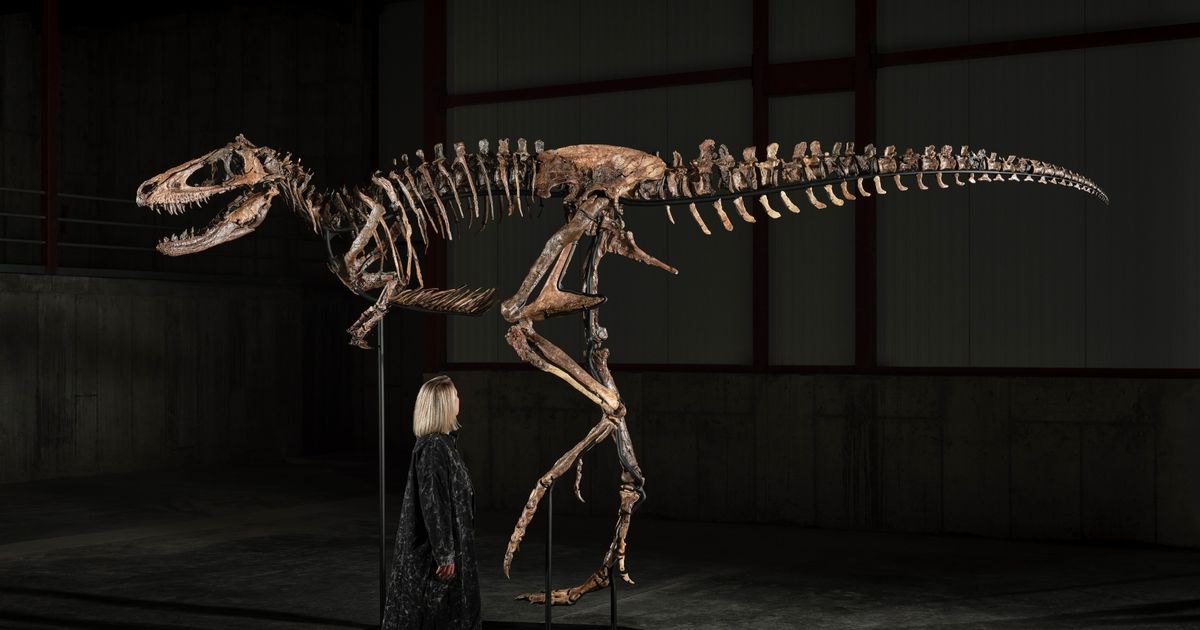
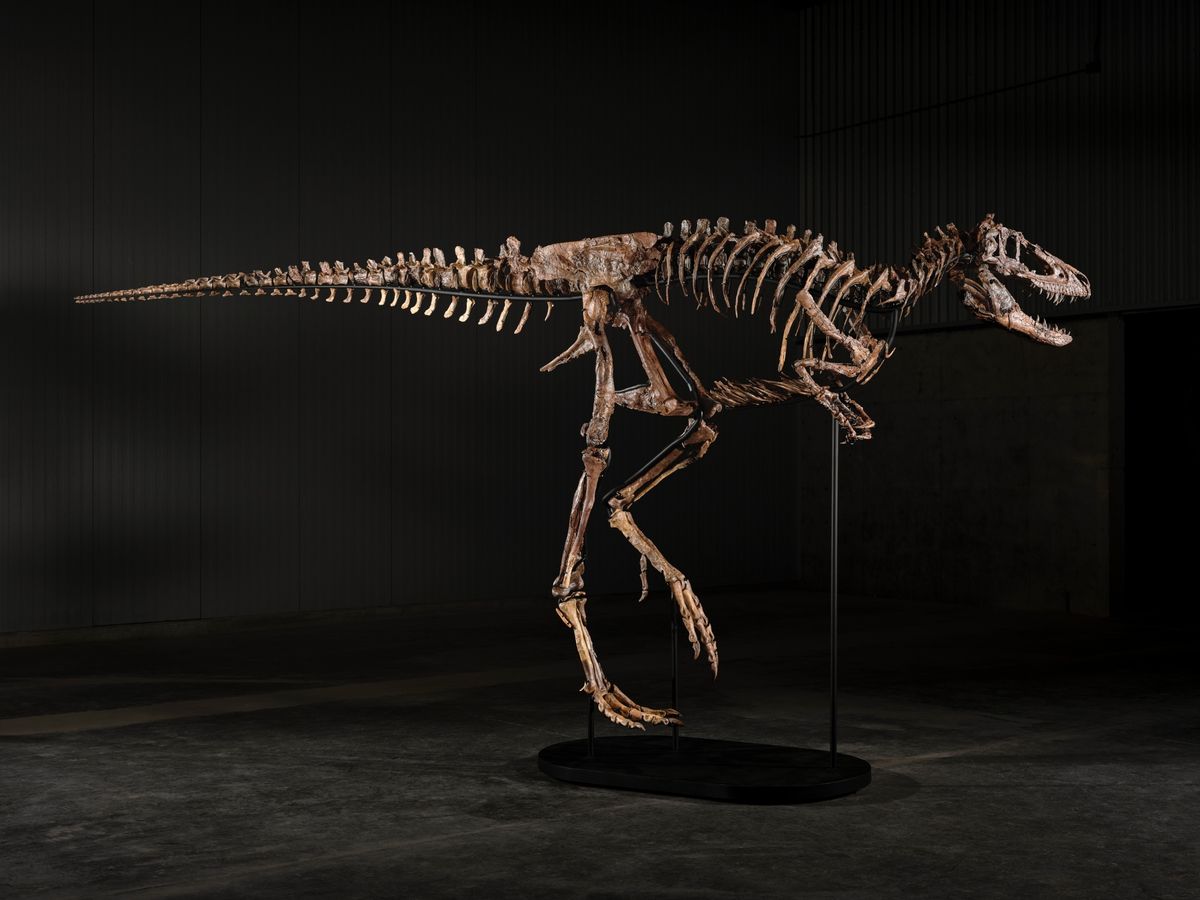
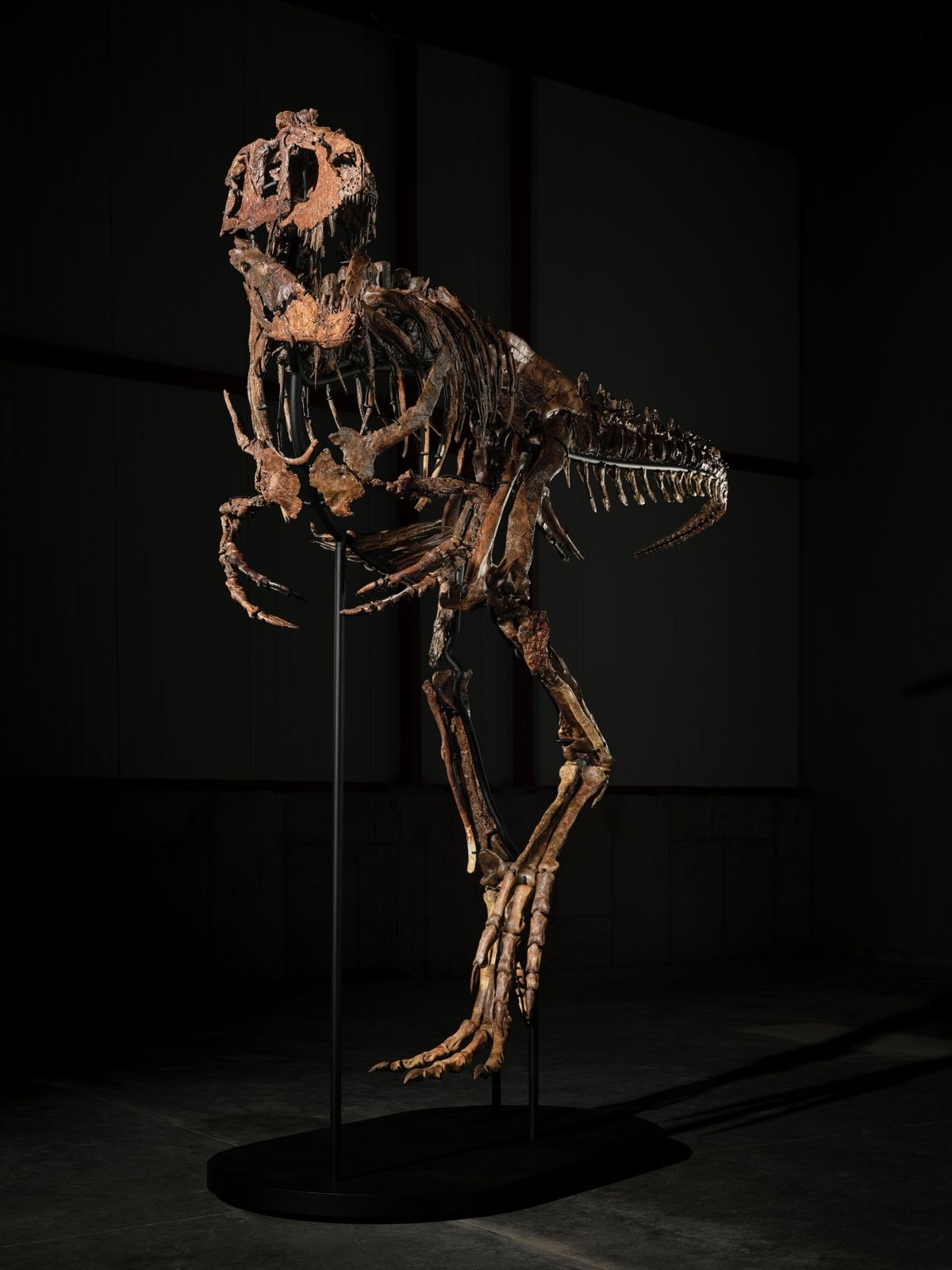
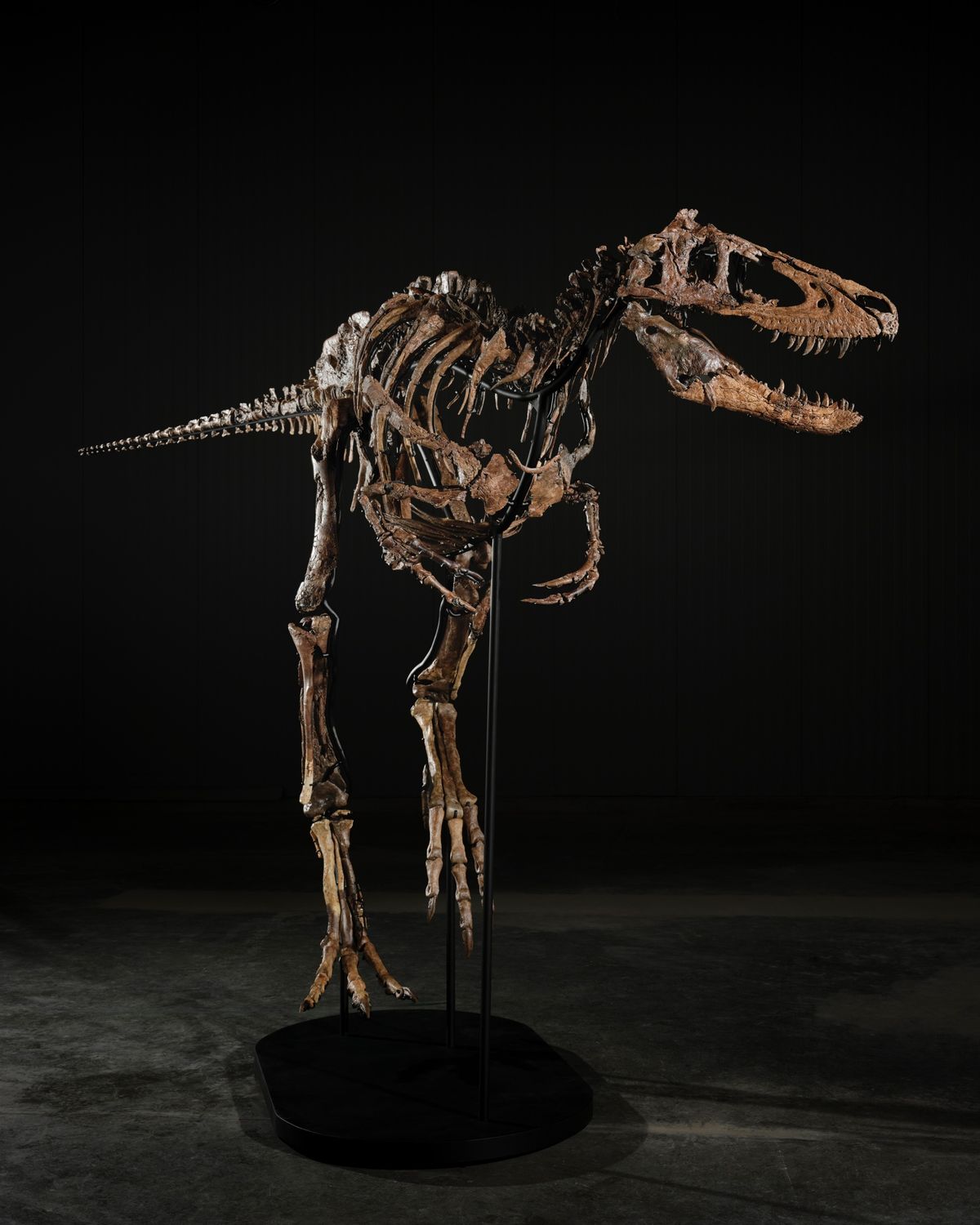
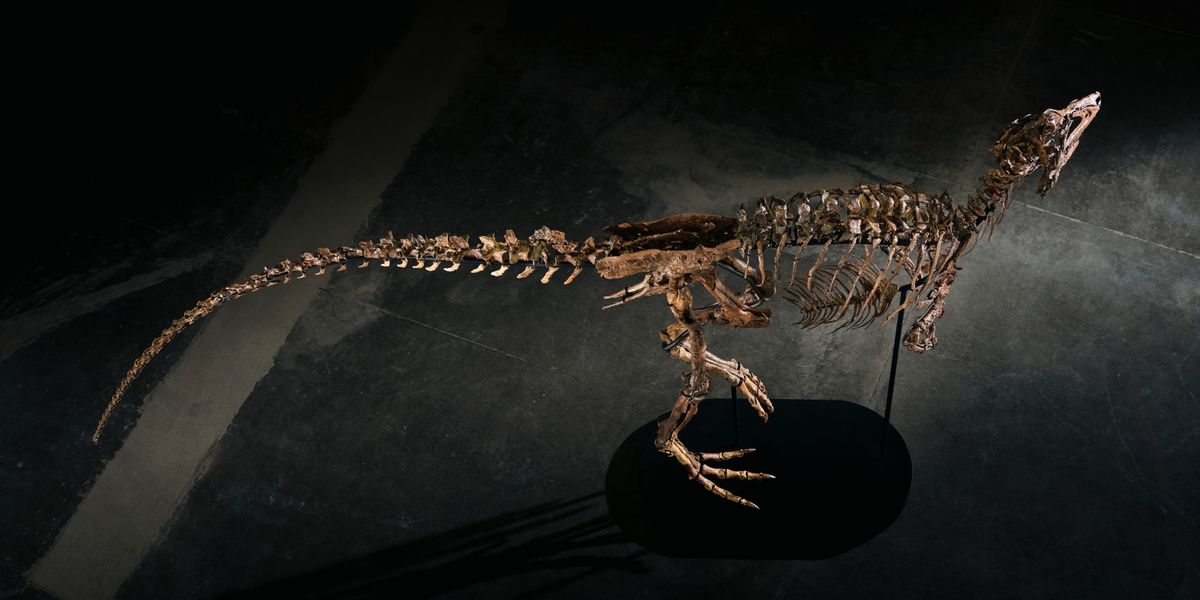
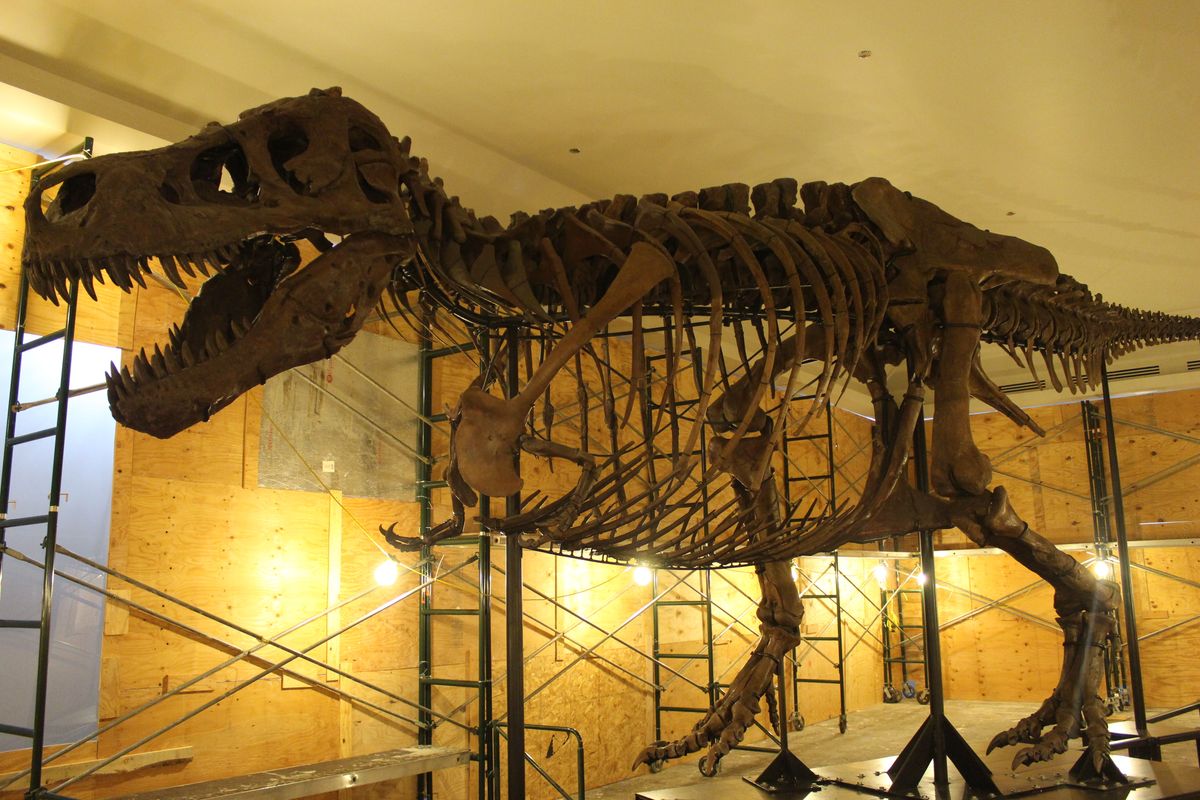
Lot 1 in New York this morning is a mounted skeleton about nineteen and a half feet long, assembled from approximately 191 fossil elements, with a skull of fifty three bones and roughly fifty teeth. It came out of the Hell Creek Formation in Garfield County, Montana, in a single field season in 2019. The estimate is six to nine million dollars.
The catalogue calls it Nanotyrannus cf. lancensis.
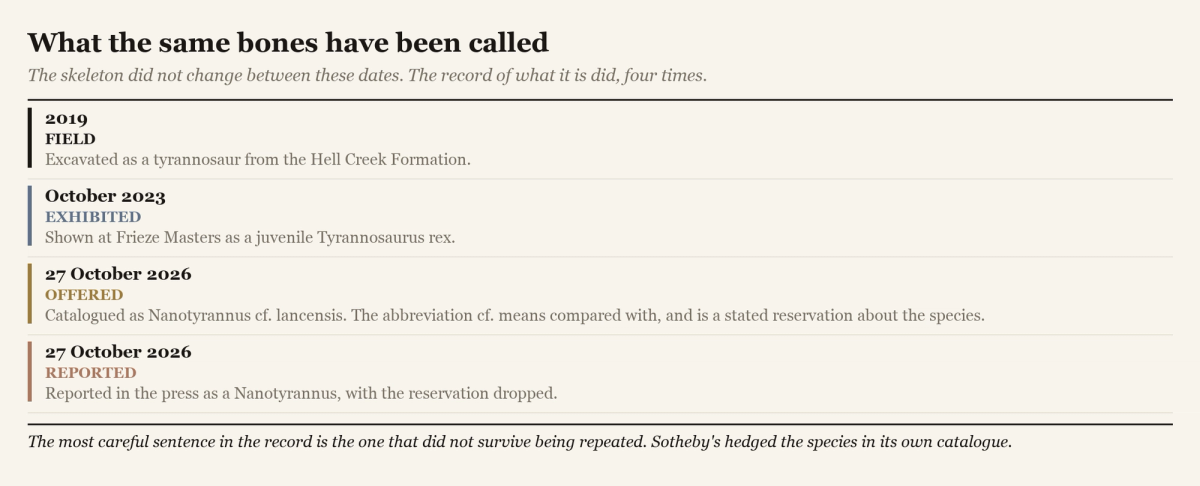
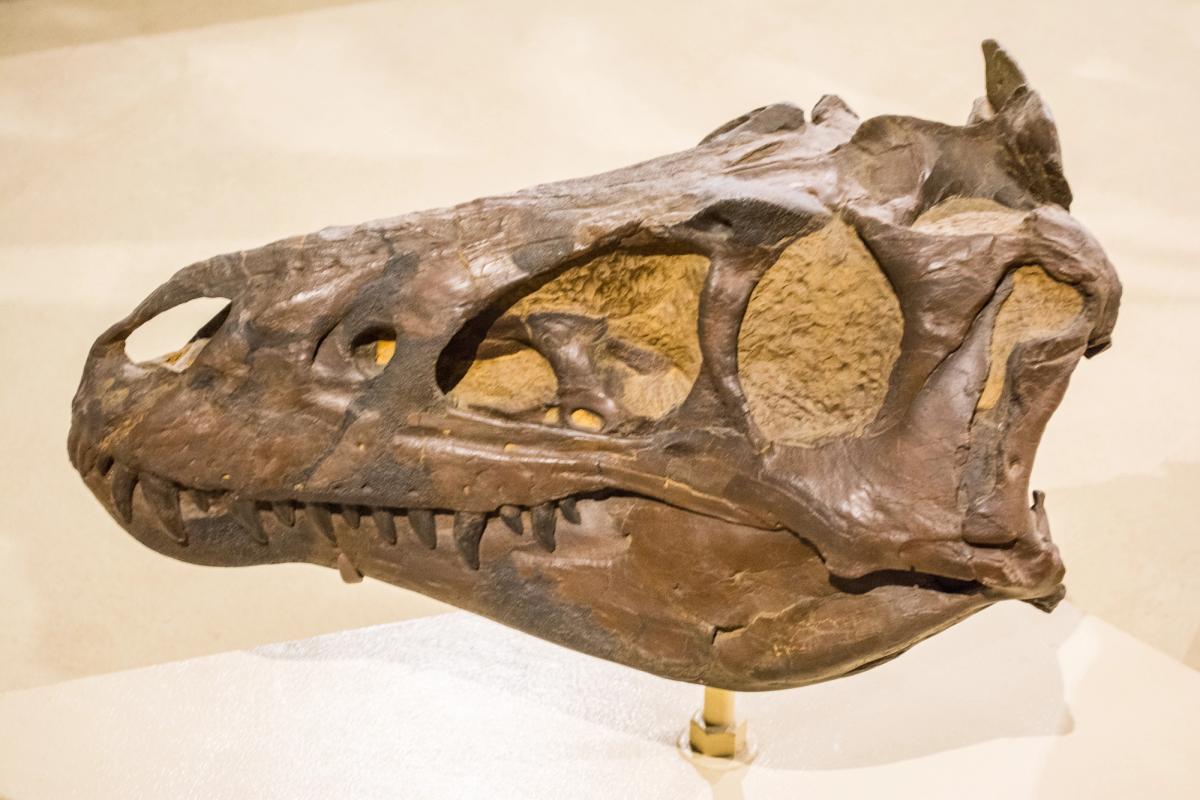
Nearly every account of the sale calls it a Nanotyrannus. The catalogue does not, quite. Those two letters, cf., abbreviate the Latin confer, and in zoological naming they mean compared with. A specimen labelled cf. lancensis resembles lancensis closely enough to be filed beside it and has not been shown to be it. It is a stated reservation, written by the people selling the object, in the document describing what they are selling.
There is no rule governing it. Stefan Bengtson, writing in Palaeontology in 1988, put the position plainly: "Since the International Code of Zoological Nomenclature refrains from any reference to open nomenclature, taxonomists are left to their own subjective interpretations." He also wrote the sentence that decides how to read Sotheby's here. "Careful and judicious use of open nomenclature reflects scientific honesty; its use is not a sign of weakness or lack of confidence."
It is the most careful sentence in the record, and it did not survive one repetition.
Three things before the rest. This sale is lawful. A landowner found a fossil on her own land in Montana and may sell it, and the section below sets out how that was settled in court. This study takes no view on where the object should end up. And it does not adjudicate the science, which is a live argument between named researchers and is settled by evidence rather than by anyone's opinion of an auction.
What is left is a question nobody at the sale is being asked. A skeleton is about to change hands. What happens to everything written down about it?
Chomper at Frieze Masters: the same bones at twenty million dollars
The skeleton has been offered before, under another name.
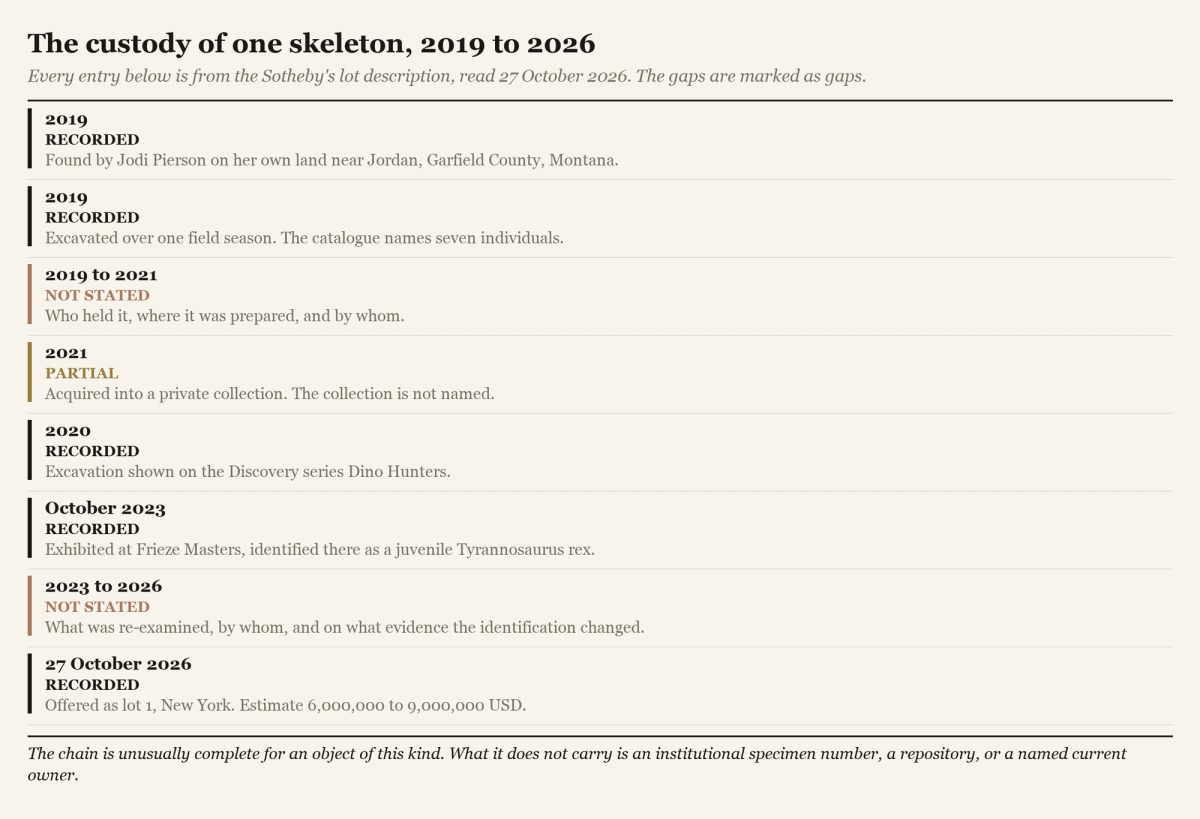
In October 2023 it stood on the stand of the London dealer David Aaron at Frieze Masters, where The Art Newspaper reported it was "named Chomper for its well-preserved set of teeth" and "priced at $20m". Salomon Aaron, a director of the firm, called it "a once in a lifetime discovery". It was presented as a juvenile Tyrannosaurus rex.
Sotheby's records the exhibition and discloses the change. Its provenance line reads "Frieze Masters, 11-15 October, 2023 (misidentified as a juvenile T. rex)". What the catalogue does not carry is the word Chomper, which appears nowhere on the lot page, nor any explanation of the name Jodi, which comes from Jodi Pierson, the rancher who found it. A reader holding only the provenance cannot connect this lot to the 2023 press about that one.
So the object has had two names and two species in three years, and the bones did not change.
The prices are worth stating precisely, because they are not the same instrument. The twenty million was a figure reported in the press for a work on a dealer's stand, privately negotiable, with no public outcome and no named person at the firm quoted giving it. Six to nine million is a published auction estimate. Whether anything was paid at either number is not public. What can be said is that the same object was publicly offered in 2023 at a reported twenty million under one species and is published in 2026 at six to nine million under another, during a period when the top of this market moved from $31.8 million to $50.1 million.
Zanno and Napoli in Nature: the paper that changed the label
The reclassification rests on work published in autumn 2025 by Lindsay Zanno and James Napoli. Their conclusion, in the abstract's own words, is that the taxon is distinguishable from Tyrannosaurus and sits outside Tyrannosauridae, and that it contains two species, N. lancensis and a new one, N. lethaeus.
Several figures in circulation about that paper do not survive checking. North Carolina State University's release says Zanno and Napoli "examined over 200 tyrannosaur fossils". That number is the university's, not the paper's, and no published table in it reaches two hundred. What the supplementary data does contain, counted directly: a phylogenetic matrix of 57 taxa by 441 characters, a morphometric dataset of 122 specimen rows, and a specimens-studied table of 106 rows drawn from 22 institutions.
Two details matter for what follows. The holotype of N. lancensis remains CMNH 7541 at the Cleveland Museum of Natural History, and it is not a skeleton: a 2026 paper in Science describes it as "an isolated skull and ceratobranchials". And the holotype of the new species N. lethaeus is BMRP 2002.4.1, the specimen known as Jane, at the Burpee Museum of Natural History.
Every one of those is a number attached to an institution.
The argument did not end when the paper appeared. The argument that these animals are juvenile Tyrannosaurus has been made for decades, and it has not ended because one paper appeared. Napoli's own framing of his case, as given to the press, is that "for Nanotyrannus to be a juvenile T. rex, it would need to defy everything we know about vertebrate growth".
The published responses are more informative than the coverage. Lawrence Witmer wrote the Nature News and Views piece. An independent ten-author team led by Griffin reached the same conclusion by a different method in Science, and two of its authors come from the Cleveland museum that holds the holotype. Andrew Farke commented in Science under the title "Not a big baby". A separate position exists again: Longrich and Saitta argued in 2024 that Nanotyrannus is valid while disputing which specimens belong to it.
And the sharpest line sits in the supplementary data rather than in any press release. Beside the new species' holotype, the authors note that it is "currently under monographic description by Carr et al. (in prep)". Thomas Carr is the principal advocate of the opposing hypothesis. A species was erected on a specimen he is independently monographing.
None of this is OAC's to adjudicate. It is set out because the lot in the saleroom carries a label that depends on it, and a label is a claim about a record.
Who owns a fossil in Montana, and what a buyer is actually promised
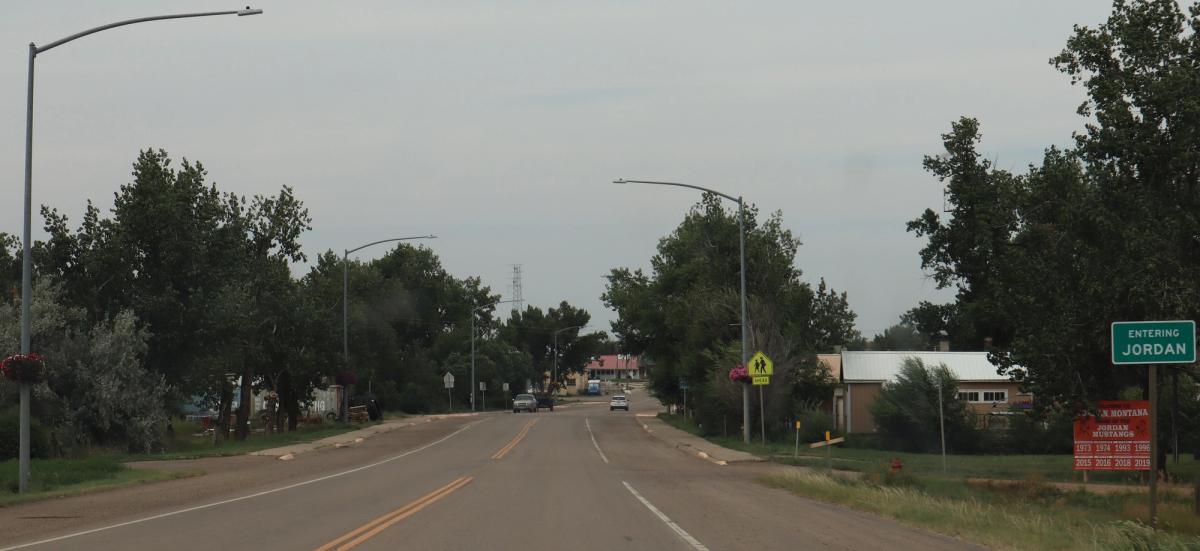
The legal position is settled, and it was settled by a fight over the fossils buried eight miles away.
When the Dueling Dinosaurs came out of the ground, a dispute began over whether dinosaur fossils count as "minerals", which would put them in the severed mineral estate rather than with the owner of the surface. The federal district court in Montana said they do not. A Ninth Circuit panel reversed in 2018 and held the fossils belonged to the mineral owners. That panel opinion was vacated within five months and ordered not to be cited as precedent. The question went to the Montana Supreme Court, which answered it on 20 May 2020 in Murray v. BEJ Minerals, 2020 MT 131.
"We decline to stretch the term 'mineral' so far outside its ordinary meaning as to include dinosaur fossils."
The court divided four to three. The Ninth Circuit, sitting en banc, affirmed a month later.
Montana's legislature had already written the rule into statute the year before. MCA section 1-4-112(3) reads: "Fossils are considered part of the surface estate, subject to severance by the fee title owner of the land pursuant to a clear and express grant." It is a rule of construction, a default rather than a prohibition, and it imposes no duty on any owner.
Federal law is explicit about where it stops. The Paleontological Resources Preservation Act of 2009 governs federal land, and Congress wrote the exclusion in the language of lawfulness. At 16 U.S.C. 470aaa-10(4), the Act does not "affect any land other than Federal land or affect the lawful recovery, collection, or sale of paleontological resources from land other than Federal land".
So: a fossil from private land in the United States is lawfully collected and lawfully sold. That is the answer, it is not a loophole, and it is why this study carries no accusation.
Other countries answer it differently, which is the only reason to mention them. Brazil's Decreto-Lei 4.146 of 1942 makes fossil deposits property of the nation. Argentina's Ley 25.743 places them in the public domain of the state, obliges landowners to report finds for registration, and at article 52 forbids type material from leaving the country. Alberta vests fossils in the Crown wherever they lie in the province and requires the minister's written permission to take one out of it. China's State Council Decree 580 of 2010 makes fossils in Chinese territory state property and, at article 26, forbids the export of undescribed fossils. Four jurisdictions, four different answers, and the United States has given a clear one.
The more interesting document is not the statute. It is the contract.
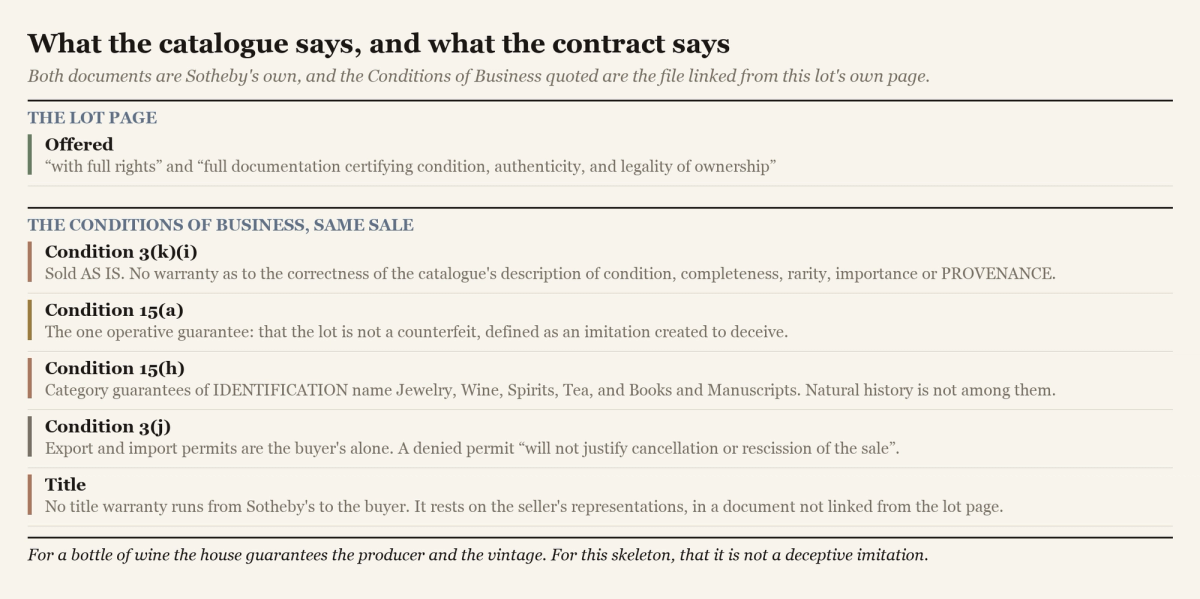
Sotheby's lot page says the skeleton is offered "with full rights" and with "full documentation certifying condition, authenticity, and legality of ownership". The Conditions of Business linked from that same page say something narrower.
Condition 3(k)(i) sells the lot "AS IS", disclaims implied warranties, and gives no warranty as to the correctness of the catalogue's description of its "condition, completeness, size, quality, rarity, value, importance, medium, frame, provenance, exhibition history, or literary or historical relevance".
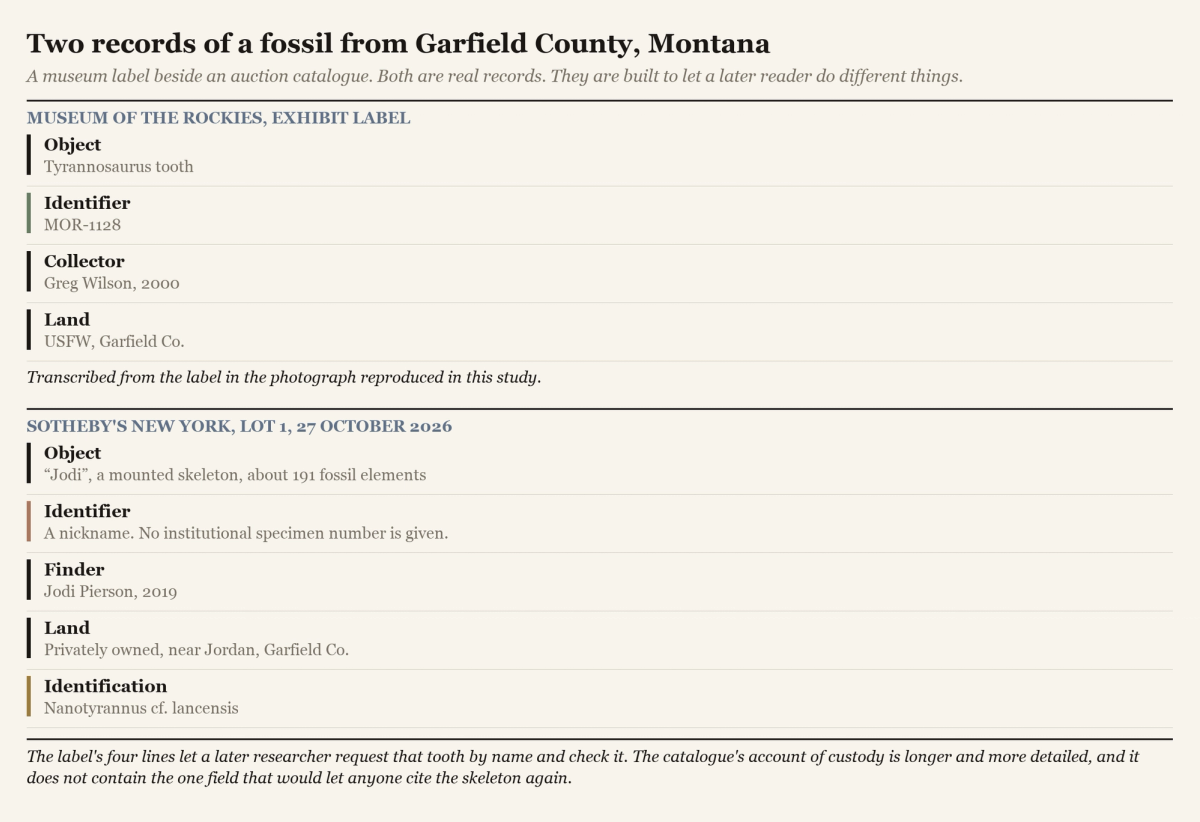
The catalogue's account of this skeleton's provenance is the best thing about it. The conditions of sale disclaim any warranty that it is correct.
The one guarantee that does operate is condition 15(a), and it is narrow. Sotheby's guarantees that the lot "is not a 'counterfeit'", which the document defines as "an imitation created to deceive". Condition 15(h) adds category-specific guarantees of identification, and it names Jewelry, Wine, Spirits, Tea, and Books and Manuscripts. For a bottle of wine, Sotheby's guarantees the producer and the vintage are as stated. For a gemstone, that its origin is natural. The words "natural history", "fossil" and "specimen" appear nowhere in the fourteen pages.
For this skeleton, the guarantee is that it is not a deceptive imitation. The species on the label is not warranted, and the catalogue's own cf. says as much in the other direction.
Two further gaps, stated as gaps. Export and import permits are the buyer's problem alone, and condition 3(j) says the denial of a permit "will not justify cancellation or rescission of the sale". And there is no title warranty running from Sotheby's to the buyer at all. Title passes on payment, and the document twice rests instead on the seller's own representations, which live in a separate Conditions of Business for Sellers that is not linked from the lot page and that this study could not obtain. So the instrument standing behind "legality of ownership" has not been read here, and nothing is asserted about what it says.
Finally, the absence that matters most to the question this study is asking. No United States instrument was located that requires a private owner of a fossil to allow scientific access, to register it, or to disclose where it was found. The word "private" appears zero times in the federal Act and in both sets of implementing regulations. Montana's own scheme defines "paleontological remains" squarely and then limits its permit requirement to "lands owned by the state"; the only provision reaching private land authorises "cooperative agreements" with private landowners. Montana's instrument for a fossil on private ground is consent, not obligation.
That absence was tested rather than assumed. The same search method finds a mandatory inventory and disclosure duty binding privately governed museums under federal repatriation law, and finds landowner reporting duties in Argentina and Alberta. The instrument can say yes. Here it says nothing.
MOR-1128: what a specimen number does that a nickname cannot
In a case at the Museum of the Rockies there is a Tyrannosaurus tooth with a small black card beside it. The card carries four lines.
Tyrannosaurus tooth. MOR-1128. Collector: Greg Wilson, 2000. Land: USFW, Garfield Co.
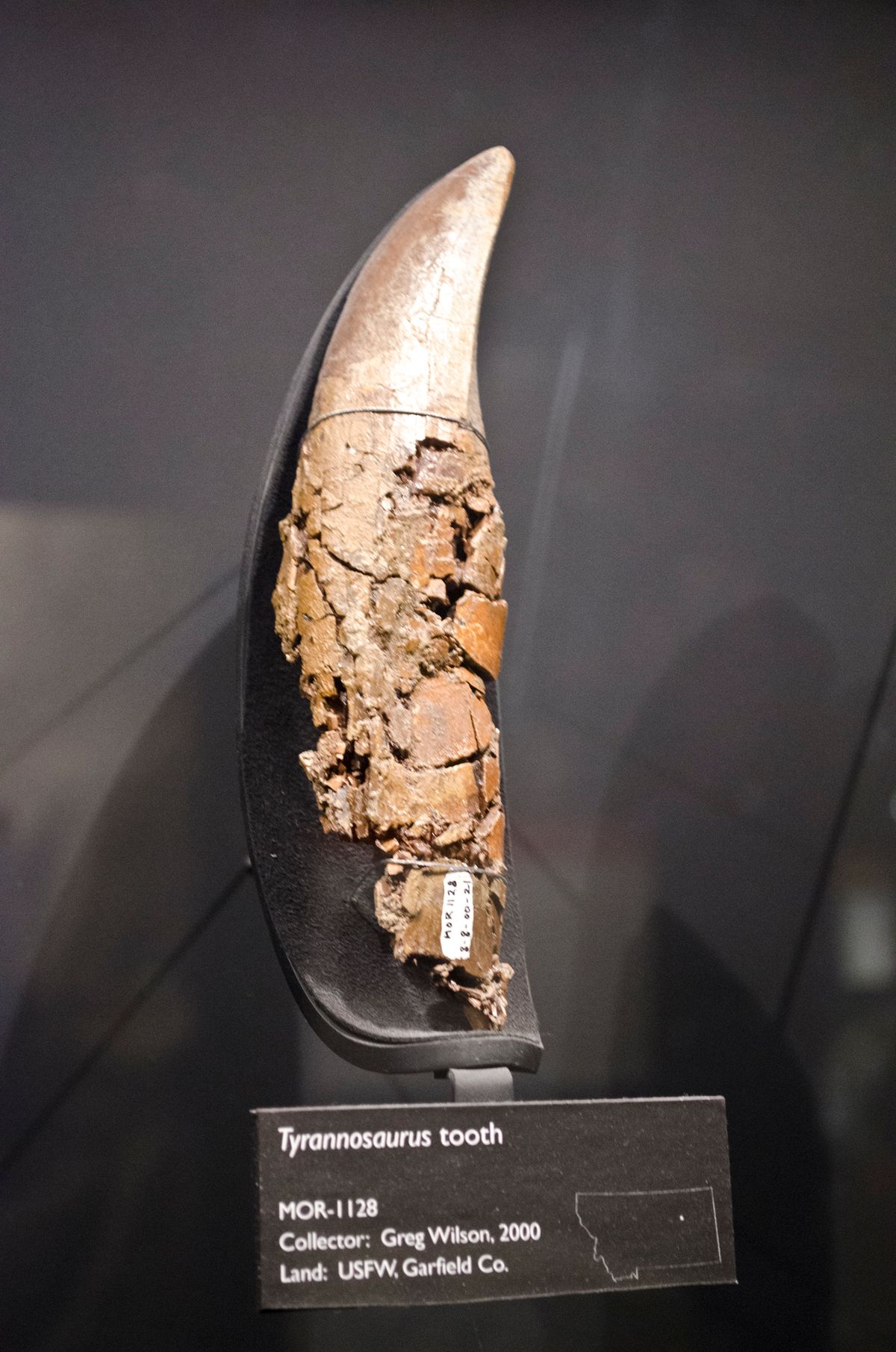
That tooth came out of the same county as the skeleton in the saleroom.
MOR-1128 is a handle. It belongs to one object, an institution issued it, and it does not move when the object moves. Anyone reading a paper that cites MOR-1128 can write to the museum, ask to see MOR-1128, and be shown the same tooth the author was shown. A second researcher can measure it again, get a different answer, and say so in print. That is the mechanism by which a published claim stays a claim instead of becoming a belief.
The other lines do work too. Collector: Greg Wilson, 2000 fixes who lifted it and when, which is the moment at which most of the information about a fossil is either captured or lost. A fossil's scientific value is only partly in the object. The rest is in the record of where it lay, what lay around it, which way up, in what sediment. Once it is out, that is gone, and the only copy is what somebody wrote down. Land: USFW, Garfield Co. records the legal status of the ground, which decides who may own it.
Four lines: a name, a number, a person with a date, and a jurisdiction.
Set the catalogue beside it. The Sotheby's entry is far longer, and as a record of custody it is unusually good. It names the finder, gives the year, the county and the nearest town, states the land was privately owned, says the excavation took one field season, and names the seven people who did it: Clayton Phipps, Luke Phipps, Katie Busch, Nathan Cooper, Chris Morrow, Jodi Pierson and Kelly Pierson. It records a television broadcast and a fair exhibition. Few objects arrive at auction with that much history attached.
What it does not carry is a number.
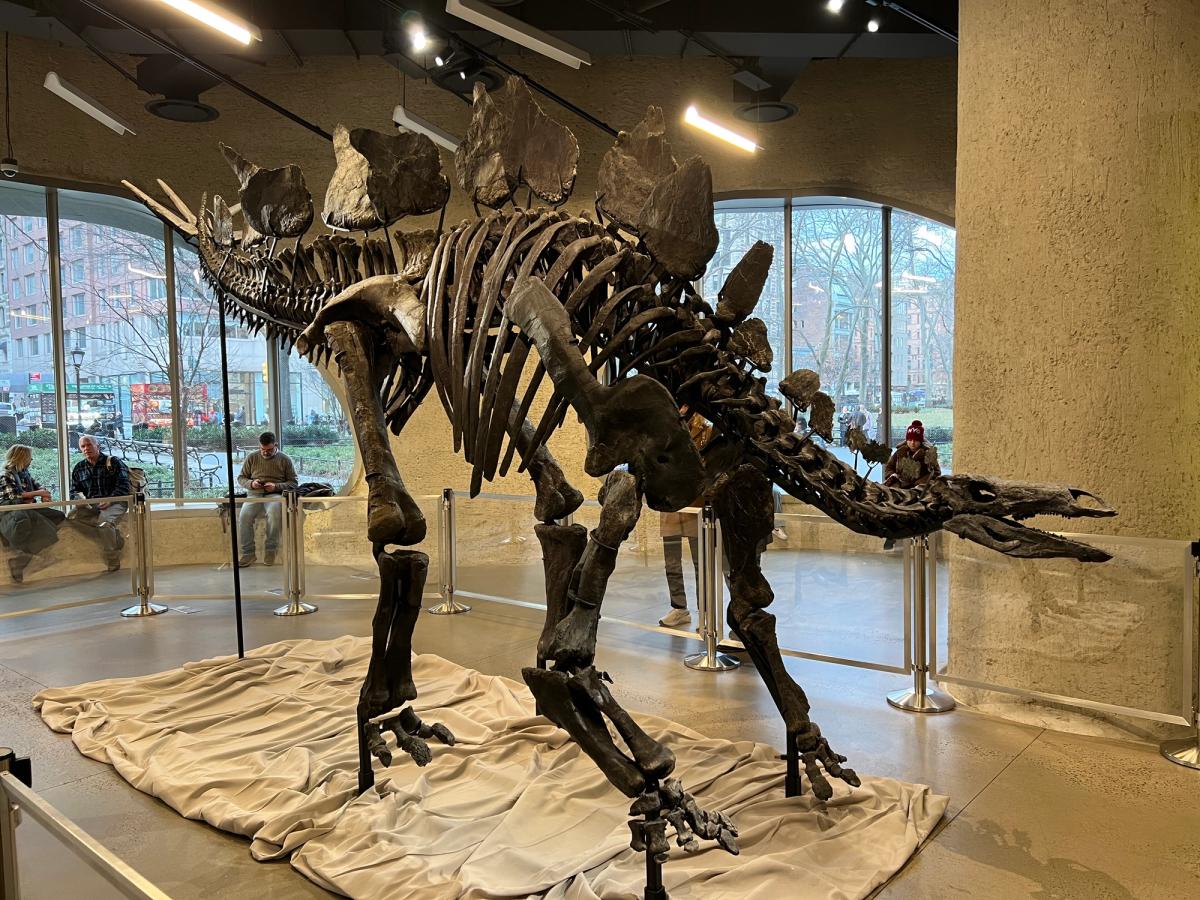
"Jodi" is a nickname. Sue is a nickname too, and it is also FMNH PR 2081 at the Field Museum, because it entered a collection that issues numbers. Apex, the Stegosaurus that made 44,600,000 in 2024, is the other case: privately owned, lent to a museum that will replace it with a cast when the loan ends, and no institutional number for it could be found. A nickname identifies an object to people who already know which object you mean. A specimen number identifies it to someone who has never heard of it, fifty years from now, holding a paper.
The absence is measurable rather than rhetorical. In the Zanno and Napoli supplementary data, the strings Jodi, Pierson, private, collector and auction return zero hits each, while NCSM 40000, the museum specimen eight miles away, returns twenty two. The morphometric dataset has a nickname column, populated for twenty specimens including Jane, Sue, Stan, Scotty and Black Beauty. The field exists, it is used for exactly this kind of animal, and Jodi is not in it.
"No peer-reviewed study can be published": a claim that lost its hedge
Two weeks before the sale, the Associated Press put the argument to both sides, and the exchange has been circulating since in a shortened form that inverts one of its halves.
Cassandra Hatton, head of science and natural history at Sotheby's, made the commercial case:
"These people are crucial in the preservation of science. We don't have enough universities and museums out there digging and doing field programs. We absolutely need private diggers who invest their own money to go do this."
The next sentence in the AP report is that Stuart Sumida, then president of the Society of Vertebrate Paleontology and a biology professor at California State University San Bernardino, "rejected the notion as a 'blatant lie.'"
The notion he rejected is Hatton's. In most retellings, Hatton's paragraph is dropped, which moves the nearest preceding idea to the scientists' own concern and makes a society president appear to call his colleagues' worry a lie. Every word of the quotation survives that cut. Only the antecedent changes. It is a correct quote made false by truncation, which is exactly why nobody noticed, and it should not be used in any form that does not carry Hatton's sentence beside it.
Sumida also told the AP that "no peer-reviewed scientific study can be published on specimens that are not held in the public trust."
In 2014 he put the same point in print, as a co-author in Palaeontologia Electronica, a journal published by his own society: "It is for this reason that virtually all high-level scientific journals do not publish data obtained from privately-owned specimens."
"Virtually all do not" became "no study can." The 2014 version is the one the evidence supports, and the journals vary more than either phrasing suggests. PLOS ONE requires deposit in "an accessible, permanent repository" and states that otherwise "the article will be rejected". The Journal of Vertebrate Paleontology, the society's own, requires deposit in "a recognized public or private, non-profit institution". Nature and Palaeontology both say specimens "should" be deposited, in wording that is byte-identical between them.
That near-uniformity has a documented cause. On 21 April 2020 the society wrote to journal editors and supplied a drafting template in quotation marks for them to paste into their policies. The journal PALAIOS carries that template word for word, and the letter's recipient list runs to five pages and includes every title named above. One society asked roughly four hundred journals on the same day, and the spread in today's policies is the spread in how they answered.
This is not an accusation against anybody. It is the same thing happening twice in one record. A careful published claim, hedged with "virtually all", was compressed into an unhedged spoken one fourteen days before a hammer. A careful catalogue entry, hedged with cf., was compressed into an unhedged headline. Neither compression required a liar. Both required only a gap between a document and a quotation of it, and that gap is where this institution does its work.
There is also a measured answer underneath the argument, published by the society that hosts the dispute. Thomas Carr's 2025 census in Palaeontologia Electronica counts 61 Tyrannosaurus rex specimens in public trusts against 71 held privately. Of the eighty collected commercially, nine are in public trusts. Carr states his own limits plainly: the count is "almost certainly an underestimate", and his data may contain duplicates "owing to specimen name changes".
That last phrase is the defect this object demonstrates, named as a known weakness by the person who built the census. And his reference list cites the 2023 Art Newspaper report of this very skeleton, under the name Chomper, as a juvenile Tyrannosaurus, at twenty million dollars.
The peer-reviewed literature has already counted this animal, under a name it no longer carries, a species it no longer carries, and a price it no longer carries.
Sue, Stan and Apex: where auctioned skeletons actually go
The usual worry about these sales is that specimens vanish into private hands. The record is more specific than that, and more interesting.
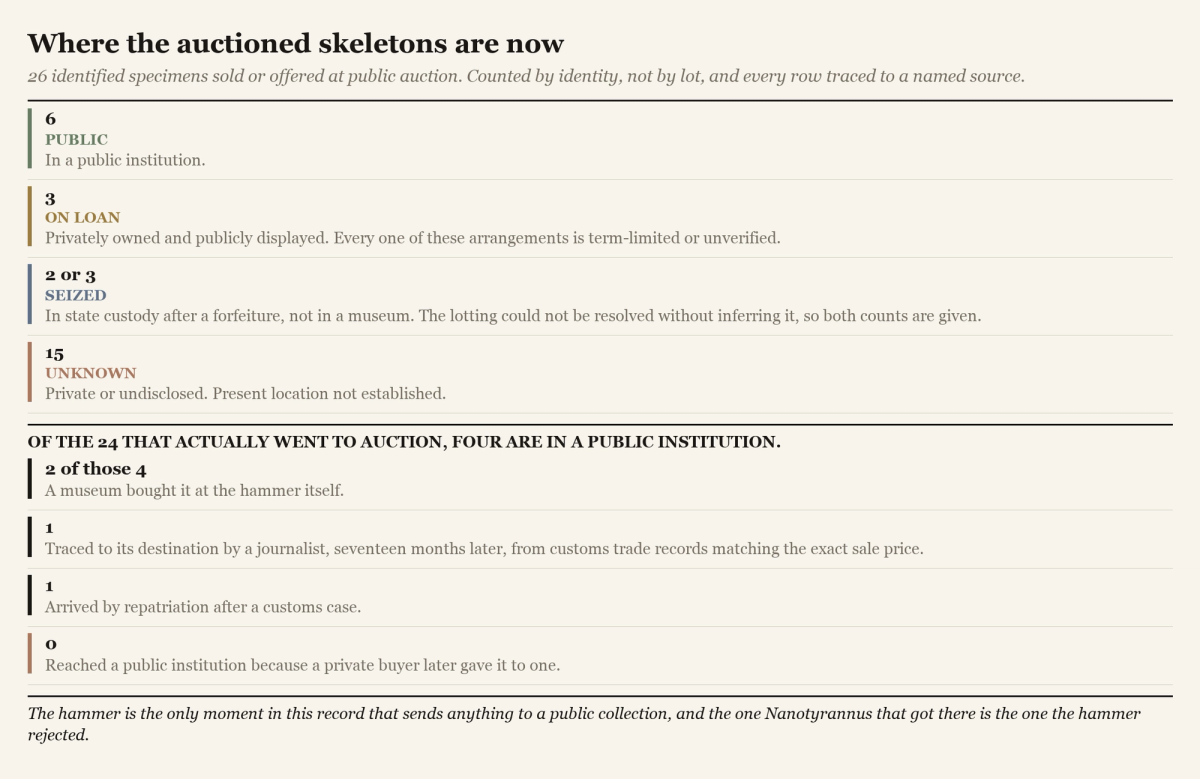
Of twenty six identified specimens sold or offered at auction, six are now in a public institution and fifteen are in private or undisclosed hands with no established location. Three are privately owned and publicly displayed, every one of those arrangements term-limited or unverified.
Of the twenty four that actually went to auction, four are in a public institution. Two of those four were bought by the museum itself at the hammer. One was traced to its destination by a journalist. One arrived by repatriation after a customs case. None got there because a private buyer later gave it to a museum.
The record price has moved four times since 1997: $8.36 million for Sue, $31.85 million for Stan in 2020, $44.6 million for Apex in 2024, and $50.1 million for Gus, a Tyrannosaurus, on 14 July 2026. It stood unmoved for twenty three years and has moved twice in the last two.
Buyers are mostly not disclosed. Eight of the twenty six are publicly known today, and only three were disclosed at the sale, each because the buyer was an institution or a company announcing its own purchase rather than because the house said so. Stan's destination was established seventeen months later by National Geographic from United States customs trade records matching the exact sale price. Not one of the five highest prices ever paid had its buyer disclosed by the auction house.
One lot in the record carries a contractual access obligation. Vulcan, sold in Paris in November 2024, came with a sale contract requiring the owner to give palaeontologists access to study it. Apex is on a four-year loan to the American Museum of Natural History with high-resolution scans released under the loan agreement, which ends around December 2028. Everything else is an intention.
And the seller is sometimes the most candid voice in the room. Of a juvenile Ceratosaurus sold in July 2025, Sotheby's said the fossil "has not been studied or described formally in a scientific journal". The house put the scholarly gap into the record itself, on the day of the sale, as a fact about its own lot.
The Dueling Dinosaurs: the one that reached a museum by failing to sell
Eight miles from where Jodi was found, in 2006, Clayton Phipps dug up two animals buried together. They went to auction at Bonhams in New York on 19 November 2013 with an estimate of seven to nine million dollars. Bidding opened at three million and stopped at five and a half, below an undisclosed reserve. The lot did not sell.
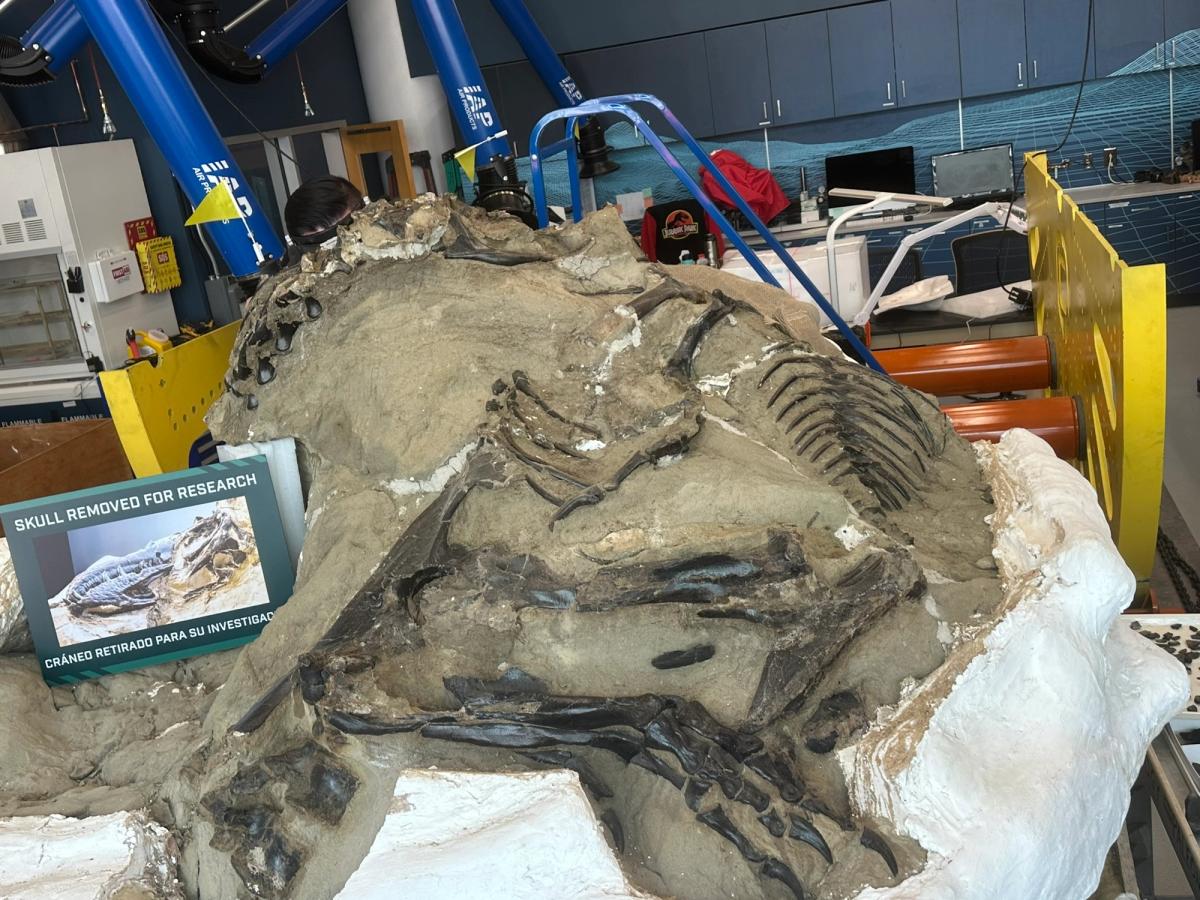
In 2020 the Friends of the North Carolina Museum of Natural Sciences acquired the fossils with private funds and donated them to the museum's vertebrate paleontology collection. The tyrannosaur became NCSM 40000, nicknamed Manteo. The Triceratops became NCSM 40001, nicknamed Murphy. Lindsay Zanno said at acquisition: "We have not yet studied this specimen; it is a scientific frontier."
NCSM 40000 is the specimen on which the 2025 paper rests, the paper that gave the saleroom its new label.
Three of the seven people who dug Jodi out appear in the record of that museum specimen too. The Nature paper thanks "C. Morrow and K. Busch for providing videography of early preparation of NCSM 40000", and its Extended Data figure 4, an in-situ excavation photograph, is "Reproduced with permission from Clayton Phipps".
In the museum's laboratory the specimen sits in its jacket with a sign beside it reading SKULL REMOVED FOR RESEARCH, in English and Spanish, so that a visitor can see both the object and the reason part of it is missing.
**The one Nanotyrannus that reached a public collection got there by failing to sell.**
What happened at the hammer
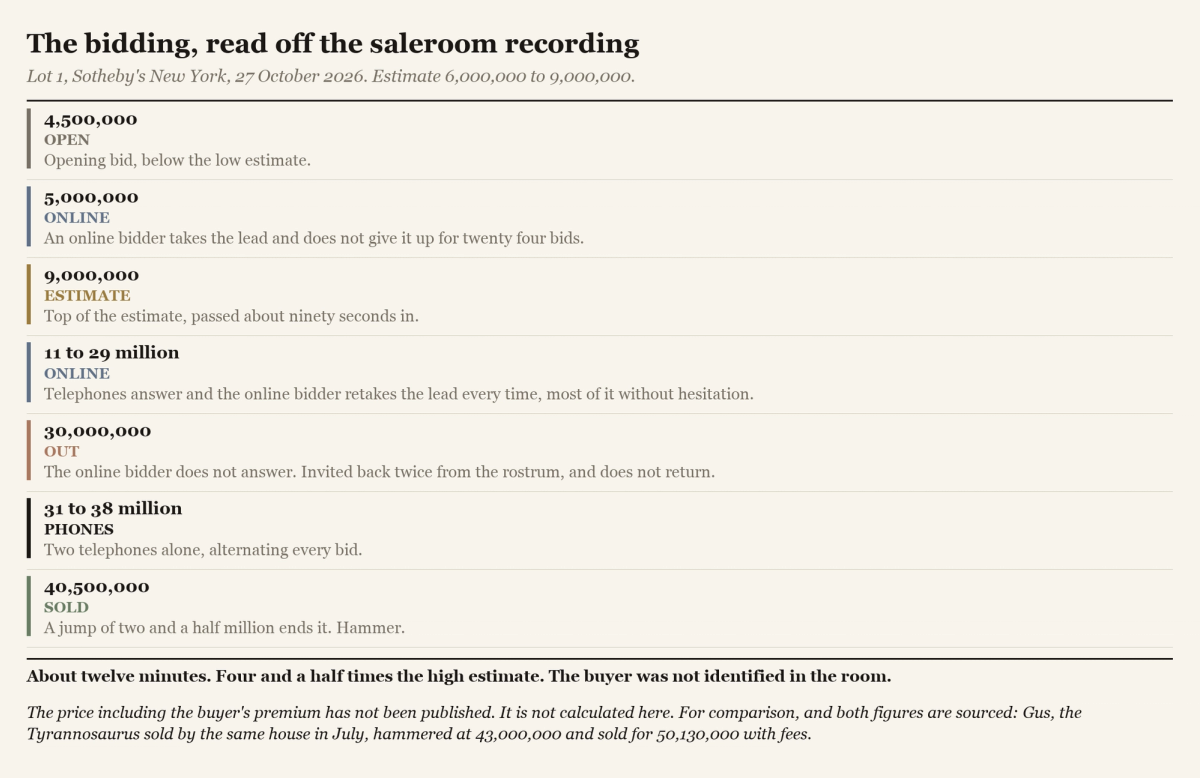
Lot 1 sold. The hammer was 40,500,000 dollars against an estimate of six to nine million. The price including the buyer's premium had not been published at the time of writing, and it is not calculated here from the premium schedule, because a derived figure sitting beside sourced ones is indistinguishable from a sourced one. The buyer was not identified. Nothing in the sections above changes. The skeleton still carries a nickname and no institutional number, the species line still carries its reservation, and the question of whether anyone will be able to re-measure these bones is now a question about one private owner rather than about a saleroom.
The bidding opened at four and a half million dollars, below the low estimate, and ran for about twelve minutes. For most of its length the lot was led by a single online bidder who answered every telephone bid without hesitation and held the lead from roughly five million into the high twenties. From thirty million the contest narrowed to two telephones in the room, and the online bidder, invited back in twice by the auctioneer, did not return. The winning bid was taken on a telephone by a Sotheby's specialist on behalf of a client. The buyer was not identified in the saleroom.
Two things were said from the rostrum before the bidding began, and both appear in this study already. The auctioneer stated that the lot was sold under the authenticity guarantee and on an as is basis, which is the contract set out above rather than the catalogue's fuller language. And he read the height correction aloud: approximately nine feet six inches on the armature, and not six feet five inches as previously stated. That withdrawn number had been corrected in the catalogue, announced in the room, and was still circulating in the coverage.
The comparison that can be made today is hammer against hammer. Gus, the Tyrannosaurus sold by the same house on 14 July 2026, hammered at 43 million dollars and sold for 50,130,000 with fees. Lot 1 hammered at 40,500,000. Whether that is the second highest hammer ever paid for a dinosaur is not stated here, because Apex's 44,600,000 is reported as a hammer by some accounts and as a price with fees by others, and the two readings put this lot in different places. The comparison that cannot be made today is this lot against that 50.1 million, or against the 44.6 million reported for the Stegosaurus Apex in 2024, because both of those are prices with fees and this one is not yet published. Setting a hammer beside a price with fees is the commonest error in reporting this market, and the house does it too: Sotheby's own announcement of the Gus result described 50.1 million as a final hammer price.
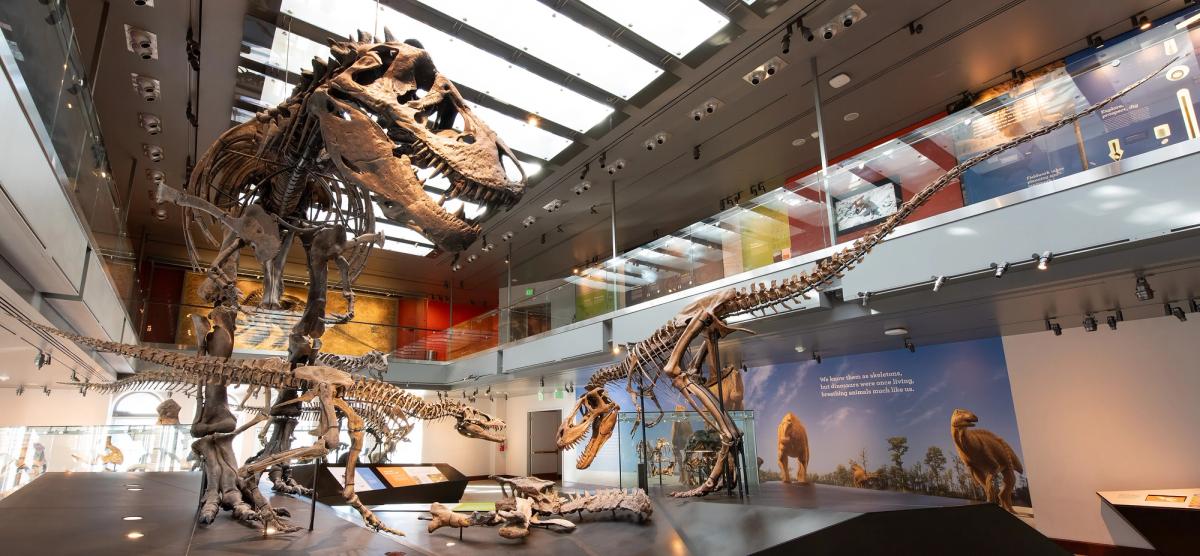
Every photograph of this skeleton belongs to the house that sold it. Sotheby's published thirty images of the lot, credited to the photographer Matthew Sherman, and the open image commons holds none at all: it returns casts in Cleveland, a growth series in Los Angeles and a tooth in Bozeman, and nothing of the animal itself. The pictures above are reproduced with the photographer credited, as any report of this sale would. It is worth noticing what that means. The skeleton that made forty and a half million dollars this morning has no image the public owns, and the only record of this auction that is not the seller's is the one below, read off the saleroom recording bid by bid.
Coda
Both skeletons have a name. Only one has a number.
The difference is functional rather than sentimental. A specimen number is an index that lets a later researcher find the same bones and disagree with whoever measured them last. A nickname is a label, and a label can be replaced. This object's has been replaced once, its species line once, and its stated height was corrected by saleroom notice while it stood in the lobby, from six feet five to about nine feet six, a change the press did not carry.
The only identifier it has held without revision across seven years is the name of the woman who found it, and in the entire public record of her own discovery she has never once been quoted.
Whatever happens at the hammer today, the bones will be fine. They have lasted sixty seven million years and will outlast the catalogue. What is at stake is narrower and more fragile: whether, in fifty years, anyone reading about this animal can get back to it. Custody is a chain of holders. A record is a chain of handles. Today the first one gets a new link and the second one still has none.
What is not claimed here
This study does not say where this skeleton ought to be held. Objects of Affection Collection takes no position on who should own an object, and nothing above is an argument that a museum, a university, a collector or a country has a better claim than any other.
It does not adjudicate the science. Whether Nanotyrannus is a genus or a growth stage of Tyrannosaurus is a live argument among named researchers, and it is settled by evidence and peer review. The positions above are reported with their speakers, their outlets and their dates.
It does not authenticate, attribute, appraise or value anything. No opinion is offered on what the skeleton is, who assembled it, or what it is worth.
Nobody is accused of anything. Finding a fossil on your own land in Montana and selling it is lawful, and the instruments establishing that are quoted above. The excavators are named because Sotheby's names them. Jodi Pierson is named because the catalogue and the press name her, and she has not spoken publicly about the sale, which is recorded here as a fact about the record and not as a criticism of her.
Three limits on the evidence, stated plainly.
The Conditions of Business quoted are the document linked from this lot's own page. Sotheby's hosts several versions, and the one at the tidiest address is four years old and carries different terms. The Conditions of Business for Sellers, which is where the seller's representations about title would live, is not linked from the lot page and could not be obtained, so nothing is asserted about what it says.
The identification of this skeleton with the one shown at Frieze Masters in 2023 as "Chomper" is a reconstruction from matching attributes: the same finder, year, state, documentary series and taxon group, and the same October 2023 showing. Several outlets assert it directly. No single primary document names both nicknames, and that is why it is described rather than asserted.
The discovery credit is unreconciled in print. The 2023 trade account says the skeleton was unearthed by Clayton Phipps. The 2026 catalogue credits Jodi Pierson with the find on her own land and names seven excavators including Phipps. Those are probably two different acts described as one, and nobody has reconciled them. This study reports both rather than choosing.