Phillips Geneva Watch Auction: What the Papers Cannot Say
On an archive extract, a buyer's premium, and the difference between a record of manufacture and a record of custody.
Phillips Geneva XXIV: what goes under the hammer in November
On 7 and 8 November, at the Hotel President in Geneva, Phillips offers 218 lots in the sale it calls The Geneva Watch Auction: XXIV. The house's own announcement describes no fewer than 220 timepieces, which is reconcilable with a lower lot count because a single lot can hold more than one watch.
It follows the sale in May that made CHF 74,846,995, reported as US$96,328,083, with 224 of 225 lots sold. Phillips describes that as the highest grossing watch auction ever held, and the claim is worth attributing rather than repeating, for a reason that is itself instructive: no auction house publishes a cross-house league table, so there is no record against which "ever" can be independently checked. The sentence in which Phillips makes the claim compares the sale against its own two previous records. Nothing larger was found at any other house.
The same page carries a figure about passing one hundred million dollars. That figure is about Phillips' spring season, not about this sale.
What makes the November catalogue worth reading closely is not the total it will make. It is that a watch is the only luxury object whose manufacturer will, on request and for some references, issue a document from its own archive about the thing you are holding. No painting has that. No piece of furniture has that. The fossil sold in New York this morning does not have that.
So the question this study asks is narrow and answerable. What does that document actually certify, and what is it quietly taken to certify that it does not?
The Extract from the Archives: the one instrument luxury has
A painting does not come with a letter from the artist confirming when it was made. A chair does not arrive with a note from the workshop. For most of the luxury market, provenance is assembled afterwards by other people: dealers, scholars, cataloguers, each adding a line to a record the maker never kept.
Watches are the exception. Patek Philippe has kept records since 1839 and will, on request, issue a document from them about a specific watch. It costs 500 Swiss francs, it can be requested only for a timepiece first sold at least ten years before the request, and only once a year for the same watch. Here is how Patek describes it, on its own page:
"This document describes the watch's manufacturing history, through the accurate transcription of its key relevant features and its date of sale."
Manufacturing history, and a date of sale. That sentence is doing less than almost everyone takes it to do, and the companies issuing these documents are the ones saying so most plainly.
Longines, on its own extract: "An Extract from the archives does by no means certify the authenticity of the timepiece or its components." Girard-Perregaux, on its own: "the document provided does not guarantee the authenticity of your watch or its components."
Patek published the same thing in the same period: that the Extract from the Archives is neither a proof of authenticity nor a warranty document. That wording was live on its pages in October 2021 and again in January and August 2022. It is not on the pages read today, which were checked for it directly: across roughly nineteen thousand characters including the obtaining conditions and the frequently asked questions, the words authentic, warranty, guarantee, owner, purchaser and provenance return nothing, while archives appears nine times and the date 1839 once. The absence is measured, and it is an absence of the disclaimer rather than a change in what the document does.
Three makers, then, saying the same thing in writing: the archive confirms a record, not an object. And each of them sells a second and dearer document for the other question, one that requires somebody to physically examine the watch. An extract runs from about 120 to 500 Swiss francs and the maker never touches the watch. A certificate of authenticity runs higher and the maker does.
Longines describes what that second document covers, and the sentence is the best thing in this subject: "The Certificate of authenticity attests to the condition of the watch at the time of delivery to LONGINES." And then: "LONGINES accepts no responsibility for the Certificate of authenticity should any component of the watch be subsequently altered."
A manufacturer, in its own customer terms, stating that its authenticity certificate speaks to one moment and makes no claim about the object's future. Authentication is a statement about an instant. Provenance is a statement about a duration. A watch house wrote the distinction down before anybody asked it to.
Lot 95 has the document. Lot 129 has the owner.
Both watches are in the November catalogue, and between them they draw the whole problem.
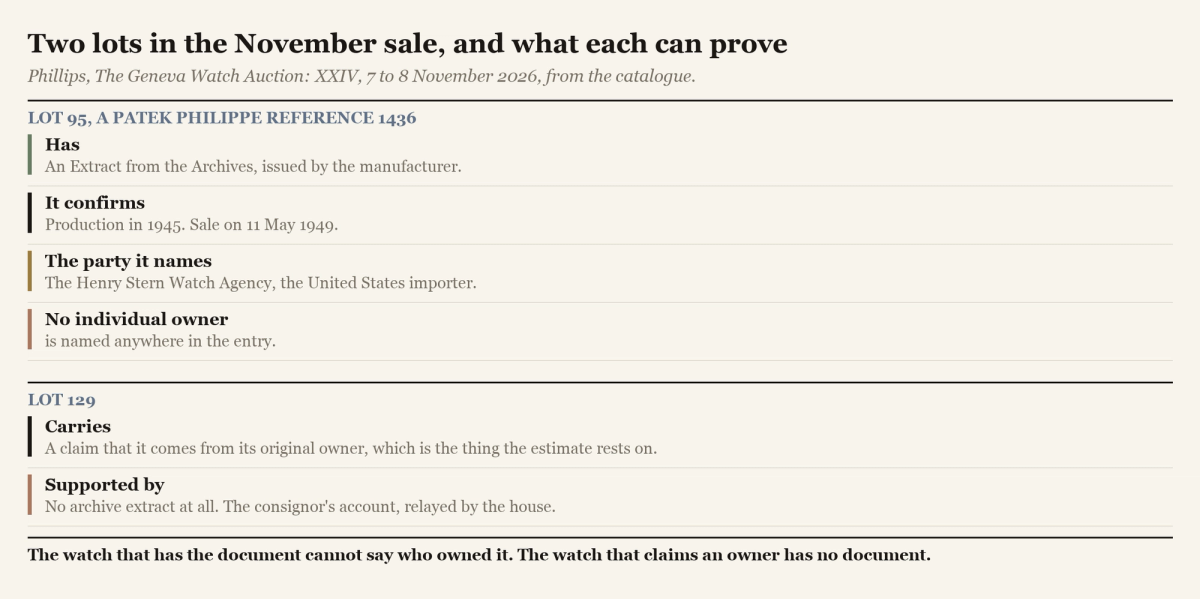
Lot 95 is a Patek Philippe reference 1436 with an Extract from the Archives confirming production in 1945 and sale on 11 May 1949. The party named as receiving it is the Henry Stern Watch Agency, the firm that imported Patek Philippe into the United States. No individual owner appears anywhere in the entry.
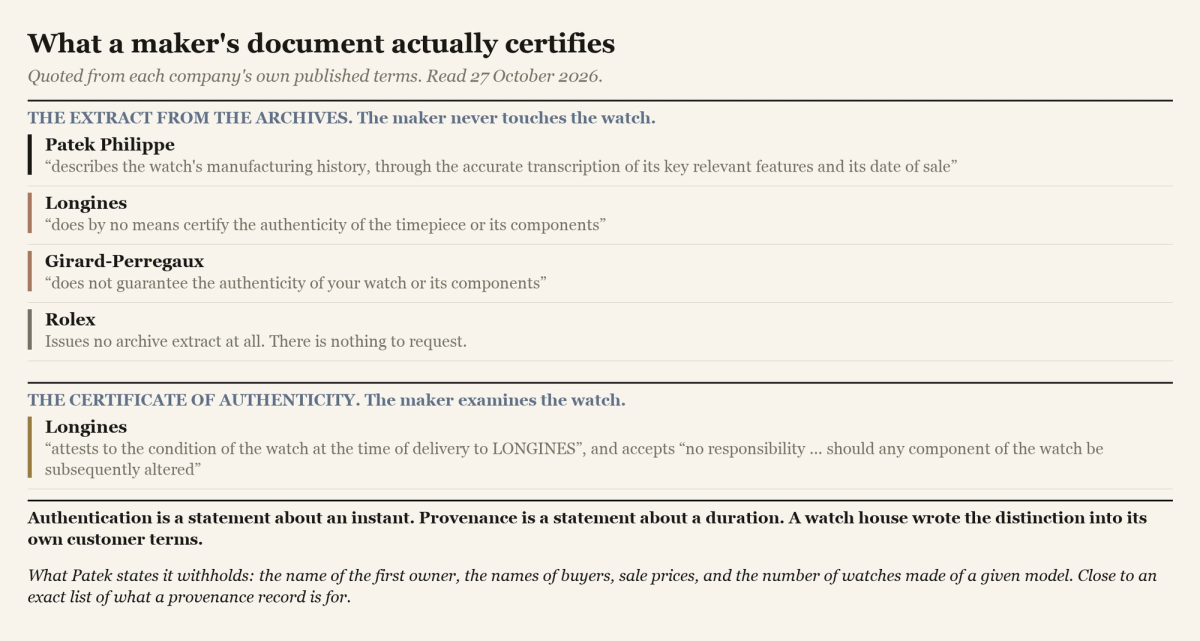
That is not an oversight, and Patek says so in its own frequently asked questions: the company does not disclose the name of the first owner, the names of buyers, sale prices, or the number of watches produced for a given model. Those four withheld items are close to an exact list of what a provenance record is for. The archive holds purchasers' names for almost every watch the company ever made, and letters sent from Geneva before the service was standardised often included the original purchaser's name. The instrument was regularised and, in the same act, stopped saying who owned the thing.
Lot 129 carries a claim that it comes from its original owner. That claim is what the estimate rests on, and it is supported by no extract at all, only the consignor's account relayed by the house.
The watch with the document cannot say who owned it. The watch claiming an owner has no document. And the document it lacks would not have named an owner either.
There is a further asymmetry, and it decides what these papers can ever prove. An extract is issued when the record matches. When it does not match, nothing is issued. Patek does not produce a document recording a refusal, so a consignor whose watch fails has silence to show for it, and silence is indistinguishable from the several innocent reasons the company itself lists for not issuing one. A record that can only be written in the affirmative cannot establish a negative.
Two cases show where that leaves a buyer, and they point in opposite directions.
In January 2026 the marketplace Bezel published an account of a sale it had cancelled on its own platform: a yellow gold Day-Date 36 offered with an apparent mid-1990s full set. In Bezel's words, "the watch itself was entirely authentic and accurately represented." The papers were not. They lacked the period watermarks, the foil tone was wrong, and the reference was printed as 182388, which Bezel states is not a valid Rolex reference. The forgery was caught because the record contradicted itself rather than because it contradicted the watch. A genuine object was wearing a document describing a watch that could not exist.
And at Phillips in November 2021, an Omega Speedmaster reference CK2915-1 sold for a little over CHF 3.1 million. The buyer was Omega. The company later described the watch, in its own words, as an assembly of mostly authentic Omega components, commonly called a Frankenstein watch. The institution holding the archive, the parts, the expertise and the strongest possible incentive to be right bought it anyway. Every resource in the field was present and the gap between a record and an object still did not close.
Seven lots sold below estimate, and the published record says none did
Phillips sold The Geneva Watch Auction: XXIII on 9 and 10 May 2026 at the Hotel President. The total was CHF 74,846,995, reported as US$96,328,083. Two hundred and twenty four of two hundred and twenty five lots found buyers.
Every one of those figures is a price with fees. Phillips says so, in a footnote on its own release: "Estimates do not include buyer's premium; prices achieved include the hammer price plus buyer's premium."
That single sentence is the most useful thing on the page, and it creates a problem that runs through almost every account of a watch sale written anywhere.
An estimate and a result are quoted on two different bases. The estimate is what the house expects the hammer to do. The result adds the premium, which in Geneva from April 2026 runs at 27 per cent up to CHF 1.6 million, 21 per cent to 7 million, and 14.5 per cent above that. Comparing the second number to the first is comparing a figure that includes the premium to one that does not, and the gap between them is the premium.
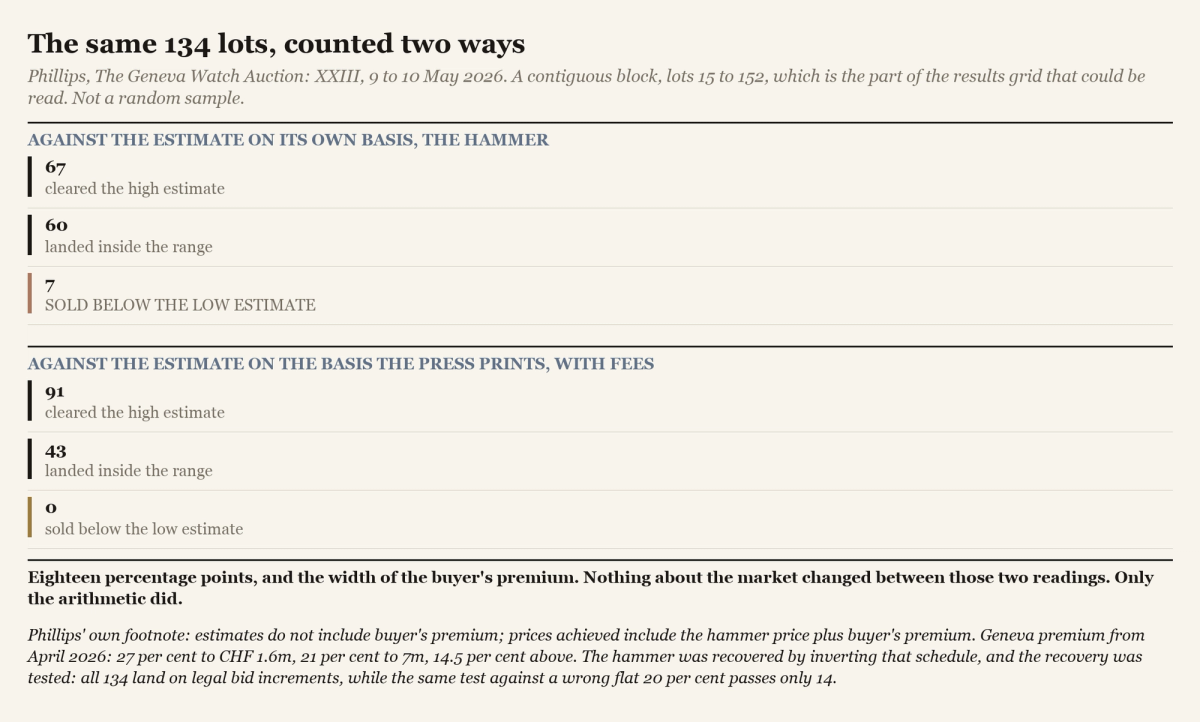
So this study did the arithmetic the other way. Taking Phillips' published results and its published premium schedule, the hammer is recoverable by inversion. That was done for 134 lots, a contiguous block from lot 15 to lot 152, which is the portion of the results grid that could be read. It is not a random sample and nothing here is offered as a result about the whole sale.
The inversion was tested before it was trusted. Auction bidding moves in fixed increments, so a correctly recovered hammer has to land on one. All 134 did, on exact multiples of CHF 500 and most on 10,000 or 50,000. Run again against a deliberately wrong premium schedule of a flat 20 per cent, only 14 of the 134 land correctly. The method can fail, and when it is wrong it says so.
Here is what the two bases produce from the same 134 lots.
Counted against the estimate on the hammer basis, 67 of the 134 lots cleared their high estimate, 60 landed inside the range, and seven sold below the low estimate. Counted on the basis the press prints, with the premium included, 91 cleared the high estimate, 43 landed inside, and none at all fell below.
On the basis the press prints, not one lot in that block sold below its estimate. On the basis the estimate was written in, seven did.
The swing is eighteen percentage points and it is almost exactly the width of the buyer's premium. Nothing about the market changed between those two rows. Only the arithmetic did.
This is not an accusation of anything. Phillips publishes the footnote, publishes the schedule, and leaves the arithmetic available to anybody who wants to do it. What it does not do, and no house does, is print the two numbers side by side. The result that travels is the larger one, and the estimate it travels beside was written on the other basis.
One lot shows the whole problem on its own. A Patek Philippe Sky Moon Tourbillon made CHF 3,242,000 with fees, which reads as a solid result inside its estimate. Its recovered hammer is CHF 2,600,000, which is 0.65 of its high estimate and reads as a soft one. Same lot, same sale, same afternoon. Strong or soft depending only on which number is printed.
And a famous example runs the other way. The Rolex reference 6265 known as the Unicorn is widely described as having nearly doubled its estimate. Phillips' own label gives it as sold for CHF 5,937,500 against an estimate of CHF 3,000,000 to 5,000,000. Recover the hammer and it is CHF 5,000,000, which is exactly the high estimate. The doubling appears only if a price with fees is set against the low end of an estimate written without them.
Where the account said Rolex, the sale said something else
The claim in circulation is that historically important Rolex prototypes and watches from their original owners consistently beat their estimates. Two of those three things can be tested against the May sale, and the third cannot be tested at all.
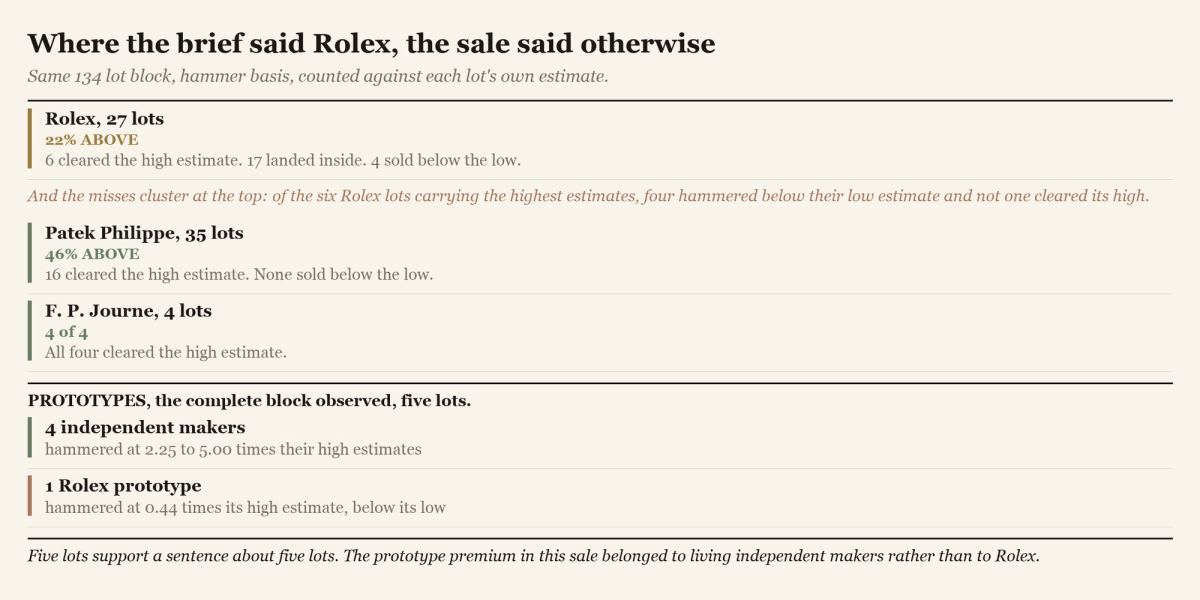
Taking the 134 lot block on the hammer basis, and counting each lot against its own estimate:
Rolex ran 27 lots. Six cleared their high estimate, seventeen landed inside the range, and four sold below their low estimate. And the misses cluster where the money is: of the six Rolex lots carrying the highest estimates, four hammered below their low estimate and not one cleared its high.
Patek Philippe ran 35 lots, of which sixteen cleared their high estimate and none at all fell below the low. F. P. Journe ran four, and all four cleared.
Prototypes were five lots, which is the complete set in the block rather than a selection. Four of them, all by living independent makers, hammered at between 2.25 and five times their high estimates. The fifth, the one Rolex prototype, hammered at 0.44 of its high estimate, below its low. Five lots support a statement about five lots and nothing wider, and that statement is that the prototype premium in this sale belonged to independent makers rather than to Rolex.
The word that has to go is "consistently". On this evidence it is not merely unsupported for Rolex; it points the other way.
The third claim, about watches sold by their original owners, is in a different position again. It could not be tested, because it is not in the data. Whether a lot comes from its first owner lives in the individual lot essay, written by the house, and not in the results grid. A study that counted it would be counting the house's own framing of its lots rather than a fact about the market. That is worth saying plainly rather than producing a number that looks like an answer.
Which leaves one figure that needs nothing adjusted at all. A steel Patek Philippe reference 1518 sold at Phillips in 2016 for CHF 11,002,000. The same watch sold at Phillips again in November 2025 for CHF 14,190,000. Same watch, same house, same fee basis, nine years apart. It is the only comparison in this subject where nothing has to be corrected before the two numbers can be set beside each other, and it is worth more than any of the famous lots that get quoted instead.
Ghost listings: a word six days older than the reporting about it
The practice has a name now, and the name is newer than the practice and younger than the coverage suggests.
"Ghost listings" first appears in a pre-suit demand letter dated 4 June 2026, written for a collector by his lawyer, and in an unfiled draft complaint accompanying it. It was reported the next day by the legal outlet Urgent Matter. The Bloomberg newsletter that carried the term to a general audience ran on 11 June, six days later, quoting Andy Freedman, a partner at Olshan Frome Wolosky.
So it is a litigant's word rather than a journalist's or a trade term. It appears nowhere in WatchPro, Hodinkee or Robb Report.
The conduct is four years older than the word. In January 2022 Jason Pitsch, writing at Professional Watches, documented dealers advertising watches they did not hold, including a Patek Philippe Calatrava reference 5196 offered using photographs Pitsch had taken himself at Patek's New York headquarters.
And the word has already split into two opposite meanings, two months apart, pointing in opposite directions on price. In the Bloomberg sense, a ghost listing is a real reference advertised at or above market by a dealer who does not have it. In August 2026 the Boston dealer European Watch Company published a definition in which the tell is a price well below market: stolen photographs, a figure too good to be true. One describes a lure upward, the other a lure downward. A sentence using the term without saying which one it means has not said anything a reader can check.
There are in fact four distinct practices sitting under the one phrase, and they are not degrees of the same thing:
A dealer may list a watch they can source on demand, disclosed as such. Chrono24 has a category for exactly this, "on request", with its own stated timeline. A dealer may list a watch as in stock that they do not hold. A dealer may list a watch with no intention of selling that watch, in order to find out who wants one. Or a listing may simply be stale, left up after the watch has gone.
The third of those has a legal name and it is older than most of the watches.
Bait advertising has been defined since 1967, and the letters went to car dealers
Part 238 of Title 16 of the Code of Federal Regulations is headed "Guides Against Bait Advertising". Section 238.0 defines the practice as "an alluring but insincere offer to sell a product or service", and states that the primary aim of a bait advertisement is to obtain leads to people interested in buying merchandise of the type advertised. The guides have been in force since 1967.
Read that against the fourth practice above. A listing posted to find out who wants a Daytona, rather than to sell the Daytona in the photograph, is not a lesser version of the problem. It is the definition.
On 13 March 2026 the Federal Trade Commission sent warning letters to 97 automobile dealership groups, signed by Christopher Mufarrige, Director of the Bureau of Consumer Protection. Among the advertising practices the letters flag is "advertising unavailable or non-existent vehicles". The names of the recipients were published on 28 May. The letters are warnings rather than findings, and they say so: they are not intended to represent any conclusion about whether a particular recipient is engaging in the practices described.
Fifty-nine years of federal guidance on this exact conduct, applied to car dealers seven months ago, and not once to a watch listing. No dealer has been charged, fined or sanctioned over one. The demand letter of 4 June was said to be headed for a Miami-Dade filing on 15 June; four months later no docket, case number or ruling for it could be located, and it should be treated as unfiled.
That absence is the finding. It is not evidence that nothing is happening.
What a watch price index is actually made of

The claim that ghost listings distort price data has been repeated widely and measured by nobody. Every source asserting it is either reasoning without figures or selling a product that filters for the thing.
But the claim is testable in a narrower form, because the indices are not alike, and each publishes what it is made of.
Chrono24's ChronoPulse is built from completed transactions. Final sale prices rather than list prices, drawn from more than six hundred thousand sales across fourteen brands and about a hundred and forty models, recalculated daily and reweighted twice a year. A listing that never settles cannot enter it. For that index the distortion claim is not weak. It is structurally impossible, and saying so is worth as much as the opposite finding would be.
Subdial's index, used by Bloomberg, is the most exposed by its own account. It works from dealer prices and then, in its own description, discounts them according to the model and how long the watch has been available for sale. The discount is the admission: an asking price is known to be the wrong number, and the index corrects for it by a rule. A listing with no watch behind it is an ask with no reservation price under it, which is the case such a correction was never calibrated on. The index covers fifty references, with no cap on any one brand.
Bezel runs a closed loop: its own platform's asks, bids and verified sales.
WatchCharts sits between the two, and the sentence that matters is reported from its published methodology rather than read on the page: that market price is drawn from a weighted thirty day window of transactions, and that where a sale price is not public, the last known price before the listing was sold is used in its place. This study could not render that page. It is served behind a bot check, and the wording above comes from search extracts of it rather than from the document, which is why it is described here and not quoted. If it is right, a listing that sits is invisible to the index, and a listing that resolves in a way the pipeline reads as a sale enters the record carrying the number somebody asked rather than the number somebody paid.
Two of those numbers are already load-bearing somewhere that is not a collector's curiosity.
In August 2026 Stephen D'Aquila of Hilco Global, writing for lenders, advised that watch appraisals be checked against current Chrono24 and WatchCharts transaction data "not dealer asking prices", because the gap between the two can be significant. The same advisory prescribes a minimum discount of fifteen to twenty five per cent for a watch without its original documentation. That is a provenance discount, written as a number, by a firm advising people lending against the object.
And since March 2026 a traded contract has settled on a watch index: Kalshi's watch futures use Bezel's indexes. Writing in Worn and Wound the following day, Zach Kazan noted the obvious structure of it, that Bezel both publishes the index and operates the marketplace generating its inputs, and that this leaves "some obvious potential pitfalls and opportunities for manipulation".
So the honest version of the brief's claim is this. Nobody has measured a distortion. One major index cannot be distorted this way at all. One corrects for stale asks by a rule that does not contemplate an ask with nothing behind it. And the numbers coming out of these series are now used to size loans and settle contracts, which is a long way from a collector reading a chart.
Coda
A watch is the best documented object in the luxury market and the market trading it keeps getting its own numbers wrong.
Those two facts are not in tension. They are the same fact. The documentation runs backwards, toward manufacture, which is the part the maker can certify because the maker was there. Almost nothing runs forward. The extract says what left the factory and when it was invoiced. It does not say who wore it for forty years, who sold it in 1988, or whether the dial in front of you is the dial that left with it. The instrument is excellent at the one moment its issuer witnessed and silent on every moment since.
The market then prices the silence. A lender writes down fifteen to twenty five per cent for a watch without its papers, which is a number put on an absence. A house builds an estimate on a claim that a watch comes from its first owner, and the document that could confirm an owner is the one document that lot does not have.
And the prices themselves arrive already bent. An estimate written on one basis, a result published on another, and the gap between them the exact width of the premium. Seven lots that sold under their estimates in a sale universally reported as having had none. A listing for a watch that may not exist, feeding a series that may or may not be able to see it, settling a futures contract published by the marketplace that generates its inputs.
None of that is fraud and most of it is not even concealment. Phillips prints the footnote. Chrono24 publishes its method. Hilco tells lenders exactly which number to distrust. Everything needed to get this right is published by the people whose numbers are being misread.
What is missing is the habit of reading it. A record is only as good as the last person who troubled to check what it actually says, and the distance between a document and what everyone assumes the document says is where value quietly gets made and lost.
The November sale will produce a total. It will be reported against estimates written on a different basis, and the number that travels will be the larger one.
What is not claimed here
This study does not value, appraise or authenticate anything. No opinion is offered on what any watch is worth, whether any price was justified, or whether any particular watch is what it is described as being. Where prices appear they are quoted from published results with their basis labelled.
Nobody is accused of anything. The practice described as ghost listing is an allegation made by named parties in a demand letter and reported by named outlets, and it is set out here with those names and dates attached. No dealer has been charged, fined or sanctioned over a watch listing anywhere, and the demand letter that produced the term appears never to have been filed. The Federal Trade Commission's letters to car dealers are warnings rather than findings, and the Commission says so in them.
Phillips is quoted from its own published materials throughout. That it publishes the footnote distinguishing estimates from results, and publishes the premium schedule that makes the arithmetic recoverable, is to its credit rather than otherwise. The conflation this study measures happens downstream of the house, in the reading.
Four limits on the evidence, stated plainly.
The hammer figures are recovered by inverting a published premium schedule, not read from Phillips. The recovery was tested against legal bid increments and against a deliberately wrong schedule, and the method fails loudly when it is wrong. It is still a derivation.
The 134 lots counted are a contiguous block, lots 15 to 152, which is the portion of the results grid that could be read. They are not a random sample of the sale and nothing here is a statement about all 225 lots.
The description of one price index's method is reported from extracts of its published methodology rather than read from the page, which is served behind an automated check this study did not attempt to pass. It is described rather than quoted, and should be confirmed before it is relied on.
And the claim that ghost listings distort price data is unsupported as a measured fact. Nobody has measured it. What can be said is structural, from the indices' own published descriptions of what they are made of, and it is said that way.