Super Bowl LXI Halftime: A Decision That Leaves No Record
On an agreement that says a company will spearhead and advise on the choice of performer, a producer who says the choice is one man's to make, a league that now says the company produces the show, and the fact that no document anywhere records how any of the eight selections was actually made.
What the agreement says, in its own words
On 14 August 2019 Roc Nation published a press release announcing that it had entered a long-term partnership with the National Football League as the league's official Live Music Entertainment Strategists. The release is still on the company's own site and it is the closest thing to a primary document that exists in public. The contract itself has never been published.
One sentence in it does the work:
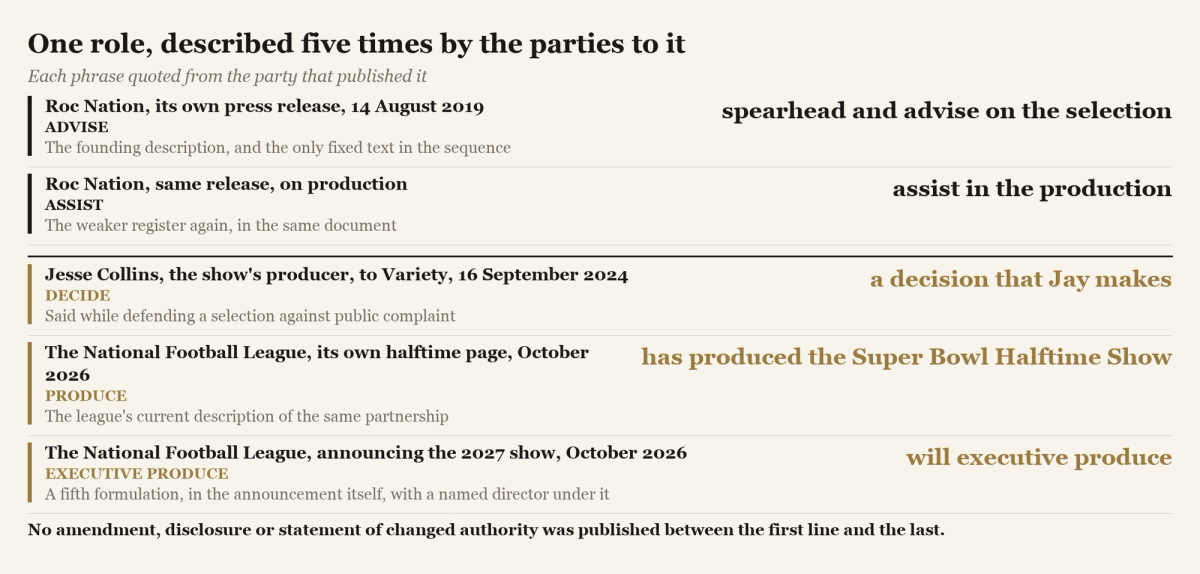
"Roc Nation will spearhead and advise on the selection of artists for NFL tentpole performances, including the Super Bowl, and will assist in the production and promotion of new music as well as culture- and cause-focused initiatives."
Read that sentence slowly, because it contains two different claims about authority and does not choose between them. To spearhead something is to lead it. To advise on something is to counsel somebody else who decides. The first describes a principal, the second describes a consultant, and the clause holds both at once without indicating which governs. A later sentence in the same release uses the weaker register again: Roc Nation "will also consult and collaborate on various aspects of production, promotion, marketing, and communications for live music events."
So the public founding description of the role is ambiguous on precisely the question that matters, and the ambiguity is not a journalist's compression. It is in the announcing party's own prose.
The release quotes both principals. Shawn Carter speaks about reach and community. Commissioner Roger Goodell calls Roc Nation "one of the most globally influential and impactful organizations in entertainment" and speaks about social change. Neither quotation addresses who will pick the halftime performer.
Two more things belong here, because together they date the position from which everything later moved.
The first is that the question of Carter performing was live at the signing. The league's own account, reported at the time of the 2027 announcement, is that when the NFL first reached its agreement with Roc Nation the commissioner made one request: that Carter perform himself, whenever the moment felt right to him. So the possibility was raised by the league in 2019, at the moment the authority was granted.
The second is the answer he gave in public that year. Asked whether the partnership meant he would perform, Carter's reply was unambiguous: "If this is about me performing at the Super Bowl, then we can just end this conversation now."
Set those side by side and the shape of the thing is already visible in 2019. The league asks the incoming adviser to consider performing one day. The adviser publicly rules it out. Nobody records what, if anything, was agreed about how that would be decided if it ever changed.
The title the parties chose, which has no defined content
The role was announced under a specific name: official Live Music Entertainment Strategists. It is worth pausing on it, because the parties selected it and nobody has ever said what it means.
A strategist is not an office with settled duties. A producer has duties, and so does a consultant, an agent, a curator and a commissioner; each of those words carries a conventional scope that a reader can test a description against. Strategist carries none. It describes a relationship to decisions without specifying whether the holder makes them, shapes them, or merely has views about them, which is precisely the question this study is unable to answer from the public record.
This is not a complaint about jargon. A title with no conventional content cannot anchor a later dispute about scope, and it cannot be used to detect a change in scope either. Had the 2019 announcement described Roc Nation as the halftime show's producer, the league's 2026 sentence would read as a restatement of the same fact and there would be nothing here to examine. Had it described the company as an adviser, the producer's 2024 account of a decision one man makes every year would read as a departure requiring explanation. Because the announced title was a word without a settled scope, neither later description can be checked against it, and both can be true at once without anybody having to reconcile them.
That is the practical function of a vague title, whether or not anybody intended it. It makes a later widening undetectable, because there is no stated boundary for the widening to cross.
What the show's producer says, which is not the same thing
Five years later the question was answered, in passing, by somebody with no reason to misdescribe it.
In September 2024 the selection of Kendrick Lamar for the following February's show had produced public complaint, much of it from people who felt Lil Wayne had a stronger claim. Jesse Collins, who produces the halftime show, was asked about it in an interview with Variety. He said the team admired Wayne and that Lamar would deliver, and then he explained how the choice is arrived at:
"It's a decision that Jay makes. Since we've been onboard with that show, he's made it every year, and it's been amazing. He's always picked right!"
That is a flat description of a decision procedure, offered by the show's producer, on the record, in the ordinary course of defending a choice against criticism. It is better evidence than a headline and better evidence than an inference, and it says something the 2019 release does not say: that the selection is one person's to make, and has been every year.
Note what the quotation does and does not establish. It establishes a practice as of September 2024. It does not establish an instrument. Collins is describing how the thing works, not citing a clause, and nothing he says explains how a role announced as advisory came to be decisional, or when.
What the league says now
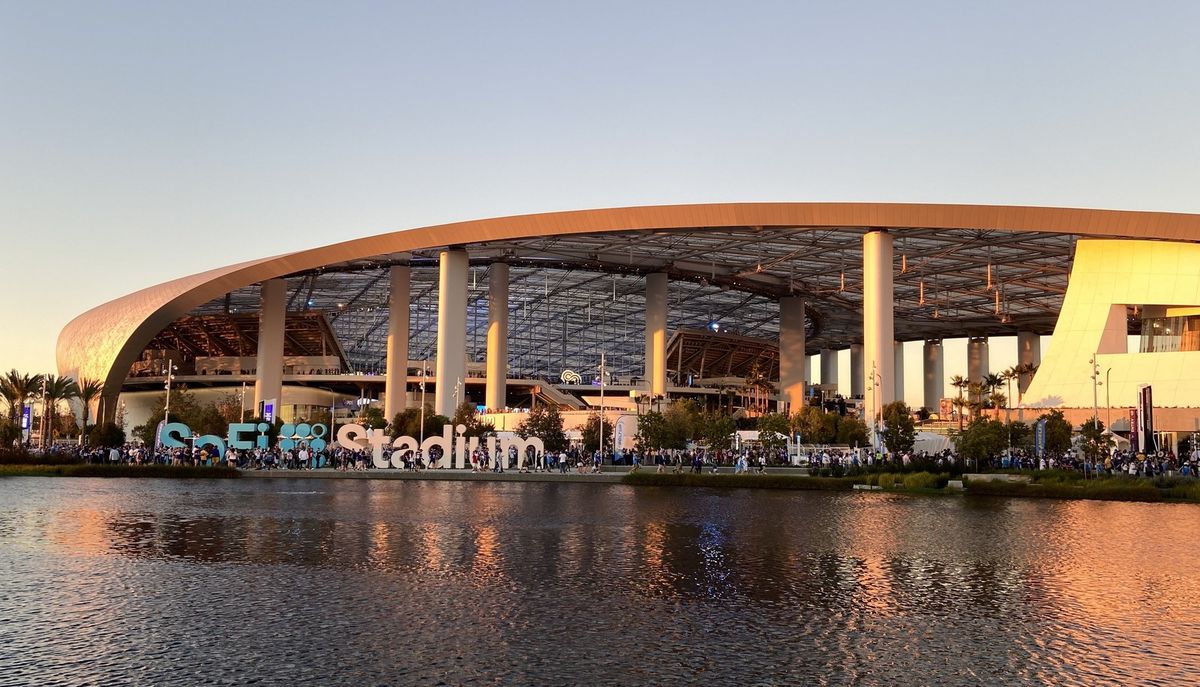
On a Monday night in late October 2026, during a nationally televised game, the NFL announced that Jay-Z would headline the Super Bowl LXI halftime show at SoFi Stadium on 14 February 2027. The league's own halftime page carries it plainly: "Twenty-five-time Grammy Award-winner Jay-Z will perform at the Super Bowl LXI Halftime Show."
The same page describes the partnership in a single sentence, and the sentence is worth setting beside the one from 2019:
"Roc Nation has produced the Super Bowl Halftime Show since partnering with the NFL."
In 2019 the company said it would assist in the production. In 2026 the league says it has produced. In 2019 the company said it would advise on the selection. In 2024 the show's producer says the selection is a decision that Jay makes. In the 2027 announcement itself a fifth formulation appears: the company will executive produce the show, with a named director working under it.
Each of those four statements comes from a party to the arrangement or from the person running the show. Not one of them is a rumour, and no two of them are in flat contradiction; each is a slightly firmer description of the role than the one before it. Put end to end they describe a transfer of authority, and the transfer has no date, no instrument, and no announcement.
The only account anybody has given of how the 2027 selection came about is a remark attributed to the commissioner, who is reported to have asked Carter to take the stage whenever the moment felt right to him. Read carefully, that sentence does not describe the league choosing a performer. It describes the league leaving a choice to the person who would occupy it.
The sentence that was never written
If the authority changed, something should say so. Nothing does.
The partnership was extended in October 2024, first reported by Bloomberg on Tuesday the fifteenth of that month. Neither the value nor the duration of the extension was made public; the trade coverage states plainly that specifics regarding the value and duration remain undisclosed, and no outlet has since established either.
Asked about the arrangement at the NFL owners meeting in Atlanta that week, the commissioner described it as "a mutually positive relationship" and added a sentence that is the closest thing on the record to an account of how the arrangement is governed: "I'm not sure either one of us really spend much time talking about contracts." He also said that "Jay is happy. Desiree Perez is happy. I'm happy, so we're all good." Those are the terms in which the parties themselves describe the basis of the relationship, and they are terms of satisfaction rather than of scope.
The agreement is not in the public record in any form. It is not a filed document. A full-text search of the United States Securities and Exchange Commission's filings for "Roc Nation" together with "National Football League", across annual reports, quarterly reports and current reports, returns nothing at all. The search is working: the same search for "Roc Nation" alone returns one hundred and sixty seven filings, including five annual reports from Live Nation Entertainment, which holds an interest in the company. So the filings mention the party and do not mention the arrangement.
That is a bounded finding and it should be read as bounded. It establishes that no filing carries both phrases. It does not establish that no filing alludes to the arrangement in other words, and a private partnership between a private company and a sports league is not the kind of thing that ordinarily appears in a securities filing at all. The point is narrower and it holds: there is no public instrument, and therefore no public amendment, and therefore no document that records the moment an advisory role became a deciding one.
Eight shows, and no published criterion for any of them
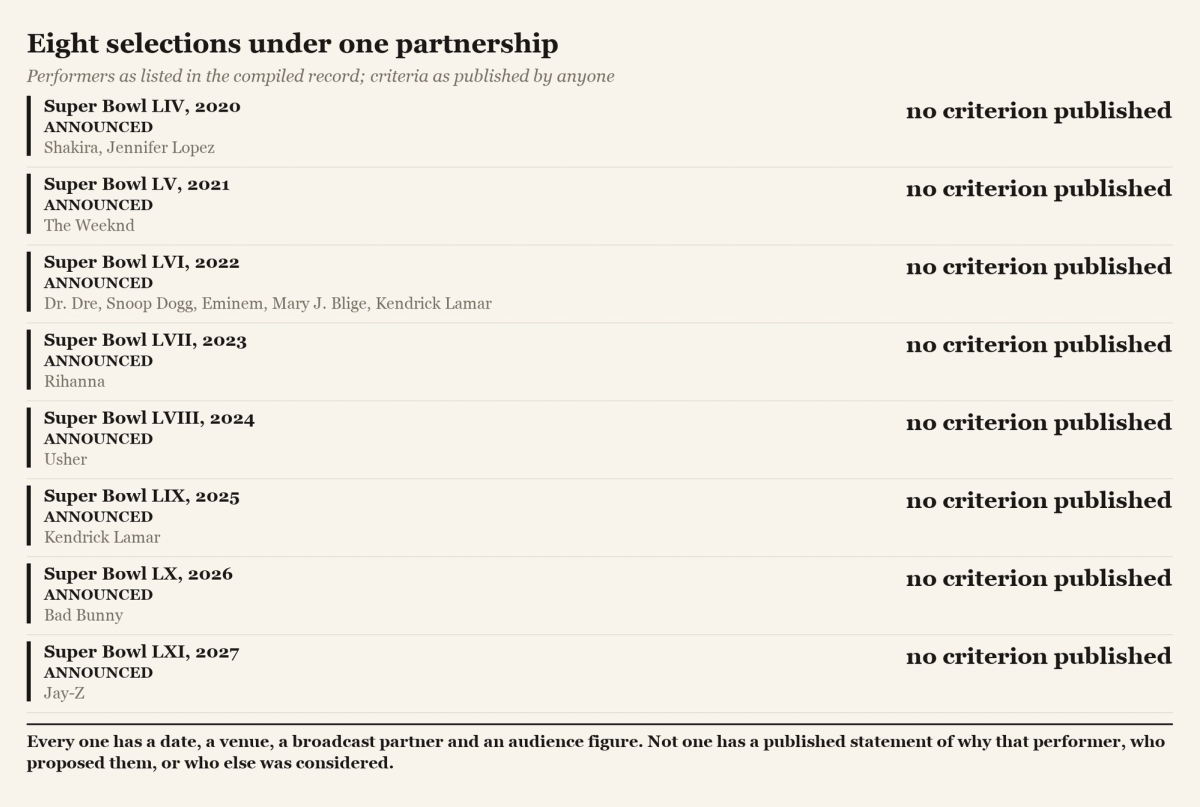
Under this partnership the halftime show has had eight performers. Shakira and Jennifer Lopez at Super Bowl LIV in 2020. The Weeknd at LV in 2021. Dr. Dre, Snoop Dogg, Eminem, Mary J. Blige and Kendrick Lamar at LVI in 2022. Rihanna at LVII in 2023. Usher at LVIII in 2024. Kendrick Lamar again, alone this time, at LIX in 2025. Bad Bunny at LX in 2026. Jay-Z at LXI in 2027.
For each of those eight there is an announcement. For each there is a date, a venue, a broadcast partner and, afterwards, an audience figure. For not one of them is there a published statement of why that performer rather than another, who proposed them, who was also considered, who was consulted, or on what the decision turned. No such statement was located for any of the eight.
That absence is bounded too, and the boundary matters. It is a claim about announcements, the league's own halftime pages, the producing company's own newsroom, and the trade and general reporting that surrounded each announcement. It is not a claim that no internal record exists. Somewhere there are emails, call sheets and shortlists. The claim is that nothing in the public record states a criterion, and that there is consequently nothing a person outside the arrangement could check.
The comparison that makes this legible is not another entertainment property. It is the way a museum records an acquisition. An accession carries a number, a date, a named donor or vendor, a stated method of acquisition and a committee that approved it. None of that exists because museums are more virtuous than broadcasters. It exists because an institution that confers permanent status on an object learned, slowly and after some scandals, that a conferral with no record cannot be examined later.
Where the announcements live, which is not an archive
The eight announcements are the only public record of these decisions, and they are publicity rather than documentation. That is not a quibble about tone. It determines how long they last and in what form.
The register of the 2027 announcement is worth recording, because it is the clearest evidence in this study that what is being produced is publicity rather than a record. The league announced it on a social platform with a pun. Its post read, in full: "GOAT's out of the bag." That is the most considered artefact this decision has produced. It is witty, it was certainly approved by several people, and it contains no information about how anything was decided.
The 2027 announcement was itself made during a live broadcast of a football game. A broadcast leaves no citable artifact: there is no page to link, no document to date, no version to compare against a later one. What survives is the coverage, and the coverage of this subject is unusually thin in exactly the places a researcher would want it thick. A reader assembling the record today finds the league's own page, the producing company's own page, a handful of trade reports, and then a long tail of items that are not sources at all. Several of the most prominent results are posts on social platforms, which carry no date a citation can rely on, no editorial responsibility, and no commitment to remain at the same address.
The contrast with the performance itself is again the point. The twelve minutes will be preserved in formats chosen for longevity, by parties contractually obliged to retain them. The decision will be preserved, if at all, in marketing material and in reposts, which are formats designed to be superseded. A publicity record is built to be current. An archival record is built to be checked. These are different objects with different lifespans, and only one of them is being made here.
This is also why the 2019 press release carries so much weight in this study. It is the single document in the whole sequence that was written to be referred to later, and it is the reason the ambiguity in its central sentence matters so much. For eight years it has been the only fixed text, and it does not answer the question.
The fee is documented and the method is not
There is one number in this story, and its position in the record is instructive.
The original 2019 agreement was valued at twenty five million dollars over five years, roughly five million a year, a figure the trade press attributes to ESPN. The parties did not publish it. A reporter obtained it.
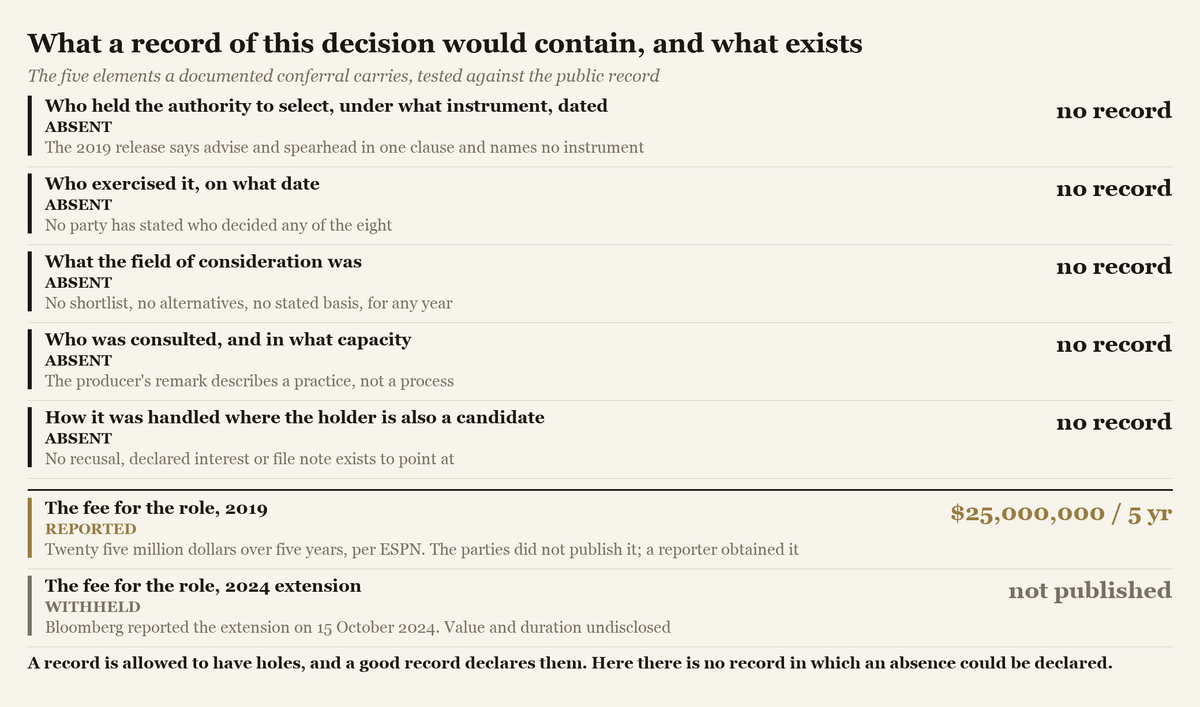
So the public record contains the price of the authority and nothing about its exercise. We can say roughly what it cost to hold the role. We cannot say how the role was used in any individual instance.
And the record has grown thinner rather than richer. The 2019 deal has a reported value. The 2024 extension has neither a published value nor a published term. On the one dimension where the public record held something, five years of operation reduced it to nothing.
What a record of a conferral would have to contain
This institution's subject is not whether a company should be more forthcoming. It is what survives, and what can be checked, after everyone involved has stopped being available to ask.
A record adequate to this decision would contain five things, and none of them is onerous. Who held the authority to select, under what instrument, dated. Who exercised it, on what date. What the field of consideration was. Who was consulted and in what capacity. And, where the holder of the authority is also a candidate for the thing conferred, a statement of how that was handled.
Not one of those five exists in public for any of the eight shows.
The objection that this is an unreasonable standard for entertainment is answered by looking at what the comparable standard actually demands, and at how recently it was adopted.
Consider the two records a work of art carries when it changes hands properly. The first is the provenance: a chain of custody naming each owner, the dates between which each held it, and the method by which it passed on, with the gaps marked as gaps. The second is the acquisition record of the institution that took it in: a number, a committee, a date, a named source, a stated method. Neither of those records exists to satisfy curiosity. They exist because the alternative was tested for most of the twentieth century and failed, repeatedly and expensively, whenever a title was questioned, a restitution claim arrived or an attribution came apart. The paperwork is the residue of those failures.
The relevant feature of both records is that they document a decision rather than an outcome. A provenance line does not merely assert that a painting is now in Chicago. It states how it got there and who vouched for each step. An acquisition record does not merely assert that an object was accepted. It names who accepted it and on what basis, which is what allows a later reader to ask whether the right people were in the room and whether anyone with an interest in the outcome was among them.
That last question is the one the halftime record cannot be asked. Where an authority to confer is held by a party who may also receive what is conferred, every documented process in the art trade and the museum sector has some mechanism for it: a recusal, a declared interest, a committee that excludes the interested party, a note in the file. The mechanisms vary and some of them are weak. What is uniform is that the question is on the record as a question. Here there is no file in which to note it, which means the question cannot be answered either way, including in the arrangement's favour.
It is worth being precise about what kind of failure that is, because a record is allowed to have holes. A good record states its absences. It says that a date is unknown, that an owner between two years cannot be established, that a document was destroyed. A declared absence is not a defect in a record; it is the record working. What is at issue here is different and worse: there is no record in which an absence could be declared. There is a sequence of announcements, and announcements are not records. An announcement tells you the outcome. A record tells you how the outcome came about, and admits where it cannot.
The distinction this rests on was drawn in 1959 by John French and Bertram Raven, in a chapter called "The Bases of Social Power" in Dorwin Cartwright's volume Studies in Social Power. Among the bases they separate are legitimate power, which rests on a recognised right to prescribe, and referent power, which rests on identification with the person who holds it. The two are not ranked, and neither is illegitimate. They are distinguished because they behave differently, and one of the ways they behave differently is this: a right to prescribe can be written down, traced and audited, and an identification cannot. When an authority grounded in the second begins operating as though it were the first, the paperwork that would normally accompany the first does not appear, because nobody ever drafted it.
The strongest objection, which is that none of this is hidden
The best argument against everything above is that it asks a cultural question in a legal register.
Nobody concealed anything. Roc Nation published its role. The producer described the procedure in a magazine interview. The league states the arrangement on its own website. The complaint about documentation might therefore be a category error: a curator's judgement is not a contractual power, selecting a performer is a matter of taste and timing rather than of right, and demanding an instrument for it is like demanding one for an editor's choice of cover.
Two answers, and the first is the stronger.
The parties chose the register themselves. Nobody imposed contractual language on this arrangement. Roc Nation announced it in the vocabulary of delegated authority, as a partnership with a defined scope in which it would spearhead and advise on selection and assist in production. Having framed the role as a grant, the parties invited the question of what the grant contains and how it changed. The question is not being imported from outside.
The second answer is that the objection proves too much. If authority in cultural production is simply constituted by repeated assertion, and documentation is beside the point, then the same reasoning excuses an auction house that publishes no provenance, a dealer who will not name a previous owner, and a gallery that declines to say who made which part of a collaborative object. Each of those is also a matter of trade practice and relationship rather than of law, and each is a hole in a record that someone will need in thirty years.
There is a third position, raised in this institution's own adversarial review, and it is the one that most deserves conceding. On this reading the sequence described above is not an anomaly at all. Authority is routinely consolidated by restatement, the opacity is often deliberate rather than accidental, and treating this instance as singular mistakes an ordinary mechanism for an exception.
That is probably right, and it strengthens rather than weakens the finding. Nothing here suggests the Super Bowl halftime show is unusual. It was chosen because it is unusually well documented at the surface and unusually undocumented underneath, which makes the mechanism easy to see. If the mechanism is ordinary, then the number of conferrals of value currently proceeding on no record at all is very large, and this is simply the most watched of them.
Coda
On 14 February 2027 roughly twelve minutes of performance will be recorded more thoroughly than almost any other cultural event of the year. There will be multi-camera masters, isolated audio stems, rehearsal footage, a broadcast log timed to the second, an audience measurement, a merchandise record and a set list. In fifty years a researcher will be able to establish what happened on that stage to a precision that most of the twentieth century's art cannot match.
The same researcher will not be able to establish how it was decided. There is no document to find. The decision that produced the most comprehensively recorded twelve minutes in American culture will be the only part of it with no record at all.
What is not claimed here
This study does not value, appraise, authenticate or attribute anything. No opinion is offered on what a halftime appearance is worth, what the role of producing the show should cost, or whether any figure quoted was reasonable. The one financial figure that appears is quoted from the outlet that reported it, attributed, and dated.
No judgement is offered on the music, on any performer's suitability, or on the quality of any of the eight shows. Whether the selections were good ones is not a question this institution is equipped to answer, and the producer's own view that they were is quoted as evidence of how the decision is made, not endorsed as a verdict on the outcomes.
Nobody is accused of anything, and one claim in circulation is specifically not made here. It has been widely written that Jay-Z selected himself for the 2027 show. No party has said so. The producer's 2024 remark establishes a practice as of that date; it does not establish who decided this particular selection, and no source located states who did. The step from "he decides every year" to "he decided this one" is an inference, it is not evidence, and it is not made in this study.
Equally, nothing here asserts that the league does or does not retain a veto over the selection. No source establishes either, and the question is left open rather than resolved by inference.
A private company is entitled not to publish its decision-making. A league is entitled to delegate a creative function and to describe that delegation in whatever terms it prefers. An executive is entitled to decline to discuss contracts. Every individual silence catalogued above is ordinary commercial practice and defensible on its own, and the finding is what they amount to together, not that any one of them is improper.
The absence claims are bounded, and each is bounded differently. The statement that no public instrument exists rests on the parties' own publications and on a securities full-text search that was verified against a control returning one hundred and sixty seven filings for the same party. The statement that no criterion has been published for any of the eight selections rests on the announcements, the league's and the producing company's own pages, and the reporting around each; it is not a claim that no internal record exists. The statement that the 2024 extension's value and term are undisclosed rests on the reporting of that extension and on the absence of any subsequent disclosure.
Three limits on the evidence, stated plainly.
Two articles relevant to this study sit behind paywalls and were not read: an interview with the commissioner published on the day of the 2027 announcement, and a trade analysis of the partnership. The commissioner's remarks about contracts and about the relationship were read directly, in two independent trade reports of the same owners meeting, which agree on the wording. His reported request that the performer take the stage whenever the moment felt right to him was not read in his own words; it reaches this study through a single news report of what he said, and is described as reported rather than quoted.
The eight-performer table is taken from a compiled secondary listing, checked against the league's own announcement for the most recent two. Nothing in the argument turns on any individual name.
And one document surfaced during research was deliberately not used. A paper whose title addressed this study's exact subject was published under a pseudonym and subsequently removed by its repository, which recorded the removal as out of scope and noted that the account had been blocked. It is not cited, quoted or relied upon anywhere above, and it is mentioned here only because a reader searching this subject will encounter it.