Matty Boy and Chrome Hearts: Who the Record Credits
On an artist whose clothes have 1,541 dated public sales and whose paintings have almost none, and on what a catalogue field decides when it names the maker of a hand-painted shoe.
What the record holds on Matty Boy and Chrome Hearts
Start with the part that is not in dispute, because it is unusually well documented and because everything else in this study is measured against it.
Matt DiGiacomo, who works as Matty Boy, was creative director of Chrome Hearts from 2018. The year is given by Honor Fraser, the Los Angeles gallery that gave him a solo exhibition, in a biography on its own site, and it is repeated independently elsewhere; no source proposes a different one. Before that he was an outside artist the house commissioned: in March 2017 Hypebeast described Chrome Hearts having "enlisted LA-based artist Matt Digiacomo" to customise leather jackets, bags, surfboards and accessories in paint and ink, and to paint live at the brand's Aoyama store. By September 2025 Honor Fraser's own event page describes him as "previously creative director of Chrome Hearts." The run ended somewhere between those two dates.
In that period a great many garments were made carrying his work, and those garments now trade. A resale database called ARCHV, which aggregates completed sales from Grailed, Mercari, Rakuma, Yahoo Auctions and a handful of archive boutiques, maintains an index for Chrome Hearts Matty Boy. Read on 27 October 2026, it states its own totals on the face of the page: 162 versions, 1,541 sales, typical £407, with 1,252 items listed for sale at that moment.
One thousand five hundred and forty one recorded transactions. Each of the ones the site shows carries a date, a platform, a size, a condition, often a colourway, and a price in both the original currency and sterling, converted at the rate on the day it sold. This is a price record of a seriousness that would not embarrass a specialist auction archive.
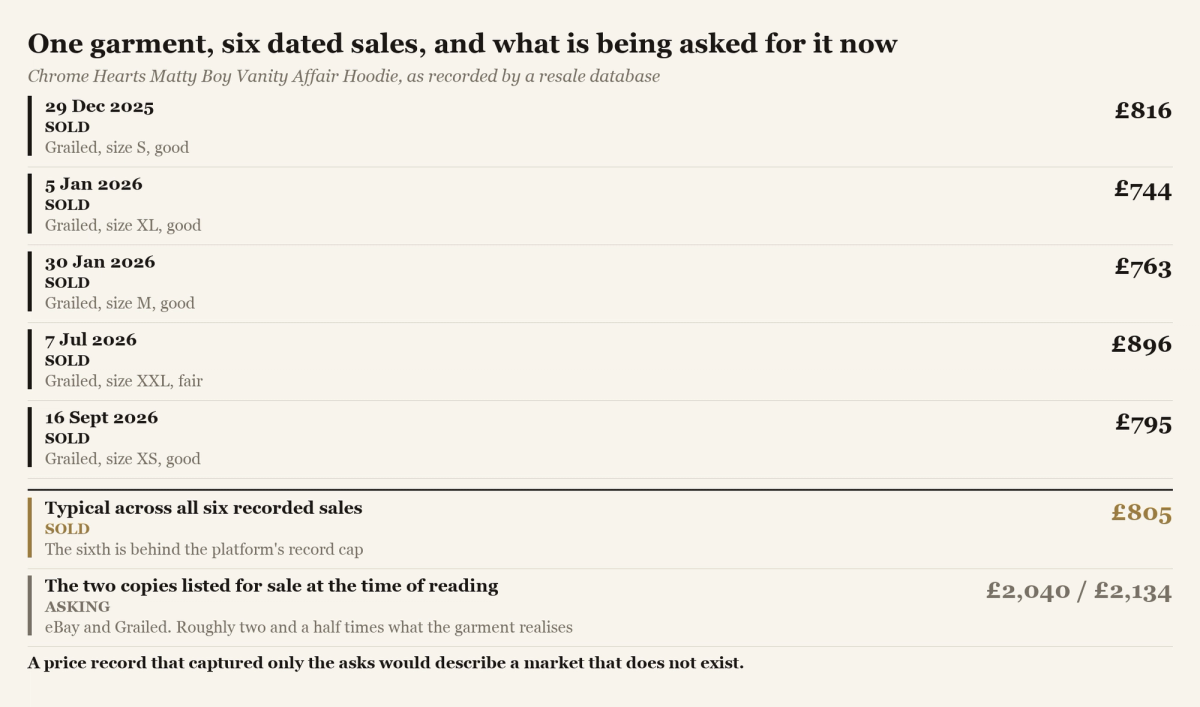
Take a single garment as a specimen. The Vanity Affair Hoodie, piece 4049 in that index, has six recorded sales. Five are visible: 29 December 2025 at £816, 5 January 2026 at £744, 30 January at £763, 7 July at £896, and 16 September at £795. The site reports a typical price of £805, a selling time of about twenty days from listing, and a change of minus three per cent across all sales. Every one of those sales happened on Grailed, which is to say between private parties, and every one has a day attached to it.
Set beside that, the two copies listed for sale at the time of reading were asking £2,040 and £2,134. Two and a half times what the garment demonstrably realises. That gap between what is asked and what is paid is not unusual and it is not a scandal, but it is worth naming precisely, because this study will meet it again at an auction house and at a dealer, and because a price record that captured only the asks would describe a market that does not exist.
What that hoodie shows in miniature, the index shows at scale. Take the next tier of pieces and the pattern holds: a Chomper Hoodie with 132 recorded sales and a typical price of £542, whose most recent recorded transaction was £378 on 26 October 2026; a Sex Records Hoodie with 81 sales and a typical of £539, down four and a half per cent; a Chomper Trucker Hat with 73 sales, typical £336, down nearly twenty one per cent; a Brain Hoodie with 40 sales, typical £577, down over nineteen. These are not guesses about a market. They are counted transactions with directions of travel attached.
The platform splits them by geography too. Of the individual sale records visible, the great majority are Western, mostly Grailed; a substantial minority are Japanese, through Mercari and Rakuma; a small number are archive boutiques. A single garment design can therefore be watched moving through three distinct markets on two continents, which is more granularity than most fine-art price databases offer for most artists.
The density goes well beyond one hoodie. The index names Sex Records jeans, jackets, bombers and camouflage shirts; 99 Eyes bags, eyewear, crewnecks, socks and boxer briefs; Chomper shorts, jackets, rings, bucket hats, sweatpants and a pendant; a Bellagio set; a styrofoam cup. A Chomper Hoodie alone carries 132 recorded sales, a Sex Records Hoodie 81, a Chomper Trucker Hat 73. The record reaches down to objects worth tens of pounds and up to a work jacket that sold for £8,835 at a boutique in August 2026.
This is what it means to say that the Chrome Hearts work sells well and resells well. It does, and more to the point, it is watched. Strangers with no relationship to the artist maintain a dated ledger of what his clothing fetches, because there is money in knowing.
Two cautions belong here rather than in a footnote, because they bound everything above.
The first is that the visible record is a fraction of the claimed one. ARCHV shows at most five individual sale records per piece to an anonymous reader. Of the 1,541 sales it claims, 558 individual records are visible and 983 are withheld, which is just under sixty four per cent. The withholding is silent: no banner announces it on the piece pages. The figures quoted in this study are therefore drawn from a visible third of a larger set, and where a "typical" price is cited it is the site's own computation over data this study cannot fully see.
The second is that some of the site's summary figures describe no transaction at all. Its brand index advertises a range of "£22 to £154,117". The top of that range is a single pair of Sex Records jeans whose own page reads, in the site's words, "£154,117 from its only sale": one transaction, in August 2026, at a venue recorded as Shengli Road Market, for $210,000. Lowest, highest and typical are identical because there is one sale. A second piece elsewhere on the platform, a pair of Chrome Hearts Miami Jeans whose attribution to DiGiacomo is not established, reports a typical of £66,826 across two sales whose recorded values are £11,511 and £122,141, a midpoint that neither sale came near.
There is a third caution, and it is the one that matters most for anybody who expects this record to still be there later.
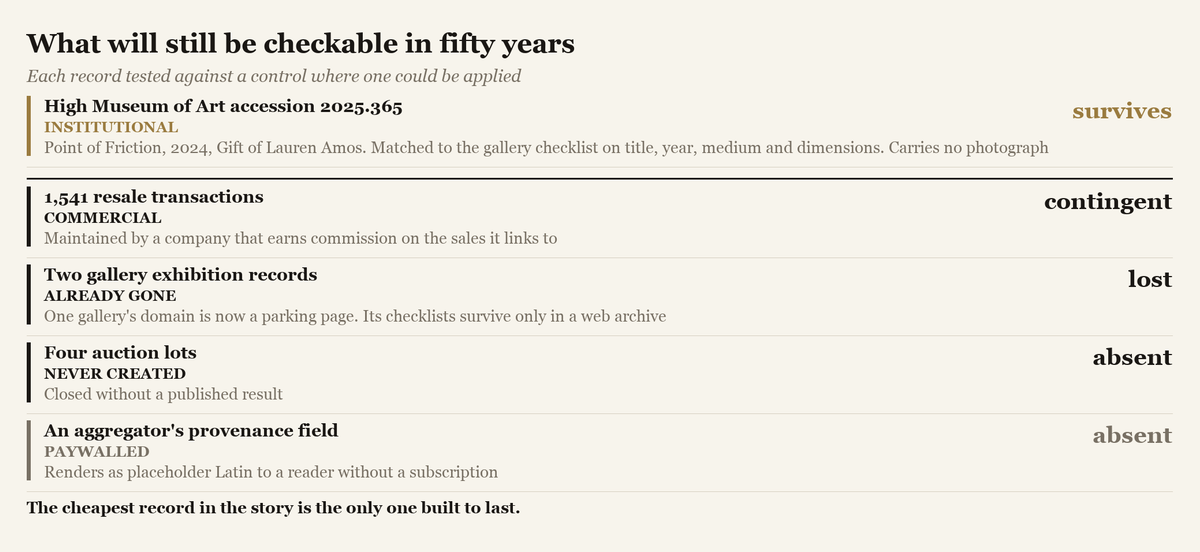
The thing doing the remembering is a business. The database says plainly that it may earn a commission on purchases made through the platforms it links to. That is a perfectly ordinary arrangement and it is disclosed. But it means the ledger exists because somebody monetises it, and the obvious corollary is that it persists only while somebody does. A museum accession number is maintained by an institution whose purpose is to maintain it. A resale index is maintained by a company whose purpose is to sell access and referrals.
One of those survives the loss of commercial interest in the objects. The other is the commercial interest. This study will shortly describe a gallery whose entire exhibition record vanished when its domain lapsed, and the point generalises: the most detailed price history in this artist's record is also the most contingent, and nothing about its present excellence tells you anything about whether it will exist in twenty years.
So the record is simultaneously excellent and, at its edges, fictional. It records real transactions honestly and then computes averages from samples of one. A reader who took the headline range would carry away a number that one receipt produced. That is not a reason to discard the dataset. It is a reason to read the rows rather than the summary, which is what this study has done.
What the same record holds on his own work, which is almost nothing
Now the other half, and the question this study was asked to answer: whether the same effect reaches the work he signs himself.
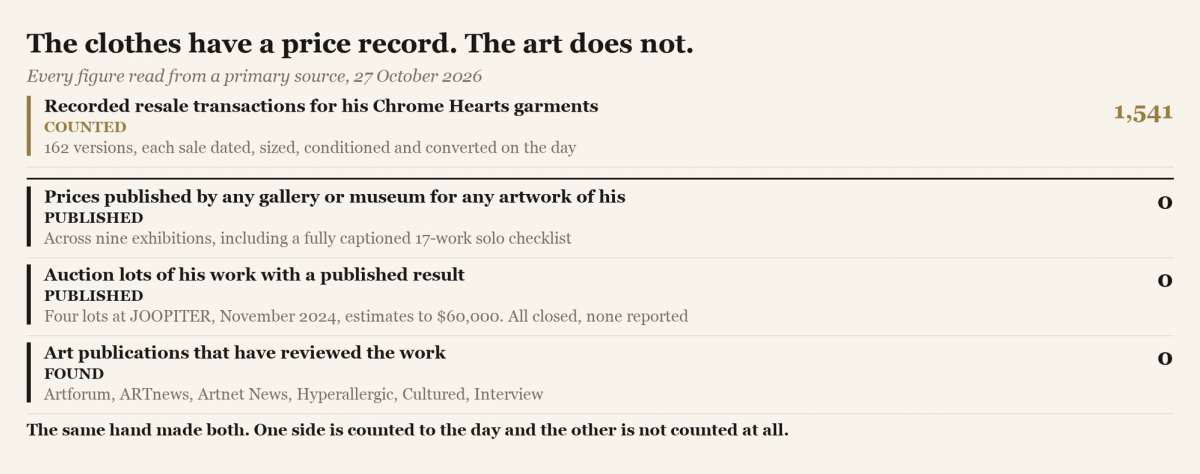
It is worth stating the honest position before the evidence, because the evidence is an absence and absences are easy to overclaim. Nobody can presently say what Matty Boy's art sells for on a secondary market, because there is no secondary market record to read. Not a thin one. Not a contested one. The places where a public price would ordinarily be created have each, for different reasons, created none.
Begin with the galleries, because that is where the work is sold first, and note at the outset that what follows is not an accusation of secrecy. Commercial galleries routinely do not publish prices. It is the normal practice of the trade, defended on reasonable grounds about negotiation, placement and the management of an artist's market. Nothing in this section asks them to behave differently.
What the section does is count the consequence. When the normal practice of galleries meets an auction house that does not publish results, a retailer that prefers to be asked, and a museum that does not price gifts, the aggregate is an artist whose work has no public price at all, and no individual party made that decision or is answerable for it.
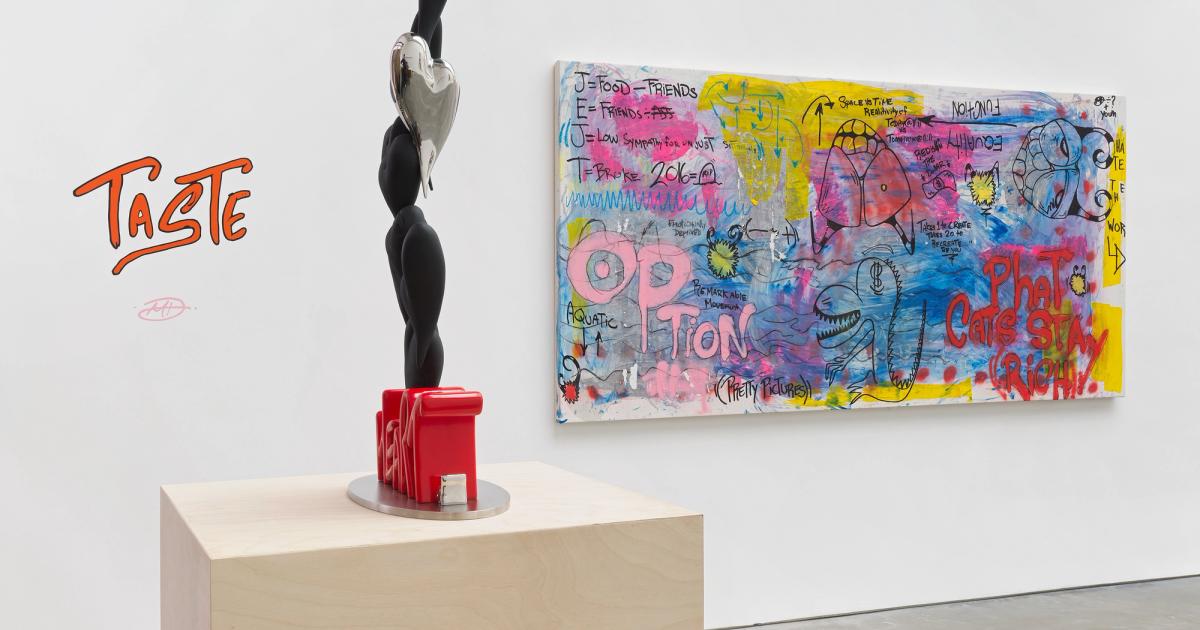
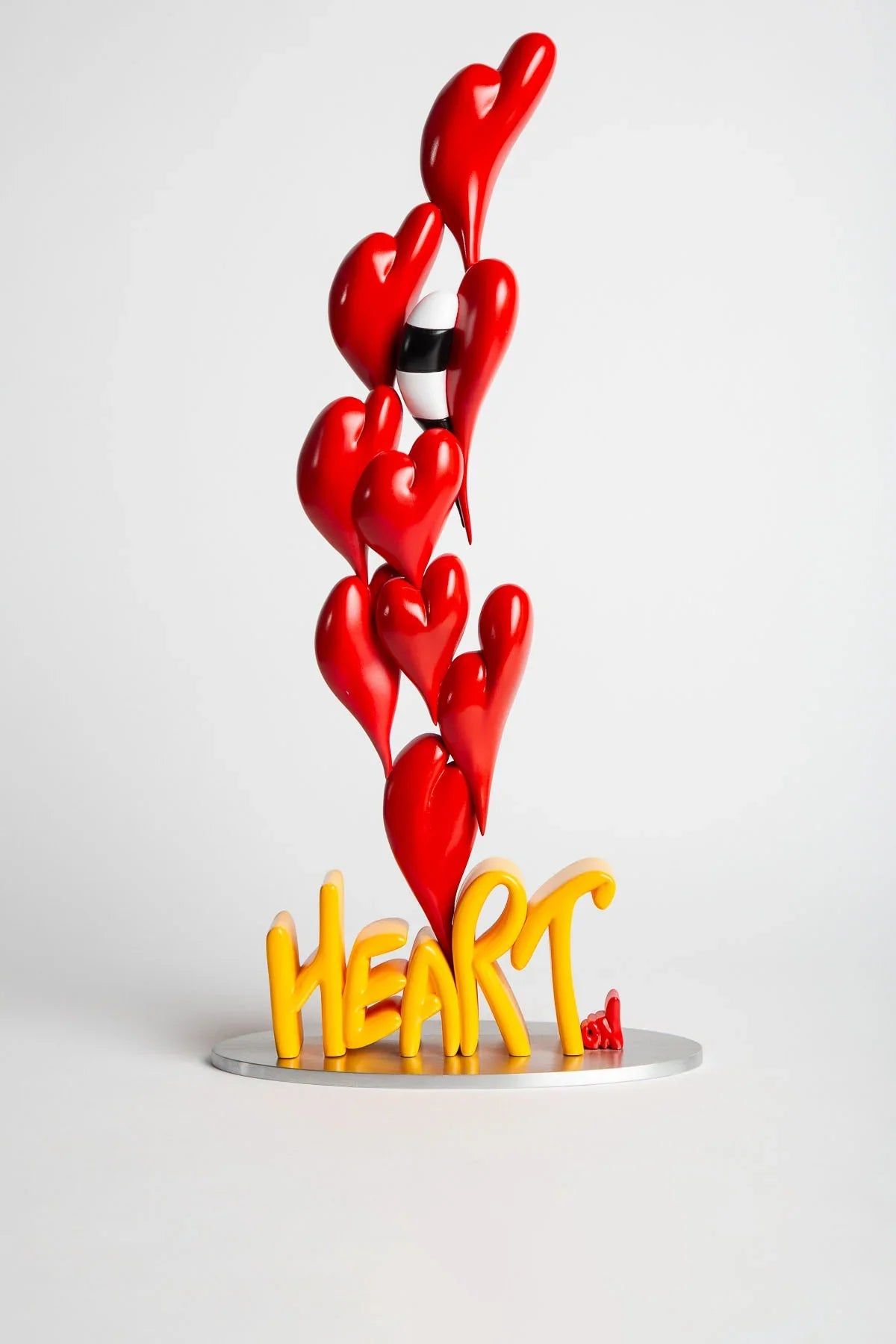
He has had two solo exhibitions with Ross + Kramer, the first in East Hampton from 30 July to 12 August 2022, the second in New York from 1 to 26 April 2025, titled Taste. The second showed fourteen paintings and three sculptures. The checklist is specific: Untitled (Half Chomper), 2023, resin, 22½ by 18 by 4¼ inches; Heart On, 2024, stainless steel, 24 by 12 by 5 inches; Point of Friction, 2024, 101¼ by 72 inches; Eye 4 Me, 2024, 84 by 72; Mouthful, HEAD, WILD CARD, REPO!, Untitled (Sex Records), Untitled (Think), and others. Media are given as oil paint, acrylic paint, oil pens, oil markers, chalk and spray paint on canvas.
No prices appear anywhere on that page. The same is true of his 2023 solo exhibition at Honor Fraser in Los Angeles, Loading…, which ran from 9 September to 2 December and included paintings, sculptures and a mock Apple Store selling customised phones, laptops and AirPods. Both galleries published what the work is and neither published what it cost. This is entirely normal in the trade and it is the first of the silences.
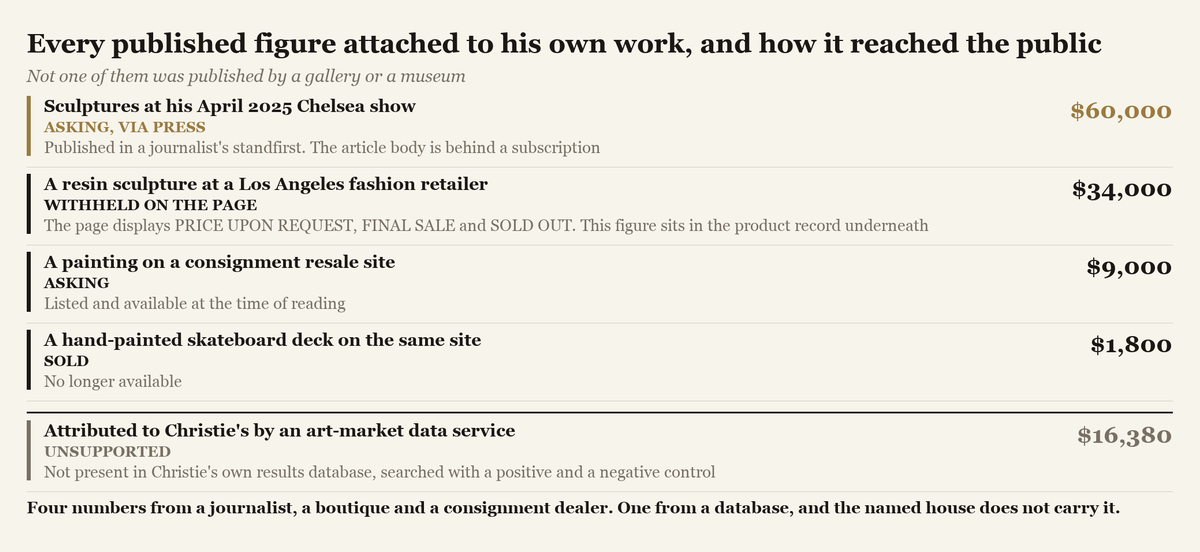
The second silence is more pointed. Maxfield, the Los Angeles retailer where the Chrome Hearts Sex Records project first launched in 2018, has sold one Matty Boy artwork: Untitled (Heart On), 2023, a resin sculpture on an aluminium pedestal, nine by eighteen by four and a half inches. Its page displays three things at once: "PRICE UPON REQUEST", "FINAL SALE", and "SOLD OUT." The product record underneath that page carries a figure of thirty four thousand dollars. The number exists in the shop's own data and is suppressed on the surface a customer reads.
That figure is reported here as what it is: a value in a product record, not a confirmed transaction price, and worth confirming with the retailer before anyone relies on it. But the structure is the finding regardless of the number. The object sold, the price was recorded internally, and the public page says ask us.
Read those three lines together and they are close to a complete theory of how a price disappears. Price upon request says the number is not for you. Sold out says the transaction has happened. Final sale says it will not be reversed. A thing was made, priced, sold and closed, and the only public trace is that all four of those occurred. The record is simultaneously complete and empty: everything about the event is published except the one fact anybody would want.
It is worth noticing where this listing sits. Maxfield is a fashion retailer, and the sculpture is merchandised in its system with a colour field reading "MULTI" and a size field reading "N/S". The object that carries the highest recorded figure attached to any DiGiacomo artwork is catalogued with the same fields as a shirt. That is not a complaint about Maxfield, which never claimed to be a gallery. It is an observation about which infrastructure his work actually passes through, and the answer, repeatedly, is retail infrastructure rather than art infrastructure.
A confusion to head off, because the titles invite it. The Maxfield piece is Untitled (Heart On), 2023, resin on an aluminium pedestal, 9 by 18 by 4.5 inches. The Taste checklist contains Heart On, 2024, stainless steel, 24 by 12 by 5 inches. Different title, different year, different material, different size. Two objects, not one, and any price attached to either does not transfer to the other.
The third silence has a byline. In April 2025, Marion Maneker wrote about the Taste opening for Puck, under the headline "Matty Boy Meets World." His standfirst says the show "highlighted his sculptures that were going for $60,000 a pop." That is the single most-quoted number attached to DiGiacomo's art, and it is worth being exact about its status. It is an asking price, not a sale. It reaches the public through a journalist rather than a catalogue. The article body sits behind a subscription, so the sentence quoted here is the one visible to any reader, and other figures circulating from that piece could not be checked.
A price that exists because a reporter was in the room is a different kind of fact from a price that exists because an institution published it. Both can be true. Only one survives the reporter.
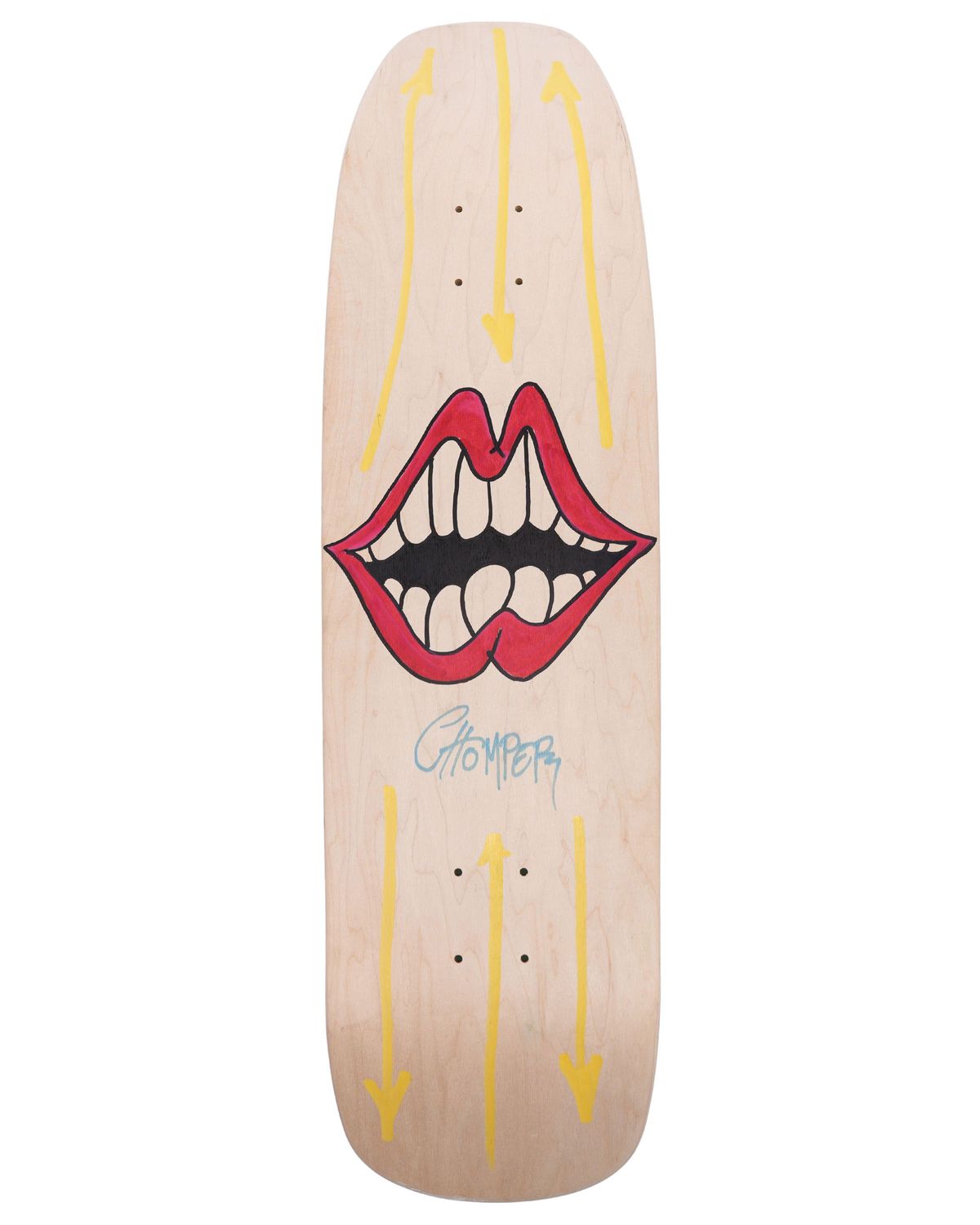
The fourth place is a consignment dealer, and it is the closest thing to a public secondary market his art has. Justin Reed, a resale platform that takes consignments and pays sellers a commission, has carried Matty Boy objects alongside his Chrome Hearts garments. At the time of reading it listed a Chomper Painting at $9,000, a framed work with the painting itself measuring 16½ by 11 inches, available. It had also carried a 'Chomper' Hand-Painted Skateboard Deck at $1,800, 33 by 8¼ inches, no longer available.
Those two are the nearest thing in this entire study to an answer. One artwork offered on the open secondary market at nine thousand dollars. One artwork offered at eighteen hundred and taken. Set against a reported gallery ask of sixty thousand.
It would be a serious error to call that a price collapse, and this study does not. The objects are different: a small framed painting and a painted skateboard deck are not the sculptures Puck described. Different work, different size, different market, different moment. What the comparison supports is narrower and still worth having: his art appears on the open secondary market in low four figures to low five figures, while his primary market reports five figures, and nobody has published a transaction that connects the two.
The platform's own language deserves one note, because it is this institution's subject. The listing carries the line "Guaranteed Authenticity. Every item is rigorously authenticated by our experts, familiar in the specifics of each brand featured." A resale platform is performing authentication on an artwork by a living artist. Whatever that is worth, it is the only authentication statement attached to any DiGiacomo object found anywhere in this research. Not the galleries, not the auction house, not the museum, not the retailer. The one party asserting that a work by this artist is genuinely by him is a consignment site, and its stated expertise is in brands.
There is a final irony worth recording in this section, and it concerns the single best price series in the entire study.
The garment with six dated sales, a typical price, a selling time and a trend figure is the Vanity Affair hoodie. No named press, no gallery and no Chrome Hearts source documents a Chrome Hearts collection by that name. It exists in commerce: on a major marketplace, in the resale database's Matty Boy index, and on a cluster of storefronts that call themselves official Chrome Hearts retail on unrelated domains, attach the same product name to different garments, and price it anywhere from a hundred and seventy nine dollars to two thousand two hundred and eighty.
So the object whose price is documented to the day, the currency and the condition is an object whose origin is documented nowhere. The market knows exactly what it sells for and has no account of what it is. That is not a flaw in this study's evidence. It is the clearest single illustration of its argument: a price record and a provenance record are different things, and having one tells you nothing about having the other.
Who the record credits, which is never him
A question changed the direction of this research halfway through, and it is the kind of question that only arrives from someone who knows how a trade actually talks: had anyone checked whether the auction houses use the name Matty Boy?
They had not. This study had searched five auction houses for "DiGiacomo" and reported that his work was absent from all of them. That absence was real as a measurement and wrong as a conclusion, and the reason is the most useful single fact uncovered here.
The houses that have handled his work do not file it under his name.
Sotheby's carries four pairs of hand-painted Nike shoes associated with him: two Air Force 1 Lows from 2021 at eleven thousand dollars each, an Air Jordan 1 Retro High from 2018 at eighty five hundred, and a Dunk Low from 2020 at the same. These sit in the house's fixed-price marketplace rather than in its auctions, and all four now read "Not Available" with no sale price or date published.
Read the attribution on one of them. The brand line says Nike. The listing title reads "Nike Jordan 1 Retro High Matty Boy Court Purple." There is no artist field, no maker field and no designer field anywhere on the page. His name appears twice: once in the title, and once in a sentence of description that reads "From artist-turned-Chrome Hearts creative director Matt Digiacomo, colloquially known as 'Matty Boy'."
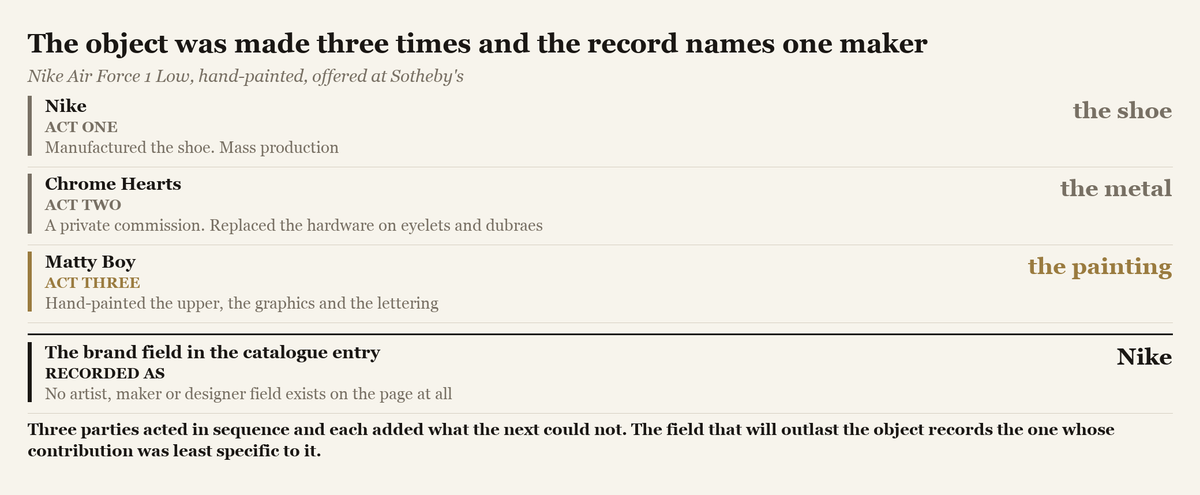
Now take the Air Force 1 from the same group and read what the listing says was actually done to it, because the object turns out to have been made three times.
Nike made the shoe. It is an Air Force 1 Low, a mass-produced sneaker, and the brand field records that and only that.
Chrome Hearts then worked the shoe. Sotheby's own description calls it a private commission by Chrome Hearts and says it "features Chrome Hearts hardware on eyelets and dubraes." The house replaced the metal. Chrome Hearts is a company whose reputation rests on sterling silver, which this institution has examined elsewhere, and the listing does not state the material of these particular parts, so this study does not either. What it states is that a second maker took a finished mass-market object and substituted its own components into it.
Then he painted it. The same description credits him with the hand-painting, the cartoon graphics, the words TEMP, STEP and CONCEPT across the white upper, and what it calls hand-finished details.
Three acts of making, by three parties, in sequence, each dependent on the one before and each adding the thing that the next could not. And the record of that object, at one of the two oldest auction houses in the world, says Nike.
That is not sloppiness, and it is worth saying why. A marketplace brand field exists so that a buyer searching for sneakers finds sneakers. It is a retail taxonomy doing a retail job. But the consequence is that the field which will outlast everything else about this object, the one a future researcher would reach for first, records the party whose contribution was the least specific to it. Nike made several million of those. One person painted that one.
This is also the exact point at which the aura becomes traceable as a sequence rather than an atmosphere. Each layer borrows credibility from the one beneath it. The sneaker is legitimate because Nike made it. The intervention is legitimate because Chrome Hearts made the hardware. The object is desirable because he painted it. And the catalogue, having to choose one name, chooses the one at the bottom of the stack.
Follow that logic to the object and it produces a question no record in this study can answer: what is this thing, in provenance terms? It is not a Nike shoe, because Nike did not fit those eyelets or paint that upper. It is not a Chrome Hearts product, because Chrome Hearts did not make the shoe. It is not straightforwardly a DiGiacomo artwork either, because two thirds of it was manufactured by other parties, one of them at industrial scale.
A conventional provenance record handles this badly, because its central field assumes a single maker. The object has three, acting in sequence, and the only honest description is the sequence itself. Yet every system that has catalogued one of these shoes has instead picked one party and dropped the other two. Sotheby's picked Nike. The auction house picked Chrome Hearts. Nobody picked him, and he is the reason the object is worth what it is.
That is not an argument that he should be credited instead. It is an argument that the field is the wrong shape. A record that can say made by and nothing else will always lose two thirds of an object like this, and objects like this are not rare: a collaboration, a customisation, a reissue, a restoration and an artist's intervention all have the same structure. The question is not who the maker is. It is what each party did, and when.
This institution's interest in that question is not theoretical, and it is worth stating plainly rather than leaving implied. The difference between a record that names one maker and a record that names a sequence of acts is the difference between a catalogue entry and a custody history. One tells you what to call the thing. The other tells you what happened to it. The shoe has had three things happen to it and carries a record of one.
JOOPITER, the auction house founded by Pharrell Williams, sold four Matty Boy lots in November 2024 in a sale called Chrome Hearts: Curated by Casanova Vintage. Lot 34 is titled, in the house's own capitals, "CHROME HEARTS Matty Boy Hand-Painted 10 Oz Title Boxing Gloves." The brand owns the first position. He modifies it.
So the answer to the question is yes, the houses use Matty Boy, and they use it the way a catalogue uses a decoration. At neither house is he the maker of record. Nike made the shoe. Chrome Hearts made the gloves. A corporation occupies the field that says who made the thing, and the man who painted it occupies the field that says what the thing is like.
This is the exchange the study set out to trace, and it turns out to be legible without any prices at all. It is in the shape of the catalogue entry. His hand raises what the object fetches, and the entry credits a brand. The value moves one way and the attribution moves the other.
There is a practical lesson sitting next to the conceptual one, and this study earned it the hard way. Searching an auction house for "DiGiacomo" was never going to find his work, because nobody files it under that name. The absence this study first reported was an artefact of the word used to look. An absence found by searching one vocabulary is a statement about the vocabulary. This institution has recorded the same failure before, when an acronym it uses internally returned nothing because the source had written out the formal name.
The name is a hazard in a second way. Sotheby's own description spells it "Digiacomo", without the second capital. The galleries spell it "DiGiacomo". An exact search for either form can miss the other depending on how a system handles case. A man with a working alias and two spellings of his surname is, in record terms, three people, and a researcher who picks one of them and finds nothing has learned nothing.
The auction that published no result
In November 2024, four objects carrying his work went under the hammer at a named auction house, and what happened to them is not public.
The sale was Chrome Hearts: Curated by Casanova Vintage, at JOOPITER, running from 15 to 27 November 2024. Four lots carried his name in their titles:
Lot 34, hand-painted ten ounce Title boxing gloves, described as one of a kind with original hand-drawn artwork and custom grommets and aglets on the laces, featured in Hypebeast in 2019 alongside a range of Chrome Hearts gym equipment. Estimate thirty thousand to sixty thousand dollars.
Lot 27, a hand-painted cross patch leather hoodie, one of a kind, thermal lined. Estimate ten to fifteen thousand.
Lot 33, a large cross hand-painted red leather tote bag, a special edition from 2022. Estimate five to seven thousand.
Lot 54, a Sex Records polo shirt made for staff of the Sex Records project, with custom Chrome Hearts buttons. Estimate two to three thousand.
Read lot 34's page today and it gives the estimate, a description in English and Japanese, and one further line: "Closed Nov 26, 10:41pm EST." The word hammer appears on the page only inside boilerplate explaining the buyer's premium. There is no realised price, no winning bid, no bid count, and no statement of whether the lot sold at all.
That is four objects, at a real auction house, with estimates reaching sixty thousand dollars, and no public outcome for any of them.
The same house runs a fixed-price marketplace alongside the auctions, and it carries one further object: a Matty Boy Sex Record patch beanie, eight by eight and a half inches, at one thousand dollars, with a live add-to-cart button. Set that against the resale database, where a Sex Records beanie has a typical realised price of £416, roughly five hundred and fifty five dollars across five recorded sales. The auction house asks about 1.8 times what the open market pays, which is an ordinary retail markup and is worth stating only because it is one of the very few places in this entire study where an asking price and a realised price can be put side by side at all.
The sale itself is worth a sentence, because its framing says something about where his work sits. It was titled Chrome Hearts: Curated by Casanova Vintage. The organising principle was not an artist, a medium or a period. It was a brand, assembled by a vintage clothing dealer. Four objects he made by hand entered the auction system inside a curation of somebody else's label, and the catalogue titles put that label first.
It is worth being careful about what "closed" means and does not mean. It does not mean sold. It does not mean unsold. It means the bidding period ended. A house is entitled to publish results or not; many online marketplaces do not, and JOOPITER's premium schedule is published plainly enough, at twenty five per cent of the hammer up to two million dollars. The absence here is of results, not of transparency in general.
But the consequence for a price record is total. If those gloves sold at the top of their estimate, the single highest price ever paid for a Matty Boy object is sixty thousand dollars and nobody outside the house knows it. If they did not sell, that too is information, and nobody knows that either. The number simply does not enter the world.
A published auction result does a particular job, and it is worth naming because its absence here is the whole point of the section. It converts a private transaction into a public fact. It is dated, attached to a described object, and produced by a party with a reputational interest in being accurate. It is the closest thing the object world has to a price that anyone can cite without asking permission. Every index, every insurance valuation, every estate appraisal and every market history rests on the existence of a great many of them.
A house that publishes no results is not doing anything wrong. It is, however, declining to create that public fact, and the consequence is that the objects pass through the one institution capable of putting a durable number on them and emerge with none.
Set this beside the hoodie from the first section. A garment he designed for Chrome Hearts, sold between two private individuals on a resale app, has a published price, a date, a size and a condition, recorded by a third party who was not involved in the transaction and who makes money from recording it. A one-of-a-kind object he painted by hand, sold through an auction house with an estimate of sixty thousand dollars, has none of those things.
The cheap thing is documented and the expensive thing is not. That is the opposite of how the art market is usually described, and it is the central mechanical finding of this study.
It is worth testing that against the one place where ask and sale can be compared directly, because the comparison supports the database rather than undermining it. Five of the Grailed listings the resale platform cites can be opened individually. All five confirm on Grailed's own page that the item sold. Grailed publishes the price the seller listed; the database supplies a different, lower figure for what it records as the sale. On those five objects the gaps are minus fifteen per cent, minus twenty, minus twelve and a half, zero, and minus twenty three and a half. A mean discount of about fourteen per cent, and in no case does the recorded sale exceed the ask.
That pattern is what one would expect if the database is capturing negotiated prices rather than scraping list prices, which is the difference between a price record and a wish list. It is inference rather than disclosure, since neither platform states that an offer was accepted below asking. But it is the kind of internal consistency that makes a dataset usable, and it is a test the primary market cannot be put to at all, because the primary market publishes nothing to test.
The reason is not mysterious and it is not anyone's fault. The resale app's prices are recorded because a commercial database found it profitable to scrape and sell access to them. The auction's prices are not recorded because the house chose not to publish them and no third party could scrape what was never shown. A price becomes public when somebody's business model requires it, and for the garments somebody's does.
A number that exists in a database and not at the house
There is one further auction claim in circulation, and chasing it to the end produced the sharpest instrumentation finding in this research.
MutualArt, an art-market data service, publishes an artist page for Matt DiGiacomo. It states that "the artist's work has been offered at auction multiple times" and that among the sold works is "Proof of Concept", which realized 16,380 USD at Christie's New York in 2024. Its navigation tab reads "Auction Results (2)" and it lists a second lot, LLS, oil marker on photograph, dated 1 August 2026, with no price. Artnet's page for him reportedly carries the same work with a sale date of 3 August 2024 and a tab reading "Auction Results (1)".
So two aggregators carry the claim, one gives a figure, and they disagree with each other about how many auction results exist.
Christie's publishes a searchable database of its own auction results. It is not blocked to this research. Searched on 27 October 2026, in a dedicated browser tab, it returns the following:
A search for Grotjahn, a single surname belonging to an artist Christie's demonstrably sells, returns results in 2025, 2024, 2014 and 2013. The instrument works on a bare surname.
A search for DiGiacomo returns nothing in any year.
A search for Zzqxnotarealartist, a string invented for the purpose, returns nothing in any year.
DiGiacomo returns exactly what an invented word returns, measured against a positive control proving that a single surname is sufficient to find a real artist.
One trap on the way to that result is worth recording because it nearly produced the opposite conclusion. A search for "Matt DiGiacomo", as two words, does return hits, across seven separate years. Those are the token "Matt" matching the catalogue independently of the surname. The same defect, in a different system, recently caused this institution to measure a phrase in its own corpus at seventy two occurrences when the true figure was one. A multi-word query on a system that treats words separately is not a search for a person, and a researcher who ran only that query would have confirmed the aggregator and been wrong.
What can honestly be said is therefore narrow and, stated narrowly, striking:
An art-market data service publishes a specific auction result, with a named work, a named house, a year and a dollar figure, which does not appear in that house's own published results, searched with both a positive and a negative control.
Not that the aggregators lied. Not that no such sale occurred. A house's public search may not surface every sale type, and a lot can be catalogued in a way that does not index an artist's name. The finding is about what Christie's publishes, and it is bounded by that.
But the consequence for anyone building a price history is immediate. The single most authoritative-looking number in this artist's entire record, a Christie's result in dollars with a work title, is one that the house's own database does not carry. Any study, any dealer, any insurer, any heir who reached for that figure would be citing a price that exists in a database of prices and not at the institution the database attributes it to.
There is a second data service in this story and its behaviour is, if anything, more instructive.
Artnet maintains a page for him. It gives his name as "Matt DiGiacomo (American, born 1990)". It records "Auction Results (1)". It names the work: Proof of Concept, 2024, oil markers and graphite on paper, 45.7 by 62.2 centimetres, with a sale date of 3 August 2024 and a status of "Auction Closed". That is a real catalogue entry with a real medium and real dimensions, and it corroborates that a lot existed.
Then look at the fields that matter. Sale, Estimate, Price and Provenance all render as placeholder Latin to a reader without a subscription. The words in the price field are Consectetur, Lorem ipsum dolor sit ame, Tincidunt dui ut ornare, Adipisci velit, beneath an invitation to subscribe to view details for this work.
That is worth sitting with. A database of art prices, asked what this work sold for, returns typesetter's filler. The provenance field, the one this institution exists to care about, is filled with dummy text. Nothing improper is happening; it is a paywall doing what paywalls do. But it means that the two most authoritative-looking records of this artist's auction history consist of one figure that the named auction house does not publish, and one field full of Latin.
A further trap sits in the names, and it is the kind that would survive into print. Proof of Concept is not Point of Friction. One is oil markers and graphite on paper, eighteen by twenty four and a half inches, sold at auction in 2024. The other is oil, acrylic, oil pens, oil markers and spray paint on canvas, a hundred and one inches by seventy two, and is now in a museum. Two similar-sounding titles, two completely different objects, and a researcher moving quickly between an auction aggregator and a museum database would merge them without noticing.
This institution has written at length about numbers that harden through repetition without anyone checking the source. It has retired a figure from its own revenue model for exactly this reason. Finding the same shape in the price record of the artist under study is not an irony. It is the subject arriving in its own research.
And the broader point is not about any of these companies. It is that the apparatus a person would naturally trust to answer "what does this artist's work sell for" consists, in this case, of two aggregators that disagree with each other about how many sales exist, one unverifiable figure, one set of Latin placeholders, and an auction house whose own database returns what an invented word returns. A reader who consulted all of them carefully would come away with a number, and the number would be unsupported.
The accession number
And then there is the fact that reorganises everything.
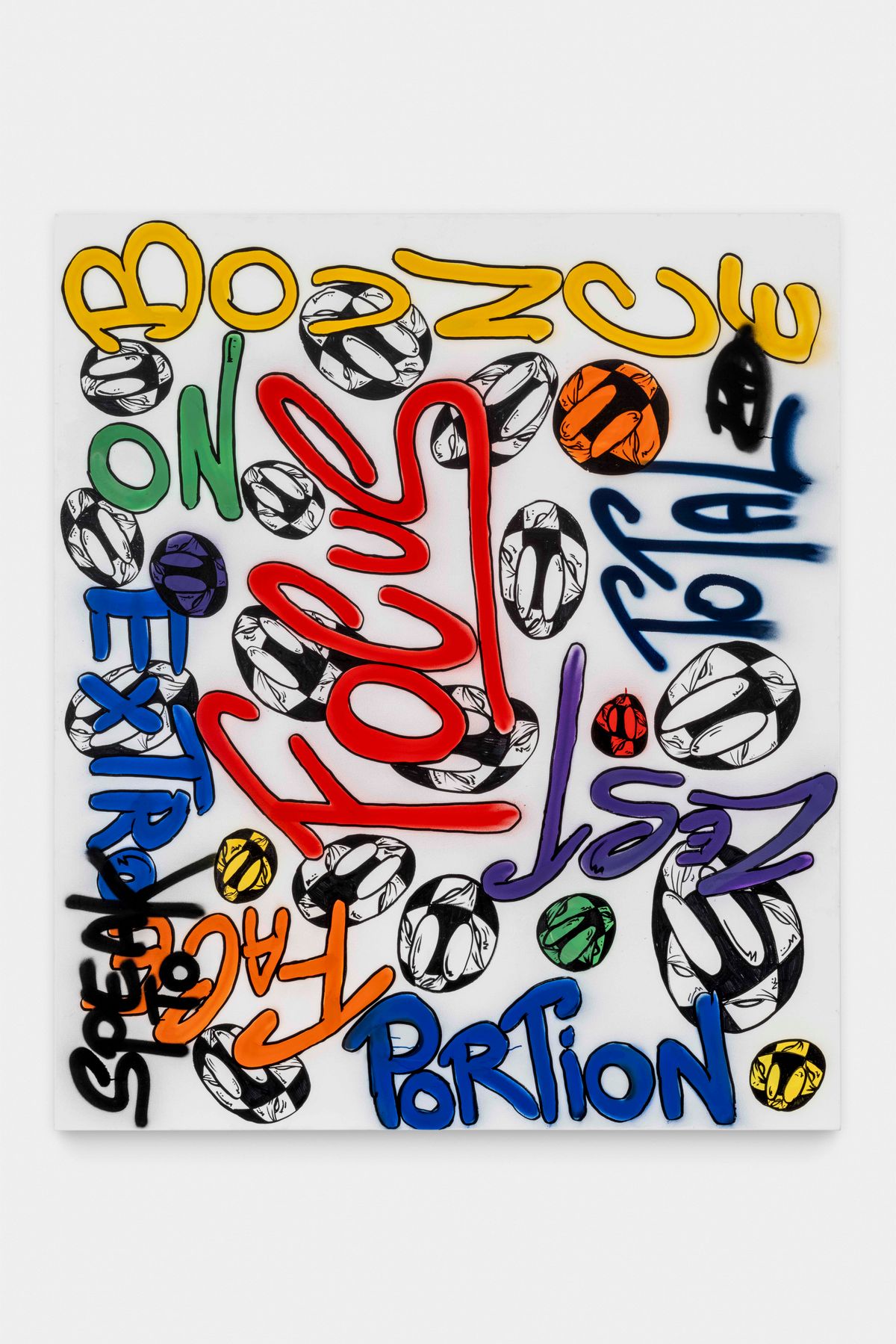
Matt DiGiacomo is in a museum collection. The High Museum of Art in Atlanta holds Point of Friction, 2024, oil paint, acrylic paint, oil pens, oil markers and spray paint on canvas, 101¼ by 72 inches, a gift of Lauren Amos. Its record gives the artist as "Matt DiGiacomo (American)". Its accession number is 2025.365. Its location reads "Currently not on view."
That painting was on the checklist of Taste at Ross + Kramer in April 2025. It went from a commercial gallery wall to a permanent museum collection inside a year.
An accession number is not a price and it is not a review. It is something more durable than either. It is a commitment by an institution to know where an object is, what it is, and that it is theirs to account for, indefinitely. It survives the gallery, the dealer, the market and the artist. It is the single field that allows a researcher in fifty years to ask to see the thing and to disagree in print with whatever was said about it.
This institution published a study one day before this one about a Nanotyrannus skeleton that sold at Sotheby's for forty and a half million dollars at the hammer. The thing that study found most serious about the lot was that it "carries no institutional specimen number, which is the one field that would later let a researcher re-measure the bones and disagree in print."
A painting by a Chrome Hearts designer has that field. A forty million dollar fossil does not.
That is not a joke at the fossil's expense, and it is not a claim about artistic merit, which is not this institution's business. It is a statement about which objects enter the permanent record and which do not, and it cuts directly against the assumption that price and permanence travel together. They do not. The cheaper object is the one that will still be findable.
There is one more thing about that museum record, and it is the quietest finding in this study.
It has no photograph. Measured rather than assumed: every image served on that page above two hundred pixels is the museum's own logo. The record names the work, the medium, the dimensions, the donor and the accession number, and shows nothing.
So the arc completes like this. A painting is made in 2024. It hangs in a New York gallery in April 2025 and is photographed there by a named photographer. It enters a museum collection as 2025.365. The museum does not display it and does not picture it. And the gallery that showed it, Ross + Kramer, no longer has a website: the domain now resolves to a parking page, and the exhibition record, the checklist and the installation photographs survive only because the Internet Archive kept a copy and because the gallery's image host is still answering.
The only public photographs of a painting in a major American museum collection are installation views, of a show that closed, hosted by a company serving a website that no longer exists.
A study about a price record that does not exist found, while it was being written, that the exhibition record was disappearing too.
The chain itself is worth setting out in full, because it is the one completely closed provenance chain in this entire study and because closed chains are rarer than anybody admits.
The Ross + Kramer checklist for Taste reads: Point of Friction, 2024, oil, acrylic, oil pen, oil marker, and spray paint on canvas, 101¼ by 72 inches. The High Museum's record reads: Point of Friction, 2024, oil paint, acrylic paint, oil pens, oil markers, and spray paint on canvas, 101 1/4 x 72 inches, Gift of Lauren Amos, 2025.365. Title, year, medium and dimensions match across both. The object hung on a wall at 515 West 27th Street between 1 and 26 April 2025, was given by a named donor, and entered a permanent collection.
A named object, a dated selling exhibition, a named donor, an accession number. That is what a provenance record looks like when it works, and this one assembled itself without anyone setting out to build it.
And nobody announced it. There is no press release from the museum, no announcement from either gallery, and no secondary record of the acquisition anywhere. Honor Fraser's page for his talk at that same museum in September 2025 does not mention that the institution owns a painting of his. Artnet shows "Galleries (0)" and one auction lot. One major art platform's biography of him says he has no solo shows at all, which is wrong three times over.
An institution accessioned his work and the art market's record-keeping does not know it happened. That is not a failure of the museum, which published the record on its own website where anybody can read it. It is a statement about which direction information flows: the commercial databases watch the commercial market, and an object that leaves the commercial market by being given away leaves their field of view entirely.
One method note belongs here, because it nearly cost this study its best finding. An automated fetch of the High Museum's own collection search reported zero results for his name. A browser, loading the same search, reports one. The results render after the page loads, so a tool that reads only what the server sends sees an empty list. Had this research stopped at the first method, this study would have said, with a straight face and a measurement to back it, that no museum holds his work. The instrument would have been working correctly and the answer would have been false.
The training that appears in no record
His education took longer to establish than any price in this study, because the answer is that there isn't one on paper.
Here is the careful version first, and the distinction in it matters more than it looks. No formal art education, art school, degree or institutional training appears in any published biography or interview located. That is a statement about the record. It is not the same as saying he had none, which is a statement about a living man that no source supports, and which this study does not make.
Where that absence was searched: both gallery biographies, at Honor Fraser and at Ross + Kramer; his own long first-person interview in L'Officiel USA; Hypebeast in 2017 and 2021; the Chrome Hearts press material reproduced in 2021; a 2025 lifestyle column covering his new brand; MutualArt's biography; and targeted searches for the phrases a profile would use, including "self-taught", "never went to art school" and "no formal training". He has no personal artist website: the obvious domain does not resolve, and his brand's site is a shop with no about page. There is no self-authored biography of him anywhere, which is a large part of why the question has no answer.
The word "self-taught" is worth isolating, because it is the thing everyone reaches for and no source says it, including him. What he says, in L'Officiel in April 2022, is this: "It was organic; I worked without anyone telling me how to do it." And, of the period after his first pieces sold, "my designs were very sought after, all while I was still learning how to make a collection."
Those sentences imply an autodidact route and assert something narrower: that his path inside Chrome Hearts was unmentored. A study may quote him. It may not convert him into a claim he never made.
What the record does hold, in his own words, is a route, and it is more specific than the version in circulation. He grew up on punk and eighties hardcore, and made one-off garments before he drew:
"I was making one-off pieces. I would take a jacket, cut it up, and sew patches onto it. Not with my art because I wasn't drawing yet; I was using old patches of American flags and punk bands that I found, and I would draw on top of them with other stencils."
Then a job, and then a recruitment:
"I started working for a concept store in Malibu called Salvation, and they had a big Brother printer that I could use to print shoes and jackets. Laurie Lynn Stark, the owner of Chrome Hearts, whom I knew because I grew up with her daughter, came in one day and was like, 'What are you doing? Come work for me.'"
This corrects a claim that reached this study secondhand and had already been written into its brief: that he started at Chrome Hearts while in high school. His own account puts a different employer first. No source located mentions high school, his age at hiring, or any school at all. The correction matters not because the difference is large but because the wrong version is the kind that gets repeated: it is tidier, it is more romantic, and it is not what he said.
What happened next he also describes:
"until one day I just grabbed a jacket and cut it up and sewed on patches with my own art, and showed it to Laurie and her husband and co-owner, Richard. They were like, 'Damn, this is cool. We'll put it in Paris.' Well, that thing sold out, and I did another one, and that sold out too. I just kept selling out without anyone really knowing who I was."
That last sentence is the whole study in his own voice, said about 2013 or thereabouts, years before anyone was tracking a price. The objects moved and the name did not travel with them.
Read that sentence again, because it is doing more work than it looks. I just kept selling out without anyone really knowing who I was. He is describing, from inside, the precise condition this study measures from outside: objects moving at speed while the name attached to them is invisible. The only difference between 2013 and now is that the objects have become expensive and the name has become famous, and the record still does not connect them.
The house's own account of the same period, published as Chrome Hearts press copy in 2021, tells it from the other side: "Having met Matt at a very young age, he came into the Chrome Hearts world thru friends and connected with the spirit of the decades-old company. Moving thru various creative departments within the delicate eco-system of Chrome Hearts, the Starks developed opportunities with him to hone his art, specifically painting and illustrating."
That is brand-authored and should be read as such; a company describing its own patronage has an interest in the mentorship framing. It also sits in mild tension with his version, which has Laurie Lynn Stark discovering his work at Salvation rather than knowing him as a child. Both can be true at once, and this study does not resolve them. What both agree on is that the training was in-house and relational rather than academic.
There is a date bracket, and it is worth stating because it is the most that can honestly be said. Honor Fraser's 2023 page describes him as currently creative director. Puck, on 4 April 2025, calls him "the former creative director behind Chrome Hearts." The role therefore ended between December 2023 and April 2025, and that is the whole of what the published record will support. No month, no announcement, no stated reason, no named successor.
So the picture is consistent and undocumented at the same time. A man who learned by cutting up jackets, was recruited by the owner of a company he already knew socially, was developed inside that company by its founders, and became its creative director. At no point does a school, a course, a teacher or a credential enter the record.
That is directly on the question this study was asked. If the aura attached to this work came from somewhere, it did not come from an institution that certifies artists. It came from a brand. And the part of this study that measures what the market records is, read in that light, a measurement of exactly how much a brand's imprimatur is worth when it is the only credential in the file.
One further absence belongs here, because it bears on everything downstream. The end of his tenure at Chrome Hearts is undated by any attributable source and unexplained by all of them. No departure announcement exists from the company, from him, or in any trade press located. No successor is named anywhere. A single lifestyle column gives the span as 2018 to 2024 with no basis offered; an anonymous social post says eight years, which would not agree with it. Honor Fraser's own site contradicts itself, its biography still reading "has served as the Creative Director of Chrome Hearts, since 2018" with no end date while its own newer event page says "previously", and at least one business data service has already inherited the stale sentence as "2018 to present."
This study therefore says what is true: that the role ended before September 2025, that nobody has published when, and that nobody has published why. It speculates about none of it. The reason to record the absence at all is that a price history is usually read against a career timeline, and in this case the timeline has a hole in it exactly where the interesting part would be.
What crossed the boundary, and who owns a name
If an exchange of aura happened, the cleanest place to look for it is not a price at all. It is a name.
Chrome Hearts gave DiGiacomo a platform called Sex Records. It launched in 2018 as a project exclusive to Maxfield in Los Angeles, part of what the company describes as an artist series developed by Laurie Lynn Stark to nurture emerging talent, and the collection, by the brand's own account, "sold out the first night." A second Sex Records collection followed in September 2021: a three-day retail installation at 40 Bethune Street in the West Village, built as a riff on a nineties big-box toy store, selling leather-patched vintage Carhartt work pants, leather racing jackets, camouflage shirts, carpenter shorts, t-shirts and hats. He described the name simply: "I always liked the word SEX, the good and the bad, it puts people on edge."
Two details about that project are worth holding, because they describe the machine that made his name.
The first is the retailer. Sex Records launched at Maxfield, which is the same shop that later sold Untitled (Heart On) as an artwork with the price withheld. The same address carried the brand collaboration that built his audience and, years later, the sculpture signed in his own name. The venue did not change. The category did.
The second is the mechanism. The company describes the project as part of an artist series developed by one of its owners "for purpose of nurturing emerging talent", and reports that the first collection "sold out the first night." That is patronage with a storefront attached, and it worked exactly as intended: an unknown designer's work moved instantly because a known brand put its name above it.
Inside that project sat a sub-line called 99 Eyes, which Hypebeast in September 2021 described as "the race-inspired 99 Eyes sunglasses that come packaged with the U LIE'N Speed Freak toy car," with a limited colourway sold through the Chrome Hearts site.
Now follow those two names forward.
In April 2025, at the opening of Taste, behind a false wall at the back of the Ross + Kramer gallery, DiGiacomo opened a concealed shop selling the first drop of his own line, Anti Promo. Among the items, according to the one named and bylined account of that evening: press-on nails at two hundred dollars, t-shirts at three hundred and thirty three, hand-painted Vans slip-ons at a thousand, a durag made with the artist Asspizza at a thousand, upcycled vintage Carhartt pants painted with the words "Speak through Relativity" at seven thousand five hundred, and "Matty Boy's signature checkerboard '99 Eyes' sweatpants and hoodies" at five hundred and five hundred and fifty.
The name went with him.
And a painting in the Taste show is titled Untitled (Sex Records), 2025. The other name went with him too, into the gallery, as the subject of a work on canvas.
This is the exchange made visible without reference to any price. A vocabulary created inside a company reappears, after he leaves it, on his own products and in his own paintings. The question of who is entitled to it is not one this study answers, and it would be reckless to pretend otherwise. No source located addresses who holds rights to "99 Eyes" or "Sex Records". Chrome Hearts is a company that litigates its marks, having sued a department store over cross motifs as recently as June 2026. A lifestyle column calling the sweatpants "Matty Boy's signature" is describing what a reader sees, not adjudicating a trademark.
What can be said is that the names travelled, and that the resale record has not sorted them out either. The same database that tracks his Chrome Hearts garments lists, under Chrome Hearts, pieces called a "Sadistic Anti Promo Zip Hoodie" and an "Anti Promo Chomper Belt". The brand boundary is more porous in commerce than in the press. Garments exist, and are traded, and are catalogued, under a combination of names that no official source has ever explained.
There is a second kind of crossing worth recording, in the other direction, because it shows the same mechanism running backwards.
"Chomper" is the name of his signature motif, a buckled, incomplete smile that recurs across his canvases and gives titles to his sculptures: Untitled (Half Chomper), 2023, resin. The gallery press release describes it precisely as "his signature mouth symbol, adorned with a buckled smile." It is his.
And it is also, in the resale record, a Chrome Hearts product line: Chomper hoodies, Chomper shorts, a Chomper ring, a Chomper cashmere bucket hat, Chomper sweatpants, Chomper socks, Chomper sunglasses. No named press source documents Chomper as a house collection. The commerce record is full of it; the editorial record contains none of it.
So the motif he owns artistically appears on hundreds of garments the market attributes to a brand, and the collection names the brand gave him appear on products he now sells himself. In both directions, the name moves and nobody writes down who it belongs to.
That is the aura exchange with the prices stripped out, and it is more legible this way than it ever was through the numbers. A brand lends a name and gains an artist. An artist lends a hand and gains a name. Afterwards, the only parties keeping a record of which is which are resale platforms, whose interest is in matching a listing to a buyer, not in establishing who made what.
One further object shows how little the record settles. In January 2024, Untitled (Half Chomper), 2023, resin, 22½ by 18 by 4¼ inches, hung at Ross + Kramer in a show called SALE ENDS TODAY, whose stated premise was limited editions: "more than 30 limited edition works on paper and over 10 limited edition sculptures from 1983 to 2023." The show's own framing presents that sculpture as editioned rather than unique.
Fourteen months later the same work, same title, same year, same dimensions, appears on the checklist of his solo show at the same gallery, where it is simply listed among three sculptures with no mention of an edition.
Nowhere does any source state an edition size. Not the group show, not the solo show, not the retailer, not any press. For an object type where edition size is the single most price-relevant fact after the artist's name, that number does not exist in public. A buyer at either show would have had to ask, and whatever they were told did not reach the record.
This is the same silence as the price, in a different field, and it compounds: an unpriced object of unstated edition, shown twice, by a gallery whose website has since gone dark.
Nine exhibitions, no review, and no gallery that says the word
Count the shows, because the number is larger than the reputation suggests and because every one of them is a place a price could have been published and was not.
Nine exhibitions, three of them solo. A first solo at Ross + Kramer in East Hampton, 30 July to 12 August 2022. Loading… at Honor Fraser in Los Angeles, 9 September to 2 December 2023. A group show, Brick by Brick, at Ross + Kramer in Chelsea from November 2023, where his contribution was a traditional brick inscribed with the word "Chaos". SALE ENDS TODAY in January 2024, a show of limited editions where his Untitled (Half Chomper) hung in a list that ran Abney, Adams, Banksy, Basquiat, Condo, Haring, Hirst, Indiana, KAWS, Warhol, Wood. Summer Selection in Miami Beach that July. The Jane Fonda benefit at Gagosian Beverly Hills, 18 July to 30 August 2024. Taste, the second Ross + Kramer solo, April 2025. The Museum of Contemporary Art San Diego's biennial Art Auction in early 2026, where sixty curator-selected works hung in the museum's galleries before a live sale conducted by a Christie's auctioneer. And an announced show at the Aspen Art Museum, In the Midst, for which no dates are published anywhere, including by the museum.
Across all nine, no gallery and no museum has ever published a price for a DiGiacomo artwork. Not a figure, not an estimate, not even the phrase "price on request". The Taste page carries a complete captioned checklist giving title, date, medium and dimensions for sixteen works, and no money anywhere on it. Every number in public circulation about his art comes from exactly two places: a journalist, and a fashion boutique.
Three of those nine deserve separate treatment because they are the kind of credential that hardens into something else if nobody checks it.
The Gagosian show is real and is not what it would look like in a biography. His name appears in two installation-view captions on the gallery's own page, his work hung beside Nan Goldin, Catherine Opie, Marilyn Minter and Ed Ruscha, and the work was, in the gallery's own words, "being presented for sale". He is also not on the artists roster for that exhibition and not among the artists the gallery thanks by name. He was a contributor to a benefit, which is a real thing to have been and is not the same as being a Gagosian artist. A study that wrote "exhibited at Gagosian" and stopped would be technically accurate and would mislead.
The San Diego show is the same shape. His work hung in a museum's galleries, selected by that museum's curators, and was then sold at a fundraiser. The museum's own collection database holds nothing by him. "Exhibited at MCASD" and "in the MCASD collection" are different sentences and only the first is true.
The Aspen show cannot become anything. Honor Fraser's homepage announces "MATT DIGIACOMO: IN THE MIDST, ASPEN ART MUSEUM". No dates are published anywhere for it, the announcement is not even a link, and the museum's own site search returns nothing for his name, against a control that returns fourteen dated results for a term the museum does use. More decisively, the Aspen Art Museum describes itself on its own about page as having been "founded by artists in 1979 as a non-collecting institution." A non-collecting museum cannot accession anything. Whatever that exhibition is, no permanent record can come out of it.
That is three museum-adjacent credentials in this record, and each is a different thing. A benefit at a commercial gallery. A fundraiser in a museum's galleries. An exhibition at a museum that cannot collect. All three are real. None is an acquisition. And the one actual acquisition, at the High Museum, was announced by nobody.
Now the silence that is hardest to explain away.
No art publication has ever reviewed the work. Searched across Artforum, ARTnews, Artnet News, Hyperallergic, Cultured and Interview: nothing. That zero was calibrated before it was believed. The same search, on the same six publications, for Kenny Scharf, a street-art-adjacent artist shown by the same Los Angeles gallery, returns reviews in all six, including Artforum notices from the 1980s and 1990s and a Cultured piece naming Honor Fraser directly. The instrument demonstrably finds art criticism about a comparable artist at the same gallery. It finds none about him.
And the strongest corroboration comes from his own dealer. Honor Fraser maintains a press section on its homepage, advertising notices its artists have received: an Artforum Critics' Pick, a Cultured must-see, the New York Times, Artillery, Whitewall, Contemporary Art Review Los Angeles. There is no DiGiacomo entry. A gallery that actively promotes Artforum coverage for its artists has none to promote for him.
What exists instead is Puck, which is a business and media newsletter rather than an art-criticism outlet, and within Puck it is one writer, Marion Maneker, across at least three items between April 2025 and August 2026. The entire critical literature on this artist is, as far as this research can establish, one journalist writing about the market.
That matters more than it sounds, and not as a judgement on the work.
A review is a record. It is dated, attributed, archived in an indexed publication, and it states what somebody thought and why, in a form that can be disagreed with later. It is one of the very few documents in the art world that is neither a price nor a sales aid. An artist with nine exhibitions and no reviews has a career that is visible in commerce and invisible in criticism, and when the commerce stops the visibility goes with it.
Set the two records side by side at this point and the pattern of the whole study repeats once more. His garments generate a thousand five hundred dated commercial records and no critical ones. His exhibitions generate no price records and no critical ones. The only writing about his art that exists is writing about his market, which means the single surviving account of a show at Gagosian and a solo in Chelsea will be two sentences by a market columnist about what the sculptures were asking.
And there is one more thing about the Puck coverage that this study must handle carefully rather than quietly, because it is the exact distinction the whole piece rests on.
The sentence quoted earlier, that his sculptures "were going for $60,000 a pop", is from the article's standfirst, which is free to read and was read directly. A second sentence is reported to exist in the body, behind the subscription, saying that paintings and small sculptures "were selling out at $50,000 to $60,000 a pop." That second sentence could not be read by this research, and it is a materially different claim: a different verb, a wider range, and both media rather than sculpture alone.
Going for is an ask. Selling out at is a sale. Same writer, same day, same show, two different kinds of assertion, and this study can verify only the first. It therefore reports the asking figure as the published one, and records the existence of the second as a thing it has not read. Anyone who wants the sold claim should buy the subscription and read the sentence, which is a short afternoon's work and would settle the most-quoted number attached to this artist's art.
Representation is the same story told a third way. No gallery anywhere publishes a claim to represent him. Artnet's own availability facets for him read "Galleries (0)". Ross + Kramer's biography line says his work "has been exhibited at" the two galleries, which is an exhibition history and not a representation statement. Honor Fraser has no artists page at all; it publishes a contributors list that also contains speakers and curators, and he appears on it as "ARTIST".
One limit on that finding, stated because an absence claim is only as good as its scope. Ross + Kramer's own artist roster is genuinely unreachable: the domain is parked and the roster page, which was served dynamically, was never captured by the archive. If a representation claim exists anywhere, that is where it would be, and it cannot be read. This study therefore reports that no representation claim was found and that one location could not be searched, which is a different sentence from reporting that none exists.
But it would be wrong, and this study will not say, that he is unrepresented. Honor Fraser behaves exactly as his gallery: it gave him his first solo show, it announced his Aspen museum show on its own homepage, and it publicised his High Museum talk as its own programming. Ross + Kramer gave him two solos and four group inclusions across three cities. Both function as his dealers. Neither says the word. The accurate sentence is that no gallery publishes a representation claim and two galleries have acted as his dealers since 2022, and the gap between those two facts is, again, a gap in the record rather than in the world.
One structural detail closes this section, because it decides what can ever happen next. The Aspen Art Museum, which has announced a show of his work, describes itself on its own about page as having been "founded by artists in 1979 as a non-collecting institution". A non-collecting museum cannot accession anything. Whatever that exhibition is, it cannot become a permanent record. The one institution that has made his work permanent remains the High Museum, through a private gift, with no announcement from anybody.
Coda
Set the two halves of this artist's record side by side and the asymmetry is almost comic.
The clothes: 162 versions, 1,541 recorded sales, each with a date, a platform, a size, a condition and two currencies. A typical price of £407. A hoodie that has sold six times in ten months and whose selling time is about twenty days. Strangers maintaining a ledger because there is money in knowing.
The art: nine exhibitions with no published price among them. Four auction lots with estimates reaching sixty thousand dollars and no published results. A retail page that says "price upon request" and "sold out" at the same time, over a product record carrying thirty four thousand dollars. A figure attributed to Christie's by two aggregators that Christie's own results do not carry, with the data service that does carry a lot rendering its price fields as placeholder Latin behind a subscription wall. A reported ask of sixty thousand dollars that reached the public because a journalist stood in the room. A painting in a museum with an accession number and no photograph. And a gallery whose website has become a parking page, taking the checklist, the installation views and the only public images of the accessioned painting with it.
The question this study set out to answer was put as a question, and it deserves to be answered as one. The Chrome Hearts work sells well and resells well; that much is known and now counted. Whether his own work has been affected by the association was the open part.
It cannot presently be known, and the reason is the finding. His own work has no price record to be affected. Every place where a public number would be created has created none, for ordinary and individually defensible reasons: galleries do not publish prices, this auction house does not publish results, a boutique prefers to be asked, a museum does not price gifts. None of those decisions is improper. Together they produce an artist with a museum accession number, a Gagosian wall, nine exhibitions and no public price history at all.
Meanwhile the garments he made for somebody else's company are among the most precisely documented objects in contemporary fashion resale, and in every record that tracks them the maker field says Chrome Hearts.
That is the exchange, and it is not the one anyone expected to find. The brand did not simply lend him credibility. The brand's objects got the archive and his own got the silence, because the archive was built by people selling clothes, and nobody is selling his paintings often enough to build one.
Which leaves the question this institution actually exists to ask. Not what the work is worth. What survives of it.
The answer, today, is a number: 2025.365. A painting, 101¼ by 72 inches, oil and acrylic and oil pens and markers and spray paint on canvas, given by Lauren Amos, not on view, no picture. It went from a gallery wall in Chelsea to a permanent collection in Atlanta in under a year and nobody announced it. The art market's own databases do not know it happened.
Of everything in this study, that accession number is the only thing certain to be legible in fifty years. Not the resale ledger, which is a commercial product and will end when the commerce does. Not the gallery pages, one set of which has already gone. Not the auction estimates, which closed without a result. Not the aggregator entries, one of which fills its provenance field with placeholder Latin. A museum wrote down what it had, who gave it, and when.
It is the cheapest record in the entire story, and it is the only one built to last.
And it is worth being clear about what that record does not do, because overstating it would undo the point. It does not say what the painting is worth. It does not say what was paid for it, by whom, or whether anything was. It does not say what the artist intended or what anyone thought of it. It answers one question only: where is this object and who is accountable for knowing.
That is a smaller claim than a price and a more durable one. Prices in this story have proved to be asking prices misread as sales, summary figures computed from a single transaction, results an auction house declined to publish, figures attributed to a house that house does not carry, and numbers withheld behind the words price upon request. Not one of them survives contact with a control.
The accession number survives every control this study could apply to it. It was read on the museum's own site, confirmed against the gallery checklist of the show it came from by four independent fields, and checked against a deliberately impossible record that correctly returned nothing.
Nine exhibitions, 1,541 recorded garment sales, four auction lots, two galleries, one museum, and the only thing that will still be true and checkable in fifty years is seven characters long.
What is not claimed here
This study does not value, appraise or authenticate anything. No opinion is offered on what any work by this artist is worth, whether any price was justified, or whether any object is what it is described as being. Where figures appear they are quoted from the source that published them, labelled asking or sold, and dated.
No judgement is offered on the quality of the work. Whether the paintings are good is not a question this institution is equipped to answer or entitled to ask, and nothing here should be read as implying one.
Nobody is accused of anything. Galleries that do not publish prices are following the ordinary practice of their trade. An auction house that does not publish results is entitled not to. A retailer that prefers to be asked is entitled to prefer that. A museum does not price gifts. Sotheby's brand field exists to help buyers find sneakers, and it does that job correctly. Every silence in this study is individually defensible, and the finding is what they add up to, not that any one of them is wrong.
The absence claims are bounded, and each is bounded differently. The statement that no art publication has reviewed the work rests on six named publications and a positive control that returns reviews for a comparable artist at the same gallery. The statement that Christie's own results do not carry a figure attributed to it rests on that house's public search, which may not surface every sale type. The statement that no formal art training appears in the record is a claim about published biographies and interviews, not a claim about the man. None of these is a claim that the thing does not exist. Each is a claim about a named store, searched a stated way.
One attribution is left open deliberately. No source located establishes who holds rights to the names that crossed between the company and the artist, and this study does not adjudicate it. It reports that the names appear on both sides and that nobody has published an explanation.
Three limits on the evidence, stated plainly.
The resale figures come from a commercial platform that discloses it may earn commission on the sales it links to, and that withholds roughly sixty four per cent of the individual records it claims to hold from an anonymous reader. The counts quoted here are its own; the individual sales are a visible subset.
The most-quoted figure attached to the art, sixty thousand dollars, was read in a journalist's standfirst. A second sentence reported to exist in the same article's paywalled body makes a stronger claim, that work was selling at fifty to sixty thousand, and it was not read. The weaker and verifiable version is the one used.
And the primary gallery record for five of the nine exhibitions survives only in a web archive, because the gallery's domain is now a parking page. Those citations point at archived copies, and a reader who follows a live link will find nothing. That is a fact about this study's sources and it is also, unavoidably, one of its findings.