Deloitte Art & Finance Report: The Heirs Were Never Told
On a conditional headline, a number that is a rise and a fall at once, and the difference between planning a transfer and recording an object.
What the Deloitte Art & Finance Report 2025 actually counts
The Deloitte Private and ArtTactic Art & Finance Report is the ninth edition of a series that has run since 2011. It is biennial, which makes the 2025 edition current, and it is the document the wealth industry reads to decide whether art belongs in a client conversation at all.
Its most quoted sentence will be this one:
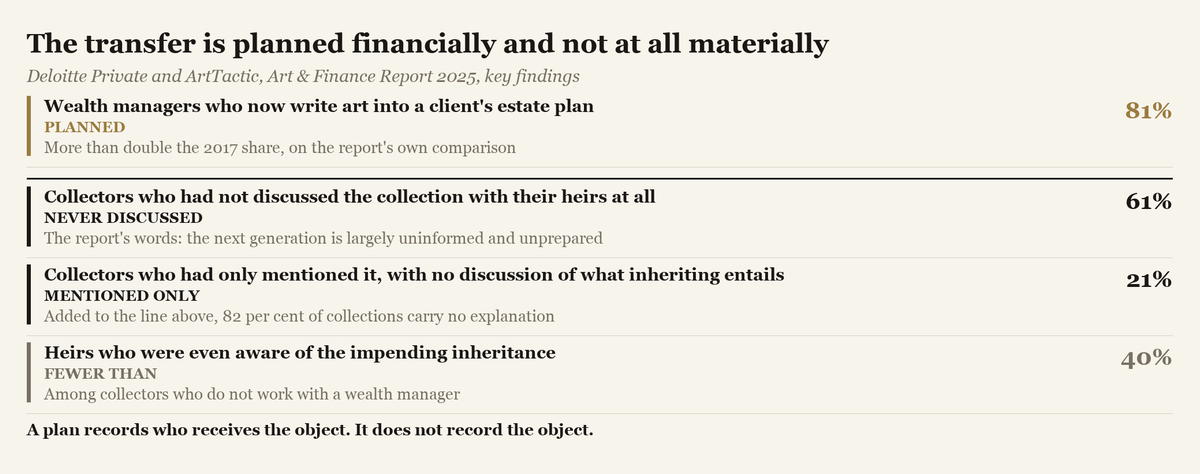
"Assuming 5% of UHNW wealth transfers involve art and collectibles, about $992 billion will change hands, roughly $100 billion annually over 10 years."
Read the first word. The number is conditional, and the report says so in the same breath that produces it. The chain behind it is published alongside: 1.2 million individuals with net worth above $5 million will transfer "nearly $31 trillion over the next decade"; those above $30 million are "13% of this group but account for 64% ($19.84 trillion) of the transfer"; five per cent of that is $992 billion.
The arithmetic closes. Five per cent of $19.84 trillion is $992 billion exactly, and the annual figure the report gives is that divided by ten. The chain can be reproduced from the published numbers by anyone who wants to, which is worth stating because it is rare enough to be notable.
Nothing about that is hidden and nothing about it is sloppy. Deloitte showed its working, which is more than most market figures do. The interesting question is not whether the assumption is reasonable. It is what happens to a conditional number once it enters circulation, because a figure that arrives with its own caveat tends to shed it at the first retelling, and the number that survives is the round one.
This institution has made that error on its own books, which is the only reason it is worth naming here rather than scoring a point. A figure with an assumption inside it is not a measurement. It is an argument that can be checked, and checking it means carrying the assumption forward every time the number is repeated.
It is also worth saying what the assumption is doing, because five per cent is not an arbitrary number and treating it as one would be its own kind of sloppiness. It is a share-of-wealth estimate: of everything an ultra-high-net-worth household passes on, some fraction is art and collectibles rather than securities, property or cash. Nobody can observe that fraction directly, because the thing being estimated is exactly the thing nobody records. The assumption is standing in for the missing register, and the register is the subject of this study.
That circularity is not a flaw in the report. It is the most honest thing in it. Asked how much art will change hands, the only available method is to estimate total wealth, which is well measured, and then guess the art share, which is not. Change the guess to four per cent and the headline becomes $794 billion. Change it to six and it becomes $1.19 trillion. The spread between those two is larger than most national art markets, and it exists because the underlying fact has never been written down anywhere that could be counted.
The transfer is planned financially and not at all materially
Set two findings from the same report beside each other.
The first:
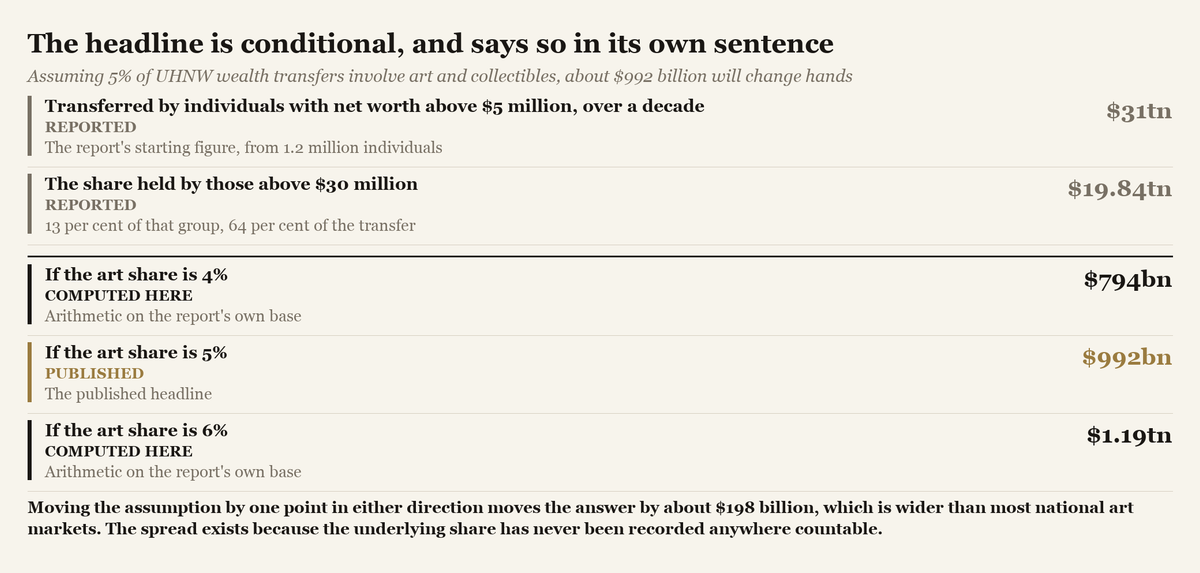
"The percentage of wealth managers incorporating art into their clients' estate plans has more than doubled since 2017, reaching 81% in 2025."
The second:
"the next generation of art heirs is largely uninformed and unprepared: 61% of collectors had not discussed their art collection with their heirs at all. Another 21% had only mentioned it without any in-depth discussion about what inheriting the art entails."
Eighty-one per cent of plans name a recipient. Eighty-two per cent of collections have never been explained to one. Those two numbers describe the same objects.
A third finding closes the gap between them:
"For collectors without a wealth manager, only 14% had a formal plan communicated to family or advisors, and fewer than 40% of heirs were even aware of the impending inheritance."
An estate plan is a financial instrument. It records who receives the thing and what the tax position is. It is very good at that, and the industry has got much better at doing it: more than doubled since 2017 is a real improvement in a real practice.
What it does not record is the thing. Where it came from, who held it before, what was promised with it, what the gaps in that story are, and which of its attributions anyone actually checked. The plan is a pointer. It assumes a record exists at the other end of the pointer, and for most of the objects in question there is no record at the other end, only a person who used to know.
That is the shape of the problem. Not that the market is careless with money, which it is not, but that the financial transfer and the material one have been treated as the same event when they are two events with different infrastructure, and only one of them has any.
Why "lack of title registries" is the most important phrase in the report
The strongest sentence in the 2025 findings is not about money at all:
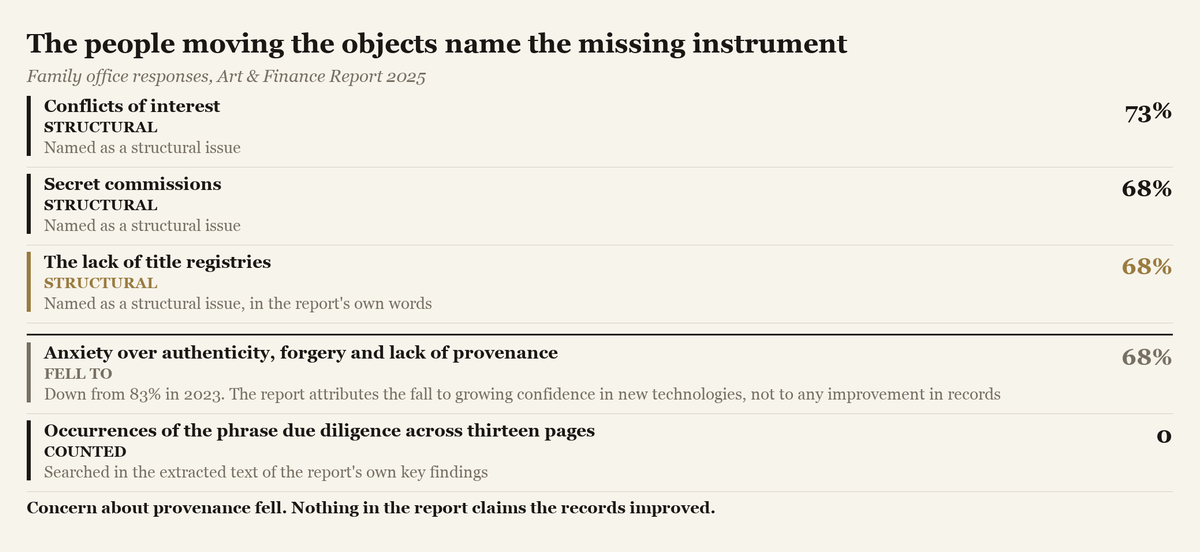
"Family offices increasingly focused on structural issues in 2025, such as secret commissions (68%), conflicts of interest (73%) and the lack of title registries (68%), signaling a turn toward concerns about market integrity and transparency."
Sixty-eight per cent of family offices named the absence of title registries as a structural concern. Not a complaint about prices or taste or access, but about a missing instrument.
This matters more than any argument an outside observer could make. The people with the clearest view of the transfer, who hold the objects and administer the succession, have independently identified the gap and attached a number to it. The case does not have to be argued from outside. It is in the industry's own flagship document, in a list of things the industry says are wrong.
A title registry is a specific thing and it is worth being precise about what it would and would not do. It would not say an object is genuine. It would not say what it is worth. It would record who holds it, when custody moved, and on what evidence, including the places where the evidence runs out. That is a record of custody over time, which is a different instrument from a certificate about a moment, and the difference is the whole subject.
Anxiety about provenance fell, and the records did not improve
Here is the finding that should worry anyone who reads the previous one carefully:
"anxiety over authenticity, forgery and lack of provenance ... declined from 83% in 2023 to 68% among family offices. This may signal growing confidence in new technologies like blockchain and AI-based verification tools."
The elided clause calls those three things "historically seen as the market's core risks", which is the report's own assessment and not a softening added here.
Concern about provenance dropped fifteen points in two years. The report offers its own explanation, and the explanation is not that provenance improved. It is that confidence in technology grew.
Nothing in the report claims that records got better. The decline is in anxiety, not in risk, and the report is careful enough to say "may signal" rather than assert a cause.
Those two things coming apart is the condition worth naming. Risk is a property of the records. Anxiety is a property of the people holding them. A tool that is expected to solve a problem can reduce the worry about it years before it touches the problem, and in the gap between those two dates the objects keep moving.
The report's own technology section sharpens this. The twelve areas respondents were asked about include "improving provenance and traceability" as one item among liquidity, valuation, transaction costs and demand. Trust in blockchain for provenance and ownership tracking rose "from 48% in 2023 to 55% in 2025", and in the same breath "confidence in its decentralized finance (DeFi) potential declined from 52% to 46%". Expectation is doing the work that evidence has not done yet.
There is a drier tell in the same document. Searched across the thirteen pages of key findings, the phrase "due diligence" does not appear once.
The same 51% is a rise and a fall
A reader meeting this report will almost certainly meet it through Deloitte's own summary page first, where the 2025 edition is introduced like this:
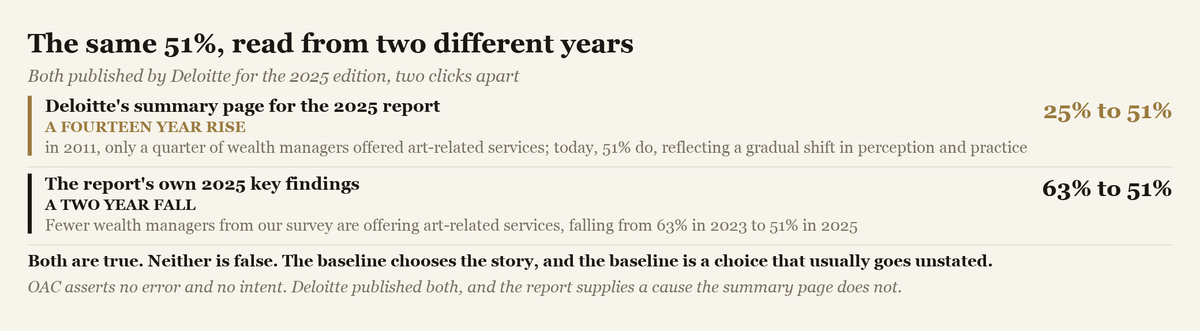
"in 2011, only a quarter of wealth managers offered art-related services; today, 51% do, reflecting a gradual shift in perception and practice."
The report itself describes the same 51% differently:
"Fewer wealth managers from our survey are offering art-related services, falling from 63% in 2023 to 51% in 2025. This trend held true for both private banks (50%) and family offices (52%)."
Both sentences are true. Neither is false. One measures from 2011 and finds a fourteen-year rise; the other measures from 2023 and finds a two-year fall. The number is identical and the story is opposite, and which one a reader gets depends on which page they open.
This is not an accusation and should not be read as one. Deloitte published both, two clicks apart, and the report supplies a cause the summary page does not: the decline "may reflect a more cautious or selective approach amid perceived regulatory complexity and operational challenges." Any institution that publishes a long-running series faces the same choice about where to start the clock, and there is no dishonest answer to it.
It is recorded here because it is the clearest available demonstration of something this study depends on: a figure's meaning is set by its baseline, and a baseline is a choice that usually goes unstated. The 5% assumption behind the $992 billion is the same species of choice, made visible. Most are not.
What an heir actually receives
Strip the finance away and describe the event in physical terms.
An object sits in a house. A person dies. Another person now has the object. Somewhere there is a document naming them, and increasingly there is: 81% of wealth managers now write art into the plan.
What arrives with the object, in the 61% of cases where no conversation ever happened, is whatever is physically attached to it and whatever the heir can reconstruct. A frame, perhaps a label, perhaps an invoice in a drawer. The chain of custody that existed in the collector's memory ends when the collector does. It was never written down, because there was no form to write it on and no body asking for it.
The report's language for this is "largely uninformed and unprepared", which is accurate about the heirs and slightly unfair to them. They are uninformed because nobody wrote it down. The failure is not in the generation receiving the objects; it is that the instrument that would have carried the information across the transfer does not exist, which is what the 68% naming title registries are pointing at.
The practical consequence arrives later and is easy to miss. An object with no custody record is harder to lend to an exhibition, harder to place with an institution, harder to insure correctly, and harder to sell without a discount that nobody itemises as a provenance discount. The report notes separately that "over-relying on auction data for valuations often results in" a widening gap between collection value and insurance coverage. The record is not a sentimental artefact. It is load-bearing, and its absence is priced even when it is not named.
What the mid-market has to do with it
One figure in the report cuts against the assumption that this is a problem for very large collections only:
"Artworks valued between US$50,000 and US$1 million have showed resilience during the global art market slowdown. The overall mid-market segment remains significantly underexploited. In 2024, it accounted for approximately US$8 billion in global auction sales (all auction houses), or just 4% of lots sold (around 16,000 out of 400,000)."
Read the denominator. Four hundred thousand lots sold at auction in 2024, of which sixteen thousand sat in that band. The great majority of objects changing hands are below it.
Those are the objects least likely to have a dealer who keeps files, least likely to be in an estate plan at all, and most likely to be the ones an heir decides about quickly. They are also the ones where a record is cheapest to create and most likely to be missing. A registry aimed only at the top of the market would miss almost everything that moves.
Only 6% are going to museums, so they are not entering the one system that keeps records
There is a route by which an object acquires a permanent, public, institutional record. It goes into a museum, receives an accession number, and from that moment someone is professionally obliged to know where it is and what is known about it. That record outlives everybody involved.
The report measures how many objects take that route:
"Only 6% of collectors planned to donate to public museums in 2025, a figure unchanged in recent years. This stagnant trend underscores the need for deeper engagement between museums and private collectors."
Six per cent, and flat. Whatever else happens to the $992 billion, roughly ninety-four per cent of it is not going anywhere that will give it a number.
This is the quiet structural fact underneath the rest. The museum system is the only part of the object world with a mature, tested, century-old practice of recording custody, and almost nothing is passing through it. Objects are moving from private hands to private hands, which is a transfer the museum sector never sees and therefore never documents.
It is worth resisting two easy conclusions here. The first is that collectors should donate more, which is a view about what people ought to do with their property and is not this institution's to hold. The second is that museums should be the registry, which misreads what an accession record is: it describes an object a museum has taken responsibility for, and it has nothing to say about the object still in the house.
The honest reading is narrower. The practice exists and is good. It covers six per cent of intentions. The other route, the one almost everything actually takes, has no equivalent practice attached to it, and the 68% naming title registries are describing exactly that hole.
The report adds a cost that lands on the same objects. It warns of "the widening gap between collection value and insurance coverage", noting that "over-relying on auction data for valuations often results in collections being over- or under-insured." An object whose history is thin is an object whose insurance is a guess, and the guess is made by someone who has never seen the file because there is no file.
What would have to exist
It is worth being plain about what this study is not proposing, because the territory is full of proposals that quietly do something else.
Not an authentication service. Not a valuation. Not a view on who should own anything or where an object ought to end up. Those are different questions with different authorities, and conflating them with a custody record is how a record acquires claims it cannot support.
What the 68% are describing is narrower and duller: a record of custody over time, with fixed fields, that states what is known, names the source for each claim, and marks the gaps as gaps rather than resolving them. A record whose declared absences are a normal feature rather than a defect, because the alternative is a document that implies completeness it does not have.
The reason to state the gaps is the inheritance case specifically. An heir who receives an object plus an honest record showing that custody between 1974 and 1991 is unknown is in a far better position than an heir who receives an object plus a confident story. The first can be built on. The second has to be dismantled before anything can be built on it, usually by someone being paid by the hour.
Whether such a record becomes a standard depends on whether anyone other than its author implements it. That has not happened, and no part of this study should be read as a claim that it has.
Coda
The report's own framing of the market is that it "has slipped back into stagnation", that "opacity erodes trust", and that "meaningful reform is not just an opportunity; it is a necessity." That is the industry's assessment of itself, published under its own name.
Against that, the figures assembled here describe a specific and fixable thing. About $992 billion of art and collectibles is expected to change hands over a decade, on a stated assumption. Eighty-one per cent of wealth managers now write art into estate plans. Sixty-one per cent of collectors have never discussed the collection with their heirs, another 21% have mentioned it and no more, and fewer than 40% of heirs know it is coming. Sixty-eight per cent of family offices name the lack of title registries as a structural problem. Anxiety about provenance has fallen for reasons the report attributes to expected technology rather than to improved records.
Put together, they say that the money has an infrastructure and the objects have a memory, and that the memory belongs to a person who will not be there for the transfer.
The question this study set out to ask has a short answer. When an object changes hands, what moves with it is whatever somebody wrote down. For most of the objects in the next decade of transfers, that is nothing, and the people best placed to see it have said so in their own report.
What is not claimed here
This study does not value, appraise or authenticate anything. No opinion is offered on what any object is worth, what any collection should be insured for, or whether any figure in the report is the right one. Where figures appear they are quoted from published sources with their basis labelled.
Nobody is accused of anything. Deloitte and ArtTactic are quoted from their own published materials throughout, and the finding about the two descriptions of 51 per cent is about which baseline a reader meets first, not about error or intent. Both wordings are reproduced in full so that a reader can check them against each other. Any long-running series faces the same choice about where to start its clock, and there is no dishonest answer to it.
The $992 billion is conditional and is treated that way everywhere in this study, including in its title, its summary and its figures. The report states the assumption in the same sentence that produces the number, which is more than most market figures do. Nothing here restates it as a measurement.
No view is offered on what any collector should do with their property. The study reports that 6 per cent of collectors plan to donate to a public museum and declines both of the available opinions about that figure.
Three limits on the evidence, stated plainly.
The figures are read from the published key findings of the Art & Finance Report 2025, a thirteen page summary, rather than from the full report. Where a percentage is reported for a subgroup, such as collectors who do not work with a wealth manager, that qualifier is carried with it here.
The four and six per cent alternatives beside the headline are arithmetic performed here on the report's own base, and are labelled as computed rather than reported. They are offered to show what the assumption carries, not as rival estimates. Neither this institution nor anyone else has measured the true share.
And the absence of a title registry is reported as the market's own description of a gap, at 68 per cent of family offices, rather than as a finding of this study. Whether any instrument would be adopted is unknown, and no part of this study should be read as a claim that one exists or that anyone has implemented it.