Christie's Awakening Wisdom: Eight Records, No Country of Origin
On a sale of eight Buddhist sculptures where the scholarship knows exactly where the objects were made and the ownership records begin, on average, about seven hundred and eighty years later
On 30 October 2026, in a saleroom on the sixth floor of The Henderson at 2 Murray Road in Central, Hong Kong, Christie's offered eight objects under the title Awakening Wisdom: Masterpieces Of Buddhist Art From A Private Asian Collection. Sale 25383. Four of the eight sold. The sale total was HK$204,450,000.
Lot 2007 was a gilt-copper alloy figure of Manjushri, Nepal, twelfth century, thirty six and five eighths inches high. The estimate was HK$60,000,000 to HK$80,000,000. It sold for HK$137,350,000, which Christie's converts to $17,507,977, a figure that includes the buyer's premium. The press reported it as a world auction record for a Himalayan gilt bronze, and that is their characterisation rather than a measurement made here.
This study is not about the price. It is about the four lines underneath it.
The record, in full
Here is the entire published provenance of lot 2007, quoted from Christie's own lot record, read on 10 November 2026.
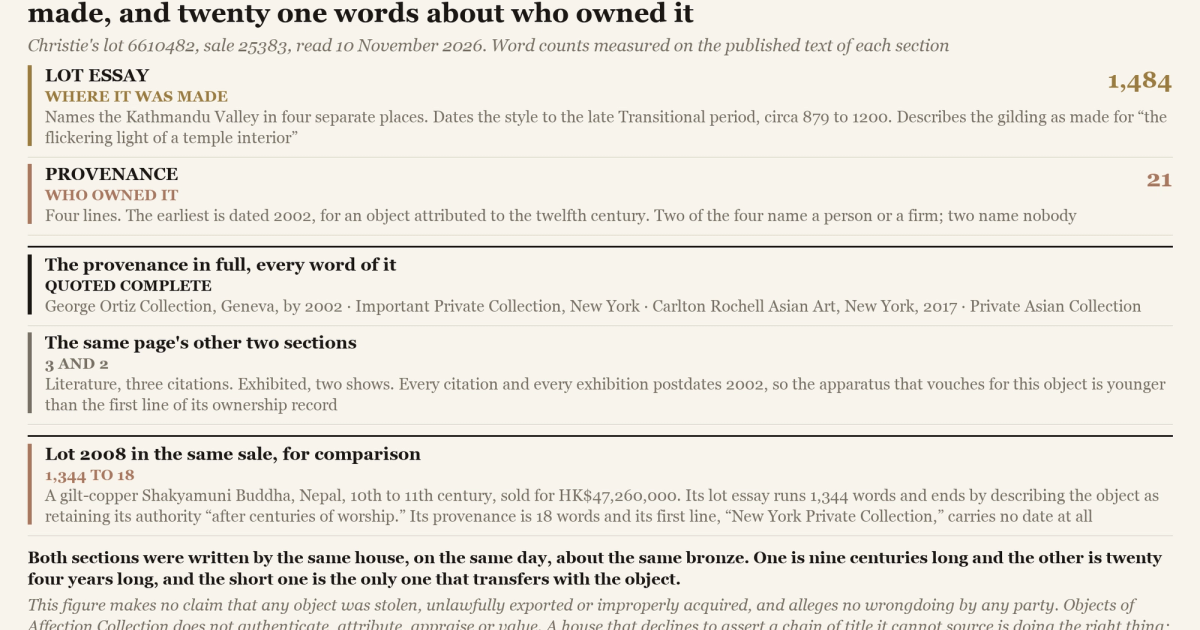
George Ortiz Collection, Geneva, by 2002 Important Private Collection, New York Carlton Rochell Asian Art, New York, 2017 Private Asian Collection
Twenty one words. Four lines. For an object attributed to the twelfth century, the earliest entry is dated 2002, and the words doing the work of eight hundred years are "by 2002."
Now here is the same page's lot essay, which runs to one thousand four hundred and eighty four words. It opens:
This monumental gilded copper sculpture of Manjushri stands among the most important works of Himalayan art ever recorded.
It identifies the deity by the prajnaparamita sutra on the lotus at his shoulder. It describes the tribhanga, the fire gilding, the tension between the smooth planes of copper and the articulated jewellery. It places the work precisely in the history of making: "the Newar aesthetic of the late Transitional period (ca. 879-1200)," heralding "the Early Malla period (1200-1482)." It explains that "for centuries, the artists of the Kathmandu Valley were among the most accomplished metalworkers of the Buddhist world." It accounts for why the object travelled, through the Chidar or Later Diffusion of Buddhism from roughly the tenth to the twelfth centuries, when monastery building across Tibet created demand that Newar workshops were placed to meet.
And it tells you where the object stood:
The brilliant fire-gilded surface would originally have intensified this effect, transforming the sculpture in the flickering light of a temple interior into an almost immaterial presence.
So the ratio on this one page is one thousand four hundred and eighty four words to twenty one. About seventy one to one. The scholarship is confident, specific and generous about the Kathmandu Valley, a temple interior, and three centuries of Himalayan art history. The ownership record begins in Switzerland in 2002 and names two people.
That is not a contradiction and it is not a failure by Christie's. The two sections answer different questions, and a house that declines to assert a chain of title it cannot source is doing the right thing. The point is narrower, and it is the whole of this study: the field that carries the cultural history and the field that carries the legal history are not the same field, and only one of them is full.
Eight lots, measured
The interesting thing about a single-owner sale of eight objects is that it is small enough to read completely. So all eight were read. For each lot: the attributed date, and the earliest entry in its published provenance.
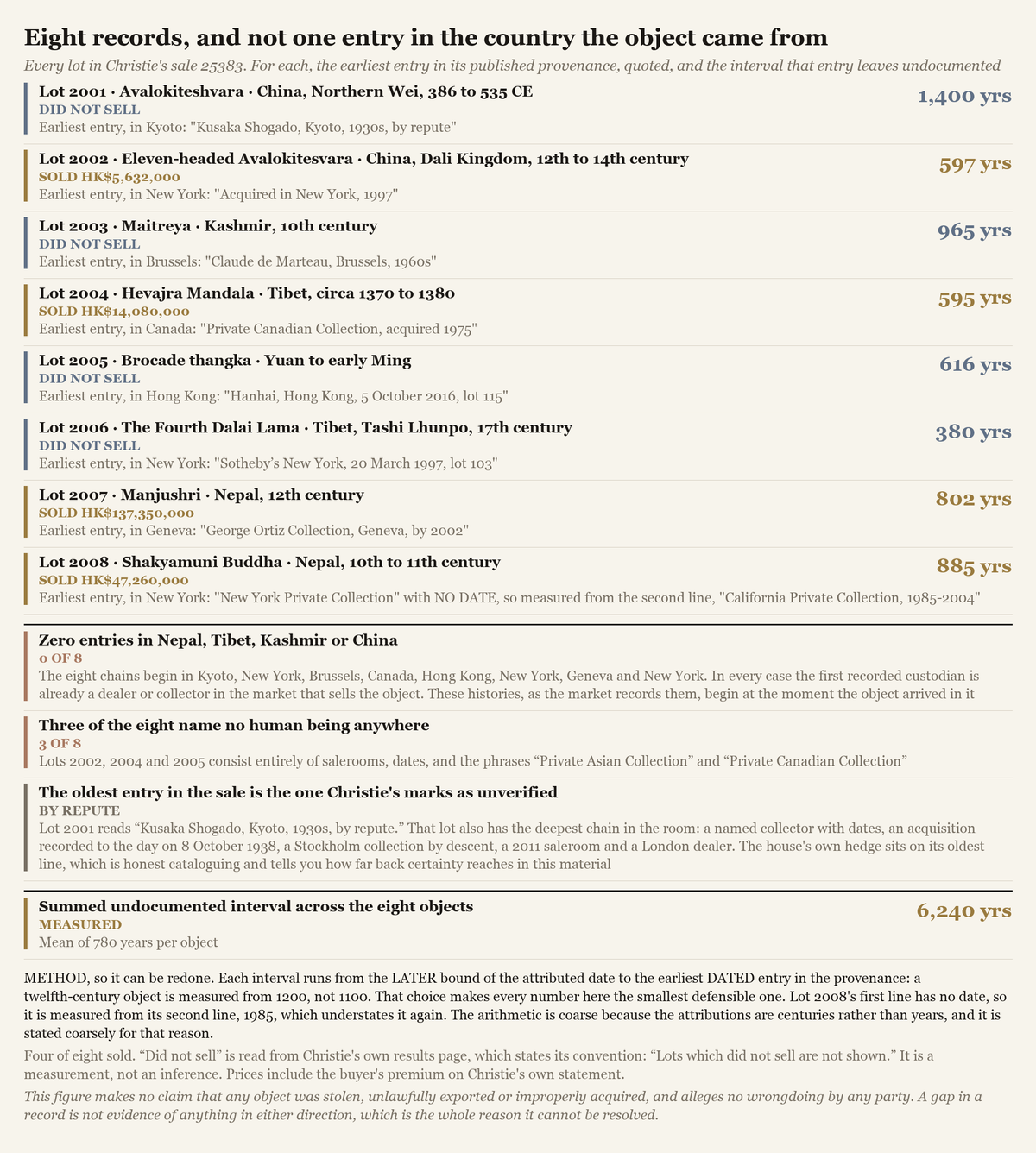
Lot 2001 is an Avalokiteshvara of the Northern Wei, 386 to 535 CE, and its earliest entry is Kusaka Shogado in Kyoto in the 1930s, qualified by Christie's own words, by repute. Lot 2002 is a Dali Kingdom Avalokitesvara of the twelfth to fourteenth century, and its earliest entry is the phrase "Acquired in New York, 1997." Lot 2003 is a tenth century Kashmiri Maitreya, earliest entry Claude de Marteau in Brussels in the 1960s. Lot 2004 is a Tibetan Hevajra mandala of about 1370 to 1380, earliest entry a Private Canadian Collection that acquired it in 1975. Lot 2005 is a Yuan to early Ming brocade thangka whose record begins at a Hong Kong saleroom on 5 October 2016. Lot 2006 is a seventeenth century Tibetan figure of the Fourth Dalai Lama, earliest entry Sotheby's New York, 20 March 1997. Lot 2007 is the twelfth century Nepalese Manjushri, earliest entry the Ortiz collection in Geneva by 2002. Lot 2008 is a tenth to eleventh century Nepalese Shakyamuni Buddha whose first line, "New York Private Collection," carries no date at all.
Three things fall out of that table, and all three are checkable against the eight lot pages.
Not one of the eight records contains an entry in the object's country of origin. Not one. The chains begin in Kyoto, New York, Brussels, Canada, Hong Kong, New York, Geneva and New York. Zero entries in Nepal, Tibet, Kashmir or China. In every case the first recorded custodian of the object is already a dealer or collector in the market that sells it. The histories of these objects, as the market records them, begin at the moment they arrived in it.
The earliest entry anywhere in the sale is from the 1930s, and it is the one Christie's marks as unverified. Lot 2001 reads "Kusaka Shogado, Kyoto, 1930s, by repute." That lot also has the deepest chain in the sale by a wide margin: a named collector with dates, Lin Xiongguang, 1898 to 1971, of the Baosongshi Collection, with an acquisition recorded to the day, 8 October 1938; then the Martin Mansson Collection, 1880 to 1952, Stockholm, "thus by descent"; then Christie's London, 10 May 2011, lot 188; then Eskenazi Ltd., London. It is the most documented object in the room, and the house's own hedge sits on its oldest line. That is honest cataloguing, and it tells you how far back certainty reaches in this material.
Three of the eight chains name no human being at all. Lots 2002, 2004 and 2005 consist of salerooms, dates and the phrases "Private Asian Collection" and "Private Canadian Collection." Lot 2008, which sold for HK$47,260,000, opens with "New York Private Collection" carrying no date whatsoever. Its second line, "California Private Collection, 1985-2004," is the first thing on the page that can be placed in time. Its lot essay runs to one thousand three hundred and forty four words against eighteen words of provenance, and ends by describing the object as retaining its authority "after centuries of worship."
Summed across the eight objects, from the later bound of each attributed date to its earliest dated entry, the undocumented interval comes to roughly six thousand two hundred years. The arithmetic is deliberately coarse, because the attributions are centuries rather than years and lot 2008's first line has no date to measure from. The average is about seven hundred and eighty years per object.
The inversion
There is a second measurement in this sale, and it is the one that explains how the market lives with the first.
Lot 2003, the tenth century Kashmiri Maitreya, has four lines of provenance. It has nine literature citations, running from Wayne Begley in 1968 through Pratapaditya Pal twice, von Schroeder, Chandra Reedy, two Zhiguan Museum volumes and a Himalayan Art Resources item number. It has eight exhibition venues across three exhibitions, 1968 to 2018, six of them on a single American tour: the Los Angeles County Museum of Art, the Seattle Art Museum, the Denver Art Museum, the Nelson-Atkins, the National Gallery of Canada and the Toledo Museum of Art, from October 1977 to June 1979.
So the object has been published nine times and shown in eight museums, and its ownership record reaches back to "Claude de Marteau, Brussels, 1960s."
Lot 2007 is the same shape: three literature citations, two exhibitions, four provenance lines, every citation and every exhibition postdating 2002.
The bibliography is longer than the title chain, and it is doing the work the title chain cannot. A buyer at this level is not reassured by the provenance. They are reassured by the apparatus around it: the catalogue entries, the museum walls, the scholars' names, the item numbers. That apparatus is real, and it is not a chain of title. It establishes that an object is important and that serious people have looked at it. It does not establish who owned it, or how it left the place it was made.
What an exhibition line establishes
Lot 2007's exhibition history has two entries. The first reads:
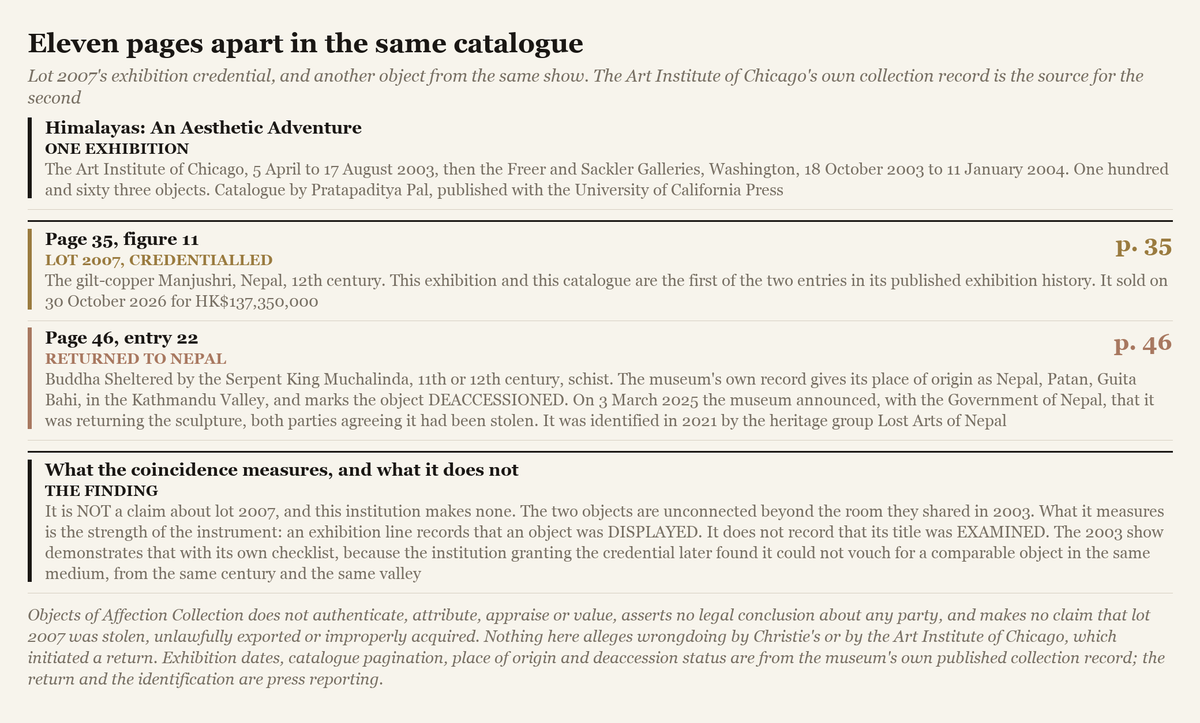
Himalayas: An Aesthetic Adventure, Art Institute of Chicago, 5 April - 17 August, 2003.
Its literature cites the catalogue of that show: Pratapaditya Pal, Himalayas: An Aesthetic Adventure, University of California Press, 2003, page 35, figure 11.
That exhibition contained one hundred and sixty three objects. One of them was Buddha Sheltered by the Serpent King Muchalinda, eleventh or twelfth century, schist, and the Art Institute's own online record for it lists the same show, the same dates, and the catalogue at page 46, entry 22. The record gives its place of origin as Nepal, Patan, Guita Bahi, in the Kathmandu Valley. The record is marked deaccessioned.
It is marked deaccessioned because on 3 March 2025 the Art Institute of Chicago announced, in collaboration with the Government of Nepal, that it was returning the sculpture. The two parties had agreed it was stolen from Guita Bahi. It had been identified in 2021 by the heritage group Lost Arts of Nepal, and had been given to the museum by a donor whose name is a matter of public record.
So the two objects were in the same exhibition, in the same catalogue, eleven pages apart. One of them is now a lot credentialled by that show. The other has been returned to Nepal as stolen.
Nothing in that is a claim about lot 2007, and this institution makes none. The two objects are unconnected beyond the room they shared in 2003. What the coincidence measures is the strength of the instrument, and the measurement is unflattering to it: an exhibition line records that an object was displayed. It does not record that its title was examined. The 2003 show demonstrates that with its own checklist, because the institution granting the credential later found it could not vouch for a comparable object in the same medium from the same century and the same valley.
Both records are empty, and that is the finding
The easy version of this story is that the market knows something it is not saying. The record does not support the easy version.
Nepal's Department of Archaeology is the authority that would have to make a claim. Its spokesperson, Sandip Khanal, told the Nepali outlet RatoPati that no application or complaint concerning the Manjushri has been filed with the department, and that the department has not received information about which place or temple in Nepal the statue came from, or when. He said the department opened its own study after the auction news broke, and that how the object left the country remains under investigation.
Read that beside the catalogue and the symmetry is exact. The seller's record of the object begins in 2002. The source country's record of its own loss does not reach the object at all. Neither party is concealing a document, because on the evidence available neither party has one.
The closest thing to a register of what Nepal lost is a book: Lain Singh Bangdel's Stolen Images of Nepal, published in 1989, a scholar's photographic inventory compiled decades after the losses. It is the instrument heritage campaigners still work from. A book is not a register. It cannot be queried, it cannot be amended when an object surfaces, and it records only what one person managed to photograph and miss.
This is the condition OAC exists to describe. A gap in a provenance record is usually read as a problem of honesty, and it is almost always a problem of instrumentation. Nobody built a record that could hold the answer, so the absence is not evidence of anything, in either direction, and that is precisely why it is impossible to resolve.
The rule that arrived eleven weeks before the sale
One more fact belongs in the record, and it is a document rather than an inference.
On 8 January 2026 the United States and Nepal signed an agreement under the Convention on Cultural Property Implementation Act, 19 U.S.C. 2602, imposing import restrictions on categories of archaeological and ethnological material of Nepal. It entered into force the same day. US Customs and Border Protection published the implementing rule in the Federal Register on 12 August 2026, with a Designated List. The restrictions run to 8 January 2031. The archaeological categories cover material from the Paleolithic through 1770 CE. Nepal had formally requested the measures on 23 May 2023.
Under that rule, covered material may not be imported into the United States unless it is accompanied by a valid export certificate issued by the Government of Nepal.
A twelfth century Nepalese gilt-copper sculpture sits well inside that range. The sale took place on 30 October 2026, eleven weeks after the rule took effect, in Hong Kong, where the rule does not apply. Christie's posted a notice on the sale itself stating that "lots of Indian, Himalayan, or Southeast Asian origin may be impacted by documentation requirements and regulations relating to the import of archaeological and ethnological material into the US."
No US import occurred and none is alleged. The observation is about the record, not about anybody's conduct: of the four places lot 2007's provenance names, two are New York. The object's own documented history runs through a city it could no longer enter without a certificate that nothing in its record shows has ever existed.
What the money was actually buying
In this sale, the depth of the record did not predict the result.
The four lots that sold were 2002, 2004, 2007 and 2008. Christie's results page states its own convention plainly: "Lots which did not sell are not shown." Lot 2001, with the named collector, the 1938 acquisition date and the descent through a Stockholm collection, did not sell. Lot 2003, with nine citations and six exhibition venues, did not sell. The two lots with the thinnest records in the room, both from Nepal, both passing through the same New York dealer in 2017, carried HK$184,610,000 of the HK$204,322,000 that the four sold lots realised.
Two honest caveats. Those two lots are also the largest objects in the sale, at ninety three and eighty one centimetres, and carried the two highest estimates, so scale and expectation are not separable from record depth here. And eight lots is eight lots. This is one sale, and it establishes nothing about the market.
What it does establish is that nothing in this sale rewarded documentation, and the critical reading of why is OAC's own and is offered as interpretation rather than measurement.
A thin record is not a discount in this market. It is closer to a feature, for three reasons that reinforce each other. Scarcity and difficulty are part of what is being bought, and an object that passed through history without leaving a trail reads as rarer than one with a paper trail, not more doubtful. The surrounding apparatus substitutes for the chain, and by the time an object has been published three times and shown in two museums, the institutional record has acquired a respectability that the ownership record never earned. And repatriation risk is priced as a distant legal hazard rather than an immediate one, which is a rational reading of an environment where the source country's own spokesman has said he does not know which temple to name.
The Ortiz line is worth sitting with, because it is the only pre-sale entry in lot 2007 that carries both a name and a place, and the public record of that collection shows what the remedy actually looks like. George Ortiz, born Paris 1927, died Geneva 2013, assembled one of the best known private antiquities collections in the world and campaigned publicly against both the 1970 UNESCO convention and the 1995 UNIDROIT convention. His collection held the Motunui epa, Māori carved panels taken to Switzerland, which New Zealand's courts held had been exported in breach of its law. New Zealand did not recover them by claim. After years of negotiation and after Ortiz's death, the New Zealand government bought them, for NZ$4.5 million, and they were deposited at Puke Ariki in New Plymouth in March 2014. Those details come from secondary sources and are attributed as such.
That is the shape of the thing. When a record is silent and a market is liquid, a source country's realistic path to an object runs through its chequebook.
Coda
The lot essay for lot 2007 is one of the better pieces of writing Christie's published this year. It knows the workshop tradition, the period, the technique, the trade route north into Tibet, the quality of light the gilding was made for. It knows the object came out of the Kathmandu Valley and it says so in four separate places.
Then the page changes heading and the same object has been in Geneva since 2002.
Both halves were written by the same house, on the same day, about the same bronze. One of them is nine centuries long and the other is twenty four years long, and the short one is the only one that transfers with the object.
Seven hundred and eighty years, on average, per lot. Eight records. No country of origin.
---
This study records what the public record contains and what it does not. Objects of Affection Collection does not authenticate, attribute, appraise or value, asserts no legal conclusion about any party named, and makes no claim that any object in this sale was stolen, unlawfully exported, or improperly acquired. Nothing here alleges wrongdoing by Christie's, by any dealer, collector or institution named, or by the Government of Nepal. The lot titles, attributions, dimensions, estimates, prices realised, provenance, literature, exhibition histories, lot essays, sale notice and results convention are quoted from Christie's published records for Sale 25383, lots 2001 to 2008, read 10 November 2026; prices realised include the buyer's premium on Christie's own statement. The four sold lots sum to HK$204,322,000 against a printed sale total of HK$204,450,000, a difference of HK$128,000 that this institution cannot reconcile and that bears on no finding above. The Art Institute of Chicago exhibition dates, catalogue pagination, place of origin and deaccession status are from that museum's own online collection record; the March 2025 return and the 2021 identification are press reporting and are attributed as such. The United States and Nepal agreement, its entry into force, the implementing rule and the Designated List range are from the Federal Register notice of 12 August 2026 and the published agreement. The Department of Archaeology position is a spokesman's comment to a news outlet, not a departmental finding. The George Ortiz biography and the Motunui epa account are from secondary sources and are marked as such in the text. No archive, temple record or export file has been read by Objects of Affection Collection.