Dior's Night in Color: The Record That Would Settle It
A house said a film was made by hand. The animation trade press printed it, looked again, and retracted it two days later. What follows is an account of what the public record can and cannot settle, and of the ordinary production documents that would settle it in an afternoon.
In the first week of November 2026, one house made two claims about human hands. One of them is certified by the French state and renewed every year. The other was made in a sentence on a web page, and within forty-eight hours the animation trade press had printed it, doubted it, and retracted it. Neither claim can be checked against any record that exists.
On 4 November, Dior released a short film called Christian Dior's Night in Color. It runs seven minutes and nineteen seconds. It was directed by Sylvain Chomet, who has been nominated for an Academy Award four times, and written by Chomet with Martin Latham. Robert Pattinson narrates. Louis Garrel voices Christian Dior, Camille Cottin voices Marlene Dietrich, Rihanna voices a star at the top of a tree. It is set on a snowy night on Avenue Montaigne in 1949. A call comes from Hollywood. Dietrich needs a dress.
The film is beautiful, and that is not incidental to what follows. It is beautiful in a way that is expensive to produce by hand and has recently become inexpensive to produce by machine, and the whole difficulty lives in that sentence.
What the house says
Dior filed the film on its own site under the heading news and savoir-faire, which is the house's own category for craft knowledge. Under a subheading reading Behind the Scenes, the page says this in full:
Chomet's meticulous process of hand-drawn animation unfolds over months, mirroring the patience required to create haute couture. In both these creative worlds, hundreds of hours of dedicated and skilful work create the appearance of effortless splendour.
Below it, a quotation from the director:
Technically, we work as they did in the 1940s. Everything is cut out, each character is animated separately, and everything is then assembled against the backdrops.
Dior's creative director Jonathan Anderson told WWD that the film is all hand-drawn using techniques that go back to the 1940s.
Three things are worth noticing before anything else happens. The first is that a section headed Behind the Scenes consists, in its entirety, of two sentences of prose and one quotation. There is no production material on that page. The second is that the house has tied the film's making to haute couture explicitly and by name, which means it has reached for the authority of the one labour claim in fashion that a government audits, in order to vouch for a labour claim that nobody audits at all. The third is that the house's prose says hand-drawn and the director's quotation describes cut-out assembly, and those are not the same method. Both sentences sit on the same page, unremarked.
What happened next
Cartoon Brew, the animation industry's trade publication, covered the film on 4 November. Its headline described the short as hand-drawn.
On 6 November at 9.15 in the morning, its publisher and editor-in-chief Jamie Lang published a correction and an apology. The piece is worth reading in full, and two passages matter here. The first is the finding:
After taking a closer look at those images and rewatching the short more carefully, it does seem likely that the claims hold some water, and that AI was used to create some of the film's final imagery and animation. We can't report that as fact and don't want to make any definitive claims based on speculation, but the evidence is compelling.
The second is the apology, and it describes a mechanism rather than a mood:
Our original article described the short as hand-drawn in its title. I based that headline on the materials provided and what I saw in the film, which I should have watched more carefully.
A house published a claim about how a thing was made. A trade publication printed the claim as a fact, on the strength of the materials provided. Two days later it removed the word from its own headline. Nothing had been added to the record in between. The only thing that changed was how carefully one person looked at the artefact.
Lang also wrote a sentence that is, as far as this institution can tell, the most accurate line published about the whole affair:
But regardless of what comes out in the coming days and weeks, or if we ever even find out if and how AI was used, I should have done a better job with the original piece.
Read the conditional in the middle of it. The editor of the animation trade press, having rewatched the film with the specific question in mind, allows openly that the question may never be answered. He is right, and he is right for a structural reason rather than a journalistic one. The artefact cannot answer a question about its own production. Only a record can, and there is no record.
Dior and Chomet have been asked for comment by Cartoon Brew, by Business of Fashion and by Fast Company, the last of these to LVMH's press office. At the time of writing none has replied.
What this institution looked at
Because the failure being described is a failure to look carefully, this study was not written from other people's screenshots. The film was taken from Dior's own page and read directly: thirty-six frames sampled across the whole running time, and the closing credits read frame by frame.
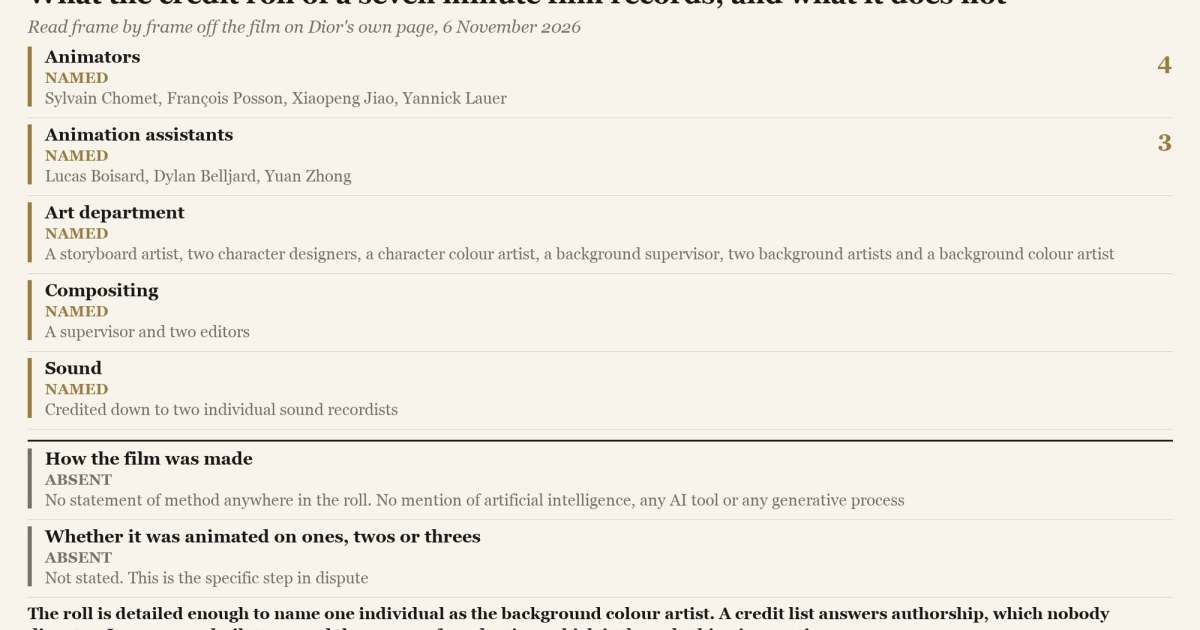
The credits name the people who animated the film. There are seven of them.
Four are credited as animators: Sylvain Chomet, François Posson, Xiaopeng Jiao and Yannick Lauer. Three are credited as animation assistants: Lucas Boisard, Dylan Belljard and Yuan Zhong.
The art department is credited separately and in similar detail: a storyboard artist, two character designers, a character colour artist, a background supervisor, two background artists and a background colour artist, each named. There is a compositing supervisor and two compositing editors. The sound credits run down to two individual sound recordists. Post-production work is credited to The Mill and localisation to TransPerfect.
Nothing in the credit roll mentions artificial intelligence, any AI tool, or any generative process. That is Cartoon Brew's observation and this institution confirms it, having arrived at it by a different route.
Seven people for seven minutes invites an arithmetic that this study declines to perform dishonestly. Animating on twos, which is the standard rate for ordinary motion, means twelve drawings for every second of film, and roughly four thousand nine hundred drawings for the animated portion of this one. Divided seven ways that is around seven hundred drawings each. Over the months Dior describes, with the cut-out method Chomet describes, that is demanding and it is not impossible. Cut-out animation builds characters from parts and moves the parts, and it is far less drawing-intensive than full hand-drawn work. A small team is consistent with it.
So the headcount proves nothing, and saying otherwise would be committing the exact error this study is about: reading a conclusion off an artefact because the artefact is suggestive.
A credit list is not a production record
Here is what the credits do establish, and it has not been said anywhere else.
The credit roll of this film is detailed enough to name one individual as its background colour artist. It names two sound recordists separately. It distinguishes a character designer from a character colour artist. This is a document of high resolution about who did the work.
It contains no statement whatever about how the work was done.
That distinction is the whole of this case, and it generalises far past Dior. A credit list answers authorship. The dispute is not about authorship. Nobody doubts that Dior commissioned this film or that Chomet directed it, and nobody has suggested otherwise. What is contested is the means of production, which is a separate fact with its own sources and its own dates, and which almost no commercial record in any industry carries.
This institution's own standard separates those two fields deliberately, because conflating them is how an industry ends up unable to answer a question about its own work. The maker is the author. The facility, the method and the tools are a different field, recorded separately, each assertion carrying the source it came from. Dior published a means-of-production claim with no source attached. The credits, which are the most detailed document the production released, were never designed to carry one.
Both sides of this argument are unsourced
The case against the film is made in frame-grabs. The most widely circulated are a misspelled tag on Monsieur Dior's dog, warped lettering, a character with six fingers, and a misplaced finger bone. Several outlets note correctly that none of these proves anything on its own.
This institution went to look at two of them.
At three minutes fifty-three seconds, the dog's collar tag is legible. It reads Bobby, which was the name of Christian Dior's real dog, and it is spelled correctly. At five minutes fifteen seconds, the sign on Marlene Dietrich's dressing room door reads Marlene Dietrich in clean, well-formed lettering with a gold star at each corner.
That is not a defence of the film and must not be read as one. Thirty-six frames were sampled out of roughly ten thousand five hundred. The defects described may sit in any of the frames that were not examined, and an absence found in a sample is a statement about the sample.
It is, however, a finding, and it is this. The claimed defects could not be located because nobody circulating them says where in the film they occur. There are no timecodes. A frame-grab travels the internet as evidence while detached from the position in the work that would let anyone else verify it.
So the accusation has precisely the same defect as the claim it attacks. Dior asserts a method and publishes nothing that would let you check it. The doubters assert a defect and publish nothing that would let you find it. Two parties are arguing about a seven minute film, in public, and neither of them has produced a pointer into the record.
The hands
There is one more thing visible in the film, and it was not visible in anyone's summary of it.
Dior's page describes the workers in the atelier as three hard-working bees. The credits name them: Paulette, Yvonne and Madame Marguerite. Those are workroom names, and Madame Marguerite is the name of a première d'atelier. Watched through the workroom sequence they behave as the atelier staff, carrying spools, working around a dress form labelled for Dietrich, attending Monsieur Dior.
The seamstresses of a couture house are called petites mains. Little hands. It is one of the few pieces of trade vocabulary in fashion that names the labour rather than the product.
In this film they are insects, and they have no human hands at all.
Nothing follows from that about how the film was made, and no inference of that kind is drawn here. It is a design choice, and in a whimsical animated story about talking furniture it is a perfectly ordinary one. It is worth recording only because of where the argument went afterwards. Cartoon Brew's own summary line, pointing readers at the evidence, was to check the hands, always the hands. A public trying to work out whether human hands made this film went hunting through the frames for hands, in a film that honours the patience of the human hand by drawing the hands that do the work as insect limbs.
The one place this claim is audited, and it cannot be read either
Dior tied the film to haute couture, so it is worth asking what haute couture actually certifies, because it is the strongest hand-labour claim in the industry and close to the strongest anywhere.
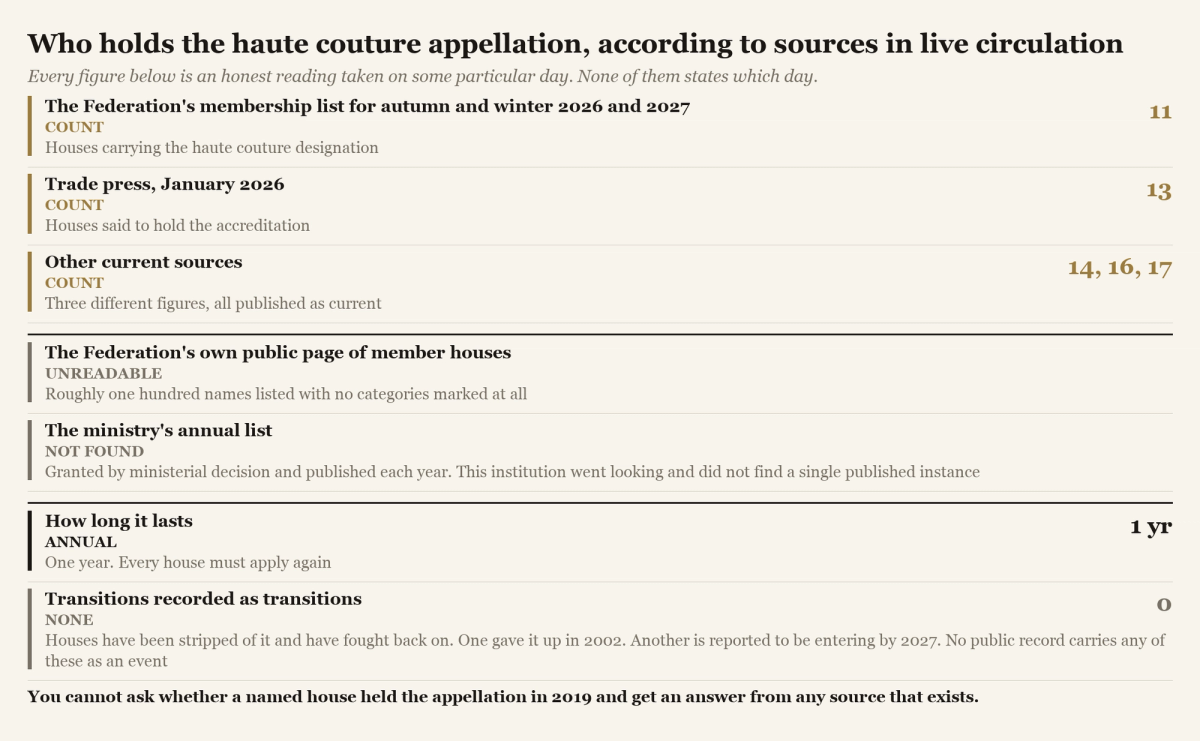
The designation is protected in French law, by a decision of 23 January 1945 confirmed by an order of 30 June 1947. It is granted by ministerial decision on the advice of a commission created inside the Fédération de la Haute Couture et de la Mode, which is the trade body whose own members the commission classifies. The criteria are, in substance, a census of employed hands: work made to measure for private clients with fittings, an atelier in Paris, a minimum of full-time staff, and collections of a stated minimum size presented twice a year.
It lasts one year. Every house must apply again.
Which means that every sentence of the form a given house is a couture house carries an expiry date, and nothing publishes the date.
Now try to find out who holds it. The Federation's own public page of member houses lists roughly a hundred names with no categories marked at all, so the one body with authority on the question publishes a page that cannot answer it. The membership list for autumn and winter 2026 and 2027 carries eleven haute couture houses. Trade press in January 2026 said thirteen. Other current sources say fourteen, sixteen and seventeen. The minimum collection size is variously given as twenty-five, thirty-five and fifty. Each of these is an honest reading taken on some particular day, and not one of them states which day.
The ministry publishes a list every year. This institution went looking for it and did not find a single published instance, and records that as a search that failed rather than as an absence.
Houses have been stripped of the designation and have fought their way back. Saint Laurent gave it up in 2002. Hermès is reported to be entering by 2027. The set moves in both directions, repeatedly, and no public record carries a single one of those transitions as a transition. You cannot ask whether a named house held the appellation in 2019 and get an answer from any source that exists.
So the most rigorously audited claim about human hands in any industry has a current state, badly published, and no history of custody whatsoever. The regulated case is better than the unregulated one. It is not good enough to settle an argument about a seven minute cartoon.
This is a season, not a house
Dior is the loudest instance of something much wider. Fast Company put it plainly on 6 November: in the age of machine-generated video, brands have rediscovered the human hand, and artisanal values have become a luxury good.
The season's evidence is a list. Prada commissioned a hand-drawn holiday film from John Pomeroy, formerly of Disney. Porsche used traditional hand-drawn animation with 3D last year. Apple released a stop-motion Mac mini advertisement in August 2026, another stop-motion film for Apple Games, and rebuilt its Apple TV and Apple Music logos with practical effects. Levi's made a stop-motion film. Starbucks used animation. Anthropologie called its film handmade.
Seven houses asserting human hands in a single season. Not one of them published a record of the work.
What makes that interesting rather than merely cynical is that the market is now paying a premium for exactly the property it has lost the ability to verify. This institution has written on the economics before. A study published on 1 June 2026 examined Gucci's machine-generated campaign imagery and argued that when perfection becomes free, imperfection becomes priceless, and that a house surrendering its visual communication to the machine hollows out the premium it charges.
That argument rested, without saying so, on a feature of the Gucci case that the Dior case removes. Gucci labelled its images as created with AI. The disclosure was present, so the market could read the labour fact and price it.
The question was what a disclosed machine costs a house. It was never how anyone would know.
Remove the label and the mechanism stops working, for a reason sharper than the absence itself. A costly signal that cannot be verified is not a costly signal. It is a claim, and a claim is exactly as cheap to make as the machine output it denies. Worse, the signal has inverted. The earlier argument priced imperfection as the mark of the human. In this case a misplaced finger bone and a six-fingered hand are cited as the mark of the machine. The tell of the hand and the tell of the machine have become the same artefact, which is why the public ended up counting fingers, and why counting fingers settled nothing.
What would settle it
The useful thing about this case is that the absence is not permanent. It has a holder, and that is the distinction that separates a gap somebody could close from a blank nobody can act on.
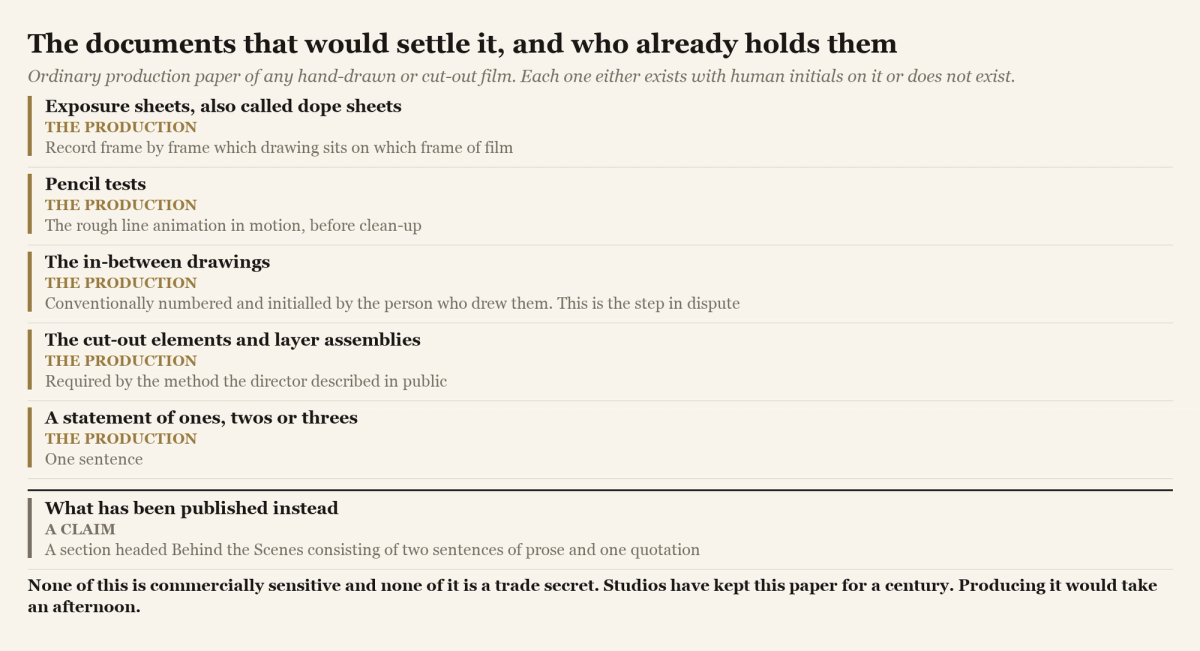
Hand-drawn and cut-out animation both generate their own documentation as a by-product of being made. The artefacts either exist with human initials on them or they do not exist:
- the exposure sheets, also called dope sheets, which record frame by frame which drawing sits on which frame of film - the pencil tests, the rough line animation in motion before clean-up - the in-between drawings themselves, conventionally numbered and initialled by the person who drew them - the cut-out elements and layer assemblies that Chomet's own description of the method requires - a statement of whether the film was animated on ones, twos or threes
Chomet described a specific method in public. It is a falsifiable description, which is to his credit, and it implies a particular set of artefacts. Producing them would take an afternoon. Nothing in this list is commercially sensitive, and nothing in it is a trade secret; this is the ordinary paper of a production, and studios have been keeping it for a century.
This institution does not authenticate, and takes no position on whether artificial intelligence was used in the making of this film. The evidence in public does not support a conclusion either way, the parties who could answer have not answered, and several outlets that looked harder than most have said the same.
The position is narrower and it is the only one the record supports. Dior does not need to be believed and does not need to be doubted. The question of how the film was made is answerable, cheaply, by documents that exist, and the house has published a claim instead.
That is the condition the luxury industry has arrived at in the season it decided to sell the human hand. A hand-made claim is now the most valuable assertion a house can make and the least verifiable one, and an industry has spent an autumn discovering that it needs a production record without yet noticing that a production record is the thing it needs.
The finger-counting will continue until somebody publishes one.
---
This study records what the public record contains and what it does not. Objects of Affection Collection does not authenticate, attribute, appraise or value, and asserts no legal conclusion about any party named. Claims attributed to Dior, Jonathan Anderson and Sylvain Chomet are quoted from Dior's published campaign page and from reporting cited above. Allegations circulating about the film's production that rest on unnamed sources are noted as circulating and are not adopted here. The film was read directly at dior.com on 6 November 2026; the frame observations describe a sample of thirty-six frames and no more.