Pagani Huayra 70 Anima: Every Hand but One Unnamed

Two accounts of one car at once: the feature any magazine would write, and the one this institution exists to write, which asks of every component what is written down, by whom, and what is not. On a car finished in paint containing diamond and striped in platinum leaf, that question has sharper edges than usual.
On the evening of 31 October 2026, on a lawn at the Wynn in Las Vegas, a man ten days short of his seventy-first birthday pulled a cover off a car and finished a story he had started on his seventieth.
The car is the Pagani Huayra 70 Anima. It is the third and last of three, built by the division Pagani calls Grandi Complicazioni, a name borrowed from watchmaking, where a complication is any function a clock performs beyond telling the time. The other two stood beside it. It was the first time the three had been in the same place, and because the series stops at three, it is likely to be the last for a long while.
Anima is Italian for soul. The announcement closes on a phrase of the company's own: una complicata ricerca di idee semplici, a complicated search for simple ideas.
What follows is two things at once, and they do not usually appear together.
The first is the kind of account any magazine would write: what the car is, what is in it, where it came from, who else had a hand in it. That account is worth writing because the car genuinely is remarkable and because the people who made it are good at what they do.
The second is the account this institution exists to write, which is about the record rather than the object. For every component and every claim, it asks a single question: what is written down, by whom, and what is not. On a car finished in paint containing diamond and striped in platinum leaf, that question has sharper edges than usual.
Both accounts are built from published sources only. Nobody at Pagani was contacted and nothing here required anyone's cooperation.
What was unveiled at the Wynn
The Anima is a Huayra, which means it is the car Pagani introduced in 2011 and has been returning to ever since, four years after it was formally replaced.
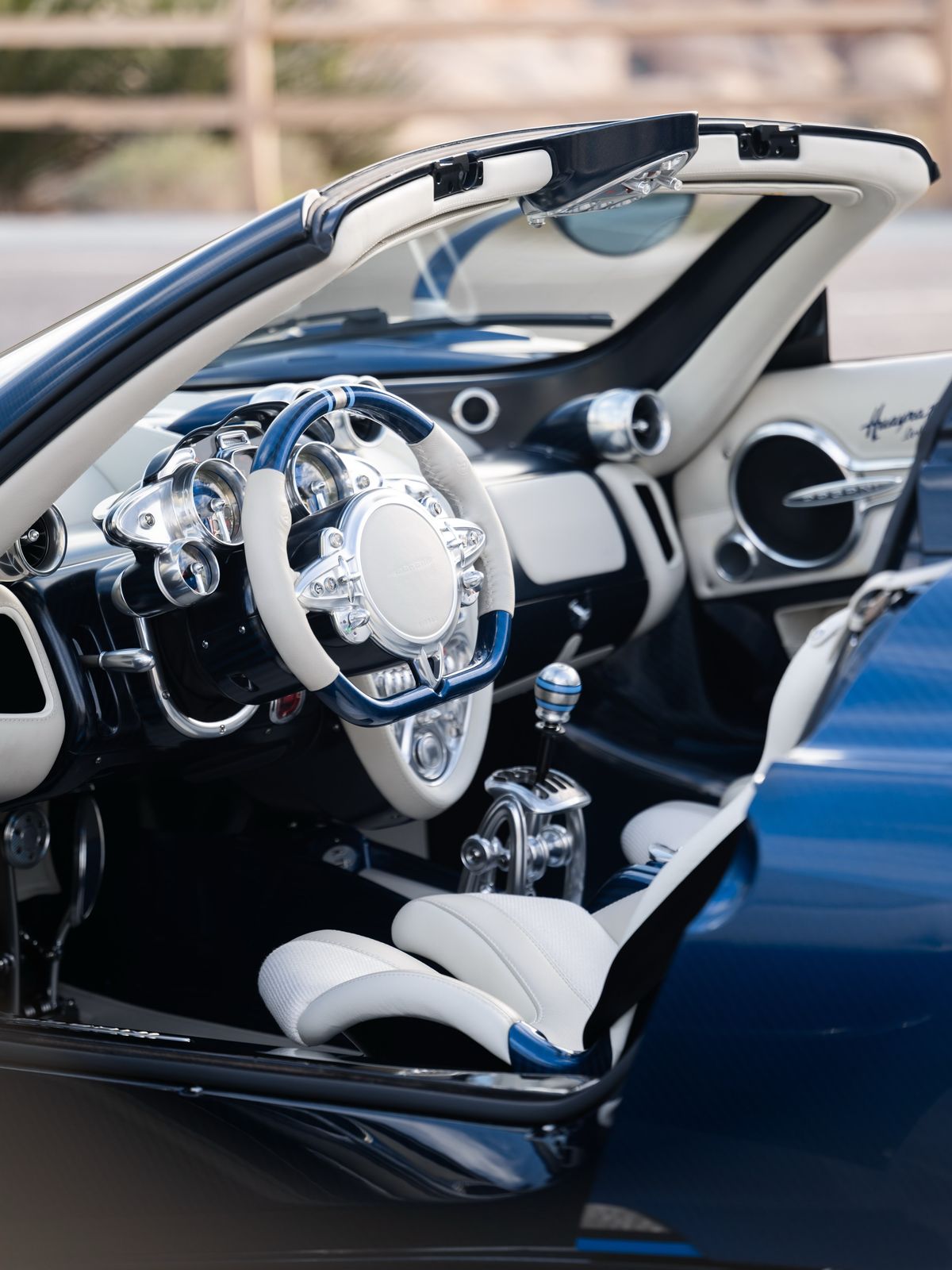
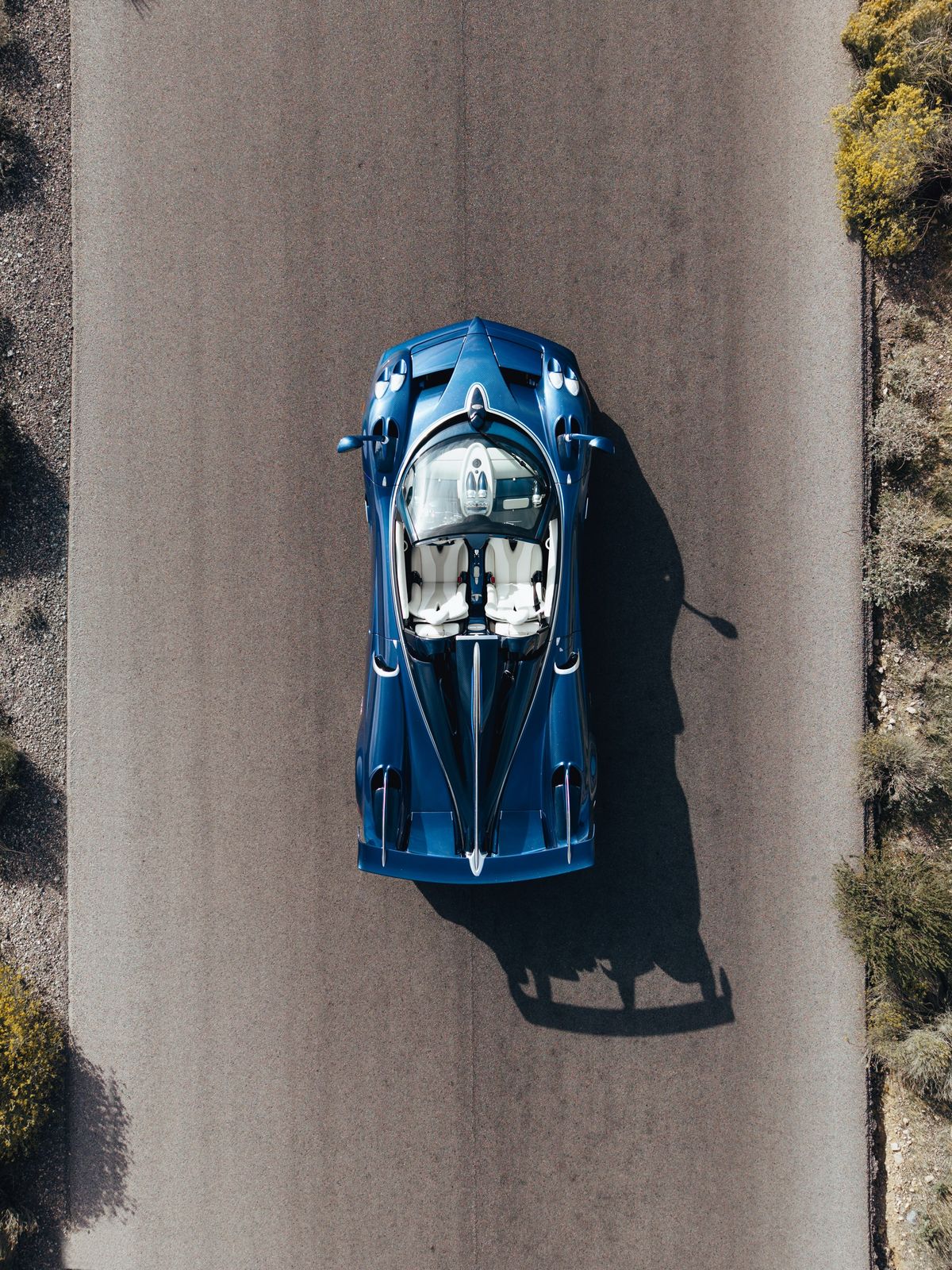
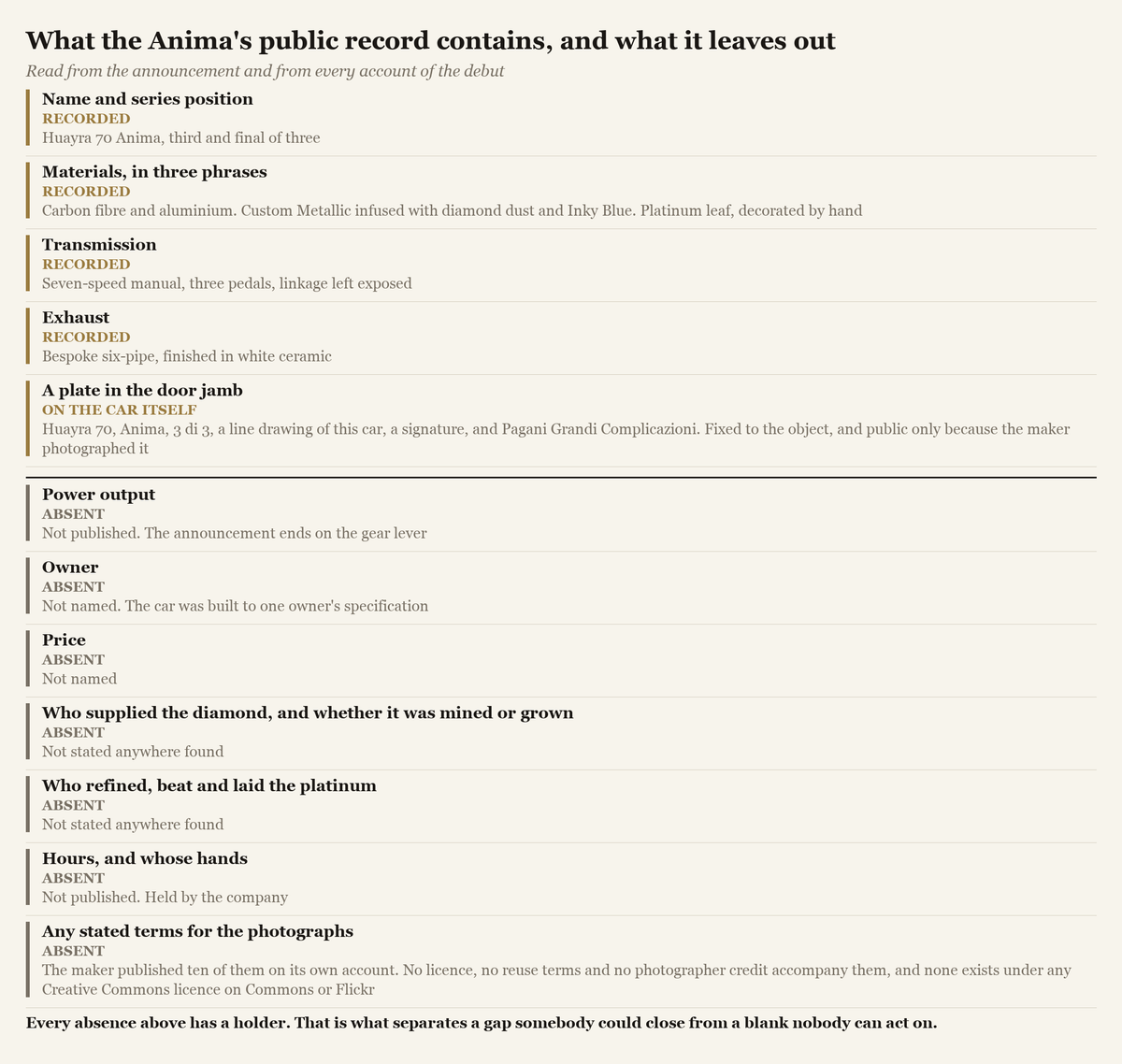
It is an open car. The manufacturer's own photographs show no roof, a tall twin roll structure behind the seats and a large rear wing, over a body of blue-tinted exposed carbon whose weave reads through the finish, with a pale stripe down the centre line. Inside it is white leather against blue. Its body is carbon fibre and aluminium. The finish is a Custom Metallic infused with diamond dust, worked together with a colour Pagani calls Inky Blue, and a stripe of platinum leaf runs along the body, laid and decorated by hand. It breathes out through a bespoke six-pipe exhaust finished in white ceramic.
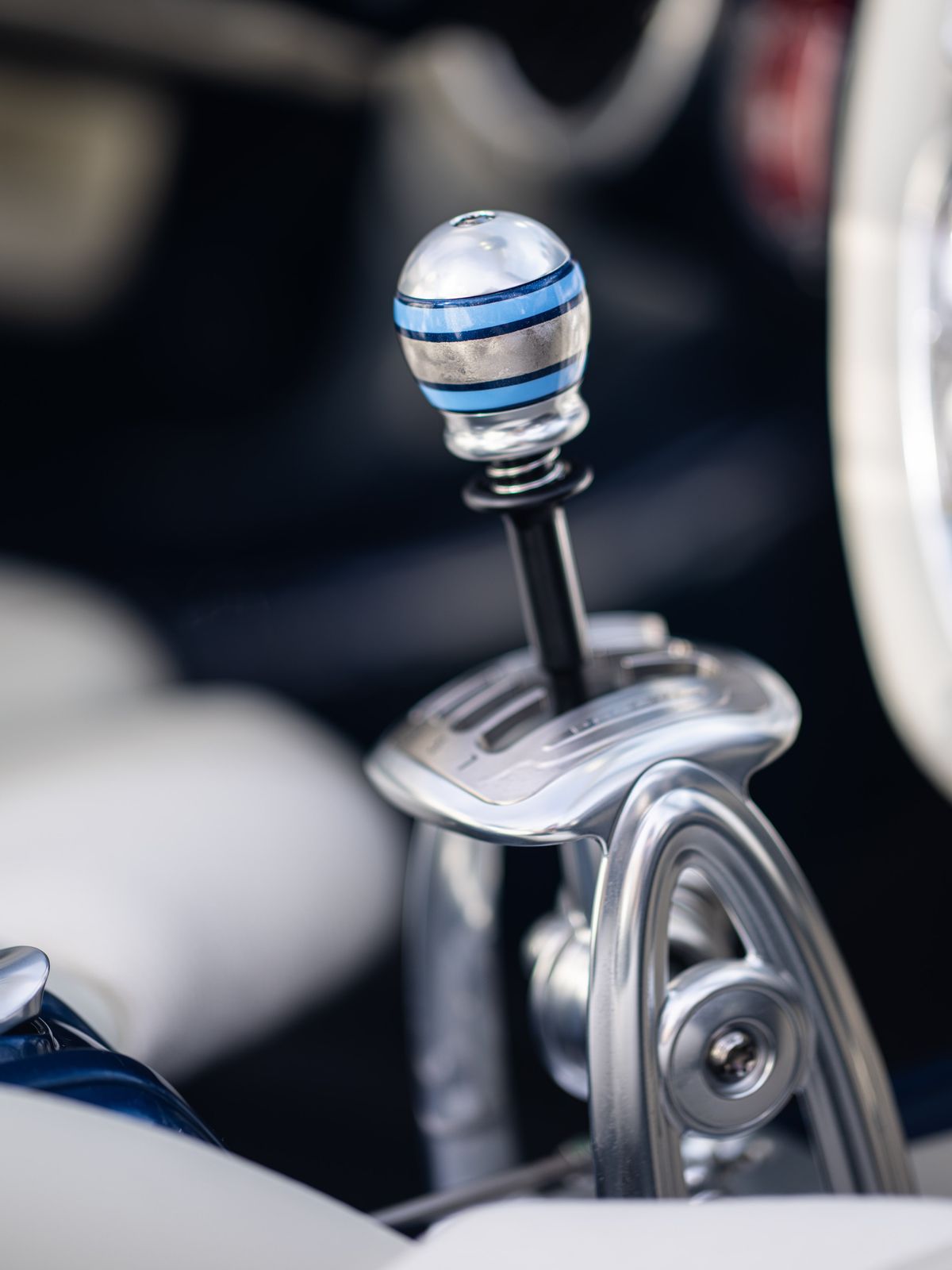
Inside is the detail every account led with: a seven-speed manual gearbox, three pedals, and a linkage left exposed so that the mechanism moving between the gears is visible while it works. On a car of this kind that is now an unusual decision, and it is the one the company chose to end its announcement on.
Pagani has not published the car's power output. It has not named the owner. It has not named a price. The announcement, as several outlets noted, finishes on the gear lever rather than on a number.
That is itself worth pausing on, because it is the first thing the record does not contain, and it is deliberate. A hypercar announcement that declines to give a horsepower figure is making a point about what the car is for. It is also, from the point of view of anybody who later has to establish what this object is, a gap on page one.
The trilogy, and the birthday it was built around
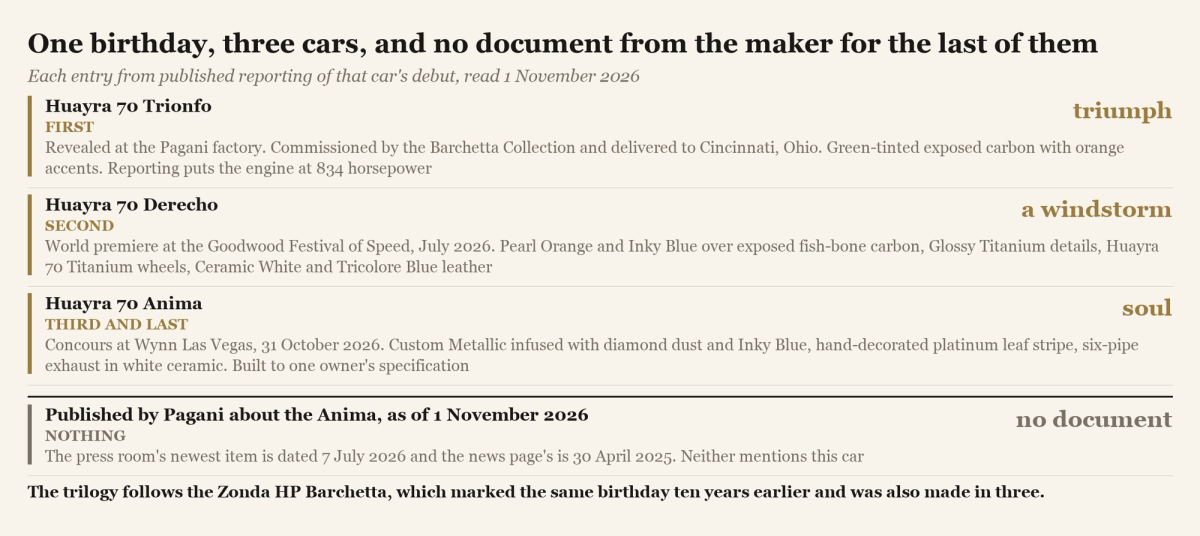
Horacio Pagani was born in Casilda, in the Argentine province of Santa Fe, on 10 November 1955. He turns seventy-one nine days after the Anima was shown. The three cars were built to mark his seventieth.
The first was the Huayra 70 Trionfo, triumph, revealed at the company's own factory. It was commissioned by the Barchetta Collection and delivered to Cincinnati, Ohio, around the turn of the year, wearing green-tinted exposed carbon with orange accents. Reporting on that car put the engine at 834 horsepower.
The second was the Huayra 70 Derecho, named for the straight-line windstorm that can flatten a hundred miles of forest without rotating once. It had its premiere at the Goodwood Festival of Speed in July 2026 in Pearl Orange and Inky Blue, over exposed fish-bone carbon, with Glossy Titanium details, a set of wheels Pagani calls Huayra 70 Titanium, and a cabin in Ceramic White and Tricolore Blue leather.
The third is the Anima. Inky Blue is the thread back to the Derecho, which used the same transparent blue over its lower carbon sections and its monocoque.
There is a precedent for the shape of this. The Zonda HP Barchetta, which marked the same man's sixtieth birthday, was also made in three.
The gearbox is not Pagani's, and that is the most interesting fact about it
Until July 2024, a Huayra could not be bought with a clutch pedal. The car had an automated seven-speed gearbox for its entire production life.
That month, at Goodwood, Pagani showed a one-off called the Huayra Epitome with a true manual. The conversion was done by Xtrac, a British transmission company, which also supplies the gated manual in Pagani's current car, the Utopia. The Epitome's engine, a six-litre twin-turbocharged V12, is supplied by Mercedes-AMG and made 864 horsepower in that application.
All three Huayra 70s carry that seven-speed manual.
So the detail the Anima's announcement ends on, the thing presented as the soul of the car, is a gearbox designed and built by a company in Berkshire, bolted to an engine built in Affalterbach, in a body made in San Cesario sul Panaro. The car is extraordinary and it is also an assembly, and the assembly is the point rather than a criticism of it. Almost nothing at this level is made by one party, and the interesting question is which of those parties the record will remember.
It will remember Pagani. The badge says so, the title documents will say so, and in fifty years an auction catalogue will say so. Whether it will say Xtrac is a different question, and on the evidence of how such catalogues are written, the answer is usually no.
This institution has published before on objects made by several hands where the record credits one. The pattern holds from a workshop in Oaxaca where the signature on a carving is the workshop's rather than the carver's, to a pair of trainers where three parties acted in sequence and the catalogue field named the one whose contribution was least specific. A hypercar is the same structure with more money in it.
The brands that are named, and the one release that names them
Pagani does publish supplier relationships. It published one in January 2026, and reading it against the Anima's silence is instructive.
At CES in Las Vegas, ten months before the Anima was unveiled in the same city, Pagani announced what it called an advanced research project in collaboration with STMicroelectronics and osdyne. The result is a central Automotive Gateway built on ST's Stellar G processors and osdyne's Rust-based secure software platform, consolidating body control, remote diagnostics, over-the-air updates and cybersecurity enforcement, and reducing the complexity of the wiring harness. A Utopia prototype served as the rolling laboratory. The unit sits in a hand-crafted carbon fibre case made at San Cesario sul Panaro.
The release quotes three people by name and title. Horacio Pagani, who is also the company's chief designer, says that technology must never overpower the human experience, but serve it. Loris Valenti, vice president of the microcontroller and digital product group at STMicroelectronics, says excellent silicon is only half the equation. Amit Singh, chief executive of osdyne, says they are bringing the same philosophy to machines.
That is a complete record of a collaboration: who, what, why, with quotations, dated, on the manufacturer's own site, still there.
So the company's practice is not to hide its partners. It names them, with their job titles, when it chooses to. Set beside that, the Anima's record is not evidence of secrecy. It is evidence of a different decision about what deserves a document, and the decision went the way it usually goes: the engineering partnership that demonstrates capability got a press release, and the object that will outlive everybody involved got a reveal.
The partners who are visible around this car are therefore a mixture of the published and the inferred. Mercedes-AMG supplies the engine, which Pagani has stated for years. Xtrac did the manual, which is reported and which Xtrac's work on the Utopia corroborates. STMicroelectronics and osdyne are named by the company itself, for a system aimed at platforms after 2030 rather than at this car. Who made the paint, who supplied the diamond in it, who beat the platinum into leaf and who laid it: unnamed, and not by accident so much as by custom.
The paint contains diamond, and nobody has said which kind
Here is where the ordinary account stops and the other one starts.
Pagani says the Anima's finish is a Custom Metallic infused with diamond dust. Every outlet repeated the phrase. None of them asked the obvious next question, which is not a gotcha but a genuine matter of record: what diamond, from where.
Diamond dust is a real industrial material and a common one. It is an abrasive, sold by the micron and by the carat, used for lapping, polishing and grinding, and it exists in two forms. One is crushed from mined stone. The other is grown in a reactor. Both are sold as diamond dust, both are chemically diamond, and at the scale used in a paint film neither is distinguishable from the other by eye or by price tag on a car. Among the named manufacturers of industrial diamond powders is Element Six, the industrial diamond arm of De Beers.
So the question of what is in the paint has a true answer, and that answer exists somewhere in a purchase order. It is not in anything published.
That might seem like a small thing. It is not, for one specific reason.
What the Kimberley Process does not cover
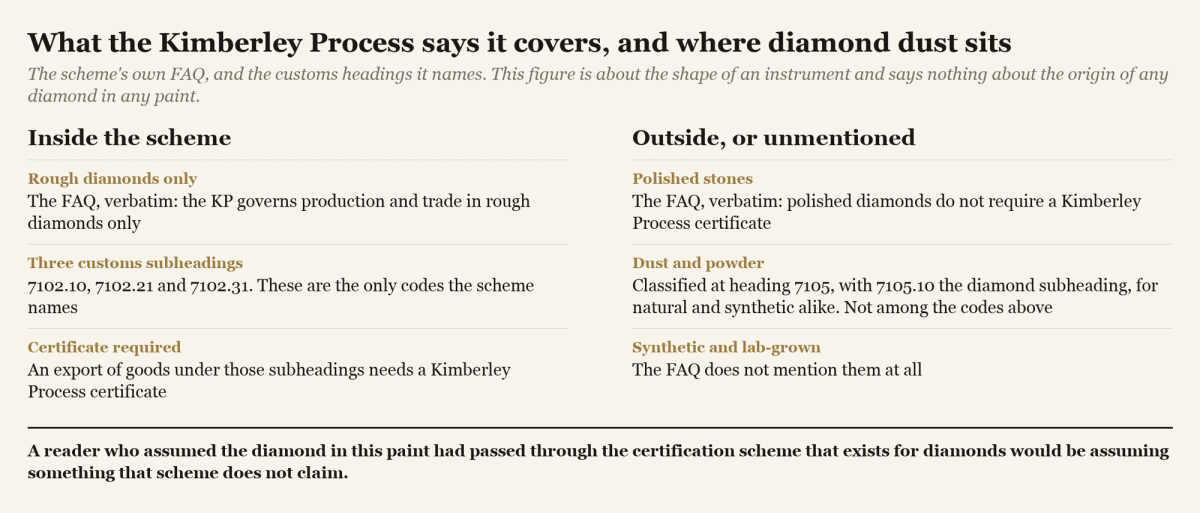
The instrument that most people would assume governs diamonds in a product like this is the Kimberley Process Certification Scheme, set up in 2003 to keep conflict diamonds out of the legitimate trade.
Its own published FAQ states its scope in one sentence: the scheme governs production and trade in rough diamonds only, under customs headings 7102.10, 7102.21 and 7102.31. The same page states that polished diamonds do not require a certificate. It does not mention synthetic or laboratory-grown diamonds at all, and it does not mention dust or powder.
Dust and powder are classified elsewhere. In the Harmonised System, heading 7105 covers dust and powder of natural or synthetic precious and semi-precious stones, with 7105.10 the subheading for diamond. Whole rough stones sit in 7102. Those are different headings, and only the 7102 subheadings appear in the scheme's statement of its own scope.
The conclusion is narrow and should be stated narrowly. Diamond dust, whether crushed from mined stone or grown in a reactor, is not within the three customs subheadings the Kimberley Process names as its scope. A reader who assumed that the diamond in this paint had passed through the certification scheme that exists for diamonds would be assuming something the scheme does not claim.
This is not an allegation about Pagani, about its paint supplier, or about anybody's diamond. It is a statement about the shape of an instrument. The scheme was built for rough gem and industrial stones crossing borders, and a tin of abrasive powder is a different trade with different paperwork. There may well be excellent records of exactly where this material came from. The point is that none of them is public, and that the public instrument everybody would reach for does not reach this far.
The stripe is platinum, which has its own chain and its own silence
A stripe of platinum leaf runs down the car, applied and decorated by hand.
Platinum is a metal with an unusually well developed responsible sourcing architecture. The London Platinum and Palladium Market operates a Good Delivery list for platinum and palladium, and refiners on it are subject to responsible sourcing requirements. In principle a bar of platinum can be traced to an accredited refiner, and that is more than can be said for most materials in most objects.
In practice, leaf is a long way downstream. Platinum leaf is beaten from refined metal by specialist leaf makers, and by the time it reaches a paint shop in Emilia-Romagna it has passed through a refiner, a leaf beater and at least one distributor. Each of those parties has records. None of them is identified in anything Pagani has published about this car.
So the pattern repeats. There is a chain, it is real, somebody could follow it, and the object arrives with none of it attached.
What the labour is, and the one figure that can be computed
The question of hours is the one a reader of this institution's recent work will expect, because it has been asked before about a carved wooden animal from Oaxaca, and the answer there was that nobody publishes it.
The answer here is the same, with one difference: Pagani publishes enough to bound it.
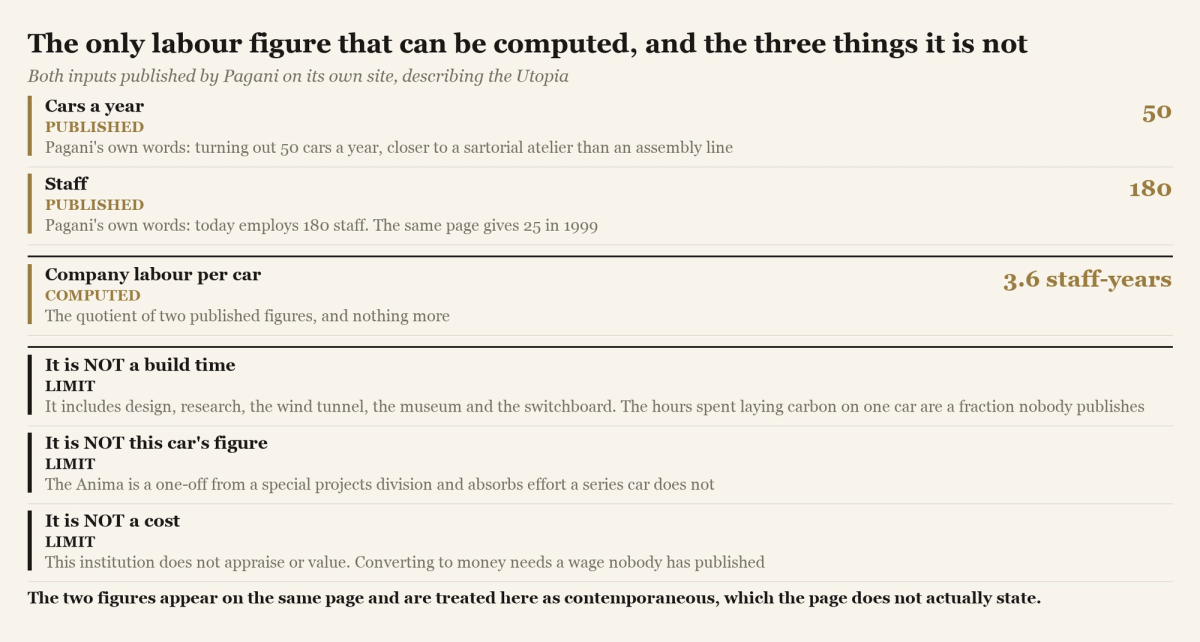
On its own site, describing its current car, the company says it turns out fifty cars a year and that it is closer to a sartorial atelier than an assembly line. On the same page it says the company today employs one hundred and eighty staff, against twenty-five in 1999.
Those two published figures can be divided. One hundred and eighty staff producing fifty cars a year is three point six staff-years of company labour for each car that leaves the building.
That number needs three fences around it, and they matter more than the number does.
It is not a build time. It includes everybody: design, research, the wind tunnel, the people who answer the telephone, the people who run the museum. The hours actually spent laying carbon and laying platinum leaf on one specific car are some fraction of it, and the fraction is not published.
It is not this car's figure. The Anima is a one-off from a special projects division, and a one-off absorbs effort that a series car does not.
And it is not a cost, which is to say it is not a valuation. This institution does not appraise or value anything, and converting staff-years to money would require an assumption about wages that Pagani has not published and that nobody outside the company could supply honestly.
What the figure does establish is a scale. Whatever this car took, it was drawn from a pool of three point six staff-years per car at a company of one hundred and eighty people, and the number of hands that touched it is closer to a hundred than to one. Not one of those hands is named anywhere in the public record of this object.
The maker's own newsroom does not contain the car
Here is a measurement rather than an argument.
Pagani maintains two public channels on its own website. One is a news page. The other is a press room.
As of 1 November 2026, two days after the Anima was unveiled and while the concours at which it was shown was still running, the most recent item in the press room is dated 7 July 2026 and concerns the company's participation at Goodwood, where the Derecho was premiered. The most recent item on the news page is dated 30 April 2025 and announces a showroom in Warsaw.
Neither carries the Anima.
Every account of this car in the world therefore traces to something other than the manufacturer's own published record: to material handed to outlets, to what was said on the lawn, to photographs taken by people who were there. That material may be entirely accurate. It is simply not, at the time of writing, anywhere the company has put its own name to and dated on its own site.
It would be wrong to call this silence, and the correction matters. Pagani did announce the car. It posted it on its own official account on the evening of the unveiling, ten photographs and a line of its own: the soul of the Atelier takes form. Thirty seven thousand people have since marked their approval of it.
So the company spoke. It spoke on a platform it does not own, in a format with no version, no dateline a citation can carry, no archive it controls, and no guarantee that the post will exist in ten years, let alone sixty. A press release is dated, attributable, archived and quotable. A post is a performance that happens to persist.
For an object whose value will one day rest on what can be established about it, that difference is the whole of it, and it is the kind of difference that is very hard to recover later.
Authenticity, answered with a list of dealers
Pagani has published one document that addresses directly how a buyer should establish that a Pagani is what it is claimed to be. It is worth reading closely, because it is an unusually clear example of something this institution writes about constantly.
On 4 December 2025 the company issued an official statement. It says demand for Pagani vehicles, new and pre-owned, has grown continuously, that the cars are highly sought after collectors' pieces, and that with demand growing faster than supply it is the company's intention to support that trend and, in its own words, protect its clients' investment.
It then says that this situation has been abused, that certain legal entities and individuals have unlawfully used the Pagani name to offer or sell new Pagani vehicles, and that such parties have not been granted the right to represent the brand.
And then it tells the reader what to do about it. To ensure the authenticity of any Pagani product or commercial opportunity, verify the official dealer network at a given link, and notify the legal department of any entity not on it.
Read that as a record instrument and it is remarkable. The question is authenticity. The answer is a list of counterparties. The test proposed is not about the object at all: not its chassis number, not its build record, not its chain of custody, not any document that travels with it. It is a test of who is standing next to it.
That is a perfectly sensible anti-fraud measure and this institution is not criticising it. It is also, precisely, authentication rather than provenance: a judgment about a party at a moment, rather than a record of an object over time. A dealer list tells you that the person selling the car is authorised today. It tells you nothing about where the car has been, and it cannot, because it was never built to.
The distinction matters most for exactly the kind of object this statement is about. A one-off whose price will be set by what can be established about it is the case where a record over time is worth the most, and a list of authorised sellers is worth the least.
The published half of the governance, and the half that is not published
Pagani publishes a corporate governance document, and it is more interesting than it sounds.
Italian law requires companies to adopt an organisation, management and control model under Legislative Decree 231 of 2001, which makes a company itself liable for certain crimes committed in its interest. Pagani's model was approved by its board on 19 December 2025 and the General Part is published in English on the company's website.
The model, by its own description, has two halves. The General Part contains the key principles. The Special Part, divided into sections by category of offence, contains for each category a description of the offences, the identified crime risk areas, and the controls. The Special Part is not on the website.
Counted over the published General Part, twenty pages, the word supplier appears twice, traceability once, origin twice and counterfeit once. The phrases supply chain, due diligence, conflict mineral, raw material and sourcing appear no times at all. Diamond and platinum appear no times. The control that makes those zeroes meaningful is that the same document does contain supplier, counterfeit, traceability and nine occurrences of Code of Ethics, so the search finds what is there.
Two things in the published half are genuinely relevant and should be credited.
The first is that the list of predicate offences includes crimes of receiving, laundering and use of money, goods or benefits of illicit origin, as well as self-laundering. Goods of illicit origin are within the model's scope. What the published half does not say is what the company does about it, because that belongs to the Special Part.
The second is a general control principle, stated plainly: every operation, transaction and action, as well as the related verification and control activities, must be documented, and the documentation must be adequately archived. That is a traceability commitment in the company's own words, and it is a real one.
So the honest reading is not that Pagani has no supplier controls. It is that the company has published a principle requiring everything to be documented and archived, has published that goods of illicit origin fall within its compliance model, and has not published the part that would say how either applies to the material in its paint. Third parties, which the document defines to include suppliers, are asked to review the Code of Ethics and the General Part, and to declare in their contracts that they have done so and will not commit predicate offences.
That is a promise not to commit crimes. It is not a record of where anything came from, and it is not offered as one.
Even the photographs are a closed record
One more absence, measured today, and it is the one that most directly affects a reader trying to establish anything about this car.
There is no photograph of the Huayra 70 Anima available under any licence permitting reuse. There is none of the Derecho and none of the Trionfo either.
That was tested rather than assumed. Wikimedia Commons holds no file for any of the three. On Flickr, a search for the car's name under every Creative Commons licence returns nothing; a search for the same name with the licence filter removed returns seventy-two results, and a broader licensed search returns three photographs, all of Huayras from 2011 and 2015. The instrument finds Pagani photographs easily. It finds no licensed photograph of this car.
The images that exist are the manufacturer's, distributed to outlets, and individual photographers', posted to platforms where the default is that all rights are reserved. Credit is not a licence. Naming a photographer correctly is a courtesy and an obligation; it is not permission, and permission is the thing that would be needed.
There is a route, and it is a perfectly ordinary one: ask the photographer. A named spotter granting permission would give this study a photograph of the actual car and would cost nothing but a message. That has not been done here, and so the photographs in this study are of other Huayras, identified as such in every caption.
The point is not that this is anybody's fault. It is that for an object two days old, the complete visual record is held by its maker and by a handful of individuals, under terms that none of them has published. In fifty years the car will still exist. Whether any image of it will be lawfully reproducible by a researcher is a question nobody is asking now, and it is the kind of question that only has a cheap answer at the beginning.
The car the same man bought for himself
There is a mirror to all of this, and it belongs to the person who pulled the cover off.
In 2022, at Rétromobile in Paris, RM Sotheby's offered a 1966 Ferrari 275 GTB/4 by Scaglietti, chassis 09021. Horacio Pagani bought it. By Ferrari's own account he had wanted that model since seeing one on a magazine cover as a boy in Argentina, roughly sixty years earlier.
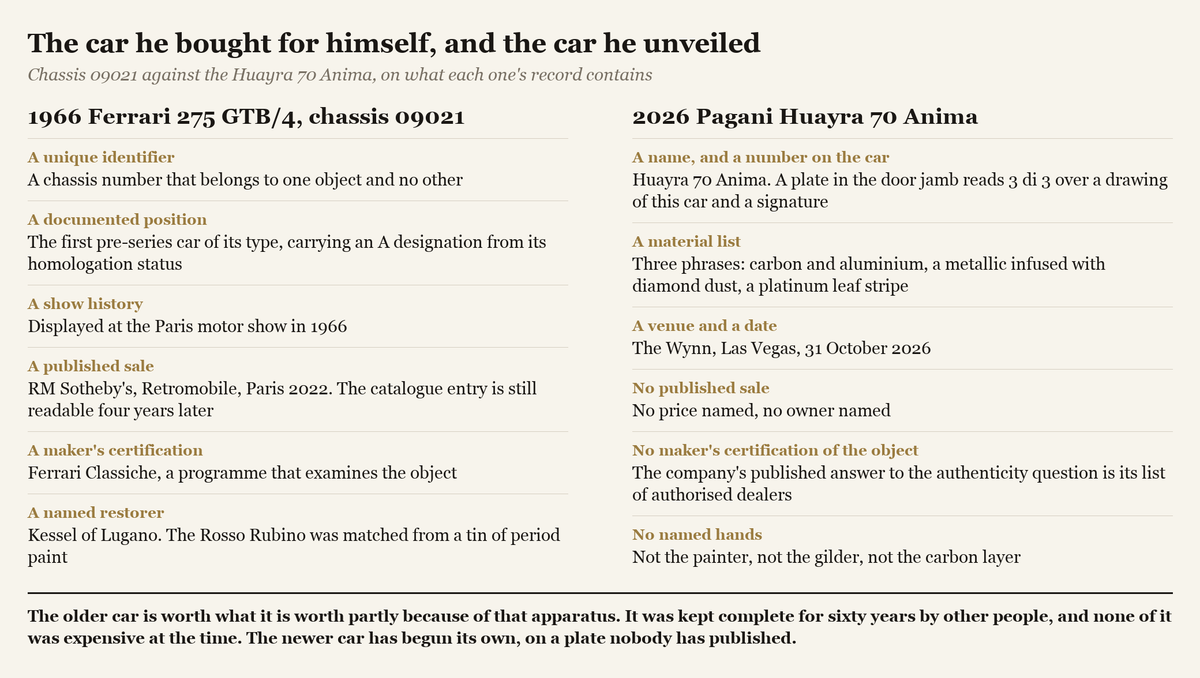
Consider what came with that car, because it is the exact inventory the Anima does not have.
It has a chassis number that identifies it and nothing else, 09021. It has a documented position in its own production run as the first pre-series car of its type, carrying an A designation that came from its homologation status. It has a show history: it was displayed at the Paris motor show in 1966. It has a published sale, with a catalogue entry that survives on the auction house's website four years later and can be read today by anyone. It has the involvement of Ferrari Classiche, the manufacturer's own programme for establishing that a historic car is what it is claimed to be, which examines the object rather than the seller. It has a named restorer, Kessel of Lugano. And when it was repainted, the Rosso Rubino was matched from a tin of period paint rather than guessed.
It even has a discrepancy, which is the sign of a record that has been looked at: Ferrari's account puts the production run at 280 cars and the auction catalogue at 330. Two sources disagree in public, which means somebody can go and settle it.
That car is worth what it is worth because of that paperwork at least as much as because of its engine. Strip the chassis number, the show history, the catalogue and the certification, and it becomes a beautiful red car of uncertain identity, worth a fraction of the same object with its documents.
None of that apparatus exists for the Huayra 70 Anima, and none of it exists for any Pagani, because the manufacturer's published answer to the authenticity question is a list of its dealers.
This is not a prediction that the Anima will be worth less. It is almost certainly the opposite in the short run. It is an observation that the man who has spent his life making objects of this quality went looking, for himself, for a car whose record was complete, and found one that had been kept complete for sixty years by other people. The 275 had Ferrari Classiche. The Anima has a reveal on a lawn and a phrase about a complicated search for simple ideas.
What this car actually demonstrates
Set the two accounts side by side.
The object is one of the most completely realised things built this decade. Carbon fibre and aluminium, a gearbox from Berkshire, an engine from Affalterbach, electronics developed with named partners, a paint film containing diamond, a stripe of platinum beaten to leaf and laid by hand, six exhaust pipes finished in white ceramic, and a mechanism deliberately left visible so the owner can watch it work. The hands that made it number in the dozens at least. The skill is not in question and never was.
The record of that object, as published on the day it was shown, consists of: a car's name, a material list in three phrases, no power figure, no owner, no price, no supplier, no hours, and a maker's press room that does not mention it.
With one exception, and it is the most hopeful thing in this study.
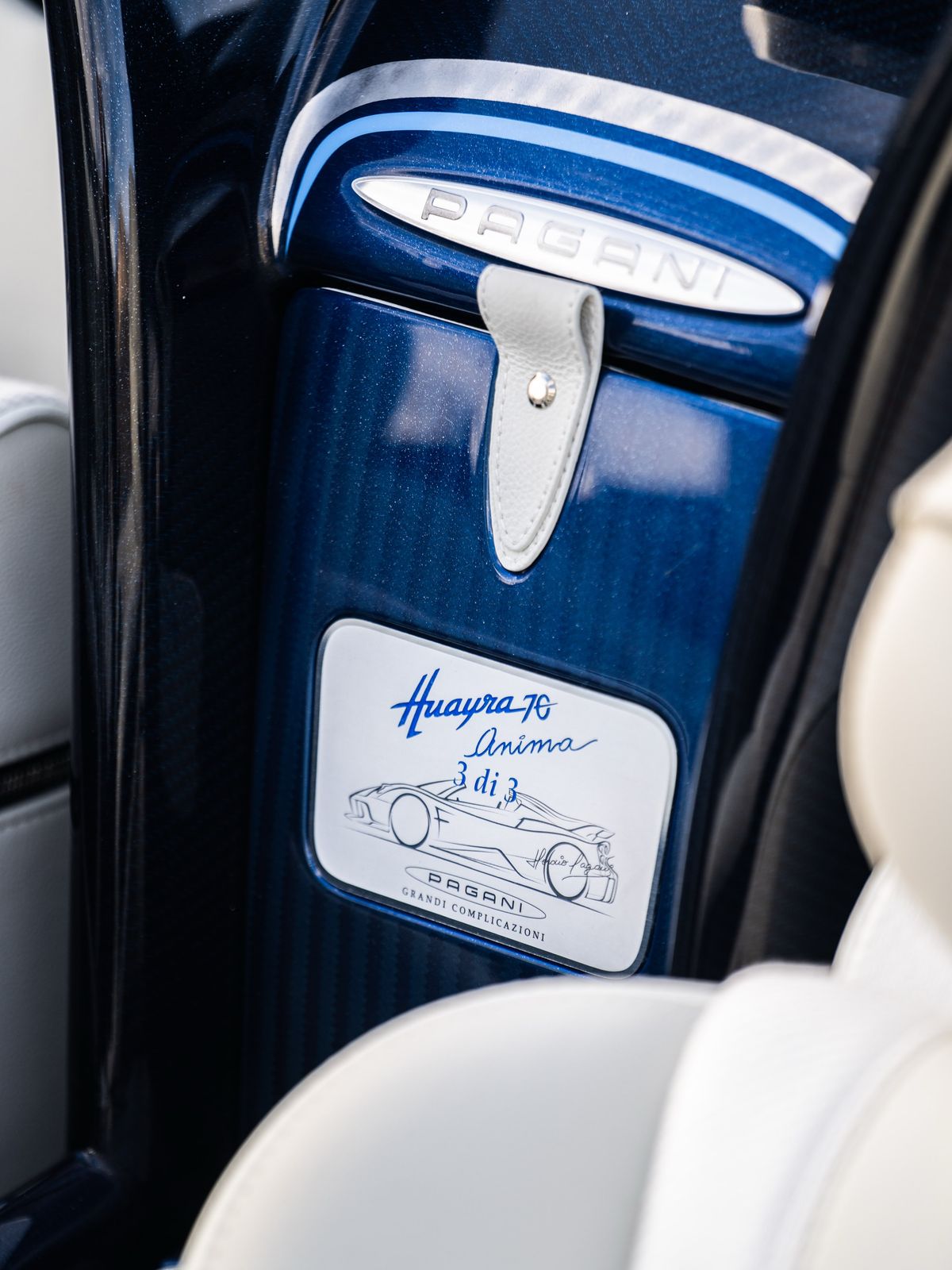
The car carries a plate. It sits in the door jamb, on blue exposed carbon, and it is photographed in the manufacturer's own announcement. In blue script on white it reads Huayra 70, then Anima, then 3 di 3. Beneath the words is a line drawing of this car and nothing else, open-topped, with its roll structure and its wing. Beneath that is a signature. At the foot of the plate: Pagani, Grandi Complicazioni.
That is a provenance artefact, made by the people who made the car, fixed to the object rather than filed somewhere. It states the model, the name, the position in the series, the division responsible, and a hand. It is exactly the first page of the apparatus the Ferrari has and this car was said to lack, and it was there all along, two inches from the sill.
What it is not is published. The plate exists in the public record only because the maker chose to photograph it and post the photograph. Nothing indexes it, nothing cites it, and no document anywhere repeats the words on it. The object knows what it is. The record has not been told.
Neither of those sentences is a criticism of the other. The second is simply what happens by default, everywhere, to every object, unless somebody decides otherwise at the moment of making. Records are not lost later. They are not made now.
What a one-off demonstrates better than a production car is how much is riding on that default. There is exactly one Huayra 70 Anima. Everything anybody will ever be able to establish about it comes from what was written down this week and what is written down from here. A series car can be understood by comparison with its siblings. This car has two siblings and they are different cars.
The cheapest moment to record what went into this object was while it was being made, by the people making it. That moment is over. The second cheapest is now.
What is not claimed here
This institution does not authenticate, attribute, appraise or value. Nothing above is a verdict on this car, on its price, on its quality, or on Pagani Automobili, and nothing here is advice about buying, selling, insuring or lending against anything.
No allegation of any kind is made about the sourcing of any material in this car. The observation about the Kimberley Process is a statement about the published scope of that scheme, taken from its own FAQ, and about customs classification. It is not a claim that any diamond in this paint is of any particular origin, that it is natural or synthetic, or that anything improper has occurred. The company's purchase records are not public and nothing here is a substitute for them.
The counts over Pagani's published governance document are counts over the General Part only, which is the half published on the company's website. The Special Part exists by the document's own description and is not published, and controls relating to suppliers and to goods of illicit origin would ordinarily live there. An absence in the published half is not an absence in the model.
The figure of three point six staff-years per car is arithmetic over two figures published by Pagani on its own site, the fifty cars a year and the one hundred and eighty staff. It is company labour per car, not build time, not this car's hours, and not a cost. The two figures appear on the same page and are treated as contemporaneous, which the page does not state.
The power figure of 834 horsepower belongs to reporting on the Trionfo and the 864 to the Epitome. Pagani has not published the Anima's output and none is asserted for it here.
The account of the manufacturer's press room and news page is a measurement taken on 1 November 2026. A press release may appear after this study is published, which would change that fact and not this study's point about the day of the unveiling.
The absence of any reusable photograph was tested on Wikimedia Commons and on Flickr with a control confirming that both find Pagani photographs readily. Other platforms were not searched, and a licensed image may exist somewhere not reached here. Every photograph in this study shows a different Huayra and says so.
The account of the Ferrari 275 GTB/4, chassis 09021, is taken from Ferrari's own magazine and from the RM Sotheby's catalogue entry for the Paris 2022 sale. The two sources disagree on the size of the production run, 280 against 330, and that disagreement is reported rather than resolved. Nothing here is a claim about what either car is worth.
The CES collaboration, its partners and the three quotations are taken verbatim from Pagani's own press release of January 2026. That system is described by the company as aimed at platforms after 2030 and is not claimed here to be fitted to this car.
The three cars of the trilogy are described from published reporting rather than from any document Pagani has issued, because at the time of writing no such document is published for the Anima.