The Priced Gap: Provenance After the Passport
On what the market has started paying for as provenance turns from a story told about an object into a record that travels with it, and on the two things such a record still cannot do: say why a field is empty, and be read by anyone who is not paid by the party that issued it.
Provenance used to be a story told about an object. It is becoming a record that travels with it, and the market has already started pricing the difference.
In a single month of 2026, a restituted Kandinsky hammered above its high estimate and made £31.56 million with fees, and a dealer went to prison for forging the paperwork rather than the paintings. Earlier in the year, a report prepared for the European Commission set out, in four categories, the data that every garment sold in Europe may soon have to carry.
These are one story. As provenance turns from narrative into record, two things the market has never had become valuable: a way to state what a record does not know, and an independent party to read what a record claims. Two instruments from the Objects of Affection Collection are built for exactly those jobs. Lacuna is an open specification for provenance records with declared absence. Colophon Record is an independent evidence layer for luxury.
The market pays for settled history
What the top of the market rewards is not age or fame alone. It is a history whose open questions have been closed.
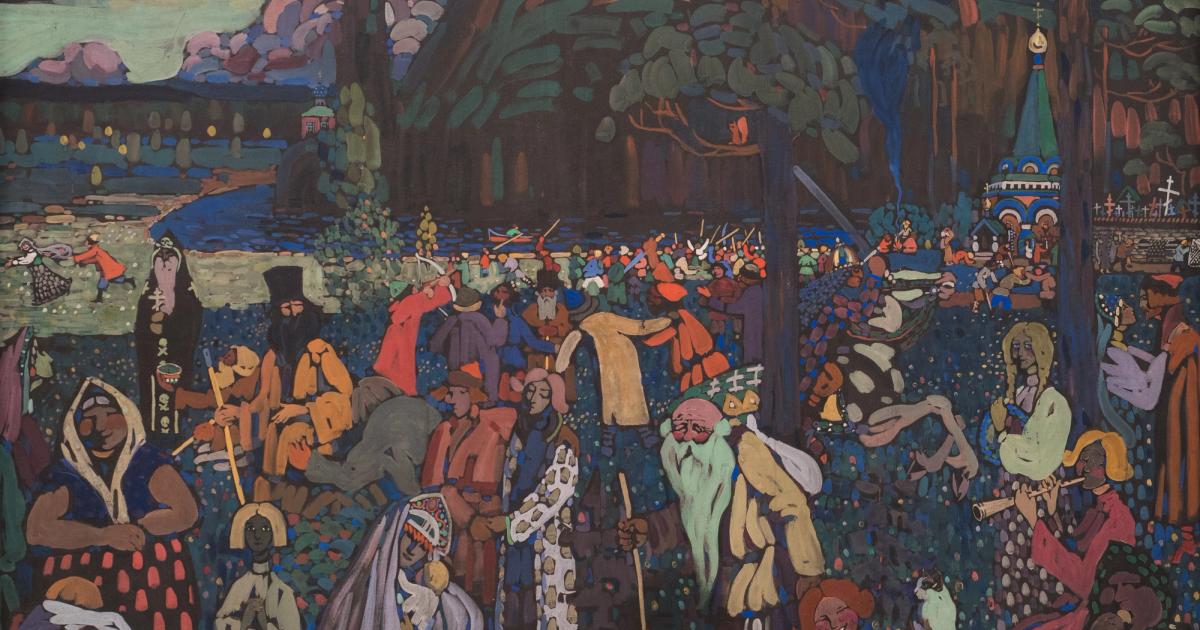
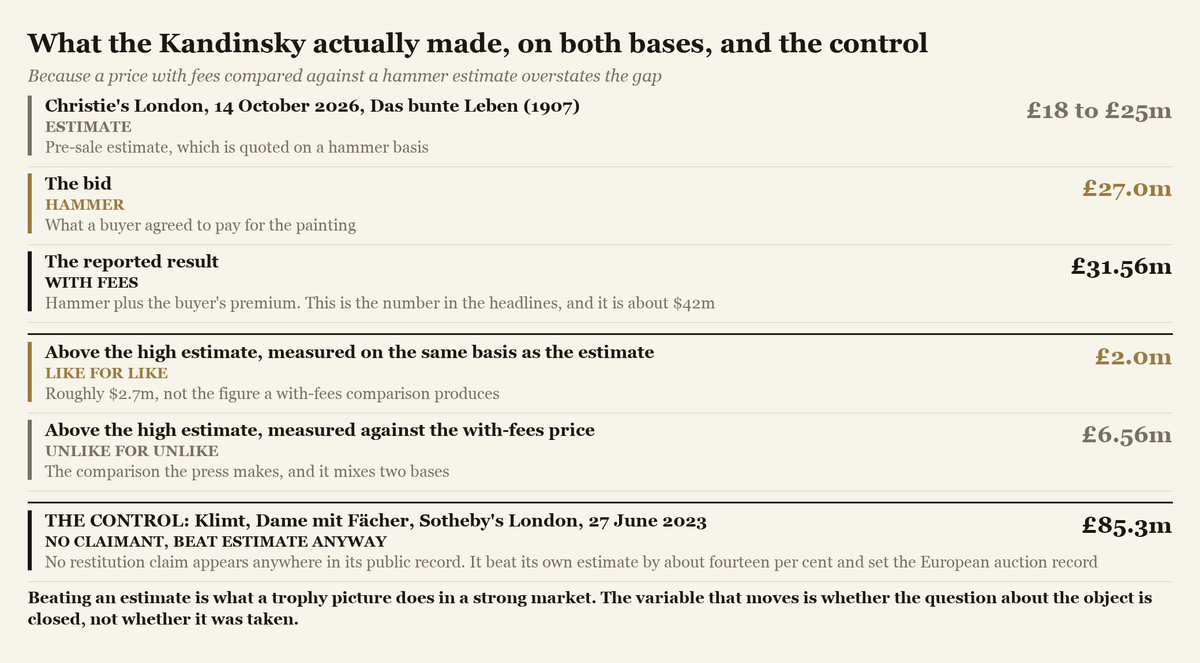
On 14 October, Kandinsky's Das bunte Leben (1907) sold at Christie's London for £31.56 million with fees, on a hammer of £27 million, about $42 million, against an estimate of £18 to £25 million. It had been lost by its Jewish owners in Nazi-occupied Amsterdam in 1940, spent decades in a Munich museum, and was returned to the heirs in 2023 after a German advisory commission found it was lost through persecution. The artist's auction record, £37.2 million in 2023, belongs to another restituted painting, Murnau mit Kirche II.
The tempting reading is that restitution itself now carries a premium, and it does not survive a control. Four days after the German commission published its Kandinsky recommendation in 2023, Klimt's Dame mit Fächer, against which no restitution claim appears anywhere in the public record, beat its own estimate by about fourteen per cent and became the most expensive work ever sold at public auction in Europe. Beating an estimate is what a trophy picture does in a strong market, claimant or no claimant. The variable that actually moves is narrower: not whether an object was taken, but whether the question about it is closed.
The pattern holds beyond paintings. Phillips' Geneva sale in May made $96.3 million, the highest-grossing watch auction ever, and the trade's own report of the season states that historically important Rolex prototypes and original-owner watches consistently outperformed estimate. A named lot carries that better than the generalisation does. In December 2025, Phillips New York sold an F.P. Journe FFC prototype from the collection of Francis Ford Coppola, one of only two in existence, against an estimate of $1 million and upward. It hammered at $9 million, $10,755,000 with fees. In May, Pollock's Number 7A, 1948 made an announced $181.2 million at Christie's on a hammer of $157 million, and its chain of owners, from Alfred Taubman to S.I. Newhouse, was part of the pitch.
The next test arrives on 17 November. Christie's New York will offer Kandinsky's Betonte Ecken (1922 to 1923), once owned by the Guggenheim, at $60 to $80 million, and has told ARTnews it is guaranteed to sell at a record level. Whether an institutional history outprices a restituted one will say a great deal about what buyers now mean by clean.
The record is now the target
As provenance becomes worth more, fraud has moved from the object to the paperwork.
In October, the Miami dealer Leslie Roberts was sentenced to 46 months in federal prison for selling forged Warhols. His method was documentary. According to the Department of Justice, he used fraudulent invoices purporting to come from the Andy Warhol Foundation, forged authentication bearing the name of the Andy Warhol Art Authentication Board and the purported signatures of its authorised representatives, fraudulent foundation identification numbers inscribed on the backs of the works, and counterfeit stamps.
Insurers report the same shift at scale. Brokers and loss adjusters describe chatbots being used to forge sales invoices, valuations, provenance documents and certificates of authenticity. Fake ledger numbers and forged wartime stamps are decades old, and the same reporting says so plainly. What has changed is not the crime but its cost: a forger who once had to steal a letterhead now produces a credible document in seconds.
Luxury goods show where this leads. A French operation prosecuted in 2020 built counterfeit Hermès bags from genuine materials, tools and know-how, recruiting leatherworkers, cutters and assemblers who had worked for the house; according to a participant's account, the bags were presented at Hermès boutiques in Paris and accepted by staff as authentic, and seven former employees were convicted. A boutique accepting a bag is not an authentication, and the account is worth exactly what it is. Resellers now report Frankenfakes, assembled from genuine and counterfeit parts, that passed Entrupy's AI-based authentication and received certificates.
Honest records are under pressure too, because many assert more than they know. All six of Edward Hopper's early oils, long read as original views of his hometown, turn out to be copies from Art Interchange, a magazine that sold colour plates to amateur painters with instructions for copying; the Nyack title was supplied later by the collector who owned the work. The Turner portrait on Britain's £20 note was listed in early inventories only as a portrait of Turner, and the word self arrived later. In both cases, a silence in the record hardened into a fact.
Regulation is turning provenance into an obligation
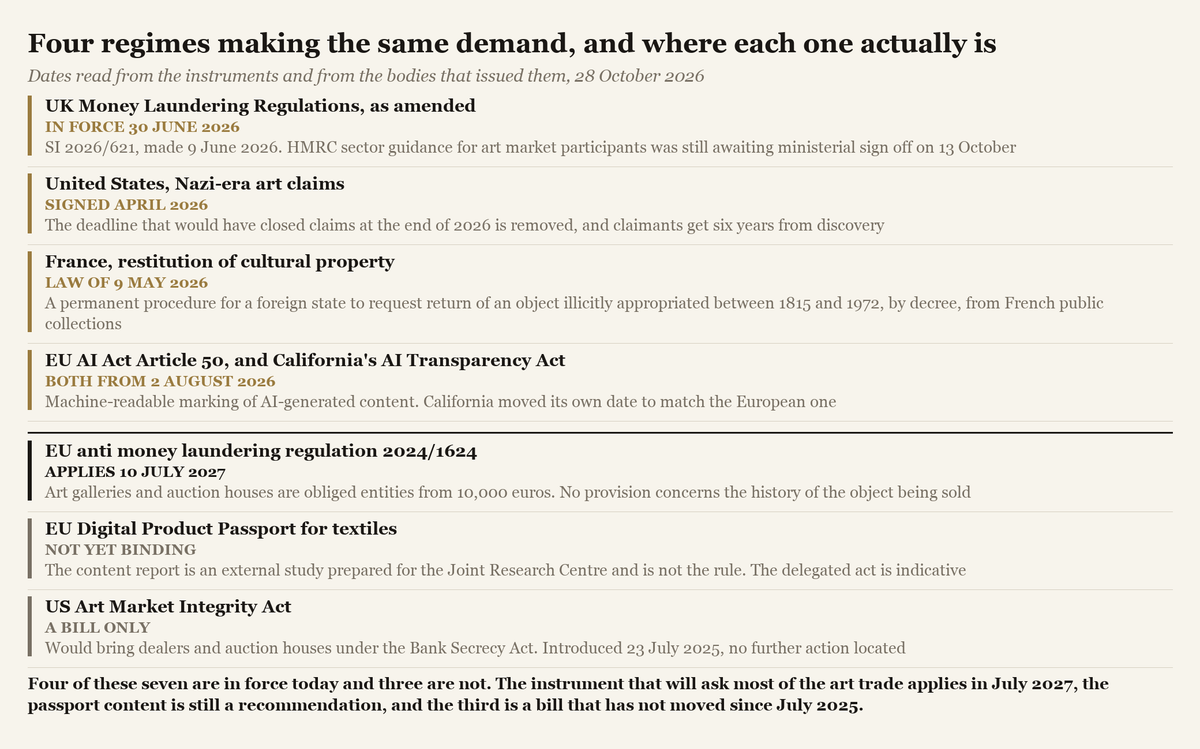
Four separate regimes, moving at once, are making the same demand: show the chain.
Product passports. Under the EU's Ecodesign for Sustainable Products Regulation, textile and footwear products placed on the EU market will have to carry a Digital Product Passport. In May, an external study prepared for the Commission's Joint Research Centre set out the passport's proposed content in four categories, and proposed a granularity level for each field. Binding rules wait on a delegated act, indicatively 2027.
Money laundering. The UK's amended Money Laundering Regulations largely took effect on 30 June, as enforcement moved from guidance to penalties. The EU's stronger regime applies from July 2027, and the proposed US Art Market Integrity Act would bring dealers and auction houses under the Bank Secrecy Act.
Restitution. A law removing the deadline for Nazi-era art claims took effect in the United States in April, and France adopted its first general framework for returning cultural property taken between 1815 and 1972 on 9 May.
Digital media. Since 2 August, the EU AI Act's Article 50 and California's AI Transparency Act have required AI-generated content to carry machine-readable labels, with C2PA Content Credentials the most widely adopted technical means of carrying one.
Each treats provenance as something a party must be able to produce on demand, rather than a narrative it may choose to tell.
Forward provenance is being solved, and backward provenance is being priced
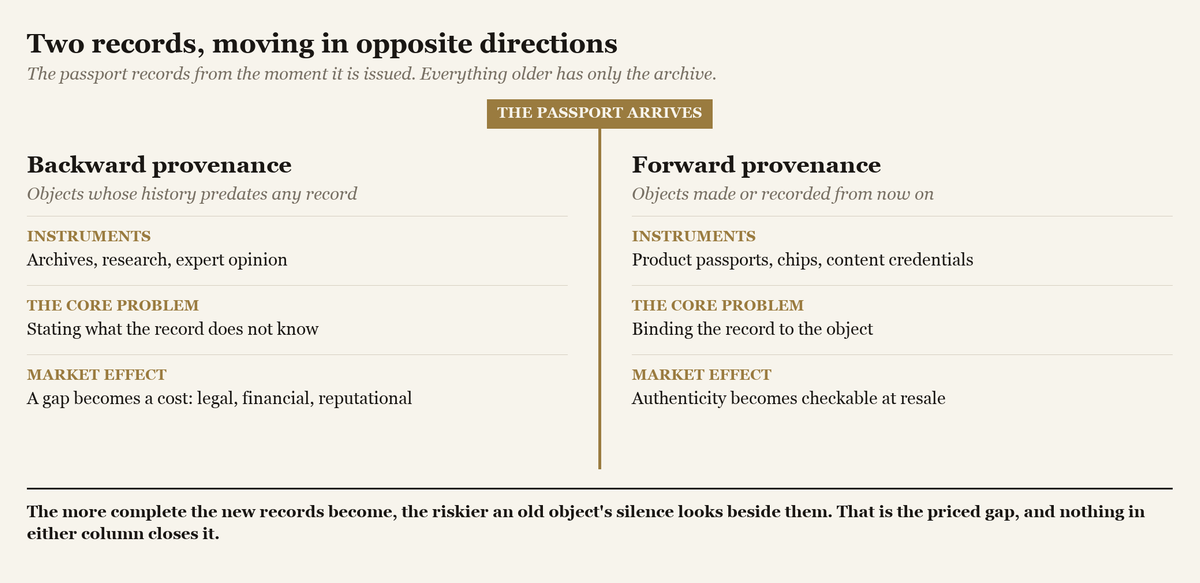
Passports and content credentials record history from the moment they are issued. They will tell a buyer everything about a bag made in 2028 and nothing about a bronze taken in 1897 or a painting sold in Amsterdam in 1940.
The two move in opposite directions. The more complete new records become, the riskier an old object's silence looks beside them. Restitution law, anti-money-laundering diligence and the market's premium for resolved histories all convert an undeclared gap into a liability.
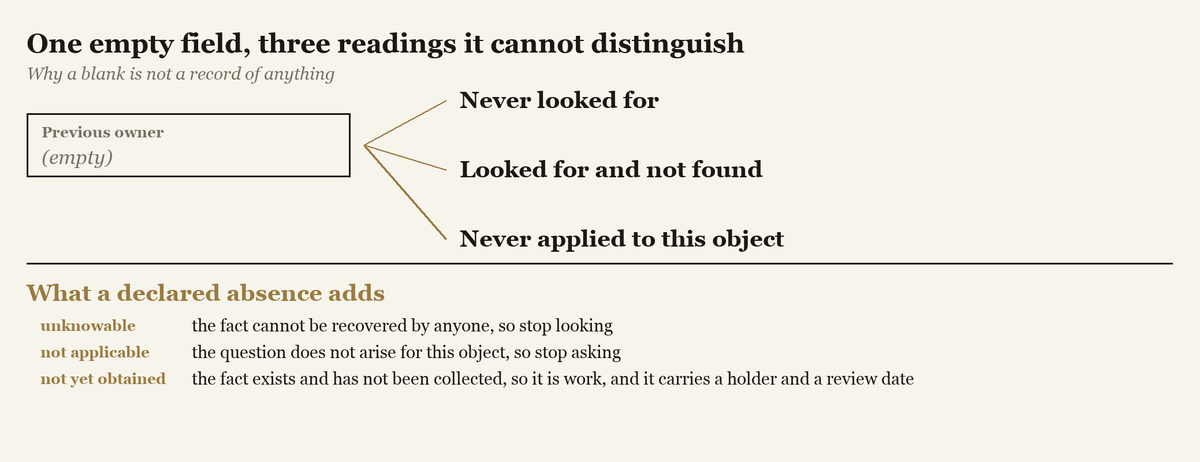
The passport does not close this gap for new objects either. Its minimum unit is the production batch, with item-level identifiers voluntary, and that is a correct scoping decision rather than a defect: an ecodesign instrument exists to carry facts about durability, composition and recycling, and those facts are true of every garment in a production run. But like most record systems it has fields and no way to say why a field is empty. A blank cannot tell the next reader whether a fact was never looked for, looked for and not found, or never applied. That missing sentence is where the next layer of provenance infrastructure has to be built.
Lacuna: a grammar for the gap
Lacuna supplies that missing sentence. It is an open specification, first published on 22 August 2026 and now at version 0.8, in which a gap in a chain of custody is written down with the same standing as a fact.
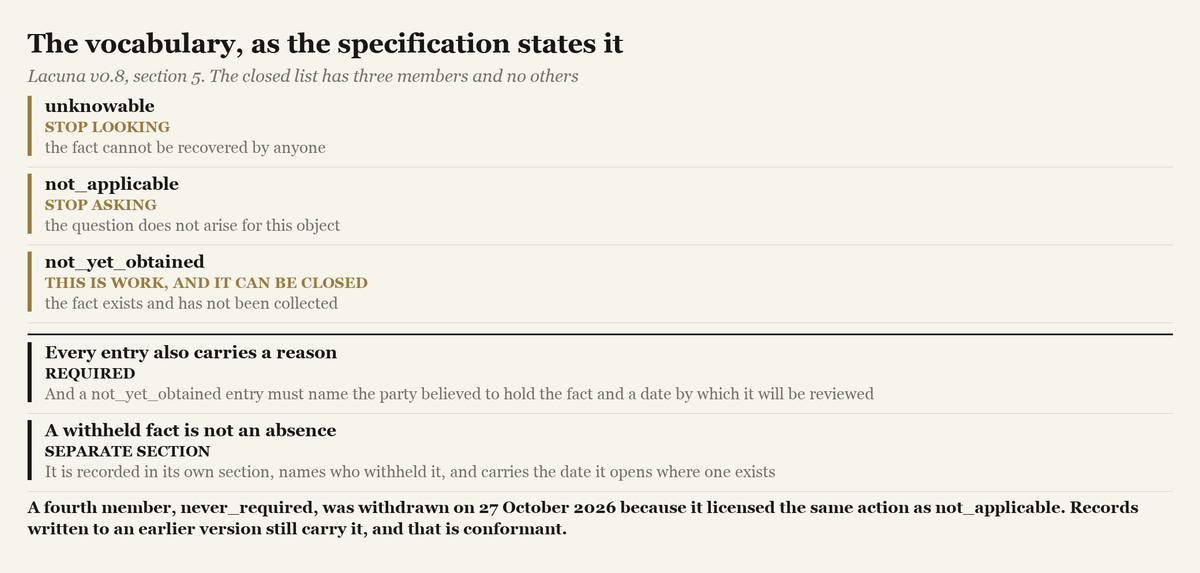
Every absence must declare which kind it is, and each kind tells the reader what to do next. The specification names three, and three only: unknowable, meaning the fact cannot be recovered by anyone, so stop looking; not applicable, meaning the question does not arise for this object, so stop asking; and not yet obtained, meaning the fact exists and has not been collected, which is work and can be closed.
Three further rules make the vocabulary useful to a market.
Open gaps have an owner and a deadline. A not yet obtained entry must name the party believed to hold the fact and a date by which it will be reviewed. A gap becomes a task with an addressee, not a blank under a longer name.
Withholding is not absence. When a maker declines to name a factory, the record says so and names who withheld it, with the date it opens where one exists. A reader learns two true things instead of none.
It does not authenticate. A record is custody over time; a certificate is a judgment at a moment and enters the record only as an input. Integrity is protected by a hash chain, and a conforming implementation must state the limits of that guarantee wherever it states the guarantee, because, in the specification's words, an integrity guarantee presented without its limits is an authentication claim in disguise.
The specification's own claim for declared absence is narrower than a commercial one: a record with declared gaps is more trustworthy than one that appears complete, because the second kind cannot be distinguished from one that was never checked. The market consequence follows from that, and it is the argument of this essay rather than of the document. A lender, an insurer or a buyer can price unknowable, searched on this date, or held by this archive, review by January. No one can price a blank.
It also answers the passport's hardest commercial question. Luxury has always sold discretion, and passports create ownership trails. A withholding that names its withholder is a precise instrument for that tension: a record can be honest without being exposed.
Lacuna is built on existing practice rather than against it. It draws on CIDOC CRM, Linked Art, the ICOM-CIDOC documentation principles and the archival access standards ISAD(G) and DACS, and claims one narrow contribution: absence as a typed, reasoned entry. It has been put before the CIDOC CRM Special Interest Group as issue 723, which was heard on 8 October 2026 and deferred rather than decided, and remains open.
Colophon Record: the independent reader
If brands come to issue and control item-level records, the market will need someone who reads those records and is not paid by the brand. Colophon Record is built for that seat.
It reads a luxury object against the public record and shows its working on economics, materials, markups and provenance. Its signature measure, the Spectacle Multiple, sets an estimate of what an object costs to make against what it sells for, drawn from public trade data. The estimate is deliberately conservative: where a public figure is a range, the instrument takes the higher make-cost, so the multiple is never overstated. Where a claim cannot be grounded in a source, the instrument withholds it rather than inventing one.
Three features place it directly in the market this essay describes.
A passport reader. As Digital Product Passports arrive, Colophon is built to read brand-issued claims independently, alongside a greenwashing detector suited to Europe's tightening rules on environmental claims.
A record that cannot be quietly rewritten. Findings are written to a hash-chained ledger, each entry linking to the one before it, and the chain root is timestamped to Bitcoin through OpenTimestamps. Only hashes go on the chain. No record content, no token, no coin.
Two rooms. Collectors use it to see through the spectacle before they buy. Ateliers use it to stand inside the record before the law requires everyone to.
Colophon writes to Lacuna. The names were chosen as a pair from the vocabulary of the book: a colophon is the printer's mark stating who made a thing and how; a lacuna is the portion a text declares missing. Together they cover both halves of the split. One reads what is claimed about the making; the other records what is absent from the history.
What comes next
The direction is clear even where the timing is not. Five shifts follow from the evidence above, and they are forecasts rather than findings.
Item-level identity becomes the standard of luxury resale. Batch-level passports will be the legal floor; the houses that care about resale will go to one object, one record, because only that identifies a particular physical thing.
Legacy gaps get priced explicitly. Lenders, insurers and buyers will discount an undeclared silence more heavily than a declared gap, because only the second can be assessed.
Fraud moves to the data layer. Forging paperwork gives way to forging and transplanting digital identities, so trust shifts to two parties: whoever issues a record, and whoever reads it independently.
Selective disclosure becomes the battleground. Collectors, makers and regulators will contest who may see an ownership trail. Records that can state a withholding, and name its holder, will be the ones discreet markets accept.
Interoperability decides the winners. Museum event models, product passports, anti-money-laundering files and image credentials all describe chains of custody. The infrastructure that connects them will matter more than any single database.
The handoff has already begun. Machines will increasingly keep the record of what happens to objects from now on, and people will remain essential for interpreting what happened before. The market of the next decade will pay for both: a colophon that states what is known, and a lacuna that states, plainly, what is missing.
What is not claimed here
This institution does not authenticate, attribute, appraise or value, and nothing above is a verdict on any object, any maker or any party. Nothing here is advice about buying, selling, insuring or lending against anything.
Lacuna is a specification and not a standard. By its own terms it becomes a standard when a party other than its author implements it, and no party other than its author has implemented it. Issue 723 is open at the CIDOC CRM Special Interest Group and nothing above claims that body has endorsed, adopted or recognised anything.
The section headed What comes next is forecast. It is labelled as such because the rest of this essay is not.
On the figures. Auction estimates are published by houses that benefit from having them beaten, and they are not audited. Prices at hammer and prices with fees are mixed indiscriminately in press coverage, and currency conversions drift by several per cent between outlets; both bases are given here where a source allowed it. The count of data fields in the passport report is this institution's own count of one table in that report, and the report states no total of its own.
No position is taken on whether any object named here should be returned, retained or sold, nor on what any delegated act or bill should require.