European Union Money Laundering Law: Art Is Not on the List

On an article of European law that requires a report of who bought a car, a boat or an aeroplane, for the stated purpose of making ownership visible, and on the fact that the same regulation defines cultural goods, regulates the people who trade them, and leaves them off that list.
The article that names three kinds of object
Regulation (EU) 2024/1624, the European Union's anti money laundering regulation, was adopted on 31 May 2024 and applies from 10 July 2027. It runs to roughly four hundred and thirty thousand characters. Most of it concerns banks, payment services, crypto-asset providers and the machinery of supervision.
One article in it is about things rather than about money. It is worth reading in full, because everything in this study follows from what it contains and from what it does not.
Article 74. Threshold-based reports of transactions in certain high-value goods. 1. Persons trading in high-value goods shall report to the FIU all transactions involving the sale of the following high-value goods when those goods are acquired for non-commercial purposes: (a) motor vehicles for a price of at least EUR 250 000 or the equivalent in national currency; (b) watercraft for a price of at least EUR 7 500 000 or the equivalent in national currency; (c) aircraft for a price of at least EUR 7 500 000 or the equivalent in national currency.
Three categories. A car, a boat, an aeroplane. The FIU is the Financial Intelligence Unit, the national body that receives reports of this kind.
The regulation also states, in the recital that explains the article, what the obligation is for. The purpose is given in six words that this institution would have been happy to write itself:
to ensure visibility on the ownership of such goods
That is a provenance obligation in all but name. It is narrow, it is threshold-based, and it concerns a single transfer rather than a chain, but its stated object is the ownership of a thing rather than the identity of a person. Nothing else in the regulation does this.
What the same regulation says about art
The obvious question is whether art was simply not in the legislator's mind. It was.
The regulation defines cultural goods in its own list of definitions, at point 56:
'cultural goods' means goods listed in Annex I to Council Regulation (EC) No 116/2009
It also brings the people who trade them inside the regime. A recital explains the reasoning, and in doing so narrows the field deliberately:
As a consequence, persons trading in goods no longer need to be subject to AML/CFT obligations, with the exception of persons trading in precious metals, precious stones, other high value goods and cultural goods.
So the drafting history visible on the face of the regulation runs like this. Traders in goods generally were inside the old regime and are being released from it. Four categories are held back and kept inside: precious metals, precious stones, other high value goods, and cultural goods. A dealer in paintings is an obliged entity in the European Union from 2027, deliberately and by name.
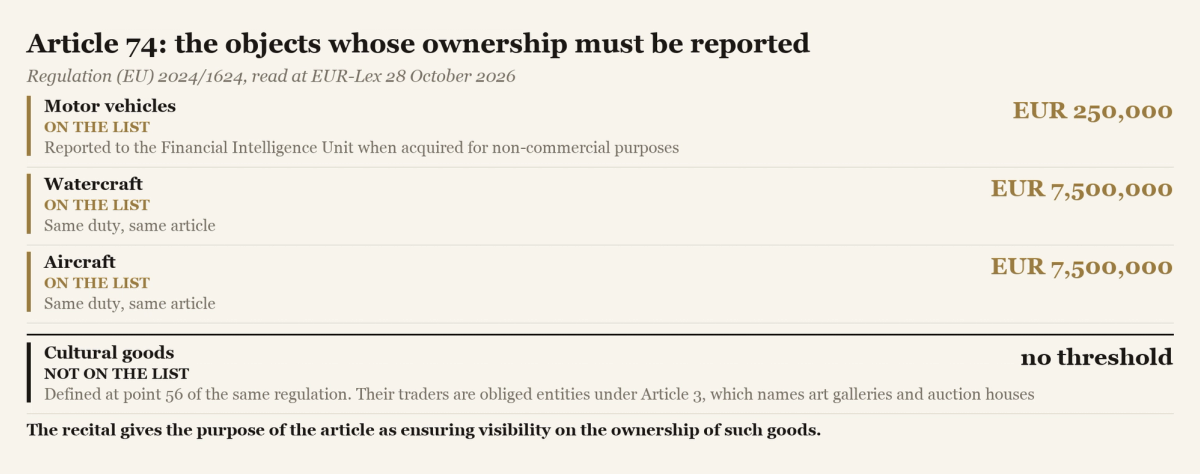
And then Article 74 lists cars, boats and aircraft.
Cultural goods are defined in the regulation. The people who trade them are regulated by the regulation. They are not in the one article that asks about the ownership of the object.
What due diligence actually asks
If the obligation is not in Article 74, the next place to look is the main due diligence duty, which falls on every obliged entity including the art dealer. That is Article 20, and it lists what an obliged entity must do. There are nine measures, lettered (a) to (i).
They are, in order: identify the customer and verify their identity; identify the beneficial owners and verify theirs; understand the purpose and intended nature of the relationship; check whether the customer or beneficial owners are under financial sanctions; understand the nature of the customer's business, employment or occupation; monitor the relationship on an ongoing basis including, where necessary, the source of funds; determine whether any of them is a politically exposed person; identify any natural person on whose behalf the transaction is being conducted; and verify that anyone purporting to act for the customer is authorised to do so.
Every one of those nine is a question about a person.
Measure (b) is the one worth pausing on, because it contains the word this study is about. An obliged entity must take reasonable measures to verify the beneficial owners' identity so that it
understands the ownership and control structure of the customer
Ownership appears, and it means the corporate structure of the buyer. Who stands behind the company that is paying. It does not mean who owned the painting.
The same construction, written in London
This is not a quirk of European drafting. The United Kingdom's Money Laundering Regulations 2017, which have applied to art market participants since 2020 and were amended with effect from 30 June 2026, build the duty the same way.
Regulation 28 sets out the customer due diligence measures. A relevant person must
identify the customer unless the identity of that customer is known to, and has been verified by, the relevant person
and must
verify the customer's identity unless the customer's identity has already been verified by the relevant person
and must assess
the purpose and intended nature of the business relationship or occasional transaction
Where the customer is a legal person, the relevant person must
take reasonable measures to understand the ownership and control structure of that legal person
Ownership again, and again it is the customer's company. Ongoing monitoring requires scrutiny of transactions
including, where necessary, the source of funds
Source of funds, not source of object. The money has to have a history. The painting does not.
Counting what is not there
An absence is a weaker kind of evidence than a quotation, and it is only worth anything if the search that produced it is stated plainly enough for a reader to doubt it.
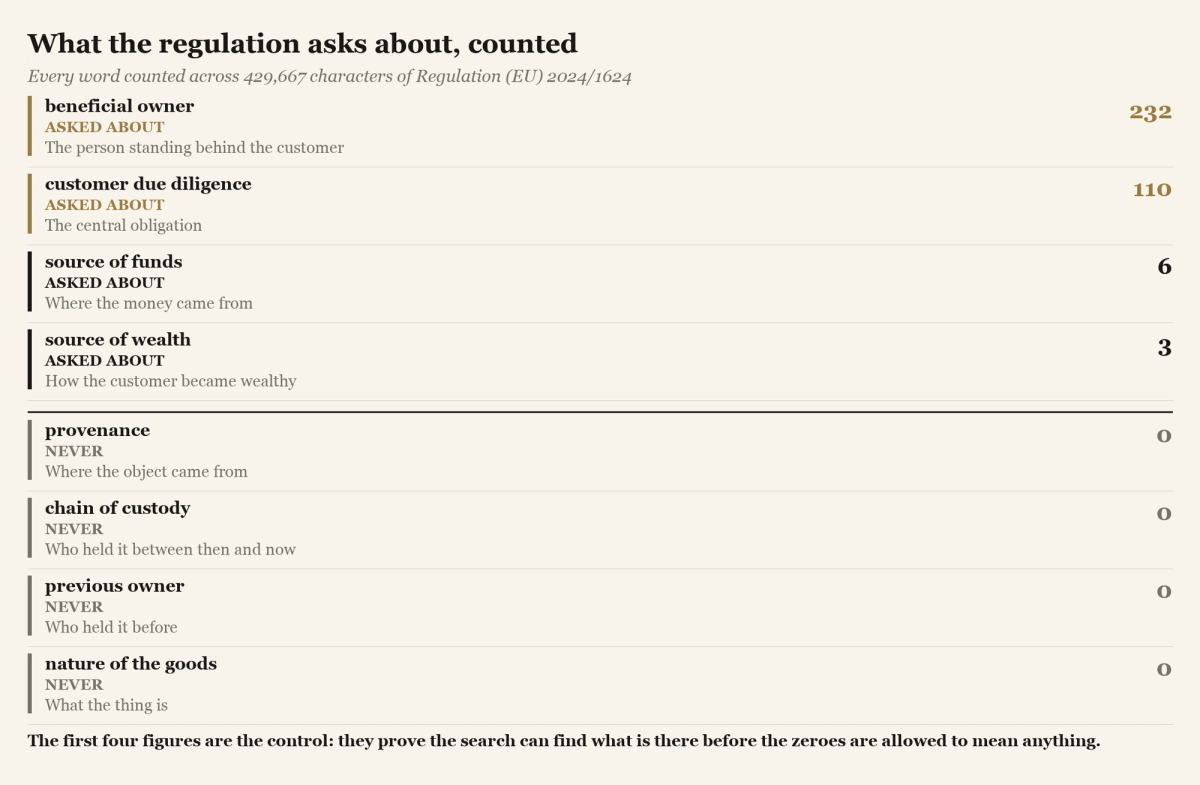
The full text of Regulation (EU) 2024/1624 was read in a browser, four hundred and twenty nine thousand six hundred and sixty seven characters of it, and searched. The word provenance appears zero times. Chain of custody, zero. Previous owner, zero. Prior owner, zero.
Those zeroes mean nothing on their own, because a search that cannot find anything proves only that it is broken. So: in the same text, beneficial owner appears two hundred and thirty two times and customer due diligence one hundred and ten times. The search works. It can find what is there.
One correction belongs here rather than in a footnote, because it is the kind of mistake that turns a wrong search into a finding. The phrase works of art also returned zero, and that is not a result. The regulation never uses the phrase. It says persons trading in cultural goods, and defines cultural goods by cross-reference to an annex of a 2009 regulation about export licences. A reader who searched for the obvious words and reported the obvious zero would have concluded that European anti money laundering law does not mention art at all, which is false. The vocabulary of a statute is not the vocabulary of the trade it regulates, and the gap between them is where false findings are manufactured.
The American bill named for the problem
The United States is at an earlier stage and the pattern is the same.
The Art Market Integrity Act, Senate bill 2400 of the 119th Congress, was introduced on 23 July 2025 and referred to the Committee on Banking, Housing, and Urban Affairs. It would amend the Bank Secrecy Act's definition of a financial institution to include
a person engaged in the trade in works of art, including a dealer, advisor, consultant, custodian, gallery, auction house
That is the whole substantive move. The detail is left to rules that the Treasury, acting through the Financial Crimes Enforcement Network, is directed to propose after enactment.
The words provenance, prior owner, chain of custody and ownership history do not appear in the bill.
It has had no recorded action since the day it was referred. Fifteen months. An earlier attempt in the 115th Congress, which would have applied the Bank Secrecy Act to art and antiquities dealers, did not leave committee either. Antiquities dealers were brought inside the United States regime by legislation in 2020, and the rules to implement that are still unwritten.
Four months without guidance
Regulation is not only what the instrument says. It is also what the supervisor tells the trade to do, and in the United Kingdom that part is currently missing.
The amended Money Laundering Regulations took effect on 30 June 2026. HM Revenue and Customs published a manual page for art market participants on 8 July 2026, updated on 13 October 2026. As at the date of this study it says the sector guidance for art market participants is
currently awaiting ministerial sign off
In the meantime art market participants are told to follow guidance published by the British Art Market Federation. The same page then lists the ways in which that guidance is out of date, including the change in the threshold
from 10,000 euros to £10,000
and changes to due diligence requirements and to the list of countries triggering enhanced checks.
So the supervisor's instruction to the sector, four months after the rules changed, is to follow a document the supervisor states does not reflect the rules, except where it conflicts with another document, in which case follow that one.
The galleries are named, and so are the freeports
One reading of all this would be that art simply did not occur to the people drafting Article 74, and that a category omitted is a category forgotten. That reading does not survive contact with Article 3, which is the list of who the regulation applies to.
Point (i) of that list reads:
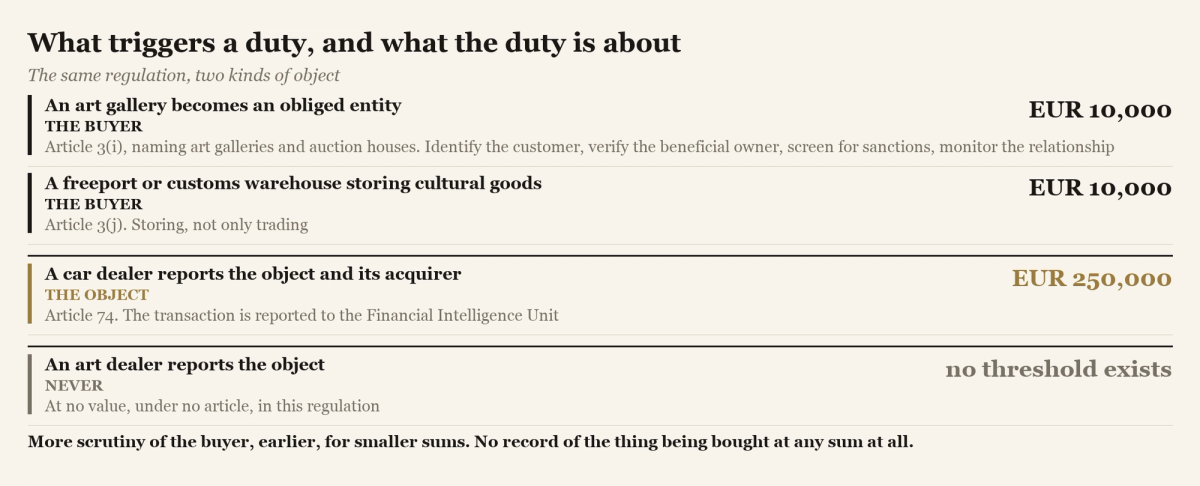
persons trading or acting as intermediaries in the trade of cultural goods, including when this is carried out by art galleries and auction houses, where the value of the transaction or linked transactions amounts to at least EUR 10 000 or the equivalent in national currency
Art galleries and auction houses, named in the operative text, not in a recital or an annex. The institutions of the art trade appear in European anti money laundering law by their ordinary English names.
Point (j) goes further and names the place the trade's critics have complained about for twenty years:
persons storing, trading or acting as intermediaries in the trade of cultural goods and high-value goods, when this is carried out within free zones and customs warehouses, where the value of the transaction or linked transactions amounts to at least EUR 10 000
A freeport operator storing cultural goods is an obliged entity. Storing, not only trading. Someone who merely holds the object and never sells it falls inside the regime.
This is a regulation that has thought carefully about the art market. It knows where the objects are kept. It knows who sells them and under what names those sellers trade. It has decided that a gallery handling a ten thousand euro transaction is a point in the financial system worth regulating.
And having established all of that, the one article about the ownership of objects still lists cars, boats and aircraft.
Ten thousand euros, and two hundred and fifty thousand
Set the two thresholds next to each other, because the comparison does something that neither number does alone.
An art gallery becomes an obliged entity at a transaction value of ten thousand euros. At that point it must identify its customer, verify that identity, establish the beneficial owner behind any company, understand the purpose of the relationship, screen for sanctions and for political exposure, and monitor the relationship on an ongoing basis.
A dealer selling a motor vehicle must report the transaction, with the object and its acquirer, at two hundred and fifty thousand euros.
The art trade is therefore regulated from a threshold twenty five times lower than the one at which the car trade reports an object. The gallery carries the heavier and more continuous burden by a wide margin. It does customer due diligence on a transaction the car dealer would not report at all.
And at no value, in no circumstance, does the gallery report the object. Not at ten thousand euros, not at ten million. There is no threshold at which the obligation appears, because the obligation does not exist in this instrument for this category of thing.
That is the asymmetry stated as precisely as the text allows. More scrutiny of the buyer, earlier, for smaller sums, and no record of the thing being bought at any sum at all.
A further count supports the point and is worth stating because it is a negative one. Across the whole regulation, the phrases nature of the goods, origin of the goods and information on the goods return zero occurrences. The instrument does not, anywhere, ask an obliged entity to find out anything about the object in front of it.
The category is borrowed, and it was written in 1992
There is one more thing to say about what the regulation means by cultural goods, and it is the part that bears most directly on how records get their shape.
The 2024 regulation does not define cultural goods. It points at another document:
'cultural goods' means goods listed in Annex I to Council Regulation (EC) No 116/2009
Follow the pointer and you arrive somewhere unexpected. Regulation 116/2009 is not about money laundering, and it is not from 2009 in any meaningful sense. Its own opening recital explains that it is a codification, tidying up an earlier instrument that had been amended several times:
Council Regulation (EEC) No 3911/92 of 9 December 1992 on the export of cultural goods
So the list that determines whether a dealer falls inside European anti money laundering law in 2027 was drawn up in December 1992, for the purpose of controlling exports, to stop national treasures leaving the Union.
Its annex is headed Categories of cultural objects, and it is organised the way a customs document is organised, with tariff codes beside each entry. Category 1 is archaeological objects more than a hundred years old. Category 2 is elements of dismembered monuments, also over a hundred years. Category 3 is
Pictures and paintings, other than those included in categories 4 or 5, executed entirely by hand in any medium and on any material
Category 4 is watercolours, gouaches and pastels, again executed entirely by hand. Category 5 is mosaics and drawings, hand executed.
Read that phrase again with the 2027 regulation in mind. Executed entirely by hand. That is the test, written for a customs officer at a border in the early nineteen nineties, deciding whether a crate needed an export licence. It is now one of the tests that determines whether a gallery must identify the beneficial owner behind a ten thousand euro sale.
It is a reasonable test for its original purpose. A nation protecting its patrimony has a clear interest in the handmade, the old and the singular, and a customs regime needs categories an official can apply at a counter without expertise. Age thresholds and handmade-ness are exactly the right kind of crude.
Whether they are the right categories for identifying where illicit money moves through the art trade is a different question, and the regulation does not ask it. It inherits the answer.
This matters beyond tidiness, because a borrowed category brings its original assumptions with it. The 1992 list is built around the object as a physical thing that crosses a border, of an age, made in a particular way. It is not built around the object as an asset with a chain of owners, because export control does not care who owned a painting, only whether it is leaving. Nothing in that annex concerns ownership, because the document it comes from had no reason to.
So the instrument that decides which objects are inside European anti money laundering law is a document with no concept of ownership history in it at all, written thirty two years earlier for an entirely different problem. The silence noted throughout this study turns out to be inherited rather than chosen, at least in part. Article 74 did not omit art from an ownership obligation so much as reach for a definition of art that had never contained one.
Why a car and not a painting
The temptation is to read Article 74 as an oversight, or as evidence that the art trade lobbied well. Neither is necessary, and a simpler reading fits the text better.
Consider what a motor vehicle, a watercraft and an aircraft have in common that a painting does not. Each of them is already registered. Ownership of a car, a ship and an aeroplane is recorded by a state body as a condition of lawful use, in a register that is continuous, that records transfers, and that exists independently of whoever is selling the object today.
Read that way, Article 74 is not creating a record. It is connecting a reporting duty to a record that is already there. The dealer reports the sale, and the authority receiving the report can match it against a register that will say who held the thing before and who holds it now.
There is no such register for a painting. If a report were required on the sale of a work of art, there would be nothing on the other side to match it to. The obligation would generate a pile of transaction notices with no continuous record of ownership to attach them to, which is a different and much weaker thing than what Article 74 achieves for a boat.
It also explains a count that would otherwise be merely odd. The regulation asks for nothing about the goods at all, not their nature, not their origin, not any information concerning them. If the drafters had thought the object's history was knowable and useful, some trace of that would appear somewhere in four hundred and thirty thousand characters. Its total absence is consistent with a view that for most categories of object there is simply nothing to ask for, and that where there is something, as with a registered vehicle, the right move is to connect to the existing register rather than to invent a duty to compile one.
This is a reading of why the list contains what it contains. It is not a claim about what any legislator intended, and no legislative history has been consulted. It is offered because it explains the shape of the article better than inattention does, and because it has a consequence.
What this makes possible
If that reading is right, the absence of art from Article 74 is not a gap in enforcement. It is a gap in the underlying record, showing through the law.
The law can require visibility of ownership for an object that is already recorded. It cannot require visibility of ownership for an object that is not, because there is nothing to be visible. Every other obligation in these instruments routes around the problem by asking about the person instead: who is buying, who stands behind them, where did their money come from, are they sanctioned, are they politically exposed. Those are answerable questions, and they are answerable precisely because people are already documented in ways that objects are not.
So a dealer can satisfy every obligation in force in the United Kingdom and in the European Union, and in the United States if the bill passes, and still be holding an object whose ownership history is unknown and undocumented. Nothing in any of these instruments asks. The obligation attaches to the person paying.
What the regulation does is make the question compulsory without specifying the form of the answer. It tells a market that ownership visibility matters enough to legislate for, demonstrates what that looks like for three categories of object, and leaves the fourth category inside the regime with no equivalent instrument.
That is not a complaint. It is a description of a vacancy, and vacancies of this shape are usually filled by a standard rather than by a statute. Statutes are slow, national, and have to survive negotiation between twenty seven governments. A record format does not. The question of what a complete ownership record for an object should contain, and how absences in it should be declared rather than hidden, is not a question for a legislature at all. It is the kind of question that gets settled by a specification that enough people adopt.
Coda
The most striking sentence in four hundred and thirty thousand characters of European anti money laundering law is six words long and sits in a recital, explaining why a man selling a yacht must tell the authorities who bought it.
To ensure visibility on the ownership of such goods.
The law has the idea. It has the vocabulary. It knows the threshold at which an object becomes worth recording and it knows how to make somebody record it. It applied all of that to a quarter-million euro car and not to a quarter-million euro painting, and the reason is not that the painting matters less. It is that for the car there was already a record to point at.
What is not claimed here
This study does not say what the law requires of anybody. Every statement above about an instrument is a quotation from that instrument or a count of words in it, read at source and dated. No interpretation is offered, no advice is given, and nothing here should be relied on by anyone deciding what their obligations are. Those are questions for a qualified adviser and this institution is not one.
Nobody is accused of non-compliance. No dealer, auction house, gallery or authority is said to have failed any duty, and the study's whole point is that the duty being discussed does not exist, which makes failing it impossible.
It is not said that the art trade lobbied for its exclusion from Article 74. No evidence for that was sought or found, and the reading offered here does not require it.
The statement that certain words do not appear is bounded by the search that produced it. The European regulation was read in full in a browser and searched by string; the United States bill was read at a government text repository; the United Kingdom regulation was read at the official legislation service. A word absent from an instrument may still be present in guidance, in case law, in a member state's transposing measure, or in an annex reached by cross-reference, and none of those were searched. The claim is about the text of the named instrument and nothing wider.
One search in this study was wrong and the correction is described in the body rather than hidden, because the error is instructive. The phrase works of art returns nothing in the European regulation, and a reader who stopped there would conclude the opposite of the truth.
The annex to the 1992 export regulation was read at the official legislation service, but only its heading and first five categories. The full annex continues beyond those, and includes value thresholds for several categories which were not read and are not described here. A reader should not take the account above as a complete description of what the European Union counts as a cultural good.
The reading in the section on registers is a reading. No legislative history, committee record or impact assessment was consulted. It is offered as an explanation that fits the text, and a different explanation that also fits the text would not be surprising.
The European regulation applies from 10 July 2027 and is not in force as described at the date of writing. The United States bill is not law and may never be. The United Kingdom sector guidance was unpublished when this was written and may have been published since, which is a thing a reader can check and this institution cannot promise to.