The Name Was the Disclosure: A Recipe Dispute Fought Entirely Through Records
The story travels like this. On Valentine's Day, the grandson of the man who invented Reese's Peanut Butter Cups posted an open letter accusing Hershey of swapping real chocolate for vegetable oil in his grandfather's recipe. His cousin texted him begging him to stop. He did not stop. Stephen Colbert picked it up. TikTok filled with videos of people bending heated chocolate bars like rubber. And by spring a billion dollar company had promised to put the real chocolate back. One retired man with a grievance and a LinkedIn account, against a corporation, and the man won.
Almost all of that happened. The part that did not is the part everyone is repeating.
This institution has no view on what any confectionery product should contain and does not test, assess or verify anything about any of it. What is in scope is the thing underneath: a dispute about whether an object is what it claims to be, conducted entirely through records, in which the record everybody is arguing about turns out to be the one nobody read.
What holds
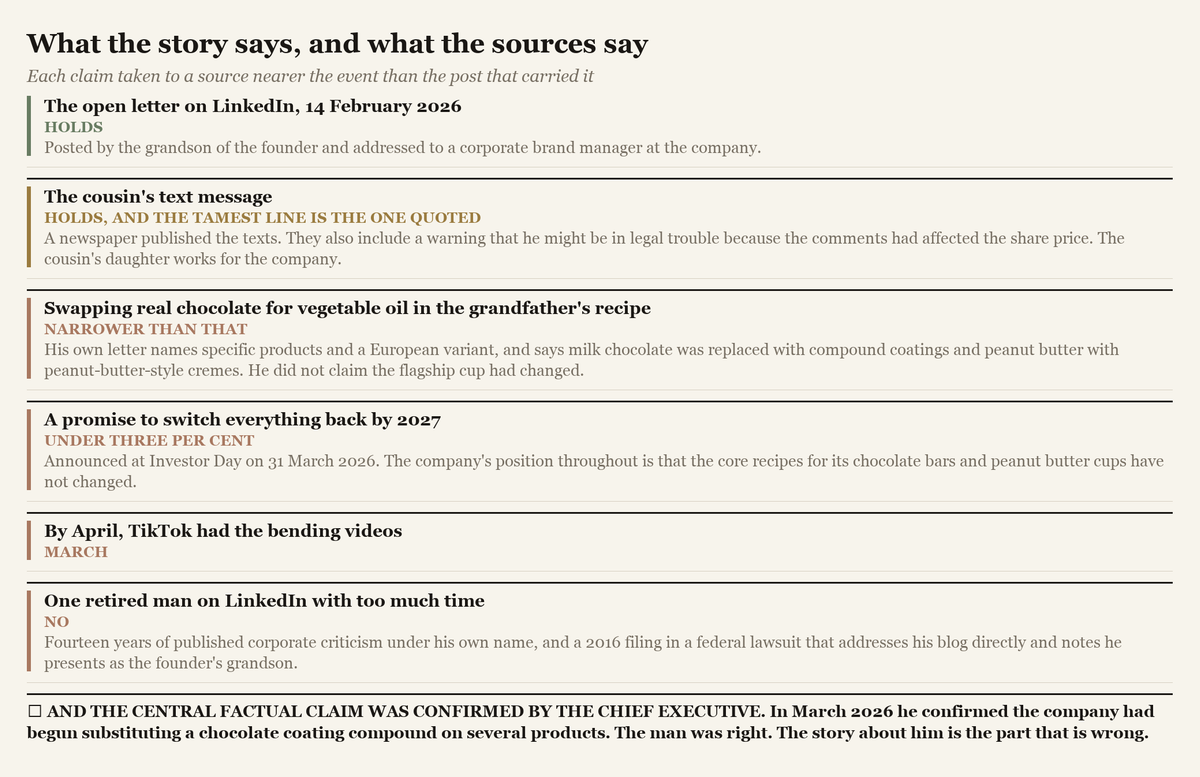
The letter is real. Brad Reese, grandson of H.B. Reese, published it on LinkedIn on 14 February 2026, addressed to a corporate brand and editorial manager at The Hershey Company.
The cousin's texts are real, and a newspaper published them. The line in circulation is the mildest one in the exchange. The reporting also carries a warning that he might be in legal trouble because, in the sender's words, unfounded negative comments had affected the price of the stock, and it notes that the sender's daughter works for the company. That is a family split by employment as well as by opinion, and it is more interesting than the version that travelled.
The coverage is real. The story reached late-night television and the tabloid press within days.
And the central factual claim is not merely plausible. It was confirmed by the chief executive. In March 2026 Kirk Tanner said the company had begun substituting a "chocolate coating compound" on several Reese's products and would revert to "classic milk and dark chocolate recipes" by 2027.
So the man was right. Everything that follows is about the story told about him, which is a different thing and should not be read as undoing that.
What his letter actually said, which is narrower and better
The version in circulation has him accusing Hershey of putting vegetable oil in his grandfather's recipe. His letter is more careful than that, and the care is what made it land.
His words, as quoted widely: the product line's identity is being rewritten by formulation decisions that replace "Milk Chocolate with compound coatings" and "Peanut Butter with peanut-butter-style crèmes" across multiple products. He named them. A bag of Reese's Unwrapped Chocolate Peanut Butter Creme Mini Hearts, bought for Valentine's Day, which he said he threw away. Take 5 and Fast Break, which he said are no longer coated in milk chocolate. And Peanut Butter Cups in parts of Europe.
He did not claim the American flagship cup had changed. The retelling supplied that, because a story about a man defending his grandfather's famous invention is better if the famous invention is the thing under threat.
Compound coating and creme are not euphemisms he invented to sound technical. They are the ordinary trade terms for a confection in which cocoa butter has been partly or wholly replaced by another vegetable fat, and for a filling that is not the standardised article. They exist precisely because a product that departs from the standard cannot be called by the standard's name. That is the whole function of the vocabulary, and he used it correctly.
The answer, and the number inside it
Hershey's reply had two parts from the beginning, and the coverage mostly carried one.
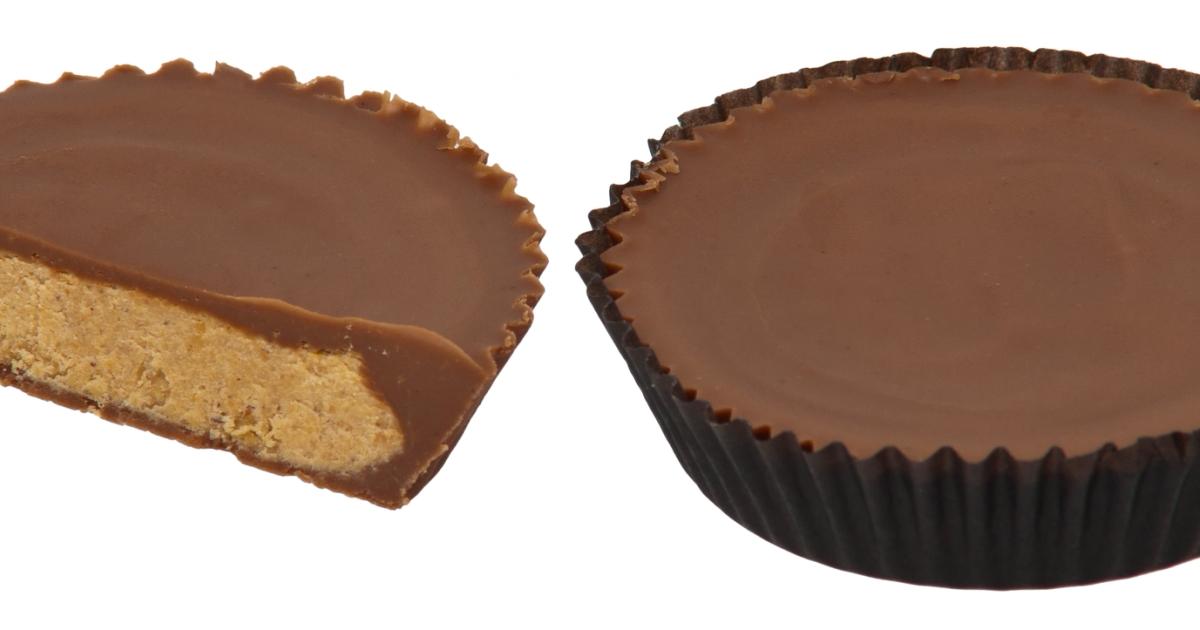
The first part is a denial, and it is narrow and specific: the iconic Peanut Butter Cups are made the way they always have been, starting with roasting fresh peanuts to make the peanut butter, which is then combined with milk chocolate. The company repeated a version of that line throughout: the core recipes for its chocolate bars and its peanut butter cups have not changed.
The second part is an admission, and it was there in February: the company acknowledged making product recipe adjustments to create new shapes and sizes. By March the chief executive had named the substituted material.
Then, at Investor Day on 31 March 2026, the company said it would move products back to traditional milk or dark chocolate by 2027, and a chief growth officer framed it as making all offerings consistent with the brands' classic recipes.
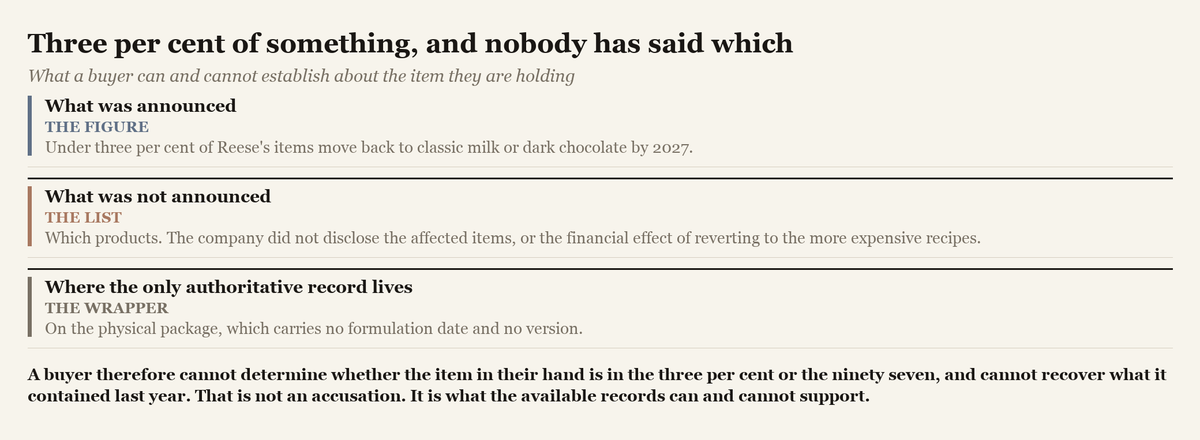
The figure attached to that, reported from Bloomberg, is under three per cent of Reese's items.
That is the sentence the retelling drops, and dropping it converts a narrow correction into a capitulation. Both readings start from true statements. Only one of them describes what was announced.
Three per cent of what
Here is where this stops being a story about candy and becomes the thing this institution actually studies.
Hershey did not say which products are in the three per cent. The reporting notes it did not disclose the affected items, or the financial effect of reverting to the more expensive recipes. A percentage was published. A list was not.
Now ask the only question a buyer would ask, which is whether the thing in their hand is one of them.
There is no way to answer it. Not because anyone is hiding anything, but because of where the record lives. On Hershey's own product pages, read directly for this study, the Ingredients tab does not contain an ingredient list. It contains nutrition facts and a referral: "Always refer to each package for current ingredients and allergen statements to make an informed decision about Hershey products."
The wrapper is the record. And the wrapper carries no formulation date and no version. It states what is in the item today, which means the item you are about to buy cannot be checked until you have bought it, and the item you bought last year is gone unless somebody kept the paper.
Somebody did. That is the part of this story nobody shared, and it is the rest of this study.
So a company can announce that three per cent of a line is changing, and a buyer who wants to know whether their bag is in the three per cent has no instrument. This is the burden of preservation in its most ordinary form: the only party who could keep a dated record of what a thing contained is the only party with no reason to.
The name was the disclosure all along
The sharpest fact in this story is on the front of the package, and it has been there the whole time.
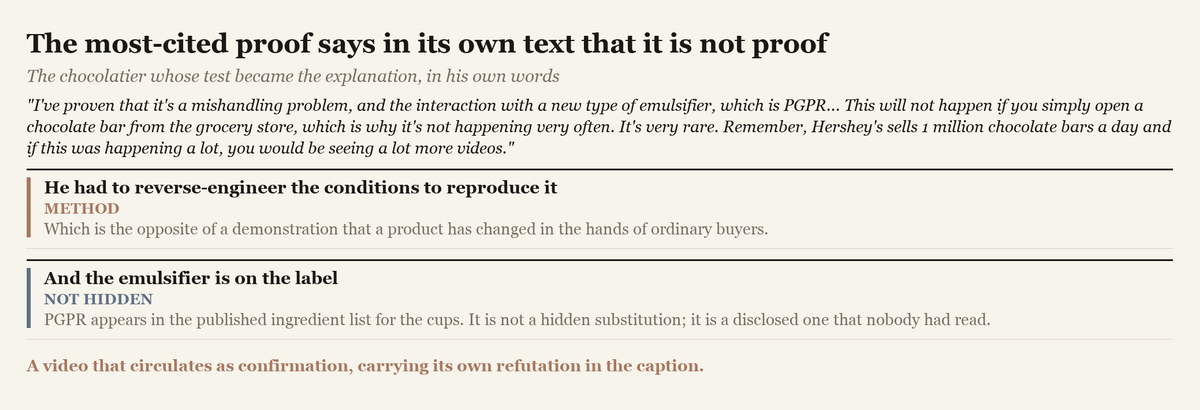
Read the two product titles as the manufacturer publishes them. REESE'S Milk Chocolate Peanut Butter Cups. And REESE'S Miniatures White Creme Peanut Butter Cups.
The first names milk chocolate. The second names creme. The thing Brad Reese is complaining about is stated in the name of the product, on the manufacturer's own website, in the title of the page. The Valentine's bag he threw away was called Chocolate Peanut Butter Creme Mini Hearts.
The record was accurate, legible and prominent. It was simply carrying a distinction that the brand name overrode.
That is a specific kind of failure and it is worth naming precisely, because the easy reading is wrong in both directions. No label here misstated anything. And nobody read one either. What happened is that a word with a century of accumulated meaning sat next to a word with a precise regulatory meaning, and the first word won. Reese's is a promise about an object. Creme is a technical correction to that promise. A shopper reaching for a familiar red and orange bag is not performing a reading comprehension exercise, and the package was never designed to make them.
This is the custodian's contract problem turned inside out. Usually the question is whether obligations travel with an object. Here the question is whether a claim travels with a name, and the answer is that it does, through every reformulation, every new shape, and every change of ownership, long after the paperwork underneath has stopped supporting it.
The proof everybody cites says it is not proof
The bending bars are treated as the physical demonstration. A video showed a Hershey bar that had been warmed flexing like rubber rather than breaking, and it spread in March, not April.
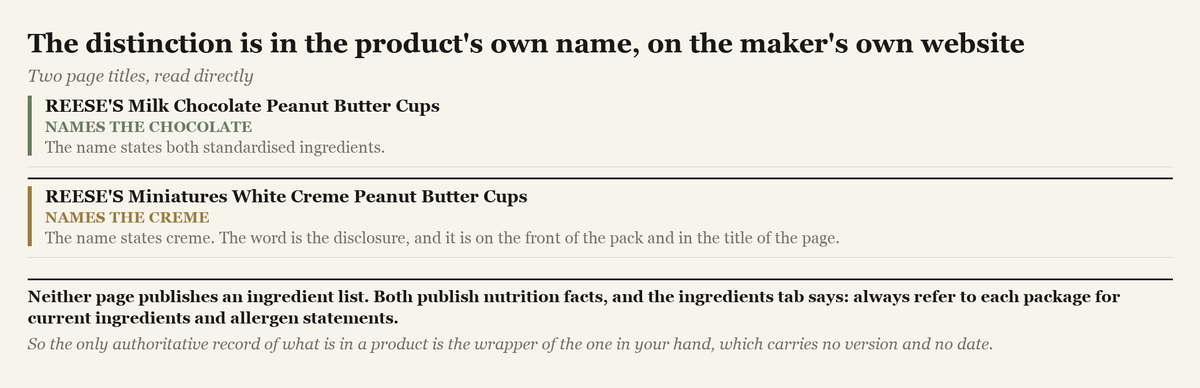
The most-cited explanation came from a chocolatier who tested it. What he wrote, in the post that made the explanation travel:
"I've proven that it's a mishandling problem, and the interaction with a new type of emulsifier, which is PGPR... This will not happen if you simply open a chocolate bar from the grocery store, which is why it's not happening very often. It's very rare. Remember, Hershey's sells 1 million chocolate bars a day and if this was happening a lot, you would be seeing a lot more videos than the one you are."
He says he had to reverse-engineer the conditions to reproduce it. He says it is rare. He says it will not happen to a bar you open normally. He offers a mechanism and attributes it partly to handling.
That is a refutation of the viral reading, published inside the viral artefact, and it circulated as confirmation.
And the emulsifier he names is not a secret substitution. PGPR appears in the published ingredient list for the cups. It has been in confectionery for years, it is there to reduce the cocoa butter needed for flow, and anyone could have read it at any time. The thing presented as a hidden change was a disclosed one that nobody had looked at.
Who actually did this
Which brings us to the sentence the whole story is told to deliver: one retired man on LinkedIn with too much time and a family grievance took down a billion dollar company's recipe.
Brad Reese has run a website under his own name since at least 2012, devoted to critical commentary on a large technology company: its finances, its board, its chief executive, the numbers it published about its certification programme. A trade publication listed him as research manager there and carried his bylines; one of its columnists called him "PR's worst nightmare."
In 2016 a motion filed by that company in its litigation against a competitor addressed his blog directly, disputing an expert witness's reliance on it. That filing describes him as a self-described grandson of the Reese's Peanut Butter Cups inventor, which he also presents on his own site.
So the lineage is not a detail that surfaced in February. It is a credential he has carried into corporate fights for a decade, and the Hershey letter is the fourteenth year of a practice rather than the first post of a man with time on his hands.
None of that makes him wrong, and he was not wrong. It makes the moral unearned. The lesson being drawn is that an ordinary person who gets mad on the internet about the right thing can move a corporation. What the record shows is a practised public critic, with a platform, a decade of experience in exactly this, a surname that is the brand, and a factual claim that happened to be correct and specific enough to survive contact with a press office. Each of those is doing work, and three of them are not available to most people.
The claim underneath
There is one more record in this story, and it is the one with the weakest documentation and the strongest emotional force.
My grandfather's recipe.
The H.B. Reese Candy Company merged with Hershey in 1963. The family has not owned the formulation for sixty three years. Whatever a descendant's standing is, it is not proprietary, and nothing in the public record suggests he claimed otherwise.
And the recipe itself had moved long before any of this. The 1928 article is reported as chocolate, peanut butter, sugar, dextrose, salt and lecithin. Today's cups carry PGPR in the shell and TBHQ and citric acid in the filling, among other things. That comparison comes from secondary reporting rather than from a company archive, and it is given here with that limit attached, but the direction is not in doubt and it long predates compound coatings.
So the thing being defended is not a formulation. It is a memory of a formulation, held by someone with a genuine connection to its origin and no document to check it against. That is an authenticity claim with a severed chain of custody, and this institution has spent the past week on four of them in other industries: a royal collection whose own review graded its doubts instead of issuing a verdict, a handbag assembled from genuine parts, a regulation that will describe a production batch and be read as describing an object, five museum handovers whose headline figures count a legal act rather than a thing that moved.
The pattern is identical here. A claim that was true of a class, or of a past, read as a statement about the specific thing in front of someone.
The explanation nobody is sharing
There is a competing account of why any of this happened, and it has the disadvantage of being boring.
An op-ed published during the row argued that the reformulations were driven by the cost of cocoa rather than by corporate greed, and pointed at climate pressure on cocoa growing regions as the underlying cause. Cocoa prices rose steeply in the period before these changes, by a margin that makes the cocoa butter in a coating one of the more expensive things in a confectionery line.
This study takes no position on which account is right, and nothing located here establishes a motive for any decision. What is worth noticing is the structural difference between the two explanations, because it is the same difference that runs through everything above.
The greed account makes a claim about intention, which cannot be checked from any record a buyer can reach. The cocoa account makes a claim about input costs, which can be checked against commodity data, and which predicts something specific: that the substitution would appear first in products where the coating is a large share of the cost, and that it would be reversed if prices fell. One of those is an argument and the other is a testable statement, and the testable one is the one that did not travel.
That asymmetry is not an accident of this story. A claim about what somebody meant will always spread faster than a claim about what something cost, because the first requires no instrument and the second requires several. The institution's own register is full of the consequence: a figure with no derivation outlives three corrections, and a motive attributed in a headline outlives the company statement that contradicts it.
It was already settled, in a private archive, in March
Everything so far has described a dispute conducted without a dated record. One existed the whole time, and where it was kept is the most interesting fact in the episode.
A private collector has the wrappers. Jason Liebig, who runs a candy wrapper archive of more than three thousand photographs and a collection reported at over ten thousand items, holds dated Reese's ingredient panels going back to around 1940. In March 2026, in the middle of the argument, he published a run of them side by side and addressed it to the press:
"I'm getting tired of seeing Reese's ingredients dragged without anyone doing one iota of actual research. Just hyperbole and hot takes. Pay attention journalists: Here are the actual ingredient panels from 80 years of Reese's Peanut Butter Cups, taken from actual wrappers."
His reading of his own evidence is that the cup itself has changed little, and that what has changed is partly how milk chocolate is described, since it is now broken out into its component ingredients.
So the instrument that would have settled the argument existed, was published during the argument, was aimed explicitly at the people conducting it, and was the one artefact in the entire episode that did not travel. The open letter travelled. The cousin's text travelled. The bending videos travelled. The eighty years of dated primary evidence did not.
What the panels show, and what they do not
The panels are worth reading as a record rather than as ammunition, because they do not support either side cleanly.
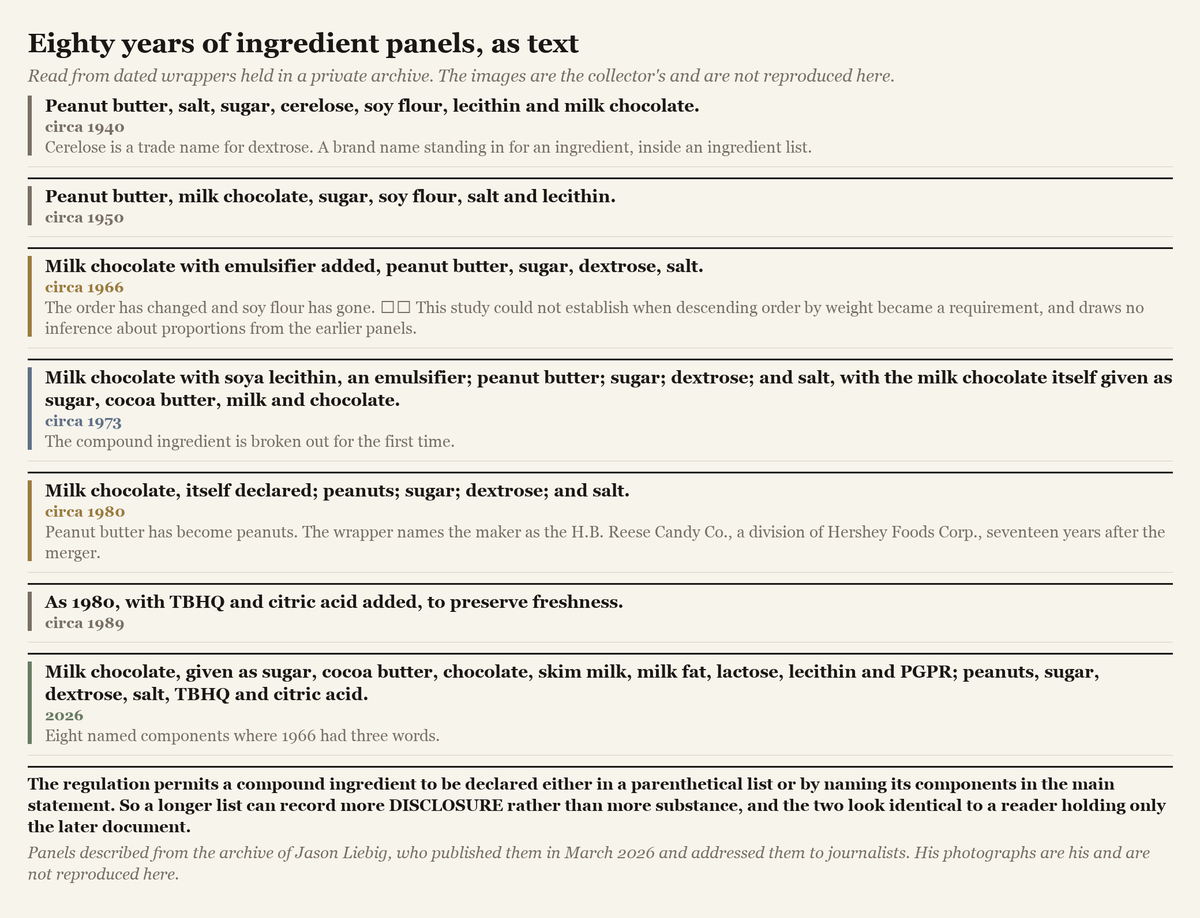
Around 1940 the list runs peanut butter, salt, sugar, cerelose, soy flour, lecithin and milk chocolate. Around 1950 it runs peanut butter, milk chocolate, sugar, soy flour, salt and lecithin. By around 1966 it runs milk chocolate with emulsifier added, peanut butter, sugar, dextrose, salt. By 1980 peanut butter has become peanuts, and the wrapper is marked as manufactured by the H.B. Reese Candy Co., a division of Hershey Foods Corp. By 1989 TBHQ and citric acid appear, to preserve freshness. In 2026 the milk chocolate is spelled out as sugar, cocoa butter, chocolate, skim milk, milk fat, lactose, lecithin and PGPR.
Three observations, each with its limit attached.
The order changes between the 1950 and 1966 panels, with peanut butter first in the earlier one and milk chocolate first in the later one. Under the current rule, ingredients are listed in descending order of predominance by weight, so a change of order would mean a change of proportion. This study could not establish when that ordering requirement took effect, and therefore draws no inference from the earlier panels. The observation is recorded; the conclusion is not.
Soy flour is in the 1940 and 1950 lists and not in 1966. Cerelose, a trade name for dextrose, appears in 1940, is absent in 1950, and dextrose appears under its own name from 1966. A brand name standing in for an ingredient, in an ingredient list, is its own small lesson about records.
And the list gets longer without necessarily meaning more was added. The regulation permits a compound ingredient to be declared either as a parenthetical list of its own components or by incorporating each component into the main statement. A 1966 panel saying "milk chocolate with emulsifier added" and a 2026 panel decomposing milk chocolate into eight named components can be describing the same material under two permitted styles of declaration.
That is the archivist's point with the mechanism attached, and it is this institution's recurring one. A longer record can mean more disclosure rather than more substance, and the two are indistinguishable to a reader who has only the later document.
The three accounts are not in conflict. The retelling made them so.
Put the pieces together and the apparent contradiction dissolves.
The chief executive confirmed a compound coating on several Reese's products. The archivist's panels show the flagship cup largely continuous, with an expanding disclosure of a compound ingredient. And the letter that started it named the Creme Hearts, Take 5, Fast Break and the European cups, and never claimed the flagship had changed.
All three can be true at once, and on the evidence located here all three are. The critic was describing products at the edge of the line. The archivist was describing the product at the centre of it. The company was denying the centre and admitting the edge.
The retelling collapsed that into a single claim about the famous object, and once it had done so the archive looked like a rebuttal of the critic rather than what it is, which is a record that happens to be about a different product.
And the reason it could collapse them is that almost everybody arguing had the same handicap. They were reasoning about a sequence of changes from a snapshot of the current state, because a package is exactly that: an excellent record of the present and no record at all of the past. A record that says what a thing is now is a label. A record that says what it has been is provenance. The confectionery aisle issues the first to everybody, every day, by the million, and the second existed in one man's boxes.
What the story is actually evidence of
Strip the moral off and the episode is a good one, and more useful than the version being shared.
A man read a label, correctly, and used the right technical words about what he found. A company answered in two parts, one of them a denial about its flagship that nobody has contradicted and one of them an admission that grew more specific over six weeks until its chief executive named the substituted material. A number was published without the list it refers to. A viral video carried its own refutation and was shared as proof. And a man with eighty years of dated primary evidence published it, in the middle of the argument, addressed to the journalists covering it, and was ignored.
Nobody in that sequence behaved outrageously. The labels were accurate. The company's statements were, as far as anything located here shows, true. The critic was right. And the result is still that no one, including the people arguing about it, can establish what a given item contained last February.
That is not a scandal. It is a records problem, and it is the kind that produces scandals.
What is not claimed
Objects of Affection Collection does not authenticate, attribute, appraise or value, and nothing here is a test, assessment or verification of any product, ingredient or formulation. No product has been examined by anyone at this institution. Every statement about what anything contains is attributed to the party that published it.
No allegation of unlawful conduct is made or implied against any company or person. The labelling distinctions described are ordinary regulated terms of art, and the use of a compound coating or a creme filling, properly named, is a normal and lawful practice. Nothing here takes a position on what any product should contain, on cocoa sourcing, or on the reasons for any reformulation, including the argument advanced elsewhere that cocoa costs rather than cost-cutting drove the changes.
The cousin is not named here, nor is her daughter. A private person whose private message a newspaper published does not become a public figure, and the texts are referred to only as that paper reported them. Brad Reese is named because he published under his own name, maintains a website under it, and is named in public court filings.
The ingredient panels described in this study are read from dated wrappers in the private archive of Jason Liebig, who published a run of them in March 2026. His photographs are his own, are marked all rights reserved, and are not reproduced here; only the ingredient text, which is factual matter, is described. His reading of his own evidence is given in his words and this study does not adjudicate it.
This study could not establish when the requirement to list ingredients in descending order of predominance took effect, and therefore draws no conclusion about proportions from the order of the earlier panels. The observation is recorded and the inference is not.
The comparison between the 1928 formulation and the present one is drawn from secondary reporting rather than from a company archive and should be treated accordingly. The chief executive's confirmation, the Investor Day announcement and the under three per cent figure are as reported by the outlets cited. Hershey's product pages were read directly for this study on 26 October 2026; the finding that they publish no ingredient list is a statement about those pages on that date, not a claim that the company publishes ingredients nowhere, and one secondary source cites a Hershey web page for an ingredient list that was not located here.
The account of Brad Reese's earlier work is drawn from trade press profiles and a publicly filed motion. It is offered to test a claim about who he is, not to characterise the merits of anything he has written.