San Martín Tilcajete: One Carving, Costed From Sources

An experiment with a stated limit: take one specific object with a published price, decompose its make-cost using only figures somebody else has already published, and write down every line that could not be reached and who holds it. The published record reaches about five per cent of the asking price and then stops.
On 31 October 2026 a workshop in San Martín Tilcajete, Oaxaca, offered a carved octopus for 5,793.31 dollars. The piece is listed as OCTOPUS #1 2026, copal wood with symbolic acrylic painting, 20 by 22 by 27 centimetres, in stock, shipping in three to twelve business days. It carries a certificate which the listing says guarantees its authenticity and artistic value.
This institution has published a series that separates what an object costs to make from what it sells for. Every study in that series worked on a category: a crocodile bag, a silk scarf, a bottle of perfume. Categories can be costed because trade bodies publish figures for them. A single object made by named people cannot be costed that way, because one workshop's costs are that workshop's private business.
So this is an experiment with a stated method and a stated limit. Take one specific object with a published price. Decompose its make-cost using only figures that someone else has already published. Then write down, in full, every line that could not be reached, and who holds it.
The result is that the published record reaches about five per cent of the asking price, and stops.
The object, and what its own record says
The listing is the workshop's own. Taller Jacobo y María Ángeles was founded in San Martín Tilcajete in 1994 and sells directly from its site. The workshop describes its own production as tonas and nahuales, the Zapotec figures of its region, and uses the word alebrije alongside them in its shop headings.
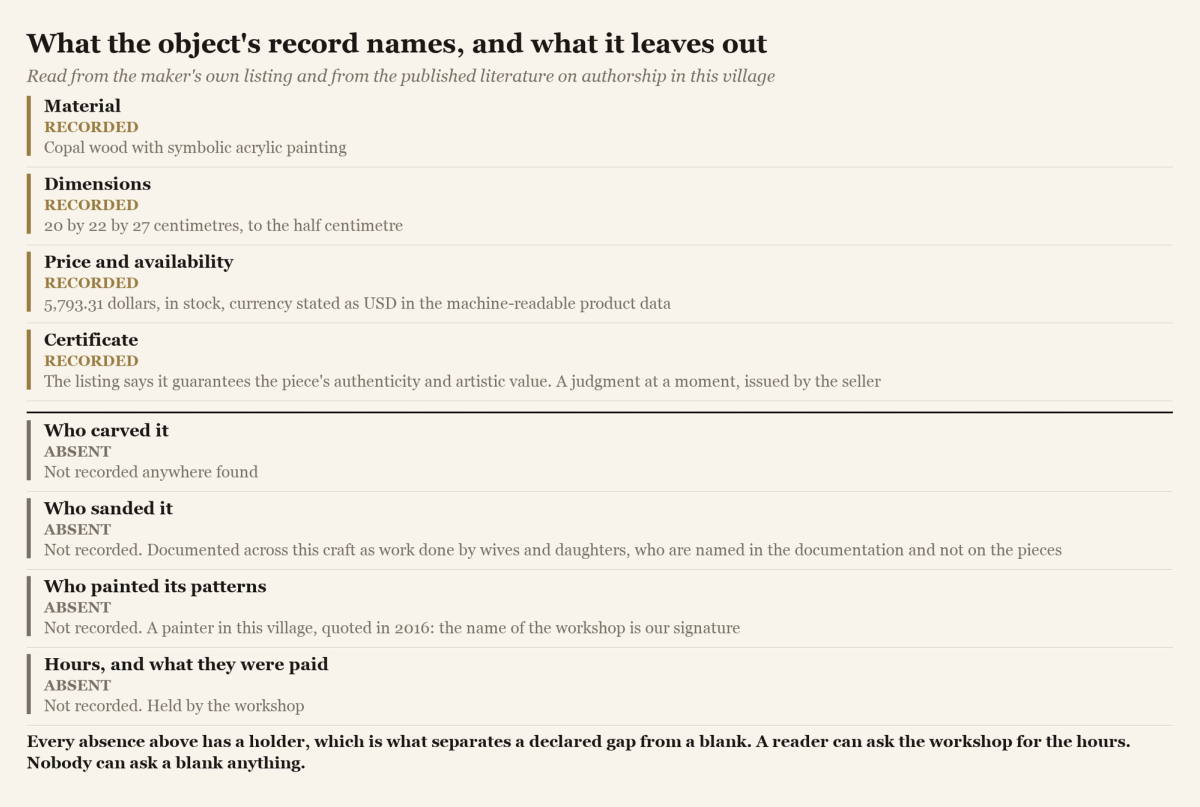
Read as a record rather than as a sale, the listing holds a useful amount. It gives the material as copal wood. It gives the decoration as symbolic acrylic painting, which settles a question that press coverage of this workshop leaves open, because the same workshop is widely documented for natural pigments made from cochineal, indigo and the bark of local trees. For this object the record says acrylic.
It gives three dimensions to the half centimetre. It gives a price in a stated currency: the machine-readable product data on the page carries a price of 5793.31 and a priceCurrency of USD, so the dollar sign is not ambiguous. It gives availability as in stock, which means the figure is an asking price and not a sale. No study in this institution's cost series has ever treated an ask as a result, and this one does not either.
Two things in the record are worth noting because they are easy to pass over.
The first is the certificate. The listing states that with its certificate, the piece's authenticity and artistic value are guaranteed. That is a judgment issued at a moment by the party selling the object. It is the thing this institution does not do and cannot do, and it is worth being precise about why: a certificate answers whether a thing is what it is said to be, on the day it is written. It does not record what happened to the object afterwards, and it is not evidence about any other object.
The second is the name of the seller. The page is headed with the workshop's name. The structured data embedded in the same page names the organisation as Voces de Copal. Both are real and there is nothing irregular in a workshop trading under a commercial name. It is recorded here because a record that a machine reads and a record that a person reads should carry the same facts, and in this case they carry two different names for the party selling the object.
The word the market uses came from another craft
A record has to call an object something, and the word attached to this one arrived from a different material, a different technique and a different city.
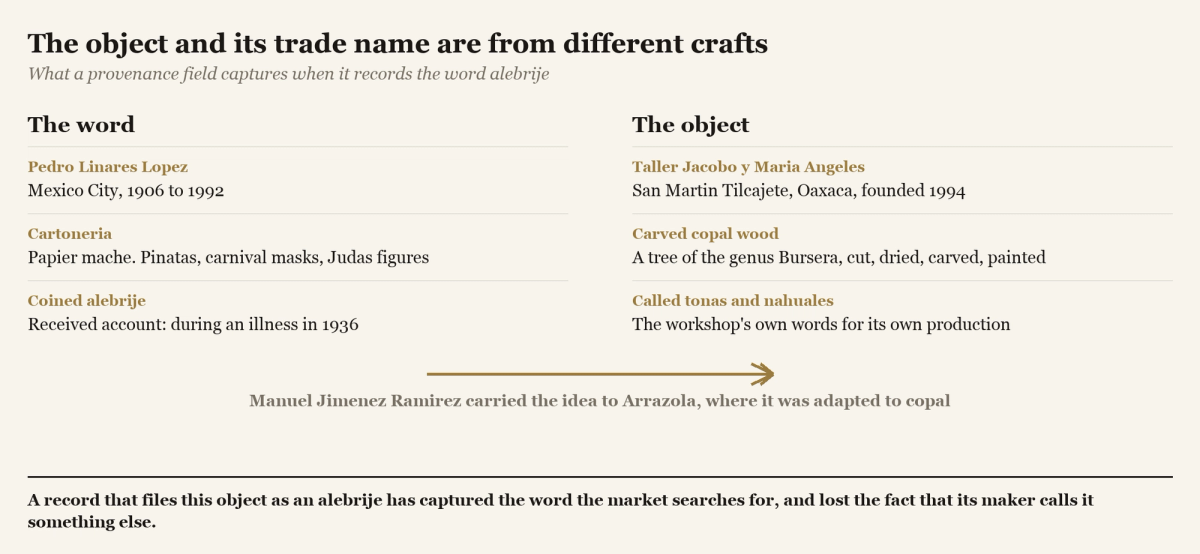
Pedro Linares López was born in Mexico City in 1906 and died there in 1992. He worked in cartonería, the Mexican papier-mâché trade that produces piñatas, carnival masks and the Judas figures burned at Easter, and his clients included Diego Rivera and Frida Kahlo. He is credited with coining the word alebrije and with the creatures it names, in the standard account after a fever during an illness in 1936. They were made of paper and paste.
Manuel Jiménez Ramírez of San Antonio Arrazola, in Oaxaca, is recorded as having been introduced to the alebrijes by Linares and as having brought the idea home, where it was adapted to carving in copal. That is how a word invented for paper sculpture in the capital became the trade name for carved wood four hundred kilometres away.
The makers do not uniformly use it. Taller Jacobo y María Ángeles describes its own production, on its own site and in its own words, as the production of copal wood carvings called tonas and nahuales, the Zapotec figures of its region. The shop headings carry alebrije as well, alongside tonas and nahuales, which is what a workshop selling into an international market would be expected to do. Both words are on the same page, and only one of them is the workshop's own.
None of this is a correction of anybody. Trade names travel, and a seller who uses the word buyers search for is doing something ordinary. It is recorded because it has a direct consequence for a record.
A provenance record that captures this object as an alebrije has captured the word the market uses. It has not captured that the maker calls it something else, that the something else is a Zapotec category rather than a craft invented in 1936, or that the two words point at different traditions in different materials. None of those facts is in dispute and none of them survives the field.
This institution has published on fields that cannot hold what is true about an object, and on registers with no provenance field at all. This is the smaller and commoner version: a field that exists, accepts a word, and loses the distinction the word was covering. A reader of that record, fifty years from now, would have no way to know that the object's own maker used a different name for it, and no prompt to ask.
What the wood can be costed from, and what it cannot
Copal is the wood. The species carvers use are in the genus Bursera, and the trade is documented in the forestry literature in unusual detail, because the growth of the carving market put real pressure on the trees.
The best published measurement comes from a 2003 paper in Economic Botany by Charles Peters, Silvia Purata, Michael Chibnik, Berry Brosi, Ana López and Myrna Ambrosio. Working from surveys of how many loads of wood each household consumed, samples of how much wood was in each load, and counts of the carving households in each village, they estimated that San Antonio Arrazola consumes 184 cubic metres of copal wood a year and San Martín Tilcajete consumes 680.5.
They then convert that into trees. For San Martín Tilcajete alone, the annual draw is either 2,440 small Bursera glabrifolia trees of about twenty centimetres diameter, or 65 large ones of thirty centimetres or more. Stated at landscape scale, they write that the village's annual consumption is roughly equivalent to felling all of the Bursera trees in 100 hectares of tropical dry forest.
That is a real published figure for the material at village scale. It is not a cost.
The object's billet can be bounded. A finished carving of 20 by 22 by 27 centimetres cannot have come from a block smaller than those dimensions, so the billet was at least 11,880 cubic centimetres, which is 0.01188 of a cubic metre. Against the village's documented annual draw of 680.5 cubic metres, this one piece accounts for something on the order of two thousandths of one per cent of a year. The real figure is larger than that, because carving removes wood and the block must start oversized, and nothing published says by how much.
What is missing is the price. No published figure was found for what a carver in Oaxaca pays for copal, per cubic metre, per load, or per piece. That absence was tested rather than assumed. The same searches, run in English and in Spanish, return finished-piece prices immediately and in quantity: Oaxacan copal carvings offered at 2,500 pesos, 3,500, 4,000 and 18,000 by one Oaxaca seller alone. The instrument can find prices in this market. It cannot find this one.
So the wood line of the decomposition is: quantity bounded from the object, consumption documented at village scale, unit price not published.
What the labour can be costed from
Time per piece is published, but not for this piece.
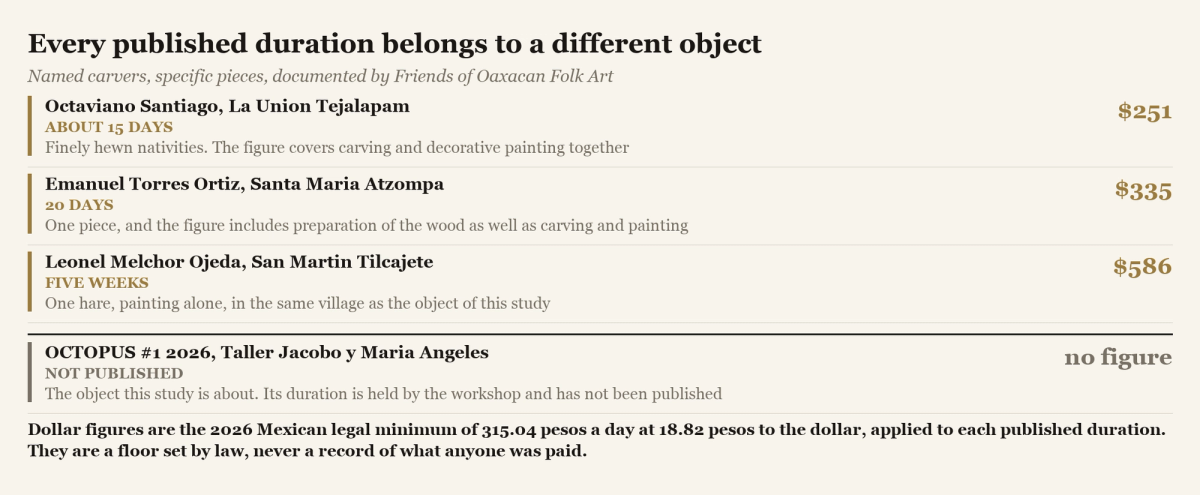
Friends of Oaxacan Folk Art, a United States nonprofit that documents the craft and its makers by name, records durations for specific works by specific carvers. Octaviano Santiago of La Unión Tejalapam makes finely hewn nativities that take about fifteen days to carve and decoratively paint. A piece by Emanuel Torres Ortiz of Santa María Atzompa required twenty days of work, including preparation of the wood, carving and painting. Leonel Melchor Ojeda, who works in San Martín Tilcajete itself, painted one hare over a five week period, and that figure is for painting alone.
Those are three named carvers, three specific objects, and three documented durations. None of them is the octopus. They establish a range for comparable work in the same craft and in two cases the same village, and that is all they establish.
For the octopus itself the duration is not published. It is not in the listing, which gives material, dimensions, price and availability and no labour information of any kind. The workshop holds that figure. It has not released it, and nobody has asked it to.
A fourth figure circulates and is not used here. Several secondary accounts state that carving at this workshop takes up to a month and that the wood then dries for up to ten months depending on size and thickness. The claim was traced to its sources and the trail does not reach the workshop or any document it has issued. It appears in general encyclopaedia text and in visitor accounts, including one that reports being told six months by a guide. It may well be true. It is not sourced, so it is not costed here.
A wage floor is a law, not a payment
Mexico publishes a daily minimum wage. For 2026 the National Minimum Wage Commission set it at 315.04 pesos a day in the general zone and 440.87 in the northern border free zone, both effective from 1 January 2026. Oaxaca is in the general zone. The increase was agreed on 3 December 2025 and published in the official gazette.
At the exchange rate on the day this study was written, 315.04 pesos is about 16.74 dollars. The rate itself is a dated measurement and is given as one: three independent sources on 30 and 31 October 2026 returned 18.82, 18.824 and 18.908 pesos to the dollar, and 18.82 is used here.
Applying the floor to the documented durations gives the only labour figure this study can defend:
Fifteen days at the legal minimum is 251.09 dollars, which is 4.3 per cent of the asking price. Twenty days is 334.79 dollars, or 5.8 per cent. Five weeks, the one documented painting duration from this village, is 585.89 dollars at the same floor, or 10.1 per cent, and that is for painting alone on a different object by a different maker.
Three sentences are needed to say what that arithmetic is not.
It is not what the workshop paid. A legal minimum is a floor set by a government, and a workshop may pay any multiple of it. Nothing published says what this one pays, and nothing here should be read as suggesting it pays the minimum.
It is not this object's labour cost, because the durations belong to other objects by other carvers.
And it is not a valuation. This institution does not appraise or value anything. The figure is an input cost computed from two published numbers, a wage floor and a duration, in exactly the way the earlier cost series computed inputs from trade figures.
The signature is the workshop's
The criterion this study set out to meet was one named maker. The honest finding is that the record names a workshop, and the hands are more numerous than the name.
Anthropologist Alanna Cant studied authorship in San Martín Tilcajete and published the result in 2016 as a chapter in Critical Craft: Technology, Globalization, and Capitalism. She describes a workshop demonstration in which the owner introduced by name the artisans who carve, paint and sand the copal in his workshop. A visitor then asked a young painter whether she ever gets to sign her own work, or whether it is always signed by the bosses. The painter's answer is the finding:
We are all people of this workshop, and this is the name of the workshop, so that is our signature.
Cant records that in almost all the cases she observed, carvings that men painted carried those men's own signatures, and that in only one case was a woman painter's authorship recognised in place of the brothers who carved the piece.
The same division appears in the documentation that names people most carefully. Friends of Oaxacan Folk Art describes Octaviano Santiago's wife sanding the pieces after carving and sometimes painting the background colours; Agustín Cruz Tinoco's wife sanding and his daughters painting; Gabino Reyes López carving while his wife does most of the painting; Calixto Santiago López's pieces painted by his wife Olivia. In one entry the painter is named in full, Rubiela Martínez Fabián, as collaborating on the painting with Manuel Cruz Prudencio.
So the women are named in the documentation and the pieces carry the men's names, or the workshop's. That is not an allegation about any workshop. It is a description of what two published sources record about how authorship in this craft is assigned, and it bears directly on what a provenance record can say about a carving.
For the octopus, the record names Jacobo Ángeles and María Ángeles. Who carved it, who sanded it and who painted its geometric patterns is not recorded anywhere that was found.
The decomposition, and where it stops
Set out as a decomposition, the object looks like this.
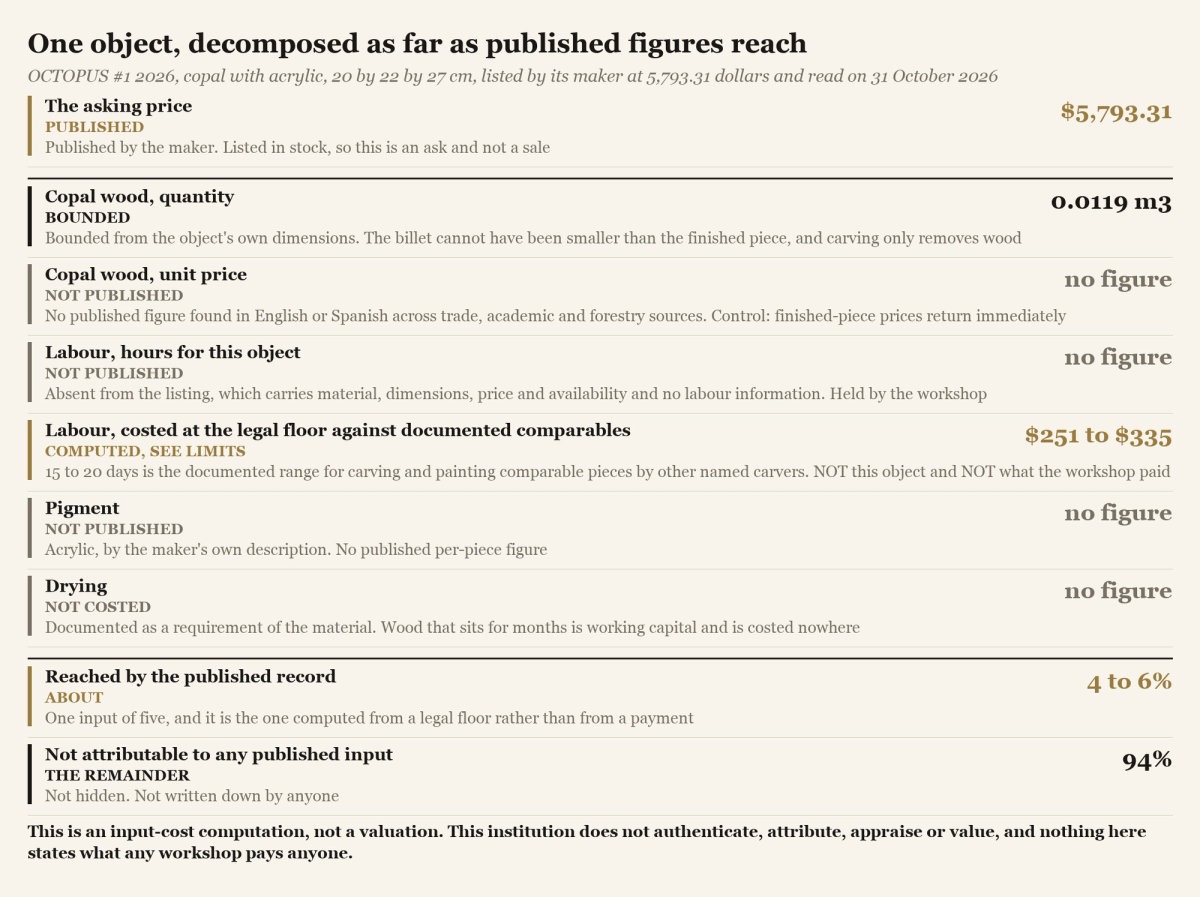
The asking price is 5,793.31 dollars, published by the maker, in stock, read on 31 October 2026.
The wood is copal, quantity bounded at a minimum of 0.01188 cubic metres from the object's own dimensions, with the village's annual consumption documented at 680.5 cubic metres and the unit price not published anywhere found.
The labour is not published for this object. Costed at the 2026 legal floor against the two documented durations that cover carving and painting together, it falls between 251 and 335 dollars, which is between 4.3 and 5.8 per cent of the ask. The third documented figure, five weeks for painting one hare, is not added in, because it covers painting alone on a different object, and it is a reason to think the range understates rather than a figure that belongs in the total.
The pigment is acrylic by the maker's own description, with no published per-piece figure.
The drying is documented as a requirement of the material and is not costed anywhere, although wood that must sit for months is working capital.
Everything else is unreached. Between about ninety-four and ninety-six per cent of the asking price is not attributable to any input this study could find a published figure for.
That residue is not the price of the sign. The earlier studies in this series could call a residue that, because they had costed the inputs with industry figures and what remained was genuinely unexplained by them. Here the inputs themselves are missing. The honest statement is narrower and more useful: the published record reaches five per cent of this object, and the rest is not hidden, it is simply not written down by anyone.
A record that said so, in those words, would be more informative than a certificate that guarantees authenticity and artistic value, because a reader could act on it. They could ask the workshop for the hours. They could ask what the carver was paid. They could ask who painted it. Each of those is a question with an addressee, which is a different thing from a blank.
What is not claimed here
This institution does not authenticate, attribute, appraise or value. Nothing above is a verdict on the object, on its price, or on the workshop that made and listed it, and nothing here is advice about buying, selling, insuring or lending against anything.
The arithmetic in this study is an input-cost computation from published figures, in the same form as this institution's earlier cost series. It is not a valuation and it does not support one. The figure of 5,793.31 dollars is an asking price for a piece listed as in stock. It is not a sale, and no sale of this object is claimed or known.
Nothing here states or implies what Taller Jacobo y María Ángeles pays anyone. The Mexican minimum wage is cited as published law and as a floor for arithmetic. A workshop may pay any multiple of it, this one's rates are not published, and no inference about them is available from anything in this study.
The durations used belong to objects by Octaviano Santiago, Emanuel Torres Ortiz and Leonel Melchor Ojeda, and are used as documented comparables for the same craft. They are not this object's hours, which are not published.
The claim that carving at this workshop takes up to a month and drying up to ten months is widely repeated and was not traced to the workshop or to any document it issued, so it is excluded from the arithmetic rather than used in it.
The absence of a published price for copal wood is a statement about what was searched. English and Spanish searches across trade, academic and forestry sources were run, and the same searches return finished-piece prices readily, which is the control. A figure may exist in a Mexican forestry filing, a cooperative's accounts or a thesis not reached here.
The account of how authorship is assigned in this craft is drawn from Alanna Cant's 2016 chapter and from the published entries of Friends of Oaxacan Folk Art. It describes what those sources record. It is not a finding about any individual workshop's practice today, and the quoted painter is quoted as Cant published her, without a name attached to a living person by this institution.
The account of the word alebrije is the standard one: Pedro Linares in Mexico City, cartonería, and Manuel Jiménez Ramírez carrying the idea to Arrazola in copal. The 1936 date and the illness attached to it are the received account rather than a documented one, and Linares is reported to have said himself that the creatures developed across his working life. That the Ángeles workshop uses tonas and nahuales for its own production is taken from its own site, read on 31 October 2026. No claim is made here about the ethnography of either term.
The two names on the selling page, the workshop's and Voces de Copal in the structured data, are both recorded because they differ. Nothing irregular is alleged in a workshop trading under a commercial name.