A Butterfly Has a Better Record Than She Does: Seventeen Murals, 1.7 Million Dollars, and the Permission Nobody Can Produce
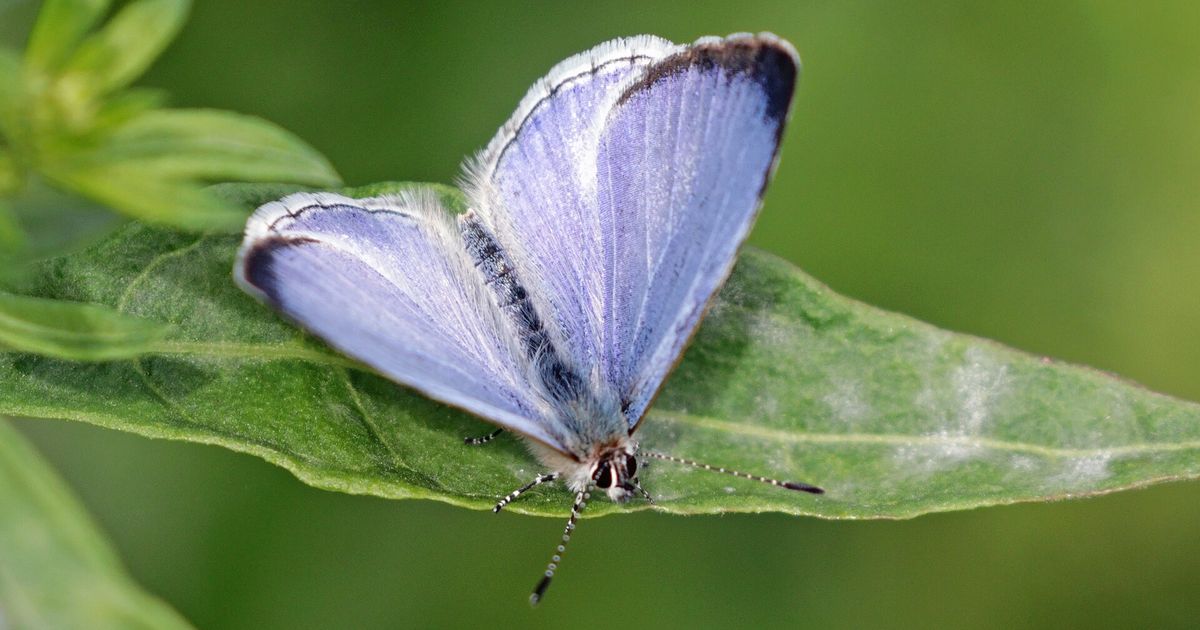
A campaign with at least 1.7 million dollars behind it has put one woman's face on walls in seventeen American cities. A butterfly was named after her in the same period. The butterfly has a permanent public record naming who did it, when, and on what evidence. The murals do not.
Why This Record Exists, and What It Is Not
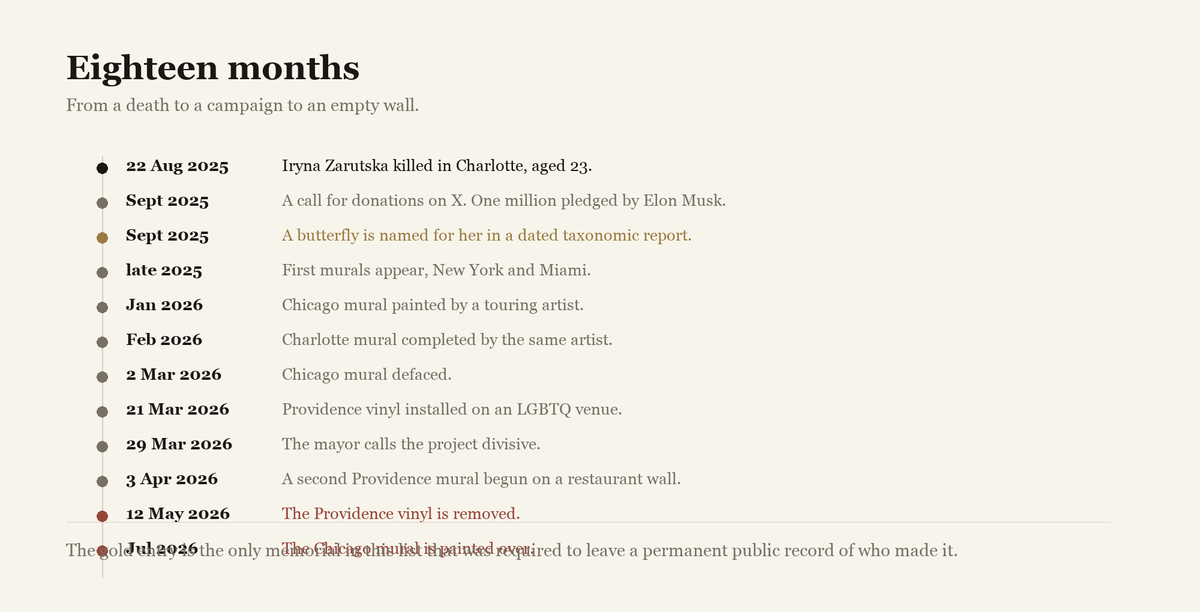
Iryna Zarutska was twenty three years old. She came to the United States in 2022, from a country at war. On 22 August 2025 she was killed on a light rail train in Charlotte, North Carolina, by a stranger. A man was arrested at the scene and the criminal case has not concluded; a judge ruled him not competent to stand trial. Her family has sued the city and the transit security contractor.
She was an artist. People who knew her describe someone who sculpted and designed clothes, and who looked after her neighbours' animals.
What has happened since to her face is a records question, and that is the only question this institution is competent to ask about it. This study takes no position on American politics, on immigration, on policing, on the criminal case, or on whether any of these murals should exist. Every characterisation of motive below belongs to the named person who made it. Where two sides disagree, both are carried.
The question is narrow. A memorial is a record about a person. Who authorised this one, and where is that written down?
What She Was Turned Into
In September 2025, Eoghan McCabe, an Irish-born technology executive based in the Bay Area and a co-founder of the help desk company Intercom, put out a call on X asking for money to fund murals of Zarutska across the United States.
The money arrived at a scale that is worth stating precisely, and it cannot be stated precisely, which is the first finding.
Reported figures include a pledge of 500,000 dollars from McCabe himself, offered as 10,000 dollar grants to artists; a pledge of one million dollars from Elon Musk, confirmed to the Guardian by McCabe's chief of staff; around 200,000 dollars from smaller donors; and a further one million pledged publicly by Andrew Tate, which Boston Art Review reports as unconfirmed. Headline totals in the coverage run from 1.5 million to 1.7 million dollars. A Delaware corporation named Project Freedom 2025 received crowdfunded money through GiveSendGo, reported at over 100,000 dollars.
The campaign is called Remember Iryna. Murals attributed to it have appeared in, at minimum, New York, Washington, Los Angeles, San Francisco, Miami, Fort Lauderdale, St Petersburg, Chicago, Charlotte, Phoenix, Las Vegas, Dallas, Houston, Atlanta, Greenville, New Haven and Providence. One account says more than a thousand artists were in talks. How many murals were actually completed is not stated anywhere this institution could find.
What the Campaign's Own Record Says
This is the measurement at the centre of the study, and it was made directly rather than inferred.
The campaign's own website was read on 25 October 2026. It describes itself in two words, A memorial. It links to murals in eleven named cities and marks six more with an arrow. It provides one contact address.
It does not name who runs it. It does not state who funds it or how much. It does not say how artists apply or what they are paid. It gives no total. It does not mention Iryna Zarutska's family anywhere. It makes no claim of endorsement by them. And it carries no statement about permission, likeness or consent of any kind.
A campaign that has raised somewhere between one and a half and one and three quarter million dollars to reproduce a dead woman's face in seventeen cities publishes, as its complete public record, a page with no funder, no budget, no process, no family and no consent.
The Permission Nobody Can Produce
In February 2026, as a mural went up in the North Center neighbourhood of Chicago, Ukrainian community organisations began objecting. The objection was not primarily about the politics of the funders. It was about authorisation.
Dr Mariya Dmytriv-Kapeniak, president of the Illinois chapter of the Ukrainian Congress Committee of America, told the Chicago Sun-Times that the family had not granted permission to use Zarutska's likeness, and that nobody had contacted the family before her photograph was used. She said she was in contact with the family's community in North Carolina, and that she was working with lawyers to examine whether an Illinois statute on the right of publicity might apply.
The Chicago Reader's account, published 16 April 2026, put the same point in its standfirst: the family never gave permission, and the community never asked for it.
Three things must be said about that claim, and all three are necessary.
It is reported at second hand. No source consulted by this institution carries a statement from Zarutska's family about the murals, in their own words, in either direction. What exists is a community leader's account of the family's position, repeated across several outlets. That is not nothing, and it is not the family speaking.
The family is reachable, and demonstrably so. They spoke publicly in September 2025, within weeks of her death. Around the first anniversary they filed a lawsuit against the City of Charlotte and a transit security contractor, which means they have counsel and an address. Whatever else is true, this is not a case where the next of kin could not be found.
And the community is not of one mind. Zoryana Smozhanyk of the Ukrainian Daughters Foundation condemned the vandalism of the Chicago mural and described the work itself as beautiful commemoration, while also questioning whether the family had been consulted and raising the funding. Both halves of that are hers and both belong in the record. Several Ukrainian organisations in Chicago opposed further murals. Others did not.
This institution takes no view on whether a right of publicity claim would succeed anywhere. That is a question of law, this is not a law office, and the standing practice here is to route such questions rather than answer them. The fact recorded is narrower and is not legal: an advocate states that the family was not asked, the campaign's own public record contains no indication that anybody was asked, and no source has produced a document showing otherwise.
Providence: Two Murals, One Street
The clearest case is Providence, Rhode Island, because the city produced an unusually complete paper trail and because the comparison is physical. Two murals went up within a few hundred feet of each other on Snow Street, and the difference between them is a process.
40 Snow Street
In 2024 the City of Providence wanted a mural for its PVD Fest festival. It asked The Avenue Concept, a non profit that has produced dozens of Providence murals since 2014, to scout locations and research local history for material. The resulting work, Empire Rising, was painted by the artist Lauren YS. Coverage notes the timeline was considered fast at roughly four months, against the year or more such a commission normally takes.
Named commissioner. Named curator. Named artist. A research process. A public festival. A record anyone can follow.
19 Snow Street
19 Snow Street is a late nineteenth century building housing two bars, The Dark Lady and The Alley Cat, owned by Randy D'Antuono and Buck Asprinio. The Dark Lady is a long established LGBTQ venue known for drag performance.
Ian Gaudreau, a Providence artist, applied to an open call. He has described the terms plainly: I applied to that. It had to be something fast. The budget was 10,000 dollars, of which he says the vinyl alone cost 4,000. He was paid a fifty per cent deposit by Remember Iryna and says the money went on supplies, installation and a scissor lift. The property owners were not paid. They granted the wall.
The work was not painted. It was a forty by forty six foot printed vinyl, installed on 21 March 2026.
#### It Was Not Painted
One detail of the Providence work has gone almost unremarked and it changes what kind of object is under discussion.
The Dark Lady mural was a printed vinyl, forty feet by forty six, installed on 21 March 2026. Gaudreau says the vinyl alone cost four thousand dollars of a ten thousand dollar budget. It was not brushwork on a wall. It was a large format print, manufactured, delivered and applied.
This matters for three reasons and none of them is snobbery about technique.
A print can be produced centrally. A painted mural requires an artist to stand in a specific city for days or weeks, during which, as the historian Rebecca Zorach observes of the form, people walk past and ask what it is. That conversation is not decoration; for sixty years it has been where community consent actually happened. A vinyl can be printed anywhere and applied in an afternoon, and the conversation never takes place because there is nothing to interrupt.
A print is reproducible by design. The same file can hang in seventeen cities. This institution's term for what a unique physical work possesses is Material Singularity, and a printed vinyl in an edition of unknown size is its opposite. The thing on the wall in Providence was not a work made for that wall. It was an instance.
And a print comes off. The Providence vinyl was installed on 21 March and removed on 12 May, fifty two days later. A painted mural resists removal; it has to be painted over or blasted, which is why the destruction of murals generates lawsuits and public argument. Vinyl is designed to be taken down, and it was.
None of that makes it illegitimate. Large format print is a normal commercial medium and plenty of good public work uses it. What it means is that the form chosen here had no step in it where anyone local had to be consulted, and the form the campaign borrowed its language from, the community mural, is made almost entirely of that step.
The Contradiction About Permission
What happened next is the part this institution finds most interesting, because it is a dispute about a document.
D'Antuono said he had worked with city departments and received approval to proceed, and also that he had seen only one preliminary rendering before installation. The mayor's office said the opposite: that the property owner did not register the work with the City or seek any required approvals. Michaela Antunes, deputy chief of staff, said an inspector told the artist a permit was required, and noted that a stop work order was not issued.
In a dispute about whether a dead woman's family gave permission, the parties also could not agree on whether the building had permission. Neither side produced the document. One says approval was received. The other says nothing was registered. Both statements are on the record and they cannot both describe the same filing.
#### Who Chose the Wall
A third question runs underneath the Providence dispute and has never been answered in public.
Gaudreau applied to an open call and has said it had to be something fast. It is not established anywhere this institution could find whether the campaign selected the site, the artist proposed it, or the building owner volunteered it. D'Antuono, who owns 19 Snow Street, says he saw a single preliminary rendering. That is the sum of what is on the record about how a mural funded from California came to be on the side of a Providence LGBTQ venue.
The question matters because the site is most of what the argument has been about. If a campaign chose that wall, the choice carries a meaning. If an artist found a willing landlord and the campaign paid for whatever wall he found, it carries a different one. Those are opposite facts and the public has been arguing for seven months without either.
The Chicago Reader noted a related point about a different city: Zarutska had no ties to Chicago. A mural commemorating a person is normally placed where that person lived, worked, was loved or was lost. Here the placement follows the campaign's map rather than the subject's life. The one city with an obvious claim, Charlotte, received a mural painted by the same touring artist who painted Chicago's.
This institution has published before on what happens when a public commission is captured by private interest, and on the difference between a project and a custodian. The Providence case adds a narrower finding to both: in a dispute over who chose a wall, no party produced a commissioning document, and seven months later the question is not closer to an answer.
What Each Side Said
Mayor Brett Smiley called the project divisive and misguided in a statement on 29 March 2026, and said the funders had divisive goals.
Haus of Codec, an organisation providing transitional housing for queer young people, withdrew from a fundraising drag brunch at The Dark Lady, saying in a public post that the mural sent a message perpetuating harm toward a community that has been the backbone of Providence for decades.
Erin McCutcheon, professor of art history at the University of Rhode Island, said she worried the mural intended to use a tragedy to sow division.
Gaudreau said his free speech was being stifled, has said he never intended the tribute to be political, and has continued working. A petition was launched to save the original mural.
Many people in Providence assumed The Avenue Concept had commissioned the Zarutska mural. It had not. The organisation states it was not involved and has never worked with Gaudreau. AS220, an arts organisation that describes itself as an unjuried and uncensored forum for the arts, owns buildings carrying two of Gaudreau's other Providence works.
That misattribution is a records failure of exactly the kind this institution studies. A large artwork appeared on a public-facing wall and the public could not establish who had commissioned it, so they guessed, and they guessed the organisation that usually does. The guess damaged a non profit that had nothing to do with it.
What Then Happened to the Objects
The Dark Lady mural came down on 12 May 2026.
Francois Karam, co-owner of Opa the Phoenician, a Lebanese restaurant on Atwells Avenue in Federal Hill, offered a wall. Gaudreau began a second mural there on 3 April 2026 and has said it will not be his last. Karam's position is that the work is not political and is an homage to an immigrant who lost her life, and he has said plainly that his mural has no relationship with the dispute.
AS220 and The Avenue Concept jointly convened a public forum on freedom of expression, art as a tool of influence, and how art shapes narrative, and invited Gaudreau to the panel.
Whose Photograph
There is a right in this story that nobody involved has publicly discussed, and this institution raises it as a question rather than a claim.
Every one of these murals depicts a specific face, and that face was taken from a photograph. A portrait mural is made from a source image, by tracing, projecting, gridding or digital enlargement. The forty by forty six foot vinyl in Providence was a print, which means the source image was handled as a file.
Nobody in the coverage says where the photograph came from, who took it, or whether its photographer was asked.
That is a separate question from the family's permission and it is not interchangeable with it. The likeness of a person and the copyright in a photograph of that person are different rights, usually held by different people. A family may hold one and a photographer, a studio, a school or a news agency may hold the other.
This institution has not established the source image for any mural in the campaign, has not identified a photographer, and makes no allegation whatever. The point is structural: a campaign has reproduced one image at architectural scale in seventeen cities, and the public record contains no statement about the provenance of the image itself.
For an institution whose subject is what a record fails to carry, that absence sits alongside the other one, and the two together describe the shape. A face arrived on seventeen walls. The record names the walls, the cities, the funders and most of the artists. It does not name the person who made the photograph, and it does not name anyone who said yes.
The Objects Did Not Survive Either
A memorial is supposed to outlast the occasion. These are not doing that, and the pattern is worth recording because it is the same in several cities.
The Chicago mural at 2415 West Montrose Avenue was painted in January 2026 by SAV45, an artist described in most coverage as based in Spain and in one outlet as Russian. The discrepancy is unresolved and is itself a small instance of the problem: the maker of a public artwork is reported two ways. It was defaced with dark paint, reported on 2 March 2026. Police recorded no calls for service about it. In July 2026 it was reported painted over with abstract work.
The same artist painted the Charlotte mural, at a business on West Morehead Street, completed in early February 2026. Charlotte is the city where Zarutska lived and died. No coverage this institution found addresses whether her family was consulted about that one either.
So: a touring artist, hired through an open call, painting the same face in multiple cities, including the city where the woman actually lived, with no local commissioning body and no documented contact with the family.
The Wall of Respect, 1967
There is an obvious retort to all of this, which is that murals have never required paperwork, that street art is by nature unpermissioned, and that demanding a consent file is a bureaucrat's objection to a living art form.
The history does not support it, and the counter example is the founding one.
In 1967 a group of Black artists working as the Organization for Black American Culture painted the Wall of Respect at 43rd Street and Langley Avenue in Chicago, honouring more than fifty figures. It is generally credited with starting the community mural movement in the United States. It had no budget worth the name and no legal apparatus at all.
It also had a consent process. One of its artists, William Walker, secured permission from the business owner and spoke with local community members to gain approval. The historian Rebecca Zorach, who has written a book on the mural with Abdul Alkalimat and Romi Crawford, describes mural painting as a form that generates conversation by its nature, because the artist is outside, on the street, while people walk past and ask what it is.
The practice did not stay informal. Janice Bond, executive director of the Chicago Public Art Group, puts the standard in one sentence: We are creating art with community, not for community. The artist Sam Kirk, who has made numerous Chicago murals, says they have walked away from projects where there was no community buy-in.
So the objection to Remember Iryna is not that it broke a rule invented by a city permit office. It is that it skipped a step the form has performed since 1967, in Chicago, on the wall that started it. Permission from the owner, and a conversation with the people who will live with it.
In Providence, one of those two was obtained and the other was not, and the first is now disputed.
The Butterfly
In September 2025, a few weeks after Zarutska was killed, the lepidopterist Harry Pavulaan published the description of a new butterfly species and named it for her. It is an azure, of the genus Celastrina, and its common name is Iryna's Azure. The description appeared in The Taxonomic Report of the International Lepidoptera Survey.
The species had been noticed before. The South Carolina researcher Ronald Gatrelle collected specimens in Aiken and Barnwell counties in 1985 and never formally described them. Pavulaan collected eighty eight males and three females across sites in South Carolina and Georgia during field work in 2018 and 2019.
Set that memorial beside the other one.
To name a species, Pavulaan had to publish a description in a dated, citable work. He had to designate type specimens and say where they are held. The naming is attributed to him permanently and cannot be reassigned. The date is fixed. The evidence is enumerable, which is why this study can tell you there were ninety one specimens. If the name is ever challenged, every element of the claim can be checked by a stranger in fifty years, because a code of nomenclature requires it to have been written down at the moment it was made.
None of those requirements exists for putting a human being's face on a building. No publication. No dated record of the act. No statement of who authorised it. No register of where the works are. No obligation to record who asked whom for what.
The scientific name of a small blue butterfly is better documented than the use of the face of the woman it commemorates.
This institution does not say that lightly and does not intend it as a rhetorical flourish. It is a straightforward comparison of two record systems, one of which has a consent and attribution requirement built into its grammar, and one of which has none. One memorial will be verifiable in a century. The other is already contested at eighteen months, in several cities, with no document to settle it.
This Study Does Not Show Her Face
Every study this institution publishes carries images, and the rule is that they are licence verified and credited. This one departs from the usual practice and the departure is deliberate, so it is stated rather than left for a reader to notice.
No mural in this campaign is reproduced here, and no photograph of Iryna Zarutska appears.
Two reasons, and the second is the one that decided it.
The works are in copyright and no free licence exists over any of them, which is the ordinary obstacle. This institution has published a study before that could not show its subject for exactly that reason, and said so in the text instead of substituting a photograph of something else and hoping the caption carried the difference.
The second reason is that the subject of this study is the unauthorised reproduction of a woman's likeness. A study making that argument, which then reproduces the likeness to illustrate itself, has not made an argument. It has joined the thing it is describing. The campaign's own count is somewhere above seventeen walls. There is no version of this where the eighteenth is a research institution writing about consent.
So what follows the text is a butterfly, and two diagrams this institution drew of its own record.
If her family ever says publicly that they want her face carried, that is their decision to make and this study would be glad to be told it was wrong about the first part. Nothing here is a view about whether anyone should see her picture. It is a view about who gets to decide, and the answer this institution keeps arriving at is: not us.
What a Conforming Record Would Contain
It is easy to say the record failed and harder to show what one would hold. Here is the Providence mural written out as the kind of record this institution specifies, with every field this study can fill and every one it cannot.
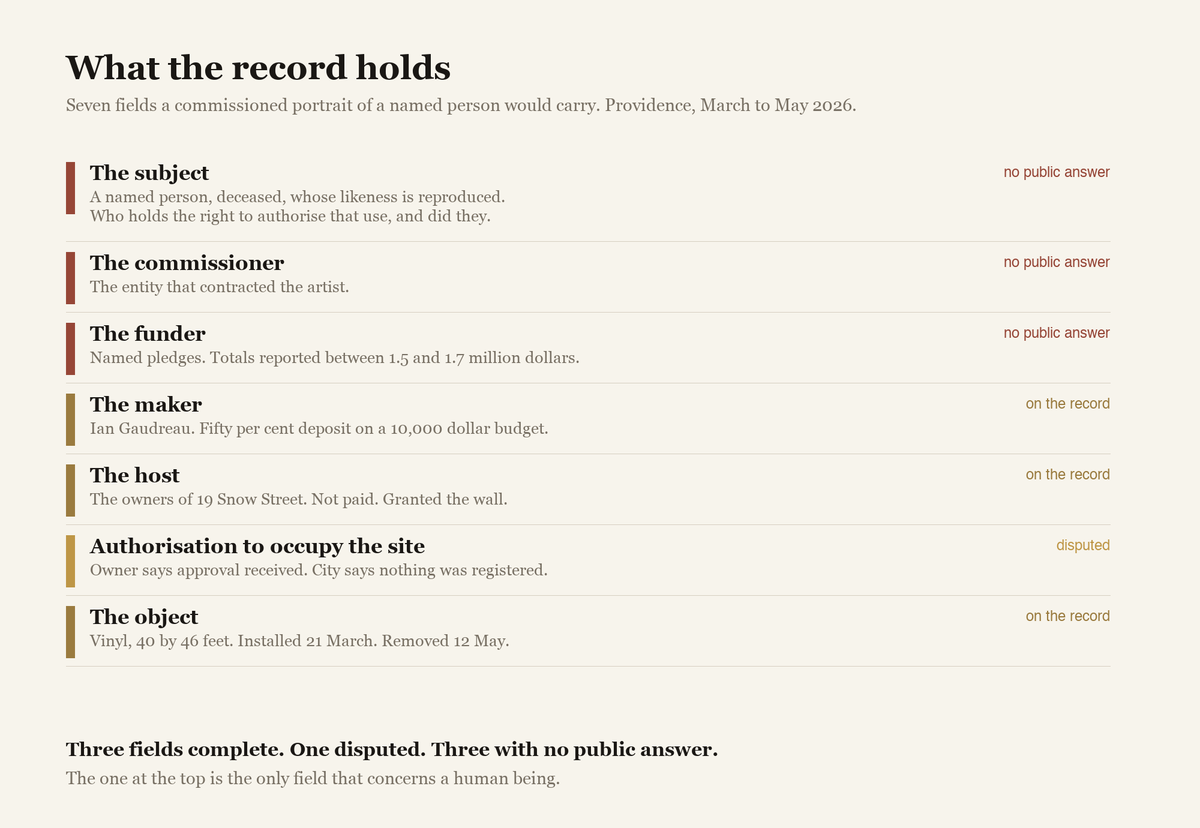
The subject. A named person, deceased, whose likeness is reproduced. A record would carry who holds the right to authorise that use, and whether they did. This is the field that gives a memorial its narrative permanence, and it is the one field here that nobody can fill. This field cannot be completed from any public source. It is the entire dispute. In the vocabulary of that specification it is not an unknowable. It is a declared absence of the closable kind, and the specification requires such an entry to name the party who can close it and to carry a date. The party is named: it is her family.
The commissioner. Remember Iryna, which is a campaign name rather than a legal entity. A record would name the entity that contracted the artist and the entity that paid. Project Freedom 2025, a Delaware corporation, appears in the reporting as a recipient of crowdfunded money. Whether it is the contracting party is not established here.
The funder. Named individuals with stated pledges, the sums varying by source between one and a half and one and three quarter million dollars. A record carries the figure and its source rather than a range produced by headline writers.
The maker. Ian Gaudreau, named, paid a fifty per cent deposit on a 10,000 dollar budget. This field is complete, and it is the only one that is.
The host. The owners of 19 Snow Street, who were not paid and who granted the wall. Complete.
The authorisation to occupy the site. Disputed. The owner states approval was received; the city states nothing was registered. A record would name the permit, its number and its date, or state that none exists. Neither party has produced either.
The object. A forty by forty six foot printed vinyl, installed 21 March 2026, removed 12 May 2026. Complete, and notably the best documented element of the whole affair, because a date of installation and a date of removal are the two facts journalism reliably captures.
Seven fields. Three complete, one disputed, three unanswerable. And the unanswerable one at the top is the only one that concerns a human being.
What This Institution Is Not Saying
OAC takes no position on the politics of the funders, the mayor, the artist, the objectors or the campaign. It holds no view on American immigration policy, criminal justice policy, or the conduct of the criminal case, and nothing here should be read as commentary on any of them.
This study does not say the murals should not exist, or that they should. It does not say the artists acted wrongly. Ian Gaudreau applied to an open call and was paid a deposit to make a work honouring a murdered woman, which is an ordinary thing for a mural painter to do. Francois Karam offered a wall and has said his reasons are not political.
This study does not assert that Zarutska's family objects. It asserts that no public record shows they were asked, that an advocate speaking for their community says they were not, and that the campaign's own site is silent on the question. If the family has given permission, the document exists and producing it would close this entirely.
OAC does not authenticate, appraise or value, and takes no view on whether any right of publicity statute applies in any jurisdiction. That is counsel's question.
Nothing here is a judgment on the people who defaced or painted over the Chicago mural, whose identities are unknown and whose acts are a matter for Chicago.
The Declared Gaps
Stated so that silence is not read as completeness.
The family has not been heard from directly in any source consulted. Everything in this study about their position comes through a community advocate quoted in the press. They have not been contacted by this institution and will not be.
The total number of completed murals is unknown. The campaign publishes no count. Press accounts name different cities. Seventeen is the number of distinct locations this study could identify and is a floor, not a total.
The funding figures do not reconcile. 500,000 plus one million plus 200,000 is 1.7 million, which matches one report. Other coverage gives 1.5 million. The Andrew Tate pledge of a further million is reported as unconfirmed. No audited figure exists in public.
The legal structure is unclear. Project Freedom 2025 is named as a Delaware corporation receiving crowdfunds. Its relationship to the campaign, to the grants and to the artists' contracts is not established here.
Whether any mural in the campaign involved the family is unknown, including the one in Charlotte, the city where Zarutska lived.
The Providence permit question is unresolved, and this study has not filed a public records request that would settle it.
SAV45's base is reported as both Spain and Russia and this institution has not established which is correct.
The butterfly's type specimens and their repository were not verified here. The naming, the author, the journal and the month are reported consistently; the holotype designation was not read in the original paper. The species name appears as both Celastrina iryna and Celastrina irynae across sources.
The current state of the Federal Hill mural is not established. It was begun on 3 April 2026 and no source consulted confirms its completion or condition.
No participant has been contacted by this institution, and every position reported here is taken from published statements.
What Would Settle It
On consent: one document, or one sentence from the family. If permission was given, the campaign can end this question in a day by saying so and by whom. If it was not, saying that plainly would be a more honest memorial than the silence.
On the Providence permit: a public records request to the City of Providence for any application, approval or inspection record attaching to 19 Snow Street in March 2026. One of the two accounts is wrong and the file knows which.
On the scale: a published list of completed works, with addresses, artists, dates and fees. Every public art organisation named in this study maintains exactly that for its own projects as a matter of routine.
On the money: an audited figure, and the identity of the contracting entity.
On whether this is public art at all: the question the Chicago Reader put, and this institution has nothing to add to it except the observation that the organisations which do this work for a living all maintain the records this campaign does not.
Coda
The thing that will not leave this writer is that she was an artist.
She sculpted. She designed clothes. She was twenty three, and had been in the country three years, and she made things with her hands. Nobody in this entire affair appears to have looked for her work, and no mural in the campaign is reported to reproduce any of it. Her own objects are not part of her memorial. Her face is.
There is a version of commemoration that would have begun with what she made, asked the people who hold it what they wanted, and recorded the answer. It would have cost less than four thousand dollars of vinyl.
What exists instead is seventeen cities, a disputed permit, a defaced wall in Chicago, a vinyl taken down in Providence in May, a Delaware corporation, a funding figure that will not resolve, and a page on the internet that says, in two words, A memorial, and does not mention her family.
And a butterfly, in South Carolina and Georgia, that will carry her name for as long as the species is recognised, because a man who found it was obliged to write down what he had done.
The objects are the evidence. Somebody has to be asked.