The Object Left the Studio. The Hand Did Not.
A provenance record is built on one assumption so basic that nobody writes it down: the object stops changing when it leaves the maker. After that, what happens to it is custody. Who held it, where, for how long, and what they did to it while they had it.
The Fall 2026 issue of the Gagosian Quarterly carries four separate accounts, by four separate writers, of that assumption failing. None of them is presented as a provenance problem. Read together they are one, and it is a problem this institution's own specification does not yet carry an answer to.
The making overlaps the shipping
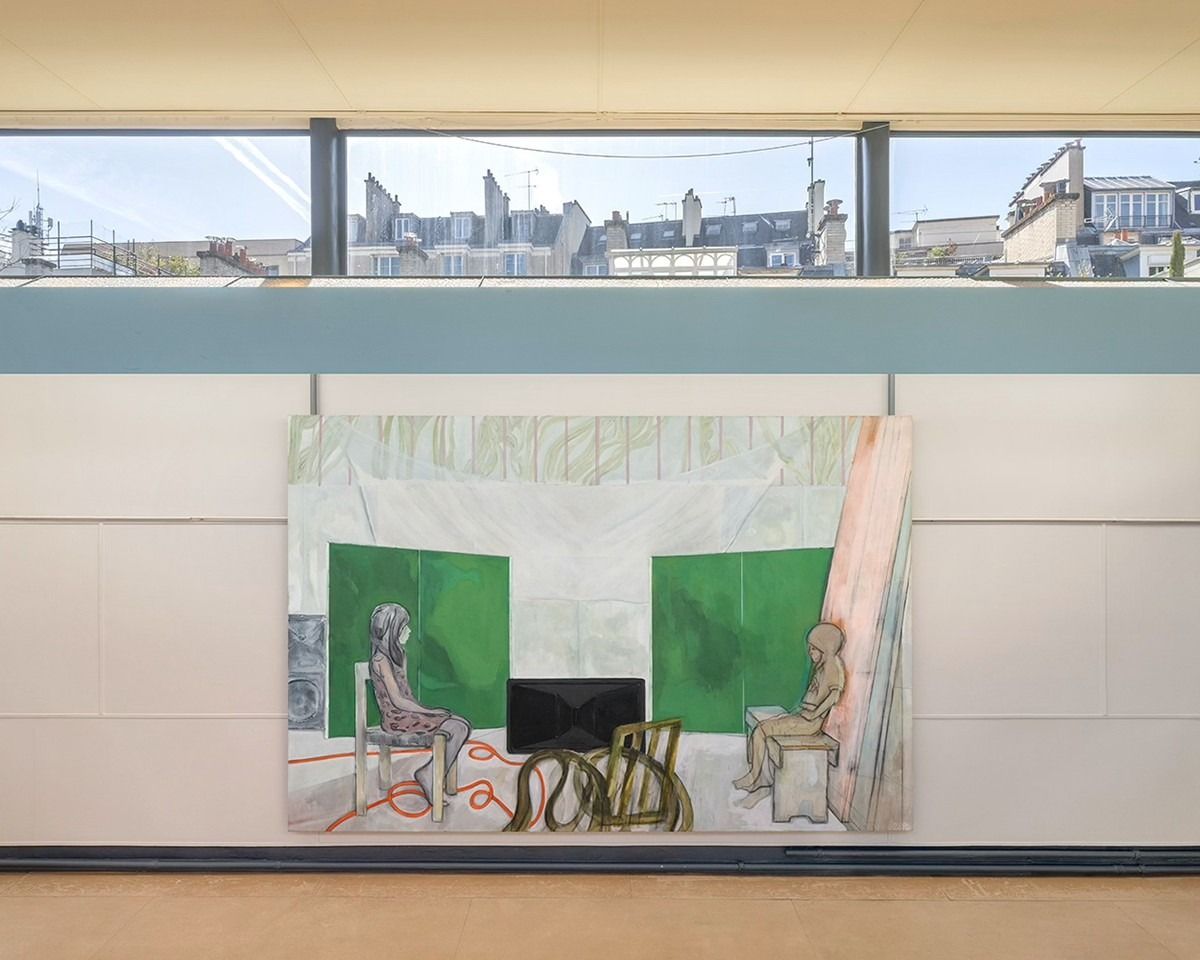
Peter Doig showed fifteen paintings at the Maison La Roche in Paris this spring, in the house Le Corbusier and Pierre Jeanneret built in the 1920s. William Middleton, reporting on the show, records one sentence that belongs in a custody record and would never get there: “Doig was still finishing the paintings right up until the moment they were collected from his Trinidad studio for transport to Paris.”
Read that as a registrar would. The date a work left the studio and the date it stopped being made are the same date. There is no point at which a condition report could have been taken of a finished object before the object moved, because there was no finished object before it moved. And Middleton adds, of another canvas in the show, that Doig “might return to a canvas years later and rethink it entirely,” and had, removing a figure from an earlier version. A painting can leave, be seen, come back, and leave again as something else.
Nothing about this is irregular. It is how a working painter works. The point is only that a record organized around the moment of completion has nowhere to put it.
The maker reverses the object
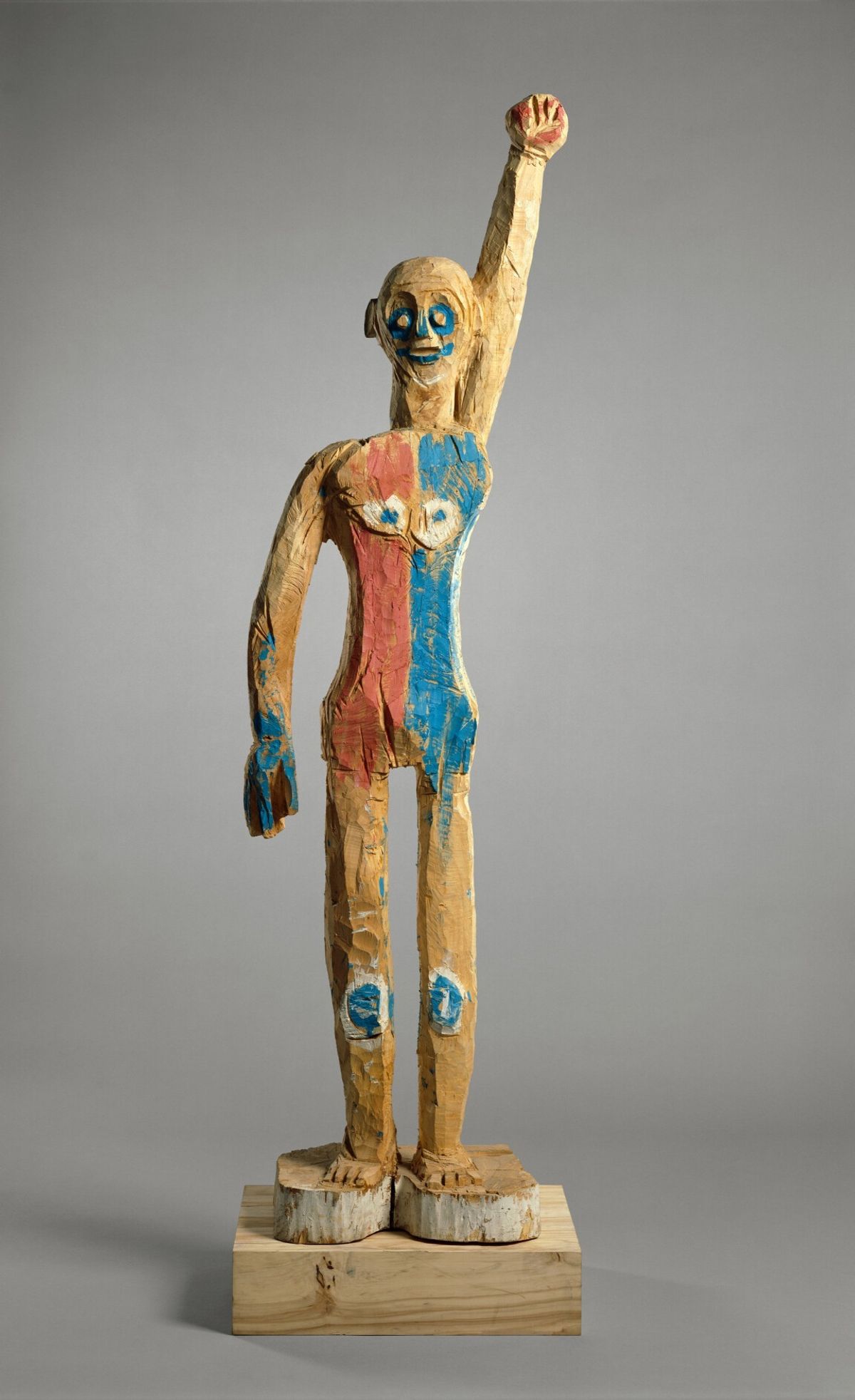
Richard Calvocoressi, in a tribute to Georg Baselitz, who died this year, describes buying a sculpture for the Scottish National Gallery of Modern Art after he became its director in 1987. Untitled, dated 1982 to 1984, is an eight-foot figure in limewood, partly painted, with its left arm raised straight up.
Then this: “At the time I did not know that originally the sculpture's front was its back, so that its left arm was its right arm. After it was shown in its original state in an exhibition of his sculpture in Bordeaux in 1983, Baselitz took it back to the studio and reversed it, paring down the face and torso to turn them into its back and applying oil paint to its new front.”
One object, two states, an exhibition between them. The Bordeaux catalog of 1983 and the Edinburgh acquisition record describe the same piece of wood, and a reader holding both would not know it without being told, because the front of one is the back of the other. Calvocoressi offers a possible reason, that a raised right arm had provoked a row over a different sculpture at the Venice Biennale three years earlier, and offers it as a guess. What is not a guess is that the director who bought the work did not know, at the time, that it had been remade.
The maker's hand as theater
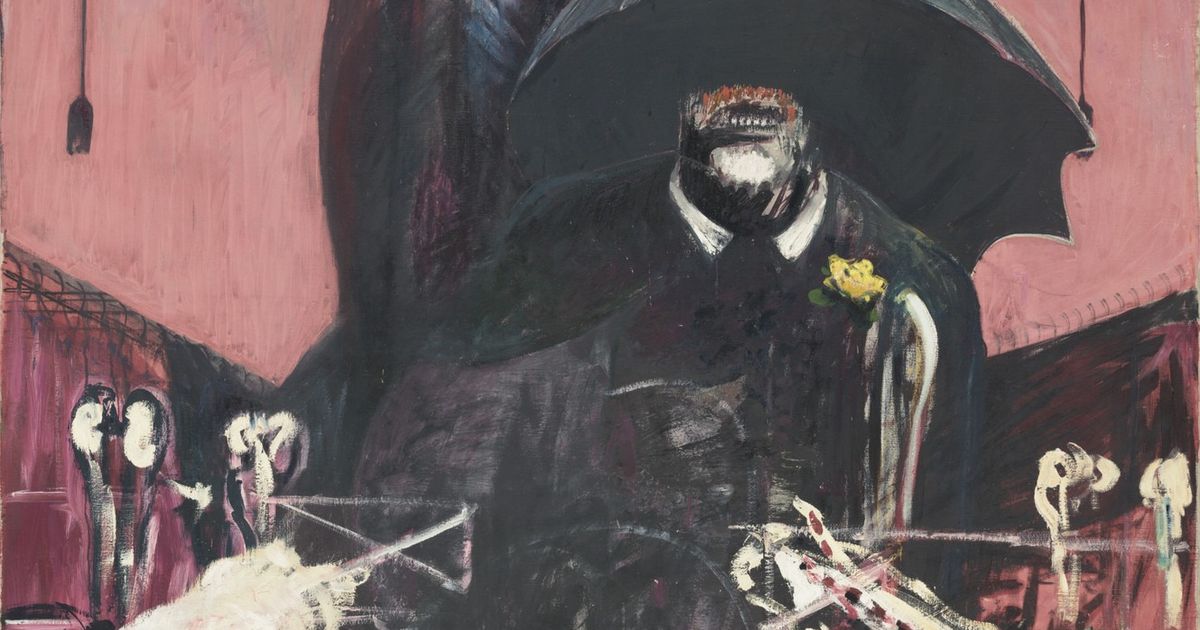
The third account is John Elderfield's, and it is the one to hold onto. In 1948 the Museum of Modern Art bought Francis Bacon's Painting of 1946 for £240, the first museum purchase of his work. Forty years later, preparing a retrospective, Elderfield arranged for Bacon to see it in New York. Bacon wanted all his pictures behind glass, so the first thing that had to happen was taking the work out of its frame. Elderfield writes that the conservators “did look nervous as Francis moved alternately close up to the surface and then back away from it,” and that they told him they were concerned the upper pink area contained pastel.
What happened next: “Bacon walked up to the painting; put his cupped hands together in front of him; spat into those hands; and rubbed them together, and then across the upper part of the canvas. It happened so fast that none of us could say a word, even when he turned around with a smile, lifted up clean hands, and said, ‘Looks good to me.’”
Later, over a drink, Elderfield understood: “his conjurer-like move had been a feint: He hadn't touched the surface of his painting.”
The frame Elderfield puts around it is the one that matters for a record. Conservators, he writes, know their work can be helped by the artist, but it makes them nervous “when artists want to participate in their examinations, for they tend to think that the artist's role ends when they give up their work as finished.” Bacon's performance was a rebuttal of exactly that sentence, staged in front of the people who believed it, with the museum's own object as the prop. He did not alter the painting. He demonstrated that he could, that nothing in the room could stop him, and that the record afterward would depend entirely on what the witnesses said had happened.
And then the line. A visiting royal tried to exchange a catalog at the museum shop without a receipt and was refused: “No receipt. No exchange.” Bacon, told the story, laughed and said he would get his dealer to adopt it for anyone who changed their mind after buying one of his paintings. His dealer did not find it as funny. But as a statement of what a maker owes the record after the sale, it is complete. Nothing.
The maker takes over the record
The fourth case is not about an object. It is about the record itself, and about a maker who decided to author it.
Martin Germann writes about Cady Noland's The Clip-On Method, the two-volume book she published herself in 2021. Germann says that for Noland the conditions of a work, “how it is exhibited, altered, reproduced, attributed, withdrawn, or allowed to continue under her name,” are part of the work. The book is her record of her own output: her writings, sociological essays she chose, and a run of one hundred and twenty photographs of her work in exhibitions and studios.
Then the detail that turns it into a case: “Mostly the page numbers are missing, which suspends a too-easy navigation, whereas the contents page indicates everything in good order.” Germann returns to it at the end. “A passage cannot simply be located again by returning to page 147. One remembers an image nearby, a position in the volume, a distance, and one starts flipping back. Orientation becomes physical and mnemonic.”
Every provenance record in the world depends on the thing Noland removed. A citation is a page number. A catalogue raisonné is a numbering. A custody record is a sequence of dated entries that can be pointed to. Noland published the authoritative record of her own work and took the addresses out of it, so that it can be read but not cited, and remembered but not looked up. The contents page still promises order. The pages decline to deliver it.
What a record owes an object its author keeps changing
Set the four beside each other and they are not four anecdotes. They are four positions on one line.
Doig: the object is not finished when it leaves. Baselitz: the object is finished, leaves, comes back, and leaves again reversed. Bacon: the object is finished and in a museum, and the maker shows he can still reach it. Noland: the object is beside the point; the record is the work, and the maker will write it in a form that cannot be indexed.
The Lacuna specification, this institution's published standard for a provenance record, currently carries four kinds of event: the object came into existence, it was held across a span of time, custody moved, and a gap where nothing is known. It does not yet carry a fifth, the object was altered, and it does not yet say who is entitled to alter it. That is now a live candidate for the next version, raised from exactly these cases, and this study is written before the question goes to the standards body that will hear it in October. The candidate is a candidate. Nothing here says the specification does the thing it does not yet do.
What the four cases settle is narrower than the specification question and worth stating on its own. A record that only begins when the maker lets go will miss Doig's last brushstrokes, Baselitz's second front, Bacon's clean hands, and Noland's missing numbers, and it will miss them silently, because in every one of the four the object afterward looks exactly like an object with an ordinary history. Object permanence holds. The limewood is the limewood. The canvas is the canvas. What has changed is the account, and the account is what a buyer pays for.
The Custodian's Contract is built on the premise that custody is where the record lives. These four cases say the record has a second author who never signed it. The burden of preservation, the work of keeping an object's account true over time, turns out to include keeping track of the one person the record assumed had finished with it.
Bacon's line stands as the maker's side of the bargain, and it is not a generous one. No receipt. No exchange. The record's answer has to be the opposite: a receipt for everything, including what the maker did after the sale, and no exchange of the account for a cleaner one.