Chassis 0: The Ferrari Luce and the Auction of Inauguration

On inauguration, speculative velocity, and the philanthropy that launders a first into a fortune
On the fifteenth of August, during Monterey Car Week, a car will cross the block at RM Sotheby's without reserve, carried by an estimate of more than 1.1 million dollars. It is not a competition car with a decade of racing provenance. It is not a coachbuilt survivor of a vanished era. It is Chassis 0, the first production example of the Ferrari Luce, Maranello's first all-electric automobile, an object that has existed as a finished product for a matter of months. The lot has no history to sell. What it has instead is a position: it is first. And in the contemporary luxury market, first is a value that can be auctioned before the object it describes has had time to prove anything at all.
The Objects of Affection Collection reads this sale not as automotive news but as an unusually clean instance of Speculative Velocity: the rate at which an object's market price outruns any material or functional reason for it. Chassis 0 is being sold at the precise moment when its speculative charge is highest and its proven worth is lowest. That inversion is the entire event, and it is worth naming plainly before the philanthropy and the celebrity design obscure it.
The Object That Sold Before It Settled
An auction is ordinarily a ceremony of settlement. A thing has been used, kept, argued over, and finally released; the hammer records what a market has concluded about it after the fact. The Luce Chassis 0 sale inverts that order. The car arrives at Monterey not as a settled object but as an opening bid on its own future. Ferrari has not waited for the Luce to accumulate a record. It has taken the very first unit, the one number that can never be issued again, and offered it while the model is still controversial, still unproven on the road, still in the earliest and most fragile phase of its life.
This is the sale of a serial number as much as a car. Chassis 0 is valuable because it is the zero, the origin point of a production line, the artifact that a future museum wall text will describe as "the first." That designation is real, and it is also entirely manufactured, in the precise sense that Ferrari controls when and how the first is released to the market. The scarcity here is not the scarcity of survival, the reason a road car becomes rare because most were driven to death. It is scarcity by decree.
The timing is the tell. A house confident that its object would appreciate through use, through the slow accrual of a service record and a reputation, would keep Chassis 0 and let the market come to it in twenty years. Ferrari has done the opposite: it is releasing the origin point of the line at the moment of maximum controversy and minimum evidence. That decision reveals what the house believes it is actually selling, which is not a car that will be proven but a narrative that is most valuable while it is still unresolved. The lot is scheduled for the peak of the argument, because the argument is the product.
Luce Means Light
The record should be corrected on one point that the coverage tends to flatten. The Luce is not Jony Ive's car alone. Its design is the work of LoveFrom, the studio Ive founded with Marc Newson, a point Engadget made plainly in its walkthrough of the car, and Newson's hand in the object is not incidental. The distinction matters to an institution that takes authorship seriously: the reflex to collapse a design collective into a single famous name is itself a form of aura transaction, in which a recognizable signature is made to stand in for the labor of a studio. Chassis 0 is being sold partly on the strength of that signature.
The car itself is genuinely radical for Maranello: a four-door, five-seat electric grand tourer with more than a thousand horsepower and the lowest drag coefficient of any road-going Ferrari yet built. Chassis 0 wears a Tailor Made configuration that plays on its own name, luce, the Italian word for light. It is, on any technical account, an accomplished object. None of that is in dispute. What is in dispute is what the auction is actually selling, because it is not selling the engineering.

The Aura of the First
Consider what a bidder acquires for 1.1 million dollars. Not the best Luce; later cars will be faster, more refined, more sorted. Not a unique body; the Luce is a production model. What the winning bid buys is inaugural status, the aura of having been present at an origin. This is a textbook aura transaction: the conversion of a semiotic position, firstness, into a price, with no corresponding change in the material object.
Ferrari understands this arithmetic completely. The polarizing design and the electric powertrain are not obstacles to the sale; they are its engine. Controversy concentrates attention, and attention is the raw material of aura. A quiet, universally admired first car would generate a smaller premium than a first car that half the enthusiast world finds heretical. The Luce's zero-sum aura is precisely that its notoriety is convertible: the outrage that dented Ferrari's stock is the same outrage that lifts Chassis 0's estimate. The house has found a way to be paid for the very reaction that appeared to cost it.
There is a specific collector psychology the sale is built to exploit. The buyer of a first is not purchasing transport, or even beauty; they are purchasing a position in a story that other people will later wish they had occupied. The value is social and retrospective: it will be confirmed by the museum retrospective, the anniversary sale, the eventual consensus that the Luce marked a turning point in the marque's history. To own Chassis 0 is to wager that the future will find this moment significant, and to be able to say, when it does, that one was present at the decision. That is not a material transaction at all. It is the purchase of a place in a narrative that has not yet been written.
The outrage that dented Ferrari's stock is the same outrage that lifts Chassis 0's estimate. The house has found a way to be paid for the reaction that appeared to cost it.
Speculative Velocity Against Material Permanence
The dialectic the OAC ran on this event resolved to a single axis: Speculative Velocity against Material Permanence. The two are not neutral opposites; in the Luce they are in open conflict. Material permanence is the property of an object that earns its value slowly, through endurance, through a covenant between maker and keeper that the thing will still matter in fifty years. Speculative velocity is the opposite motion: value assigned in advance, at speed, on the expectation of resale rather than the fact of stewardship.
An electric car is an unusually hostile host for material permanence. Its defining components, the battery and the software, are the parts most certain to degrade and be superseded. A Hollowed Object is one whose reason for being can be revoked from a distance or exhausted by time, and an EV whose value is staked on being first is doubly hollowed: obsolescence is built into the hardware, and the firstness that justifies the premium is a fact about the calendar, not the car. The 1.1-million-dollar estimate is a bet that the narrative will hold longer than the machine. This is the same structure the OAC identified in the Luce at its unveiling; the auction merely gives it a number.
The electric drivetrain sharpens the contradiction to a point. An internal-combustion Ferrari can, in principle, be kept running for a century; its mechanical parts can be remade, its systems understood by any competent hand, its life extended by care. A high-voltage battery pack cannot be so kept. It degrades on a chemical schedule indifferent to devotion, its management software depends on support that the manufacturer alone controls and can one day withdraw, and its eventual replacement is less a repair than a transplant that quietly ends the originality of the object. To auction an electric car as a permanent artifact is to sell a promise the hardware is structurally unable to keep. The Luce is not a hollowed object by metaphor. It is one by battery chemistry.
The 250 GTO Problem
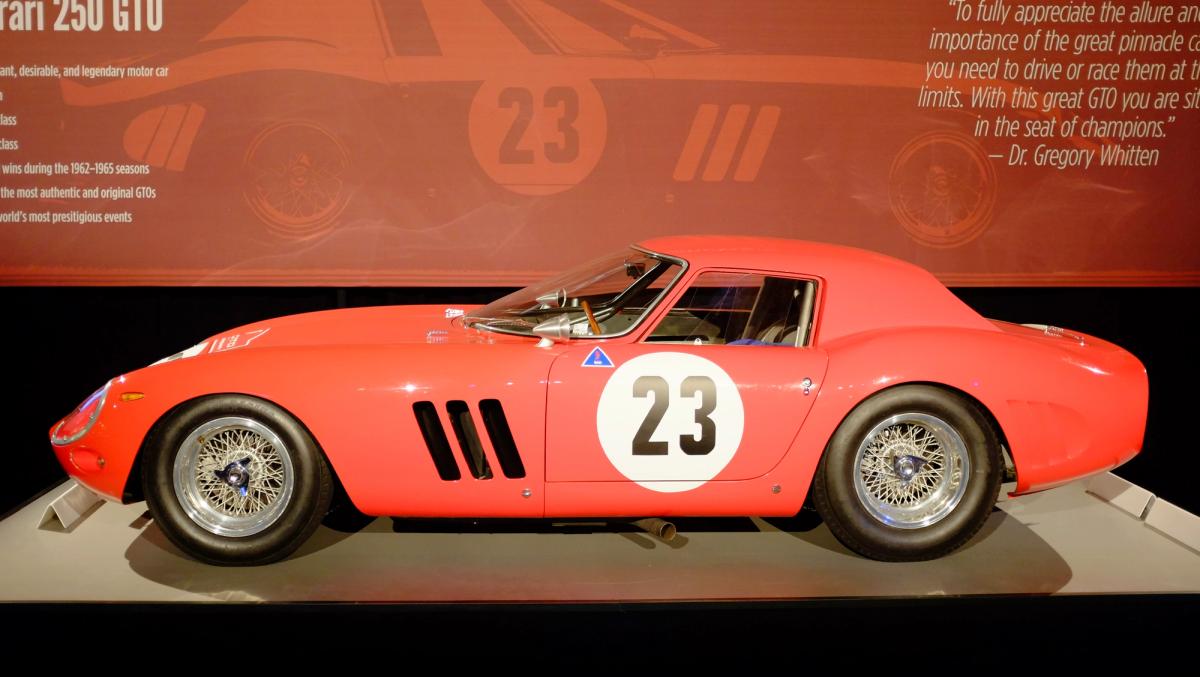
Ferrari's own history contains the counter-example that indicts the Luce sale. A 250 GTO commands tens of millions of dollars, and the OAC has no quarrel with that valuation, because a 250 GTO's price rests on something material and irreversible: a specific racing history, a body shaped by hand, an engine built when the marque's identity was inseparable from competition. Its aura is earned and non-transferable. You cannot decree a second 250 GTO into being.
Chassis 0 borrows the grammar of that valuation, the language of chassis numbers and firsts and Monterey estimates, and applies it to an object that has earned none of the underwriting. A combustion Ferrari still gestures, however faintly, at the engineering prowess that once defined the prancing horse. The Luce gestures at a designer's signature and a serial number. When the same auction house that sells the GTO sells Chassis 0, it lends the electric car the aura of the racing car without any of the substance, and that loan is the mechanism by which speculative velocity disguises itself as heritage.
The difference is not snobbery about propulsion. It is a difference in where the value is stored. The GTO's worth is stored in events that happened: races run, hands that shaped aluminum, a history no marketing decision can revoke or duplicate. The Luce's worth, at 1.1 million dollars, is stored in an announcement, first, that Ferrari itself authored and could have timed differently. One valuation rests on the irreversible past; the other on a designation the seller controls. When the two share a saleroom, the market is invited to forget which is which, and forgetting is exactly what an aura transaction requires.
Charity as Tactical Friction
Every proceed from the Chassis 0 sale is to be donated, as Robb Report set out when the lot was announced, through the Ferrari Foundation, to educational initiatives in the United States and to M-TECH Alfredo Ferrari. This is a real gift, and it should be acknowledged as one. It is also, structurally, the most sophisticated element of the entire operation. The charitable frame performs what the OAC calls tactical friction: a small, genuine moral good placed at the surface of a transaction to slow and soften the reading of what lies beneath it.
What lies beneath is institutional necrophagy: the practice by which an institution feeds on the aura of its own firsts, converting an inaugural artifact into liquidity while the model is still warm. Philanthropy does not cancel that mechanism; it launders it. Because the money goes to education, the sale becomes difficult to criticize without appearing to argue against schoolchildren, and that difficulty is the point. The gift is sincere and the gift is cover, and in the contemporary luxury economy those two facts are not in tension. They are the same instrument.
The gift is sincere and the gift is cover. In the contemporary luxury economy those are not in tension; they are the same instrument.
The Backlash as Confirmation
When the Luce was unveiled, the reaction was severe enough to move Ferrari's share price and to prompt Lamborghini's chief executive, Stephan Winkelmann, to cite the response, in remarks Luxurylaunches gathered, as validation for delaying his own company's electric plans. Purists objected to the powertrain and to the styling; enthusiasts spoke of betrayal. It is tempting to read the Chassis 0 auction as Ferrari's answer to that backlash, a way of monetizing the noise. It is more accurate to say the backlash and the auction are the same phenomenon observed at two moments.
The outrage is a defense of narrative permanence: the belief that a marque's meaning is a covenant that cannot be rewritten by a product decision. What the enthusiasts were mourning was not a bad car but a broken promise about what Ferrari is. The auction then takes that mourning and prices it. A rival's decision to delay, cited as vindication, is itself an admission that the aura is the asset under contest, that the real competition among these houses is not over engineering but over who controls the story of the thing. Chassis 0 is the trophy in that war, and its estimate is the war's current scoreline.
It matters, too, where in the week this lot falls. Monterey is the global clearing-house of automotive aura, the days each August when the market decides what the past was worth and, increasingly, what the future will be worth in advance. To place Chassis 0 among the GTOs and the coachbuilt survivors is to enroll it in that appraisal, to have it read not as a new and unproven product but as an instant classic, its future collectibility ratified before it has been earned. The saleroom does not merely sell the car. It certifies the premise that a first, any first, is already history. That certification, and not the aluminum or the battery, is the most valuable thing changing hands.
What Chassis 0 Confirms
Set against the OAC framework, the Luce Chassis 0 auction confirms, with unusual clarity, that speculative velocity has become the dominant force in luxury object-making, and that material permanence now survives mostly as a marketing vocabulary borrowed to dress the sale. The Custodian's Contract, the promise that an object will be kept and maintained across a lifetime, is here subordinated entirely to the resale event. Nobody is buying Chassis 0 to drive it into the ground. They are buying a position in a market that has agreed, in advance, to treat firstness as permanence.
This does not make the Luce a fraud or the Foundation's gift a lie. It makes Chassis 0 an unusually honest index of where value now originates: not in the covenant between an object and its keeper, but in the velocity with which a designation, first, can be converted into a price and a headline before anyone has had to live with the thing. The OAC's One Original Principle holds that singularity must be material, earned in the object, not administered by a serial number. Chassis 0 is the counter-case, and it is going to sell.
Coda
On the fifteenth of August the hammer will fall, a number will be recorded, and a foundation will receive a genuine gift. The car will be beautiful, and it will begin, from that moment, to age at the rate all electric objects age, while the value assigned to it will pretend not to. Somewhere in that gap, between the light the car is named for and the depreciation it cannot escape, the whole contemporary economy of the first is visible. Chassis 0 will not be the last inaugural artifact auctioned before it has settled. It is simply the one that, for a single evening in Monterey, will make the mechanism impossible to look away from.