The Decorated Shed Has Nothing Behind It: Two Fifth Avenue Scaffolds and the Refusal to Be Absent
On construction sheds, the one architecture that admits it is provisional, and what it costs to make one lie
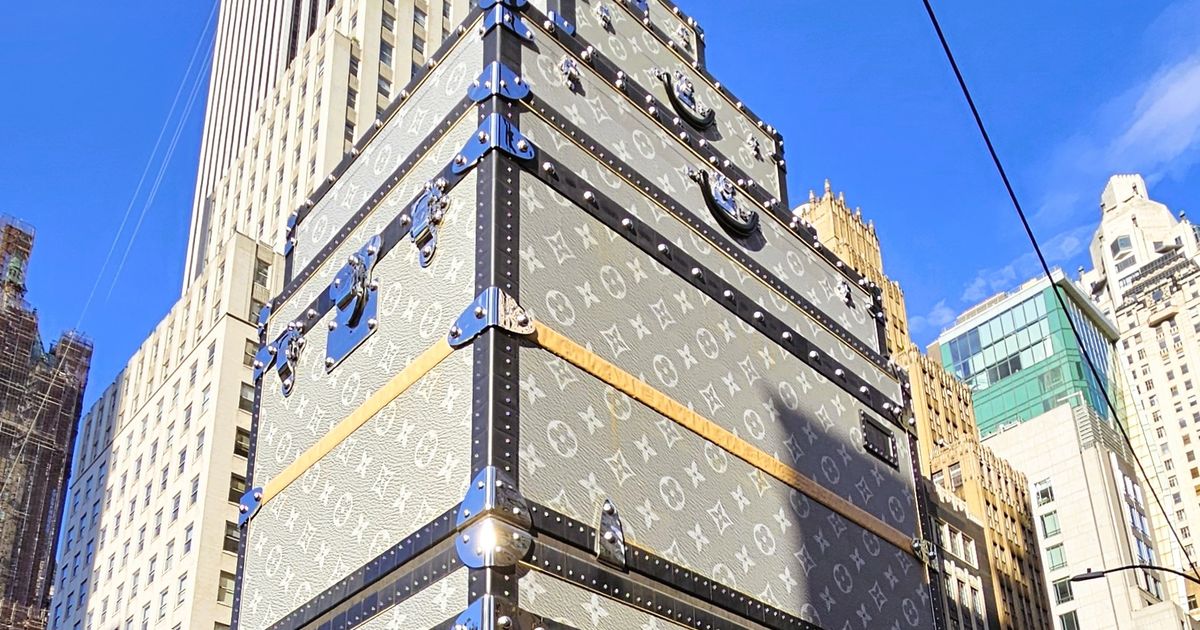
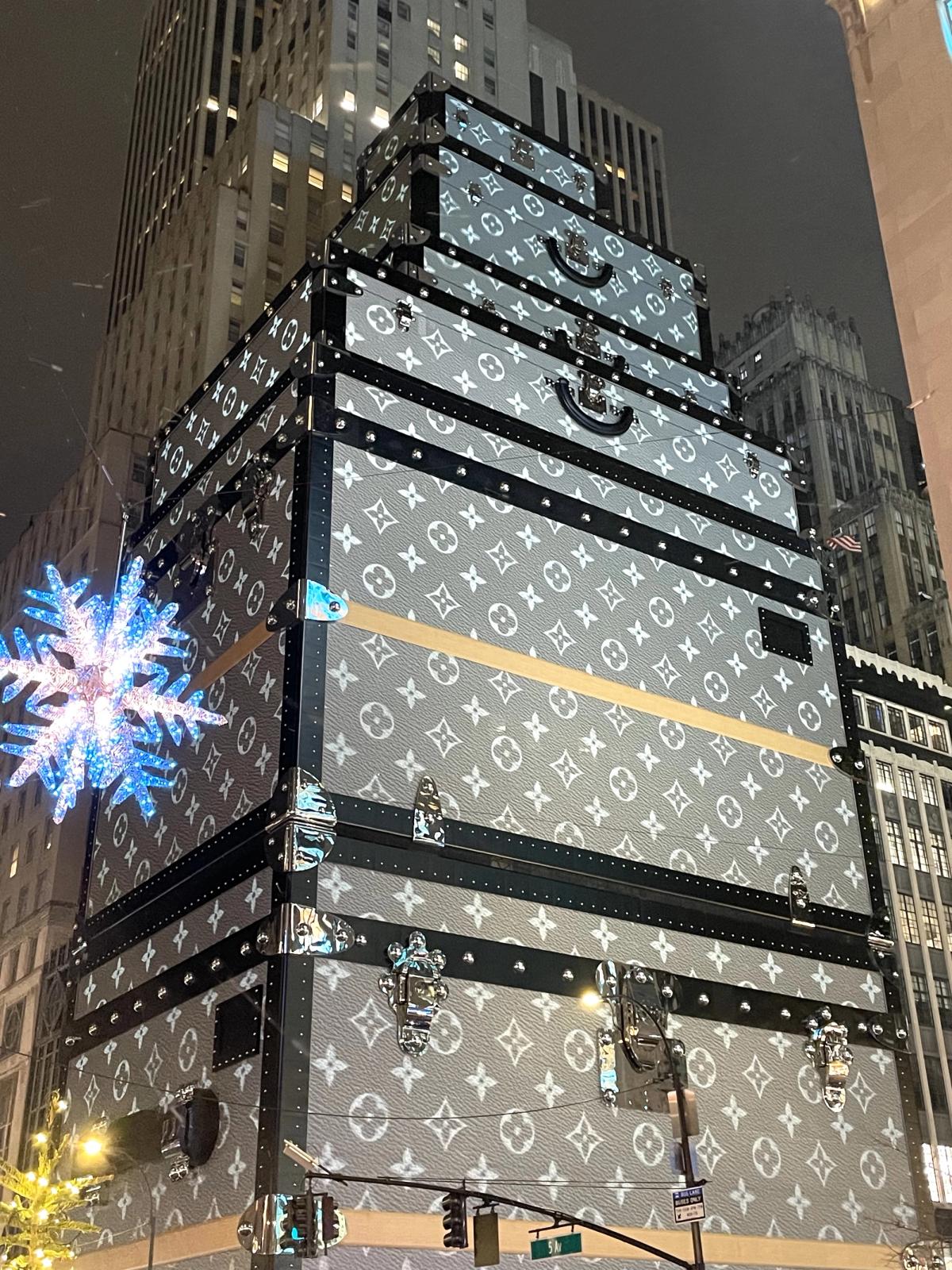
At the corner of Fifth Avenue and East 57th Street, Louis Vuitton's flagship is being demolished. In its place will rise a larger store and an office tower, on a footprint that The Architect's Newspaper reports will nearly double the old one. While that happens, the site is covered by a construction shed sixteen stories and roughly 240 feet high, built to resemble a stack of the house's grey canvas trunks, complete with hardware, locks, handles and corner protectors, the largest of the trunks weighing about five thousand pounds.
Nine hundred feet south, at 56th Street, Prada's flagship is under renovation while the company builds a tower alongside it. Its scaffolding has been finished by the New York studio 2x4 in the house's pale green, wrapped in a double layer of semi transparent scrim that produces a shifting moiré as you move past it, with lighting that activates at dusk to reveal the structural frame underneath.
Writing in Curbed, Lauren Sinclair described the first as a "meme-able sculpture of logomania" and "an instant landmark, instantly recognizable", and the second as reading from a distance "like a minimalist green volume, almost a building onto itself at urban scale", whose "thousands of intricate components reveal themselves" only as you approach. She closed with the observation that most scaffolding is not designed at all, being shaped by efficiency and compliance, and that for these houses losing visibility on this street for an indefinite period is not an option.
That last sentence is correct and it is not the whole finding. This institution reads these two structures as a single event with two halves that are not equivalent, and the difference between them is the more useful half.
The shed that decorates nothing
Sinclair's phrase for the Prada wrap, the decorated shed, is not a casual description. It is the central term of Robert Venturi, Denise Scott Brown and Steven Izenour's Learning from Las Vegas, published in 1972, and it was offered without contempt. A decorated shed is an ordinary building with a sign applied to it, and the authors preferred it to the duck, the building distorted into the shape of its own function. The sign, they argued, is the honest place for the message. The building can then be a building.
The Fifth Avenue sheds invert the term rather than illustrate it. In Venturi's formulation the shed is a real structure doing real work, and the decoration is applied to its front. Here the decoration is applied to a frame that encloses a demolition. There is no shed. There is no building. Louis Vuitton's sign has been affixed to an absence, and it is the most legible object on one of the most expensive retail blocks in the world.
The decorated shed was a building wearing a sign. This is a sign with the building taken out from behind it, and it works better than the building did.
This is not the Hollowed Object in its usual clothes. In the ordinary case an object retains its badge, its name and its price while its internal content is quietly evacuated, and the evacuation is concealed. Here nothing is concealed. Everyone on the street understands that the trunks are canvas print on a frame and that the store is gone. The structure declares its own emptiness and loses no force by doing so, which is a harder problem for this framework than the concealed case and should be stated as such.
The reason it loses no force is that the object was never what was being sold on this corner. What is sold here is continuity: the assurance that the house is present, has always been present, and will be present when the building returns. A construction shed is the one form of architecture whose entire social function is to announce that a condition is temporary. Both houses spent a great deal of money to make one say the opposite.
Narrative Permanence, purchased by the month
Retail construction on a flagship site is a multi year interruption. For most businesses that interruption is absorbed as a cost. For a house whose valuation rests on the sense that it is permanent, the interruption is the threat, because an empty hoarding on Fifth Avenue is a public statement that the brand is temporarily not there.
What both structures buy is Narrative Permanence: the continuity of the story across a gap in the object. The trunk stack does it by making the gap itself into an event worth photographing. The Prada scrim does it by making the gap look like a finished building. Neither is advertising in the ordinary sense, because neither is selling a product. Both are paying, at architectural scale and for years at a time, for the absence of an admission.
It is worth being precise about the transaction. This is an Aura Transaction conducted on a construction site: a semiotic position, we are still here, converted into a physical form, with no product changing hands and no material claim made. The house is not asserting that the trunks are trunks. It is asserting that the corner is still its corner.
The half that is more interesting and got less attention
The two scaffolds are usually discussed together, and treating them as equivalent misses the finding.
The Louis Vuitton shed is a trompe l'oeil executed at enormous scale with real conviction, and its authorship is genuinely unclear: The Architect's Newspaper attributes the design to Shohei Shigematsu of OMA, while a house spokesperson told the same publication that the installation was designed by its in house team. That disagreement is left standing here rather than resolved, because a house and an architect describing the same object differently is itself a fact about how authorship is handled in this market.
What is not unclear is how the trunk stack performs. It resolves completely in a photograph taken from across the street. It requires no approach, no second look and no explanation. It is, in Sinclair's word, meme-able, and the metric it optimises for is the metric the attention market actually pays.
The Prada scrim optimises for the opposite. A double layer of semi transparent mesh producing a moiré is an effect that does not exist in a still image taken from distance. It requires the viewer to move. Its components resolve on approach. Its lighting reveals the structural frame at dusk, which is to say it deliberately shows the ordinary pipe scaffold underneath rather than disguising it. It is the more materially serious of the two objects and the more honest about what it is, and it has been discussed a fraction as much.
One scaffold rewards a photograph. The other rewards a walk. The market pays for the photograph, and it is not close.
This institution's interest is not in preferring the quieter object, which would be a taste position and worth nothing. It is in the mechanism the pair exposes. Legibility at distance is what the attention economy compensates, and legibility at distance is very close to the opposite of what material craft produces. Craft rewards proximity. It is legible in the hand, in the weave, in the component. An object optimised to be understood instantly from sixty feet away has been optimised against the conditions in which making is perceptible at all.
That is the same trade this institution has traced through objects small enough to hold. Here it is running at 240 feet, on the same street, by two houses at once, and the results are visible from the pavement.
What the scaffolds measure
The field of inquiry this institution works in begins with why humans give meaning to things, and holds that the objects are the evidence. These two objects are unusually clean evidence, because almost everything that normally complicates the reading has been stripped out. Nothing is for sale in them. Nobody will own them. They will be dismantled. Neither has a function beyond concealment, and concealment could have been achieved with the standard blue plywood at a fraction of the cost.
What remains, once function and ownership and permanence are all removed, is a pure expenditure on continuity of meaning. Two houses looked at a multi year hole in their own narrative and decided that the hole was the thing that could not be allowed to exist. The trunks and the scrim are what it costs to not be absent.
Coda
Venturi and Scott Brown went to Las Vegas to argue that the sign was the honest part of the building and that architects should stop pretending otherwise. Fifty four years later, on Fifth Avenue, the argument has been completed in a direction they did not propose. The sign has outlived the shed. It has outlived the building. It stands at 240 feet over a demolition, it is the most recognisable structure on the block, and when the real building is finished behind it the sign will come down and be thrown away. Whether the building that replaces it will be as legible as the thing that stood in for it is a genuinely open question, and the honest answer is that it does not need to be.