Georgia O'Keeffe's Near Abiquiu: The Appendix Did Its Job
On a painting known for ninety five years from one entry in an appendix, a provenance of two lines that names nobody, and a register of a hundred and thirty five absences that said what kind each one was
A woman in the East Village told her niece there was a Georgia O'Keeffe in the closet. The niece moved the coats, found a box, photographed what was inside and emailed the pictures to Christie's. The painting is now lot 34 A in the 20th Century Evening Sale, estimated at three to five million dollars, and the woman who owned it has died.
That is the story that ran in nine outlets in forty eight hours, and it is a good one. This is not about that story.
It is about the eleven days between the email and the catalogue, and the reason they were eleven days rather than eleven months. A photograph of an unframed landscape sent by a member of the public is ordinarily the beginning of a long problem. This one was not, because in 1999 a scholar had published an entry for exactly this painting, with a reproduction, under a number, in an appendix of works she could not find. The entry is why an email became a lot.
What is established, with its dates
The lot page, read on 7 November 2026, gives the following. Near Abiquiu, New Mexico I, painted in 1930, oil on canvas, 10 by 24 inches. Signed with initials "OK" in the artist's star device and titled and dated "Near Abiquiu -30" on the original backing board. Property from an East Village Private Collection. The estimate carries a sale room notice: "Please note the estimate for this lot has been updated to $3,000,000-5,000,000." The lot is marked with a third party guarantee.
The exhibition history is one line. New York, An American Place, Georgia O'Keeffe: Recent Paintings, 1931. Ninety five years ago, once.
The literature is two lines. Barbara Buhler Lynes, Georgia O'Keeffe: Catalogue Raisonné, volume II, New Haven, 1999, pages 1106 and 1121, number 100, illustrated. And a footnote, page 320 note 46, in the Metropolitan Museum's 2011 catalogue Stieglitz and His Artists.
The provenance is two lines, and here they are in full:
Downtown Gallery, New York. Acquired from the above by the family of the present owners, 15 April 1963.
Twenty four words. They do not name the artist, they do not name a person, and they cover sixty three years with the phrase "the family of the present owners". Everything the public learned this week sits outside them: the mother who bought it, the master's degree it was given for, the apartment wall it hung on until the mid 1980s, the gallery packing it went back into, the guest who was said to have looked at it too closely, the coats, the niece, the death. All of that is in a press release and in the coverage, and none of it is in the document that will travel with the painting.
This institution does not treat that as a failure by Christie's. A provenance line is a statement somebody is prepared to stand behind, and a house that declines to assert what it cannot source is doing the right thing. The point is narrower and it is about where the weight sits. The record of this painting's picture is dense. The record of its object life is twenty four words.
The record of the picture is dense, and that is worth stating precisely
The same lot cites the Beinecke Rare Book and Manuscript Library at Yale for a letter O'Keeffe wrote to Alfred Stieglitz on 16 June 1931, in which she drew the same view and wrote, "This is the Lobo Mountain...I want to paint this mountain...but it is quite impossible." It cites a 1987 edition of her letters for what she wrote to the critic Henry McBride in the summer of 1929. It cites the Metropolitan Museum of Art Bulletin of autumn 1984 for a curator's description of how the New Mexico light let her see over great distances. It names the mountain, it names the pueblo it stands north of, it places the work as the first of three.
Four archival and published citations for the image. Two lines for the custody. That asymmetry is not peculiar to this lot. It is what the art market's documentary apparatus is for, and has been for a century: it was built to establish what a thing is and who made it, and it was never built to establish where the thing has been.
The entry in the appendix
The Georgia O'Keeffe Museum publishes the 1999 catalogue raisonné digitally, as Access O'Keeffe. The painting is there. Its record, read on 7 November 2026, says this:
Mountains in the West Near Abiquiú N.M. I, 1930 CR No. App. II 100 Unknown status or location.
The image on that page is captioned "For reference use only. Black and white scans from Lynes publication Appendix II." The whole of its Title and General Remarks section is the title and the note "Source of title: Appendix II of Lynes, 1999 publication."
Three things follow from that short record, and they run in different directions.
The first is that the instrument worked. A title, a date, a medium, a measurement, a black and white reproduction and one sentence of status were enough, twenty seven years later, for a photograph from a stranger to be matched to a known work. Nothing more elaborate was needed. The appendix entry is the reason the painting went from a closet to a Rockefeller Center viewing room in under a fortnight.
The second is that the catalogue and the sale do not call the painting the same thing. The 1999 instrument titles it Mountains in the West Near Abiquiú N.M. I. Christie's titles it Near Abiquiu, New Mexico I. Both are defensible, and the catalogue's own convention records where a title came from, which is why the difference is visible at all. But anyone searching the published record under the auction title will not find the entry that made the auction possible.
The third is a dated observation and it will not stay true. On 7 November 2026, with the painting hanging in New York and its photograph in nine newspapers, the catalogue raisonné still read "Unknown status or location." The record's core fields show a last update of 6 November 2026. There is nothing wrong here and no criticism intended: a museum's catalogue is not obliged to move at the speed of a press cycle, and it should not. It is simply the clearest available picture of what a record is. The object moved. The account of it had not yet.
What Appendix II actually is, measured
The coverage describes the painting as having been in "an appendix" of the catalogue raisonné. Nobody appears to have gone and read the appendix. It is public, and it took an afternoon.
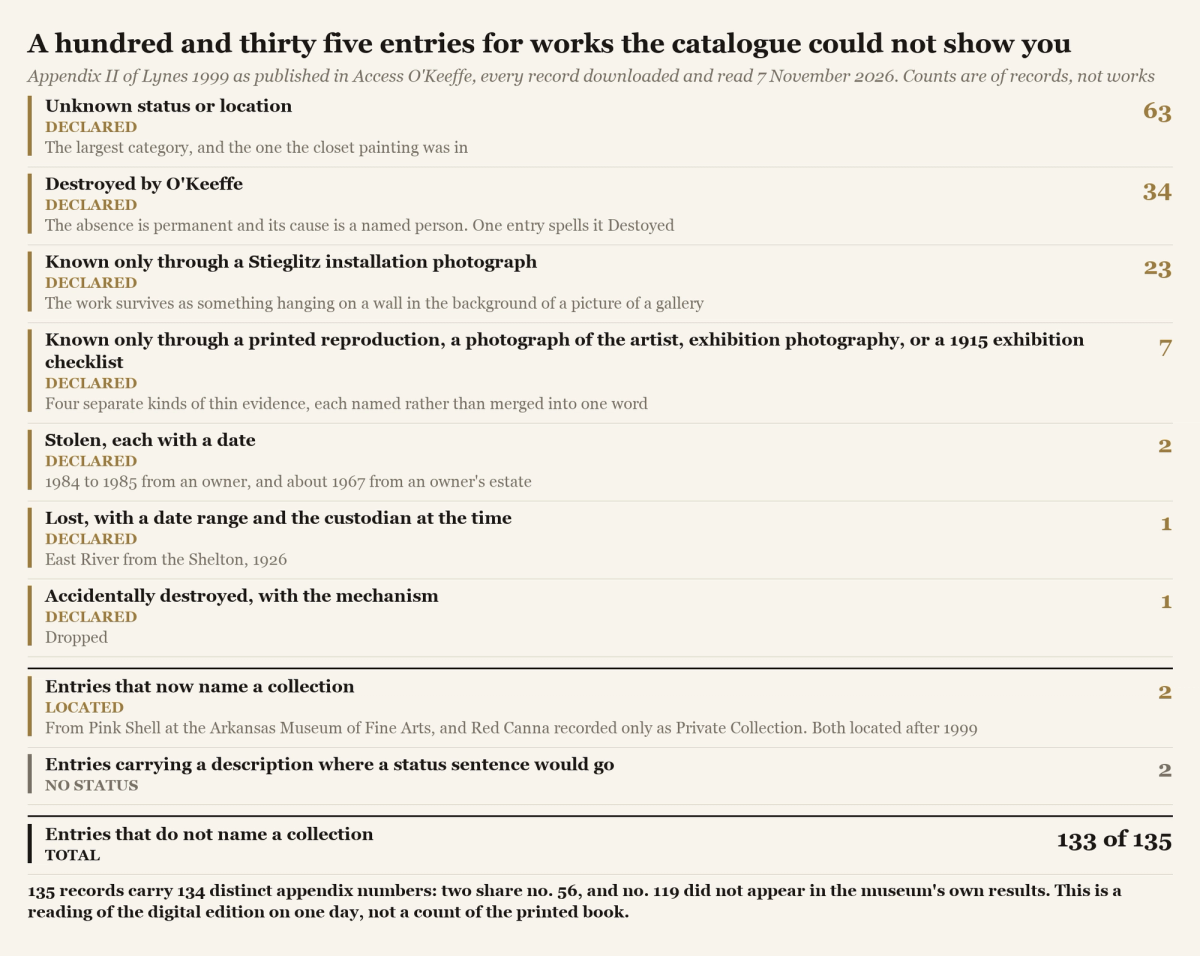
The museum's own filter returns 135 records in the series it calls "Works Listed in Appendix II of Lynes Publication". Every one was downloaded and read. They carry 134 distinct appendix numbers: two records share number 56, and number 119 did not appear in the museum's own three pages of results. What follows is a count of records, not of works, and it is a reading of the digital edition as it stood on 7 November 2026, not of the printed book.
Of the 135, two carry a collection. From Pink Shell, 1931, at the Arkansas Museum of Fine Arts, and Red Canna, 1919, recorded simply as "Private Collection". The other 133 do not.
What makes the appendix remarkable is not that it lists absences. It is that it says what kind of absence each one is.
63 records read "Unknown status or location." 34 read "Destroyed by O'Keeffe." One of those spells it "Destoyed". 23 read "Known only through a Stieglitz installation photograph." 3 are known only through a printed reproduction. 2 are known only through a photograph of the artist with the work in shot. 2 are recorded as stolen, each with a date. 1 is known only through exhibition photography. 1 is known only through a 1915 exhibition checklist. 1 is recorded as lost, with a date range and a named custodian. 1 is recorded as accidentally destroyed, with the mechanism. * 2 carry a description where a status sentence would go.
Three of those sentences deserve to be read in full, because they are better absence records than most institutions write for works they still hold.
Destroyed by O'Keeffe.
The absence is permanent, and its cause is a named person. Thirty four times.
Accidentally destroyed when dropped.
Nothing obliged anyone to supply the mechanism. It is supplied.
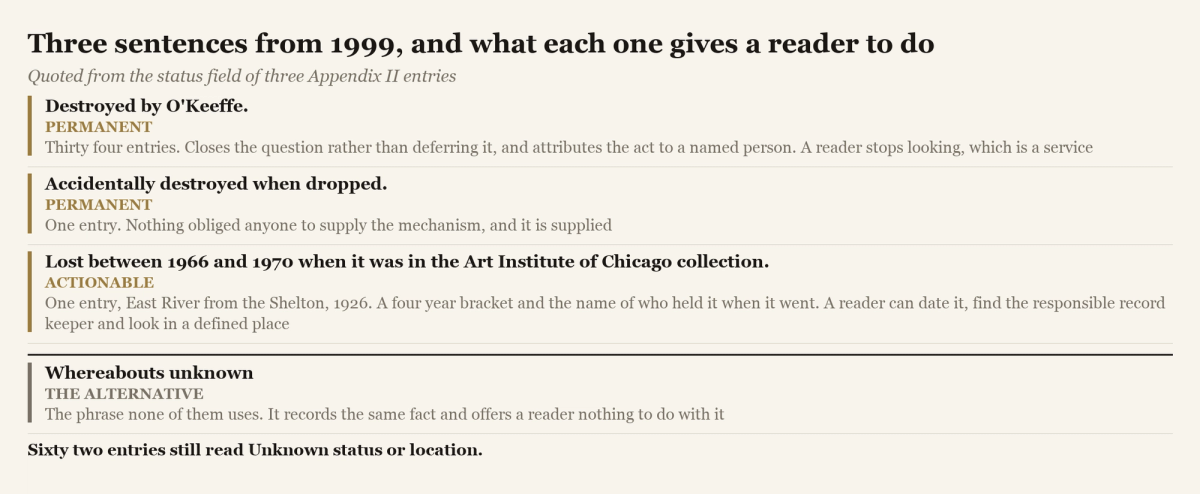
Lost between 1966 and 1970 when it was in the Art Institute of Chicago collection.
That is East River from the Shelton, 1926, Appendix II number 83. Not "lost". Not "whereabouts unknown". A four year bracket and the name of who was holding it when it went. A reader can act on that sentence. A reader can date it, locate the responsible record keeper, and go looking in a defined place. "Whereabouts unknown" offers nothing to do.
This is a vocabulary of absence with at least eleven forms in it, published in 1999, in a printed catalogue, by a single scholar working on one artist. It answers the question a blank cannot answer, which is not where is it but why can I not see it, and could that change.
The painting in the closet was in the largest category. Sixty three entries read "Unknown status or location." One of them has now been located.
Sixty two have not.
The twin, and what it shows
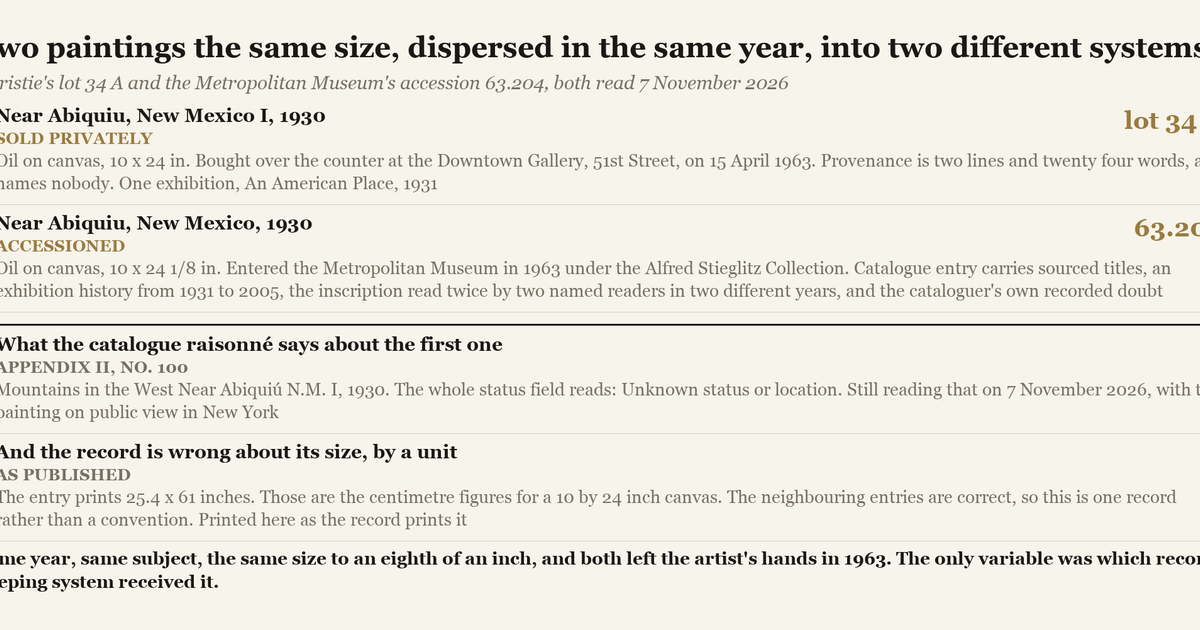
Christie's names the second work in the series as Near Abiquiu, New Mexico, 1930, at the Metropolitan Museum of Art. The Met's own record gives it as oil on canvas, 10 by 24 and an eighth inches, accession number 63.204, Alfred Stieglitz Collection, 1963.
Same year. Same subject. The same size to an eighth of an inch. And both left the artist's hands in the same year, 1963, by two different mechanisms: one into a museum under a credit line, one over a counter at the Downtown Gallery on 51st Street on the fifteenth of April.
Sixty three years later, the catalogue entry for the Met's version carries a title and the source of the title, an alternate title and the source of that, a list of exhibition titles, an exhibition history running from 1931 to 2005, the inscription on the back read twice and attributed to two different readers in two different years, a reference to a 1984 Museum Bulletin, and a remarks field that quotes an archivist's own doubt in the archivist's own words, including the sentence "I may not have examined this at the Place".
The entry for the one that went over the counter carries a title, a date, a medium, a measurement that is wrong, and one sentence.
The measurement is worth naming exactly, and then leaving alone. The record prints "Oil on canvas, 25.4 x 61 inches". Those are the centimetre figures for a 10 by 24 inch canvas. The neighbouring records are correct, so this is one entry rather than a site convention, and it is the mildest imaginable demonstration of the thing this study is about: a record is a thing a person typed, and it is only as good as the last hand that touched it. No argument is built on it here.
Nothing about this comparison reflects on the Met, on the museum in Santa Fe, or on the family. It is a natural experiment nobody designed. Two nearly identical objects entered two different record keeping systems in the same year, and the difference between what is now known about them is total. That difference is the whole value proposition of institutional custody, stated more plainly than any argument could state it.
What we have already published, and why this is not that
This institution has looked at rediscovered paintings before, and the finding here is deliberately narrower than it first appears.
Our study of Gustav Klimt's Portrait of Fräulein Lieser ended on the line that object permanence is not the survival of the thing but the survival of the account of who held it and by what right. This study does not improve on that sentence. It extends it to a case that runs the other way. In the Klimt the hole was in the distant past and the thing that broke the sale was a document written in 2024 that had no field for uncertainty. Here the thin stretch is the recent past, inside one apartment, in living memory, and the instrument that held for twenty seven years was precisely one that declared what it did not know.
Our two studies of Edward Hopper's first oils followed a catalogue raisonné that marked its uncertainty in brackets, and watched every exhibition and sale downstream drop the brackets until a guess read as a fact. This is the same mechanism with the opposite outcome. Marked uncertainty survived, and it paid.
Our study of Monet's Iris examined a provenance of four lines that was complete and disclosed nothing. This provenance is two lines, and the question asked of it is different: not what it conceals, but what a two line provenance can still be made to carry.
And our study of the Louvre jewels measured what a documented ownership chain adds at auction, and found a smaller number than the one usually quoted. That number is not re-argued here. This study measures a register of absences, not a premium.
What would settle the sixty three years
The gap is not unknowable. It has a holder, and in at least one case the finding aid already names the folder.
The Georgia O'Keeffe Museum's own archive holds the Georgia O'Keeffe Papers, MS-33, whose business papers cover the artist's dealings with Edith Halpert and the Downtown Gallery in folders divided 1958 to 1961, 1961 to 1963 and 1964 to 1966. Its finding aid names a painting list titled "Halpert Stock Record 8/28/63 oils". The Archives of American Art at the Smithsonian holds the Downtown Gallery records, 1926 to 1969, received from Halpert's executor in the 1970s, including correspondence with clients concerning sales and purchases.
Naming a folder is not reading one, and this institution has not read either. They are named here as a route and not as evidence. What can be said is that the sale date given on the lot page, 15 April 1963, is the kind of claim that a dealer's stock record is designed to confirm or contradict, and that both collections are open to researchers.
A sentence that said "sold by the Downtown Gallery on 15 April 1963, per Halpert stock record, Georgia O'Keeffe Papers MS-33" would be a different kind of object from a sentence that said "acquired from the above by the family of the present owners". It would cost one afternoon and it would outlive everybody now alive.
Where this reading could be wrong
The counts above are of a live website and will drift. They are records, not works, and the museum's digital edition includes material added since 1999, so a located appendix entry may have been located last year or last week. The dimension error may be fixed by the time this is read, and so may the status line. Every number here carries the date it was taken for that reason.
The 15 April 1963 date is Christie's, and is not confirmed by any archive this institution has opened. The purchase price of $3,800, the master's degree, the coats and the box are press reporting, attributed as such and absent from the lot. The sequence between the press figure of about three million and the lot page's sale room notice of three to five million is not established and no claim is made about which came first.
And the strongest objection to the whole argument is worth stating rather than hiding: it could be said that the appendix entry did not make this sale, that a signed and dated inscription on the original backing board would have got there on its own. That may be right. But the inscription says "Near Abiquiu -30", and the catalogue entry is what connects that phrase to a known work, in a known series, exhibited once in 1931, sitting beside a near twin in the Metropolitan Museum. The inscription establishes a hand. The entry establishes an identity.
Coda
The best sentence in this whole affair was written in 1999 by somebody with no reason to expect anybody would ever need it.
Lost between 1966 and 1970 when it was in the Art Institute of Chicago collection.
Nobody was watching. No market depended on it. There was no obligation to say when, or who, or how, and the compiler could have written "whereabouts unknown" and moved on, and no reviewer would have objected. She wrote the bracket and the custodian instead.
A hundred and thirty five times in that appendix somebody declined to leave a blank and said what kind of absence it was. Twenty seven years later one of those entries turned a photograph taken behind a coat rack into a catalogued lot in eleven days.
The painting is the asset. The entry is the infrastructure. One of them was free to make, and it is the one nobody writes about.
Sixty two entries still read "Unknown status or location."
---
This study records what the public record contains and what it does not. Objects of Affection Collection does not authenticate, attribute, appraise or value, and asserts no legal conclusion about any party named. The lot details, provenance, literature, exhibition line, estimate and series attribution are quoted from Christie's published lot record for lot 34 A, Live Auction 24266, read 7 November 2026. The catalogue raisonné readings are from the Georgia O'Keeffe Museum's Access O'Keeffe, read 7 November 2026, which states that the Museum does not authenticate works. The Metropolitan Museum tombstone is from the Museum's own collection record for accession 63.204. The circumstances of the discovery, the purchase price and the gift are press reporting and are attributed as such. The owner, her niece and her mother are not named at the family's request, and this institution reproduces no name that was published elsewhere. No archive named in this study has been read by Objects of Affection Collection, and the folders cited are named as routes, never as evidence.