King Charles III Portrait: The Red King’s Material Wager

On oil studies, sovereign objects, and the meme that cannot hold...
What Arrived in the Silk Tapestry Room
In July 2026, a large oil study entered the Silk Tapestry Room at Buckingham Palace and took up its position as one of the first objects visitors encounter on entering the State Rooms. It was not the finished commission. Jonathan Yeo’s completed portrait of His Majesty King Charles III has hung at Drapers’ Hall in the City of London since August 2024, fulfilling the engagement Yeo accepted in 2020 to mark Charles’s fifty years of membership in the Worshipful Company of Drapers. What arrived at the Palace was a study, gifted by Yeo to the Royal Collection: a preparatory canvas measuring approximately 230 centimetres in height, dominated by a field of crimson and scarlet from which a figure in a Welsh Guards uniform emerges, one hand resting on a sword hilt. Above his right shoulder, a butterfly hovers in the red field.
The Palace’s summer opening season runs from July 9 through September 28. For those twelve weeks, the study hangs in the company of Van Dyck, Gainsborough, and Sargent, in a Picture Gallery recently rehung to double the number of paintings accessible to the public. The work must simultaneously perform as art, as a statement of monarchical continuity, and as an object capable of outlasting its own viral image. The first two functions are well-understood by the institutions managing the display. The third is where the analysis becomes interesting.
Two years before it arrived at the Palace, at the May 2024 unveiling, the portrait generated one of the more concentrated episodes of public art debate Britain had seen in recent memory. The crimson field was compared to fire, to blood, to hell, and to a Francis Bacon canvas from 1949. Memes proliferated at scale within hours. Animal rights protesters attached Wallace and Gromit imagery to the canvas at the Philip Mould Gallery in June 2024. The king, at the unveiling, said simply: “It is remarkable how it turned out.” What OAC examines here is whether the object that arrived in the Silk Tapestry Room in July 2026 is the same object that was unveiled in May 2024, or whether two years of viral circulation have already changed something essential about what it is.
The Canon It Enters: Four Centuries of the Sovereign Gaze
British royal portraiture is a technology before it is a genre. Its function is not to represent the monarch so much as to project the institution, and the grammar through which it does so was established almost entirely by one Flemish painter who arrived in London in 1632 and spent the next nine years as court painter to Charles I.
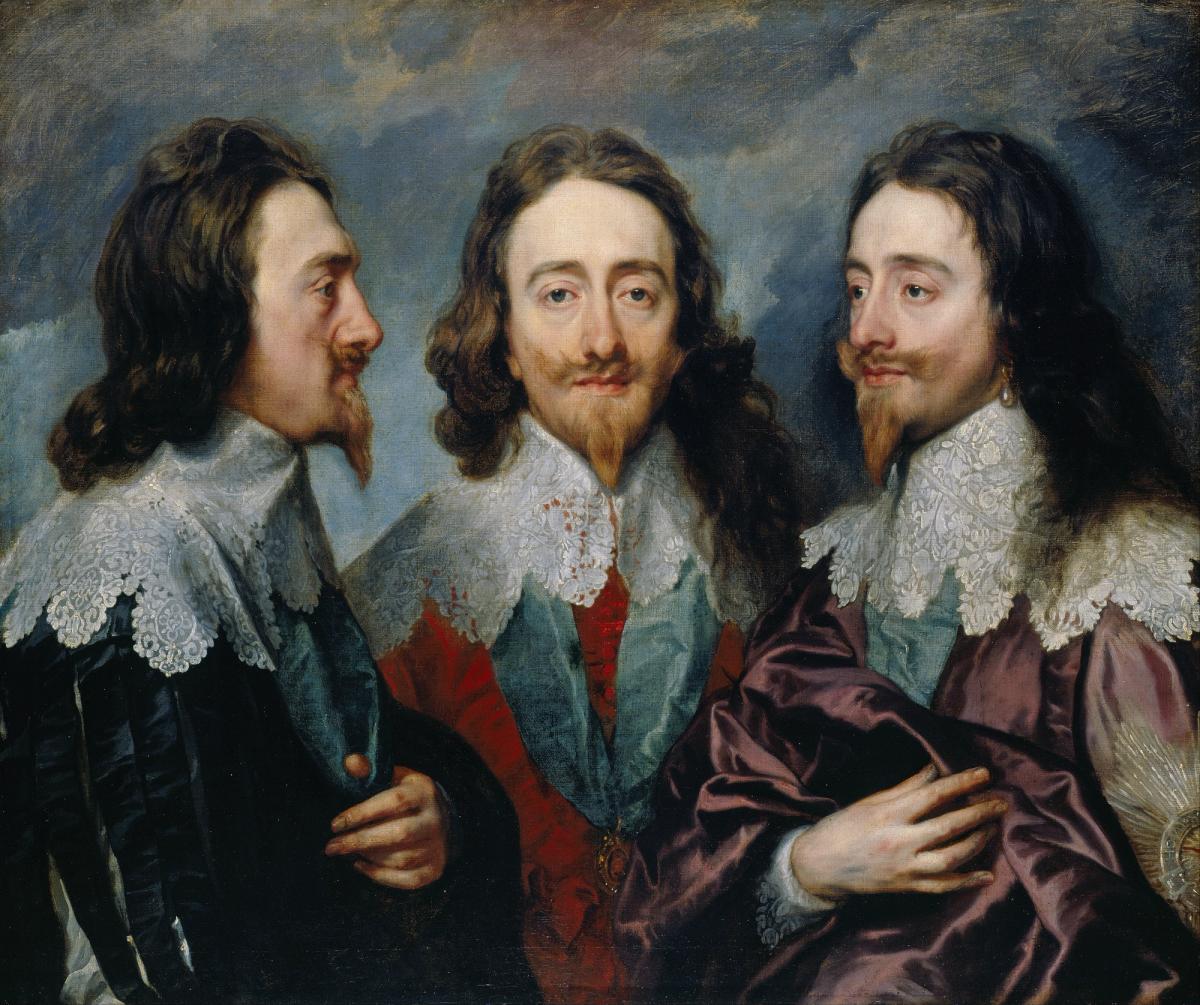
Anthony van Dyck fixed the visual syntax that every subsequent British royal portrait has negotiated with or against: the full-length composition, the loose and confident pose suggesting ease within authority, a landscape in the distance implying dominion over territory rather than mere tenancy of rooms, light falling with aristocratic certainty across silk and armour. His portrait of Charles I established a template so authoritative that it survived intact through Reynolds, Gainsborough, Lawrence, and Sargent, across three centuries and four social revolutions, without fundamental rupture. The grammar did not need updating because its purpose never changed. It existed to project continuity, and continuity does not require novelty.
The template is a mechanism for producing what OAC’s framework calls Narrative Permanence: the deliberate construction of an object engineered to resist obsolescence by encoding its subject within a visual language whose authority derives precisely from its repetition over time. A Van Dyck portrait does not require you to know anything about the English Civil War that would destroy its patron within a decade of the sitting. The grammar speaks across context. It is legible now, in fifty years, in three hundred years, because legibility is its design specification. The sovereign portrait is not supposed to be interesting in the way a Francis Bacon is interesting. It is supposed to endure.
Yeo’s study has been installed inside this tradition. The Picture Gallery rehang that placed it beside Van Dyck and Gainsborough is not a casual curatorial decision: it is a deliberate act of contextual framing, an argument that the crimson field belongs in the same canon as the full-length equestrian portraits that defined the form. Whether the object can sustain that argument, or whether the meme-cycle that preceded its Palace arrival has already determined the terms of its reception, is the institutional wager the display is making.
Yeo’s Argument: The Crimson Field and the Butterfly
Jonathan Yeo, born in London in 1970, is not a conventional choice for a state commission. Self-taught after a period of recovery from Hodgkin’s lymphoma, he built a career on portraits of politicians, activists, and figures from popular culture. He painted Tony Blair. He painted Malala Yousafzai and David Attenborough. In 2007, he fabricated a collage of George W. Bush from cuttings sourced from pornographic magazines: a protest artwork using the portrait form as an instrument of critical analysis rather than institutional flattery. The Drapers’ Company, commissioning a portrait to mark fifty years of royal membership, understood, at some level, what they were engaging.
Yeo’s stated rationale for the dominant red palette was to produce a “contemporary jolt” within the traditional visual language of royal portraiture, to minimize visual distraction and focus the eye on the human being beneath the regalia. The red uniform of the Welsh Guards, which Charles has held since 1975, bled into the background to produce not a portrait of a man in a red room but a portrait of a man dissolving into the institutional color of his office. This is not a reading the artist has discouraged, and it is not an accident of composition. The form’s disappearance into the field is the argument.
The uniform bleeds into the background. A man dissolves into the color of his office. What looks like a painting of power is also, held at a particular angle, a painting of what power does to the person who holds it.
The critical reception moved in several directions simultaneously. Some praised the portrait’s departure from convention, its willingness to bring the vocabulary of contemporary painting into a form that had been technically conservative for three centuries. Others objected to the palette’s intensity. Art teacher Robert Brinkerhoff reported hearing the word “blood” the instant he saw the image, and asked publicly whether the red referred to the centuries of colonial bloodshed produced by British imperialism. This reading was not Yeo’s stated intention, and it is not an interpretation the institution has acknowledged directly. But it is not an arbitrary projection either: the portrait was commissioned by a livery company whose history is inseparable from the centuries of trade and extraction that a field of blood-red might invoke in a viewer positioned to ask the question.
The butterfly is a different register entirely. Positioned above the king’s right shoulder, it was Charles’s own suggestion: a monarch butterfly (Danaus plexippus), a species whose populations are acutely sensitive to temperature disruption from climate change, representing the king’s decades of environmental advocacy and his metamorphosis from heir to sovereign. The choice is precise, sincere, and symbolically coherent within the tradition of emblematic portraiture. It also became, within hours of the unveiling, one of the first elements consumed by the meme-cycle: the butterfly was overlaid, enlarged, multiplied, and detached from the composition at scale. The sovereign object and the meme object became, for the majority of people who encountered the image, indistinguishable. They had met the same image through different systems.

The Sovereign Object as a PLCFA Category
OAC’s Material Singularity framework describes an object whose value is irreducibly bound to its specific physical instance: one hand on one canvas, one surface carrying a specific Labor Density embedded in its making, one set of sittings between one artist and one subject across a defined span of time. In this case: four sittings between Jonathan Yeo and Charles III, from June 2021 to November 2023, across more than two years. The oil study possesses these properties in full. It cannot be reproduced without ceasing to be itself. The meme is not it. The photograph of it is not it. The material fact of the canvas, the pigment, and the specific negotiation between painter and subject is the thing that exists only once.
What OAC’s framework calls the Custodian’s Contract names the institutional obligation that attaches to such objects: the Royal Collection Trust holds the study not as a commodity to be traded but as an artifact to be preserved, displayed, and maintained against the forces of depreciation, both physical and semiotic. This is a materially different relationship to value than the one the secondary art market operates under. The study has no price tag in the Silk Tapestry Room. It is not for sale. Its custodian is the sovereign institution itself, and the Burden of Preservation that the Royal Collection assumes is both physical (climate control, conservation protocols, security) and interpretive: contextualizing, defending, and maintaining the work’s institutional reading against the counter-readings generated by its viral circulation.
This is what distinguishes the Yeo study from the commercial luxury objects OAC typically analyzes. A luxury bag conducts its Aura Transaction through restricted supply and brand management. The portrait conducts its through institutional mandate: it is preserved not because it is rare in the market sense but because the state has decided it matters to the record. The Semantic Burden it carries is extraordinary by any standard. It is required to signify continuity, authority, artistic patronage, environmental commitment, and the ongoing legitimacy of a seven-hundred-year institutional form. No commercial object is asked to carry this weight. Precisely because of this, the sovereign object is also uniquely exposed: its value cannot be hedged through market mechanisms, and if the institutional narrative around it collapses, there is no secondary market to absorb the loss. The Custodian’s Contract is not just a preservation arrangement; it is an existential bet.
What Speculative Velocity Does to the Material Covenant
Within forty-eight hours of the May 2024 unveiling, the portrait had been converted into meme content at a scale no custodial apparatus was designed to address. The image circulated as a template: the king surrounded by flames, the king in hell, the king as a medieval misattribution, the king with the butterfly enlarged to absurdity. These were not critiques in any analytical sense. They were consumable content, produced at speed by people who had not seen the canvas and were engaging not with it but with its image-signal.
Speculative Velocity names the acceleration of an object’s cultural and economic lifecycle through digital circulation: the conversion of material presence into transient sign-value at speed. The portrait’s meme-cycle is a pure instance of this dynamic. The physical study in the Silk Tapestry Room is 230 centimetres tall and was made across more than two years of considered work between artist and subject. Its meme derivatives were produced in minutes by users whose encounter with the work was entirely mediated. The meme is not the object. It does not damage the canvas. The canvas does not validate or invalidate the meme.
What is at stake is not the object itself but the institution’s capacity to control the meaning the object carries. When the primary popular encounter with a work is a joke about blood and the devil, the portrait’s claim to Narrative Permanence is at minimum deferred. The institutional reading (sovereign transformation, environmental advocacy, the serene continuation of monarchical authority) must now compete with a much louder counternarrative that arrived first, at greater velocity, and through channels the Royal Collection cannot access. As OAC’s study of the price of the sign in luxury objects demonstrated, sign-value once decoupled from material presence operates by its own logic. The same decoupling is visible here, in a non-commercial register that makes its effects particularly legible.
The meme does not eat the canvas. It eats the argument the canvas was commissioned to make.
Institutional Necrophagy and the Crimson Problem
There is a second-order problem that the Material Singularity vs. Speculative Velocity framing does not fully address, and it concerns what the institution is doing with the controversy rather than what the controversy is doing to the institution.
Institutional Necrophagy names the process by which institutions consume potentially critical material, absorbing it into their own legitimation structures in ways that neutralize its charge. The institution does not suppress the critique; it ingests it, digests it, and converts it into cultural capital. The controversy becomes evidence of institutional openness. The contested work becomes evidence of institutional confidence. The act of display absorbs the dissent.
The crimson field of Yeo’s portrait carries multiple irreconcilable readings. The artist intended a contemporary formal jolt. Some critics read it as a reference to colonial violence, the red as the color of centuries of imperial extraction. Others saw fire, or hell, or a man burning in the color of his own power. The institution’s response to this polyphony has been to frame the study as part of the summer opening, to position it as one of the first sights visitors see on entering the State Rooms, to present the Picture Gallery rehang as a celebration of the Royal Collection’s engagement with contemporary art. This framing converts a contested, polyphonically interpreted object into evidence that the Palace is culturally engaged and publicly accessible. The controversy is absorbed as a benefit.
The Zero-Sum Aura dynamic is visible in the structure: every reading that challenges the institution is simultaneously annexed by the institution’s willingness to display the work. By exhibiting a portrait that generated controversy, the Palace signals confidence. By placing it beside Van Dyck and Gainsborough, it signals canonical authority. There is no position from which the display can function as a genuine challenge to the institution that hosts it. The portrait cannot critique the Royal Collection from inside the Silk Tapestry Room. It can only become evidence in the argument the institution makes with itself about its own cultural relevance.

The Hollowed Object Threshold
Against this analysis, the materialist position holds: the physical study in the Silk Tapestry Room has not been hollowed. It retains its full material presence, its Labor Density, its irreducible instance of artist-and-subject negotiation across four sittings over two years. The meme does not alter the pigment. The institution’s management of reception does not change the canvas. What has been hollowed, if anything has, is not the object but its position in public discourse. And these are different things.
OAC’s Hollowed Object framework defines the phenomenon as occurring when an object retains its formal properties but has lost its material covenant: when the gap between its sign-value and its material value has expanded to the point where the object functions primarily as a vehicle for cultural abstraction rather than as the thing it materially is. The canonical OAC case is the commercial luxury object whose material investment has been reduced while its sign-value is inflated through brand management. This study’s position is that the Yeo oil study has not crossed that threshold, and the reason is structurally instructive.
The study cannot be hollowed in the commercial sense because it is not in the commercial circuit. The Hollowed Object dynamic in luxury goods operates through the mechanisms OAC analyzed in its study of the price of the sign: when a brand extracts sign-value from a heritage narrative while reducing material investment, the object becomes a carrier of pure markup. The Yeo study has no markup. No one is buying it. Its custodian is a public institution with a mandate to preserve, not to profit. The canvas is intact. The Labor Density is preserved. The specific negotiation between artist and subject is encoded in the surface and is not available anywhere else. What the viral meme-cycle has hollowed is not the study but the legibility of the argument it was supposed to make to a public that now arrives at the Silk Tapestry Room, if it arrives at all, having already met the image as a joke.
Study and Portrait: The Material Distinction the Coverage Has Missed
There is a final material question that most coverage of the Buckingham Palace summer opening has passed over, and it has direct implications for how the Custodian’s Contract is working in this case.
What is on view in the Silk Tapestry Room is not the portrait. The finished commission, the work for which Yeo was engaged in 2020 and on which he conducted four sittings with the king between 2021 and 2023, hangs at Drapers’ Hall in the City of London, where it has been since August 2024. What arrived at Buckingham Palace is an oil study: a related but distinct canvas that Yeo gifted to the Royal Collection as a separate act of institutional presentation. The two objects share a subject, a palette, and an artist. They are not the same work. They represent different stages of the artistic process and, crucially, different custodial arrangements.
The Drapers’ Company holds the finished commission under the terms of the original patronage relationship: a private livery company that commissioned a specific work now holds it in the building for which it was made. The Royal Collection holds the study under the terms of an artist’s gift: a different covenant, a different site of authority, a different mode of public access. The Drapers’ Hall context (a historic livery hall in the City of London, accessed by appointment or special event) produces an encounter that is private, deliberate, and structured by the original institutional purpose of the commission. The Silk Tapestry Room context (a State Room in a royal palace, accessible to hundreds of thousands of summer visitors over twelve weeks) produces an encounter that is mass, casual, and structured by tourist programming.
What this bifurcation reveals is that the commission, as an object with a single custodial identity, has already fractured. The institution with the greatest material authority over the primary work (the Drapers’ Company, holding the finished portrait) is not the institution managing the primary public encounter with it (the Royal Collection, holding the study). The portrait most people will see, if they see it, is not the portrait. It is a related preparatory canvas that happens to be in a more accessible location. This is not a failure of curation; it is a structural fact about how large custodial institutions acquire and display works. But it does complicate any simple account of the Custodian’s Contract as a unified covenant between one object and one keeper.
Coda
The oil study of Charles III will leave the Silk Tapestry Room on September 28, 2026, when the Palace closes to summer visitors. The finished portrait will continue to hang at Drapers’ Hall, in the company it was commissioned to serve, fulfilling the mandate for which it was made. The memes will continue, generated now by reference rather than by encounter: the image has achieved the kind of cultural persistence that no longer requires the object’s presence.
This is the condition the framework identifies as the post-Material Singularity state: not the destruction of the object’s integrity, but the achievement of a circulation that has become independent of it. The crimson study in the Silk Tapestry Room will go on being excellent oil painting in a room that knows how to hold excellent oil painting. Its derivatives will go on being what most people mean when they say they have encountered the King Charles portrait. The two things, the material object and its cultural shadow, are now running on separate tracks, and only one of them requires a custodian.
Whether this represents a success or a failure depends entirely on what the portrait was for. If it was for the Worshipful Company of Drapers, to mark fifty years of a member’s service, the finished work at Drapers’ Hall is doing exactly what it was asked to do, quietly, in the building for which it was made. If it was for the cultural record, as a contribution to the four-century conversation about how British institutions represent sovereign authority to themselves, it is holding its end of that conversation with more formal honesty than most of its predecessors. The red field is a contemporary jolt. The butterfly is a precise environmental argument embedded in a tradition that has never made one before. Van Dyck’s Charles I has no position on climate change. Jonathan Yeo’s Charles III does, even if the meme has made it temporarily difficult to hear.
The object endures. The argument it is making has only begun to be heard.